Alex Flinn's Blog
January 31, 2019
How writers predict what will become obsolete: Breathing Underwater for the iPhone generation
My publisher is releasing my 2001 book, Breathing Underwater, with a new cover, its third. The reason for this is, basically, because boys don't like to read the book with its current cover, which shows a boy and a girl. I actually got an e-mail from a teacher who wanted to know how to buy 100 copies of the book with its 2001 cover for this reason. I find this a bit frustrating because I feel like girls get forced to read tons of "boy books," apparently because they are more agreeable. Nonetheless, it DOES sort of look like a romance novel and I like cover 3 better than cover 2 (though not as much as cover 1 which was a legit work of art). I'm also happy that my publisher is giving Breathing Underwater this kind of love after so many years. I can attest to the fact that it has changed and even saved many lives.
Anyway, this is the never cover. Feel free to squee:

Book cover showing white notebook paper with title, Breathing Underwater and author, Alex Flinn in tear-stained ink
I predict a lot of teens won't see the cover because they'll be reading the book on their phone. Which is not something I would ever have predicted.
When my publisher recovered the book in 2011, I'd just read an article about Judy Blume changing the sanitary pad belts (which were not even a thing when I was a teen) in Are You There, God? It's Me, Margaret to modern feminine hygiene products. I asked if I could remove beepers from the text and change them to cell phones. I was happy they let me make a few other changes, such as jettisoning Beanie Babies, a huge fad in 2001. I didn't ask this time around because I didn't think it would be that bad. But editor suggested I could make some small tweaks to anything dated, so I gamely did.
It was bad.
Since I also tend not to use much pop culture in my books or select references very carefully, so those few references (such as saying a mom who dresses too young "thinks she's Madonna") actually still hold up. I don't like reading about made-up rock groups, and I feel like the number of teens in YA who are obsessed with 1980s groups is exaggerated. Therefore, I tend to choose references that aren't to the newest, coolest thing. For example, one music reference in Breathing Underwater is to Insane Clown Posse. Yes, they are still out there. But if they weren't, I don't feel like referencing them brands the book as being in 2001. I do feel like country, rap, and genres other than pop become less dated. I'd never mention a boy band or any artist who was under 21 at the time of the book.
The only pop culture reference I changed was Oprah to Ellen and only because the reference was to a character watching Oprah's show. The way the reference is phrased, it would still work if Ellen had a show 5 years earlier, so I'm good for a while.
What I didn't foresee in 2011, perhaps because I was a mean mom whose kids had flip phones pretty late, was the number of functions smart phones would take over in people's lives. Like, how could I have predicted that CLOCKS wouldn't be a thing in the future? Or picking up photos.
Anyway, this is what I changed. I thought it was interesting. I'd be curious what others have seen become dated in their books, and what to watch out for. A few things, like going to the mall, I don't think are actually obsolete, but I predict they will be in a few years, so I used the opportunity:
Oprah to Ellen
"waste case" to "weirdo"
References to someone writing a note to a friend on paper, instead of a text
References to getting photos developed and having a physical copy with him
Digital clock
Clock radio
Hanging out at the mall
Double date (I feel like it's now a group hang)
Reference to a phone left off the hook making a noise
References to existence of pay phones
The term, grass, to mean marijuana
ghetto blaster for a loud radio (probably should have changed in 2011)
Rollerblades (I feel like they do still exist, but only in certain places, Miami being one)
"flake" to "ghost" for ditching someone
"boat person" (used offensively for an immigrant) to "refugee"
"You the man" to "You rock"
The Rock instead of Shaquille O'Neal for a famous bald person (I could have left Shaq, but I feel like a few years from now, that won't be the case)
K-Mart to Wal-Mart
Threat of parent taking away a computer to a phone
AP rather than honors (I feel like now, schools -- at least in Miami -- push smart kids to take AP everything)
Girl wearing pantyhose
Teen subscribing to a print magazine (I didn't feel like this was completely obsolete, but getting there)
The idea of there being a full-serve and a self-serve pump at the same gas station (Should have changed in 2011)
Someone giving out his home number as the best way to reach him
Scooby Doo to SpongeBob
Cool teen driving a Trans-Am (switched it to Range Rover -- Corvette would have been okay, but I needed 3 seats)
How to avoid this in the future? I'm not sure if it's completely avoidable. I just wrote a book which mentions a teen wearing a shirt that says, "What would Beyonce do?" I feel like Beyonce, Gaga, and similar will stick around a while, though you never know what the future will bring. Yes, one can avoid all pop culture, but at some point, it sounds unnatural to me. I try not to use truly off-the-wall slang, which is why I'm not changing much in that category.
But the fact is that electronics age faster. I've taken to saying, "phone" for everything. It's also probably helpful if characters aren't constantly on their phone. Girls of July takes place in a part of the country with minimal cell phone coverage, and my new manuscript takes place at a boarding school, and the main character's main friends are her suitemates, so that is fortunate. Generic is probably better. I didn't want to mention Amazon Prime as the service a character uses to watch old movies, so I just said, "streaming service." So I guess that would be my biggest tip. But there was really no way to predict the demise of full service gas stations or pantyhose, and I'm sure there will be other such items in the future.
I've often contemplated that people in the past thought we'd have flying cars by now. But they never predicted how many different inventions keep you from having to touch the sink, toilet, soap, or towels in a public bathroom.
Anyway, hope teachers find the book. It has a new, gender-neutral cover and completely updated content.


June 15, 2018
"Oh, Earth! You're too wonderful for anybody to realize you!"
– Thornton Wilder, Our Town
What does it mean to realize life every, every minute? And is it possible to do that and also accomplish anything?
When I was a high school senior, I got the lead in a play, Our Town, at our local community college. At the time, this was literally the best thing that had ever happened to me. I’m not using “literally” as hyperbole here. I never got leads, and I beat out a girl who was eventually nominated for a Tony Award. I was pretty jacked.
In case you didn’t attend high school in America, Thornton Wilder’s play, Our Town is a meta-theatrical play about a fictional town, Grover’s Corners, New Hampshire. The godlike Stage Manager shows us around the town and introduces us to the Gibbs and Webb families. The events of the play follow their children, George and Emily, through courtship and marriage, and Emily’s death in childbirth.
It is Emily’s death on which I am focusing here. Emily dies at twenty-six, and, as she is brought to her “grave,” a series of chairs on which the dead sit, she asks to relive one day, her twelfth birthday. But she doesn’t get very far into it before she realizes how unsatisfying it is. She and her mother barely look at one-another, living their lives in an automatic fashion. Emily realizes she, and everyone, has squandered life by not paying attention.
At this point, Emily gives a beautiful speech, saying goodbye to the things she loved about earth, ending with, “Oh, earth! You’re too wonderful for anyone to realize you!” She turns to the Stage Manager and asks, “Do any human beings realize life while they live it, every, every minute?” The Stage Manager responds, no. “Saints and poets, maybe. They do some.” When I was seventeen, I couldn’t say Emily’s words without bursting into tears. I got yelled at for being melodramatic. I’m weepy, typing them. Now, with at a few decades behind me, it’s easy to understand why. Yet I understood the tragedy of these words at seventeen too.
Lately, I’ve been thinking about what Emily (and Wilder) meant. What does it mean to realize life “while [you] live it, every, every minute?” For sure, I feel like it means to put down your phone when you’re at the dinner table and pay attention to the people who are there. Yet, there were no cell phones in Wilder’s time (1938). Even landlines were not common then, and George and Emily as teens communicated by shouting at one-another out their windows. So that can’t have been what Wilder meant.
In the scene, Emily notices how young her mother is. She never really saw her at the time, and she realizes her mother (who is still alive in the present, after Emily’s death) never really saw her. Now the chance is over.
But that’s still not “every every minute.”
So I’ve been thinking about other things, about noticing. Have you ever gone to bed after a day of physical exertion and, only then, realized your feet hurt or your legs ached? They must have hurt before then, but you didn’t notice. Or, I’ve always had a theory that, after you know someone for a while, you stop looking at them as much. Like, physical beauty isn’t as important as personality or intelligence because who really sits around, going, “Damn! She is just so pretty!”” This can be a good thing, I think (as can not noticing pain) because, I assume people who see me every day aren’t thinking that I gained weight or have some new wrinkles. And I don’t notice theirs.
I’ve been contemplating this when I walk my dog. I do so a few times a day, often at sunset. I usually go alone. I live in a very beautiful place, with sunshine and flowering trees. At night, it is dark enough to see a lot of stars. I try very hard to appreciate the moon or the sunset, the feeling of the breeze against my arms. It’s easy when you’re alone.
But every, every minute is harder.
Also, do we think that even “saints and poets” notice life every, every minute while they’re doing mundane things like shoving leftovers down the garbage disposal? And is that a good thing? I’m no saint, but as a writer (which is sort of like a poet), I wonder if we notice life “every, every minute.” We definitely notice some things better than other people. But writers are always the one walking around with their heads in the clouds, barely noticing that they’re about to get hit by a car. And saints seem like they must have been pretty busy too.
I have an Apple Watch app which tells me to take time to breathe. I think it's supposed to promote mindfulness,which is nice. But there again, when you're doing that, you have to worry about what the watch is doing!
Life is short. Events of recent months have made it clear that being young is no guarantee of a long life. Seventeen young lives were lost in a massacre about an hour away from my house in February. Shortly after, six people were killed when a bridge collapsed by a local college (bringing to mind another Thornton Wilder work, The Bridge of San Luis Rey), one young woman killed even as her best friend was pulled from the seat beside her, unscathed. As I was writing this, my daughter told me about a friend’s college roommate, who drowned swimming with friends. The man who played the Stage Manager in my production of Our Town was a drama teacher at a local high school, at which a drama student, Helen Witty, died in a tragic accident some later.
When you’re young, you think you’re immortal. We all did. When you’re older, you realize you’re not. By then, so much of life has gone by, so many people are gone. When my daughters go somewhere, I always make sure to say goodbye to them, not to be in a fight, because it would be too hard to have them go away and not come back. They may think it's silly. But then, maybe not because maybe death is not so unthinkable in the age of Stoneman Douglas High. If so, that's sad too.
What does realizing life “every, every minute” mean to you, and how would that play out in real life?
May 26, 2018
A novel for young people is the story of a step.
A novel for young readers is the story of a step, a step toward adulthood. Your character isn't going to change the world . . . yet. Okay, maybe s/he is if he's Harry Potter or she's Katniss Everdeen, but those were also multi-novel series, and arguably, each novel was also a step. Richard Peck's novels were all, in their way, coming-of-age novels. In his last, The Best Man, the main character, Archer, learns to get along with his annoying friend, Lynette, and he learns what kind of man he wants to become.
I've had readers write and tell me my novels, particularly Breathing Underwater, "didn't really have an ending." What they mean, of course, is that it didn't have a neat bow ending where the main character gets over all his problems, is warmly accepted back into his social group, and gets the girl. In that case, no, it does not. Breathing Underwater is the story of the step Nick takes of realizing he did something wrong and that he needs to change. That he will change is implied by his signing up for a second anger management class. Because I wanted to throw him a bone, and because I hated the ending of M.E. Kerr's Night Kites, I also let him get back together with one friend. But he doesn't get the girl, because that would defeat the purpose of the book. He takes one step toward bettering himself, and we hope there will be others.
I fully appreciated J.K. Rowling telling us pretty much the entire life history of every HP character at the end of Book 7 because I'd invested so much time in these characters that I wanted to know. But no one in my books (with the exception of a couple of historical short tales in Beheld, one of which involves a troll's curse that requires marriage), is getting married. My fairy tales generally end, as fairy tales do, with a kiss.
My upcoming book, Girls of July, is about four young women who each need to come to terms with something: their families, in two cases, an illness and the anger that comes with that, in one, being an over-achiever and the anxiety that comes with that. No one's cured by the end of the book, but I hope terms have been come to.
By the same token, a novel for young readers shouldn't be about less than a step. For that reason, most novels are not really what they're ostensibly about, if that makes sense. If a book (like Julie Murphy's excellent Dumplin') is about a girl entering a beauty pageant, it's not really about whether she wins or loses the pageant. It's about what she learns from being in it. Similarly, if a book (like the recent, When Dimple Met Rishi) is about two characters contemplating arranged marriage, it isn't just about their romance, but about their learning to listen to different viewpoints. In real life, someone could enter a pageant or go away for the summer and come out of it just as dumb as they were before.
In real life, people don't always learn from their experiences. In children's literature, they must. That is why the story is always about that step in the journey.
May 24, 2018
10 Things I Learned About Writing From Richard Peck
The world lost Richard Peck yesterday, and I am saddened, not only because a great voice is now silent and children’s literature has lost one of its most generous souls, but also because he will never see the book I dedicated to him, my fourteenth and the one that, other than my first, most exemplified the ideals I learned from Richard. So I’m putting it out there for anyone who loves Richard Peck but doesn’t happen to read Girls of July (HarperCollins, June, 2019), so they can see it.
To Richard Peck, whose advice I still take (and pass on) 20 years after we first met
Of course, anyone who knows me already knows I talk about his advice all the time. And anyone who knew Richard knew how generous he was.
I first met Richard Peck in January, 1998 at the Key West Literary Seminar, where I went for a workshop with him. This was a brave and somewhat bizarre move for me. I didn’t have much money. I was working at a lawyer (at a job that weirdly dictated our vacation as being between Christmas and New Year’s), and I had a two-year-old. I’d been writing casually for two years, but I didn’t know if I was good enough. I wanted to find out. I charged Richard Peck (who had just been added to teach “beginning” children’s writing) with that responsibility.
He said I was good enough. He said I would definitely be published. He also said that the book I showed him seemed like six books, and I should cut it down to a single narrator, perhaps the victim of the dating violence portrayed in the book. I said, “The only single narrator I can imagine is the abusive boyfriend.” In 1998, two years before Walter Dean Myers’ Monster was published, he thought I was joking.
I went home and took his advice, most of it. I earnestly tried to write the book in the viewpoint of the victim, but I ended up writing it in the viewpoint of the abuser, Nick. We corresponded once in that time period. The book, later titled Breathing Underwater, was accepted in 1999. Richard blurbed it when it came out in 2001. I heard from him occasionally, including a note with the 5Q 5P VOYA review of the book. The typewritten note said, "Yippee yippee yippee." The book didn't completely comport with Richard's values. It has swear words, for one thing. But he supported it, nonetheless. 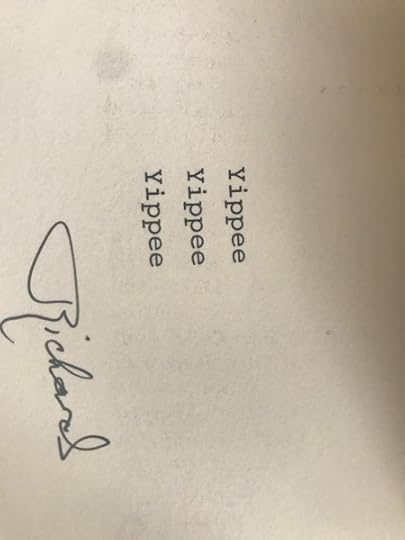
I had other mentors along the way. Joyce Sweeney introduced me to my agent, and that agent, George Nicholson (himself a contemporary and friend of Richard Peck) taught me so much about the industry, including things I hope are still true. My editor, Toni Markiet, has been a godsend. A lot of publishing is luck, and I have been very lucky in meeting all these people. But none of them taught me to write quite like Richard Peck did. And here are some of the things he taught me, in that first workshop, in subsequent conversations, and in reading every single one of his middle grade and young adult novels, and also from observing his career. Here is what I learned.
1. Your first sentence should make the reader ask why. Meaning it should give the reader information but also leave the writer with questions. The first sentence of Richard Peck’s last novel was, “Boys aren’t too interested in weddings,” and by this sentence, we know that this is going to be a book about a boy and a wedding, and indeed, I wondered why. The first sentence of my first novel, based upon that advice, was, “I’ve never been in a courthouse before.”
2. The first chapter should hold the promise for the rest of the book. When I read manuscripts for SCBWI, I tell the writers that, “I want to know what the book is about in the first ten pages.” But it’s a little more than that. The first chapter should hint at what the characters (and the reader) will get out of the story. In Breathing Underwater, a judge sends Nick to an anger management class, saying, “Maybe you’ll even learn something.” That’s the promise. In my most recent book, the character, Britta, says of a planned journey, “It could change our lives.” And that’s the promise because it will.
3. Take the characters on a (geographical) trip. Richard suggested this as a way to expand characters’ horizons and open their minds. In Richard’s books which I read, his characters went as far as Russia or as near as a train trip into the city. They transferred to new schools or boarded the Titanic, but they all went on journeys. In all of my own books, characters have either taken a trip or moved/transferred schools. In my first novel, the characters, inspired by the trip I took, went to Key West. In Beheld, Kendra flees Salem, travels to Germany then England and finally back to America. In my upcoming novel, characters spend a month in the Adirondacks. And yes, mine have also been on Titanic.
4. Include an elderly character, for perspective. I believe there is one in each of Richard's novels. I have included elderly character in three of my novels, or six if you include Kendra, the witch from Beastly, Bewitching, Mirrored, and Beheld, who is 300 but looks 16. I do include her, actually. She is a mentor. My first novel had an elderly, wheelchair-bound English teacher. My most recent, Girls of July, has a wise grandmother who brings the four girls together. This was why I dedicated the book to Richard. All or most of Richard’s novels included such a character, with the most famous being Grandma Dowdel of A Long Way from Chicago and A Year Down Yonder.
5. Retype your novels. Richard said he retyped each of his novels seven times. This was in the days of typewriters. I assume he eventually word-processed. I admit I was sort of afraid to ask. I retyped my first novel, from a handwritten draft and then again from the finished draft (written on a typewriter) to my computer. I retyped it again on each revision from my editor. I have retyped each subsequent novel at least twice (always from a handwritten first draft). I believe in it.
6. Take your readers to the party. Richard reflected that, in one of his novels, Princess Ashley, which was about bullying and teens out of control, readers enjoyed it because they got to go to the cool parties with the narrator, Chelsea. I remember this whenever my books get too bleak. In Breathing Underwater, Nick and Caitlin went to parties, to Key West, and swam with dolphins. When my editor asked me why the latter scene (and she was right; It was a long one) was there, I said it was there for that reason. In Nothing to Lose, which is about a boy who kills his abusive stepfather, he also falls in love with a beautiful carny on the double Ferris wheel.
7. If there’s going to be a ghost, put it in the first chapter. This was from Richard’s Blossom Culp novels, and it ties in with number 2. If a book is paranormal, it shouldn’t come as a complete shock to readers. There should be some hint of it. The reason for this is twofold: First, if the reader wants a paranormal, it would be great if they knew that’s what they were getting. Secondly, it’s not really fair to change the rules late in the game. A character shouldn’t sprout wings at the top of a cliff if flying was never hinted at.
8. Read Widely. I am blocking out the exact number of children’s books Richard said he read each week. It was at least three, maybe four. It was a lot. I don’t read that many, but I read. Richard gave each of us a reading list when we got to Key West. Mine had Rob Thomas and Chris Crutcher on it. I don’t really respect writers who don’t read other writers in their genre, or who don’t know their history. Richard also told us about Hornbook, SLJ and VOYA.
9. Spy on teens. Yeah, I do this. I go to Starbucks or McDonalds or the mall and listen to teens all the time. Early in my career, I walked around the middle and high schools near my house and took notes. I got whole characters for my books this way and whole conversations I used in them.
10. Don’t be afraid to change directions. This, I deduced from Richard’s long career. After decades of writing mostly realistic YA, Richard switched to middle grade, wrote historical fiction, wrote about mice or zombies. That’s how he stayed relevant for more than 40 books.
The world lost Richard Peck yesterday, but his legacy lives on in his books and in the advice he gave to so many of us. Thank you, Richard Peck!
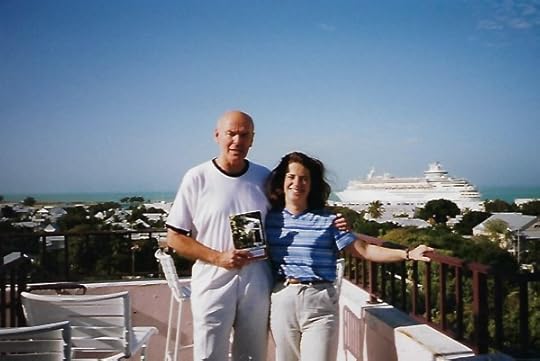
I am including one of the few known photographs of Richard Peck in a T-shirt. Key West does that to people.
May 7, 2018
Breathing Underwater is 17 this month, and it's getting a new cover! Why I wrote it
In her letter, this young woman reflected on the book and said it had made her come to grips with her own anger problems. Her teacher had asked them if they had issues with anger, and she hadn't raised her hand but realized she should have. She also asked me why I had written the book, was it just to entertain or to communicate something with readers and also, the age-old question of "Why is there not a movie? This would sell?"
Since I'm a bad blogger, I thought I would reproduce my answer to her (Her name has been changed).
Dear Samantha:Thanks for your e-mail. I'm glad you enjoyed the book and got something out of it. I wrote Breathing Underwater mostly because I thought it would be an interesting read. It is the type of thing I would like to have read as a teenager. I liked books with fast-paced stories and interesting characters. However, I am also happy that a lot of people have gotten something out of it, left bad relationships, or were compelled to look inward at their own anger issues. One young woman at a school in New York read the book and was so moved by it that she left her boyfriend then suggested the entire school read it. I visited the school and met her. She said, "You saved my life." Last time I heard about her, she was studying in France. So, even though the book was about the boy in this situation, I hoped that young women would read the book and recognize their boyfriends and the mind games they are playing. I'm glad that has happened.
At the time I wrote the book, I was volunteering with battered women and was familiar with what could happen in a worst case scenario. A woman at the shelter where I volunteered was killed by her ex-husband when she met him to deliver their kids for visitation. The court system here has a way to deliver the kids so that parents wouldn't have to see one-another. However, she thought it would be safe to meet him at a supermarket, and he shot her in the parking lot. That really showed me what could happen. There are murder-suicides like that every day in America. We have to take it seriously and not downplay the behavior that leads up to it.
I think it's okay that you didn't raise your hand, but I'm glad you realize you could have. I wish you the best of luck in bettering yourself. I hope you find someone to talk to also. So often, girls turn anger inward, which also causes problems.
As far as your other question, Breathing Underwater has been optioned for a movie a couple of times, but so far, it hasn't happened. I think it is because the story is pretty complex, and it would be hard to adapt it to a 90-minute film. My dream for it is that I think it (along with its companion, Diva) would make a good TV series, maybe on Freeform, something similar to The Fosters. I guess it could still happen.
Thanks again for your e-mail.
August 31, 2016
Win an Advance Copy of Beheld
Head on over to Twitter and enter to win an advance copy of Beheld (which other mere mortals will be able to purchase in January) Just tweet what you would do if you had Kendra’s witch powers (Me, I would use them to communicate with my dog, to say stuff like, “The bathroom is for humans” and “I’m only insisting you eat dog food because it’s healthier than just eating cheese.”). Had some pretty good entries so far. Best wins. If you enter, tag #beheldcontest and @alex_flinn Ends Friday.
June 27, 2016
Beheld cover -- coming January, 2017!
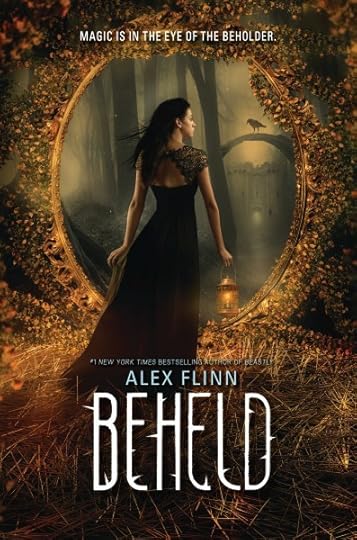
This is it! The cover for my upcoming novel, Beheld! I was so excited to write this! It’s about Kendra, the witch from Beastly (though you can totally read it if you haven’t read my other books -- it’s not really a series-series). I always wanted to write about her own love story, like what is Kendra about? Doesn’t she have a boyfriend when she’s helped so many others find love? This book traces Kendra’s life and quest for love from 1692 Salem, through 1813 Germany, WW2 era London, to the present, and we get to know Red Riding Hood (in the form of Salem witch accuser Ann Putnam), Rumpelstiltskin, a young war bride in an East of Sun, West of Moon story, and two ugly ducklings in present-day Miami. Here’s what the publisher says about it:
A love that lasts through the ages . . .
I first beheld James over three-hundred years ago. Since then, I have tangled with witch hunters and wolves, helped a young lady spin straw into gold, cowered in London as German bombs fell, and lived through heaven knows how many shipwrecks.
I once even turned a boy into a beast in order for him to discover kindness and true love. But you know that story.
I have survived it all as a powerful witch. But powers have limits, and immortality can be lonely.
I have helped others find love, but my own true love is lost to me.
Now, I am in Miami, uniting yet another couple for yet another romance.
Still I seek my own true love, looking for the one I have always . . .
BEHELD
February 22, 2016
A Villain is a Hero in His Own Story: Why Villains Need Backstories
I’ve just been answering an e-mail from a college student who is writing a paper on Malificent (or, as I told her, “the old fairy”) in Sleeping Beauty and wanted to know why I gave her the backstory I did in my novel, A Kiss in Time. As I sometimes do, I got a little long-winded and started to reflect on villains and backstories in general, so I thought I’d share it in a blog post.
I chose to give Malvolia (my own, made-up name for the old fairy) a backstory because characters have backstories. No one is just evil for the sake of being evil. There must be a reason. The fairy tale’s ostensible reason,being offended at not being invited to a party is a stupid reason to get so angry that you put a death curse on a baby. There has to be another reason, a reason why she feels wronged, terribly wronged. Also, there should be a reason why she wouldn't be invited to the party. What were the king and queen’s motivations? Obviously, this was a very big party, not a little tea or something, and the king and queen (who have a lot of money) would likely invite all the people (and fairies) who reasonably should be invited. Also, logically, they wouldn't want to offend such a powerful fairy unless they had a very good reason. So I started to think of what a good reason would be and, also, what would make Malvolia feel so wronged that she would try to take revenge in such a horrible manner.
In a word, the reason why the villain’s backstory needs to be considered is motivation. There is a saying that "a villain is a hero in his own story."
I've seen it attributed to Chekov but I've also seen people say that it is unknown who said it, so I'm not sure (though Chekov did come up with that cool saying about the revolver on the mantlepiece, so I like Chekov’s writing advice in general). What that means is, no one thinks he or she is the villain. Like, a criminal would say he had to commit a crime to feed his family, or to get rid of someone who was mean to him or because the system did him wrong and he had no choice. He wouldn't say, "I committed that convenience store robbery, then shot the clerk because I am a terrible person." So I enjoy getting to the bottom of why that person did what they did, whether or not I agree with that person. That person may end up being Jean Valjean (who was justified) or Fagin (who was less so) but every character must have a reason behind his actions. Les Miserables and Oliver Twist are actually both very good illustrations of this principle. In Les Mis, Javert thinks of himself as the hero of the story because he is following the law, which he is bound to do. He thinks of Valjean, an escaped criminal, as the villain. But we, the reader (and the audience for the musical version for decades now) think of Javert as the villain and Viljean as the hero. Maybe not the ONLY villain, and maybe not as bad a villain as, say Thenadier, but a villain. But if there was a musical called Javert! (with an exclamation point after it, like Oliver! or Oklahoma!), we would think of Javert as the hero.Similarly, Oliver Twist has several villains and antiheroes. Dickens, was, after all, the king of writing antiheroes. He gave us one of the first and best-known books written in the viewpoint of the villain: A Christmas Carol. I realize “antihero” sounds cooler than Ebeneezer Scrooge, but he was really one of the best, and that’s why so many sit-coms have a Christmas Carol parody episode each year. Charles Dickens saw all sides, and his book delved deeply into why Scrooge became the man he became.
In Oliver Twist, the first villain we meet is Mr. Bumble, who won't give Oliver more food and then sells him to a funeral home. But he would likely say he was a hero. He didn't give Oliver more food because, after all, he didn't have more food. The Parish can’t spend all their money overfeeding workhouse boys. And he sold him to the funeral home because he was making it hard to keep order in the workhouse and, also, selling Oliver provided money for food for all the other orphans. The next main villain we meet is Fagin, who runs a band of boys and teaches them to pick pockets, so he's a villain. But, on the other hand, he also feeds the boys presumably better than they were fed in the workhouse, so he's a hero. The truest villain in Oliver Twist is Bill Sykes, a violent criminal who eventually beats his girlfriend to death. But I wrote a whole book on the psychology of that backstory, and it is called Breathing Underwater, so you can read it if you like. Nonetheless, I do believe Bill Sykes is a true villain. However, I would guess he would still disagree with me on that. He likely had a father who beat him and beat his mother and definitely lived in a time and place where the odds were stacked against the poor, much as they were stacked against Oliver. He would say he's done what he's done to get by (and, I would guess that, had he lived long enough to be sorry, he would also be very sorry about what he did to Nancy). He would probably tell me that, had Oliver not been taken in by Mr. Brownlow at the end of the story, Oliver may well have turned out to be Bill Sykes or Fagin. And he might even be right. We’ll never know.
A more recent example of a villain who is a hero in his own story is Snape in Harry Potter. I don’t know about other readers, but I suspected Snape’s backstory, or something like it, all through the series, long before it was revealed in Half Blood Prince or Deathly Hallows. Of course he was a double agent, and of course he was heartbroken. But, weirdly, Rowling provides less motivation for many of the other main villains in HP. Dolores Umbridge, for example. Or Bellatrix. However, in my mind, Bellatrix is just some confused Squeaky Fromme (again, not a hero) taken in by a charismatic, Manson-like Voldemorte.
The first time I started thinking about my villain’s backstory was when I was writing an early draft of the book that eventually became Breathing Underwater. The villain started talking to me, and I wrote pages and pages in his viewpoint, with the idea of writing a sequel about him. Eventually, the sequel became the book. I’m not saying that you have to write a whole book about your villain or even pages and pages about his motivation. But you should definitely at least spend a long time thinking about it.
January 14, 2016
Conference Tomorrow!
Tomorrow, I’ll be at the SCBWI Florida conference here in Miami. I am giving a workshop on fairy tales, and I’m critiquing manuscripts, but I’ve gone many years when I haven’t been speaking, just to learn. I’m always amazed when writers think they know to much to learn from a conference, and I once sort of wrote off a fellow writer as a snob for saying something like that. For anyone who wants to write for children, I always recommend SCBWI (Society for Children’s Book Writers and Illustrators). There was not an active chapter in Florida when I started, but our RA, Linda Rodriguez Bernfeld, changed that. Since then, I’ve known many people who have gotten published as a result of attending our conference. Others have learned to be better writers, which has led to their publication.
If you want to write or illustrate for children, visit their website and join. You get a free newsletter, access to SCBWI critique groups, and discounts on conferences. Every region has a conference. You can attend your own or others. Many writers attend ours in Florida, as we have great speakers and are in Miami in January. You also meet great writer friends who will “get” you and hold your hand (literally or metaphorically), and it’s hard to put a price on that!
January 10, 2016
How to Get the Most From Your Conference Critique
You’re attending a conference! Yay! And you’ve sent your manuscript ahead for a critique! Double yay! Lots of people submit manuscripts for critiques, hoping to be “discovered” by an editor or agent. Even if that doesn’t happen, you can get a lot out of a critique by a fellow writer, which may eventually put you on the path to discovery.
Every year, I critique manuscripts for my local SCBWI. Once, I got a manuscript that was so perfect that I referred the writer to my editor and agent, and my editor published her! Here's that book.
I've gotten a few other practically perfect manuscripts, manuscripts where I didn't have much to say. But usually, I've gotten manuscripts that have needed work. But if the work is done, these writers can get published too. I recently ran into a woman at a teachers’ conference, who reminded me that I had once critiqued her at SCBWI. This was her published book, which became publishable sometime after we met.
Also, I was once one of the people getting critiques. An early version of my first novel, Breathing Underwater, was critiqued by Richard Peck at Key West Literary Seminar in 1998. It was that critique that encouraged me to go on – and Richard also encouraged me to put it in a single viewpoint, which I did.
So how do you get the most out of a critique? The first step is to make your manuscript as perfect as possible in the first place. This may seem counterintuitive. After all, you’re paying for a critique. But you really shouldn’t be wasting valuable critique time, correcting punctuation errors. A while back, a relative asked for help with a novel she was writing. I told her, “Fix this, this and this” (the items I’ll outline below), “and I’ll be happy to help you.” I think she got insulted, because she never gave me the manuscript. But really, I meant, "Hey, I think you're smart enough to fix this stuff on your own." I’m not a 9th grade English teacher. I assume she wants help on items like characterization and plot. For that to be the focus of my critique, the following items need to be perfect.
1. Format. Twelve point Times New Roman font, double spaced, no extra line between paragraphs. This is important because Word automatically formats every document as a letter (single spaced with a break between paragraphs). You’re not writing a letter. Align left. Number the pages. Plain numbers are okay, but even better, number with your name, a partial name of your manuscript, and the page number. E.g, Flinn/Beheld 1For the first chapter and each subsequent chapter, space about one-third of the way down the page. Center the title or chapter number. INCLUDE THE TITLE AND YOUR NAME. I realize this will take up valuable space from your ten pages you’re allowed to submit. First off, tough. It’s true. You’re really only getting to send nine and a half pages. Secondly, you’ve just saved a bunch of space by not spacing between the lines.
2. Spell everything correctly. Don’t just use spellcheck. Read your manuscript aloud because this is the best way to notice errors.
3. Make sure everything is in the same tense. I realize you switched from past to present or vice-versa, but make sure you got it. Again, reading your manuscript aloud is the best way to catch this.
4. Punctuate correctly. Commas matter. Here’s a worksheet my daughter’s journalism professor gave out about commas. The serial, or Oxford, comma is arguable. She is a journalist, and journalists typically don’t use them. However, most novelists I know do. You should read the rules, learn them, and decide what you want to do. See what I did there? I just had four sentences in a row with different comma usage rules applied. Commas are power!
5. Read that manuscript aloud one more time, and make sure you got rid of any remnants of abandoned ideas that will be confusing. Character used to be named Anna, but now, she’s Hannah? Take out all the Annas.
6. While you’re at it, make sure that the reader will have some vague idea where the story is going by the end of the ten pages.
7. Finally, bring a good attitude. I know you wanted a critique with an agent, and you got a writer instead. Or the agent doesn’t want to see your full manuscript. Or maybe the suggestions your critiquer is giving sound crazy. Maybe they even ARE. Maybe the critiquer didn’t read your manuscript carefully, and that’s why she isn’t getting what is completely obvious to you. But give it a good listen, and then think about it. Discuss the changes with someone else who has read your manuscript (”Hey, she had this crazy idea, but did you think . . . ?”). You don’t have to do everything your critiquer suggests, but if you have one or two good tips, it’s worth the price.
Hopefully, you are reading this and thinking it sounds really obvious. I think it is. But I’ve had manuscripts that included these “obvious” errors. I have one or two right now. When I meet with these people for their critiques, we’re going to spend a portion of their fifteen minutes, fifteen minutes they paid for, discussing commas, tense, and why they should include their title, stuff they could easily have learned by reading a book. I think it’s kind of a waste of their money. Don’t waste yours.
If you do all this, you aren't guaranteed of being discovered by an editor, agent, or friendly writer who will introduce you to hers. But you're a lot closer. And, if you don't do this stuff, you definitely WON'T.