Lex J. Grootelaar's Blog
March 21, 2019
Russian Doll — Mike is Loki or a god of some kind…
Netflix’s Russian doll, a new twist on the Ground Hog day loop: does bring some interesting dynamics to the incurable repeating-day-interstellar-flux predicament. Giddy-up its a good show, but that’s not what I want to talk about at all…
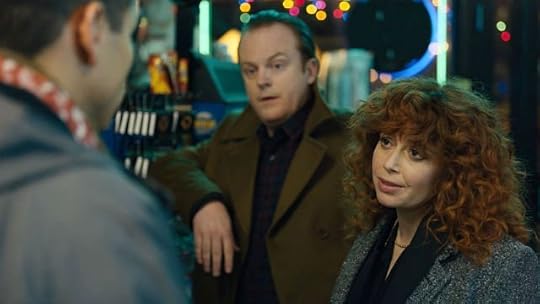
I want to talk about the asshole character Mike — nickname: gingerbread; a womanizer, and a literature professor. He is easy to picture right — a very flat character that is easy not to like–and whose purpose is to show the values of the other characters. Just copy and paste this trope from any of the other–one hundred or so stories that have ‘one of these’– and it raises no eyebrows; it’s just a simple, useful plot moral compass at this point. Which is why it is so compelling that in Russian Doll, Mike is the most flushed out iteration of this character–I have ever come across.
The series has a decent script, but one that lifts a few famous pop-culture lines (to the point where I was like, hey can they get away with that? i.e. ‘A lot of ins a lot of outs; interested parties’. A line spoken — that was clearly lifted from the Big Lebowski’ ) there are others if you keep you ears open. So the dialogue wasn’t very innovative–is what I’m saying, and yet for one character it was. I was quite taken back by this afford mention character’s blunt introspective self-insights: ‘I’m the hole that sits as the absence of choice’. He says this when confronted: he is supposed to be a dick, and yet, Asshole or not, someone that can say that about themselves, is functioning on entirely different level of self-awareness. Not to spoil things but the confirmation scene with him and one of the main leads (in Mike’s office); is handled with such a smoothness that the audience kind of develops an sympathy for Mike, just based on his non-contrived responses. And this is a guy we are supposed to hate–not have conflicted feelings for.
Here’s a theory I have been mulling around–this character Mike created the loop that the leads are stuck in. When you watch the show: play attention to Mike: he is directly connected to both loops, arguably both first deaths (the result of, or catalyst for). He has this overly developed sense of self, he is lifted above regular moral constructs and lacks empathy for other humans: yet understands empathy as a necessary concept. He is the puppet master, 100 per cent for Allan, and maybe the main lead was looped in on Allan’s timeline, not the other way around. Mike is some entity, creating repeating loops for some reason, and giving himself a front row seat.
Maybe–just maybe…
… Or he could be just a very well-written side character, representing the polar opposite of the second main.
I also obsessed about a certain sub-character from Stranger Things season one and their unique story arch.
check it out here
S teve is the Greatest Character – his Rare Character Arc h


January 1, 2019
Books 55-60 for 2018 – thoughts
[image error]
Well, it was kind of a wild-ride setting out to read sixty novels in 2018 … And I almost didn’t pull it off – truth be told, I had to spend the last four days of this past year reading 8-10 hours a day. But no way was I going to start a new year with the baggage of coming so close.
The Wisdom of the Desert – Thomas Merton
A collection of thoughts or credos from Christian Monks that isolated themselves in the desert. This was a thought-provoking read, and it definitely draws comparisons to the ways of living by Buddhist monks. That said I prefer literature of the latter, texts that speak more to an understanding of how the environment and harmony impacts a person’s thoughts, or more concisely an indirect spiritual connection. I.e. not the black and white martyrdom of faiths with firm decorum exploring isolation – but an interesting read none-the-less.
Harry Potter and the Deathly Hallows – J.K. Rowling
Harry Potter as a series – The last three books, (none of which I have spoken about yet) demonstrated a surprisingly good development of character growth. Or did they… This is a very good series, one I think everyone should read or read to their children, yet I’m a very evil person – so let me first air some grievances and then I’ll wrap up my thoughts on the seven books in a stoic bow.
Part of any Good vs Evil conflict is remorse towards evil – that wasn’t really there; wouldn’t a fate worse than death be: living but made powerless, wouldn’t that be true mark of the Good? (Saruman being banished in LOTR for example)
Why did the friendships between Ron, Harry and Hermione become so redundantly flat?
I wanted a better Snape Harry resolution, granted it was my favourite part, (the character redemption) but it was all expressed in flashbacks. I would have loved Snape like dying for Harry or at least them hugging him it out or something.
Also, this climax of events should have led to some kind of new wizarding world order – couldn’t that have been flushed out? The universe had a ton of faults that led to this rise of evil, yet everything is business as usual post the end of Hewho(m)mustnotbenamed? Shouldn’t the Ministry of magic be redesigned? Shouldn’t the wizarding charter or constitution towards the rights of lesser magical creatures be re-written? Odes of inequality were sown throughout, wasn’t that the grander theme? Why wasn’t it concluded?
Hmm… Also Shouldn’t there have been reaching implications that nothing will ever be the same? Even in the LOTR books, the Shire is impacted and changed for the first time, so great was the impact of the war (not in the movies).
That said finishing these books felt like I closed a loop I created in my childhood, when I stopped reading them at 13. The story is terrific, from the perspective of growing up and the innocence of youth with all the truck loads of nostalgia that comes with it.
Lincoln in the Bardo – George Saunders
Cool approach with multiple perspectives, although I preferred the historical citations more than the fictional ones that moved the main narrative. I guess this is a creative historical non-fiction/fiction? Booker prize, Oscar-bait? I found it too campy and a bit on the nose – there is a literal gates of heaven judgment scene …
Wabi-Sabi – Leonard Koren
Beauty in the un-order, in the simple and smooth – yet flawed, out of a hundred straight sticks, the bent one is what holds the eye. This novel speaks to a kind of tone in Japanese Culture that can be found in pretty much everything Japanese. An interesting idea to embrace – the ideals of but never seek complete perfection. Not so much embrace flaws but respect them and hold them in esteem. Need to read more on this Wabi-Sabi concept.
Infinite Jest – David Foster Wallace
Okay, I knew this novel was going to be hard to read, but I didn’t think it was going to be as hard as it was. The only way I can begin to talk about this novel is to consider it as Art or as Anti-poetry – meaning that if poetry seeks to minimize the medium with abstraction. Wallace sought to maximize literature in Abstraction, leaving no stones unturned, spelling out metaphors but never explaining them in of themselves, if that makes any sense. Everything is complicated, everything: from sentence structure to prose, to word choices, to the footnotes, the multiple-narrative character switches, the meanings, the lack of meaning, the symbolism, the lack of symbolism – is the joke on the reader – on the industry? On what literature is? On why people read?
You can’t skim a line, let alone skip one. Every single piece is an import part of the puzzle he has created.
I loved it, as I love writers who expand upon Form, similar to Avant Garde artist that seek to move forward a movement. Fiction made immensely complicated is almost the point with this book, a complicated subjected matter isn’t essential, although it is definitely there. To discuss the subject matter would be a whole other can-of-worms as Infinite Jest is about everything and nothing.
This novel is an expansion of what is possible within the confines of the ‘written’.
Sooooo pretentious soooo Pretentious… And now I’m a notch more pretentious for reading it.
Alas, this was never my intent, alas here we are sixty books later.
December 14, 2018
Books 50-55 for 2018 – thoughts
[image error]
Art Theory: A Very Short Introduction – Cynthia A. Freeland
This is a subject I have semi-organically taken a strong interest in – there seems to be this ongoing game of cat and mouse between: people that bring forth a definition of ‘what art is,’ and people that break down that definition. One never quite catches the other. This book gives a concise historical overview of this never-ending fight for a definitive answer.
A little Book on the Human Shadow – Robert Bly
Building on the notions of the ‘self’ established by Jung. The human shadow: parts of the human psyche that are repressed over the course of ones’ character development; passed from mother to child – father to child in a ‘children carrying the sin of the adults around them’ progression of self. Yet also gives credence to ones’ personality being defined by what you are not, just as much as what you are.
What I found very interesting was the books discourse on consuming the shadow by safely embracing – these senses of repression (inner darkness) and in a way growing as a person. Then, in turn, pulling less or having a shorter shadow. This idea goes over, and above negative or ill feelings towards life you have hidden inside – but also speaks to the inner ‘Witch’ in all men or the ‘Inner giant’ in all women. Aspects of our society and our upbringing cause us to develop our shadow-like-bag and pass it on to others. Kind of bleak, but perhaps as I get wiser (a term I will use loosely) I’ve started to see, (best conveyed in Lit) how inter-generational impacts can be passed on – but also if one is able to eat their shadow these impacts are stopped. A little heavy food for thought…
Letters to My Daughter – Maya Angelou
A bad-ass through and through – this novel is a self-reflective memoir of a sort. My favourite scene she plucked from her life was:
Her mother very matter-of-the-fact saying, “Maya you’re going to do great things.” (Maya was at the time in a very poor and kind of complacently living on her own; her mother was never one to sing praise or complement). And so, in response, Maya decides to stop drinking and smoking as much – because her mother said she would do great things one day. It almost seems that those simple words from mother to daughter created a self-fulfilling prophecy, Maya couldn’t fail because her mother told her she wouldn’t.
Harry Potter and the Order of the Phoenix – J.K. Rowling
Thoughts pending
Harry Potter and the Half Blood Prince – J.K. Rowling
Thoughts pending
5. Books. Left.
December 1, 2018
Books 45-50 for 2018 – thoughts
[image error]
Silence of the Lambs – Thomas Harris
This was a very clean novel, no untied threads or structural inconsistencies. I was really taken back by Harris’s deep understanding of not only forensic science – but also butterflies and dress making. This attention to seemingly insignificant details, aided to create a rich well researched story. The novel is a rip-roaring thriller, that also has a few humbling insights into the human condition – a feat in of itself.
Personal Poems – Ian Williams
First book of poetry I have ever read; won’t be the last. Abstract yet accessible.
A Short History of Tractors in the Ukraine – Marina Lewycka
This novel really demonstrates how the weight of inter-generational struggles impacts a family of immigrants. The relationship between the two sisters is at first even a touch cliché but then develops into an unexpectedly rich dynamic – which I won’t spoil, ‘xpect to say it’s a real insight into a family that straddled WW2.
Harry Potter: Goblet of Fire – J. K. Rolling
Hmmmmm – I mean its good middle fare for the series. I think I’m going to speak to these books altogether once I’m done the remaining 3.
Invisible Monsters – Chuck Palahniuk
Unfortunately, when reading Chuck, I was anticipating a Fight Club like book and there is no doubt this work is of the same ilk, which was kind of disappointing, because it didn’t feel new. I respect that he wanted to speak to the aspects of ‘individual physical representation…’But it seemed a little flat. My biggest issue was that I couldn’t suspend my disbelief in how many of the characters were mirror representations of one another -in their actions it became – ‘sigh’ inducing….
October 22, 2018
Books 40-45 for 2018 – thoughts
[image error]
The Sisters Brothers – Patrick deWitt
I read this novel almost completely blind, Patrick was coming to speak at my humble city and well, it was Booker prize shortlisted, that was more then enough for me to read it… And the novel was a gruff, western saga!? with tough as nails characters, a minimal fast paced writing style, and Wicca dark magic foreshadowing – a hugely enjoyable surprise; very compelling and a book that I would recommend.
Harry Potter and the Chamber of Secrets – J.K. Rowling
This book is kind of bleak, and definitively my least favorite thus far, that said I really dug the flying car, some very beautiful imagery with Harry and Ron flying to Hogwarts.
Neil Gaiman – American Gods
I have now read a few books from the 80’s, there is definitely a Gritty dark feel to a lot of them and I don’t think this aspect ages well. I wanted to love this book, I really did, and perhaps I was wishing it was in graphic novel format as there were so many scenes that stretched my imagination, that said – And I love Neil – I just found this book underwhelming. The stakes! The stakes didn’t work for me. I enjoyed the sub plot of the town more then the main arch… 
October 1, 2018
Books 35-40 for 2018 – thoughts
[image error]
Tao Te Ching – Lao Tzu
Simple. Brilliant. Timeless. I have read perhaps an embarrassing amount of self-improvement books, which could be completely boiled down into one or two of the simple poems contained in this book. Also in this translation, the translator uses the feminine pronoun a choice made based within the Tao itself:
Know the masculine
But keep the feminine:
and become a watershed to the world,
And I think that choice (and text) shows the amount of ‘still’ humility and grace that is contained within this collection of poems.
The Fall – Albert Camus
It’s amazing how many post-WWII writers were trying to piece the world together.
This novel was full of the unspoken thoughts many of us share about society, with strong tones of Nihilism – it definitely has a “God is dead and we killed him” vibe.
The story may actually be an interpretation of Nietzsche’s final days of mental stability/instability. A great read for anyone interested in modern/postmodern philosophy.
Kitchen Confidential – Anthony Bourdain
I have worked in a few kitchens – and so much of this novel was spot on: the stress of a rush, the sense of working with a pirate crew, achieving good flow, and the principals he described as to what makes a good worker. Perhaps the part I found most interesting was the tales he regaled about “BigFoot” arguably one of his principal mentors; I was reminded of a former heavy mechanic I use to work with whose manners and ethics I still respect to this day.
A great read for anyone that has worked in a rough environment or just plain loves food and the passion that goes into it.
The Story Grid – Shawn Coyne
A fantastic tool – a way to lay out a story in all of it’s working parts.
For myself, I edit and revise until the point of memorization, this takes a long time and many drafts. Using the story grid method, you can see all the elements of your work ‘visually’ after draft one. This is a structural editing practice I’m definitely going to try out with my next work.
Harry Potter – Philosophers Stone (audio)
I wanted to read this series because as a young kid discovering the world, HP made a big impact on me, but I stopped reading them after the fourth book, around the time the first movie came out.
I’ve made it the third book now. The first one is a tough read as an adult, I’m not going to lie and the 2nd book is even harder. Even through a nostalgic lens its tough – but it is amazing how JK improves and grows as a writer even within the first three books, and this notion of watching her style and creativity strengthen is the driving reason why I’m reading them now.
Lordly lordy this first book is a push.
September 18, 2018
Remai Gallery

The modern artist… is working and expressing an inner world – in other words – expressing the energy, the motion, and other inner forces.
Jackson Pollock
August 30, 2018
Books 30-35 for 2018 – thoughts
[image error]
Book Thief – Markus Zusak
Two things I loved about this novel: that the story was told from the perspective of Death (even death was heartbroken by what was going on in Nazi Germany), and the stylistic choice to describe the colour of the sky every time a character passed on. It was such a good choice to set the tone.
The novel was chilling and perhaps I shouldn’t have read it on my summer vacation, ‘cause all I wanted to do was smoke cigarettes and mourn humanity.
The Grammar Bible – Michael Strumpf and Auriel Douglas
This took me a long time to read as I would often try and cram in a few chapters once I had finished a different work of fiction – it is a book on grammar after all… Things don’t come much drier. That said it may have been the best thing I have done for my writing endeavors. And if you can grin and bear it I think everyone should read a book of this ilk. All aspects of grammar were well represented and at times fun (a term used loosely).
The Lord of the Rings Trilogy – J. R. R. Tolkien
Well, it had to be done. When I set out to read sixty books this year I wanted to make sure this trilogy made the list. I have always been a huge LOTR fan – the films came out in the sweet spot of my adolescence. I got right into the books: they are brilliant the man has more words to describe geography then I have in my entire vocabulary roster. Also, something I was really drawn into was the time given to Faramir and Eowyn and the development of their relationship; as they both overcame adversity, a crazy ass father/honor and the pitfalls of being a woman in middle earth.
I mean we all love the Aragon Arwen thing in the films, but in the books, it’s an afterthought.
That said I’m sure if Peter Jackson had a time machine there would be nine films instead of three and not a beat missed: Tom Bombadil, Saruman in the shire, the above mention romance, the seeing stones etcetera…
If you can get through the pacing of the first novel and haven’t already this trilogy is definitely worth it. And Tolkien’s use of grammar is flawless!
July 27, 2018
July 5, 2018
Books 25-30 for 2018 – thoughts
[image error]Halfway to sixty — the going was a bit thick there in the middle.
East of Eden – John Steinbeck Sometimes in order to understand why a character acts in a certain way a backstory is created or subplot is developed to show the intrinsic drive of that character and their “why.” I can not think of a better example of establishing a “why” motivation than with Steinbeck’s characters in this novel as it goes back 3 family generations. This novel is epic yet simple and has a story that builds brilliantly.
I loved how the historical elements are woven in and I will never forget the character of Sam Hamilton. That said the aspect that stuck with me strongest was how in the novel a conversation between friends transformed lives and transcended time.
Why Buddhism is True – Robert Wright Robert Wright transitions from a skeptic to someone (who with the scientific method) firmly supports and believes in mindful meditation and the reader who follows this journey is left with little room for doubt. A good read, although at times perhaps it was too in-depth with its arguments. That said I’m not one who needs that much in the way of convincing in regards to the importance of meditation.
Another roadside attraction – Tom Robbins I enjoyed this novel, it was a fun, very abstract, and complex. A story that only seemed truly outlandish once it was stepped away from, yet there was nothing but tranquility while the pages were flipped.
The Gambler – Fyodor Dostoyevsky There are writers and then there are the godfathers of literature. Dostoyevsky is the latter. As I’m aggressively studying French, I really enjoyed how a good deal of the French was left in the translation. It fully conveyed a feeling of trilingualism that the character demonstrates and the meeting of cultures (and social classes) that happens in the novel’s backdrop.
Cannery Row – John Steinbeck Sigh – I wanted more “East of Eden” and this short earlier work of Stenbeck does stand well enough on its own, yet I feel like he was feeling out the story seeds and hinted at characters that he would later fully developed in “East” and in “Grapes of Wrath.”