Roman Leao's Blog
November 13, 2025
Kingdoms of the Radio: Tibetan Bells & a Bird from Hell [ficção]
Joaninha pulled her 1982 Honda Accord up to the high curb in front of the Boonville Mercantile and killed the engine. The weary mid-size sedan, however, had its own ideas and continued to diesel as if it was having an epileptic fit as the young woman gathered up the items that had rattled out of her purse on the bumpy drive over from Ukiah.
She was glad that she was almost done having to make the daily trip over to the college, but wasn’t looking forward to sinking money that she didn’t have into the aging car to ensure that she could achieve escape velocity from her hometown. Graduation was coming up fast and Joaninha was hoping that the Accord and her journalism degree would get her at least as far away as the East Bay, maybe Humboldt County.
“Just a moment!” A cheerful voice from the Mercantile’s backroom called out as she triggered the tiny bronze Tibetan bells hanging on the shop’s front door.
“It’s just me,” Joaninha called back. “I can take over if you want, Mom.” The familiar earthy smell of Nag Champa incense filled her senses as the stress of upcoming finals melted away, at least for the moment.
“Sera, thank goodness,” a lively gray-haired woman in her early 50s bustled out from the stockroom, wrestling herself into a wool sweater as she walked. “Where is Kiḍa today?” Joaninha’s mother asked, using her native Marathi translation of a name she found, frankly, ridiculous.
“He drove over the mountain today, mom. He is finally starting the interviews for his project.”
“I don’t know why your boyfriend wants to talk to those idiots,” an old-timer shopping with a female eclectus parrot on his shoulder chimed unbidden into the conversation.
“I don’t remember asking your opinion, Floyd,” Joaninha’s mother snapped, long having had enough of the local’s morning commentary on everything from the weather to Bill Clinton’s recent remarks on the Oklahoma City bombing.
“Hey, I’m just saying… ,” the man replied. The bright red and purple parrot, uncharacteristically, was silent on the matter.
“That’s your problem, Floyd,” the woman pointed out, “you are always ‘just saying!’ Why don’t you keep your trap shut for a change.”
“Keep your trap shut! Keep your trap shut!” The tie-dyed-colored bird joyfully joined in the dialogue.
“You should follow the advice of your feathered friend, Floyd,” Mrs. Joaninha advised as she grabbed her keys to leave. “Between the two of you, she’s the only one with any sense.”
This last parry finally brought a moment of quiet to the Mercantile as the parrot bobbed up and down on Floyd’s shoulder in silent agreement.
“Where are you running off to, Mom?” Joaninha asked as she punched the No Sale key on the ancient cash register. “It looks like we have enough change in the till to take care of the afternoon rush.” She raised one eyebrow toward the store’s one customer that her Mom was finally done berating.
“I need to go drive your father to the clinic,” the woman explained, speaking back over her overtly parrotless shoulder as the bronze bells tinkled again. “He was in the wood shop and chopped off a finger or something, I don’t know. You know your father.”
“Mom! How long ago did he call you?”
“Don’t worry, mulagī,” the woman dismissed her daughter’s fears out of hand. “Your father is such a drama king. I’ll probably be right back.”
“Shut your trap!” The parrot called out in farewell.
“What can I do you for, Mr. Anderson?” Joaninha made the decision to not worry that her father might be bleeding out on the floor of his shop.
“Just the usual,” the man sighed as he hefted a ten-pound bag of Roudybush bird pellets onto the counter. “I’m serious, you know. I don’t think your man should be out there kicking over rocks that are better left undisturbed.”
“Well, for starters, he’s not ‘my man’, Mr. Anderson, but I’m sure that he would appreciate your concern. That’ll be four dollars.” Joaninha took the fiver proffered from her customer and hit the till, handing him back his change. “TK’s a big boy, he can take care of himself. I think it’s important that he works through his abandonment issues while he’s still relatively young.”
“Is that what he’s up to?” Anderson asked, the parrot leaning in to hear the response. “Those cultists didn’t abandon your man, the State had to go in and take him away before those dummies killed him!”
“TK says Girrasol was a commune, not a cult,” Joaninha said, now thinking back to her own misgivings about the project. “I’m sure that everything will be fine.”
“Commune, my ass!” Anderson snorted. “You just tell that boy to watch his six.”
“I’ll do that, Mr. Anderson. You have a good day, now.”
“Commune, my ass! Commune, my ass!” The parrot repeated as the pair retreated. “Commune, my ass!”
Follow the story:
Kingdoms of the Radio: Serafina’s Gift
Kingdoms of the Radio: Charlie Perigo 1
Kingdoms of the Radio: Zongo Kumalo 1
Kingdoms of the Radio: Karoline Rosenda 1
Kingdoms of the Radio: Zongo Meets The Stick
Kingdoms of the Radio: Ride a Painted Pony
Kingdoms of the Radio: Fadeout (Rock Hound Magazine, 1970)


October 31, 2025
Kingdoms of the Radio: Serafina’s Gift [ficção]
The Kid zipped up the nylon track bag he had just stuffed with everything he would need to conduct the interviews to complete his Senior film project. He had just spent the morning checking out one of the college’s brand new Sony DCR-VX1000 video cameras upon penalty of painful death.
He had also mortgaged his soul to the drama department for the use of one of their portable lights. If he failed to bring it back, he would be damned to be cast as Idiot One for whatever production called for protracted humiliation for the foreseeable future.
On a whim, he had started out creating a documentary on his name. First name: The; last name: Kid. His unusual appellation had caused equal parts confusion, intrigue, and down right hassle in his twenty four years, but it wasn’t until he started digging into the origins of his name, that the strangeness of it really began to reveal itself.
The Kid, or, as he preferred to be called these days, TK (which at least teased the possibility of a name to be named later), had been born on one of the most notorious Mendocino communes of the early ’70s. From an early age, he had been told that his parents didn’t want to propagate any moribund Judeo-Christian mythologies by giving him a handle that echoed the very values they were trying to eschew.
When Child Protection Services finally showed up, wondering why the child was not only missing from the closest school roster, but from any such registers, they had scribbled his no-name in the blanks where it remained even after they finally hauled him away from the wreckage of his parent’s utopian project.
A knock on the door of his rented bedroom broke The Kid’s reverie. Serafina Joaninha, a young woman who often felt that she had more name than she knew what to do with, entered without waiting to be invited and asked the very question he had been asking himself, “Are you ready for this?”
Joaninha was a startling young beauty of Portuguese and Goan extraction, and The Kid was routinely unnerved by the way she always just seemed to appear when he was thinking of her. Of course, he did think of her a lot. The two met cute in a Mendocino College film class, the pair being the last two sitting through a screening of the 1932 Danish film, Vampyr.
The Kid, having been mesmerized by the slow-moving, dreamlike movie, hadn’t noticed the fellow cinephile sitting next to him until the final frame. When he finally turned, for a moment he thought the Polish actress Rena Mandel had somehow escaped the screen and had joined him. Joaninha had the same uncanny dark eyes and doll-like mouth as the character of Giséle. The fact that she was wearing an antique lace-collared black dress only added to the illusion.
“I got you something, Ken Burns,” Joaninha plopped down on The Kid’s bed, giving the bag of equipment a little bounce while perfectly sure The Kid wasn’t go to complain, having long recognized the effect her presence had on him. She had originally been flattered by his look of disbelief that he was lucky enough to be noticed by her but she was growing tired of The Kid’s tendency to put her on a pedestal.
Perhaps when he finished his damn documentary, he would finally gain the confidence to realize his own worth. Joaninha was willing to wait a little longer, but she wasn’t interested in being worshiped. She had enough self-awareness to know that if they were going to make it, they would need to be equal partners in the relationship.
“It’s a clapperboard!” The Kid exclaimed as Joaninha handed over the wooden device she had hidden behind her back. “That’s the one thing I forgot!”
“I even got you some chalk. What are you calling this opus?”
“I thought I’d name it after Cole’s last album,” The Kid said.
“Kingdoms of the Radio, it is,” Joaninha pronounced and proceeded to chalk the title onto the clapperboard. “Let’s kick this thing off right now. Grab the camera.”
The Kid, excited to start his long-planned project, dug out the video camera and tripod and set them up before the young woman.
“Scene one apple, take one!” Joaninha announced. “Mark!” With that proclamation, she struck the clapperboard’s striped sticks together and they were both off to the movies.
Follow the story:
Kingdoms of the Radio: Serafina’s Gift
Kingdoms of the Radio: Charlie Perigo 1
Kingdoms of the Radio: Zongo Kumalo 1
Kingdoms of the Radio: Karoline Rosenda 1
Kingdoms of the Radio: Zongo Meets The Stick
Kingdoms of the Radio: Ride a Painted Pony
Kingdoms of the Radio: Fadeout (Rock Hound Magazine, 1970)
Kingdoms of the Radio: Tibetan Bells & a Bird from Hell
Kingdoms of the Radio: Enrique Bravocado 1
Kingdoms of the Radio: Zongo Khumalo 2
Kingdoms of the Radio: Karoline Rosenda 2
Kingdoms of the Radio: Enrique Bravocado 2
Kingdoms of the Radio: Don’t Poke the Bear (Pt. 1)
Kingdoms of the Radio: Don’t Poke the Bear (Pt. 2)
Kingdoms of the Radio: Charlie Perigo 2
Kingdoms of the Radio: Zongo Khumalo 3
Kingdoms of the Radio: Charlie Perigo 3
Kingdoms of the Radio: Chae Burton 1
Kingdoms of the Radio: Enrique Bravocado 3
Kingdoms of the Radio: A Prisoner at the Palace (Pt. 1)
Kingdoms of the Radio: A Prisoner at the Palace (Pt. 2)
October 25, 2025
Kingdoms of the Radio: A Prisoner at the Palace (Pt. 2) [ficção]
With Shane’s solid presence gone from the scene, the concrete bunker seemed to close in on the pair left alone for the first time since they left the airport.
“So…” Rosenda began before being cut off by a recalcitrant Cole.
“Look,” the fallen star looked down at his bare feet, “I’ve been a right twit, and I’m sorry. For everything.”
“No, it’s all right,” Rosenda sought to diffuse whatever heartfelt confession was coming her way. If pressed, she actually preferred her musicians to be unrepentant messes. If Cole was going to start blubbering on about how he grew up playing in bomb sites and the like, she may have to pitch him into the lagoon herself. Everybody had their own bombsites to navigate, and it was by living vicariously through free spirits like Cole that made them feel as if there just may be a way out.
“I can’t do this anymore.”
“PCP? I think that’s probably a good idea,” Rosenda offered.
Cole chuckled in spite of being in some sort of obvious torment.
“No, not PCP, although, come to think of it, that has just made the list. I mean this, all of this. The whole business of fame and art and bullshit.” Cole sat down on an overturned five-gallon bucket and stared at his hands.
“Come on, Lucious,” Rosenda sought to snap the man out of his funk before she had to slap him. “You’ve got it made. So many people would kill to be in your position. Albert King is opening for you tomorrow night. Albert fucking King!”
“My position? Do you have any idea what my position costs a person? Did you know I had a wife and a kid?” Cole asked.
Rosenda was shocked, knowing—and even somewhat admiring—Cole’s roguish rap sheet. “No, I guess I didn’t,” she began.
“You wouldn’t,” Cole explained. “A beautiful little daughter. It doesn’t fit the profile does it? The thing is, I bought the hype and became this “Lucious Cole’ wanker. The wife packed up their stuff and left one night when I was out doing God knows what. And that was that.”
“I’m sure that she still cares…”
“No. That was that,” Cole rued. “I’ve been told by her South London gangster brothers that if I so much as phone, I’m a dead man, and I am predisposed to believe them. Sometimes I wish I was a dead man.”
“Come on, Lucious!” Rosenda exploded. “Get your act together, man. So your old lady ran off with your kid, do you think that’s the worst story you could hear within a block’s radius of this building? Let alone in this city? Jesus. You have a gift that helps people forget all the shitty things that have happened to them. Maybe just three minutes at a time, maybe for a few hours; but man, that’s magic. Can’t you see that?”
“How can I help others forget when I can’t even help myself?” Cole answered her indignation with a primal wail. “I didn’t sign up to be their fucking psychiatrist. I certainly didn’t sign up to be anybody’s priest. Why do you think I stumble around this shitty planet high out of my mind? I can’t bear being left to my own thoughts. Do you know what that’s like?”
“No,” Rosenda conceded, starting to feel a little empathy toward the man she had primarily seen as a cartoon rock star. “I guess I don’t.”
“God bless you, then,” Cole offered, more than a little jealousy creeping into his voice. “I hope you never learn.”
He began to sing in a mournful tenor, the sound filling the hollow concrete chamber and reverberating until the air was wholly suffused with his song. “The wind doth blow today, my love, and a few small drops of rain; I never had but one true-love, in cold grave she was lain.”
“That’s beautiful, Cole,” Rosenda whispered as the last word hung in the air, a catch in her quiet voice. “Is that one of yours?”
“I wish,” Cole gave a sad snort. “No, love, that song is older than this here fair city.”
“What’s it called?”
“The Unquiet Grave.”
The damp cold followed Shane under the colonnade as he returned carrying a bag of ice and a twelve pack of Olympia, which he promptly dropped when he saw Rosenda tied to a wooden chair in the middle of the room. Several bottles shattered when they hit the floor and cold beer seeped out of the carton and began to pool on the fresh concrete.
“What the fook ’appened?” His secondhand accent surfaced as Shane rushed to untie the woman. “Where the hell’s the English?”
Rosenda had been crying, and Shane naturally thought that it was either from the non-consensual bondage or the thought of what Avidan was going to say when he found out that his star had flown the coop.
“Don’t worry, Karoline,” he tried to soothe her, “we’ll get ’im back. They aren’t too many places to hide in this town that I don’t know about.”
“Forget it, Bear,” she sighed, looking up at him as he worked to undo Cole’s rope work. “He’s gone.”
Follow the story:
Kingdoms of the Radio: Serafina’s Gift
Kingdoms of the Radio: Charlie Perigo 1
Kingdoms of the Radio: Zongo Kumalo 1
Kingdoms of the Radio: Karoline Rosenda 1
Kingdoms of the Radio: Zongo Meets The Stick
Kingdoms of the Radio: Ride a Painted Pony
Kingdoms of the Radio: Fadeout (Rock Hound Magazine, 1970)
Kingdoms of the Radio: Tibetan Bells & a Bird from Hell
Kingdoms of the Radio: Enrique Bravocado 1
Kingdoms of the Radio: Zongo Khumalo 2
Kingdoms of the Radio: Karoline Rosenda 2
Kingdoms of the Radio: Enrique Bravocado 2
Kingdoms of the Radio: Don’t Poke the Bear (Pt. 1)
Kingdoms of the Radio: Don’t Poke the Bear (Pt. 2)
Kingdoms of the Radio: Charlie Perigo 2
Kingdoms of the Radio: Zongo Khumalo 3
Kingdoms of the Radio: Charlie Perigo 3
Kingdoms of the Radio: Chae Burton 1
Kingdoms of the Radio: Enrique Bravocado 3
Kingdoms of the Radio: A Prisoner at the Palace (Pt. 1)
October 21, 2025
Kingdoms of the Radio: A Prisoner at the Palace (Pt. 1) [ficção]
A heavy drizzle spattered the Lincoln as it rolled through the damp San Francisco night. Karoline Rosenda was silent and still except for periodically twisting around in her seat to check on their charge. Be OK! Be OK! Echoed over and over in her thoughts like a fire alarm, but she wisely kept it to herself.
Shane, of course, said nothing. Rosenda knew him to adopt the platitudinous “silent type” affect whenever things got tense, and she had to admit; this was bad. Really fucking bad. If Z found out that she had let her star get dosed and subsequently lobotomized by their driver, both of them were going to be looking for jobs. That’s if the dumb son-of-a-bitch lived through this. If he died on them, they were really fucked.
It was bad enough that they were cruising around town with a naked and hogtied British national trussed upon the backseat. God forbid if they got pulled over for something. Rosenda breathed a small sigh of relief that they had the Lincoln. This was San Francisco; nobody was going to mess with a Lincoln Continental with an Irish driver. They might as well have diplomatic plates on the car from the borderless nation of Privilege.
“Wash going on?” A slurred voice from the backseat made Shane and Rosenda jump. “I can’t moove.”
“Lucious, listen to me,” Rosenda tried to explain. “It was for your own good, you were going to hurt yourself.” She climbed around to face the beleaguered rock star and searched his swelling face for a sign that he understood. Cole, for his part seemed to be taking in this new information and weighing its merit.
“Oh, all right,” he ultimately conceded. “Can you untie me now?”
“Sure…”
“No,” Shane interjected, “we can’t. Not until we get to our safe house. There you can run around like a chicken with your head cut off all you want. In my car, you stay tied.”
“Oh, all right.”
The Lincoln moved with the stealth and purpose of a panther north along Scott past Alta Plaza Park toward the Marina.
“Are we going to hide him at some millionaire’s house?” Rosenda asked as she watched the buildings get fancier and fancier as they got closer to the Bay.
“Just keep an eye on him and don’t worry about where we’re going,” Shane growled. The Lincoln caught the green light and swung left on Lombard, following the sparse traffic along the curve toward the bridge, before suddenly swerving right onto Lyon. It wasn’t until Shane turned past the newly restored Palace of Fine Arts rotunda and parked behind the science center that one of the Oppenheimer brothers had opened in the old exhibit hall that Rosenda began to guess what his plan might be.
Designed by local architect Bernard Maybeck, and built for the 1915 Panama-Pacific Exposition, the Neo-classical Palace of Fine Arts framed a picturesque lagoon, complete with swans that slowly floated through their private dream world. The tableau was designed to echo a decaying ruin, and until the last few years, it had done it’s job extremely well; the original wood, plaster, and burlap finally succumbing to the harsh weather arriving from the Pacific.
The City had just finished rebuilding everything in poured concrete and steel, and Shane, who knew everyone from the contractors to the supervisors, had the keys.
“Hold tight, I’ll make sure we’re sound,” Shane stepped out of the Lincoln and took off toward the museum. Rosenda watched him go, fully expecting the night to end in the cavernous exhibition building. Shane, however, veered off toward the rotunda before completely disappearing into the fog.
“Say, sweetheart,” Cole tentatively tried his luck at using his battered charm. “Can’t you loosen this rope a bit? I mean, bloody hell, your friend there is either a cowboy or in to some really kinky shit. I can’t feel my hands.”
Rosenda thought hard about the possible ramifications of loosening Cole’s bonds, then thought about what Shane might do if he came back and Cole was back on the loose. She quickly realized that he might not do a thing. It was really no skin off his balls if Cole fucked right off and was never heard from again. She, however, did not have that luxury.
“Look, Lucious, I don’t care what issues you are working through that make you act like a drunken clown juggling lit torches in a lumber yard, but you are not going to burn down my career.”
Cole was still trying to muster his faculties enough to construct a pithy rejoinder when Shane yanked open the rear suicide door. He reached into the Lincoln and without a word, grabbed Cole by a confluence of knots, which invariably made them all suddenly cinch tighter.
The rock star yelped as he was hauled out of the car and to his feet. Shane silently took his measure, and deciding that the man before him was probably not going to bolt, produced a large, very sharp knife.
“All right, I am going to cut you loose. If you bolt, I’ll catch you, and when I do, I’m going to pitch you into the lagoon,” he explained, pointing with the blade toward the murky, freezing pond that reflected the ornate colonnade and rotunda. “We need to get you inside and find you some clothes. Are you onboard, smart guy?”
Cole, whose core temperature was dropping fast as he stood buck naked in the fog, only nodded his head enthusiastically.
It was mere minutes before Shane reappeared and ushered the pair toward an open door in one of the larger columns that held up the soaring Greco-Roman dome. A concrete angel impassively watched over the proceedings as he stood off to the side, making sure that Cole wasn’t going to make a break for it. Once inside, he shut the door behind them, throwing the space into total darkness.
“Don’t move,” he warned. “There’s a lot of construction tools laying about, and I wouldn’t want either of you to break any of them.” With that, the pair could hear his retreating footfalls moving away from them.
“How the hell does he know where he’s going?” Cole asked in genuine wonder.
“Don’t ask me,” Rosenda shrugged in the void. “Maybe he’s a fucking leprechaun.” That garnered a snort from Cole somewhere to her right, which was as close as she could come to seeing in the dark.
With the sound of a powerful electrical contact being thrown in the distance, a row of flood lamps suddenly bathed the narrow 60-foot-tall room in blinding light.
Cole, whose retinas had just retracted to the back of his dry skull, recoiled and looked for someplace to hide as if he were a giant cockroach. He didn’t, or couldn’t, see Shane step out of another door across the room carrying a paint-splattered pair of coveralls which he threw to Cole without a word as he approached, hitting him square in the chest.
“Put those on,” he instructed. “We’re tired of looking at your bony ass.”
Rosenda, who to that point had been too freaked out by the situation to process that she was basically alone with a musician infamous for his sexual proclivities and prowess, only nodded her head in slight disappointment.
“Look, Cole, I’m sorry I had to clock you, but I’m sure you’d have rather stayed out of the county psych lockup, and there was no way to reason with you.”
“It’s all right, mate,” the Englishman acquiesced. “I would have done the same for you.”
Shane considered the slight musician doing his best to knock him out and laughed despite himself.
“That shot was ace,” Cole asked probing his outraged face with his long fingers made for playing guitar. “Is there anywhere around here to get some ice? I’d hate to do the gig tomorrow night looking like I caught the worst of a rugby scrum.”
Shane thought about it for a moment and ventured he could trust Rosenda to babysit while he popped over to the liquor store on Chestnut. Besides, it was her ass if the fool went AWOL. He could go for a cold one himself.
“I’ll be right back,” Shane said, surveying the scene as someone coming in off the street might. “If anyone comes by—they shouldn’t, but if they do—you two work for Shamrock Construction. Mick Jigger here, is a painter, obviously, and you…”
Rosenda lifted one carefully sculpted eyebrow, curious to how Shane saw her fitting into his alibi.
“You figure it out.” With that, he left the way they came in and disappeared into the fog.
Follow the story:
Kingdoms of the Radio: Serafina’s Gift
Kingdoms of the Radio: Charlie Perigo 1
Kingdoms of the Radio: Zongo Kumalo 1
Kingdoms of the Radio: Karoline Rosenda 1
Kingdoms of the Radio: Zongo Meets The Stick
Kingdoms of the Radio: Ride a Painted Pony
Kingdoms of the Radio: Fadeout (Rock Hound Magazine, 1970)
Kingdoms of the Radio: Tibetan Bells & a Bird from Hell
Kingdoms of the Radio: Enrique Bravocado 1
Kingdoms of the Radio: Zongo Khumalo 2
Kingdoms of the Radio: Karoline Rosenda 2
Kingdoms of the Radio: Enrique Bravocado 2
Kingdoms of the Radio: Don’t Poke the Bear (Pt. 1)
Kingdoms of the Radio: Don’t Poke the Bear (Pt. 2)
Kingdoms of the Radio: Charlie Perigo 2
Kingdoms of the Radio: Zongo Khumalo 3
Kingdoms of the Radio: Charlie Perigo 3
Kingdoms of the Radio: Chae Burton 1
Kingdoms of the Radio: Enrique Bravocado 3
October 16, 2025
Kingdoms of the Radio: Enrique Bravocado 3 [ficção]
That must have been some really good coke. It what seemed like no time at all, Zongo and I had hacked our way through the heavy stuff and were starting to see moonlight coming through the other side.
The night was dead quiet except for what I took for the hypnotic crashing of the surf somewhere far in the distance. I was the first to break through the undergrowth and distinctly heard the sound of a bullet being chambered. Once you’ve been on the wrong side of that sound, you never forget it. I stopped cold. Zongo, clueless to the situation, blundered right into me knocking us both out into the open.
My mind reeled as it took in the scene of the biggest Moon I had ever seen silhouetting a Victorian mansion and a helicopter with a surfboard lashed to the bottom of it.
“Hey, man, ever been shot?” A voice out of the darkness questioned.
“Holy fuck!” Zongo exploded and shoved me aside. “It’s Charlie Fucking Perigo! Who shot you, you fucking maniac?”
“Charlie did,” Perigo said. “Zongo, you son-of-a-bitch. What are you and your buddy trying to do, give me the heebie jeebies? You know I have a delicate constitution.”
“The only thing delicate about you, Chuck, are them fancy panties you wear under those baggies.”
“You ought to know, Freddie, I got them from your sister.”
The two went on and on, playing the dozens until I finally broke in. “So I take it you two know each other?”
It turned out that Zongo and Charlie met right after he’d come back from Vietnam and they had been thick as thieves for a while. I guess they just kind of lost touch when Zongo went south to to be part of the San Francisco scene. Both Charlie and I laughed our asses off when he told us the story about the how the Condor sign talked to him one night. Who’s to say? I’ve seen, if not crazier things, some pretty weird shit out there on the edge.
Well, we spent a good piece of time there in the courtyard, laughing and smoking some primo weed that Charlie was holding. At one point, we had been talking about all the heads that had been showing up in Mendo, and wouldn’t be cool if we had a place where we could all hang out together where we wouldn’t get hassled.
Zongo took a big hit and looked kind of philosophically up at the moon so that we followed his gaze. “Have I got an idea!” he said once he had blown out the hit, and that was that. Girassol was reborn.
Kingdoms of the Radio: Charlie Perigo 1
Kingdoms of the Radio: Zongo Kumalo 1
Kingdoms of the Radio: Karoline Rosenda 1
Kingdoms of the Radio: Zongo Meets The Stick
Kingdoms of the Radio: Ride a Painted Pony
Kingdoms of the Radio: Fadeout (Rock Hound Magazine, 1970)
Kingdoms of the Radio: Enrique Bravocado 1
Kingdoms of the Radio: Zongo Khumalo 2
Kingdoms of the Radio: Karoline Rosenda 2
Kingdoms of the Radio: Enrique Bravocado 2
Kingdoms of the Radio: Don’t Poke the Bear (Pt. 1)
Kingdoms of the Radio: Don’t Poke the Bear (Pt. 2)
Kingdoms of the Radio: Charlie Perigo 2
Kingdoms of the Radio: Zongo Khumalo 3
Kingdoms of the Radio: Charlie Perigo 3
Kingdoms of the Radio: Chae Burton 1
October 6, 2025
Kingdoms of the Radio: Chae Burton 1 [ficção]
I guess every community has its own creation myths; stories that bring members together in shared tradition while allowing new people to understand in a deeper way where the group was coming from. Girassol was no different.
My favorite one was when Charlie almost shot Zongo and Enrique as they first popped out of the forest. I had taken a little hike into the woods to pee, so I missed it, but I would have loved to see Zongo’s face; not just at seeing the property for the first time, but staring down the barrel of an automatic for the first time as well. I’m guessing.
Charlie used to love to tell how the huge Moon we had that night had risen above the tree line behind the mansion. It was a full moon at vernal equinox and came over the house due east, throwing some spooky shadows back over the courtyard.
He’ll probably kill me for telling you this, but Charlie was always afraid of the Menehune. Ever since he was a little kid. So, imagine the scene; it was dark, with this big full moon rising over an abandoned ranch from the 1800s and there are noises coming toward him.
What would you do?
Kingdoms of the Radio: Charlie Perigo 1
Kingdoms of the Radio: Zongo Kumalo 1
Kingdoms of the Radio: Karoline Rosenda 1
Kingdoms of the Radio: Zongo Meets The Stick
Kingdoms of the Radio: Ride a Painted Pony
Kingdoms of the Radio: Fadeout (Rock Hound Magazine, 1970)
Kingdoms of the Radio: Enrique Bravocado 1
Kingdoms of the Radio: Zongo Khumalo 2
Kingdoms of the Radio: Karoline Rosenda 2
Kingdoms of the Radio: Enrique Bravocado 2
Kingdoms of the Radio: Don’t Poke the Bear (Pt. 1)
Kingdoms of the Radio: Don’t Poke the Bear (Pt. 2)
Kingdoms of the Radio: Charlie Perigo 2
Kingdoms of the Radio: Zongo Khumalo 3
Kingdoms of the Radio: Charlie Perigo 3
October 2, 2025
Kingdoms of the Radio: Charlie Perigo 3 [ficção]
I had been surfing the late afternoon break at Manchester, north of the lighthouse, and the sun was starting to drop behind the mountain. The great whites off the coast have been known to come in to feed when it gets dark, so I rode one last wave all the way to the beach, collected my stuff, and lashed my board to the copper’s skid.
Chae came and met me at the edge of the dunes. I had talked her into exploring the old ranch with me and she had showed up ready to go, dressed in cutoffs and hip boots. She looked so good, I almost asked if she wanted to forget the ranch altogether.
I mentioned once before that being alone on the Girassol property always made me feel paranoid, like I was being watched from the tree line. This particular evening was really bad. I had a serious case of chicken skin by the time as soon as I landed the chopper. I could swear I heard voices, but I wasn’t about to say anything to Chae.
It’s embarrassing, but as a kid, I was deathly afraid of the Menehune, the race of little people who live …well, in remote forgotten places just like Girassol. I had an auntie from the Big Island who told be about them, and I never got over it. I know they’re supposed to be friendly; they were the ones who came out at night and built all the ancient temples and fishponds, but for some reason, they freaked me out. Maybe it was because they only came out at night. I never did like that story the cobbler and the elves, either.
I know it’s wasn’t really in keeping with the whole peaceful warrior trip, but I used to keep my service piece, a Colt Commander, in the chopper just in case I got bum rushed by a wild boar or some critter out in the deep country. I grabbed the gun and began a recon of the perimeter. By this time, the sun was down and one of the fattest moons I had ever seen was rising up, casting the courtyard in an unearthly light.
Across the clearing from the main house were the ruins of some smaller buildings, maybe worker’s quarters or something at one time. Behind that mess, was a dark tangle of green that made ’Nam look down right barren. That’s where the sound was coming from. Of course it was, right?
I have to say; I didn’t spend a whole lot of time down in the shit, not as much as the grunts, but the whole scene that night was bringing me right back to my time in-country. I took a defensive position behind one of the collapsed walls and waited for the little fuckers to come out of the woods. To my surprise, it wasn’t Menehune at all.
Kingdoms of the Radio: Charlie Perigo 1
Kingdoms of the Radio: Zongo Kumalo 1
Kingdoms of the Radio: Karoline Rosenda 1
Kingdoms of the Radio: Zongo Meets The Stick
Kingdoms of the Radio: Ride a Painted Pony
Kingdoms of the Radio: Fadeout (Rock Hound Magazine, 1970)
Kingdoms of the Radio: Enrique Bravocado 1
Kingdoms of the Radio: Zongo Khumalo 2
Kingdoms of the Radio: Karoline Rosenda 2
Kingdoms of the Radio: Enrique Bravocado 2
Kingdoms of the Radio: Don’t Poke the Bear (Pt. 1)
Kingdoms of the Radio: Don’t Poke the Bear (Pt. 2)
Kingdoms of the Radio: Charlie Perigo 2
Kingdoms of the Radio: Zongo Khumalo 3
September 29, 2025
Kingdoms of the Radio: Zongo Khumalo 3 [ficção]
It had been a couple of years since I’d been back north, but I thought I knew every place there was to know. In fact, that’s one of the things that made me want to leave in the first place. I had directions and a map to Garissol from Mrs. Chaves, but they didn’t really make sense. Where she had drawn the road to the old ranch, there was only a solid wall of brambles. I knew that the fuckers grew quickly in the county, but this looked like virgin territ
Enrique had a couple of big old machetes in the back of his bus from a harvesting job, so we decided to try and see what, if anything, was on the other side of the blackberries. We had spent so much time trying to find a road that seemed to no longer exist that the sun was starting to go down. I guess if we hadn’t still been a little wired, we probably would have waited until the next day.
It was pretty rough going, but we did start picking up signs of an old wagon road deep in the thicket. I found it incredible to think that maybe no one had been out this way since the first cars drove up the coast. The very thought sent a chill up my spine especially since the next thought was, “Why not?”
Follow the story:
Kingdoms of the Radio: Charlie Perigo 1
Kingdoms of the Radio: Zongo Kumalo 1
Kingdoms of the Radio: Karoline Rosenda 1
Kingdoms of the Radio: Zongo Meets The Stick
Kingdoms of the Radio: Ride a Painted Pony
Kingdoms of the Radio: Fadeout (Rock Hound Magazine, 1970)
Kingdoms of the Radio: Enrique Bravocado 1
Kingdoms of the Radio: Zongo Khumalo 2
Kingdoms of the Radio: Karoline Rosenda 2
Kingdoms of the Radio: Enrique Bravocado 2
Kingdoms of the Radio: Don’t Poke the Bear (Pt. 1)
Kingdoms of the Radio: Don’t Poke the Bear (Pt. 2)
Kingdoms of the Radio: Charlie Perigo 2
September 28, 2025
Put on This Record: hyphenated-man—Mike Watt & the Missingmen (2010)
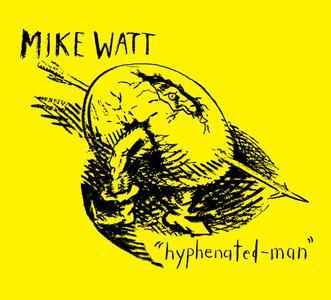
To be familiar with punk rock veteran Mike Watt is to know and appreciate his idiosyncrasies, moreover, to have learned to expect him to make those left turns that light out for the territories and sometimes veer into the weeds. The thing about left turns, however, is if you make enough of them, you end up heading in the same direction that you started.
Ever since forming the seminal ’80s punk band, the Minutemen, with his boyhood chum and dueling partner D. Boon and surfer/rhythmatist George Hurley, Watt has consistently taken the road less traveled by. The Minutemen are infamous for incorporating jazz, funk, hard core, Beat poetry—along with the kitchen sink—into their own personal strain of musical and philosophical expression. For a group that eschewed branding and easy cut-and-paste sloganeering, if it could be said that they had a motto, it was, “Punk is whatever we made it to be.”
Watt and his various co-conspirators have always viewed punk rock as a big tent sort of affair. The whole reason this type of music and scene appealed to three dudes from San Pedro, California was its lack of inherent rules. In keeping with that spirit, Watt recorded this, his third concept album, or “opera,” in 2010. The first opus, Contemplating the Engine Room, used his father’s experience on Navy submarines as a metaphor for his own life in an Econoline van, and the second, The Secondman’s Middle Stand, mapped his near-death sickness onto Dante’s The Divine Comedy. Both of these works were very personal in nature, and in the case of the last one, perhaps a little too personal at times—but, hey, nobody said punk is supposed to make you comfortable.
This time out, Watt enlisted guitarist Tom Watson and drummer Raul Morales, collectively called the Missingmen, to help create a cycle of 30 “little songs” that were inspired in part by the proto-surrealist paintings of Hieronymus Bosch. On his website, hootpage.com, Watt wrote that the punchy, ultra-lean tunes owe much to the Minutemen’s econo credo of “no filler, right to point, and distilled down to the bare nada.” Specifically, it was the documentary, We Jam Econo: The Story of the Minutemen, that finally got this restless artist to slow down and take a look back, allowing him to recognize something beautiful and utterly vital in the short form.
At the virtual needle drop, the album leaps out of your speakers/ear buds with arrow-pierced-egg-man. Clocking a mere 1:19, the song is a clarion call from the pit, a diseased chunk of meat thrown over the wall to help spread the contagion. Watt’s bass is greased up and firing on all cylinders. After playing the conservative sideman with the Stooges for a few years before this—as if anything Stooge-related could be called conservative—it’s great to hear him playing, if not more aggressively, then more dynamically.
Interestingly enough, the bass was the last piece of this particular puzzle to be added. This time out, Watt wrote on D. Boon’s Fender Telecaster, showed the Missingmen how the songs went, then retreated to later respond to what they had come up with. If he didn’t “chimp” (or “write about” in Pedro-speak) this unorthodox method, I would have never guessed that this music was anything but organically grown. It sounds like three guys jamming in a sweaty-ass shed and hollerin’ about 16th century religious art from the Netherlands. As one does.
The tendency to play “spot the influenced influence” as is hard to resist as Watt’s music has touched so many fellow artists over the years, just as playing within an ever-widening sphere of musicians has continued to color his own work. On bird-in-the-helmet-man, I hear echoes of Albert Bouchard and early Patti Smith-infected BÖC, while belly-stabbed-man’s “gut kicked – hard / truth hits – hard / emotions gush – but no word hole” is a Pop Group Amnesty Report from the depths of hell.
If I had to call a break-out single for “alternative” radio play (as if there were anything resembling a valid record and/or radio industry anymore) it would have to be the Trees Outside the Academy-era Thurston Mooresque hollowed-out-man with its pleasant droning melody, relentless drive, and totally fucked-up lyrics. “Now the hat that’s worn is like a horse track / pairs of peckers promenadin’ ’round a sack / a swollen bagpipe waitin’ for the ear-knife / castrate hack,” makes a perfect Sonic flip side to Sister’sTuff Gnarl, a connection made more overt when one considers the cover on Watt’s own Ball-Hog or Tugboat record.
The song that most evokes the spirit of Pedro for me is, appropriately enough, finger-pointing-man. Here, Watt’s lyrics sound like they could have been torn from his own Spiels Of A Minuteman folio. “Conviction’s like some affliction / without the clout of some doubt / it’s fuckin’ nonsense / ignorin’ content / and letting’ the mouth just spout.”
The sharp angularity of Tom Watson’s chording juxtaposed with the singsong delivery of funnel-capped-man, brings to mind San Francisco’s own Deerhoof, in fact, the first time I saw Raul Morales play, I was reminded of the ’Hoof’s Greg Saunier—if not stylistically, through their respective jazz-inflected approaches—in the giddy zeal that they both seem to take in playing drums.
Over the years, Watt’s vocal delivery has become more like his bass playing, a distinctive and singular expression of his muse. Printing out the hyphenated-man lyrics from the hootpage may help you find your way inside Watt’s vision, or you can just let the Missingmen’s churning accompaniment propel you headlong down their peculiar rabbit hole.
Using one of Bosch’s less fantastical icons as an avatar, Watt lays out the impetus for the opera in own-horn-blowing-man, while keeping one eye out for any hint of lurking solipsism. “Go figure the trigger / to really holler, fuckin’ holler / and hoist yeah, foist / expression from repression / not badge-buffin’ or baggin’ wind / but to get out what’s stuck within.”
September 24, 2025
The Next Civil War: Dispatches from the American Future—Stephen March
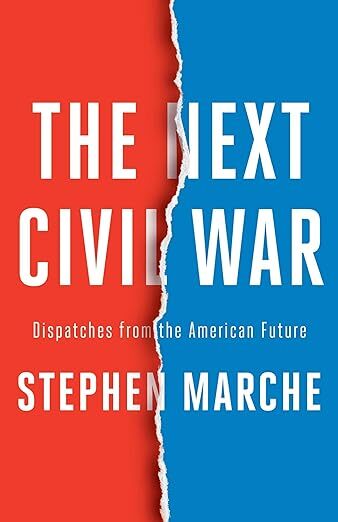
It has only been three years since Canadian writer Stephen March took a hard look at his country’s downstairs neighbor and found us… well, let’s just say that we aren’t going to get our deposit back. Like a tenant that has decided to start cooking meth in the kitchen at night, what the United States does affects the entire building, and March smartly surmised that the future of the American experiment would best be sussed somewhat from arm’s length.
When one is fully immersed in the the circular firing squad of 21-century American politics, it is difficult to shift one’s eyes anywhere than your neighbor’s trigger finger. As an outsider, March peered through the front window, and what he found is disturbing.
March walks us through traditional, and very familiar-sounding, lead-ups to civil conflict. Economic and environmental instability worsens every year? Check. Political gamesmanship overrides all other governmental concerns? Checkedy motherfuckin’ check. Under those sorts of strains, March points out that even long-established national identities can fracture with shocking speed. Iraq in 2006 had a “relatively high” Shia/Sunni rate of intermarriage. “The supposedly permanent and intractable religious rift was a relic from antiquity,” he writes. “Then it wasn’t.”
Our Canadian judge sees the cleaving of national purpose as a done deal, a problem inherent in the very founding of the union. “There is very much a Red America and a Blue America,” he writes. “They occupy different societies with different values, and their political parties are emissaries of that difference.”
“Democrats represent a multicultural country grounded in liberal democracy,” he illustrates. “Republicans represent a white country grounded in the sanctity of property. America cannot operate as both at once.” But, man, it is fun to point fingers. March points his own finger at media empires who make fortunes on what Friedrich Nietzsche called the pleasure of contempt. “Blaming one side offers a perverse species of hope,” March admits. “Such hopes are not only reckless, but irresponsible.”
As a foreigner, March is in the position to say what would be unthinkable to the average American. “The U.S. system is an archaic mode of government totally unsuited to the realities of the 21st century. The forces tearing America apart are both radically modern and as old as the country itself… bloody revolution and the threat of secession are essential to the American experiment.”
After detailing several scenarios that might touch off a conflagration—some of which, such as the movement of outside National Guard troops into another state’s territory, and assassination, albeit, still attempted and ancillary at this time—March warns that once started, civil wars are really hard to stop. He writes that in 50 years of counterinsurgency we still have not learned that “violence that imposes order to control violence produces more violence and more disorder.” You can not achieve pacification by murdering people. I think Bob Dylan said that.
Even if you were compelled to go that route, the overwhelming force of the state is useless against stochastic resistance. “A succession of winning firefights makes exactly no difference.” Lt. General Daniel Bolger, author of Why We Lost: A General’s Inside Account of the Iraq and Afghanistan Wars writes. “The local people have to run their own government.”
March goes further, saying that it is impossible to de-radicalize the next generation while at the same time taking away their most basic rights. “It’s hard to find youth so stupid that you can kill and imprison their parents and tell them you love them afterward. It didn’t work in Iraq and Afghanistan. It won’t work in the United States.”
“This is the other thing that would occur,” writes retired colonel Peter Manor, “massive detention centers across the United States where people who were suspected of being disloyal… would be warehoused on a massive scale.” The U.S. is already the most incarcerated society in the world. A civil war would explode those numbers. Who would support or pay for that? Let’s not even get into the political morass of donor states vs. recipient states.
The traditional intractability of the American populace may be the key to avoiding this scenario all together, given the hopelessness of fighting it out. “If you’re in a situation where you’re using armed force to try and quell a population, you’re either going to have to kill a bunch of them, or you’re going to pull out and let them have local control,” writes Lt. General Bolger. “You’re never going to talk them into seeing it your way.” The typical conclusion of insurgency conflicts is not victory by either side but exhaustion by all.
Even the paperwork is daunting. March points out that uncertainty over small questions of daily life is a major reason why Scotland and Quebec are not independent nations today. Pensions, passports, national debt, dual citizenship, the military… are all things that would quickly become a bureaucratic nightmare.
Once again, March leans into his innate Canadianess to say what an American would not. “At this point in history… much of the U.S. Constitution simply does not apply to reality. Democrats and Republicans alike worship the document as a sacred text, indulging a delirious sentimentality that was the precise opposite of what the framers envisioned as the necessary basis for responsible government.”
He goes on, “Americans worship ancestors whose lives were spent overthrowing ancestor worship; they pointlessly adhere to a tradition whose achievement was the overthrow of pointless traditions.” March, perhaps naively, calls for a new Constitutional Convention, not understanding the very real possibility for real chaos to ensue, not grasping that there is always more to lose.
March does understand that the failure of the American experiment, and he does claim that it is failing, would left the world a lessor place. “The world needs America,” he writes. “It needs the idea of America… [a place] where contradictions that lead to genocide elsewhere flourish into prosperity.”
He does believe that the problems that plague our society at this point in our history are not beyond the capacity of the American people to solve. “There is one hope, however, that must be rejected outright: the hope that everything will work out by itself, that America will bumble along into better times,” March warns. “It won’t.”
“If history has shown us anything, it’s that the world doesn’t have any necessary nations,” March sounds the alarm. “Once again, the hope for America is Americans.” Let’s not let him, the world, and ourselves, down.