
Kam Miller's Blog
October 8, 2017
Gary Lennon: Hell’s Kitchen kid to Hollywood baller
Welcome! I’d like to introduce you to Gary Lennon, one of the best, most prolific writer-producers in the town.
Gary has written for hit TV shows, including “The Shield,” “Justified,” and “Orange is the New Black, and he’s currently executive producer for “Power” on Starz. He also develops like a madman. He developed a miniseries about Studio 54 for Starz, where he has an overall deal, and a Showtime series with . Beyond TV, Gary has mounted numerous plays, including “The Interlopers,” which is one of my favorites. Oh yeah, Gary wrote and directed the indie thriller “.45” starring . I told you, he’s prolific.

One-sheet for Gary Lennon’s film “.45” starring
Milla Jovovich. Image courtesy of Think Film and Capitol Films.
I attended a staged reading of Gary’s play “A Family Thing” before the full production debuted at the Bootleg Theater. The play explores the tumultuous relationships of three brothers. The eldest, an angry thug with a criminal past, and the youngest, a recovering alcoholic screenwriter, fear for their lives when their middle sibling, a charming-yet-violent convict, is released from prison.
[image error]
Staged reading for “A Family Thing” by Gary Lennon. Photo by Kam Miller.
“People have low expectations of the Burns brothers,” the eldest brother says to the screenwriter. “Who’d have thought you’d make a living with words.”
Gary himself doesn’t just make a living with words; he has worked continuously in Hollywood for more than a decade. His family and his difficult relationships with his own brothers provide frequent fodder for his muscular, multi-layered work. “A Family Thing” includes echoes from Gary’s own life. The indie film “.45” – a story about an illegal gun dealer who savages his girlfriend, then suffers her revenge – stems from events he witnessed.
Gary describes his positively Dickensian youth with the same mix of pain and humor that pervades his work. He was orphaned by age 11. Grew up a New York street kid. Endured the kind of life and desperate circumstances that typically lead to criminal activity or an early grave. So what saved Gary from such a terrible trajectory? He credits his unstoppable desire to be a writer. And while that desire would be his saving grace, his brutal past also became his most powerful muse.
So how did he do it? One of Gary’s frequent admonitions is: “Find your tribe.” He believes it’s one of the most important survival tips for artists. Find your tribe. Find the people who get you.

Photo courtesy of Gary Lennon.
During one of our lunches, Gary said he didn’t fit in with his brothers or the other kids raising themselves on the street. “We’re so informed by the way we’re raised,” he said. “I was definitely born into the wrong tribe. I felt very early on I was not wanted. When I was young, I started searching for like-minded people to gather into my tribe. We all do. I think that’s an innate quality in us – wanting to be seen and heard.”
Despite a limited education at the time, Gary found an outlet through acting, then writing. When Gary was starting out, he wanted to join the Circle Repertory Lab, a critically acclaimed, award-winning theater company in New York City. It has been home to many amazing playwrights and actors including Sam Shepard, Tennessee Williams, John Hurt, Kathy Bates, Jeff Daniels, and David Morse, among many others.
“I saw Circle Rep Lab’s work when I was a teenager, and I knew that somehow I belonged to that tribe,” Gary said. He had identified kindred spirits, but they didn’t recognize him at first.
“Actually, it wasn’t easy for me being a playwright in New York because I did not belong,” he said. “I didn’t go to Julliard. I didn’t go to Yale. I didn’t go to Brown. I didn’t go to North Carolina School of the Arts. All of those wonderfully talented people came to New York to create, which I think is an amazing thing, but I came from a Hell’s Kitchen tenement. I had no real access to that world.”
He tried knocking on the front door, an experience that may sound familiar to those trying to break into the industry. “I was young, fearless, and ignorant, which I think was a blessing,” Gary said. “I wrote a letter to the head of Circle Rep literary asking him to read my plays.”
Gary got a rejection letter. “It said, ‘No, thank you, we only take submissions from agents and managers.’ And I thought, ‘Oh, that’s not very tribe-like,’” Gary said with a laugh. “Then I thought, ‘How am I going to get to these people?’”
In what became a Gary Lennon hallmark, he shifted his perception and found another door. “I put my play, ‘Dates and Nuts,’ into a manila envelope,” he said. “I left it backstage at the Lucille Lortel Theater on Christopher Street addressed to Marshall Mason. He was directing a play there. Attached to my play was just a handwritten note on a page of legal pad paper. It said, ‘I’m Gary Lennon. I’m a playwright. I wrote this play. I’d love for you to read it. I love your work.’”
Gary had been a huge fan of Mr. Mason and still speaks of him with reverence. “Marshall Mason was one of the founders of Circle Rep. He directed all Lanford Wilson’s plays, including ‘Talley’s Folly,’ which won the Pulitzer prize in 1990. He’s a brilliant director.”

Director Marshall Mason and Pulitzer Prize winnning playwright Lanford Wilson of the Circle Repertory Company. Photo by Brad Clift.
A week after young Gary left his play backstage for Marshall Mason, he came home to a phone message from him! He recounted it: “And he was like, ‘Hi, this is Marshall Mason, Gary Lennon. I received your play. I thought it was wonderful. I’d like to have coffee and talk about it.’ And I was like ‘What?!’ I was f*cking beyond over the moon. I called him back. He met me at a tiny little diner on Hudson Street.
“He told me I was a good writer,” Gary said. The memory still chokes him up.
“He told me I was a good writer, and it was so big for me because he was a big deal,” Gary said. “He was so generous. And he said, ‘Well, you know about Circle Rep.’ I said, ‘I do.’ He said, ‘You should become a member.’ And I said, ‘Oh, I would love to.’ Of course, I didn’t tell him the front office had already sent me a rejection letter. And he said, ‘Contact so-and-so and start coming to the meetings. We’ll put you in the lab.’”
Just like that, Gary was in the tribe. He was accepted. His work was validated. Isn’t that what all artists want? The experience reinforced that important distinction – find the people who get you.
“My work isn’t easy to take,” Gary said. “And I’m proud of that, by the way. Some people DO NOT like it. And some people do. You have to gravitate to your tribe. Early on, I remember getting a rejection letter from Playwrights Horizons. And it said, ‘Dear Mr. Lennon, your material is too revved up for our tastes.’ That was the letter, seriously. And so I didn’t send them any more material. I shifted my focus, my perception. And Circle Rep got me.”
The anecdote illustrates his “shift your perception, find another door” model. “I don’t believe in creating suffering in my life,” Gary said. “If I’m getting resistance in an area, I just stop pushing on the same door. Literally, it’s about a shift in perception. Just an inch to the left or an inch to the right – there’s another door.”
Gary’s sheer force of will plays a role in his success, then and now. “Any time I had someone tell me ‘no,’ it didn’t create a sense of inertia,” he said. “I wasn’t decapitated. I didn’t have to lie down so you could roll over me. I had a different response when someone said ‘no’ to me. And I still have it. I get more determined.
“I don’t want to defy anybody. I just want to do it, whatever it is. When someone shows me an obstacle, I will find a way to get around it.”
Gary believes there always is another door. It may not be for that particular project, but there is another door. In a way, Gary has always been finding those doors. A street kid without a formal education deciding to be a playwright took courage; it took being able to see there was another choice, another life out there instead of the seemingly inevitable one set before him.
[image error]
Playwright Gary Lennon talking with actor , who attended the staged reading of “A Family Thing.” Photo by Kam Miller.
Since then, Gary has found tribe members in the feature and TV worlds. “They’re producers and executives,” he said. “When I have a new piece of material, I think, ‘Oh they’ll get this or they’ll support this.’ It’s important to do that with writers, directors, and actors.”
In the meantime, take his advice to heart. If you feel like you’re banging your head against a door that just isn’t opening, shift your perception; you’ll likely find another door that will open for you. The door could be an agency, management company, production company, studio, network, a fellowship program, a production, an idea, or even a specific person. Trying a different door may be just the trick you need to move ahead.
While you’re at it, identify the folks who will help you stay motivated – and help you see when some door is sturdier than your head. They’ll also remind you that you’re pretty tough, too.


July 11, 2017
Industry job hunt
You’re excited to launch your career. You want – no, you need your first job in the industry, but you don’t know anyone and you don’t know where to start. Here are my recommendations, along with several industry job hunting links.
Here’s the best place to begin – pick up Carole Kirschner’s book, Hollywood Game Plan: How to Land a Job in Film, TV, or Digital Entertainment. Veteran Hollywood exec Carole is a mentor-extraordinaire. She’s the director of the CBS Writer’s Mentoring Program and the WGA Showrunner Training Program. Her book is packed full of stories from successful Hollywood insiders about their first industry experiences. Plus, there is a step-by-step guide of concrete things you can do to navigate the entertainment industry and advance your career.

If you’re interested in a more in-depth and vigorous course, Carole has created her 20-part virtual master class called “Carole Kirschner’s Hollywood Boot Camp.” Here’s a link to a preview, and you can download “5 Things You Must Have to Break Into Entertainment” free of charge.
If you want an even more personal, tailored consultation, Carole also sees clients privately.
How do you find the jobs?

One of the most up-to-date and comprehensive industry job listings is the UTA job list. Published by United Talent Agency, it has lots of leads on jobs on all levels: executive management, assistant, personal assistant, entertainment PR & marketing, music industry, tech/new media/web 2.0, casting, general office (receptionist/bookeeper/PA/runner), as well as non-Los Angeles positions. The UTA job list also includes internships in many of these areas. It is limited in its distribution, yet you can find posted on some sites. However, UTA may yank that poster’s privileges to the UTA job list at any time, so just be aware.
Here’s a link to The Anonymous Production Assistant (TAPA) site, which currently posts the UTA job list. TAPA also has their own job list.
Grapevine Jobs started small and has evolved into a super resource. Like the UTA job list, they cover a breadth of jobs, but Grapevine is international. So you may just find that dream job that fulfills your wanderlust, too. Here’s a link to grapevinejobs.com.
Another place you might find a lead is Cynopsis Media. Their leads tend to be technically specific. However, they do have listings for positions outside of Los Angeles, so if you’re looking for other markets, this may be a great resource.
Two other websites that post entertainment-related job opportunities are entertainmentcareers.net and showbizjobs.com.
If you’re looking for production-oriented jobs, check out Mandy.com. They not only advertise below-the-line positions but also have casting breakdowns and auditions. Who knows, you may just get discovered here.
Another production-oriented site is StaffMeUp.com. They do a lot of reality TV production staffing. They also have some scripted TV jobs as well.
Want to find out what’s in production and what production may need staff? Below The Line Production Listings has all that information. It’s a bit Byzantine, but you can find the info to unlock the leads you need.
A couple of subscription-based job listing services include ProductionWeekly.com and 4entertainmentjobs.com.
Temp agencies can also be a great way to meet potential employers and get to know company cultures. In LA, different temp agencies tend to staff different studios or sections of the city. Word of mouth will guide you to the best fit for you.
Also, vibrant tracking boards can be a godsend. Finding your way onto insider tracking boards that spread word-of-mouth notices about job opportunities – often by the person vacating the position – can give you the inside track to the position. The best way to get on tracking boards is to join alumni and professional organizations.
Cheers!
Smart tactics to achieve your goals
So you’ve set your goal. You know you want to write that script, TV pilot, novel, or play. You’ve been working on it, but…you’re just not getting anywhere. What’s up with that?
There are some very specific things you can do to increase the chances of achieving your goal or goals.
Get SMART.
Setting goals is great. However, most people set a big goal, such as writing a TV pilot. That’s a big, amorphous goal. It’s difficult to get your arms around it. The experts at the Individual Development Plan – a web-based career planning tool – suggest breaking up big goals into smaller, more understandable and achievable goals. They suggest a cool tool called the SMART principle (Goal Setting Strategies for Scientific and Career Success, Science, December 3, 2013), which has been widely used in business
environments.
When breaking down a larger goal, the SMART principle suggests making it:
S – Specific – Is it focused and unambiguous?
M – Measureable – Could someone determine whether or not you achieved it?
A – Action-oriented – Did you specify the action you will take?
R – Realistic – Considering difficulty and timeframe, is it attainable?
T – Time-bound – Did you specify a deadline?
So for example, when writing a TV pilot, a writer could make “finish writing the treatment” as a goal. That treatment is measurable. It is actionable. The writer could set a timeframe, say, a rough draft in a week or two weeks. The final draft could be due in a month’s time. There’s one SMART goal.
In The Hero Succeeds, I give you specific elements of a treatment, grid, TV pilot draft and assignments within the treatment, grid, and TV pilot draft to accomplish. This helps to make those goals more manageable.
Another SMART goal could be “finish writing the pilot story grid.” The grid is measurable and actionable. The writer could set a timeframe, say the major landmark scenes in two days. That’s six scenes. The completed first draft of the grid in a week. The completed second draft of the grid in two weeks. A final draft of the grid in three weeks. That’s a second SMART goal.
Another SMART goal might be the outline. With the grid done, the outline will usually go fairly quickly. However, each writer is different so she should plan according to her needs. The outline is measurable and actionable. The outline time frame could be the first draft in a week and the final draft at the end of week two. That’s a third SMART goal.
Now comes the writing of the script! A SMART goal for the script might look like something like this – The complete draft is measurable and actionable. The time frame could be the first 15 pages (or first quarter) in the first week, the second 15 pages (or second quarter) in the second week, the third 15 pages (or third quarter) in the third week, and the fourth 15 pages (or final quarter) in the fourth week.
This SMART goal setting is obviously for a drama, which can have 55-65 pages. A comedy will have fewer pages 30-35 pages. A drama could have more than 60 pages so that final fifteen might be a final 20 pages.
This target goal would have the writer writing approximately two pages Monday–Friday and two to three pages on Saturday and Sunday.
Breaking up large goals into smaller, actionable, and measureable goals makes them easier to accomplish. When you’re stuck on a project, think about focusing on smaller pieces. You’ll find putting your energy into a smaller, more manageable part of the project will help you make the progress you want. Before long, you’ll be crushing your goals.
Cheers!
]
Three tricks to work a day job and still get writing done
Writing with a day job can be tough. You come home from work exhausted. You wake up with barely enough time to get ready and get to work. There just doesn’t seem like there’s enough time in the day to write. Still, you’ve got that killer idea. You dream of writing that screenplay, TV pilot, novel, or play. You want to be a writer, dammit! How can you get out of this rut?
First, you need to accept writing your project may take longer than you like. You’ll need to write it in smaller increments. You won’t be able to have hours at a time to write. Yes, it would be ideal to have days upon days to write. It would be fantastic to write without interruption or distraction. It would be bliss to have someone bring you your meals and take the debris away after you’ve finished allowing you to continue writing endlessly day and night. However, that’s not in the cards right now – at least not on a regular basis.
On the regular, you need to write in smaller time blocks. And you need to be okay with it. For example, during the week, you could set aside 25 minutes a day to write on your project. Then on the weekend, you could schedule an hour to write on your project.
I know that doesn’t sound like a lot of time, but the day job writing schedule doesn’t allot for a ton of writing time. And you’ll be surprised at how much you can accomplish in a short amount of time. Even just breaking a little story each day is, well, a little bit each day.
Why didn’t I suggest eight hours on the weekend or sixteen hours? Well, you have to do laundry, clean your house, wash your car, grocery shop, take your dog to the vet, get your hair cut, etc. You may need to do regular chores that you can’t do during the week. If you plan too much writing on the weekend, if you set a goal that’s simply unrealistic, you set yourself up for failure. Plus, you also have to schedule some relaxing time with your family and friends. All work and no play is a formula for burnout.
If you can write two hours or more on one weekend, great! If you can only get the hour in, fantastic! You’re hitting your goal. You’re still pushing your project forward. And you’re doing more than you were when you weren’t writing.
The ideal-writing-environment-or-no-writing will kill your writing dreams.
Aspiring writers have to learn to write even when conditions aren’t ideal. Many writers feel like they can only if everything is ideal. This may mean they have complete silence, or they have four hours to themselves to write, or they can go to a coffee shop to write, etc. If these writers don’t have an ideal writing environment, they can’t write. Period. Marrying writing time to an ideal writing environment will kill your writing dreams. Accepting you may not have an ideal writing environment – whether that’s time, place, sound, etc. – will increase your chances of success.
In your non-ideal writing environment, you may find yourself struggling the first several 25-minute sessions. That’s okay. Eventually, you’ll start cranking out words and pages. You’ll adjust. You may be able to work your way up to a two-page minimum per day for a screenplay and a couple of hundred words per day for prose. But just try the 25-minute time frame at the beginning because it’s your time that seems limited at first.
Once you’ve got some writing under your belt, try editing during your downtime at work or during lunch. (Obviously, if your job doesn’t have downtime, don’t edit at work!) Editing can be interrupted pretty easily. Plus, you can get back into the editing groove quickly. So five minutes here and there works well for editing.
Writing with a day job can be a challenge, but many writers have completed scripts, novels, and plays while working, raising families, and being part of the human race. Pulitzer Prize winning novelist Toni Morrison was an editor at Random House and taught university literature while writing novels. (“Daily Rituals”, Slate.com, May 2, 2013). Joseph Heller wrote copy for magazine advertising by day and Catch-22 at night – for eight years! (“Daily Rituals”, Slate.com, May 2, 2013 and “Joseph Heller”, Wikipedia). William Faulkner worked as a night supervisor at a university power plant while he wrote As I Lay Dying (“Daily Rituals”, Slate.com, May 2, 2013). And probably the most diligent day working writer was Anthony Trollope. A civil servant for the post office, Trollope would write for three hours each morning before his shift. He did this for 33 years and published more than two dozen novels! (“Daily Rituals”, Slate.com, May 2, 2013).
Working a day (or night) job and writing can be crazy-busy. However, it can be doable, if you accept you may not have your preferred ideal writing conditions and it may take longer to write your project. In the end, it will be worth it. You’ll have finished your project. You’ll have proven you can write under a difficult situation. You may just find that the process of writing fed your creative soul and made that difficult situation more fun.
Cheers!
Three sure-fire creativity boosters
Three ways to break out of your creative rut
Writers, you’re hip deep into a project and suddenly, you’re wondering, “Where’d my genius go?” You had that spark at the beginning of the project. Words were pouring out of you like hot lava. Now your brain feels like sludge. Pushing through your act two feels like Shackleton’s expedition. If you could imbue your on-screen struggles with as much angst as you’re feeling off-the-page, you’d be golden. You need your genius but she’s nowhere to be found.
Your genius is still hanging around. You’ve probably been pushing yourself so hard, she got pushed aside. You just need to invite her back into your work. Now is a good time to reconnect with your genius so you can blast through the rest of your novel, script, or play.
Creativity boosters
Take a walk. Creativity lagging? You might have chair-butt-itis, too much time spent sitting hunched over your computer. Exercising your body can help energize your writing.
Almost every dimension of cognition improves after 30 minutes of aerobic exercise, and creativity is no exception. The type of exercise doesn’t matter, and the boost lasts for at least two hours afterward. However, there’s a catch: this is the case only for the physically fit. For those who rarely exercise, the fatigue from aerobic activity counteracts the short-term benefits. (“Forget Brainstorming,” Newsweek, July 12, 2009.)
Take a nap. Naps may allow your right brain to perform housekeeping duties like consolidating story and organizing research. Often people say they figured out their story dilemma after sleeping on it for a short period.
The latest research… may help explain the mental spark that sometimes occurs during a nap. Researchers monitoring the brain activity of 15 at-rest individuals found that the right side of their brain – the hemisphere most associated with creativity – chattered busily to itself as well as to the left hemisphere, which remained relatively quiet. (“‘Power naps’ may boost right brain activity,” Health.com, Oct. 17, 2012.
Keep your glass half-full. A positive mood can make you more innovative.
Listen to upbeat music. Plug into a comedy website for a laugh or find an uplifting video on YouTube. Or touch base with that friend who always puts a smile on your face. You just may find your genius is smiling with you.
Still can’t find your genius? Watch this TED talk by Elizabeth Gilbert author of “Eat, Pray, Love.”
https://www.ted.com/talks/elizabeth_gilbert_on_genius
Hot places to volunteer in Hollywood
You’ve moved to Los Angeles and want to give back. Volunteering is also a great way to meet new people, learn about our writing community, and maintain your positive attitude. Here are some places to consider volunteering.
WriteGirl
WriteGirl is a Los Angeles based not for profit organization that pairs girls who want to write with women writers who mentor them. Yep, it’s that simple and brilliant.
Each year, WriteGirl sponsors workshops, panel discussions, and other events to encourage teen girls to be creative, get through high school, and get into college. Their website touts that since 2001, 100 percent of their graduating seniors have been accepted to college, and many have received partial or full scholarships!
If you want help the next gen of women writers, check out WriteGirl.
Young Storytellers Foundation
The Young Storytellers Foundation helps public school students starting in the fifth grade in filmmaking. Students learn through mentoring, collaboration, and performance. These young storytellers not only get to write their stories, they get to see their works come to life on stage and screen – often with professional actors.
This program is provided free of charge to the Los Angeles Public Schools system. It progress throughout the college years when former young storytellers become mentors themselves.
If you want to empower young storytellers, regardless of background, check out this worthwhile program
Cheers!
.
Four fantastic books for writers
Want to find the perfect writing book for your favorite writer? You could easily get overwhelmed with your choices. When searching on Amazon, 432,536 books pop up for writing. Let me narrow the field for you. There are four books I try to read every year. Each time I read them, they still offer precious pearls of wisdom and inspiration. These aren’t how-to books. These aren’t breaking into Hollywood books. These books share hard-won wisdom from writers to writers. These are like old friends that any writer at any level can lean on during those cold, lonely hours of uncertainty.
Bird by Bird by Anne Lamott
Anne Lamott’s “Bird by Bird” is one of the best books on writing – period. Every writer should at least check it out of the library and give it a read. The third chapter alone, titled “Shitty First Drafts,” can embolden a writer to keep pushing through whatever crappy thing he is writing right now and have hope it’ll someday be wondrous to behold. I often give this book to friends who are starting their first screenplay, novel, non-fiction book, etc. Written in a down-to-earth, inspiring, no nonsense way, “Bird by Bird” is well-received across the board. Thank you, Anne Lamott, for writing such a generous, funny, lovely book.
On Writing by Stephen King
Another old friend is Stephen King’s “On Writing.” In it, Steve describes his humble beginnings, which to me is the most interesting part of the book. Successful writers talking about struggling – color me fascinated because that’s the job. Certain aspects of the business get easier over time, but every project is its own mountain to climb. Many days the job is just you and the screen. All the trappings fall away. I could easily be typing on that student desk in the laundry room of Steve and Tabitha’s trailer praying I write something half as good as “Carrie.” “On Writing” inspires me yearly. It tells the ultimate writer’s American dream story, and that’s something no writer can resist.
101 Habits of Highly Successful Screenwriters by Karl Iglesias
In his book “The 101 Habits of Highly Successful Screenwriters,” Karl Iglesias interviews some of the top screenwriters in the business to find out when they wake up, what they eat for breakfast, if they exercise, when they take lunch, and other juicy, mundane tidbits of famous screenwriters’ daily lives. Ed Solomon likes big whiteboards. Leslie Dixon feels more clever after noon. Eric Roth likes to work in the middle of the night when he is “sort of half-asleep.”
This book sits in the first cubby of my bookshelf. I see it every day. It dares me to remember what I’m supposed to be doing. And while my habits aren’t exactly like the writers in the book (several eschew caffeine!), I’m reminded to do the things that make me productive.
There is a new edition of the book “The 101 Highly Successful Habits of Screenwriters: Insider Secrets from Hollywood Screenwriters.” However, from reading the Amazon reviews, it seems the new edition isn’t dramatically different from the original. If your writer already owns the first edition, she may already have the bulk of the new edition.
The Tools of Screenwriting by David Howard and Edward Mabley
“The Tools of Screenwriting” by David Howard and Edward Mabley is a critical examination of screenwriting. There are many other helpful screenwriting books, but I continue to learn from “The Tools of Screenwriting.” There is always some nugget I’m reminded of when I go back to it or something concept that clicks because of my current project. The book is a treasure chest full of gems waiting for discovery.
Full disclosure: I was fortunate enough to have David Howard as my thesis advisor in film school. What an honor. So I’m a bit biased. But don’t take my word for it, read what the illustrious feature filmmaker, former artistic director of the Sundance Institute, former co-chair of the Columbia University Film School, and former dean of USC’s Film School, Frank Daniel, had to say about this book:
“What the would-be screenwriter needs most is an unbiased, non-dogmatic introduction to dramatic structural principles and an understanding of the different narrative techniques and storytelling devices that cinema has learned to use. David Howard has wisely outlined this area for himself and covered it in a concise, readable, knowledgeable, and intelligible manner. He has also been very generous with his pointers, advice, and admonitions about screenwriting and storytelling.”
What’s more, Professor Howard has broken down some of the best screenplays in the Hollywood history: “Chinatown,” “Some Like it Hot,” “Citizen Kane,” “The 400 Blows,” “Rashomon,” and more. Just like re-watching a favorite movie, I love to go back and read the analyses for these great films.
Cheers!
What is a story grid?
You’ve got a great idea for your TV pilot or spec – now what? Well, the pros start by “putting it on the board.” Before we tackle writing the script or even the outline or a beat sheet, we break our stories on note cards or a white board. We break the broad strokes of our story scene by scene. This creates a story grid.
The story grid for Angela Robinson’s great How To Get Away With Murder episode “Skanks Get Shanked” episode looks like this…
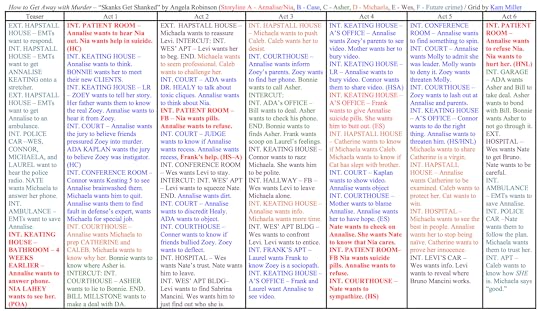
In The Hero Succeeds, I give you all the details about using story grids to fit an entire pilot on one page. This way you can see your whole story laid out in front of you. You can rearrange scenes easily and see how moving scenes will affect your story.
The pros use story grids and boards because they are the fastest ways to break story. With story grids, we don’t have to invest the time writing the script, only to figure out we need to scrap a bunch of scenes, rearrange a storyline, or worse, do a page-one rewrite.
Getting your story on one page isn’t easy. However, once you do have your emotionally satisfying story on one page, you’ll be able to start your outline and script with confidence. If you’ve write concisely and focus on your characters’ wants, a one-page story grid will equal the length of a half-hour comedy or one-hour drama. If you have too much for a one page grid, your script will likely be too long. Plus, you can whip out that story grid as a reference during your writing process. One page travels really well, so if you’re on a plane, on the beach, or at the coffee shop, you’ll have your entire story handy.
Cheers!
Four top writing contests
You’ve done it! You finished your original TV pilot script. Wow. It feels awesome. It feels like you’re going to burst if someone doesn’t read it right now and tell you how amazing it is. What can you do?
Enter it in a TV pilot contest!
Here are three top TV pilot contests. These three contests are very different from each other. That’s one of the things I love television; it’s open to different tastes and voices. One size does not fit all. Check these contests out and see if one speaks to you.
Austin screenplay and film festival
I love Austin! And Austin loves creatives. If you get a chance, go to the Austin Film Festival. Even better go there as a competitor. You’ll meet lots of folks. And if your TV pilot script gets you into the semi-finals or the finals, lots of folks will want to meet you. The prize money is $1000, but the big bonus is the festival access.
Humanitas New Voices
The Humanitas New Voices prize awards emerging writers with $15,000 grants. They also pair these young writers with working TV writers to supervise them as they write their next TV pilot script. This is an amazing way to work for new writers to work on their craft and build relationships within the industry.
Scriptapoolza TV writing competition
Scriptapoolza has been around for 19 years. It has a track record. The prize money isn’t high at $500. However, being able to say your script made it through the gauntlet of readers in a contest is an endorsement. If you win or place in Scriptapoolza, reps will take notice.
TrackingB TV pilot contest
The TrackingB TV pilot contest is the youngest and most commercial contest on this list. It’s also the most expensive to enter. However, it boasts finding a pilot script that was put to series within eight months of winning the contest. That script was Mickey Fisher’s Extant and that show starred Academy Award winner Halle Berry. Extant ran for two seasons on CBS. It launched Mickey Fisher’s career. If you’ve got a commercially-viable TV series, you might want to check out the TrackingB TV pilot contest.
Make no mistake – winning any of these of these contests can launch your career. The entertainment industry is equal parts talent, determination, persistence, and luck. It’s all about getting your stellar script in front of the right eyeballs and the right time. So write an undeniable script and get your work out to the world.
Cheers!
Four outstanding TV writing programs
You’ve worked on your TV writing portfolio. All of your scripts are current and fierce. This is your year. You can feel it. Now what do you do. Here are four TV writing programs designed to help emerging writers break in.
CBS Writers Mentoring Program
The CBS Writers Mentoring Program rocks. Carole Kirschner and Jeanne Mau have developed a fantastic curriculum. They pull great guest speakers of showrunners, executives, writers, agents and managers, and other industry reps. Plus, they work hard to staff their mentees on current TV shows.
NBC Writers On The Verge
Karen Horne and Jen Grisanti have shepherded the NBC Writers on the Verge with steadfast hands. They also have stellar guest speakers and programming as well as terrific placement for their selectees on current TV shows.
The Warner Bros. Television Workshop
The Warner Bros. Television Workshop has been around for 30 years and is open to all comers! Most recently, Rebecca Windsor has continued to develop this well-established program. The WB Television Workshop also works to staff its selectees on shows.
ABC Disney Writing Program
The ABC Disney program has been around for 25 years. It is the only program that pays its fellows. With the salary, the fellow is eligible for benefits. That’s pretty nice! The program provides access to executives, producers, and literary representatives. There are also opportunities for staffing on shows.



![[image error]](http://kam-miller.i365art.com/wp-content/uploads/2012/06/dscn0683.jpg)
![[image error]](http://kam-miller.i365art.com/wp-content/uploads/2012/06/dscn0673_2.jpg)