Allen Levine's Blog
July 20, 2020
Running During Covid
One of the most interesting things about the pandemic is its effect on me and my running friends. COVID has changed so many things about how, where, when, and how far we run.
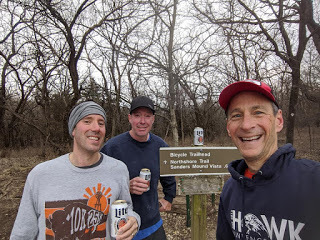 Obviously taken after a run... Pre-COVID single-track trail.
While most of my running friends are mainly trail runners, the percentage of road miles logged has increased exponentially. This switch from dirt to asphalt has taken place because most of the trails in this area are single track. With the closure of theaters, restaurants, pools, and other entertainment venues, people who normally don't spend a lot of time on trails are heading out with their families to hike. So the single track trails are much more crowded than they had been. Passing a hiker (even with both individuals wearing masks or buffs), is a close proximity affair - a bit too close for some of us. And running on the trails with friends also leads to the issue of slipstreaming. Kansas in the summertime is a sweaty, dirty affair. I definitely wouldn't feel particularly safe slipstreaming my friends. And I pity anyone who might be slipstreaming me (and not just because of COVID).
So anytime 2-4 of use want to get together for a run, we pick roads that allow for wide lateral spacing. We run when we know there will be little traffic. And we try to pick routes that will involves as few encounters with others as possible. And when coming across another person, we give wide berth.
The trails will always be there, and are something we can look forward to running again. But for now, single track runs are usually done solo and are few and far between.
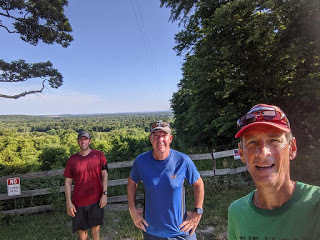 Same trio as above. Photo taken recently during a road run. Note all three runners are spaced more than 6' apart even for the pic.
Another aspect of COVID is that it has caused almost all races to postpone or be canceled. This has created a real crisis for some runners. A certain segment of the larger running community needs to have a goal in order to train. Races of all distances are the goal that many runners use to get their training into high gear. Ive never been a big fan of racing. I don't like running with rage groups of people. But even I have cut a few runs short since the outbreak. I think why push it? I'm not training for anything. When one of my running buddies verbalized this thought during a foursome run a couple of weekends ago, I knew that I was not alone. Most of the running I've undertaken over the past 4 months has been maintenance. 3-4 miles a day. Maybe 7 and change for a longer run. With no 25K - 50K races in sight for me or my friends (even if I didn't plan to participate), there is no incentive to really run outside of my comfort zone.
While cancellations and postponements have curtailed enthusiasm for some, there has been an uptick in virtual races. For some (especially those who had already been training for races that were cancelled), the virtual race proved to be good enough to keep up the training momentum. My buddy, Mike, for instance, had planned to run the grueling Rockin K marathon (and trust me, it is grueling - see one of my earlier posts about it). Instead of having the race, the organizers laid out the course and let runners complete it at their leisure. Mike drove out to the country and ran the gorgeous, yet brutal, course and received his finisher's schwag a few weeks later. Virtual races have been, I'm sure a saving grace for those who run for exercise, a sense of community, the chance to compete against themselves or others, and endorphin junkies. Since safety should be our primary objective as a running community and as a nation, these races set a good example of how we should responsibly move forward for the coming months (year?) of running during the pandemic.
Special thanks to Rube Miley for taking the selfies.
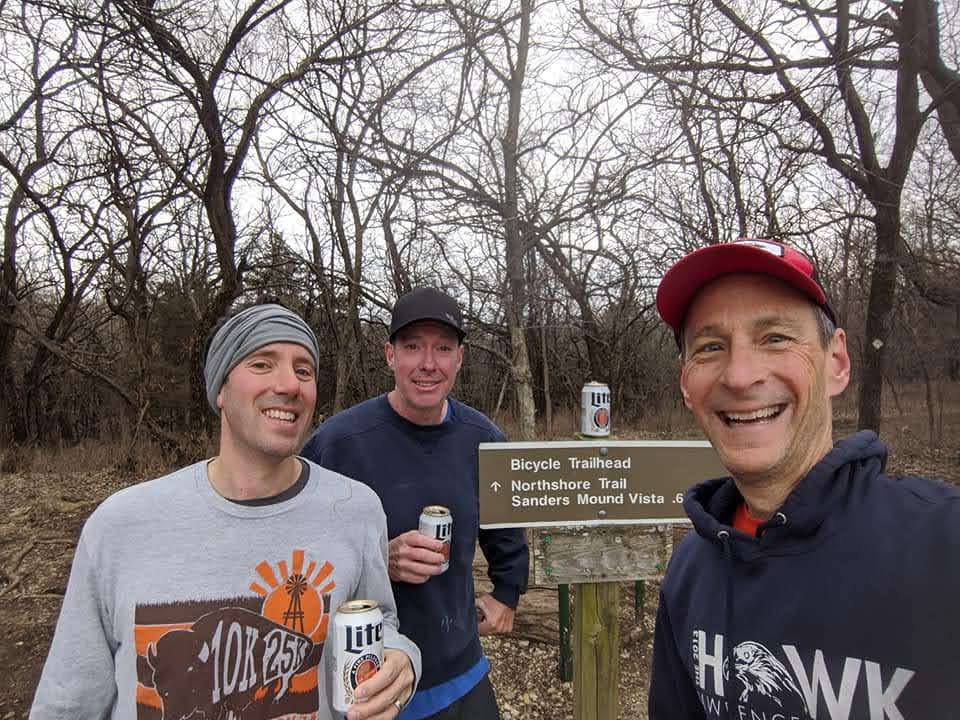 Obviously taken after a run... Pre-COVID single-track trail.
While most of my running friends are mainly trail runners, the percentage of road miles logged has increased exponentially. This switch from dirt to asphalt has taken place because most of the trails in this area are single track. With the closure of theaters, restaurants, pools, and other entertainment venues, people who normally don't spend a lot of time on trails are heading out with their families to hike. So the single track trails are much more crowded than they had been. Passing a hiker (even with both individuals wearing masks or buffs), is a close proximity affair - a bit too close for some of us. And running on the trails with friends also leads to the issue of slipstreaming. Kansas in the summertime is a sweaty, dirty affair. I definitely wouldn't feel particularly safe slipstreaming my friends. And I pity anyone who might be slipstreaming me (and not just because of COVID).
So anytime 2-4 of use want to get together for a run, we pick roads that allow for wide lateral spacing. We run when we know there will be little traffic. And we try to pick routes that will involves as few encounters with others as possible. And when coming across another person, we give wide berth.
The trails will always be there, and are something we can look forward to running again. But for now, single track runs are usually done solo and are few and far between.
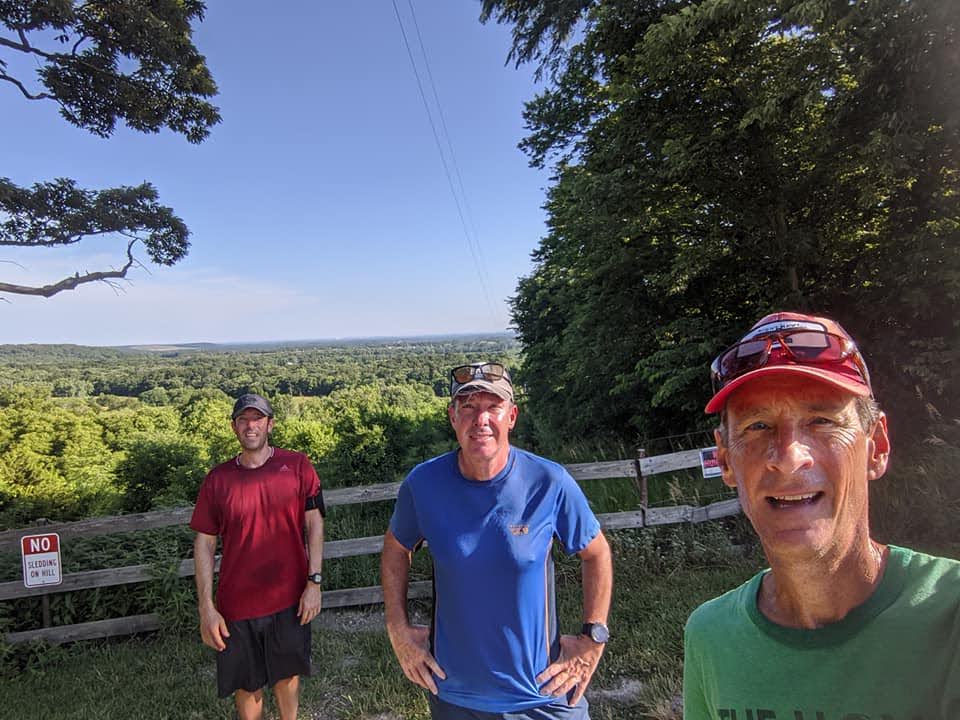 Same trio as above. Photo taken recently during a road run. Note all three runners are spaced more than 6' apart even for the pic.
Another aspect of COVID is that it has caused almost all races to postpone or be canceled. This has created a real crisis for some runners. A certain segment of the larger running community needs to have a goal in order to train. Races of all distances are the goal that many runners use to get their training into high gear. Ive never been a big fan of racing. I don't like running with rage groups of people. But even I have cut a few runs short since the outbreak. I think why push it? I'm not training for anything. When one of my running buddies verbalized this thought during a foursome run a couple of weekends ago, I knew that I was not alone. Most of the running I've undertaken over the past 4 months has been maintenance. 3-4 miles a day. Maybe 7 and change for a longer run. With no 25K - 50K races in sight for me or my friends (even if I didn't plan to participate), there is no incentive to really run outside of my comfort zone.
While cancellations and postponements have curtailed enthusiasm for some, there has been an uptick in virtual races. For some (especially those who had already been training for races that were cancelled), the virtual race proved to be good enough to keep up the training momentum. My buddy, Mike, for instance, had planned to run the grueling Rockin K marathon (and trust me, it is grueling - see one of my earlier posts about it). Instead of having the race, the organizers laid out the course and let runners complete it at their leisure. Mike drove out to the country and ran the gorgeous, yet brutal, course and received his finisher's schwag a few weeks later. Virtual races have been, I'm sure a saving grace for those who run for exercise, a sense of community, the chance to compete against themselves or others, and endorphin junkies. Since safety should be our primary objective as a running community and as a nation, these races set a good example of how we should responsibly move forward for the coming months (year?) of running during the pandemic.
Special thanks to Rube Miley for taking the selfies.


March 9, 2020
Aconcagua
I returned from Mendoza, Argentina a few days ago. I had flown there in early/mid February in order to climb Aconcagua, a 22,800+ ft peak. Aconcagua is the highest mountain found in both the Western and Southern Hemispheres. It is the tallest peak outside of the Himalayas.
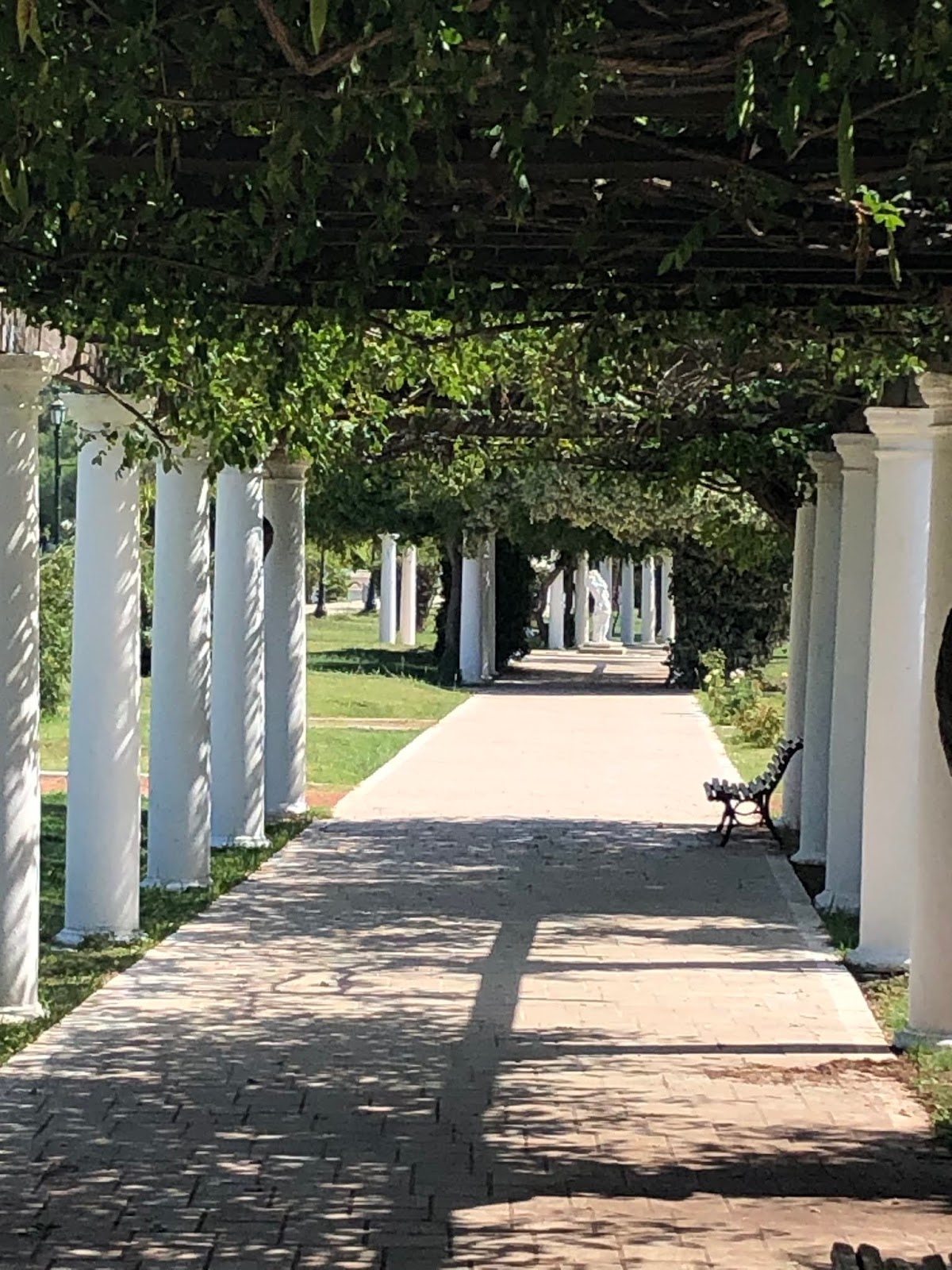
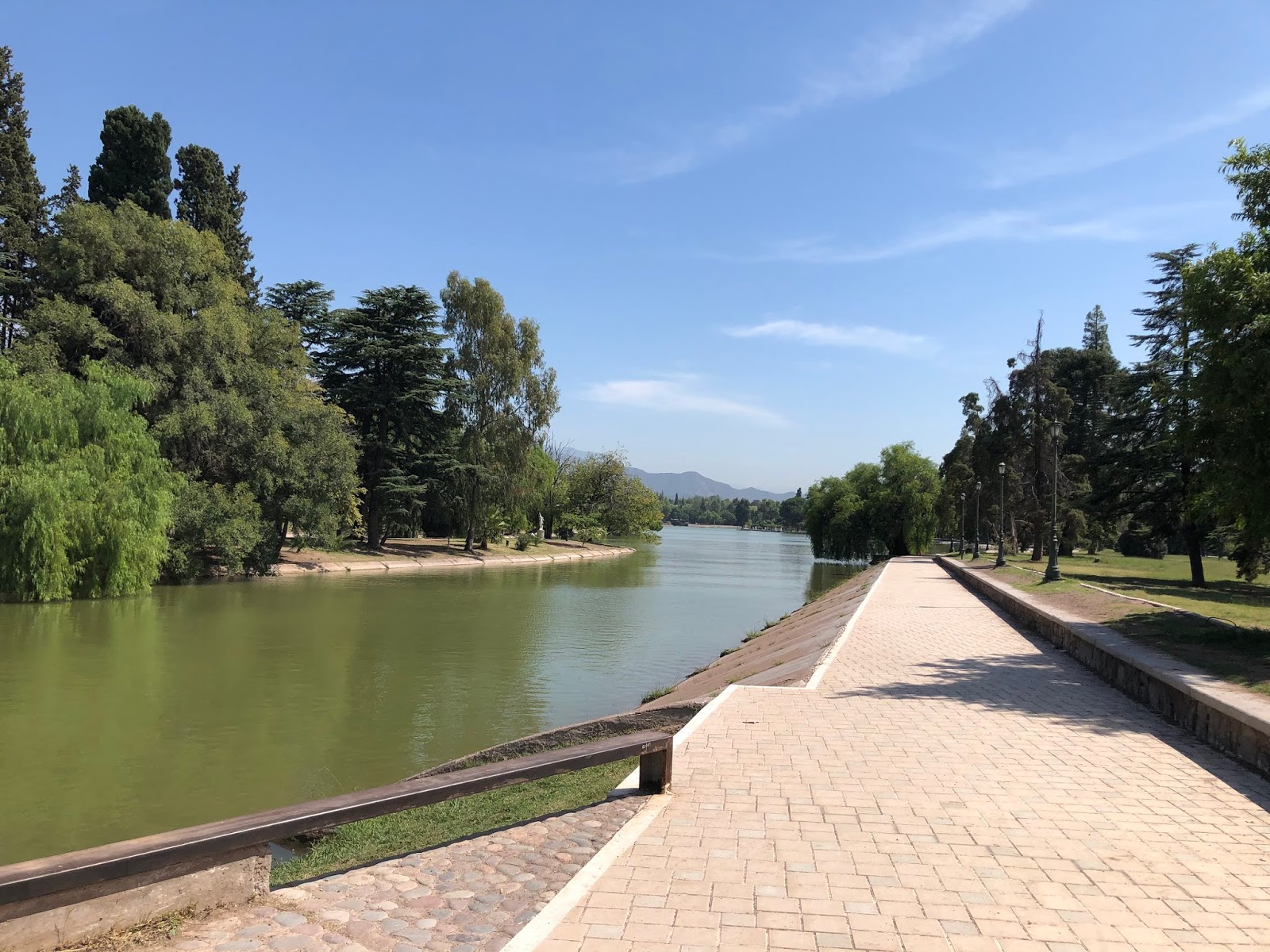
Parque San Martin
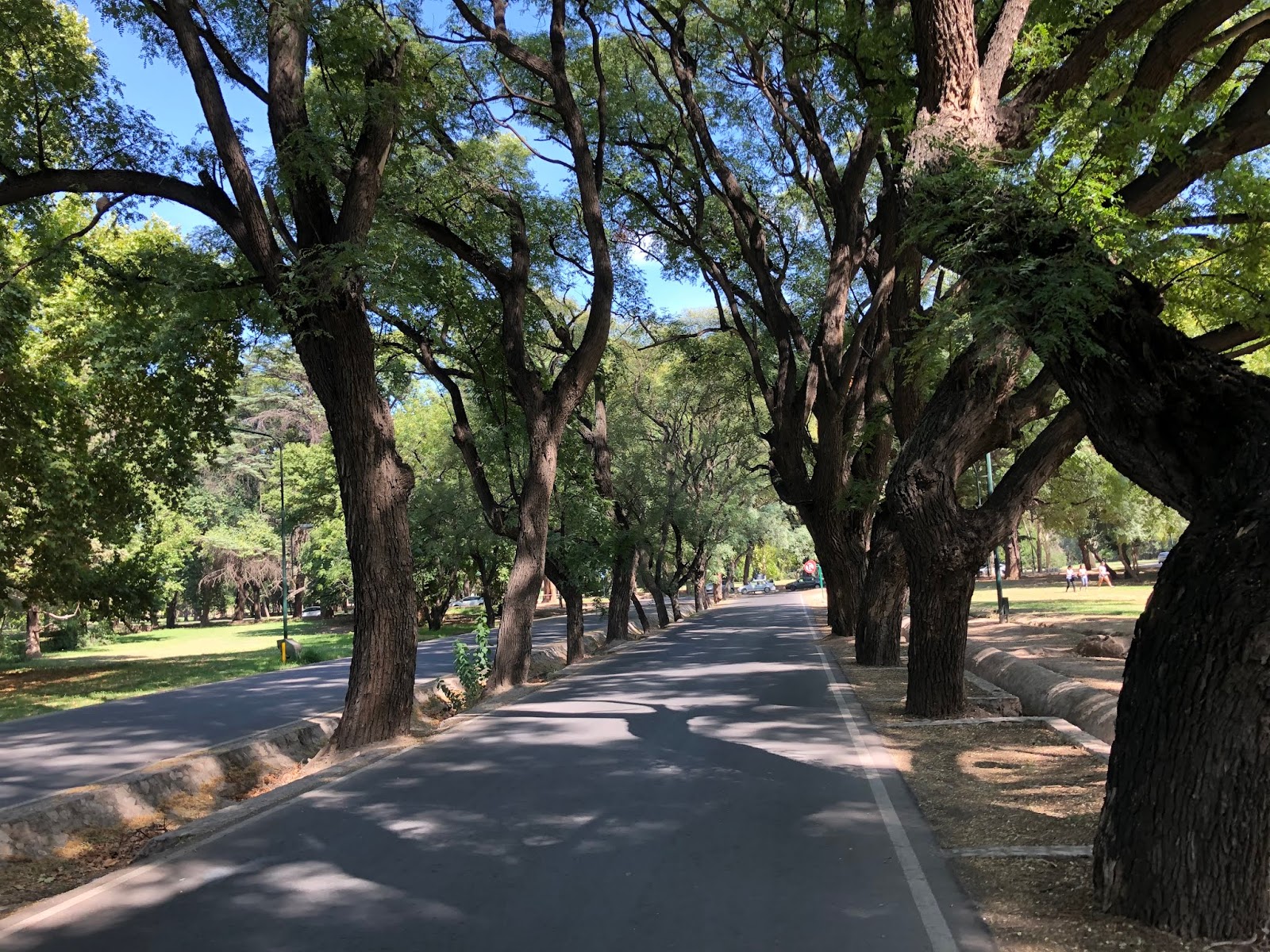
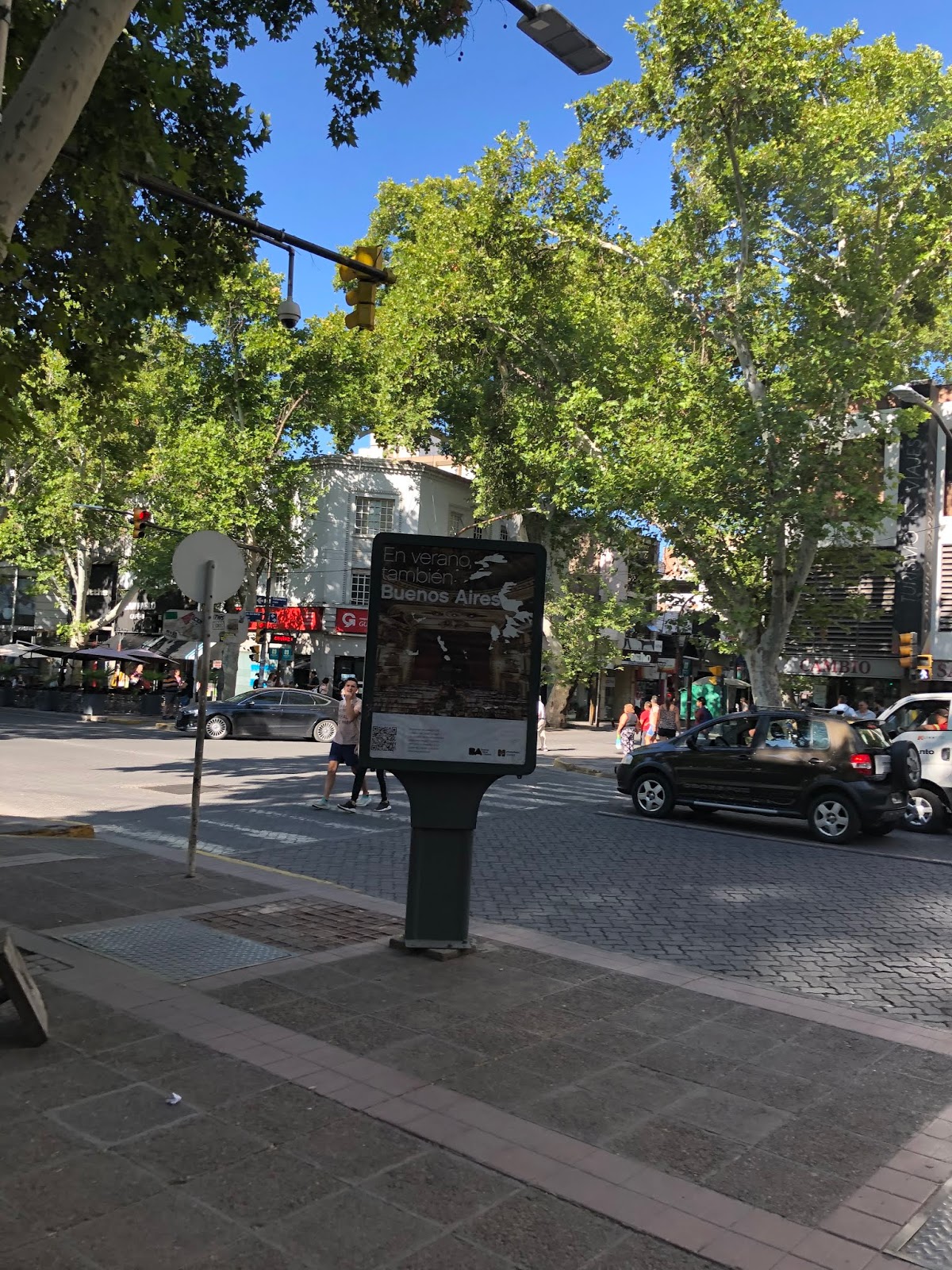 Streets - Mendoza
I had wanted to climb the mountain since I was about 13 years old and had read an article about three climbers who had summited in the 70's (before tragedy befell them). That article had likely been my first ever read about mountaineering. And I was captivated by it.
Fast forward 40 years, and I found myself in Mendoza, Argentina, one of the loveliest little cities I have experienced. February is the middle of summer south of the equator. The temperatures were almost perfect 70's (F) throughout my stay. The streets were all broad, tree-lined avenues with ever-changing sidewalk patterns and designs. Like Paris and New York, every random block offered something to see or do. The town is bustling, vibrant, and yet also pretty laid-back. It's focal point outside of its main district is a park called Parque General San Martin. The park is one of the largest of its kind I have ever encountered. It felt as if it would give Central and Golden Gate Parks a run for their money size-wise. There were some lovely manicured portions near a long lake. But the portions I liked best were allowed to grow a bit wild. Creating a ceiling for the wavy green carpet was a canopy of beautiful leafy branches (these from a good variety of trees).
While I spent several days in Mendoza at the conclusion of my climbing trip, I only had 48 hours in the town before we left for the mountain. The time was mainly spent getting our gear in final order for the climb.
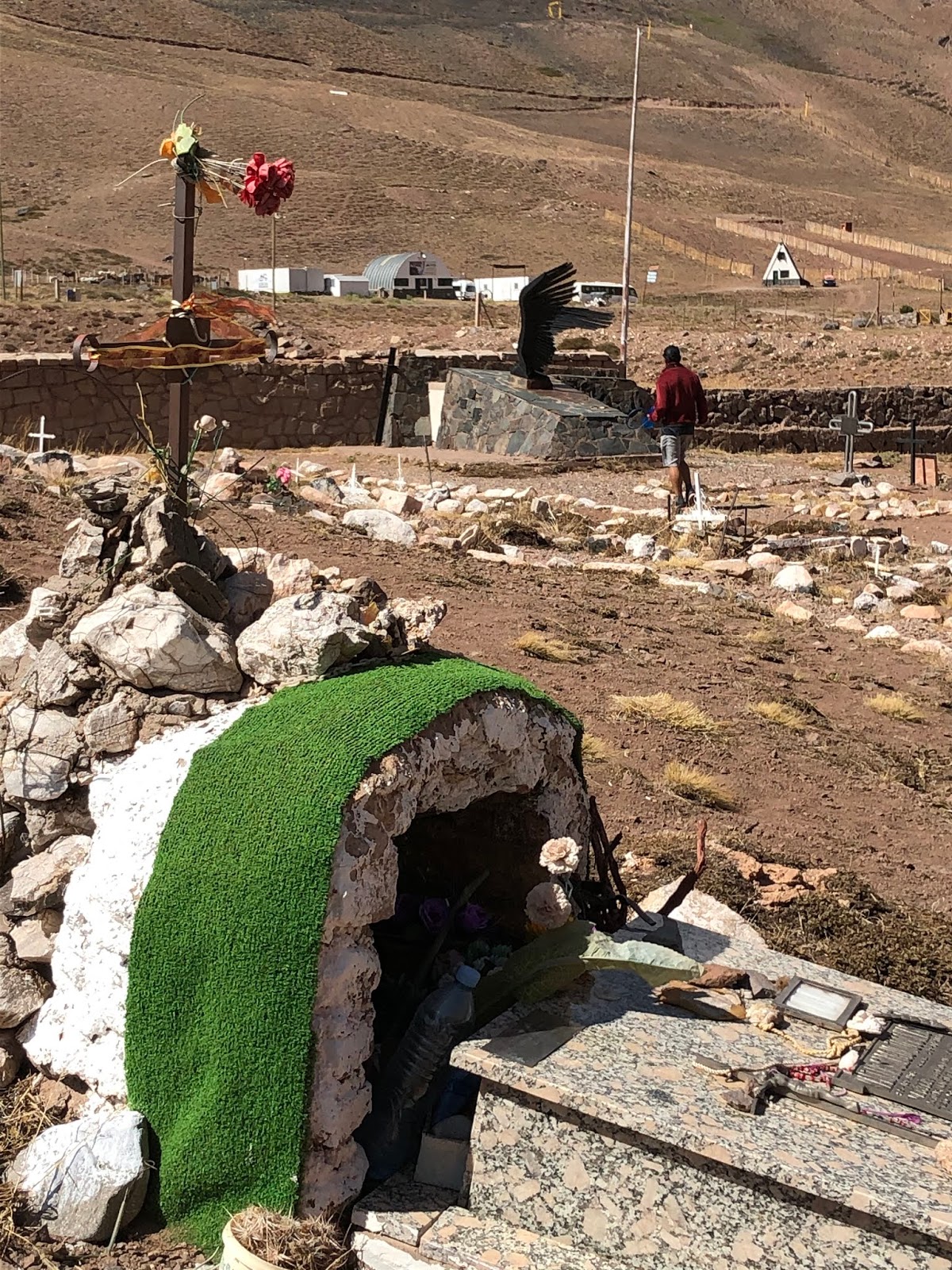 Cemetery - PenitentesWe left the city and took a bus several hours through the countryside and mountains until we arrived at a small mountain village/ski resort called, Penitentes. It was just above the town that we stopped the bus and got our first glimpse of Aconcagua from the side of the highway. Before heading back to our (very) spare rooms at the village's hotel, we stopped by the Aconcagua climber's cemetery. The little cemetery was sobering (very much along the lines of cemeteries that appear near mountains like Everest). We also knew a Russian climber had been killed on this mountain a week before our arrival. And, while it would not dampen our spirits, the cluster of graves likely would remain in the back of our minds for the duration of the trip.
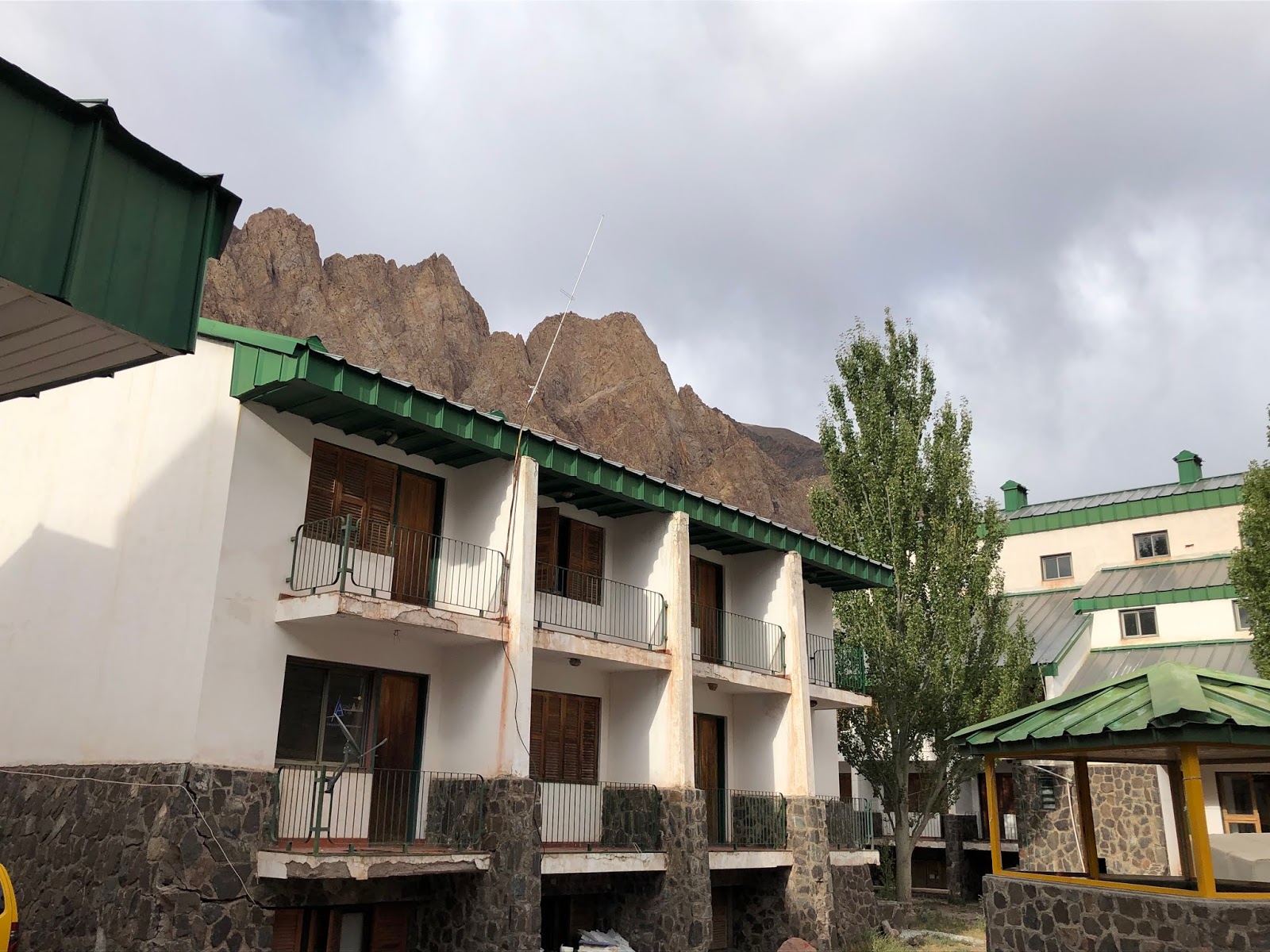 hotel pénitentes The next morning we were up relatively early (unlike other mountaineering trips, nothing in Argentina happened particularly early in the AM). We drove to a place called Punta de Vacas, put on our packs and took a 9 mile hike to our first camp on the way to basecamp for the Polish Glacier Route. This camp and the one that followed were both rudimentary places along a river. We pitched our tents, had dinner, and then went to sleep. The highlight of the hike to the second camp were several sightings of llama-like packs of animals called guanacos. These beautiful animals, along with fox, and massive jack rabbits can be found from trail head all the way through to basecamp (and slightly above).
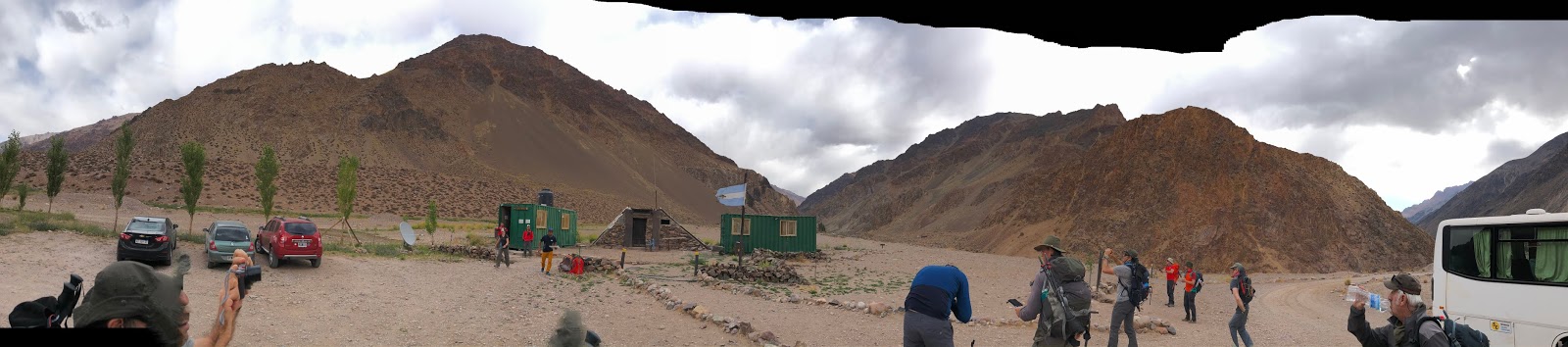 Punta De Vacas
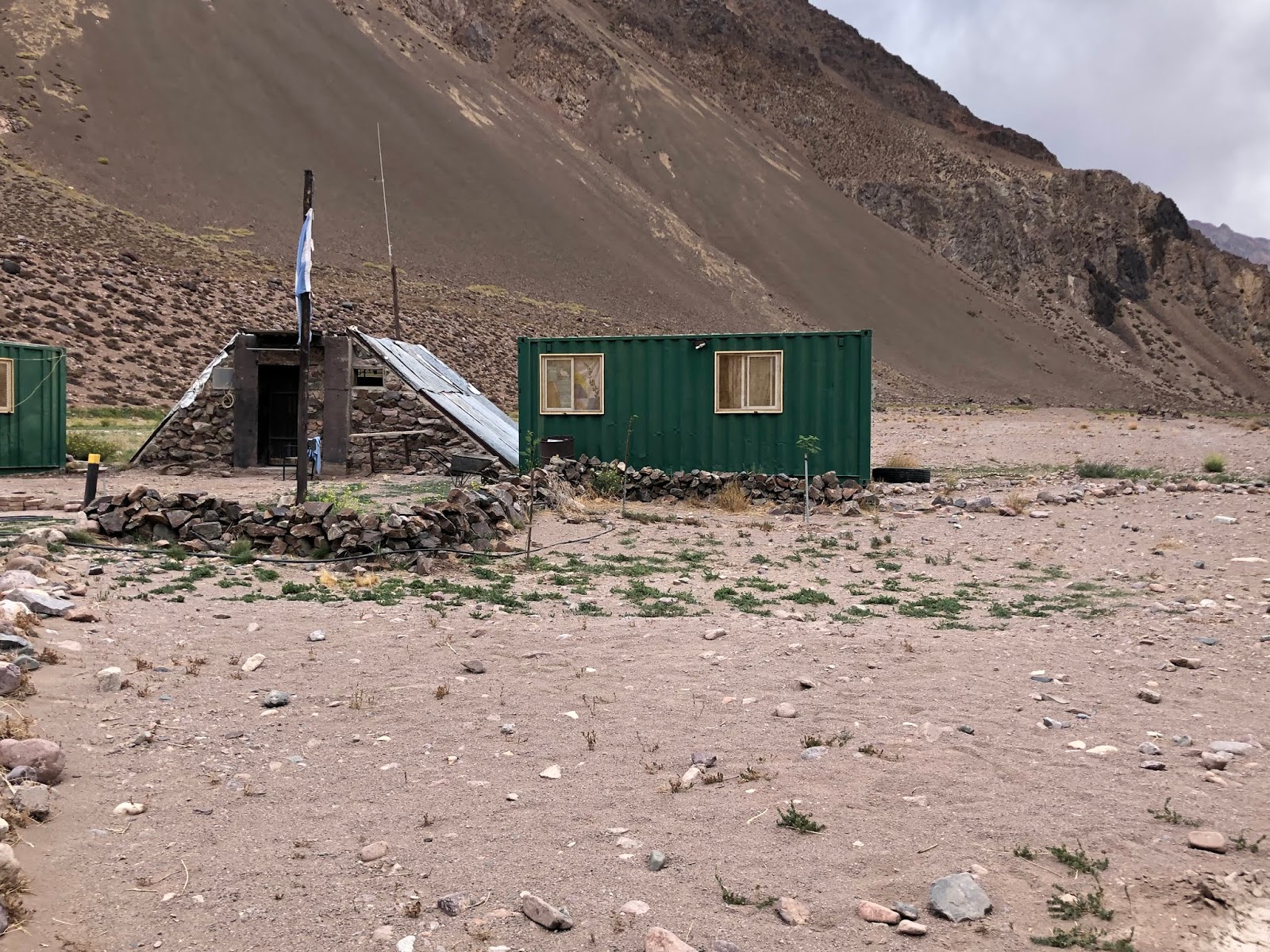 Punta De Vacas
On the third day of hiking, we finally arrived at the basecamp at a place called Plaza Argentina. We spent the next couple of days acclimatizing (the camp is slightly lower than 14,000ft), getting final gear in order for moving up the mountain, and being checked/approved by the camp doctor for ascent any higher up the mountain.
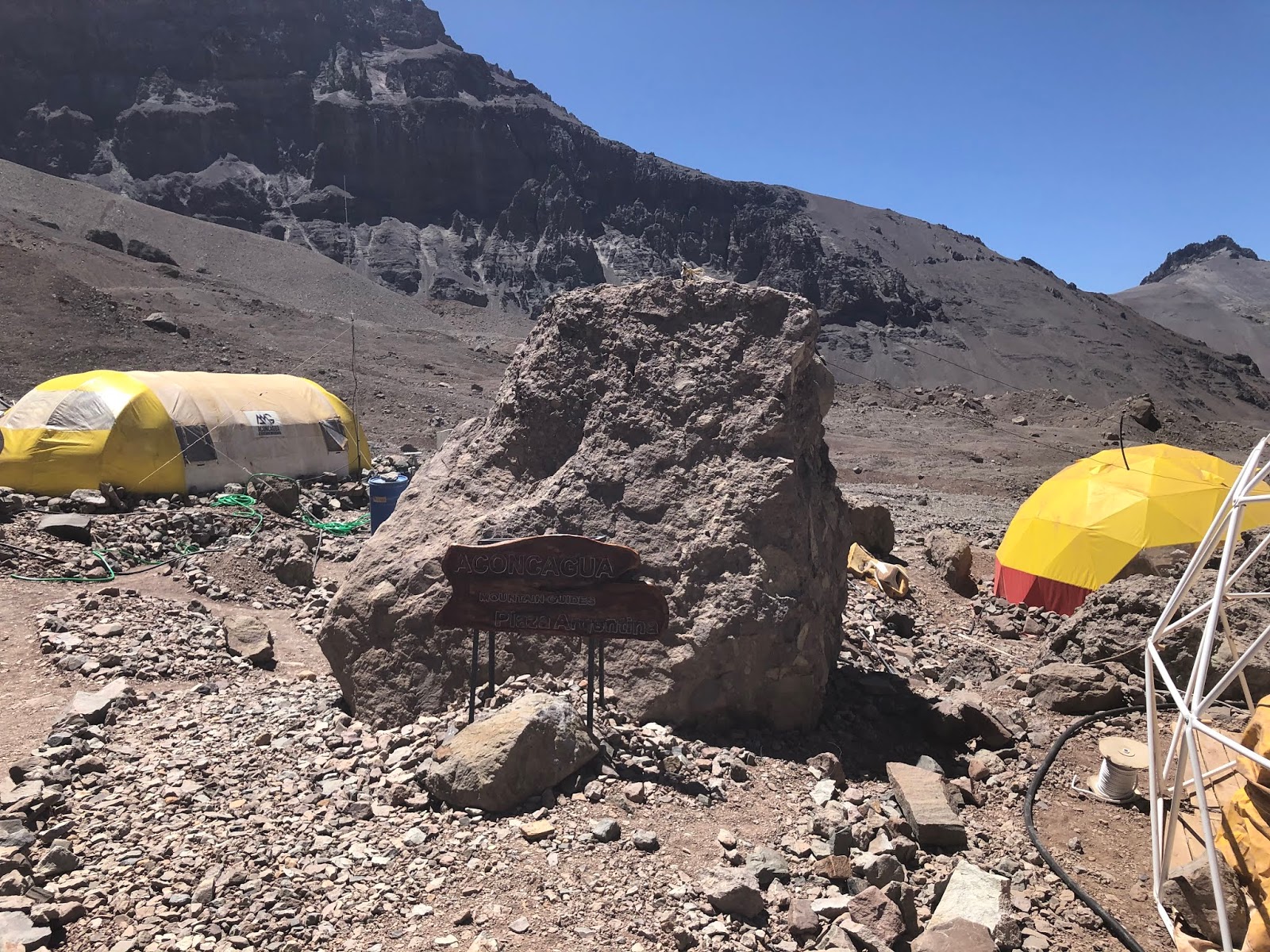 After the first doctor checks, a few members of our team (a relatively experienced team for what we were attempting) were flagged for further review. After day 2 at basecamp, the first member of our team to drop was airlifted to a hospital for AMS-like symptoms.
 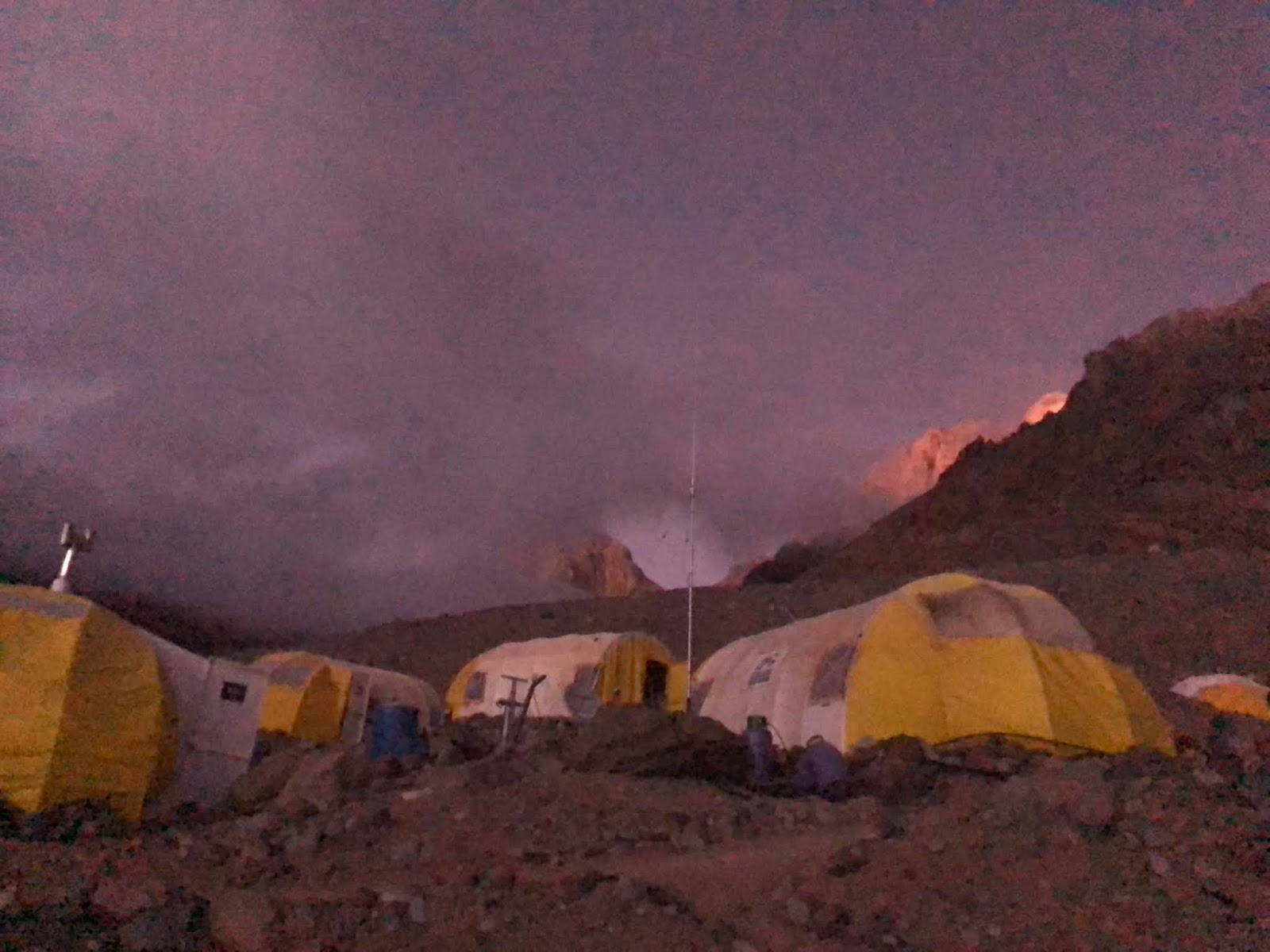 Basecamp - Plaza Argentina
 The next several days were spent carrying gear from basecamp up to the higher 3 camps. Usually a load would be carried to the next camp up. We would then descend and spend the night at the lower camp before repeating the process and moving higher. While we experienced incredible weather throughout our trip, the temperatures were still quite cold. A hot water bottle stuck in the foot of a sleeping bag was not something you wanted to forget to do before retiring for the night. There was also a lot of wind on a couple of occasions - once while we were climbing, and once overnight (the constant whipping of the tent made sleep impossible).
The night before we arrived at camp 3, we lost another member who was escorted off to the safety of the other basecamp, Plaza De Mulas, (this is the basecamp used for teams ascending by the normal route) where we would meet with him in several days.
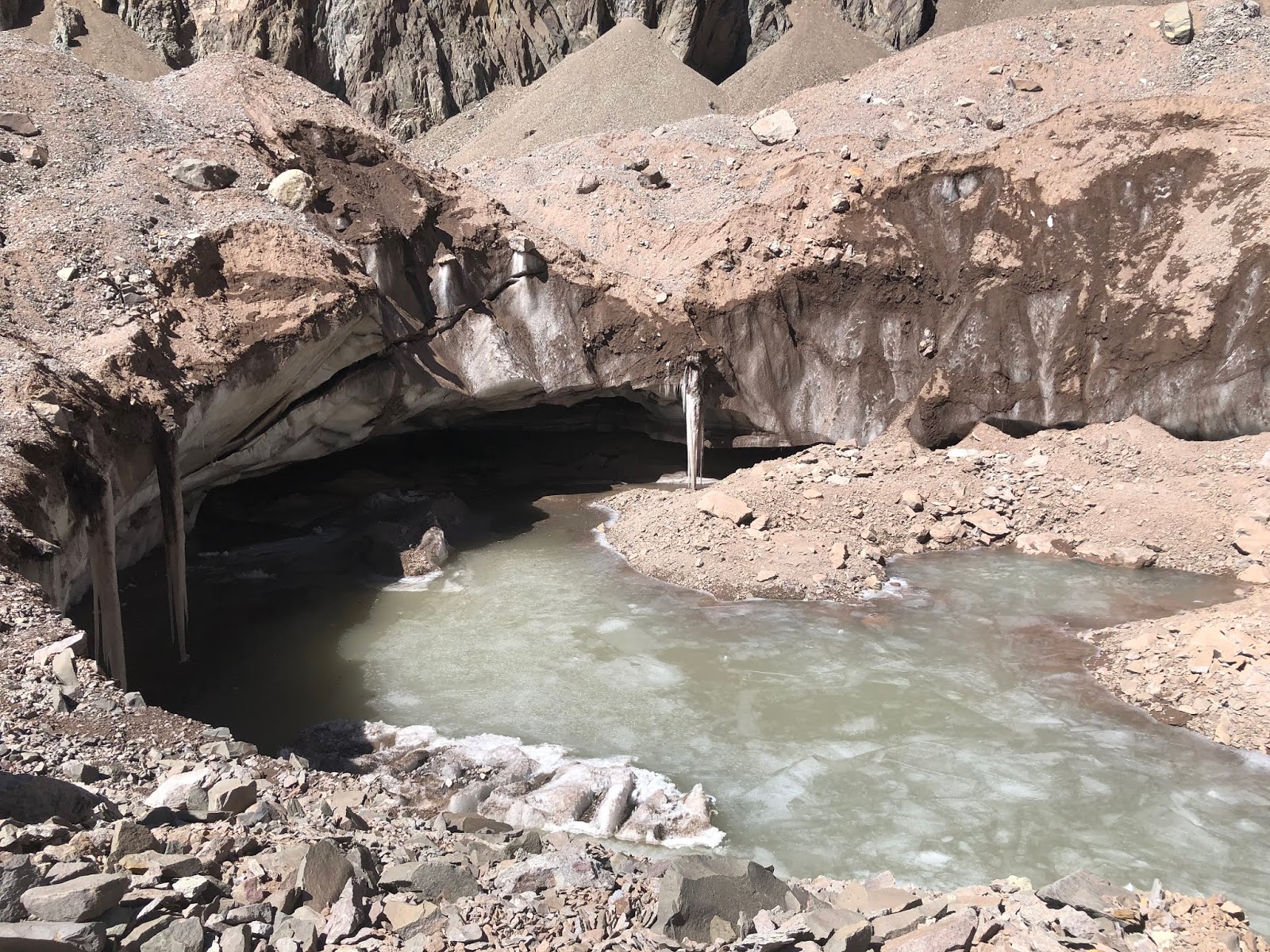 Pool within a glacierWhile he was in some difficulty, he was not having a medical emergency, so he was able to remain part of the team. But sadly, he would not be around for the summit bid.
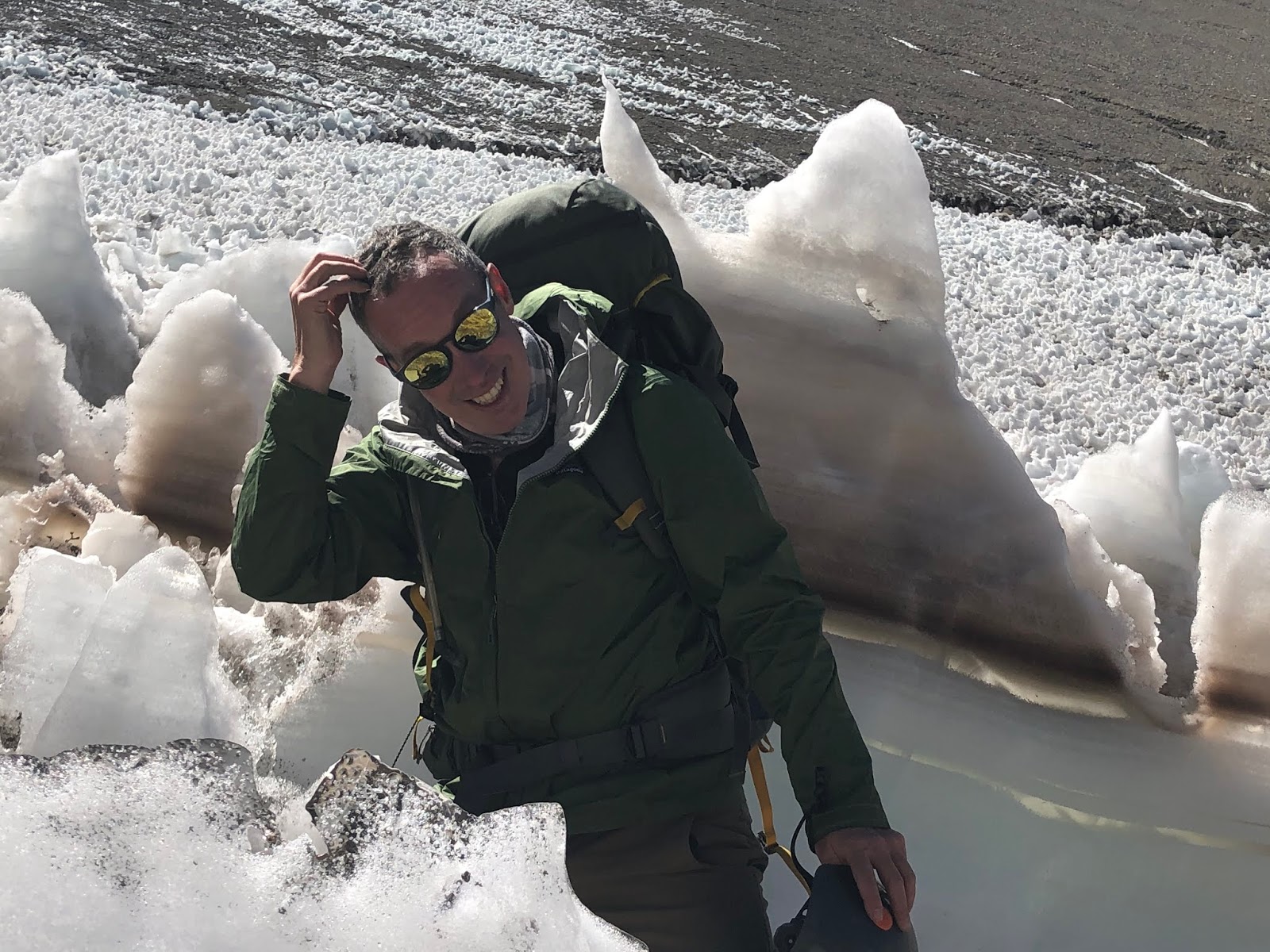 Among the penitentes on the mountain
The summit day arrived a day early. Weather, which had been so kind to us for most of the trip, was now closing in. The decision as made to take a summit shot a day early in order to avoid snow, wind, and clouds. The team would have one less day of acclimatization, but would have a better chance at making the summit due to the forecast.
We awoke between 3:30 and 4 in the AM. The temperature outside was single digits (F). We had a cold breakfast, geared up, and headed up the mountain with lights on around 5:30 AM. We had about 3,000ft to ascend over 1.8 mi - a journey that would take up to 8 hours in one direction. We started up the mountain. It was steep, but no more so than it had been over the past several days. The main difference was the cold. I had 4 layers on my legs, 4 on my torso, double boots, double guide gloves with gore-tex mitten covers, and I was still cold. My fingers kept going numb. I constantly shook my hands in order to keep the blood circulating. Unlike previous days, we carried very little weight. I had a couple of liters of water, some rain gear, and electronics. Everything else was left at high camp (camp 3) at just under 20,000ft. We hoped to return in many hours with a summit realized.
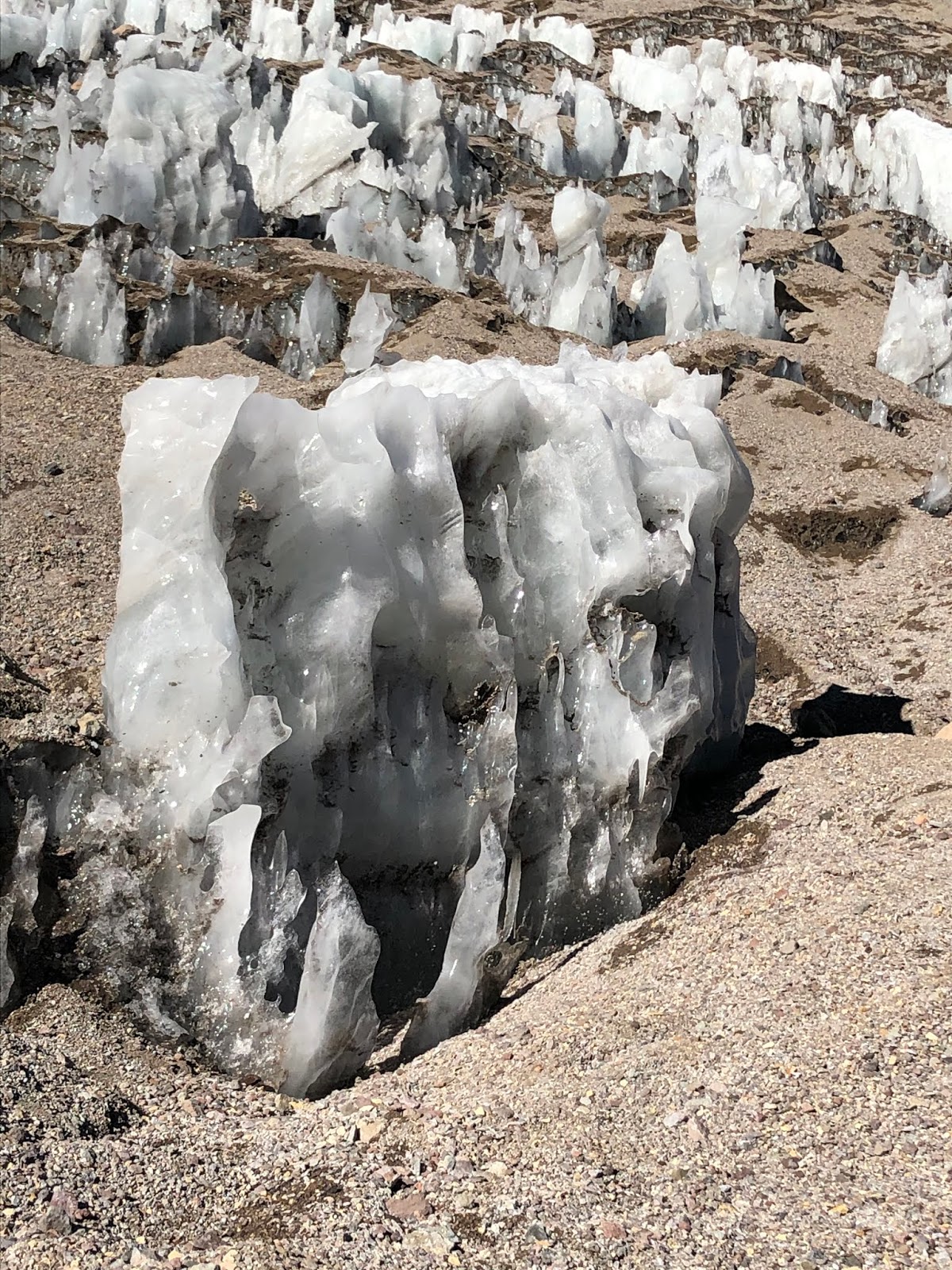 Ice formations on the glacier
Just after the first stop of the day, another member called it a day. He had been atop Kilimanjaro and Elbrus. He had made it higher than he had gone before, but lack of sleep on summit night coupled with the altitude caused him to turn around while he felt able. Shortly afterward, at our second stop, one more of our team dropped out citing dizziness/light-headedness. While both of these were disappointing developments, they were the correct decisions to be made under the circumstances.
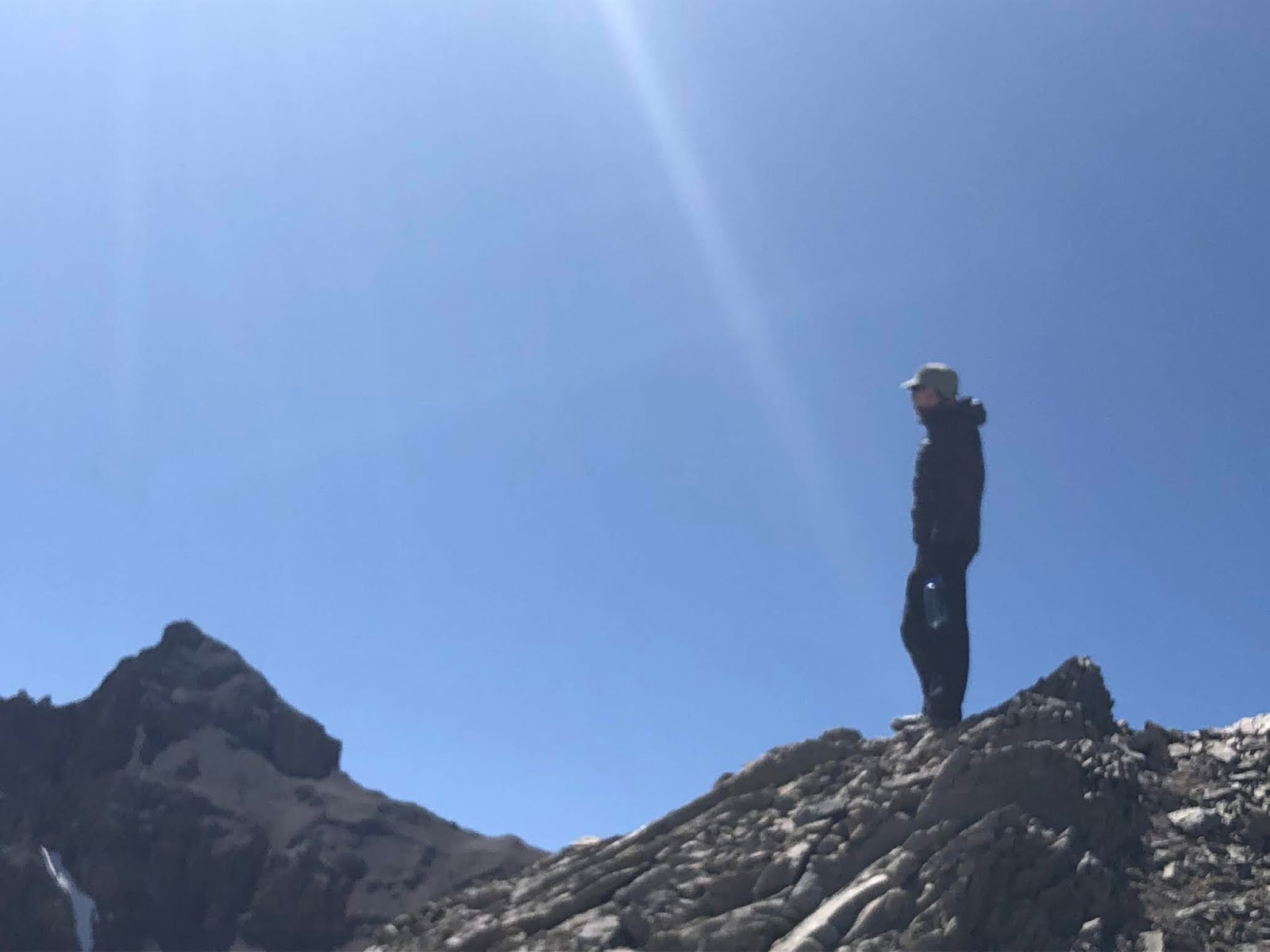 Paul Coughlin Camp 3
We had lost the two team members in a section that zig zagged through the upper reaches of the mountain. The next sections we faced were the traverse and the Canaletto. The traverse came just as the sun started to rise. It was cold, with somewhat more exposure than I had expected on the climb. It was tedious, but we made it across. The Canaletto was the final, intensely taxing portion of the climb. We started it after a short break. The altitude made speed almost impossible. The route itself was a bit sketchy due to the looseness of rocks and boulders. There seemed to be a very real danger of a person above you triggering a slide or a rock fall that could come down when you were below.
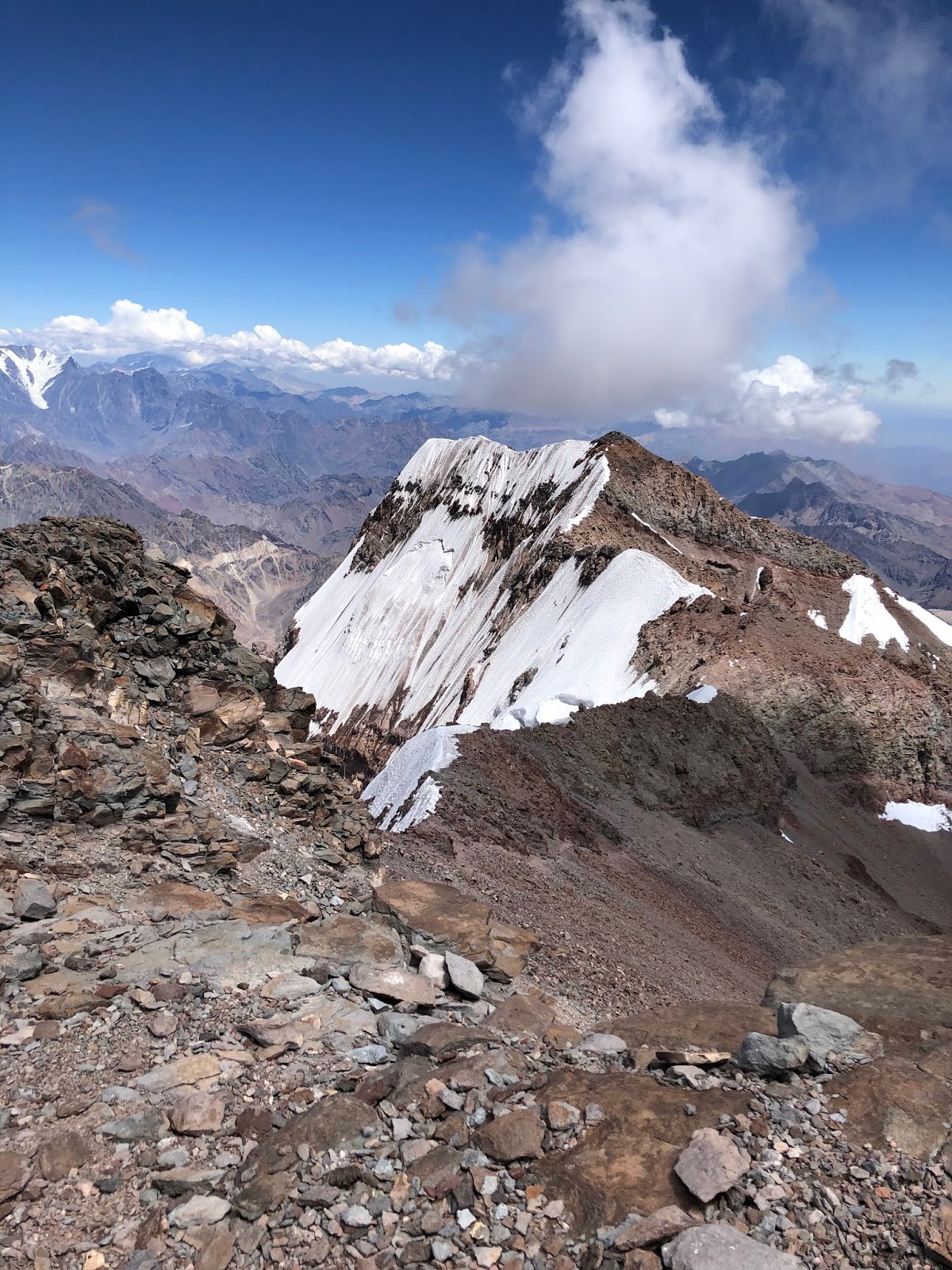 South Wall taken from Summit
It is strange to be in a section like the Canaletto on Aconcagua. You are so near the summit, you can actually see it. It is several hundred meters away, then only a couple of hundred meters, and ultimately only 100 or so. But it takes forever to get there. You can only take a step every few seconds or you are completely out of breath. If it had not been for my teammates, I likely would have turned around with less than 100m to go. It was incredibly hard and I felt I was close to not having enough in the tank for a return to high camp - getting down always needs to figure into calculations. But, with some encouraging, I was able to struggle to the summit.
I was the oldest team member to make it to the top of Aconcagua. There were 3 of us on the trip who were 54, one who was 59, and another in his early 60's. I don't know why I was the only one over 50 to make the summit, but I was. I pondered that for a bit at the top. At least for now I've decided that Aconcagua will be my last 20,000ft+ summit. There are great smaller mountains with beautiful and exciting climbing opportunities. The time and effort needed to continue to climb the biggest mountains in the world may now simply be too much to bear at my age.
Aconcagua is a mountain unlike others I've climbed. It is colder, more austere, steeper (in some instances), higher, and a bit more dangerous (mainly due to rockfall - which seems to be caused by global warming). I normally come off of mountains raring to do more. Aconcagua changed that for me. The fun factor, present in most mountains, was missing from Aconcagua. It was beautiful and challenging, but I would describe very little of the climb as fun. It was mostly a bit of a struggle in a cold, inhospitable environment. Every moment on the approach to, and on the mountain itself, is spent coated in a fine dust. You are filthy from nose to toes (and inside your nose and ears as well). Your clothes, hats, shoes, and sleeping bag all carry the same dirt. If you take a shower at a basecamp, you will be back with a fine powdery dirt skin-covering within 24 hours.
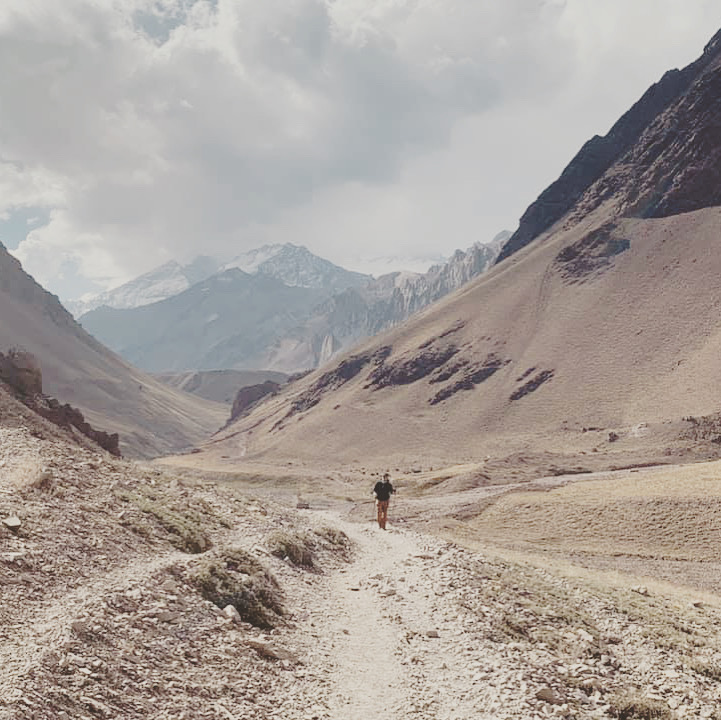 Hiking 15 miles out with a sprained ankle - beautiful hike, though painful
I had always wanted to climb Aconcagua and now it is done. But would I recommend it as a climb for other people? My honest answer is probably not. I would leave it for people who are driven to climb the seven summits. I'd do something easier that would take a bit less time and effort - Mera Peak, maybe. Or perhaps something else in the Annapurna region. There are beautiful mountains that don't require the pound of flesh that Aconcagua demands. Our team was tremendously lucky due to weather. We got 60% of the team to the summit - about twice the average. And even with the luck, I would still describe the climb as the hardest I have ever faced.
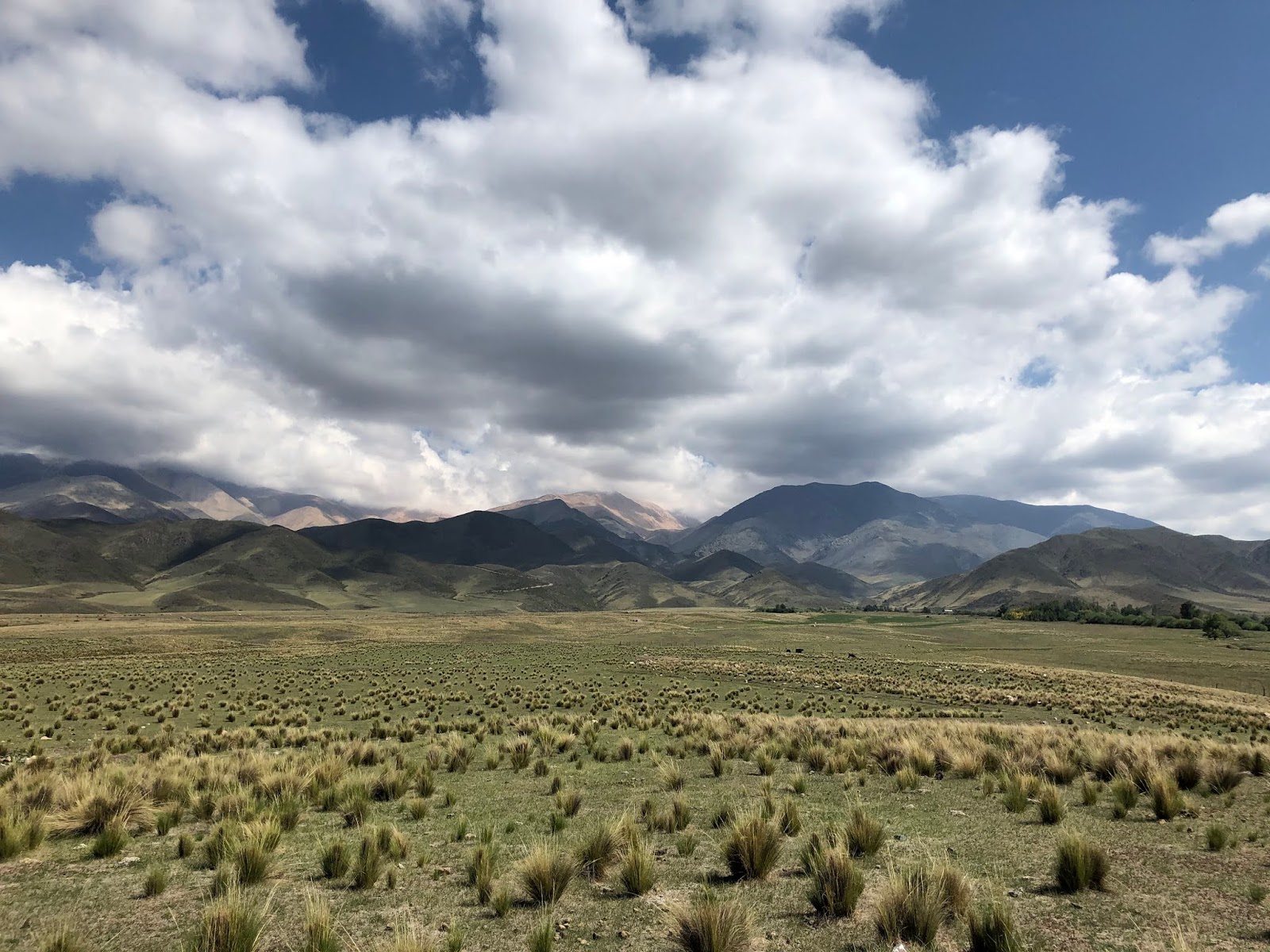 EstanciaIan Taylor Trekking was fantastic - Ian was along as was his top Sherpa from Nepal, Ang Kami, who was there simply as a climber. Aconcagua Mountain Guides did a tremendous job with logistics, safety, and food. I cannot think of a single negative thing to say about ITT or AMG - both organizations gave us the safest possible experience we could have on the mountain.
 Wild horses on the estancia
Our final days (and there were quite a few since we had summited early) were spent back in wonderful Mendoza and in the nearby wine region. I rode horseback through the countryside under Mt. Plata and an active volcano. Wine was consumed, massages were obtained, and injuries addressed (including a sprained ankle I got sliding into Plaza de Mulas on my way down the mountain). The region is truly lovely and worthy of a prolonged visit.
January 2, 2020
2019 Recap/Review
2019 was a good year overall. I got some solid climbing in on mountains and walls. And I've got to say I am not as fond of the big granitic or sandstone walls as I am of snow and ice-covered slopes. Somehow, the exposure on the walls seems greater.
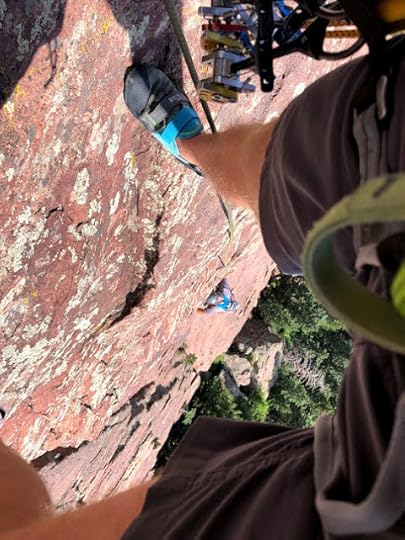 Climbing a pitch. Photo Courtesy of Jack Tyson
I also got in a couple of 25K trail races. And again, while I think races are fine, I much prefer to run solo or with a couple of friends than to be part of a herd of people at an event. I realize that some need to have a goal. But most often, I prefer the journey where running is concerned (unless it is to do something crazy like run across, Joshua Tree, Zion, or some other park/desert. Then the goal defines the journey).
I played a lot of disc golf. My game got a bit better. I won my division in a doubles tournament with my buddy, Paul. My group of disc golf friends also started traveling more to courses around our region. There are some fantastic ones nearby in both large cities and tiny burgs.
My favorite travel spot again this year was Leadville. It is a special place for me. The altitude, mountains, trails, hiking, biking, paddling, and running opportunities make it, for me, my top destination in the US. Next year will again find me traveling around the world. But 2019 saw more time spent in the mountains in the US than in previous years. I hope to be back again in Summer 2020.
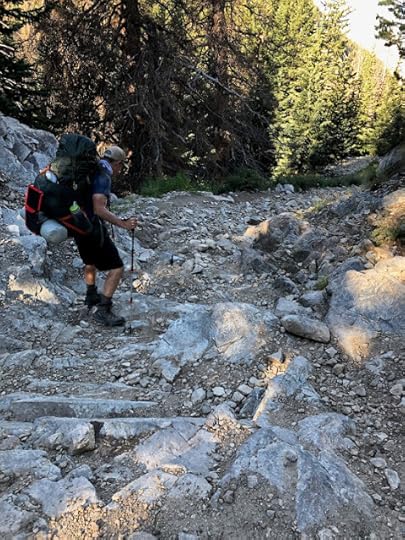 Sangre De Cristos - Descending from Basecamp with a very heavy pack.
In 2019, a chunk of my reading was dominated by a French author, Philippe Besson. I had seen that M. Besson's latest book, translated by Molly Ringwald (yes, that Molly Ringwald - who knew?), had been blurbed by one of my favorite authors, Andre Aciman. So I checked it out of the Lawrence Public Library and sat down to give it a read. About 2 days later I was done and immediately sought out every book Besson had written that had been translated into English. His writing is so exquisite that it make you want to earn to read/speak better French so that it can be enjoyed in the author's native tongue. I found two more of his novels at Watson Library on the KU campus. And then there were no additional translations available in any library or for purchase. He has a new-ish novel out. It is my hope for 2020 that it will be translated into English. So with that explanation, here is the list of my favorite reads from 2019.
FAVE BOOKS 2019:
1. In the Absence of Men - Philippe Besson
2. Lie With Me - Philippe Besson
3. His Bother - Philippe Besson
4. Climbing Everest: The Complete Writings of George Mallory - George Mallory
5. The Apprentice: My Life in the Kitchen - Jacques Pepin
6. Betty Blue - Philippe Dijan
7. The Passion of Michel Foucault - James Miller
8. No Friend But the Mountains - Behrouz Boochani
And now a new category - worst books I read in 2019. There were actually 3 that I read because they were by writers I like, were blurbed by writers I like, or suggested by friends, but they were either so terrible, or disappointing, that I would not recommend reading them. One, I will say, got great reviews, but it has such glaring plot flaws that it is beyond me (and an editor buddy with whom I discussed it) as to how anyone could like it.
LEAST FAVE BOOKS 2019L
1. Out East: Memoir of a Montauk Summer - John Glynn
2. The River - Peter Heller
3. M Train - Patti Smith (who I normally absolutely LOVE - I wish her book hadn't been so disjointed, boring, and self-indulgent).
BEST THINGS I'VE WATCHED
Those who know me know that I strongly prefer European movies where people sit around pieds-á-terre and say pithy, relevant things, have affairs, and nothing much else happens. I love that type of movie. I see almost no American movies (just 1-2 each year). I also love movies and TV about adventure, travel, sports, and cooking. That being said.
1. Rocketman
2. Pavarotti - Ron Howard Dir.
3. Andy Murray: Resurfacing
4. Around the Next Bend
5. Ride with Norman Reedus
6. Mid 90s
7. Hillary (Season 1)
8. Sanctuary
9. American Ninja Warrior
10. Eighth Grade
I may add to, or change these lists as I recall other things I read and watched. But this is a good start.
 Climbing a pitch. Photo Courtesy of Jack Tyson
I also got in a couple of 25K trail races. And again, while I think races are fine, I much prefer to run solo or with a couple of friends than to be part of a herd of people at an event. I realize that some need to have a goal. But most often, I prefer the journey where running is concerned (unless it is to do something crazy like run across, Joshua Tree, Zion, or some other park/desert. Then the goal defines the journey).
I played a lot of disc golf. My game got a bit better. I won my division in a doubles tournament with my buddy, Paul. My group of disc golf friends also started traveling more to courses around our region. There are some fantastic ones nearby in both large cities and tiny burgs.
My favorite travel spot again this year was Leadville. It is a special place for me. The altitude, mountains, trails, hiking, biking, paddling, and running opportunities make it, for me, my top destination in the US. Next year will again find me traveling around the world. But 2019 saw more time spent in the mountains in the US than in previous years. I hope to be back again in Summer 2020.
 Sangre De Cristos - Descending from Basecamp with a very heavy pack.
In 2019, a chunk of my reading was dominated by a French author, Philippe Besson. I had seen that M. Besson's latest book, translated by Molly Ringwald (yes, that Molly Ringwald - who knew?), had been blurbed by one of my favorite authors, Andre Aciman. So I checked it out of the Lawrence Public Library and sat down to give it a read. About 2 days later I was done and immediately sought out every book Besson had written that had been translated into English. His writing is so exquisite that it make you want to earn to read/speak better French so that it can be enjoyed in the author's native tongue. I found two more of his novels at Watson Library on the KU campus. And then there were no additional translations available in any library or for purchase. He has a new-ish novel out. It is my hope for 2020 that it will be translated into English. So with that explanation, here is the list of my favorite reads from 2019.
FAVE BOOKS 2019:
1. In the Absence of Men - Philippe Besson
2. Lie With Me - Philippe Besson
3. His Bother - Philippe Besson
4. Climbing Everest: The Complete Writings of George Mallory - George Mallory
5. The Apprentice: My Life in the Kitchen - Jacques Pepin
6. Betty Blue - Philippe Dijan
7. The Passion of Michel Foucault - James Miller
8. No Friend But the Mountains - Behrouz Boochani
And now a new category - worst books I read in 2019. There were actually 3 that I read because they were by writers I like, were blurbed by writers I like, or suggested by friends, but they were either so terrible, or disappointing, that I would not recommend reading them. One, I will say, got great reviews, but it has such glaring plot flaws that it is beyond me (and an editor buddy with whom I discussed it) as to how anyone could like it.
LEAST FAVE BOOKS 2019L
1. Out East: Memoir of a Montauk Summer - John Glynn
2. The River - Peter Heller
3. M Train - Patti Smith (who I normally absolutely LOVE - I wish her book hadn't been so disjointed, boring, and self-indulgent).
BEST THINGS I'VE WATCHED
Those who know me know that I strongly prefer European movies where people sit around pieds-á-terre and say pithy, relevant things, have affairs, and nothing much else happens. I love that type of movie. I see almost no American movies (just 1-2 each year). I also love movies and TV about adventure, travel, sports, and cooking. That being said.
1. Rocketman
2. Pavarotti - Ron Howard Dir.
3. Andy Murray: Resurfacing
4. Around the Next Bend
5. Ride with Norman Reedus
6. Mid 90s
7. Hillary (Season 1)
8. Sanctuary
9. American Ninja Warrior
10. Eighth Grade
I may add to, or change these lists as I recall other things I read and watched. But this is a good start.
June 23, 2019
2 World Records Fall
I watched a mile race on Youtube the other day. It was 50-54 year olds trying to break the age-group world record of something like 4:21. To me, that seemed like a pretty staggering thing to be able to do. I've run forever, and I can't recall, even in my youth, being able to break 6 minutes (which is probably the reason I've never been a professional runner). Well, I'm happy to announce that there is a new sub 4:20 world record in the age-group. Watching people who really know how to run and who have the body-type necessary for speed is really something to behold. I'm always amazed that good runners, female or male, at any age, look like good runners.
In other running news, I also heard a piece on Only A Game about a 100+ year old woman who set the 100 meter world record in her age group (not a crowded field, I'm guessing). She finished in just over 33 seconds. And honestly, I bet that is faster than a lot of people literally half her age could do it.
Keep running, reading, and take care of each other and yourself.
In other running news, I also heard a piece on Only A Game about a 100+ year old woman who set the 100 meter world record in her age group (not a crowded field, I'm guessing). She finished in just over 33 seconds. And honestly, I bet that is faster than a lot of people literally half her age could do it.
Keep running, reading, and take care of each other and yourself.
December 24, 2018
2018 In Review
I haven't written a lot of posts for Running Conversations this year. In fact, I've done very little posting on any social media platforms at all. I've continued to write, but I've gone back to using actual physical journals to record mainly my travels, and, to a lesser extent, my thoughts/feelings. A large part of the withdrawal from social media is due to something I read decades ago in Western Civ at KU. WEB Dubois' words about religious experience have always stuck with me. And, while I'm not religious, I do want to take a moment to explain his thoughts. To paraphrase: your religious experience is your own. It can be very real/valid, but it only applies to you. My religious experience would only be valid for me. I like that idea. I have had many thoughts, dreams, revelations, etc... - they make sense to me completely. Yet if I were to try to explain them to others, they would be meaningless or simply unrelatable.
This past year I applied that concept, not to religious experience, but to life in general. I have stopped sharing on social media (this posting being an obvious exception) the everyday humdrum activities (and even some non-humdrum activities) that I undertake. While they are valid to me, they really have no bearing upon anyone else. We (and by that I me) waste an incredible amount of time on social media reading friends' postings about nothing. And I really mean nothing. And I too am guilty of this. I know so much more about my friends (even distant ones) than I used to. Yet I am no closer to any of them as a result of all of this information. In fact, it gets in the way of human contact, because when we get together we have very little to talk about.
Enough explanation. I'll now write a bit about 2018 and then get to the lists of books, TV, movies, etc... that I found interesting in the past year.

Kilimanjaro (photo credit: Diarmuid Morrissey)
2018 marked a big change in my outdoor athletic endeavors. Following a bike accident in 2017 (which I wrote about in an earlier post), I decided to stop putting on hold the things I wanted to do in my life. I hired a trainer and began to work out in order to strengthen my core and upper body.
In Jan/Feb I flew to Tanzania and climbed Kilimanjaro through Ian Taylor Trekking. I found the country to be one of the more remarkable places I have visited. The people are uniformly friendly and dress in wonderful colorful garments. I felt at home the moment my plane landed. My main regret from the trip is not allowing more time on either side of the climb. I did get to spend a couple of days touring the countryside and also the city center of Arusha. But if I could have stayed longer I certainly would have.

Happiness at the base of the Barranco Wall on Kilimanjaro
In May I flew to Seattle and rented a car that took me to Mt. Rainier. I had no interest at all in climbing that mountain, but felt I needed to learn how to climb on glaciers properly. My team was one of the first of the season to take the Emmons Glacier Route. The famous mountaineer, Eric Simonson, joined our IMG-led group as well. I ended up getting much more than I had bargained for. While my group did not reach the summit, we did get to experience a storm at 12,000 ft that locked us in tiny exposed tents for a day. I hated every minute of that trip and have no plans to return to the beautiful place. But I did get the training results I needed.

Starting up the Emmons Glacier on Rainier
In August, some friends and I drove to southern Colorado to climb a mountain called Blanca Peak. Blanca is one of Colorado's 14ers. It is the highest of three 14ers that share a ridge line - Ellingwood and Little Bear sit to either side. Blanca has a little bit of exposure between the saddle ridge line and the summit. There was some decently-challenging scrambling required as well. When we reached the top we were greeted with the best weather I have ever experienced on the summit of a mountain. It was clear and warm. I felt fortunate to be there with friends, a good view, and great weather. We stayed in our camp at 11,000 ft. an extra day after the climb and enjoyed the pretty valley lakes that sit in the trough of the three mountains. For me, Blanca served as a final tune-up before what would be the big adventure of the year. Here's a link to an interesting description of the Blanca Peak trip by Gary Henry - https://www.14ers.com/php14ers/tripreport.php?trip=18903
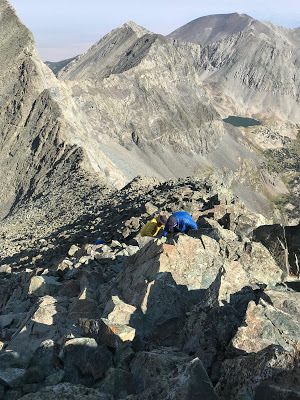
The rest of the team coming up the saddle to the summit on Blanca
In September/October I was in Nepal. I was there to climb a mountain interchangeably called Island Peak/Imja Tse. In order to climb the 20,305ft peak, I spent 3 weeks acclimatizing with a team of people trekking around the Everest region of the Himalaya. On our journey we went to Everest Base Camp (EBC) and later got beautiful pictures of the world's highest mountain from the summit of the 18,000+ ft Kala Patthar nearby. A few days later after leaving the last vestige of civilization at Chukung, our team of seven found ourselves at high camp on Imja Tse preparing to head up the mountain at 2AM. Following a rocky steep trail under a perfectly clear, starry sky, we reach the crampon point for the glacier in the dark. In the coldest portion of the night, we roped up, and trekked along with crampons and ice axes. We abseiled down a crevasse or two, ascended ladders and made our way to the base of the headwall just as the sun came up. The team ditched ice axes and began to ascend the wall using jumars and crampons to follow a fixed line. The summit was the highest and smallest summit I've encountered. All 7 of us and a couple of our sherpa guides were tethered to an anchor as we spent about 15 minutes enjoying the view of Lhotse, Imja Lake and the surrounding mountains. It was then time to abseil down the face of the headwall and make our way back across the glacier. We spent a short time packing up high camp and then descended to basecamp, stopping there for only a short time before continuing on to Chukung for the night. The summit day was something like 17 hours of work at high altitude. I don't ever recall a time in my life where I was as tired as during the long trek from basecamp to Chukung.

Climbing the headwall (Allen above and Andy Stark from Manchester in the foreground)
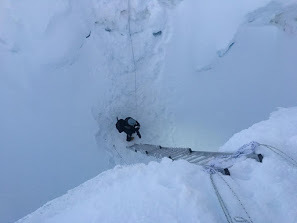
Abseiled into the crevasse - now need to climb out
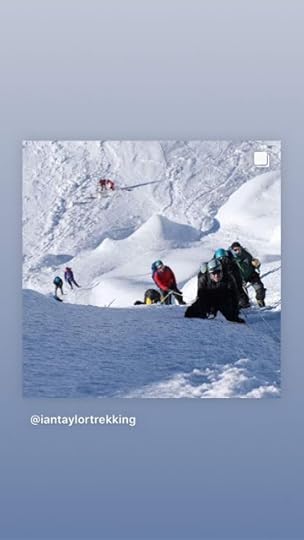
Full team on the headwall at Island Peak
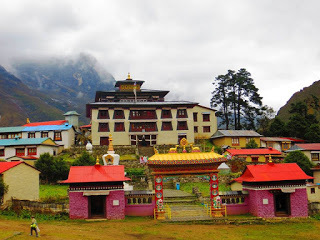
Buddhist Temple in Tengbouche

Island Peak/Imja Tse
My climbs on Kili and Island Peak, as well as the trek to EBC, introduced me to some of the nicest, determined, and interesting people I have had the pleasure to encounter - the other team members as well as the in-country guides, porters, and Sherpas. I've stayed in touch with most of the other team members and a good number of Sherpas and guides from Tanzania, and am in the process of making plans to do more climbs where we can once again go for a summit together.
Some notable books I read this year
Sparsholt Affair - Allan Hollinghurst
The Feather Thief - Kirk Wallace Johnson
Selected works (an assortment) - Felice Picano
Lions and Shadows - Christopher Isherwood
Solo Faces - James Salter
The Snow Leopard - Peter Matthiessen
My favorite movies I saw this year
Call Me By Your Name
Free Solo
Gabriel and the Mountain
Sherpa (I had the pleasure of watching this in Namche Bazaar with one of the Sherpas feature in the movie)
Lunag Ri: David Lama and Conrad Anker Walk the Line (35+ min on You Tube)
First Ascent of Lunag Ri Solo (3+ min - David Lama)
Meru (while I had seen this before, I watched it another couple of times in 2018)
TV
Great British Baking Show
Big Mouth (Season 2)
Atypical (Season 2)
Million Pound Menu
London Spy (Season 1)
Somebody Feed Phil - The Second Course
American Ninja Warrior (my favorite thing on TV)
Queer Eye Season 2 (great, heartfelt show in the midst of the world turning ugly)
Deals in the Desert (Like Million Dollar listing except in the Middle East)
American Crime (Season 2)
Best Cities/Towns I've Visited in 2018
Geneva, Switzerland (one of my favorite cities in the world - I love being there every year or so)
Namche Bazaar, Nepal (first night in my room I cried - I was so happy to be in this fabled town)
Kathmandu, Nepal
Arusha, Tanzania (I felt instantly at home in this city an surrounding area in Africa)
Alamosa, Colorado
Best Places I Spent Time In
Musee d'art et d'histoire - Geneva http://institutions.ville-geneve.ch/fr/mah/ - fantastic museum
MAMCO - Geneva - https://www.mamco.ch/en/100/Homepage-partners - great space for modern art/installations
Nelson-Atkins - Kansas City - A gem in the center of the US.
Amani Cultural Tourism Coffee Plantation - Near Arusha, Tanzania
Buddhist Monasteries in Tengboche and Khumjung, Nepal
Garden of Dreams - Kathmandu
Thamel district, Kathmandu
Hong Kong Airport - Weird, I know. But the airport is a great place to spend a long layover. It features nice lounges that can be joined for not too much money, good art exhibits to look at, and lovely, clean, open architecture.
Runyon Canyon - Nice place to take a hike in the middle of LA. Great views from the top of the park.
Final thoughts:
I do hope to do a few more posts in 2019 than in 2018 here and on my other blogs/websites. I have written a couple of reviews of the Tanzania and Nepal trips in this blog and on google and Facebook. You can find the google review by typing in 'Ian Taylor Trekking Company' on a search, and then clicking on the word 'reviews' in the company information that comes up on the right side of your screen.
For 2019 I'm looking at one or two epic runs. I also plan to climb a difficult little 14er in Colorado and then a larger summit somewhere else on the globe.
I plan to spend more time reading and writing as well. I hope everyone who reads this will be inspired to find things that are meaningful to themselves, and will then have the courage/motivation to just go do them.
This past year I applied that concept, not to religious experience, but to life in general. I have stopped sharing on social media (this posting being an obvious exception) the everyday humdrum activities (and even some non-humdrum activities) that I undertake. While they are valid to me, they really have no bearing upon anyone else. We (and by that I me) waste an incredible amount of time on social media reading friends' postings about nothing. And I really mean nothing. And I too am guilty of this. I know so much more about my friends (even distant ones) than I used to. Yet I am no closer to any of them as a result of all of this information. In fact, it gets in the way of human contact, because when we get together we have very little to talk about.
Enough explanation. I'll now write a bit about 2018 and then get to the lists of books, TV, movies, etc... that I found interesting in the past year.

Kilimanjaro (photo credit: Diarmuid Morrissey)
2018 marked a big change in my outdoor athletic endeavors. Following a bike accident in 2017 (which I wrote about in an earlier post), I decided to stop putting on hold the things I wanted to do in my life. I hired a trainer and began to work out in order to strengthen my core and upper body.
In Jan/Feb I flew to Tanzania and climbed Kilimanjaro through Ian Taylor Trekking. I found the country to be one of the more remarkable places I have visited. The people are uniformly friendly and dress in wonderful colorful garments. I felt at home the moment my plane landed. My main regret from the trip is not allowing more time on either side of the climb. I did get to spend a couple of days touring the countryside and also the city center of Arusha. But if I could have stayed longer I certainly would have.

Happiness at the base of the Barranco Wall on Kilimanjaro
In May I flew to Seattle and rented a car that took me to Mt. Rainier. I had no interest at all in climbing that mountain, but felt I needed to learn how to climb on glaciers properly. My team was one of the first of the season to take the Emmons Glacier Route. The famous mountaineer, Eric Simonson, joined our IMG-led group as well. I ended up getting much more than I had bargained for. While my group did not reach the summit, we did get to experience a storm at 12,000 ft that locked us in tiny exposed tents for a day. I hated every minute of that trip and have no plans to return to the beautiful place. But I did get the training results I needed.

Starting up the Emmons Glacier on Rainier
In August, some friends and I drove to southern Colorado to climb a mountain called Blanca Peak. Blanca is one of Colorado's 14ers. It is the highest of three 14ers that share a ridge line - Ellingwood and Little Bear sit to either side. Blanca has a little bit of exposure between the saddle ridge line and the summit. There was some decently-challenging scrambling required as well. When we reached the top we were greeted with the best weather I have ever experienced on the summit of a mountain. It was clear and warm. I felt fortunate to be there with friends, a good view, and great weather. We stayed in our camp at 11,000 ft. an extra day after the climb and enjoyed the pretty valley lakes that sit in the trough of the three mountains. For me, Blanca served as a final tune-up before what would be the big adventure of the year. Here's a link to an interesting description of the Blanca Peak trip by Gary Henry - https://www.14ers.com/php14ers/tripreport.php?trip=18903

The rest of the team coming up the saddle to the summit on Blanca
In September/October I was in Nepal. I was there to climb a mountain interchangeably called Island Peak/Imja Tse. In order to climb the 20,305ft peak, I spent 3 weeks acclimatizing with a team of people trekking around the Everest region of the Himalaya. On our journey we went to Everest Base Camp (EBC) and later got beautiful pictures of the world's highest mountain from the summit of the 18,000+ ft Kala Patthar nearby. A few days later after leaving the last vestige of civilization at Chukung, our team of seven found ourselves at high camp on Imja Tse preparing to head up the mountain at 2AM. Following a rocky steep trail under a perfectly clear, starry sky, we reach the crampon point for the glacier in the dark. In the coldest portion of the night, we roped up, and trekked along with crampons and ice axes. We abseiled down a crevasse or two, ascended ladders and made our way to the base of the headwall just as the sun came up. The team ditched ice axes and began to ascend the wall using jumars and crampons to follow a fixed line. The summit was the highest and smallest summit I've encountered. All 7 of us and a couple of our sherpa guides were tethered to an anchor as we spent about 15 minutes enjoying the view of Lhotse, Imja Lake and the surrounding mountains. It was then time to abseil down the face of the headwall and make our way back across the glacier. We spent a short time packing up high camp and then descended to basecamp, stopping there for only a short time before continuing on to Chukung for the night. The summit day was something like 17 hours of work at high altitude. I don't ever recall a time in my life where I was as tired as during the long trek from basecamp to Chukung.

Climbing the headwall (Allen above and Andy Stark from Manchester in the foreground)

Abseiled into the crevasse - now need to climb out
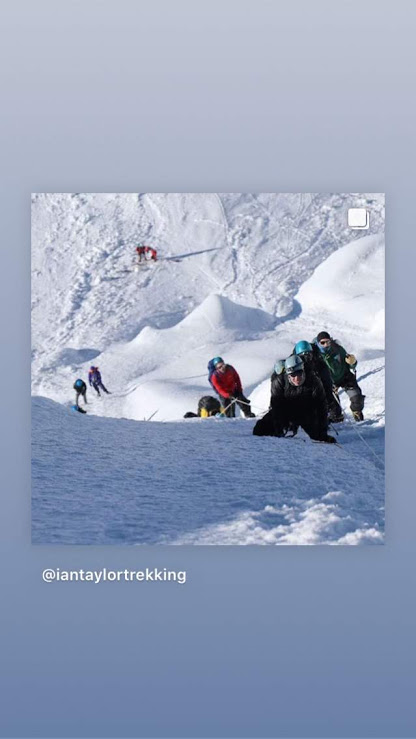
Full team on the headwall at Island Peak
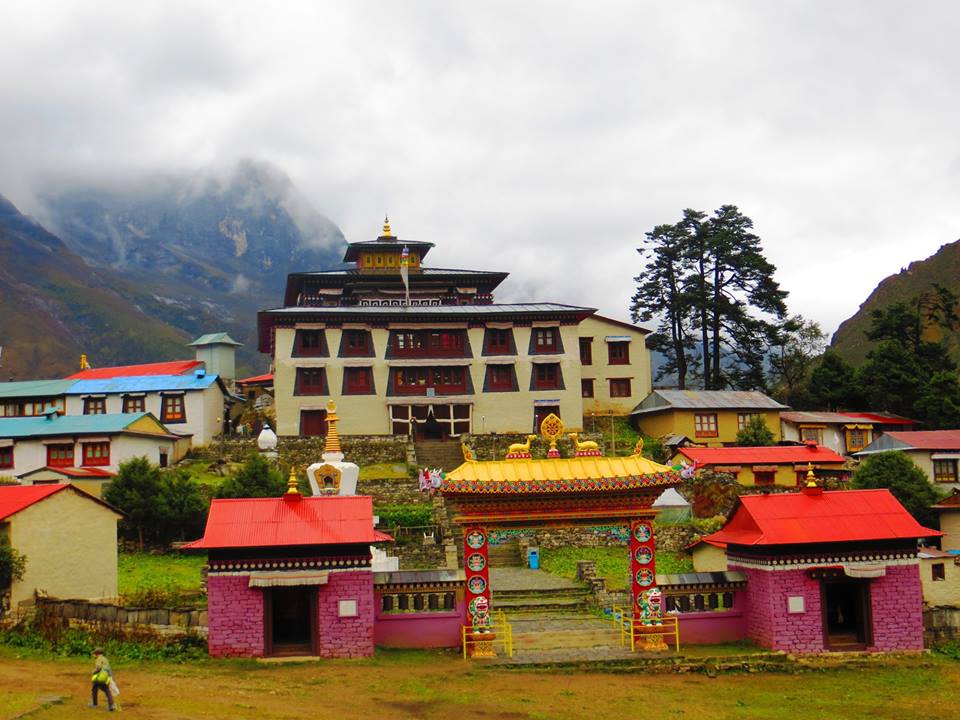
Buddhist Temple in Tengbouche

Island Peak/Imja Tse
My climbs on Kili and Island Peak, as well as the trek to EBC, introduced me to some of the nicest, determined, and interesting people I have had the pleasure to encounter - the other team members as well as the in-country guides, porters, and Sherpas. I've stayed in touch with most of the other team members and a good number of Sherpas and guides from Tanzania, and am in the process of making plans to do more climbs where we can once again go for a summit together.
Some notable books I read this year
Sparsholt Affair - Allan Hollinghurst
The Feather Thief - Kirk Wallace Johnson
Selected works (an assortment) - Felice Picano
Lions and Shadows - Christopher Isherwood
Solo Faces - James Salter
The Snow Leopard - Peter Matthiessen
My favorite movies I saw this year
Call Me By Your Name
Free Solo
Gabriel and the Mountain
Sherpa (I had the pleasure of watching this in Namche Bazaar with one of the Sherpas feature in the movie)
Lunag Ri: David Lama and Conrad Anker Walk the Line (35+ min on You Tube)
First Ascent of Lunag Ri Solo (3+ min - David Lama)
Meru (while I had seen this before, I watched it another couple of times in 2018)
TV
Great British Baking Show
Big Mouth (Season 2)
Atypical (Season 2)
Million Pound Menu
London Spy (Season 1)
Somebody Feed Phil - The Second Course
American Ninja Warrior (my favorite thing on TV)
Queer Eye Season 2 (great, heartfelt show in the midst of the world turning ugly)
Deals in the Desert (Like Million Dollar listing except in the Middle East)
American Crime (Season 2)
Best Cities/Towns I've Visited in 2018
Geneva, Switzerland (one of my favorite cities in the world - I love being there every year or so)
Namche Bazaar, Nepal (first night in my room I cried - I was so happy to be in this fabled town)
Kathmandu, Nepal
Arusha, Tanzania (I felt instantly at home in this city an surrounding area in Africa)
Alamosa, Colorado
Best Places I Spent Time In
Musee d'art et d'histoire - Geneva http://institutions.ville-geneve.ch/fr/mah/ - fantastic museum
MAMCO - Geneva - https://www.mamco.ch/en/100/Homepage-partners - great space for modern art/installations
Nelson-Atkins - Kansas City - A gem in the center of the US.
Amani Cultural Tourism Coffee Plantation - Near Arusha, Tanzania
Buddhist Monasteries in Tengboche and Khumjung, Nepal
Garden of Dreams - Kathmandu
Thamel district, Kathmandu
Hong Kong Airport - Weird, I know. But the airport is a great place to spend a long layover. It features nice lounges that can be joined for not too much money, good art exhibits to look at, and lovely, clean, open architecture.
Runyon Canyon - Nice place to take a hike in the middle of LA. Great views from the top of the park.
Final thoughts:
I do hope to do a few more posts in 2019 than in 2018 here and on my other blogs/websites. I have written a couple of reviews of the Tanzania and Nepal trips in this blog and on google and Facebook. You can find the google review by typing in 'Ian Taylor Trekking Company' on a search, and then clicking on the word 'reviews' in the company information that comes up on the right side of your screen.
For 2019 I'm looking at one or two epic runs. I also plan to climb a difficult little 14er in Colorado and then a larger summit somewhere else on the globe.
I plan to spend more time reading and writing as well. I hope everyone who reads this will be inspired to find things that are meaningful to themselves, and will then have the courage/motivation to just go do them.
August 31, 2018
Catharsis of Ultra-Running and Being Outside
 Blanca Peak
I read an article in the March issue of Outside about a skier, Adam Roberts, and his struggles with mental illness until his death in an avalanche in 2016. From the article, skiing seemed to be one of the few refuges that allowed a restless mind to come into full focus on a task at hand. Being outdoors in the mountains, seeing their beauty, experiencing their challenges and rewards, all served to bring a purpose and instill meaning in a life that was otherwise full of doubts. The piece, entitled, The Boy Who Lived On Edges, got me thinking about how much being outdoors, experiencing nature, and using one's body, have helped me and a large number of my friends overcome obstacles in life - from depression to divorce.
A common theme among ultra runners is that many started running the longer distances after a traumatic event. On
several runs with friends, we have talked about how the end of a relationship led to big miles for more runners we know than can be counted using just fingers. And this seems true for other outdoor friends as well. Many have taken up cycling, mountain climbing, or other outside endeavors after breakups.
Being outdoors and challenging oneself, perhaps offers both some sort of animal-brain instinctual solace coupled with building self-esteem. Interacting with nature creates an awareness of limitations. But often, through repeated exposure, the limitations transform into challenges to be faced and then overcome. For a time, for instance, early on in my trail-running life, going for over 3 hours seemed impossible. Now, running a 24 hour race seems all too possible (though I have little to no desire to actually undertake that challenge ;-).
 Near Barranco Wall - KiliWhen I was on a mountain trip recently, I met a woman whose divorce had led her to try climbing. Heading off to be challenged by assorted peaks around the globe had revealed both a talent and a passion for high-altitide climbing that she had not known she had.
I have struggled with depression for most of my life. I'm also a bit OCD with a sprinkling of ADD and anxiety for good measure. I took Zoloft for a few years to get depression under control. For the rest I've mainly tried intermittent therapy, writing, reading, and meditation. And, while all of those activities have worked to some degree, nothing has ever performed as well as simply getting outside. For me, I relish physicality in nature - running, biking, kayaking, climbing, hiking (you name it). If it is something particularly challenging, so much the better.
But even during times when I'm doing an easy hike or just camping, the act of being in nature nurtures my spirit. Viewing a pretty vista during the day, or seeing a couple of shooting stars in the high desert at night can better my outlook on life for a month.
 Breaking camp on RanierAnd in having these interactions with nature, it is almost impossible not to meet new people who share the same passions, needs, goals, and experiences. Since embracing a life dedicated to undertaking as many outdoor activities as possible, I have (counterintuitively) made more friends than I did in the first two-thirds of my life. Even though many of the experiences are solitary, hiking, biking, running, and climbing have brought wonderful new people into my life through clubs, training, and travel. These people have become welcome additions to my close-knit circle of friends.
And with that, my ramblings for today are complete. Keep running (and do as much of it on trails as possible).
Here are a couple of links to friends' blogs about a recent climb of Blanca Peak in Colorado: https://www.14ers.com/php14ers/tripreport.php?trip=18903 https://ruberuns.blogspot.com/2018/08/blanca-hawks.html
March 8, 2018
A Shared Sentiment
I almost never do this with this space, but in light of what is happening. I think this piece is worth a read. It is a reminder of what we stand to lose if we do not protect public lands.
From Adventure Journal
From Adventure Journal
February 2, 2018
Mt. Kilimanjaro
Over the past couple of weeks I have been in Tanzania. I had booked the trip in order to visit Africa for the first time and also to climb Mt. Kilimanjaro. Rising to 19,341 ft, Kilimanjaro is about a mile higher than any mountain in the US lower 48. While not overly technical, it is a serious endeavor, and needed to be treated with planning and a healthy dose of respect. Preparation for the trip was a large undertaking. First were the shots. I got vaccinated for Typhoid (actually a couple of pills), Hep A & B, Japanese B Encephalitis, Varicella (yes, I've never had chicken pox), TD, Meningitis, Yellow Fever, and Rabies. And I also would take an anti-malarial while there. In addition to medical preparations, there was physical fitness involved. I joined a gym and hired a personal trainer to get my shoulders and core ready for carrying a pack long distances over rough terrain. I worked with the trainer once a week and incorporated weights and other core work into my schedule 3-4 times each week. Finally there was gear - a lot of gear. I won't go into the full list, but I will have a partial list of items needed/used for the trip at the end of this post.
I knew months in advance what I would be doing, so I purchased some gear and took a trip to Mt. Langley and also a trip to Anza Borrego to give it all a test run. I ended up purchasing better gloves and a much better summit coat - both of which served me well on the roof of Africa.
I don't know that I'll post a lot about the 10 days I spent in Tanzania, or the 8 days on the mountain. I feel too close to the immensity of the undertaking at the moment. Suffice it to say, the trip was beautiful in every sense of the word - the people, the scenery, the weather - everything we encountered made me grateful to have made the decision to go on the journey.
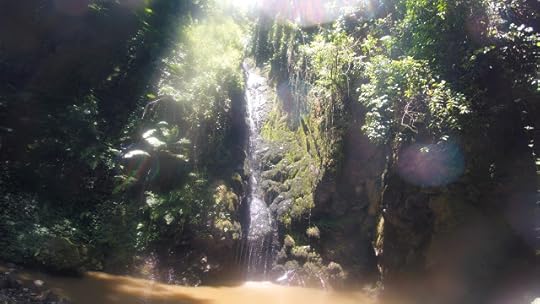 Waterfall we encountered while hiking through the coffee plantation/cooperative
The day before heading to the mountain, a couple of people joined me for a tour of a coffee plantation that was comprised of 2,200 small farmers who had banded together to create a cooperative. We spent the better part of a day walking along single track trails on the side of a mountain looking at the farms where banana and avocado trees shaded the coffee plants. We also saw calabash, maize and quinine trees. Adults we encountered were friendly and as curious about us as we were about them. Children waved and smiled and periodically followed us as we meandered along the pathways through the fields and ended up at a beautiful waterfall.
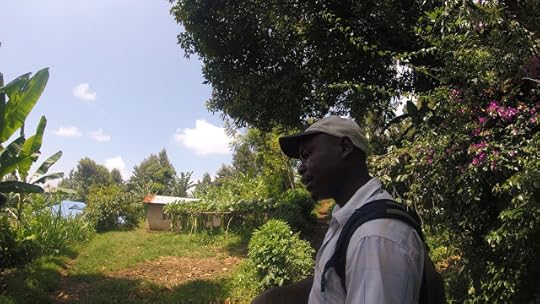 Clemency, our coffee guide, showing us calabash plants along the way - they are in the background hanging from a trellace set up in front of the little farmhouse.
The tour concluded with us preparing coffee from scratch. First we separated shells from the dried coffee beans by means of a very large 2 person mortar and pestle. Next we roasted the beans to a medium roast. To do this, we stirred the beans over open coals in a blackened ceramic pot using a wooden spoon. That took about 20 minutes. We then put the roasted beans back into the mortar and pestle and smashed them by hand into an espresso grind. The resulting coffee was shockingly sweet and delicious.
 Using an age-old technique for getting the beans to a medium roast
For the rest of the trip, my highlights were the rainforest days at the beginning and end - where we encountered monkeys and a civet. My favorite climbing day was the famed Barranco Wall - I could've gone back down and done it again. My favorite plants were found in the same climate zone as the wall - the giant senecio https://en.wikipedia.org/wiki/Dendrosenecio and the lobelia deckenii https://en.wikipedia.org/wiki/Lobelia_deckenii The Lobelia, in particular, is a fascinating plant. It holds a large amount of water in its open leaves during the day. So much so that, in fact, you can scoop out water with your hand. The plant shuts back up completely at night in order to protect itself from freezing. As it ages, it grows a large flowering top with hundreds of buds in little cave-like enclosures that attract bugs. The bugs in turn attract birds, and the birds both help pollenate and repopulate the plant - making for a true symbiotic relationship.
The highlight of the trip was really the trip itself. The totality was certainly greater than the sum of the parts. However, since our group was interested in summiting, that remained the ultimate goal. It took us 6 hours of trudging from our high camp at 15,000 ft (already higher than any mountain in the US lower 48) to reach the summit at Uhuru Peak at 19,341 feet. We left camp at midnight in a snowstorm and simply went up at a snail's pace (due to the altitude). Step by step in the dark and cold for hours was psychically and physically difficult. There were many false summits. There were people we passed in serious distress due to altitude sickness - some heading down the mountain with help, while others paused to question the ramifications of following their dreams any further. Honestly, I had never seen people with altitude sickness beyond a minor headache. It was shocking and difficult to witness. All, at least, were being helped.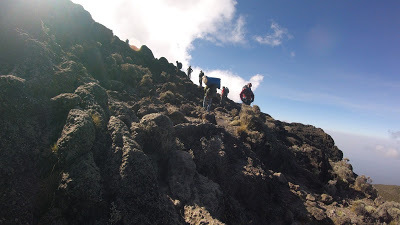 Making our way up the mountain
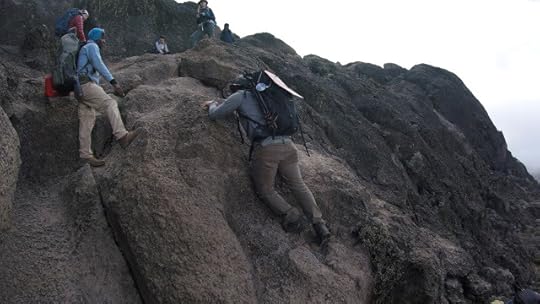 Me looking a little less than graceful with a pack and solar panel hanging from it
The summit itself was magnificent. Huge castle-like glaciers clung to the mountain's outer walls while the interior gave way to the depths of a long extinct volcano crater. We spent about 30-40 minutes going from Stella Point at the low point summit to Uhuru at the top. Once there, the clock was ticking. Spending too much time over 19,000 feet is not a great idea. Photos were taken, tears were shed (at the absolute beauty of our surreal surroundings), and congratulatory embraces were given freely.
 The summit!
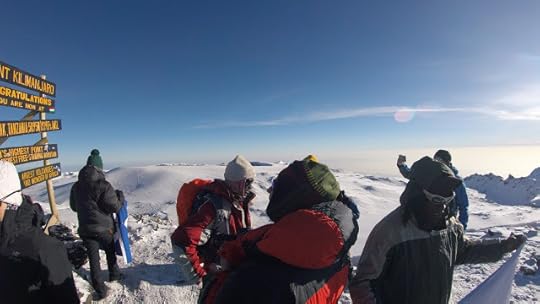
Getting ready for a team pic.
 Sunrise at the summit
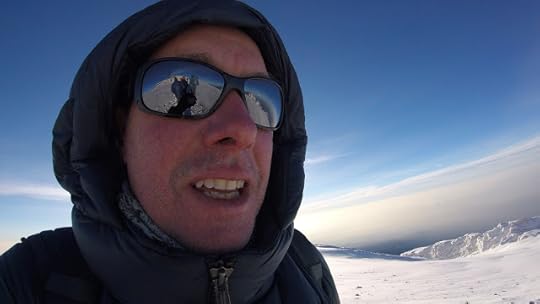 Cold at the top - see the glacier over my left shoulder
 White wonderland at 19,341 ft. Glaciers in the distance.
Throughout the trip, we we helped by guides and porters. The porters did every step of the trip we did except much faster and carrying much greater weight. Our guides made sure our pacing was perfect in order to limit recovery time needed and to aid in acclimatization. The guides were also fonts of knowledge for local flora and fauna.
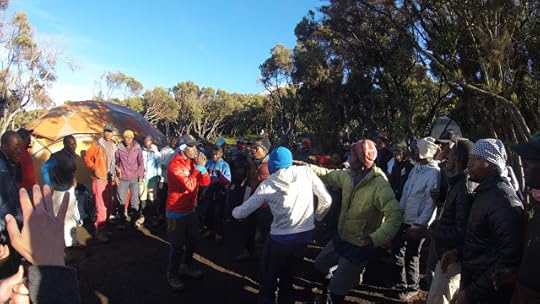
While being a porter is considered a good job in Tanzania, it is certainly a job no westerner would take. I have never seen people work harder in my life. I have also never witnessed people with such amazing dispositions and life outlooks. And that is something that can be found throughout Tanzania. The people there, in large part, are very poor - much poorer than I think most of us would even consider possible. But in the midst of poverty, they seem to be proud of who they are, have a lust for life, and a real desire to learn, to meet new people, and to share what they know. They take pride in appearance. Wherever we went people always looked good - children in spotless clothing, women in colorful dresses and head coverings, men in crisp shirts and pants. It was an odd culture shock from a western perspective - where we often look a bit, ummm... unkempt. On several occasions we joined our porters and guides in singing and dancing. The performances, in which we all participated, were beautiful and done with joyful abandon that quickly spread from Tanzanians to the visitors.
 Sharing songs and dances - Amani (in the orange) is leading this song
I had gone to Tanzania with quite a bit of money to buy gifts and mementos. Instead, I pretty much gave everything I brought away to help the people who had given me such a wonderful experience. Others in our group did much more - really stepping up to provide ongoing assistance to these sweet people who can do more with a little than others could do with a lot.
I hope to be back in Tanzania in the future and see and share more of the wonderful place that I would describe as a complex paradise.
Partial list of gear:
Patagonia Fitz Roy ParkaPatagonia Torrentshell JacketPatagonia Torrentshell PantsPatagonia Capilene Middleweight BottomsPatagonia Nano Puff VestBuff - 2 buffsJulbo Spectron 4 sunglasses - 2 pairSalomon 4D Quest Hiking BootsOutdoor Research Sol HatOutdoor Research Men's Arete GlovesOutdoor Research Rocky Mountain High Gaiters - note: did not use - in fact no one used the gaiters they brought on this trip.Marmot - Never Summer Sleeping Bag - note: the zipper malfunctioned, but I was able to use the bag for the trip. I spent a little time and fixed it upon my return home.Black Diamond Headlamp Go Pro Hero 4 CameraOsprey Kestrel 38 Pack - small, good pack - most of my provisions were carried by a porter.1 x 1 ltr and 1 x 1.5 ltr Nalgene bottles1 x 2 ltr - Nathan bladderLeki Trek Poles
I knew months in advance what I would be doing, so I purchased some gear and took a trip to Mt. Langley and also a trip to Anza Borrego to give it all a test run. I ended up purchasing better gloves and a much better summit coat - both of which served me well on the roof of Africa.
I don't know that I'll post a lot about the 10 days I spent in Tanzania, or the 8 days on the mountain. I feel too close to the immensity of the undertaking at the moment. Suffice it to say, the trip was beautiful in every sense of the word - the people, the scenery, the weather - everything we encountered made me grateful to have made the decision to go on the journey.
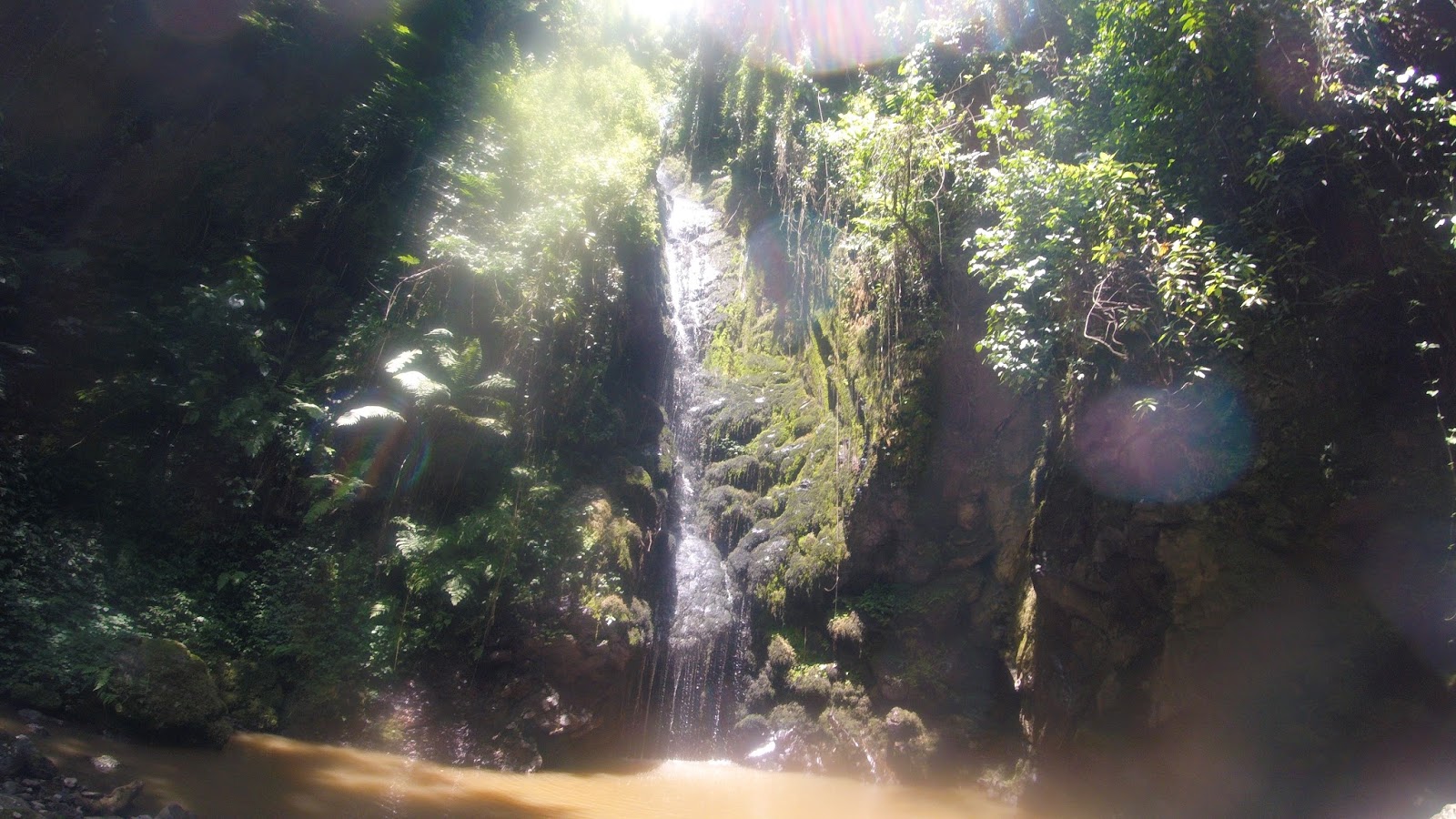 Waterfall we encountered while hiking through the coffee plantation/cooperative
The day before heading to the mountain, a couple of people joined me for a tour of a coffee plantation that was comprised of 2,200 small farmers who had banded together to create a cooperative. We spent the better part of a day walking along single track trails on the side of a mountain looking at the farms where banana and avocado trees shaded the coffee plants. We also saw calabash, maize and quinine trees. Adults we encountered were friendly and as curious about us as we were about them. Children waved and smiled and periodically followed us as we meandered along the pathways through the fields and ended up at a beautiful waterfall.
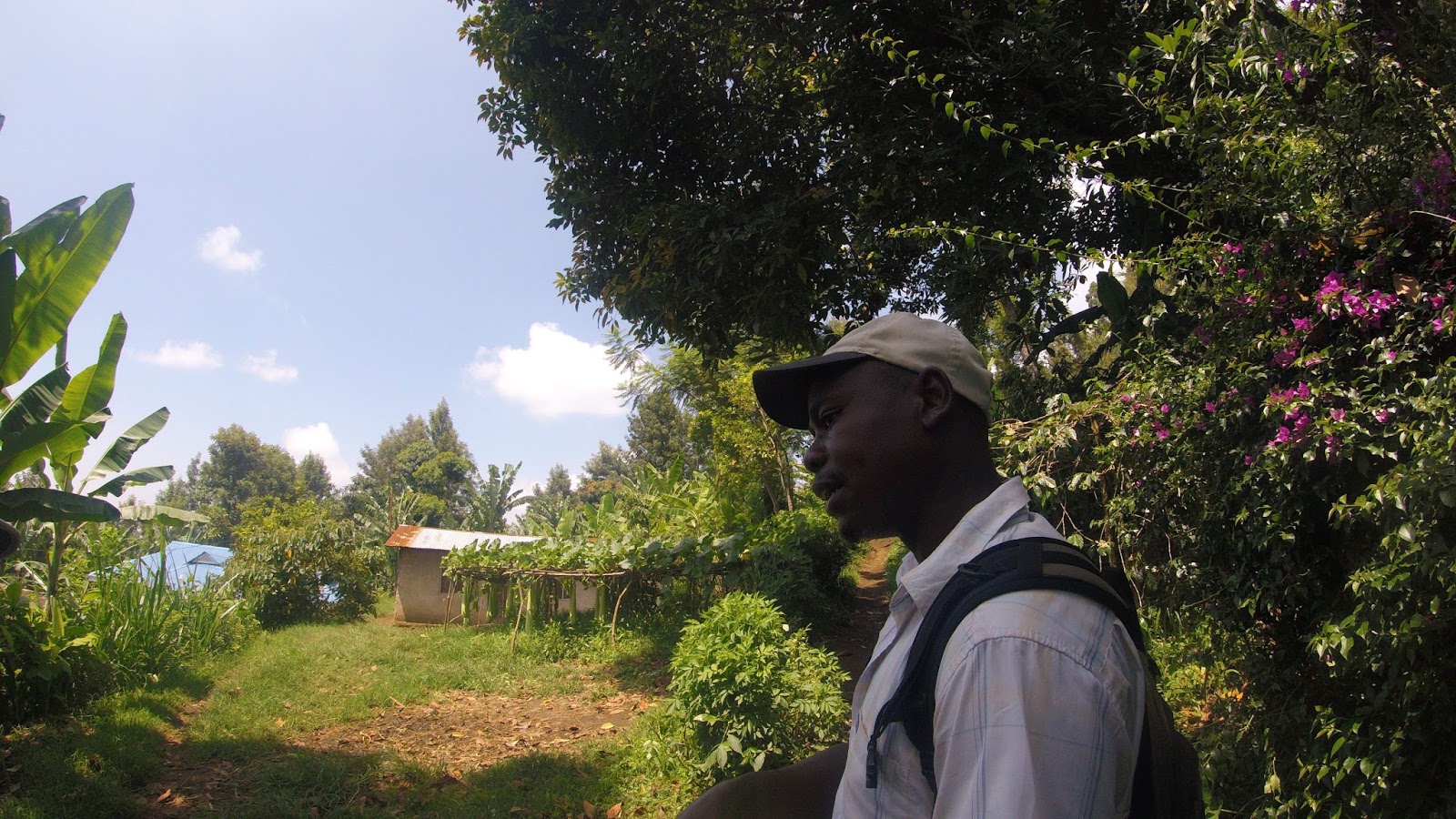 Clemency, our coffee guide, showing us calabash plants along the way - they are in the background hanging from a trellace set up in front of the little farmhouse.
The tour concluded with us preparing coffee from scratch. First we separated shells from the dried coffee beans by means of a very large 2 person mortar and pestle. Next we roasted the beans to a medium roast. To do this, we stirred the beans over open coals in a blackened ceramic pot using a wooden spoon. That took about 20 minutes. We then put the roasted beans back into the mortar and pestle and smashed them by hand into an espresso grind. The resulting coffee was shockingly sweet and delicious.
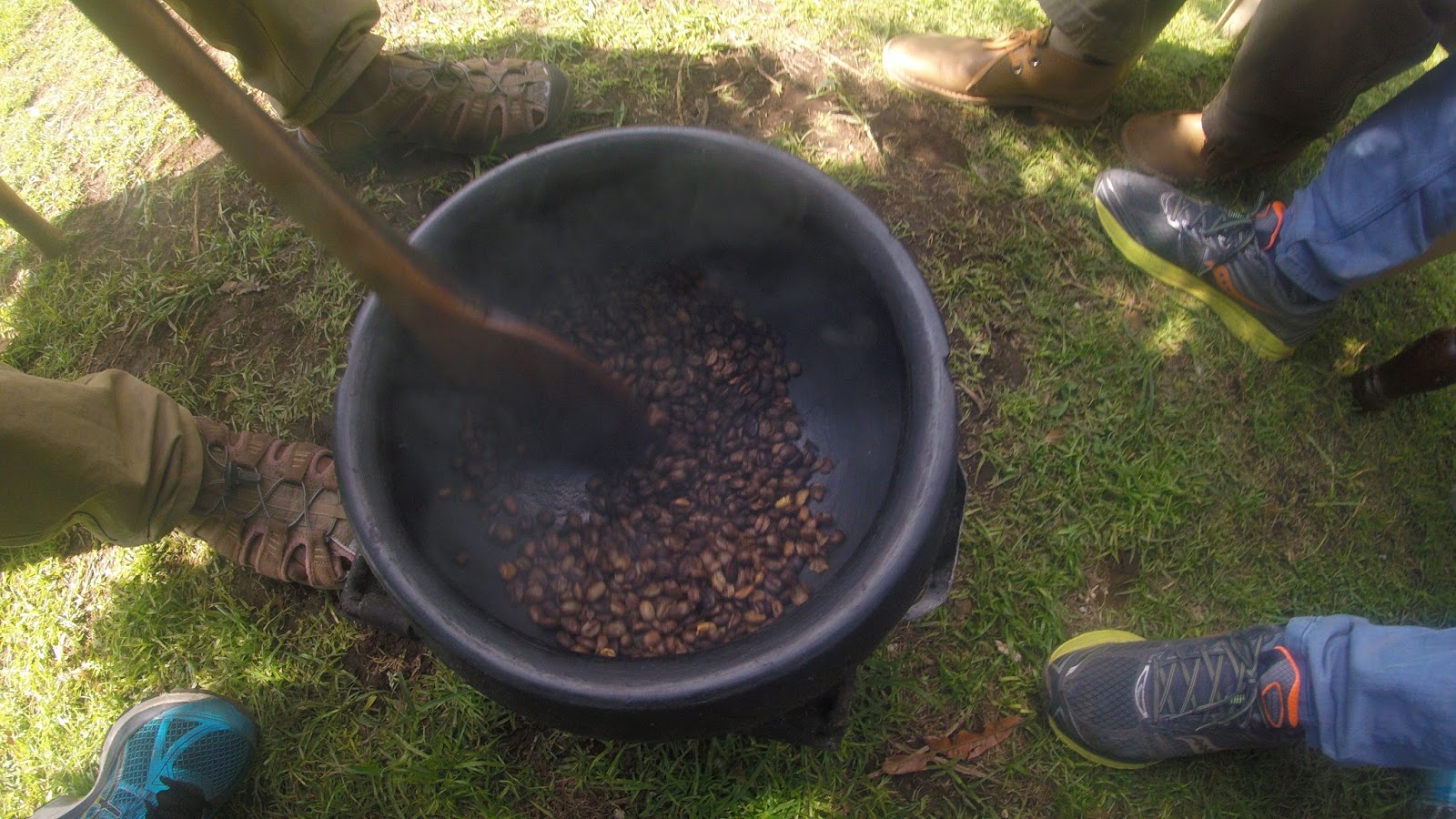 Using an age-old technique for getting the beans to a medium roast
For the rest of the trip, my highlights were the rainforest days at the beginning and end - where we encountered monkeys and a civet. My favorite climbing day was the famed Barranco Wall - I could've gone back down and done it again. My favorite plants were found in the same climate zone as the wall - the giant senecio https://en.wikipedia.org/wiki/Dendrosenecio and the lobelia deckenii https://en.wikipedia.org/wiki/Lobelia_deckenii The Lobelia, in particular, is a fascinating plant. It holds a large amount of water in its open leaves during the day. So much so that, in fact, you can scoop out water with your hand. The plant shuts back up completely at night in order to protect itself from freezing. As it ages, it grows a large flowering top with hundreds of buds in little cave-like enclosures that attract bugs. The bugs in turn attract birds, and the birds both help pollenate and repopulate the plant - making for a true symbiotic relationship.
The highlight of the trip was really the trip itself. The totality was certainly greater than the sum of the parts. However, since our group was interested in summiting, that remained the ultimate goal. It took us 6 hours of trudging from our high camp at 15,000 ft (already higher than any mountain in the US lower 48) to reach the summit at Uhuru Peak at 19,341 feet. We left camp at midnight in a snowstorm and simply went up at a snail's pace (due to the altitude). Step by step in the dark and cold for hours was psychically and physically difficult. There were many false summits. There were people we passed in serious distress due to altitude sickness - some heading down the mountain with help, while others paused to question the ramifications of following their dreams any further. Honestly, I had never seen people with altitude sickness beyond a minor headache. It was shocking and difficult to witness. All, at least, were being helped.
 Making our way up the mountain
 Me looking a little less than graceful with a pack and solar panel hanging from it
The summit itself was magnificent. Huge castle-like glaciers clung to the mountain's outer walls while the interior gave way to the depths of a long extinct volcano crater. We spent about 30-40 minutes going from Stella Point at the low point summit to Uhuru at the top. Once there, the clock was ticking. Spending too much time over 19,000 feet is not a great idea. Photos were taken, tears were shed (at the absolute beauty of our surreal surroundings), and congratulatory embraces were given freely.
 The summit!
Getting ready for a team pic.
 Sunrise at the summit
 Cold at the top - see the glacier over my left shoulder
 White wonderland at 19,341 ft. Glaciers in the distance.
Throughout the trip, we we helped by guides and porters. The porters did every step of the trip we did except much faster and carrying much greater weight. Our guides made sure our pacing was perfect in order to limit recovery time needed and to aid in acclimatization. The guides were also fonts of knowledge for local flora and fauna.
While being a porter is considered a good job in Tanzania, it is certainly a job no westerner would take. I have never seen people work harder in my life. I have also never witnessed people with such amazing dispositions and life outlooks. And that is something that can be found throughout Tanzania. The people there, in large part, are very poor - much poorer than I think most of us would even consider possible. But in the midst of poverty, they seem to be proud of who they are, have a lust for life, and a real desire to learn, to meet new people, and to share what they know. They take pride in appearance. Wherever we went people always looked good - children in spotless clothing, women in colorful dresses and head coverings, men in crisp shirts and pants. It was an odd culture shock from a western perspective - where we often look a bit, ummm... unkempt. On several occasions we joined our porters and guides in singing and dancing. The performances, in which we all participated, were beautiful and done with joyful abandon that quickly spread from Tanzanians to the visitors.
 Sharing songs and dances - Amani (in the orange) is leading this song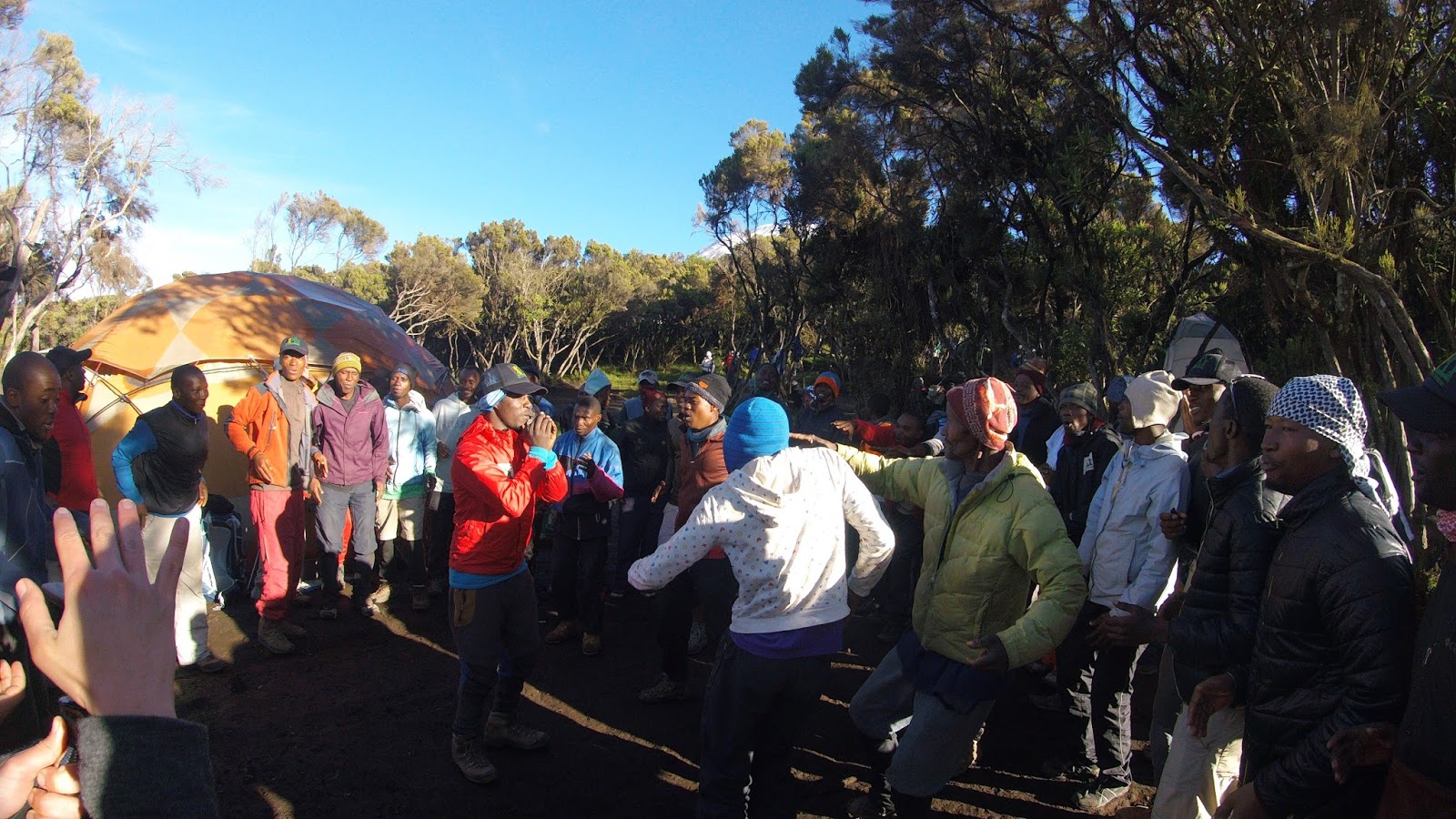
I had gone to Tanzania with quite a bit of money to buy gifts and mementos. Instead, I pretty much gave everything I brought away to help the people who had given me such a wonderful experience. Others in our group did much more - really stepping up to provide ongoing assistance to these sweet people who can do more with a little than others could do with a lot.
I hope to be back in Tanzania in the future and see and share more of the wonderful place that I would describe as a complex paradise.
Partial list of gear:
Patagonia Fitz Roy ParkaPatagonia Torrentshell JacketPatagonia Torrentshell PantsPatagonia Capilene Middleweight BottomsPatagonia Nano Puff VestBuff - 2 buffsJulbo Spectron 4 sunglasses - 2 pairSalomon 4D Quest Hiking BootsOutdoor Research Sol HatOutdoor Research Men's Arete GlovesOutdoor Research Rocky Mountain High Gaiters - note: did not use - in fact no one used the gaiters they brought on this trip.Marmot - Never Summer Sleeping Bag - note: the zipper malfunctioned, but I was able to use the bag for the trip. I spent a little time and fixed it upon my return home.Black Diamond Headlamp Go Pro Hero 4 CameraOsprey Kestrel 38 Pack - small, good pack - most of my provisions were carried by a porter.1 x 1 ltr and 1 x 1.5 ltr Nalgene bottles1 x 2 ltr - Nathan bladderLeki Trek Poles
January 12, 2018
Change in an Instant
The following is a piece I had written in 2017, late summer, after a bike accident. I didn't publish at the time because I needed a bit of distance mentally to recalibrate and to change my focus from simply running, and fitness for fitness' sake, to a more well-rounded fitness with a purpose mind-set. Don't get me wrong. Running is still the pinnacle sport for me. It brings a self-awareness that is lacking in other sports (at least for me). There is a no BS factor to running. You either do it or you don't. But running won't help you climb mountains or hike long distances with a pack. I always thought it would, but it doesn't.
Over the past 5 months I've worked with a trainer in a gym in order to improve fitness. I've also spent time with experienced friends as I have learned about mountaineering, trekking, multi-day hiking and camping, high-altitude assimilation and gear and the fitness needed to make weeks long trips successful. It is my hope that the accident in 2017 will lead to travels and treks in places both in the US and around the world that will be challenging and affirming, but also will allow me to be immersed in other cultures - to learn from and perhaps adopt good practices from the people I hope to meet along the way.
So here is the original post a few months later:
I had a bike accident on the trails recently that put the kibosh on either the Grand Canyon R2R2R or the Zion Traverse for 2017. My buddy, Chris, and I had planned to do one of the runs in October (which had already been rescheduled from March - following the Joshua Tree Traverse). But missing a month of real training in the two months leading up to the run shut down any notion of being able to knock it out in 2017. And, since 2018 and 2019 are just around the corner, I've little doubt that we will be able to push through one of the runs in the next 12-24 months.
The accident, which injured a hip and lung, put me off all training for about 5 days. Then I could only run short painful distances - 3-5 mi - before I wanted to stop. After a few weeks, the daily runs were 4 - 10 miles. But they were still irritatingly slow. Breathing was always painful. And in bed at night I had to lie in very specific positions in order to ease the pain enough to fall asleep. It has only been in the past couple of weeks that sleep hurts a bit less and speed and distance are starting to return to my runs.
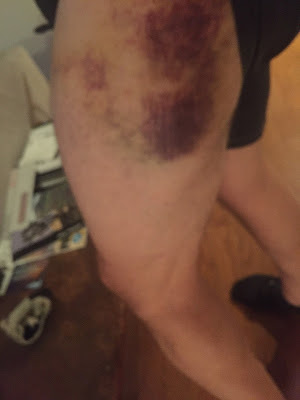 Here's a lovely pic of my leg below my hip taken a few days after the wreck. Ouch, Elliot!!
The break from mega miles allowed me to step back from my normal routine and examine what I am doing, and what I wish to accomplish over the next few years (in addition to the above-mentioned R2R2R or Zion Traverse). Having an accident of the sort I did made me aware of just how lucky I have been to be healthy and injury-free (mainly) for most of my life. But it also reminded me that circumstances can change in an instant. There are many things I want to do and have put off for various reasons. I want to climb several mountains, see two or three ancient ruins that I have not been to before, and finally hike in remote portions of the Southern Hemisphere.
So, while recuperating, I decided to stop waiting to do the things I want to do. I booked a couple of trips to climb mountains. I hired a trainer to work with me to build core strength. I dropped 15 lbs so far. I'm hoping to drop another 10-15 in the coming 2-3 months. I figure the less weight one carries up the side of a mountain, the better. If I go in a bit underweight, I'm sure I'll be able to put it back on upon my return home.
Anyway, what sort of amazed me about everything is how easy it is. We live in a world where one simply can decide to undertake what in previous times would have been an epic journey. While still challenging, today we can simply set our minds to do wonderful things, train, learn, and then go and do. You do not have to be rich or a top-tier athlete. You just need to decide what you want to do and then commit. And think about doing it soon. Because life can change in an instant.
Over the past 5 months I've worked with a trainer in a gym in order to improve fitness. I've also spent time with experienced friends as I have learned about mountaineering, trekking, multi-day hiking and camping, high-altitude assimilation and gear and the fitness needed to make weeks long trips successful. It is my hope that the accident in 2017 will lead to travels and treks in places both in the US and around the world that will be challenging and affirming, but also will allow me to be immersed in other cultures - to learn from and perhaps adopt good practices from the people I hope to meet along the way.
So here is the original post a few months later:
I had a bike accident on the trails recently that put the kibosh on either the Grand Canyon R2R2R or the Zion Traverse for 2017. My buddy, Chris, and I had planned to do one of the runs in October (which had already been rescheduled from March - following the Joshua Tree Traverse). But missing a month of real training in the two months leading up to the run shut down any notion of being able to knock it out in 2017. And, since 2018 and 2019 are just around the corner, I've little doubt that we will be able to push through one of the runs in the next 12-24 months.
The accident, which injured a hip and lung, put me off all training for about 5 days. Then I could only run short painful distances - 3-5 mi - before I wanted to stop. After a few weeks, the daily runs were 4 - 10 miles. But they were still irritatingly slow. Breathing was always painful. And in bed at night I had to lie in very specific positions in order to ease the pain enough to fall asleep. It has only been in the past couple of weeks that sleep hurts a bit less and speed and distance are starting to return to my runs.
 Here's a lovely pic of my leg below my hip taken a few days after the wreck. Ouch, Elliot!!
The break from mega miles allowed me to step back from my normal routine and examine what I am doing, and what I wish to accomplish over the next few years (in addition to the above-mentioned R2R2R or Zion Traverse). Having an accident of the sort I did made me aware of just how lucky I have been to be healthy and injury-free (mainly) for most of my life. But it also reminded me that circumstances can change in an instant. There are many things I want to do and have put off for various reasons. I want to climb several mountains, see two or three ancient ruins that I have not been to before, and finally hike in remote portions of the Southern Hemisphere.
So, while recuperating, I decided to stop waiting to do the things I want to do. I booked a couple of trips to climb mountains. I hired a trainer to work with me to build core strength. I dropped 15 lbs so far. I'm hoping to drop another 10-15 in the coming 2-3 months. I figure the less weight one carries up the side of a mountain, the better. If I go in a bit underweight, I'm sure I'll be able to put it back on upon my return home.
Anyway, what sort of amazed me about everything is how easy it is. We live in a world where one simply can decide to undertake what in previous times would have been an epic journey. While still challenging, today we can simply set our minds to do wonderful things, train, learn, and then go and do. You do not have to be rich or a top-tier athlete. You just need to decide what you want to do and then commit. And think about doing it soon. Because life can change in an instant.
December 24, 2017
2017 - Best of:
I thought I'd take a moment and make a year-end list of things that I have enjoyed in 2017. I don't think a lot of explanation about each item is necessary. If you find something intriguing, please feel free to write me or to explore it on your own.
Best Thing I Did in 2017:
No question that the Joshua Tree Traverse was the best thing I did. To spend a day deep inside the spectacular national park with two friends on a self-contained 40 mile sufferfest was not simply a highlight of the year, but a highlight of my life. It was, for me, life-affirming and life-changing. The teamwork and camaraderie needed in planning and training with trips to the desert park that preceded the traverse all combined to make the whole experience tremendously fulfilling.
Scoring honorable mentions in the Best Thing I Did category were two trips: The first to Colorado to climb Mt. Evans by bike, and Mt. Massive a pied. The second to spend a few days in the Sierras hiking and camping above 11,500ft, culminating at the summit of Mt. Langley.
A couple of kayak trips down the Kaw also deserve honorable mentions as well. Too often I think I neglect to appreciate some pretty wonderful things I have right in my back yard. Paddling down a deserted huge river with a buddy, seeing bald eagles, and then hanging out midstream to watch fireworks going off overhead at the conclusion of the trip - priceless.
A sub category here - Top Adventure Buddy. There were five friends in the running for this designation who I joined in various forays into the wilderness. But there was only one who was involved in several episodes of the craziness. Jack Tyson gets this year's TAB award. He was instrumental in the success of the traverse. He also was the planner, stager, and teacher for the backpacking trip up Langley. That trip gave me a new level of confidence to tackle bigger mountains in 2018.
Best Thing I Read:
Two non-fiction books tie for the honor in this category - Buried in the Sky: The Extraordinary Story of the Sherpa Climbers on K2's Deadliest Day by Peter Zuckerman tells the story of a tragedy from the (often ignored) perspective of the Sherpas and high altitude workers who performed heroically throughout the ordeal. And Empire Made: My Search for an Outlaw Uncle Who Vanished in British India by Kief Hilsbery, which is a personal story that tracks one family's roots through the period of British colonial rule in India and its neighboring countries.
The best work of fiction I read this year was from Irish author Sebastian Barry. His novel, Days Without End , about two homeless youths trying to survive in the American West in the mid 1800's, is a masterpiece.
The best magazine I discovered was Alpinist. While it is one of those expensive quarterly publications, the writing and pictures are nonpareil. After buying my first issue at the newsstand, I finally ponied up the cash for a subscription (and I'm glad I did). Each issue is like getting a new wonderful book to read.
Best Thing I Saw:
I'm just going to have to list these in no particular order. I saw a lot of things that moved me in different ways (though a few were simply low-brow diversions that I found enjoyable). Some are series, some are movies, and some are documentaries:
Banff Film Festival - always good. Always.
Merli
I am Bolt
Master of None
Outback Truckers - all seasons(I really apologize for liking this, but I do)
Magnus
Sirens - both seasons
Valley Uprising
One Mississippi
Shot in the Dark
Atypical
Best Thing I Listened To:
The Mighty Mighty Bosstones concert which ended with my top song by them, Pretty Sad Excuse, topped my listening experiences this past year. And, while none of the following would qualify as my favorite song/band/artist, I listened to a lot of:
Kishi Bashi - any song
Matthew Byrne/Great Big Sea - The River Driver
Oliver Daldry - Catch the Wind
Lord Huron - The Night We Met
Teleman - Dusseldorf
Best Art/Science Experience:
I acquired many works of art this past year. My favorite piece would have to be by the very talented artist, Samara Umbral 5 Alive/Surge. A couple of photos by German artists, Jeanne Faust, Zu Sonst Wer Wie Du, and Tobias Zielony, Licht, also struck a chord within me. During the year I was also privileged to purchase works by Greg Thomas and Lisa Grossman to give to friends as gifts. For me, there is little that is better than being able to give a friend a piece of art he/she likes. The gift is good for the friend, but it also helps the artist to continue to make a living pursuing their passion.
While it wasn't really visual, Janet Cardiff's Forty Part Motet at the Nelson was a real highlight of the year for me. I experienced the Motet on numerous occasions, and each time I was transfixed. It never got old.
And finally, the Cockefaire lecture series at the Linda Hall Library - tracing the Transformation of the World - 1650-1720 was, perhaps the most knowledge I had dropped on me in a short time (over the course of three lectures). If you haven't been to an event at Linda Hall, or have not even visited the library, you should really put it on your schedule.
Best Thing I Did in 2017:
No question that the Joshua Tree Traverse was the best thing I did. To spend a day deep inside the spectacular national park with two friends on a self-contained 40 mile sufferfest was not simply a highlight of the year, but a highlight of my life. It was, for me, life-affirming and life-changing. The teamwork and camaraderie needed in planning and training with trips to the desert park that preceded the traverse all combined to make the whole experience tremendously fulfilling.
Scoring honorable mentions in the Best Thing I Did category were two trips: The first to Colorado to climb Mt. Evans by bike, and Mt. Massive a pied. The second to spend a few days in the Sierras hiking and camping above 11,500ft, culminating at the summit of Mt. Langley.
A couple of kayak trips down the Kaw also deserve honorable mentions as well. Too often I think I neglect to appreciate some pretty wonderful things I have right in my back yard. Paddling down a deserted huge river with a buddy, seeing bald eagles, and then hanging out midstream to watch fireworks going off overhead at the conclusion of the trip - priceless.
A sub category here - Top Adventure Buddy. There were five friends in the running for this designation who I joined in various forays into the wilderness. But there was only one who was involved in several episodes of the craziness. Jack Tyson gets this year's TAB award. He was instrumental in the success of the traverse. He also was the planner, stager, and teacher for the backpacking trip up Langley. That trip gave me a new level of confidence to tackle bigger mountains in 2018.
Best Thing I Read:
Two non-fiction books tie for the honor in this category - Buried in the Sky: The Extraordinary Story of the Sherpa Climbers on K2's Deadliest Day by Peter Zuckerman tells the story of a tragedy from the (often ignored) perspective of the Sherpas and high altitude workers who performed heroically throughout the ordeal. And Empire Made: My Search for an Outlaw Uncle Who Vanished in British India by Kief Hilsbery, which is a personal story that tracks one family's roots through the period of British colonial rule in India and its neighboring countries.
The best work of fiction I read this year was from Irish author Sebastian Barry. His novel, Days Without End , about two homeless youths trying to survive in the American West in the mid 1800's, is a masterpiece.
The best magazine I discovered was Alpinist. While it is one of those expensive quarterly publications, the writing and pictures are nonpareil. After buying my first issue at the newsstand, I finally ponied up the cash for a subscription (and I'm glad I did). Each issue is like getting a new wonderful book to read.
Best Thing I Saw:
I'm just going to have to list these in no particular order. I saw a lot of things that moved me in different ways (though a few were simply low-brow diversions that I found enjoyable). Some are series, some are movies, and some are documentaries:
Banff Film Festival - always good. Always.
Merli
I am Bolt
Master of None
Outback Truckers - all seasons(I really apologize for liking this, but I do)
Magnus
Sirens - both seasons
Valley Uprising
One Mississippi
Shot in the Dark
Atypical
Best Thing I Listened To:
The Mighty Mighty Bosstones concert which ended with my top song by them, Pretty Sad Excuse, topped my listening experiences this past year. And, while none of the following would qualify as my favorite song/band/artist, I listened to a lot of:
Kishi Bashi - any song
Matthew Byrne/Great Big Sea - The River Driver
Oliver Daldry - Catch the Wind
Lord Huron - The Night We Met
Teleman - Dusseldorf
Best Art/Science Experience:
I acquired many works of art this past year. My favorite piece would have to be by the very talented artist, Samara Umbral 5 Alive/Surge. A couple of photos by German artists, Jeanne Faust, Zu Sonst Wer Wie Du, and Tobias Zielony, Licht, also struck a chord within me. During the year I was also privileged to purchase works by Greg Thomas and Lisa Grossman to give to friends as gifts. For me, there is little that is better than being able to give a friend a piece of art he/she likes. The gift is good for the friend, but it also helps the artist to continue to make a living pursuing their passion.
While it wasn't really visual, Janet Cardiff's Forty Part Motet at the Nelson was a real highlight of the year for me. I experienced the Motet on numerous occasions, and each time I was transfixed. It never got old.
And finally, the Cockefaire lecture series at the Linda Hall Library - tracing the Transformation of the World - 1650-1720 was, perhaps the most knowledge I had dropped on me in a short time (over the course of three lectures). If you haven't been to an event at Linda Hall, or have not even visited the library, you should really put it on your schedule.