
Stephen K. Hayes's Blog
November 19, 2025
Ichi-Go Ichi-E, Wisdom for the Holidays
We spend days – weeks even – preparing our recipes, fussing over the physical preparations, but how are we preparing to meet what is the most important part of a Holiday…our relationships with the people present?


August 3, 2025
Mountain Quest 2025
Rainy Mountain Quest is now a grand memory…
As promised, I will list notes from the kata taught over the August 2025 weekend.
These are from the Kuki Shinden Ryu bojutsu collection Sabaki Kata
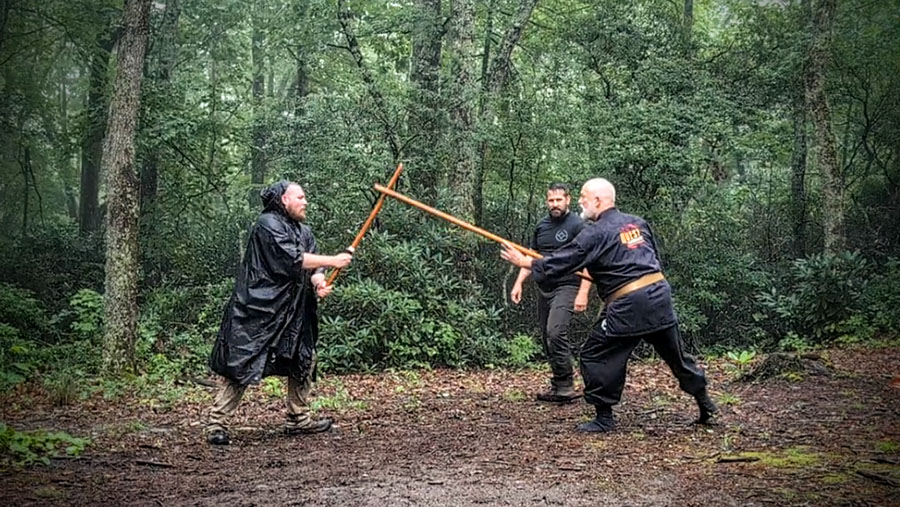
GEKICHU
From left (…your left side forward) seigan no kamae, left (…side forward) tsuki thrust.Right (…side forward) yoko men lateral head strike (…to his left).Right (…side forward) tsuki thrust.Flip strike tip back, swing overhead, and hit with right (…side forward) do uchi torso strike (…to his left ribs)Resume left seigan no kamae.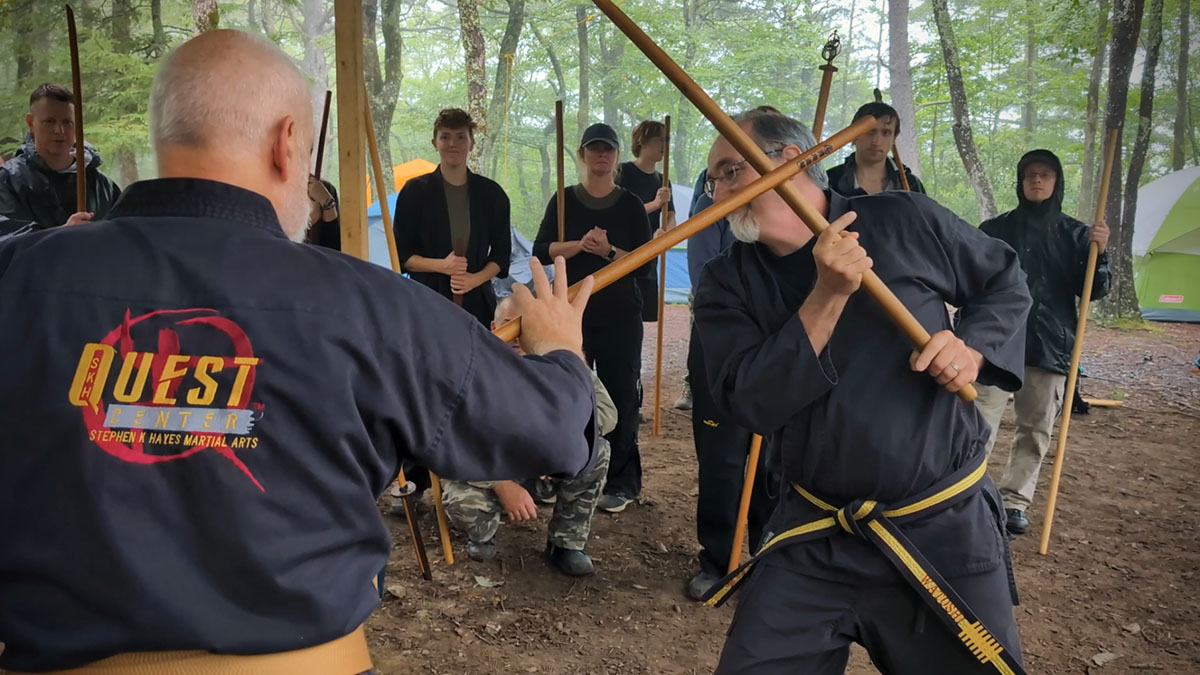
KERI AGE
From left (…your left side forward) hokosaki no kamae (seigan with rear tip low), left tento men downward head strike.Leave the bo in position and step into right (…side forward) hokosaki.Right (…side forward) tento men downward head strike.Leave the bo in position and step into left (…side forward) hokosaki.Feint with left (…side forward) tento men, suddenly convert to left (…side forward) do uchi torso strike to his right ribs.Resume hokosaki no kamae.I did not include the description of what the adversary is doing with his sword in these descriptions.
I don’t expect anyone to learn and apply this technique without having been there.
It is listed as a reminder for those coached through the kata at Mountain Quest 2025.
February 15, 2025
Best Martial Arts Advice I’ve Been Given
Best advice ever given? “Know yourself and exactly why you are training in the martial arts, then carefully select the best role model teacher who directly addresses your motivating passion.”
50 years ago I looked all across America for a teacher who inspired me with his skill, ability to teach, and who lived an exemplary life. Awkwardly, too many martial artists I found in the early 1970s were into the drug scene, suffered from disastrous relationships, and seemed to put self-promotion ahead of sharing warrior discipline. I was finally driven overseas to find a teacher worthy of me, and a martial art that clearly addressed what I wanted to get.
It is so important to consider the character, knowledge, life values, and life style of anyone you would call teacher. You are getting so much more than just technique. You are getting a way of thinking, a way of relating to problems, a way of finding solutions, a way of regarding those who would attack you, and even a way of dealing with those who would befriend you.
Unfortunately, I have seen too many young students sign on with a real low life teacher, perhaps knowing his flaws, but convinced they can learn some technique without also taking on his negative aspects. I silently shake my head. It is just not worth the risk. Pick a skilled teacher you respect and hope to be like one day. Training with a bad person is its own punishment.
This naive ignorance regarding a teacher’s influence is even more awkward today. When I was studying martial arts in the 1960s, the most important question was, “Who is your teacher?” That does not seem to count for much these days. Young people seem to have no appreciation for the importance of lineage in martial arts study. Everybody is on their own, taking little bits from various seminars and blending a best-guess as to what is proudly called one’s “own system”.
I say find someone who lives what you admire, and commit to studying with them.
December 27, 2023
Year End “Big Clean”
Ō-sōji (literally, “big cleaning” at year end) is a significant tradition in Japan. This ritual symbolizes purification and renewal of one’s home, workspace, dojo, and environment. Transcending mere physical cleaning, it assumes a spiritual dimension.
Take time to clean areas that may usually be passed over. Get rid of things you don’t use. Use a super sensitive eye to re-see cluttered areas you have become blind to. In particular, make sure your dojo shrine shelf sacred area is cleaned and renewed. Clean and declutter the entrance to your dojo. A fresh entry will welcome positive energy.
Cleaning is a symbolic act of bidding farewell to the old year (and problems or impurities it brought). By thoroughly cleansing your home and dojo, you purify your heart and mind. You make space for new blessings, good fortune, and positive energy in the coming year. We can then welcome the new year with a sense of spiritual freshness, having prepared our dojos and homes for renewal.
October 28, 2023
Things Come to Pass
[image error]
42 years ago I stood at this Togakure Mountain shrine. I was just beginning my work of promoting the ninja martial art, making my teacher an international martial arts celebrity, and testing myself out in the rough competitive world of martial arts systems. I was full of enthusiasm, confidence, and determination.
Over the decades, I underwent the bright heights of personal accomplishment, fulfilled purpose, and success. I was also subjected to the dark depths of betrayal, jealousy, and cowardly back-stabbing. The ninja martial art turned out to be far more nuanced and complex than the straight-forward karate world I had inhabited in the 1960s.
Now 42 years later, I have come full circle. I understand at deeper levels. I have developed an ability to quickly grasp what an aggressor wants to do, and that allows me to give him what he expects as a way to confuse him. I have also become an expert on the laws and how they are used against good and noble defenders.
Full circle indeed. I am quieter now. I would much prefer to get others talking so that I can learn more about what motivates (and limits!) them. I am quick to compliment and praise the other’s martial art, whether I believe in it or not. I prefer to stay unpredictable by appearing predictable. I am pleased to say I fully got what I set out to find when beginning my martial arts training those decades ago.
From here on out, I serve what advances my life while making the world a better place.
July 27, 2023
Dealing With Symmetrical and Asymmetrical Violence
The purpose and methodology preserved in our To-Shin Do kata were not created to address mutually consented fighting, where we agree to fight another martial artist until one of us quits. Our practice methods address handling non-consensual violence. That means self-protection, or stoping harm when attacked with criminal violence.
The purpose determines the strategies used to achieve the goal. The strategies dictate the tactics. The tactics determine the choice of techniques. “Winning a fight I agreed to take part in” is not the same as “eliminating harm from invasive criminal violence”. You can’t take the strategies, tactics, and techniques used to achieve one goal and put them into action to achieve a different goal.
This is not a value judgement of one over the other. It is instead a decision as to what is appropriate and relevant for a specific objective. Change the goal, and your ways of reaching that goal have to change too.
In our To-Shin Do training, we have to recognize why our kata is not appropriate for consensual fighting. It is designed for non-consensual violence. Our techniques were developed by intelligence gatherers who hoped to never have their cover blown, requiring them to fight another in a prolonged battle. If an enemy did discover that they were there on nefarious purposes and attempted to restrain them, they needed methods to counter the enemy’s technique quickly and make an effective escape.
We must understand the huge differences between consensual fighting and non-consensual violence. Consensual fighting is usually face-to-face, with the goal of overcoming another who, like us, is probably going to use in-and-out attack-and-withdraw techniques. For consensual fighting, there is no need to study attacks from the rear, grab immobilization manhandling, chokes, eye and throat attacks, and limb damaging responses. These are all methods inappropriate for a symmetrical match where there are two trying to singularly emerge victorious. In a surprise assault, however, asymmetrical attacks from unsuspected angles, surprise initiation, rough manhandling, more than one assailant, and a continuous barrage of strikes and immobilizations require a different form of response from the victim. There is clearly an attacker and a defender.
This is a vital difference we need to grasp if we are to understand the methods handed down through traditional kata in To-Shin Do training. Our goal is to use our training to develop specialized skills of evading and then entering our strikes and takedowns where the attacker is momentarily off-center and out of balance. In that way, we use timing, leverage, and simplicity in place of the conventional fighter’s speed, strength, and complexity.
June 29, 2023
To-Shin Take Charge of Your Thoughts
We all have bad days.
Here’s another truth. Our To-Shin Do training teaches us that no one is in charge of your mood but you. No one can hurt your feelings. No one can make you mad.
I know. This conflicts with the currently popular view where everyone believes they are a victim. But an even older theory states that if you can give your power away to outside circumstances, you can choose to take it back. It takes an awareness that, at every moment in life, you are 100% responsible for your own happiness. That is your power. That is your choice. And you can choose not to give your power away to technology, situations, or other people.
One great secret to not having bad days is to not take other people’s behaviors personally. Look at most people and you will see they are stumbling through life presumably doing the best they can. They are not deliberately trying to hurt your feelings, insult you, or ignore you. They are trying to win and you somehow got in their way. They are barely aware of their own perceptions.
So, when you’re having a bad day because something has gone wrong, remember there are ways to break the cycle.
Develop the skill of awareness. When something goes bad, stop and notice how it makes you feel. Say “OK, this is the way it is. And I have the power to change that.”Decide to do a pattern interrupt at that point. You cannot think of two things at the same time. If you’re thinking about what a bad day you’re having, you cannot think about all the wonderful things happening in your life. It is your job to focus on the things that make you happy, make you feel better, or lead to a better world.Take a few moments to focus in on something that makes you feel good – petting your dog, listening to inspiring music, going outside to take in the beauty of nature, calling a friend to chat for a few minutes. Any kind of pattern interrupt is needed, where you’re not thinking of the bad day or the bad thing that just happened.Reframe the event. Put the event in perspective. If you think about it, in the great scheme of life and the world, in 10 years our problems will be seen as pretty insignificant.Mentally make a short list of what you’re grateful for. Be aware of how you can be of service to someone else.Ask yourself, “Where does this pattern come from? Who taught this to me?” You may be surprised that you picked up this negative belief pattern from someone in your life. Choose to change the belief pattern. Choose a different outcome for the situation. Script a different result.Realize that it’s your job to look for solutions in life. Stop focusing on the negative “bad” day’s events. Power in life is seeking out the solutions to the challenges you face.And in truth, once you choose to get past the bad of the day, in the big scheme of life, you probably won’t even remember what happened that day.
May 25, 2023
Clarifying My New Position
In my mid-70s, I now call myself retired. That just means I no longer run a dojo, I drastically cut back on my traveling seminars, and I have assigned rank-awarding duties to the To-Shin Do seniors.
I am however still working with a select few dedicated students.
In the past, I devoted my entire life to promoting our martial art in the public eye. I had no job or other commitment that could split my devotion to promoting To-Shin Do. We did our best to attract all who might have been seeking a martial art dedicated to absolutely effective self-protection – from the physical perspective, the legal entanglements, and the inner reality of dealing with violence in the most effective manner. I think we were pretty unique. I knew of no other martial art that we could have been compared to.
My focus is now much smaller than it was years ago. I leave the promotion and building of To-Shin Do to anyone who wants to take it and address new frontiers. Let’s see if there is a legacy that others choose to carry on?
I have accomplished my 2-fold purpose. That purpose was 1. to gain access to the secrets of how to handle physical altercations and 2. the secrets behind the arcane Asian spiritual paths. I consider myself successful. I got what I was looking for. And I did it all for myself. Yes, I aided countless people along my way, but I was focused on my own growth way more than I was ever focused on any student’s growth.
I am still available to all who seek me out. I am willing to teach anything I know. I am just a bit harder to access for regular training.
For some, I will be an “advisor”. I will offer my knowledge that you will add to your greater amalgam of martial capability. You will have other teachers of other systems you study with too, and I will be just one more voice added to the chorus guiding you. Admittedly, in many cases, those other systems will not align with the purposes or principles of To-Shin Do, but that is OK with me if it is OK with you. We will focus on whatever I can offer to make you a better martial artist.
For others, I will be a “teacher”. I will guide you in all aspects of your journey. I will share core knowledge in how to be the most effective at self-protection, how to run a successful school, how to adapt the lessons from the dojo into lessons in living as a powerful, dignified, and focused individual, and how to effectively teach your own students. Most likely you will be solely focused on To-Shin Do as your martial practice, with little time devoted to other martial arts with principles at odds with To-Shin Do. We will focus on your becoming a tatsujin “fully actualized human being”.
We can do private lessons in my house dojo or by Zoom. Lessons can cover physical applications, history, philosophy, and personal development. I will only teach what I know and daily demonstrate in my life, because those are the things I truly believe in. Lessons can focus on modern considerations we developed from the mid-1990s, or on historic bases for knowledge of the ninja ways I studied in the 1970s.
Think about it. Are you one of the few up for a special relationship with the aging slightly more reclusive founder of To-Shin Do? I am still here. Will you choose to be here too?
April 27, 2023
The True Awakening Behind the Kuji Mudras and Mantras
There are so many variations on the ninja’s kuji-kiri and kuji-in, huh? I believe people are hoping to find the “one and only authentic kuji system”, and they are confused by the differing deities and states assigned to the various mudra and cuts depending on where and from whom one learns the kuji.
This makes sense to me. Just like there are variations in all the martial art systems, so there are variations (sometimes radical) in the kuji systems. I think above all, regardless of system, it is necessary for one to absolutely believe in the power of kuji, unquestioningly, just as a Catholic believes in the power of making the cross or an Islamic believes in touching the 3 centers.
The 9 (actually 10…) “deities” associated with the kuji are in truth more accurately experienced as “states” or “experiences” or perceptions, personified as named deities. For example Fudo Myo-Oh is a symbol for kuji 1’s state of imperturbable physical, mental, and spiritual strength, as the antidote to what decreases those strengths. It is totally possible to link to that strength directly, without having to reference or identify with the character Fudo Myo-Oh. Though we usually do teach kuji 1 with a reference to Fudo and his sword and rope, it is more important to use the mudra to link to the actual state of strength.
February 26, 2023
The Tragedy of the “Wave Person”
There is an American interpretation of a Japanese concept that is totally backwards.
Some martial artists love to brag that they are “ronin”, a lone masterless samurai. They even name their (usually small) training halls “Ronin Dojo”.
Maybe this comes from a misguided sense of the American pioneer spirit, going it alone to forge a new destiny? But even those original pioneers needed each other. They needed a community, needed helpful backup, to contend with the savage onslaught of killer bandits, righteous Indians, snakes, wolves (always in a pack), tornados, and flash floods. One single wagon creaking across the vast prairie and through the mountains all by itself would have been suicide.
Likewise the samurai of old Japan. What was most desired was warrior protector employment with the most powerful group possible. One would accept ronin status only at the very bottom of the barrel. Being a ronin was a tragic fate, usually reserved for left-over samurai from a defeated and disbanded army, and usually a not so specially skilled samurai. It was a bitter and tragic fate.
In modern times, Japanese youth who do not qualify for the university, and therefore have to take an involuntary year of hanging around before applying again the next year, refer to their status as being a “ronin”. It is a sad term, filled with regret and a little bit of irony. Nobody wants to be a ronin.
Bragging of being a “lone wolf” can come from a deep fear that we are not worthy of others showing up for us or caring about us. Others see us as just not worth our involvement. Maybe something important for American martial artists to explore – if they dare? The ronin label in America becomes a twisted badge of honor, a proclamation of “I don’t need any help” or “I want to do it my way” or “Nobody knows as much as me”, spoken life a defiant 5-year old.
But it could also mask a deep fear of not being worthy of help, unworthy of advice from more skilled people, or not deserving of a community. Being a ronin is, in its original meaning of being a “person (as short-lived and ephemeral) as a wave”, a truly pitiable condition. You are no more than an ocean wave to be seen and immediately forgotten? No Japanese wants to be exiled from community, wandering lonely and rejected through life. Is it truly any different for Americans?
The martial arts of old Japan have been branded by Miyamoto Musashi as the dokko no do, the “solitary way”. You set out alone and either make it or fail. But is this the best attitude for martial artists today? What will you have learned by the time that it is all over, and are you willing to accept ultimate defeat as a possibility? And what if your final lesson was “I should have opened up to the camaraderie of my fellow followers of that path”?
I think that there is incalculable power in having a strong community that has your back, that will stand with you, and sometimes allows you to aid them. The bigger and more caring the community, the more advantage you gain. How sad and lonely is that single practitioner, too good for advice, beyond learning from others’ shared lessons, and at core, so brittlely terrified that maybe, just maybe, they are not worthy of others’ care and shared joy.
Branding yourself a ronin is not a badge of honor. It is to admit to the final disgrace of simply being of no value to all others.
Stephen K. Hayes's Blog
- Stephen K. Hayes's profile
- 56 followers

