P. Jo Anne Burgh's Blog
October 24, 2025
And Then, We Were Seven
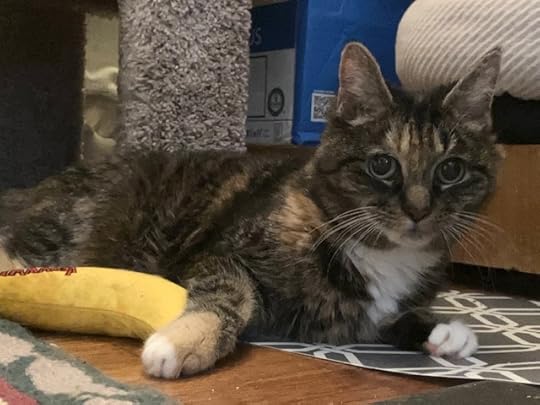
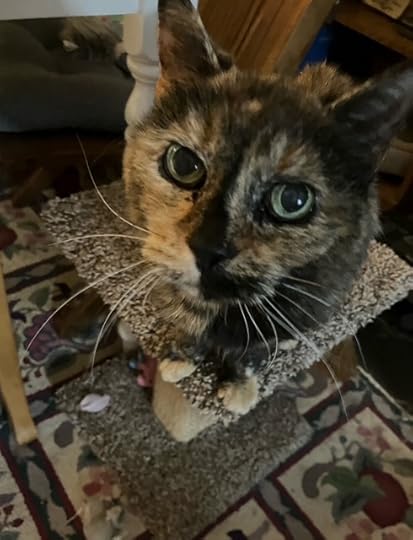
It wouldn’t quite be fair to say I wasn’t considering adopting another cat, but I definitely wasn’t considering adopting two.
Turns out, life had other plans.
Ever since Ned’s passing two years ago, I’ve lived with four cats. Some people think this is a lot of cats, but it didn’t seem like a particularly large clowder to me. A few months ago, I considered adopting a diabetic ten-year-old tuxedo cat named Julio. The problem was that Julio is on a very strict diet to manage his diabetes. Since all my cats are grazers, there would be no way to keep him on his diet. So although he’s a lovely boy, I concluded that I wouldn’t be able to take him in.
The next possibility was a five-year-old blind cat named Owen. He’d been dumped in an apartment building parking lot. He was sleek, pewter-gray, and incredibly sweet. I was supposed to be writing his bio, but instead, I decided to adopt him. The next day, as I was completing an adoption application, I received an email advising me that Owen had died earlier that day. Apparently, he’d had an undiagnosed tumor on his spleen, and it burst that morning.
A few weeks ago, the shelter’s website showed Melody, a three-month-old kitten with a scarred eye. Since Charlotte also has a corneal scar, I thought briefly of adopting Melody, but I realized that this little kitten would not be a good match for a household with three super-seniors (ages 17, 16, and 15) plus Charlotte, age 9.
I’d pretty much set aside the notion of adding to my feline family when I received an email on a Saturday evening at the beginning of the month. The president of the shelter announced the passing of one of our volunteers, Elaine, and the need for someone to foster Elaine’s two elderly cats. And just like that, I knew.
Immediately, I emailed the president and said I’d take them. Adopting, not fostering. I kept thinking about what would happen to them if no one stepped up, how these two super-seniors would end their days in a shelter because no one would ever want such old cats, and I couldn’t bear it.
It took a few days to organize everything, but on Thursday, the head of the adoption team, Martha, took me to Cromwell where the cats were. Elaine was 80 years old; her husband is in his early 90s, and although relatives have been coming in to help, it was clear that caring for the cats was more than he could manage.
And so, Stella and Kallie now live with me. Stella is 16 years old, the same as my Rosie, but at 6-1/2 pounds, she’s half Rosie’s size. If I didn’t know better, I’d think Stella was barely out of kittenhood. Kallie, who isn’t much bigger, turned 19 last week. (Yes, I have a cat who is old enough to vote.)
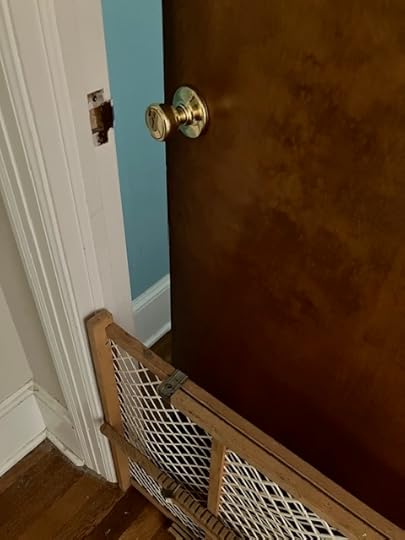
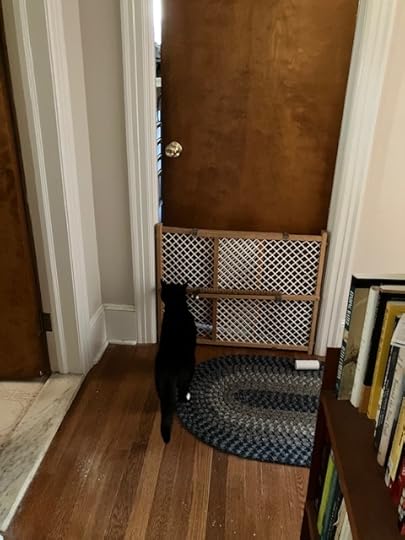
It’s only been two weeks, but it feels as if we’ve been together for a long time. The ladies (as I call them) reside primarily in my office. This arrangement has a number of advantages, including the ability early in their residence to keep the door closed while they became situated and the others grew curious about what was going on. It helped that I was with them most of the day so they could grow to feel more comfortable not only with their surroundings, but with me. After a few days, I opened the door a bit while keeping the baby gate in place. Gradually, the door opened wider; then, I moved the baby gate to allow access if someone wanted to go in or out. It’s a process, to be sure.
Both ladies have distinctive personalities. Stella is a talker, but from the start, she ensconced herself in a bed on the treadmill desk where she’s safe from any cats who may wander into the room. Kallie likes to spend her days in the low perch next to my desk so I can pet her as I’m working. Stella likes to be petted on her head, but she doesn’t care to be touched on her body while Kallie adores being combed and groomed.
They also have their similarities. Both ladies are both amazingly agile for their ages, leaping effortlessly from the rug to their perches. For Kallie’s birthday, I gave them both catnip bananas, and they both reveled in this wonderful treat. It also turns out that they’re both shameless food thieves, each trying to filch turkey from my open-faced sandwich. Kallie is a bit more cautious about such thievery, but the time Stella did, she literally dashed up to the desk, grabbed a piece, and jumped to the floor before I could catch her. (I have since learned not to leave turkey unguarded.)
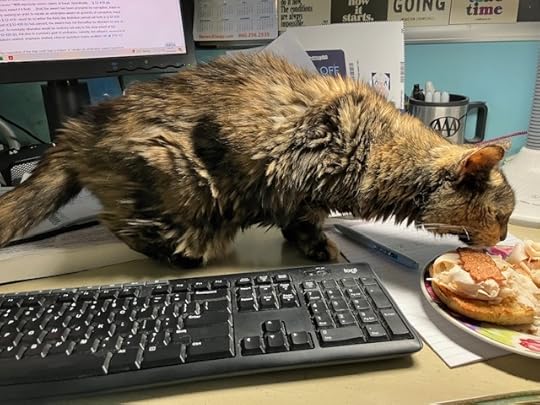 Kallie is a much slower food thief than Stella
I wouldn’t say it’s all been smooth sailing, of course. Both ladies have litter box issues, and so my office is basically carpeted in housebreaking pads. Stella has an unspecified intestinal problem, meaning that she routinely produces very stinky poop puddles the texture of paint. Not only that, but at first, she didn’t bother getting into the litter box before making her deposits. A couple days after I brought them home, I took Stella to the vet to see what might be done. When we returned home, she climbed into the litter box to pee, and then marched across the room to make a poop puddle. The light bulb went on in my brain: while the puddle was medical, the failure to use the litter box was behavioral. Whatever her reasoning for going outside the box, it wasn’t because the diarrhea caused such urgency that she couldn’t make it in time.
So I started to praise her lavishly and give her a couple of crunchy treats whenever she did anything in the box. Since Stella is highly food motivated, bribing her with treats has helped tremendously. After two weeks, practically the only time she uses the housebreaking pads is during the overnight hours when I’m not in the room to be her cheerleader. We haven’t yet solved the medical aspect, but at this point, she’s on steroids (which, according to her former vet records, worked last spring), a probiotic, and Metamucil, and she just started an antibiotic because who knows? She’s also hyperthyroid and on meds for this, but I have no idea whether one condition affects the other. Fortunately, Stella is easy to pill although she swears a blue streak at me as I poke the pills down her tiny throat.
Kallie isn’t perfect in her litter box habits either, but at least hers isn’t a medical issue. In fact, if her vet records are accurate, this 19-year-old girl has no health problems at all. The only reason I haven’t completely signed on to this notion is that when I picked them up, both girls were very skinny and had mats. I suspect that in Elaine’s final weeks when her (very) elderly husband was trying to care for his dying wife, the cats may have been largely overlooked. According to Stella’s former vet, one of her meds ran out in July, and the other would have run out in late September. Understandable in light of everything, but it has meant some adjustments.
Now, two weeks into our lives together, everybody is progressing. Stella is extremely vocal, but it’s Kallie who’s been brave enough to wander out of the office when I’m out here. For the past couple days, I’ve kept the door and the gate open during the day to let my resident cats and the new ladies begin the process of getting to know one another.
I’m certain some people think I was crazy to take Stella and Kallie in (and I didn’t even know about the litter box issues). I now have five super-seniors plus Charlotte, the young punk kid. Olivia and Rosie have been on meds for a few years, and Danny has been on special food for about 12 years. I know that in five years, it’s likely that my household will look very different, but that’s how life goes. As I’ve told people many times, in person and when writing cat bios, nobody comes with a guarantee. Look at poor Owen, who was only five years old—younger than anybody in my house—and on the verge of going home when his tumor burst. There’s no predicting how long any of us will be here. I’m positive that when Elaine adopted Stella and Kallie nine years ago, when Stella was seven and Kallie was ten, she figured that she’d outlive them.
At first, people kept telling me I was an angel for taking in Stella and Kallie. I know they meant it as a compliment, but the saying irked me. I didn’t take the ladies in because I wanted a gold star or a jewel in my halo. I took them because I couldn’t not. I wanted them, pure and simple. I’d never met them—didn’t even know what they looked like—but as soon as I read that email, I knew they were meant to be mine. The day after I’d said I’d take them, Martha told me that Elaine’s husband was considering keeping Kallie, which left me stressed and panicked all week. When I left the house to go to meet Martha on Thursday, my palms were sweating. (For perspective: I have argued in front of the Connecticut Supreme Court with my hands perfectly dry.) I don’t recall what Martha said when we got to the house, but within moments, it was clear that both cats were coming home with me. It was the best decision for everybody.
And so, now there are seven of us—six cats and me. Certainly not what I expected. But there’s no question that this is exactly how we were meant to be.
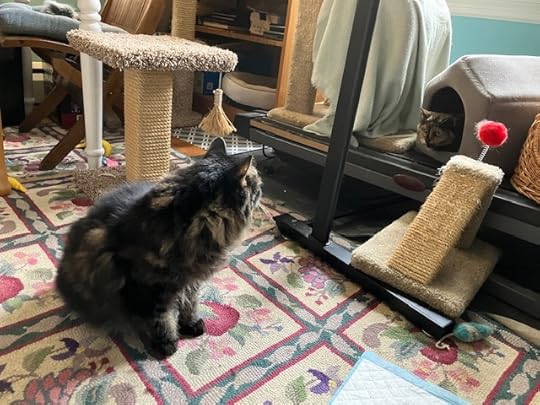 Rosie (left) getting acquainted with Kallie


September 11, 2025
A Regular Day
 Photo credit: Sixteen Miles Out on Unsplash
It was a regular day, right up until it wasn’t.
God knows, I wasn’t paying attention. The day before—a Monday in September, bright and sunny—I was in a judge’s chambers in Hartford with an Assistant Attorney General. The lawyer I was working with was on the west coast, and so I’d shown up, and we were discussing the AAG’s claim that the action I’d created—something about a license for someone working in elevators—should be dismissed—for lack of jurisdiction, I think. The judge, whose name I don’t recall, told the AAG—I think his name was Aaron—that he would have to file a written motion to dismiss by Wednesday. The judge—maybe a woman, but I couldn’t say for certain now—told me that I had to get a handful of documents served by then. Sure, fine. Whatever.
The next morning—another bright, sunny September day—I was getting ready to leave when my local public radio station (Remember public radio? Back before the felon cut all the funding?) said something about an airplane having collided with one of the Twin Towers in lower Manhattan. I remembered the Twin Towers, because in 1987, I’d delivered documents there. Don’t recall what documents, to whom, or why, just that I had to drive down from Stamford and whisk up to a triple-digit floor—101? 102? 106? I don’t remember now, because I was more concerned about getting home to continue unpacking, because in the spring of 1987, I was moving to downtown Stamford and an errand to the Twin Towers was unremarkable at best.
But on that September morning—I don’t remember what I thought when I heard about the plane hitting that first tower, except that at the time, I didn’t think much. I went to the lawyer’s office and made copies of the documents that needed to be served. At one point, his bookkeeper said that the radio announcer had said a plane hit the Pentagon, but the bookkeeper thought that was a hoax—no idea why, but that was his opinion.
The bookkeeper also doubled as the lawyer’s go-fer, and he was going to serve the documents, so I left all the copies with him and headed off to my therapist. I had public radio on in the car. As I pulled into her parking lot, just before ten o’clock, the announcer said that the tower had fallen. I sat in the car for a few minutes, listening to things that made no sense because nobody knew what was happening. Then, I went in for my appointment, and since my therapist had been in sessions all morning, it fell to me to tell her what was going on. Then, we talked about whatever was going on in my life for fifty minutes. When I went back out to my car and turned on the radio, and it turned out that while I was in my appointment, the second tower fell.
I went over to a small supermarket near my therapist. Inside, the place was eerily silent even though there were people in the aisles. I recall being in the bread aisle, and a couple of workers were stocking shelves and talking, but not about what had happened. I didn’t know whether they even knew. I don’t remember what I bought.
Back to the car and public radio. The governor told everyone to go home, I think. I went home and watched television, but only up to a point. Eventually, I had to turn it off. I recall sitting in bed, talking with an old boyfriend—not about anything in particular except what had happened, not what might happen or what anyone could do. Later, I learned that my church held a prayer vigil, but at the time, it didn’t occur to me to go out in search of others to be with.
At some point the next day, the AAG from Monday—Aaron—called me. The lawyer I was working with was stuck on the west coast since no planes were flying. Aaron said that he’d spent most of the prior day tracking down family members in New York City—I think he said they were in Brooklyn. He asked if I’d agree to an extension of time for him to file his motion to dismiss because he didn’t think he’d get it filed that day. I told him to take all the time he wanted, that I didn’t care when he filed it, and I asked if his family was okay. They were, thank God. I remember that conversation because in those moments, we weren’t opposing counsel—we were humans who knew there were things more important than a lawsuit.
My memories of the days that followed are hazy after all these years. One evening, my next-door neighbors and I gathered on my lawn with lit candles because there was a vigil being held. I watched lawmakers gathering on the steps of the Capitol, singing “God Bless America.” A local humor columnist wrote his column, but it wasn’t funny because as he said, it wasn’t time yet.
What I remember most about that time was that we were one. All the crap that divides people now—political affiliation, religion, ideology—we set it all aside. We came together. We were one nation, for maybe the last time.
It didn’t last, of course. All the cracks and crevices opened again. As the years have gone on, the divisions have become more ferocious. Now, we have a pseudo-leader who thrives on dividing people, honoring his pals and vilifying those who disagree with him. If what happened then were to happen again, I can’t imagine the reaction, but I feel sadly certain that the unity we knew all too briefly in 2001 would not be repeated.
Today, people across this nation have commemorated those attacks. The two planes that collided with the towers, causing those statuesque buildings to collapse into rubble. The one that crashed into the Pentagon. And the incredibly brave passengers on Flight 93 who, knowing they would die regardless, took heroic actions to keep the evil ones from taking additional lives.
And the helpers, such as the wonderful people of Gander in Newfoundland, who welcomed planeloads of people diverted from U.S. airports. Fred Rogers always said that in scary times, look for the helpers. Blessings on all those helpers who stepped up in those hard, scary days.
Tonight, as I recall that day, I think of those whose loved ones who had awakened that morning and gotten on those planes or headed off to work in those buildings with nothing more pressing on their minds than where they might have lunch or whether they’d meet a particular deadline. Such trivial concerns, and so precious because in the end, focusing on what’s trivial is such a luxury. In twenty-four years, memories grow foggy, and it’s easy for people to forget what our lives were then, who was lost and who remained.
More than twenty years ago, I went to Ground Zero in lower Manhattan, the former site of the Twin Towers. I can’t say exactly when it was, only that the site was mainly rubble. I didn’t expect to cry—I’m not an easy crier—but I recall standing there, looking down into the pit, with tears welling. I want to say there was a chain link fence, but I can’t be certain. I recall that someone had fashioned two pieces of metal—girders, maybe—into a cross shape.
You think you’ll remember everything, all the details. You think it’ll stay with you forever. But memories fade. Eventually, you remember a handful of moments. A mild, sunny day as you hustled to get out the door on time and heard a weird report on the radio. A bookkeeper telling you the radio newscaster is wrong. Sitting in a parking lot as you hear that an office tower where you once rode the elevator has impossibly collapsed. Walking through the bread aisle in a silent supermarket. Turning off the television because you just can’t, not now. Telling a lawyer to file his motion whenever he wants, because there are things more important than deadlines. Standing on the lawn with neighbors, holding candles and feeling the futility as you wonder if things will ever be okay again.
The world is so different now, and yet still, I wonder if things will ever be okay again. I want to believe they will, but I can’t say for certain.
September 7, 2025
The Season has begun!
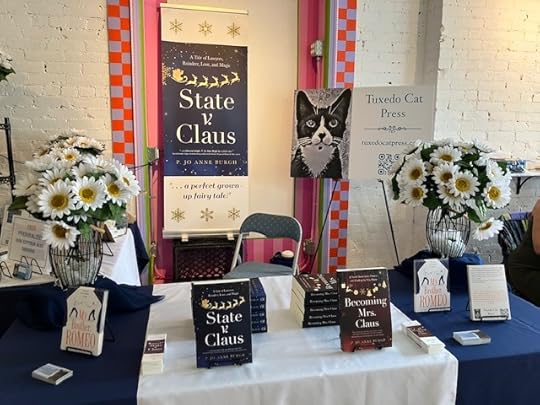 Tuxedo Cat Press at NoRA Cupcake Company, Middletown, CT
I can picture you squinting, maybe scratching your head: What season?
THE Season.
Football?
Good God, no.
Pumpkin spice?
Nope.
Back to school?
No (and besides, you’re late).
Country fair season?
No, but you’re getting closer.
You mean . . . ?
Yes! It’s Book Event Season!
Um . . . is that even a thing?
It is at my house, baby.
Allow me to explain.
At present, I have scheduled ten confirmed event days (one fair is two days) where I will signing and selling books, and more are possible. (See my Upcoming Events pages for details – I have one on my author website and one on Tuxedo Cat Press’s site.) Not bad, considering that (a) there are only fifteen (15) weekends between now and Christmas, (b) I have a full-time day job and various other commitments, and (c) I’d really like to get back to work on my third Claus book.
Even so, I’m looking forward to the Season, and I’d love to have you join me. At outdoor events, I’ll have a tent; at indoor events, a table. Either way, you’ll see the banner for State v. Claus and the sign for Tuxedo Cat Press. As we get closer to the holidays—probably in late October or early November—I’ll be offering free gift-wrapping as well as personalized inscriptions so that you can wrap up your holiday shopping (pun intended) in one stop.
The truth is that the Season actually had its soft open at the end of August, when I had a tent at Dudleytown Brewing Co. in Windsor, Connecticut. I’ve never figured out why book fairs and booze seem to go together so well, but who am I to argue? Yesterday, I took part in an author festival at NoRA Cupcake Company in Middletown, Connecticut, and the owners generously gave each of us a free cupcake. The only blip was when the forecasts for severe thunderstorms, hail, and the possibility of a tornado ramped up, so we closed down a little bit early. (Fortunately, no tornadoes materialized in or around this part of the state.)
Now that Labor Day is past and September is under way, the Season has begun in earnest. Some people wonder why I pack up my station wagon and trek all over the state most weekends in the fall and early winter, especially since I don’t have a spouse or convenient helper to assist with loading and unloading, setting up and breaking down, and keeping track of supplies and inventory from week to week. Sometimes I wonder, too, especially after I arrive home and collapse on the sofa, wishing someone else would get up to feed the cats.
But the truth is, I genuinely enjoy doing these events. Not only do I get a chance to meet other authors and craft folks, but I get to talk with potential customers about books, cats, and whatever else comes up. (People routinely exclaim over Charlotte’s photo on the Tuxedo Cat Press sign and tell me about their own cats, at which point I assume a stern expression and say, “We have a rule here at Tuxedo Cat Press.” I pause just long enough for them to become slightly concerned, and then I continue, “If you tell us about your cat, you have to show us photos of your cat.” At which point they laugh and pull out their phones, delighted to comply with the “rule.” Inevitably, the photos are of beautiful cats who are clearly well-cherished, and the proud owners tell me stories about their furry beloveds.)
The other reality is that for an independent author like me—one who doesn’t have Penguin Random House’s publicity department behind me—hand-selling is unquestionably the best way to get my books into the hands of readers. Potential customers can order the books online, but knowing the author can make the difference between scrolling past a thumbnail and clicking on it. While I don’t have the name recognition of a Stephen King or a Danielle Steel, I’ve had people tell me that they came to an event specifically because they saw that I was going to be there, which is the kind of statement that makes my heart swell with gratitude.
Another advantage of hand-selling at shows and fairs is that I can answer questions about my books. Some people want to know how I came up with the Claus books, and others have more specific questions about content. On one memorable occasion, a woman asked me whether how much sex there was in my books. Usually, this question comes from someone who likes a very clean, sweet story; however, this time, the woman was concerned that the book would not be spicy enough. It turned out that she ran a book club in Manhattan, and her group preferred novels with a significant amount of explicit erotica. I confessed that her group was likely to be very disappointed in my books since there isn’t much sex and what little there is mainly happens “off stage.” She thanked me, replaced State v. Claus on the stack, and headed off to catch her train. I hope she found a title that would fit her group better.
This year marks my fourth season doing fairs and author events. My first event was in December, 2021, a last-minute appearance at a local Christmas tree farm. In fact, it was so last-minute that I had to borrow a table and chair from a friend, after which I went to a local office supply store to purchase a cash box and a Square reader and to the bank to get dollar bills so I could make change. Four years later, I’ve worked out my display generally, but one thing I’ve learned is that every event space is different and flexibility is key. (Also, always carry a roll of painter’s tape. I learned this from an experienced author at one of my first events, and it’s possibly the best advice anyone’s ever given me. You can tape signs to your tent poles on breezy days or to walls at indoor events, and you can tape the bases of decorations to keep them from being knocked over. In fact, maybe carry two rolls, because people will want to borrow it. Trust me on this.)
If you’re an indie author and you’ve been looking for a way to liven up your sales, I’d encourage you to look into participating at local fairs and author events. Mind you, this will take some research, networking, and a fair bit of persistence, but I’ve definitely found it to be worth the effort.
Especially now, when the Season is here.
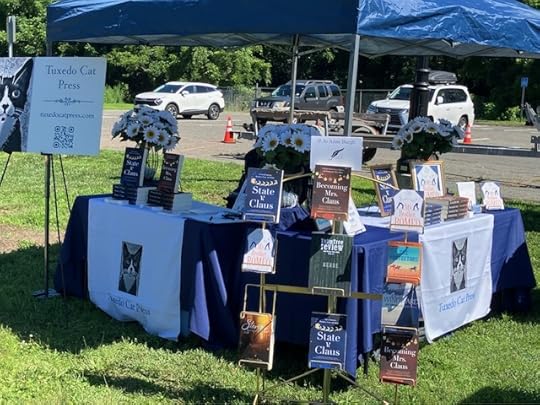 Tuxedo Cat Press at the Book Walk in Old Wethersfield, CT
August 18, 2025
Manageable
 Photo credit: Nam Anh on Unsplash
There’s an old joke that goes like this:
“How do you eat an elephant?”
“One bite at a time.”
Last Friday, I went outside to clean the moss off my basement steps. There are four steps leading from the yard down to the square of cement in front of my basement door. I can’t recall the last time I cleaned them off. Quite possibly never, if I’m honest. Since I’ve lived here for 26 years, that’s a whole lot of not-cleaning, but they’re just a few steps in my backyard. I’m not even certain whether they’re stone or cement, although they’re perfectly squared off, leading me to suspect they were poured.
A few weeks ago, as I was walking down the steps, I slipped. Just a little, and I didn’t fall. The thought flashed through my brain that I should clean off the moss that covered the steps, but then I moved onto the next thing and forgot all about them. Then, last week, I slipped again. Again, it was just a little bit of slippage, and I didn’t fall, but it occurred to me that if I actually did fall and sustained injury, I’d be on my own. Only a person standing in a certain part of my backyard would ever see me. My neighbors might hear me if I could manage to be loud enough, but if I were to hit my head and be knocked out—more likely that I’d be a late-night snack for one of the bears that is frequenting our neighborhood.
As I wrapped up work on Friday, I decided it was time to clean off the steps. How big a deal could it be?
Not big at all, as it turned out. Not only did I clear off the steps and clear out the cement square at the bottom, but I started pulling the weeds from the back garden space that I’d successfully ignored all summer. The weather was unseasonably cool (which is exactly how I like it), I was listening to a podcast on sovereign immunity (continuing legal education credits), and best of all, it turned out that the job wasn’t particularly onerous. Yes, I worked up a mild sweat, but nothing unbearable. In fact, I hauled the detritus down into the woods, and as I tramped back up the hill to the house, I found myself contemplating pulling more of the weeds-gone-wild. Soon, I told myself.
Soon turned out to be this evening. With the weather just a touch too cold for swimming, I traded shorts and flipflops for jeans, socks, and sneakers (all sprayed with tick repellant), sprayed the rest of me with bug repellant, and started pulling and cutting the weeds that had grown unchecked since the spring. An hour and a half later, the space running along the side of the house and around the back was essentially weed-free. I’d even spent some time hacking away the nasty prickers and invasive ivy-type plant that were choking the flowering quince (which, in fairness, I haven’t missed since it literally blooms one day of the year).
There’s still a lot more to do, but I’m kind of amazed at what I’ve accomplished in just a couple short after-work stints. All summer, as I watched the weeds grow, looking messy and unhealthy and overwhelming, I did nothing because the idea of cleaning up the area felt so huge. But as it turns out, these tasks were manageable. The secret was to break them into bite-sized pieces and fit them into convenient pockets of time. Little bites of the elephant.
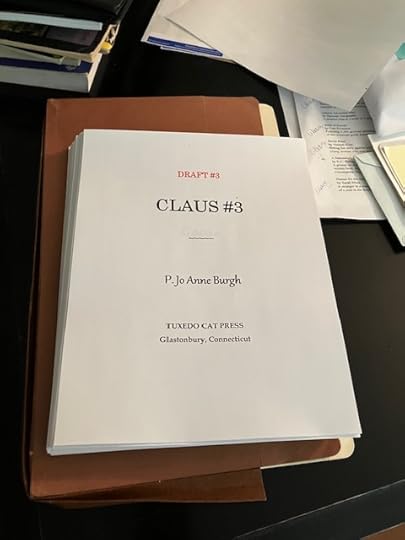
Such pearls of wisdom are rolling around in my brain these days as I prepare to pick up Draft #3. The draft has been sitting in a folder on the piano for a solid month. Other than work and cat bios, this blog post is the first thing I’ve written since July 17, when I printed out the draft. I know I’m getting ready to tackle it, though, because lately, I’ve been reading books about writing. Last week, I finished Writers on Writing, Vol. II, a book of essays on writing from the New York Times. Right now, I’m switching back and forth among Letters to a Young Writer, by Colum McCann; Dear Writer, by Maggie Smith; and Novelist as a Vocation, by Haruki Murakami. (All highly recommended, by the way.)
As I read what all these very different writers have to say about writing, I find myself thinking about my own next draft. Should I concentrate first on big-picture issues, such as ensuring that story arcs and internal logic are sound? Is it okay to start to play with language and sentences, or would it be a better use of my time to resolve the big issues (and I know there are some) first? Would I be better off waiting for notes from the person who is currently reading it? Is it okay to dive in simply because I want to?
Inevitably, I think about the size of the manuscript. Like most of my mid-process drafts, it’s more than 140,000 words—143,261, to be exact, and this is with at least a couple of scenes missing, so if it were complete, it would be even longer. I need an overview, a map of what’s happening, when, and to whom throughout the book, the entire 492 pages.
The whole thing is overwhelming—which is why I need to remind myself to take small bites. Step #1: pick up the printed manuscript and start reading. Not marking, not making notes—just reading as if I were a regular reader. See what my first reactions are to whatever happens. Notice when something seems bumpy or abrupt or unending. Pay attention to the blips I instinctively want to explain, but don’t do anything about them. Just read.
The weed analogy isn’t perfect, of course. Weeds will always come back, while once I’ve cut something from the manuscript, it’s gone. (Okay, not really: if I cut a large block of text, I save it in a document labeled “extra lang”, just in case I ever want it back.) But I think the comparison works, at least to a certain extent. Both weeding and editing are huge jobs that can be wildly intimidating if I forget that I don’t have to do everything at once. Just as I can always put down my pruning shears and go inside for a drink, I can also stop working on a particular scene and do something else book-related, like reviewing my research for a few more vivid details that can enhance a moment.
Or maybe, I could focus on just one scene at a time. One paragraph. One sentence. Sometimes, just a single word.
Because that’s how you eat the elephant.
July 18, 2025
The 100 Day Project 2025, Day Who the Hell Knows?
 Photo credit: Gerd Altmann on Pixabay
I nearly had a break today. I came thisclose to taking off the most beautiful day in ages, the kind the weather people call a “top ten weather day.” The heat wave broke, the sky was vivid blue with feathery white clouds, the temperatures were mild, and I had no deadlines looming.
Or so I thought.
Turns out, I’d forgotten about one. I only remembered because the client called around noon to ask about the project. And just like that, my day off was shot to hell.
I did the work, of course. It’s what I do. By the time I finished, it was too late to get to the pool for adult swim. Then, a woman on Buy Nothing texted to remind me to pick up a lovely set of frying pans she was giving me. After I finished work and retrieved the frying pans (gorgeous!), I loaded the car for tomorrow’s book event, heated last night’s leftovers—and came out here on the porch to write this post.
Because you see, I’ve basically finished Draft #3 of my new book.
(hold for applause)
I wrote the last scene on Monday, and I printed the draft on Wednesday. Since I’ve spent so much time on the final third of the book, I could probably go back to work on the first part with a clear head, but I haven’t. Because I really do need a break.
What this means, of course, is that the third Claus book won’t be out in time for the holidays. This makes me sad, because at last year’s holiday events, people asked, and I assured them it would be out this year. Except now it won’t be, and some of those people are going to be disappointed. I know, because they’ve already asked. When I told them it wouldn’t happen this year, they were all very nice—all my readers are—but I could see the disappointment.
I hate disappointing readers.
On the other hand, what I’d hate much, much more would be putting out a book that wasn’t ready. Think how awful that would be. My beautiful, trusting readers would pick up the book they’d been waiting for, and instead of reading a good story, they’d be slogging through way too much verbiage and trying to navigate plot holes. Who needs that?
What does this mean to my 100 Day Project 2025? I think it means that as far as the book goes, it’s done early. The alternative is to put it on hiatus until my brain has had a chance to rest so that I’m ready for editing.
Editing is so much easier than drafting, in my opinion. When you’re drafting, you have to figure everything out. When you’re editing, the words are already on the page. You can take them out, rearrange them, and replace them, but the framework is there. And if you let your brain cool off so that you can approach the manuscript like a normal reader, there’s even a chance that you’ll spot the gaps and the redundancies. Granted, beta readers and developmental editors will do the same, and it’s always interesting to read their comments, but as any good beta reader or editor will tell you, in the end the decisions are all yours.
So, I’m calling the 100 Day Project 2025 done. Not because I worked on the book for 100 days, but because I did what I set out to do, i.e., finish the draft. Once I’ve let the manuscript sit for a bit, I’ll have a better idea what the next stage will look like. (Some people say to let it sit for three months. I’m incapable of that. Not to mention, three months from now will be the beginning of the holiday event season, and I definitely won’t have the time or energy to undertake a massive edit as I juggle the day job and the weekend jaunts hither and yon with a car full of tables, books, and display materials.)
Many thanks to everyone who has supported me in this (Less Than) 100 Day Project. Wishing you all a lovely, relaxing break before we all gear up for the next stage!
July 2, 2025
The 100 Day Project 2025, Day Whatever
 Photo credit: Tim Cooper on Unsplash
I’ve lost track of the count. While I’ve been making notes and thinking over the past two days, the only writing I’ve done (other than legal work) has been a couple scribbled notes. (I nearly wrote “a few,” but the truth is there are only two, one yesterday and one today. If I’m going to confess, I may as well be honest.)
At first, if I missed a day, I circled it on the calendar. Then, I found I was forgetting to cross off days, and I had to try to remember whether it was because I’d written and not noted it or if I’d simply not written. Either way, it wasn’t terrific. At this point, I could make a decent guess about how many days I’ve missed—ten, maybe. Not brilliant, but at least I’ve plodded along.
The upside is that by pushing myself in the past two months, I’ve made very good progress on the section of the book that really, really needed work—as in, it wasn’t there. All I had was a note that I had to add a climax and a conclusion. Those are pretty big things to need to add.
My problem was that I hadn’t figured out what they were going to be, apart from a vague notion about something at the very end. I’d also forgotten the most important thing about my process, which is that I write to discover the story. When I started following the characters instead of dictating to them, the final ascent to the climax began to unfold. (Yes, I’m mixing the hell out of my metaphors. Enjoy.)
One thing that has helped is listening to audiobooks. I’ve never been fond of fiction read aloud—I’m always losing track of the plot—but I’m a huge fan of memoirs read by the author (or, in the case of Dame Judi Dench’s amazing Shakespeare: The Man Who Paid the Rent, an actress who sounds exactly like Dame Judi). At present, I’m listening to talk about what he’s been cooking and eating, and I’m enthralled. (Seriously: the name of the book is What I Ate in One Year (And Related Thoughts).) Last year, I listened to him narrate another of his books, Taste, which is about his life as well as food. He’s a wonderful narrator, dry and funny and occasionally a charming curmudgeon, as when he indulges in a brief rant against Halloween. He inspired me to start watching his series, Searching for Italy, which he constantly renames in What I Ate, as when he talks about how filming would soon start on Where the Fuck is Stan in Italy? or something like that.
One advantage to listening to Stanley Tucci talk about what he cooks and watching him as he chats with Italian chefs is that he’s inspiring me to experiment in the kitchen. Another, much bigger advantage is that he’s giving me ideas for how to make scenes in my book more vivid by going deeper into issues such as what people are eating in various locales to highlight the differences between their worlds. Granted, I was already doing this, but one of my notes is “more re distinctive food.” After all, what we eat is usually quite specific to where we are. Here in New England, we eat cod and lobster and other local seafood because nearly all the New England states have coastlines, while in Kansas and Utah, any ocean fare has to be flown in. People tend to eat what’s local (and therefore more affordable), which is one reason that I doubt a lot of households in southern Florida are serving venison for the upcoming holiday weekend. On the other hand, the best salmon sashimi I’ve ever eaten was at a restaurant in Seattle, because that’s what they have in the Pacific Northwest. (I still say that they don’t let you leave the state of Washington until you’ve eaten salmon prepared at least five different ways.) In the U.S., a significant percentage of the meat on our plates is beef, chicken, turkey, or pork, because the main animals being raised for food here are cattle, poultry, and pigs.
All of which means that my characters at the North Pole will have very different diets than I presently do. My research has revealed that people in the Arctic eat polar bear, reindeer, and walrus, among other local meats. They don’t have the climate to be growing corn or citrus fruit, so such items aren’t part of their diet unless someone imports them. In the same way, the chefs in Searching for Italy use the terrain and climate and circumstances available to them, which is how it happens that one region is renowned for its basil pesto while a chef in Rome makes brilliant creations using offal because the neighborhood where she’s located was so poor that at one time, when they butchered animals, the good parts went to the wealthy located elsewhere and they were left with the innards that the rich people wouldn’t touch.
Of course, my book is fantasy, so my characters have other ways of obtaining foods that most people living in Arctic regions wouldn’t have ready access to. After all, the North Pole must have Christmas cookies, and how could there Christmas cookies without eggs and flour and sugar? While I’m certain I’ve still left a million world-building questions unanswered (some deliberately), I’ve tried to address the issues that matter to the stories I’m telling, such as food. As a result, listening to Stanley Tucci tell me about his menus and recipes (which include a lot of pasta) inspires me as an author even though people in the Arctic will have vastly different diets than those in southern Italy.
In any case, it looks as if I really am going to have a completed draft in the not-too-terribly distant future. Unfortunately, I have a sinking feeling that I’m going to spend at least part of the upcoming holiday weekend working, which means that the break I’d anticipated—a break when I could have spent hours on the porch writing—will need to be pared down. Fingers crossed that I’ll be able to spend a good chunk of one of the days on the back porch filling in gaps. If all goes swimmingly, I may even wrap up this draft before the end of the month—which was my original end date for the 100-day project—which would mean that even if I haven’t worked every one of the hundred days, setting that goal actually accomplished what it was supposed to, i.e., getting me back to work.
Wouldn’t that be something?
June 15, 2025
The 100 Day Project 2025, Day 52(!)
 Photo credit: Farrinni on Unsplash
You probably thought I’d given up.
Oh, no.
Come on, admit it. You figured I threw in the towel, especially since my last blog post had nothing to do with this project.
Well, maybe. I mean, it’s been a while.
I’ll admit, I’ve missed two days (which is why this was Day 52, not Day 54). And some of my writing days have been fairly minimal—half an hour (or less), or just research, or mainly reading and editing. It’s certainly been no #1000wordsofsummer this year.
But that’s actually a good thing.
Sure, right.
No, really, I’m not making excuses. For where this book is now, a daily word goal would have been counterproductive. Word goals are good when you’re putting down the first draft and figuring out the story. That’s not where I am now. At this point, I’m fleshing out a piece of the story that I’d found wildly intimidating. By going slowly and including research, I’m making real progress, not just slap down some words and call it done progress. I’m cutting phrases and lines and paragraphs and whatever else needs to go. I’m editing what was already there to accommodate the new material. I’m seeing how the new stuff is going to impact what came before, such as where I need to drop in references so that what happens in the climactic section isn’t coming out of the blue. (I hate it when I get broadsided by critical information just at the pivotal moment. It’s like reading a murder mystery and being told on page 332 of a 335-page book that the main suspect had a twin brother nobody knew about, and the two planned the murder together, with one of them accepting an award at a black-tie event—perfect alibi—while the other committed the murder.)
The reality is that barring a flat-out miracle—including three months when I don’t have to practice law and yet money magically appears in the bank every month, as well as a brilliant (and affordable) editor who is free to drop everything and spend four weeks helping me turn this mess into a masterpiece—there is simply no way this book will be out for the holidays this year. I hate that so much. At book events last year, I kept telling people that the new book would be out this year. Now, I’m making myself a liar. The only option would be to write and publish a novella-length piece in this series, except that there isn’t time to do that because I’d have to start from scratch and it’s already the middle of June and I have no ideas for something short and self-contained. I can’t even use the first section of the present book, because there’s nothing particularly Christmasy about it, and if I’m going to publish a novella about Santa Claus at the holidays, it needs to be Christmasy. Plus, because I’m me and I require everything to fit together, it would somehow need to advance the series.
Sigh.
You’re probably wishing right now that this was another post about ecclesiastical garments. Mea maxima culpa.
Except . . . you know. . . .
No. Absolutely not. It wouldn’t work.
Well, maybe. . . .
Forget it. I’m sticking with the manuscript in progress.
But what if. . . ?
This is ridiculous. I can’t get distracted. Not now. I cannot go from start to finish on another book–especially not in time for the holidays. It is not possible. It doesn’t matter that there’s this one large, gaping hole in the narrative, and there isn’t room in this book to deal with that issue because it would make the book much longer and it doesn’t fit anywhere with any of the rest of the story anyway, so it would have to be separate anyway except that it wouldn’t be long enough to be a novel by itself, so. . . .
I’m just saying. . . .
Oh, shut up.
 Photo credit: fr0ggy5 on Unsplash
Well. I certainly didn’t see this coming when I started this post. And I don’t know whether it’ll be possible anyway.
But it would address that gaping hole, which is nice because the book I’m currently working on is the final book of the series, so this would take care of that issue before I get to the finale. Not that anybody has ever mentioned the hole. Maybe I’m the only one who sees it. Maybe it’s not really a hole at all.
I hate moving away from the book in progress now, just when I’m finally getting a firm handle on it. After all, do I really have to have a new book this year? Of course not. Nobody’s going to cry if I tell them it’s not happening this year. Most of the people from last year’s events probably won’t remember anyway. It’s not as if they’re sitting around saying, “Oh, I can’t wait for [fill in the event], because P. Jo Anne Burgh said she’s going to have a new book this year!”
And yet, there’s another story to be told. . . .
I need to think about this.
Moral of the story: be careful what you write.
 Photo credit: Aaron Burden on Unsplash
May 26, 2025
The Celebrant’s Garment
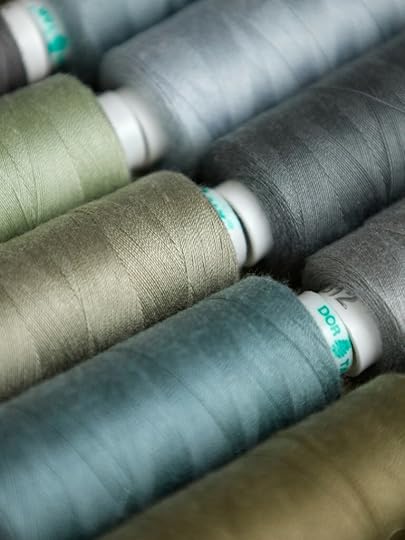 Photo credit: Victor Volkov on Unsplash
Yesterday, I was distracted during the proclamation of the gospel. At risk of being sacrilegious, I confess that instead of listening to the words that were read, I contemplated textiles and seamstresses.
Allow me to explain.
The way things are arranged at my church is likely the same as at many Episcopal churches. We generally have two priests at a service. One of them preaches, and the other is the celebrant, meaning that their main job is to celebrate communion. Other participants include the organist/choir director, the choir, the acolytes, and the lay reader. It’s a nice division of labor.
Yesterday, I served as the lay reader. This means that I read two of the four Scripture readings of the morning. The third, a psalm, was chanted, and the choir led this. The fourth, which was from one of the gospels, was proclaimed by the priest who preached. The gospel reading is a very big deal because it involves the words and/or acts of Jesus. The acolytes (three teenagers—one carries the cross, and the other two carry candles) lead the priest into the main aisle of the church and stand, with candles burning and cross held high, while the priest proclaims the gospel. Everyone in the church turns to face the cross, meaning that some turn around completely.
The area in the front behind the pulpit and lectern is called the chancel. Because the chancel is relatively narrow and deep, rather than the typical wide stage, it is sometimes a challenge to fit the choir in when the choir school sings with the adults. On the lectern side of the chancel (stage left, as opposed to the pulpit side at stage right), six seats are built in. During a typical service, the celebrant sits in the seat closest to the front, with the lay reader beside them and room for one more participant. The acolytes occupy the back three seats, which allows them to get in and out easily.
Yesterday, as I said, when the gospel was being proclaimed, I found myself distracted. Since we were all facing the cross which was in the main aisle, the celebrant stood directly in front of me. (Side note: until I came to my present church, it had been a long, long time since I’d seen clergy in robes. At my former church, the pastor sometimes wore a sweater vest and occasionally didn’t bother with a tie. I tried not to see this casual attire as disrespectful—after all, Jesus didn’t wear a tie, either—but I do like the formality of clergy in clerical garb.)
All of which is to say that as the gospel was proclaimed, I stood mere inches from the celebrant’s vestments, including his chasuble, which is the sleeveless outer garment worn over his alb (the official name for his robe). The chasuble is an oblong piece of cloth with a hole for the head, not unlike a fancy poncho. The chasuble is decorated with the colors of the particular season within the liturgical calendar, which is a whole other topic. The celebrant wears a white alb with a hood (which hangs down in back), and the chasuble is worn on top of the alb.
In any case (for the third time now), as I was supposed to be listening to the gospel, I was instead fascinated by the celebrant’s chasuble. The main fabric was a lustrous white-on-white jacquard. To see its drape was to recognize its substantial weight. Down the back and across the neck (though partly hidden by the hood) was a strip of deep navy velvet about three or four inches wide. It was stitched on with gold thread that formed open boxes along the edges of the velvet.
As I studied this garment, the fabric and the finishing, I found myself thinking of the people who made it. Who designed the jacquard fabric? Was it intentionally designed for priestly garb, or is the same fabric used for other purposes? Who crafted it? Who did that perfect stitching to attach the velvet strip? Did these people know what they were creating? Did they care? Was it simply another job to them, or did they see their work as their contribution to the priest’s ministry? Did they recognize that in dressing the priest in such beautiful garments, they were participants in his or her work?
This wasn’t the first time I’d had such thoughts, i.e., who came up with that? When I had surgery several years ago, I ended up staying overnight. For reasons not relevant now, I was in the cancer wing. This hospital spared no expense for cancer patients, from free parking to rooms nicer than I’ve seen in some hotels. In this case, the bathroom (which was larger than mine at home) had lovely blue-green tiles on the walls, and the bedroom blended hospital necessities with tasteful, serene décor. The color scheme evoked the peace of the beach when the water is calm. As I waited for my friends to arrive to take me home, I wondered who had designed this space. Did the creator of those tiles know that they would be in a hospital bathroom? Did the person who blended this color of paint intend it to be used to create a low-stress space for someone who might be overwrought and terrified? Did the people who designed the network of hospital-specific connections and outlets think about the extent to which they might be making a task easier for a hospital professional who was in the thirteenth hour of an eight-hour shift?
So many invisible, unknown people contribute so much to our days. It behooves us to think of them, at least occasionally. In one of her novels, the magnificent Laurie Colwin’s pregnant main character looks around at everyone else on the bus and thinks, “Every one of these people was born.” In the same way, I look around my living room as I type, and I think, “Every thing in this room was made.” The fabric of the chair, the lamps and their shades and bulbs, the artwork, the books on the shelves (which were made both in terms of content and in their physical selves, with paper and ink and covers and artistry). Someone thought of them, someone designed them, and someone figured out how to turn that design into a tangible object that now occupies space in my house (which someone else designed and built). Someone hand-embroidered the tablecloth on the side table, which means someone wove the fabric (maybe the same person, maybe not) and dyed the thread. Someone else crafted and placed each of the strings inside the piano, attaching them to the pins. Another person designed the narrow metal bookcase that folds up flat. Someone else figured out that adding ridges to nails, i.e., screws, can hold the wooden pieces of the bookcases together more securely. Yet another person operates the machines that create the chips that make it possible for me to write on this computer. And so on.
It’s easy to fall into the trap of thinking that only certain types of jobs or professions are “creative.” In fact, I suspect that most, if not all, of us possess an element of creativity. Maybe it’s obvious to the world, such as if you’re Monet or Chopin, Meryl Streep or Yo-Yo Ma. But maybe your creativity is of a quieter, less public variety. Maybe you baked cupcakes for a child’s birthday party, or you planted a garden of potted herbs on your fire escape. Maybe you fashioned a cat bed from an old fleece blanket so that a terrified formerly-feral cat will have a soft, safe place to sleep. Maybe you figured out how to create a new wiring harness for an old car where the original harness was chewed up by chipmunks and the car is old enough that the manufacturer no longer makes that part. Maybe you run the loom that creates the jacquard fabric that someone else will sew into a priestly garment that will ultimately be worn by a celebrant while celebrating the Eucharist.
I did listen to part of the gospel reading yesterday, honestly. But I also contemplated the skill and artistry of the people whose names I’ll never know, who combined their gifts to create a beautiful garment for a sacred purpose. Both, I think, were holy uses of my time.
May 19, 2025
The 100 Day Project 2025, Day 27
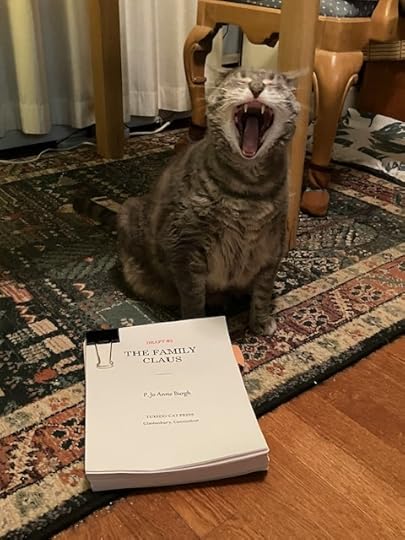 Danny is very excited that there’s finally a printed draft.
It’s been two weeks since I posted an update.
(You thought I quit, didn’t you?)
I wasn’t going to quit, but I did come perilously close to a . . . hiatus . . . over the past several days. It’s the kind of thing that can happen when the Day Job takes over your days (and nights) for weeks on end, including weekends. I know work will slow as we move into summer because after 28 years, I recognize that this is how things roll, so I know to be grateful for the current hectic pace. Still, I’m exhausted, and there comes a point where too many things demand your attention, and you say, “Fine, whatever. I’ll get back to the book when I get a chance.”
Here’s the weird thing: even though I’m wiped out and would desperately love to take a couple weeks off from any book-related obligations, my brain is still working on the book. I went low-key for a couple nights last week, assembling pieces and printing the draft so that I could accomplish something without having to think too hard. For a few more nights, I wouldn’t say my writing efforts were minimal, but they consisted of 30 minutes or even less, and I produced few new or improved scenes.
And then came today. Last night, I worked until 1:15 a.m. By the time I finished editing, I was exhausted. I was prepared to go to bed after I’d finished scooping litter boxes and giving the cats meds and snikkies—except then, I felt the urge to write.
I wasn’t going to. I’d already given myself permission to skip a night. Maybe that permission was what I needed. Because a few lines came to mind, and the next thing I knew, I was settled in the recliner with Charlotte by my side and my favorite CDs providing atmosphere as I wrote.
As it turns out, this is what happens when you do something enough with the intent of making it into a habit: it actually becomes a true habit. The details may vary—last night, I wrote at 2:00 a.m., not 9:30 p.m.—but the basics remain constant. For me, for this project, the basics are simple: I just have to work on the book. That work doesn’t have to take any particular form—I can add words, edit, do research, do production—as long as whatever I do advances the book in some way. But I need to do it, and so far, I have.
Will I make it through the entire 100 days without a break? No idea. I’d love to think so. At least I don’t have to produce 1,000 words every day this time, and that’s a huge break. Still, I’d love to end with an actual viable manuscript that’s undergone some decent editing. It won’t be final—absolutely cannot happen in this timeframe—but if it were a complete book, with all the scenes it needs and none of the stuff it doesn’t—that would be amazing.
Coming up: Day 28. We’ll see what happens.
May 5, 2025
The 100 Day Project 2025, Day 13
 Photo credit: Aaron Burden on Unsplash
Caveat for all the writers who really want to write someday, but who believe can’t write unless they feel inspired: you may not want to read this post.
(If you’re still reading, don’t say I didn’t warn you.)
Working on this book for thirteen days straight has reminded me of a truth I’d forgotten: a proven* way to become inspired to write is to start writing, and then keep writing.
You read that correctly. Instead of waiting for the inspiration before you start writing, take whatever weird little nugget of a thought you have, and start writing about that. If the weird little nugget is, “I forgot to buy mustard,” start writing about a person who goes to the supermarket or the corner bodega or the general store or the gourmet shop or Costco—in other words, anywhere you can go to purchase mustard—and follow them around the store to find out why they forgot the mustard. Did they leave the list at home? If so, why? Were they distracted when they were getting ready to leave the house and they left the list on the kitchen counter? Or are they accustomed to chatting on the phone with their spouse or significant other or parent while shopping and that person tells them what to get, only this time, that person is unavailable for a specific reason—out of town, had a fight, died, just separated, is working and can’t be disturbed, is trying to get the baby to sleep, is running a marathon—so the shopper is on their own. Or maybe there’s some hostility attached to the mustard, such as how they only need it because Rachel is bringing her new boyfriend Kyle when the group goes on a beach picnic and the shopper is in charge of the sandwiches, and nobody likes Kyle because he’s so judgy, and he claims he can only eat this certain brand of mustard, so the shopper subconsciously doesn’t want to buy it, especially since with any luck, Rachel will dump him before the next picnic and nobody else likes that brand.
All those possibilities out of something as mundane as “I forgot to buy mustard.”
And it doesn’t have to end there, either. The forgetting of the mustard can be a sign of something else, such as early-onset dementia or the breakdown of a relationship. You can explore the personalities and dynamics of the group of friends who go to the beach picnics, including the secrets they’re hiding from one another—Sophia has a crush on Rachel, Paul can’t stand George’s stupid jokes, Bethany is cheating on her husband Richard (which Sophia and George know, but Paul and Rachel don’t). The possibilities are literally endless, but until you start writing it all down, you’re probably not going to find any of it.
(Truth: before I started writing this post, none of these ideas existed for me. The forgetting of the mustard had its genesis in the fact that a couple nights ago, I went grocery shopping, but even that connection was thin because I didn’t buy mustard, nor did I forget anything—at least, nothing I’ve remembered so far.)
For weeks before I started this 100-day project, I was struggling with the third section of my book. I knew vaguely what needed to happen, but knowing the end doesn’t tell you squat about how you get there. For the first few days, I didn’t touch the third section; instead, I went back to the second section, where I was fairly comfortable, and worked on things like chronology and editing language. Even though the third section was looming, I let myself focus on a section where I was more comfortable, essentially revving up for the tougher part ahead.
Last week, I decided to play around with the missing material in the third section—and this time, I was able to come up with a plot line. So for the past several nights, I’ve been constructing pieces of the story that didn’t exist at this time when I started this program, but which is serving multiple purposes so far.
Would I have come up with this new plot line if I hadn’t been writing regularly for several days? Maybe. After all, ideas sometimes hit out of the blue. On the other hand, there’s a strong argument for the idea that because my mind has already been in the story every night (and during the day when I’m doing other things), it was already primed for another new idea.
So for those of you who are waiting for inspiration, I’m here to suggest that you might have the whole thing backward. Maybe instead of hanging around waiting for the muse to show up, you tell the muse, “To hell with you, I’m going to write anyway.” Obviously, I can’t guarantee anything, but my guess is that you make it a point to write day after day—even if what you’re writing isn’t your dream of the Great American Novel, maybe if you feel as if you’re writing utter crap—sooner or later, the muse is going to show up. After all, nobody likes being ignored, right? Of course, while you’re writing every day, you’re also out living life—talking with coworkers, watching out the window while your commuter train speeds through towns, watching the dynamics of the kids and parents in the drop-off line, noticing the neighbors’ landscaping as you speed-walk through the neighborhood at lunchtime. And all that life can give you ideas, too.
Start writing, and keep writing. Obviously, you don’t have to follow this practice if you have a better method that’s enabling you to produce lots of brilliant work. But if you don’t . . . maybe give it a shot. Worst thing that happens is that you write a huge pile of stuff, and maybe it’s all crap. But maybe you might unearth something in that pile that is your very own brilliant nugget of an idea. Wouldn’t that be fabulous?
*Proven by me. I did it. At least, I’ve been doing it for thirteen days.