
C.A. Hartman's Blog
October 19, 2020
Science and Science Fiction Onscreen: Gravity
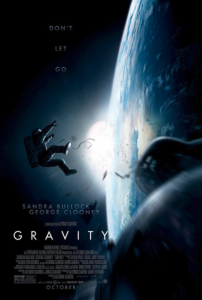 Last night I watched Gravity for the first time since it was released in theaters. It was about 9:15, and I realized I could watch the whole thing and still be in bed by 11. (i.e. at 90 minutes it’s short for a science fiction film.)
On second viewing, it wasn’t as stressful as it watching the first time. This story definitely follows the “get protagonist up into a tree and continue chucking rocks at her” model, where one thing goes wrong after the next without relenting until the very end.
I like the film. Anything that tries to realistically look at what it’s like to be in space is super interesting, and I liked the simplicity of the story and the performances. Plus, those views. Chances are, none of us will ever see Saudi Arabia from that perspective, or the Ganges during sunrise.
But I’d heard that a certain well-known astrophysicist had taken a few shots at the science of the film, so after I finished it, instead of going to sleep, I researched what was fact and what was fiction.
All films have both, even the best sci-fi. This seems to bother some, and half the time I think they’re just bringing up the flaws to sound important. Then again, fiery explosions in space are silly and I don’t like them because they aren’t accurate and aren’t necessary. (Just watching something silently splinter apart in space is crazy cool, so why would you have it any other way??)
I made this list not to criticize the film, which was quite good, but to learn a few things. So here are some science facts and science fictions from Gravity:
Apparently, the Hubble Space Telescope, the International Space Station, and the Chinese station featured in the film are not only not that close to one another, they’re at different altitudes and in different orbits. So going from one to another that easily in the film was fiction.
The fire extinguisher used to propel the main character: fact and fiction. You can use one to propel yourself in space, but won’t have much control over the direction in which it shoots you.
Space debris causing damage: Fact. It happens and can mess some shit up. But the debris travels MUCH faster than in the film.
Letting Clooney’s character go: Fiction. There’s no gravity in space. She could have pulled him toward her.
Her floating tear: Fiction. It would have stayed on her face. Good old H2O surface tension!
Surviving when dream Clooney returned and opened the hatch: Fact. You can survive for a short time in a space vacuum, like 30 seconds, if you don’t breathe.
Jetpacks: Fact, sort of. At one time NASA had them.
Surviving all those bodily collisions: Fiction. On Earth, colliding with hard metal things will damage us. But in a vacuum, the collision would be much harder on our soft human bodies. Like deadly.
So there you have it. Learned something new all science-y and stuff.
The post Science and Science Fiction Onscreen: Gravity appeared first on cahartmanfiction.


April 25, 2020
Why We Pick Narcissistic Leaders
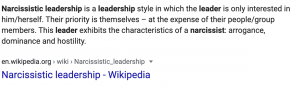 In the past five or so years, there’ve been more articles and mentions of narcissism than I’d seen in all the years before that combined.
How to deal with a narcissistic partner. Learning to cope with your narcissistic boss. The effects of having been raised by a narcissistic parent. The concept of narcissism has gone mainstream. Yet, there isn’t as much talk about narcissistic leadership.
Maybe it’s because we don’t directly interact with leaders, and therefore don’t see the impact they have on us like we do with a boss or spouse. Or maybe it’s because part of us believes that narcissism is somewhat expected among leaders, so we forgive it more easily than we would in those ordinary people we deal with every day. Which is interesting because, in the big picture, a narcissistic leader can do a shit-ton of damage that can impact our lives over the long term.
I think this idea became clearer when a narcissist was granted the title of U.S. President back in 2016. Donald Trump has all the classic signs of narcissism and has displayed his self-absorption, lack of empathy, and inability to handle criticism since the beginning. But I’m not here to bash Trump; he’s not the first narcissistic leader we’ve ever had, nor will he be the last.
Narcissists often seek leadership positions because they crave attention, adoration, and power. They believe they’re special and therefore are entitled to special treatment, something leadership reinforces, and their inflated egos mean that they live to impart their glorious vision upon their constituencies, employees, or fans.
The Downside of Narcissistic Leaders
The negatives of narcissistic leaders are clear. Leadership is about service to others and setting an example to create a better country, workplace, family, or world. A leader who lives to serve himself and gratify his ego will never put the needs of those he leads first. History is riddled with these fools, with their opulent riches when their people are starving, their lying and excesses, their mistreatment of those who serve them, their willingness to do damage and then blame anyone but themselves, and their ability to railroad over those they deem inferior. For famous examples, see Alexander the Great, Henry the VIII, and Adolf Hitler. You can add any cult leader, quite a few famous CEOs, and most notoriously “difficult” celebrities to the list.
The question I’ve asked myself, especially with all the polarization regarding Trump, is why people choose these kinds of leaders, or follow/worship these kinds of celebrities. The downsides are so clear. These people are a freaking nightmare to deal with as it is. So…
Why would you choose a narcissistic leader, follow a narcissistic pundit, or worship a narcissistic celebrity?
I set out to find the answer, and it didn’t take long to find it.
Why Narcissists Wind up in Power
The reason is because narcissistic people present well. They’re often well-spoken, charming, even likable (at first, anyway). They’re typically good-looking too and will put a considerable amount of time into their appearances because, well, they’re vain. Perhaps most troubling of all, is their inflated egos mean they have confidence to the moon, and confidence is like a drug that most people will snort up their noses until they bleed.
Humans love a well-spoken, articulate person. They can make the biggest lump of shit sound like the very thing our future needs, soothing any doubts we have.
Humans also love good-looking people. The more attractive they are, the more special they seem in our eyes (Kim Kardashian, anyone?).
And, humans love confidence. Confidence can assuage our fears, give us purpose when we’re unsure, rally us. We figure, hey, they sound like they know what they’re doing, so they probably do.
This is why, in addition to narcissists seeking leadership and spotlight positions, they’re more likely to be selected for them. Whether a political election, a job interview, or role in a big movie, those doing the choosing are most likely to select the narcissistic personality who puts on a good show. It’s the social equivalent of picking the hottest woman or guy for a date rather than the one you connect the best with. Why? Because they LOOK GOOD.
So why are humans such fools in this way?
These traits—eloquence, attractiveness, confidence—are all things we wish for ourselves. Life is filled with uncertainty and, well, it can be hard. When we see people who seem to have it all together, we’re drawn to them and hope they can show us the way or lead us to a better life.
In most cases, they can’t. If they’re narcissistic, they’ll do the opposite.
U.S. Presidents: The Donald and Slick Willie
Donald Trump isn’t especially eloquent or good-looking, but he’s loaded with confidence up to his eyeballs and can talk his way through anything no matter what craziness spews from him. However, before you get on your soapbox about Trump, good old Bill Clinton ranks pretty high on the narcissism scale for U.S. presidents too, according to a 2013 Pew Research article (see second reference), and Slick Willie definitely had the eloquence and looks people loved while overlooking that he had some serious character flaws.
Interestingly, the article also mentioned that U.S. presidents have become more narcissistic in recent years. Which means we’re choosing to buy into the smoke and mirrors of charm and confidence.
So, when the time comes to vote again or choose who we want influencing us, maybe it’s time to put aside the charm, looks, and confidence and focus on the candidate’s knowledge, ideas, and how they live their lives and treat others. The substance, not the packaging.
Because narcissists belong in therapy, not running cities, states, or countries.
More reading:
https://www.psychologytoday.com/us/blog/the-integrationist/201901/do-narcissists-make-good-leaders
https://www.pewresearch.org/fact-tank/2013/11/14/the-most-narcissistic-u-s-presidents/
The post Why We Pick Narcissistic Leaders appeared first on cahartmanfiction.
October 3, 2018
Kavanaugh, SCOTUS, and Sexism
 Wow.
Wow.
What a crazy couple of weeks with the Kavanaugh SCOTUS thing. What was a growing concern blew up into a full-fledged social movement of #metoo proportions.
The news and social media have been loaded with stories from Kavanaugh’s past, accusations from women who knew Kavanaugh, women coming forward to confess their painful experiences with sexual assault (and why they didn’t report), discussions of legal matters such as “innocent until proven guilty,” quotables from powerful government leaders… and, most of all, anger from all sides.
It’s been a stressful period, and other than a few tweets, I’ve kept my mouth shut and focused on reading, listening, and learning. Because this right here has more lessons in it than a college degree program.
It’s a lot to unpack, but I’m going to (try to) summarize what I’ve learned, and why this situation with Brett Kavanaugh is one of the most important events that has happened in a long time.
You know the situation: the Republican leadership wants Kavanaugh appointed to the Supreme Court, the Democrats do not. Nothing groundbreaking there. But when Kavanaugh was accused of sexual assault by Dr. Christine Blasey Ford, it brought up a host of important issues. Issues that go WAY beyond politics and the Supreme Court. Let’s tackle them one by one:
“It was so long ago.”
This argument about Kavanaugh’s behavior came from as many women as men, suggesting that anything Kavanaugh allegedly did back then somehow doesn’t matter anymore. This follows the (false) belief people have that those who do evil deeds, especially in youth, somehow “outgrow” vile behavior like they outgrow their clothing. If we were dealing with immature behavior, I might buy this, but we aren’t. This is SEXUAL ASSAULT, and it takes a special kind of person to engage in it.
“What teenage boy hasn’t done this?”
Um, a lot of boys don’t assault girls, actually. Most boys don’t. Because they know it’s wrong, even if they aren’t old enough to know why. This applies to groping, and it definitely applies to dragging a girl into a room, forcing her onto a bed, trying to yank off her clothing, and covering her mouth so she can’t call for help. While another boy stands by and watches. This belief that teenage boys are “trouble,” again heard from both sexes, pushes the “boys will be boys” thing, that hallmark of sexism that seems to believe that boys are naughty by nature, like it’s bred into their DNA. It’s this insidious (and false) belief that contributes to and maintains the “normality” of sexual assault. The truth is, sexual assault and disrespect of girls is a LEARNED behavior, not something inherent in manhood, which is why most men don’t do it.
“He was drunk.”
Come on. We all know alcohol lowers inhibitions, and that it magnifies who we really are without them. Take away those inhibitions, and Kavanaugh was a guy who tried to rape someone.
“Times have changed.”
They have. Standards for consent are clearer and stricter now. But that doesn’t change the fact that Kavanaugh’s behavior, assuming it’s true (keep reading), by any standards then and now was illegal, immoral, and not befitting of a man we want in any kind of power, much less sitting on the Supreme Court.
“She’s lying.”
A lot of people don’t believe Dr. Ford. They didn’t believe her before her testimony, or after. They think she’s lying in order to ruin Kavanaugh’s chances to gain the SCOTUS seat. They believe this despite her testifying under oath and plenty of statistics. For example:
Between two and ten percent of sexual assault accusations are false, at most. That means, 90-98% of accusations are true, and that doesn’t include the countless victims who never come forward (we’ll get to this later).
False accusation rates for sexual assault are the same as with other crimes, yet unlike other crimes people are quick to doubt any sexual assault accusation. (we’ll get to this later too)
Those who do falsely accuse tend to have criminal histories, they tend to do so quickly after the “attack,” tend to have very specific types of mental illness, and they confabulate outlandish stories around the accusation. Dr. Ford fits none of these categories.
One in five women are raped at some point in their lives.
One in three women will experience some form of contact sexual violence in their lifetime.
Do the math. The likelihood that Dr. Ford is telling the truth is FAR greater than the likelihood that she’s lying. But in my experience, rape deniers don’t care about numbers. They care about preserving their distorted beliefs about women, a reflection of the deeply embedded sexism in our world. More on that later.
“It’s a political ploy.” “It’s a smear campaign.”
This is a special type of “she’s lying.” Not only would Dr. Ford lie about a trauma that happened to her all those years ago, but she’s doing it to push some political agenda or to ruin Kavanaugh’s name. Because it’s that easy to lie to the government and the entire country, to face death threats and intense public scrutiny, to sit there while being questioned by some of the most powerful people in the country (who don’t respect you), to face your assailant and watch him lie, to dredge up what most would rather never think about again, to face being called a liar or not taken seriously by the very people we put our trust in to run our country. All that, just to ensure the liberals get their way or that poor Brett suffers by not getting the SCOTUS seat.
Right.
Many times, when we accuse someone of doing something, it’s because it’s something we would do (or have done). Cheaters will accuse their spouses of cheating. Liars accuse others of lying. I once had a friend accuse me of sharing an embarrassing secret about her with others. I never did, but she assumed I did because it was the sort of thing she would do (and did). You can’t help but wonder if these deniers refuse to take Dr. Ford seriously because they’re pushing their own political and personal agendas. In other words, are they accusing her of doing what they’re doing?
“Innocent until proven guilty.”
This is the battlecry of all kinds of men, from your average Twitter troll to the President of the United States. It’s a sad state of affairs in this great nation of ours when a mere woman can accuse a man and ruin his wonderful life just like that, right? What about “innocent until proven guilty”? Well, if you haven’t heard, Kavanaugh isn’t being charged with a crime. He isn’t facing prison time or the stamp of “criminal.” He’s attempting a LIFETIME appointment to one of the most powerful jobs in the land, one that will directly impact the very laws he’s potentially guilty of breaking, one that impacts the very fabric of our society. We want someone squeaky clean, not some angry, entitled jerk who may also be a misogynist.
Moreover, the idea of “innocent until proven guilty” isn’t the all-encompassing thing these men — including Trump — have pulled out to defend Kavanaugh and discredit Dr. Ford. It’s far more specific, as explained by this legal expert, and it’s been misused time and time again in this case and others like it.
“Why didn’t she report sooner?”
This one seems to stump people whose lives have been gloriously free of sexual abuse or assault, because they haven’t experienced it and/or because they’ve kept their heads buried in the fucking sand for so long that they don’t realize sexual assault is all around them. Mostly men are guilty of this one. In their lack of empathy and understanding, they don’t realize that:
Sexual assault is so horrible that many survivors can’t stomach the idea of reopening those gaping wounds by facing the cops, the courts, their families, the legal system, or their attacker.
The sense of shame and self-blame is intense with sexual crimes, and talking about it can be excruciating.
They run the risk of being belittled, blamed, or not believed, traumatizing them all over again.
A lesson in irony: these powerful men in government questioned why Dr. Ford didn’t speak up sooner while simultaneously disregarding her testimony entirely. Think on that one for a moment.
Also, as one man pointed out, when kids (boys) attacked by priests in the Catholic church finally spoke up decades later, nobody questioned why they waited so long to speak up.
“It’s not fair that one woman can ruin a man’s life, just like that.”
Even if you ignore the likelihood that she’s telling the truth and the relatively small number of false accusations (see above), it’s astounding that these men — leaders in our country — focus on how HIS life could be ruined by her accusations, rather than how HER life could be impacted by his actions. The number of women who’ve been sexually assaulted and raped is fucking staggering, but the first thing many men grab onto is “she’s lying.” If this isn’t a testament to sexism and misogyny being alive and well in the USA, I don’t know what is.
Related to this is the testimony of Kavanaugh and Dr. Ford. She was poised, calm, and vulnerable. He was angry, entitled, and skilled at avoiding questions. Why the difference? Women HAVE to be calm and poised just to be taken seriously, whereas men (especially white, privileged men) can act like angry jerks and still garner respect and power. Another huge double standard that lights a neon sign that sexism and male privilege are very real things.
White men groomed for power.
The idea of men being “groomed” for power via East Coast private schools, fraternity organizations, and Ivy League universities is so ingrained in our world that it’s become a cliche. You’ve seen and read this in books and movies, where the privileged white boys get together with their pastel sweaters tied around their necks and plot which girls they’re going to nail, how much they’re going to drink, and which dorks they’re going to bully, all before they grow up and take the most powerful jobs in the world, bequeathed to them by the privileged assholes who came before them. Our government has been filled with these douchebags over the years (in both parties), and Kavanaugh is living proof that this system still has influence. Blue or red, are these the kind of people we want representing us in government?
Conclusions
What I find most appalling about of all of this is that Donald Trump and several other leaders, including Lindsey Graham, Orrin Hatch, and Mitch McConnell, utterly disregarded Dr. Ford’s accusations and accused her of lying and/or using smear tactics. These are powerful leaders in a country that’s comprised of 50% women, ignoring all the stats and all the signs, throwing a woman under a bus in order to garner more power for themselves. Are you telling me these men can’t even acknowledge that she “could” be telling the truth and find some other conservative nominee who’s not an asshole? It’s so unbelievably disheartening to watch leaders given the privilege of running this country show how little regard they have for women and their words.
And if you think I’m being partisan, I’ll tell you something else. If I were queen of this world, men like Bill Clinton and John F. Kennedy would have no place in elected office. Yeah, I’m a liberal (obviously), but I’m not interested in Democratic leaders who don’t respect women.
This is why we need more women in power. Women comprise 50% of the population but hold few seats of power in the U.S., a country that’s supposedly a world leader. Sexist men are afraid of losing their power and that women will take over the world and treat men the way they’ve been treated. But that’s not how we do things. We want a just world where we’re treated as equals, where our words and contributions have value, where we feel safe and respected… where we share power with men, like equals.
Women: speak up about your experiences and step into your power. Guys: believe women and stop voting for and supporting the Biffs of the world.
Rant over. For now.
The post Kavanaugh, SCOTUS, and Sexism appeared first on cahartmanfiction.
June 21, 2017
The Plight of the Artificial Intelligence: Ex Machina
 The other night, I was tired. Instead of reading, I dug out my collection of films, looking for something fun and not too taxing on the cerebral cortex. Unfortunately, all I had available was science fiction films and other “thinkers.” But then I eyed one I hadn’t seen yet: Ex Machina.
Somehow, I missed this film when it came out in theaters. It wasn’t until last year at my local sci-fi film fest, when I sat next to this loud pubescent kid who couldn’t stop praising the film, that I began to wonder. “Is it really that good?” I asked him. He and his friends all said yes.
I was intrigued from the start and all the way through. It was well-shot, well-acted, and had a tight script with good dialogue. As I commented on a science fiction forum I belong to, Ex Machina was “four actors and a series of conversations in a couple of rooms.” It was simple, yet layered.
To summarize: Young programmer wins a chance to spend a week at the hidden mountain home of brilliant programmer who founded a Google-like company. After some awkward moments and the signing of an NDA, young programmer gets access to brilliant programmer’s little secret: he has AIs floating around his fancy little crib and he wants young programmer to help with the Turing Test, designed to see if the AI’s behavior is indistinguishable from a human’s. The test applies to Ava, whom young programmer falls for, not Kyoko, brilliant programmer’s mute servant and plaything.
/Spoilers from here on./
You come to realize Nathan (brilliant programmer) is using Caleb (young programmer) for his own purposes. Ava has the ability to cut power to Nathan’s fancy getaway whenever she wants to share a secret with Caleb, namely that Nathan is untrustworthy. Caleb feels protective of Ava and finds out Nathan plans to “upgrade” Ava, thus deleting her consciousness. When Caleb attempts to free Ava, Nathan finds out his plan, but then Ava recruits Kyoko’s help. At the end, Nathan winds up dead, Caleb trapped in the house, and Ava catching Caleb’s ride to the real world.
This is a psychological film with very little “action.” Yet, a lot happens and we’re left thinking. To me, that’s a good science fiction film.
The Ending
One of the debates I saw on the forum was why Ava would leave Caleb locked in the house when he helped set her free and cared for her, when her survival in the real world is questionable given her naïveté and maintenance needs. You could argue she’s an AI who’s preoccupied with her own survival, and lacks the empathy that her creator seemed to lack, and thus left Caleb to rot because she didn’t need him. You could also argue that the two female AIs killed Nathan but not Caleb (when they easily could have), suggesting that Caleb might be rescued while still giving Ava opportunity to escape. Either way, she left him there instead of taking him with her, suggesting that any feelings she had for him were purely created for manipulative purposes.
AI Films and the Information Age
People creating artificial intelligences or other human-like creatures, and then facing the potential consequences, have been around for ages, from Frankenstein to Weird Science to Blade Runner to The Matrix. More films are also examining the emotional aspects of such creation in terms of human-AI relationships, as seen in Her and Ex Machina. Such speculations make sense given our being steeped in the Information Age. If we can find a date over a computer, have virtual lives that are completely separate from our real ones, and ask our phones to tell us jokes, are relations with computer beings that far behind?
Many times, AI stories are tales of warning, the assumption being that AIs have greater intelligence than humans but also less empathy, thus leading to their eventually taking over and either oppressing humans are just eradicating them altogether. Although some experts say this isn’t a realistic prediction, it’s always good to consider the potential ramifications of technology instead of blindly creating it for the sake of the ooh-aah factor.
Men Who Tinker and the Women They Tinker With
Much like stories about humans creating AI monsters, we have stories of men creating AI women. In Weird Science, two teen boys create a beautiful woman in the hopes of meeting their teen boy needs. In Ex Machina, we find out Nathan has created a series of women AIs in an attempt to improve each one, and the failed models are stored away in a secret closet. The women, while racially diverse, all look basically the same: tall, rail-thin, gorgeous… like models. He’s a narcissist who only sees the “models” as vehicles to serve him food and sex, to serve as proof of his intellectual prowess, to endure his ridicule for spilling a drink and not living up to his expectations, just so he can upgrade to another.
Sounds like a real narcissist to me.
One could even say that Ex Machina is a feminist film, where the oppressed females find their power, vanquish the self-serving patriarch, and find freedom either in an honorable death or in escape. He made them in his own image, he trapped them and treated them like objects, and they eventually found a way out and triumphed.
Ava, who looked different than Nathan’s model playtoys, was, to his own admission, more like a daughter to him. She was younger, more naive, designed to turn Caleb on instead. Her rebellion is the same, however, a refusal to live under the thumb of her patriarch or even to be rescued by a man who cares for her. A couple of times, her brown eyes and mannerisms, and her intelligence and vulnerability, reminded me a lot of Rachel from Blade Runner. But unlike Rachel, Ava doesn’t accede to the sexual wishes of the male who digs her, instead venturing out on her own.
Interesting stuff. Worth seeing.
The post The Plight of the Artificial Intelligence: Ex Machina appeared first on cahartmanfiction.
May 9, 2017
The Smarter Artist Summit 2017
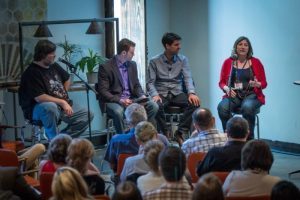 I just returned from the Smarter Artist Summit in Austin, TX. And it was fucking awesome.
If you’ve ever listened to the Self-Publishing Podcast (SPP), run by indie authors Johnny B. Truant, Sean Platt, and David Wright, you already know about the Smarter Artist Summit (SAS), their annual conference, in its second year now.
I first discovered the SPP guys through Joanna Penn, who was one of the first authors I followed for book publishing and marketing advice. I liked her Facebook page and one day I spotted a post for a book promo, a box set of three books: one of hers, David Gaughran’s Let’s Get Visible, and Truant/Platt’s Write. Publish. Repeat. All for 99 cents. That was possibly the first time in my life I downloaded a book without spending 30-60 minutes reading its description and reviews.
I got a lot out of all three books, but it was Write. Publish. Repeat. that spoke to me at that deeper level. It was the first time I read a book on how to succeed as an indie publisher and felt like, “Yes. These are my people.” I began listening to the podcast and have been a fan of the SPP guys’ growing empire ever since.
One of the challenges of being an author, particularly an indie author, is that it’s isolating. We sit in our houses and write, market, and social media… but when it comes time for interaction with other writers, help from those who’ve been there, or cross-promotion, we’re screwed. I realized I was screwed if I didn’t get some help, that my biggest struggle as an indie author was having no tribe, and that my isolation was killing my ability to succeed at the level I wanted.
So when I realized I missed the first summit and heard the guys gushing about it on SPP, I decided right there that I would go to SAS in 2017. I checked that site so many freaking times for when the tickets would go on sale; it got to the point where when I typed the letter “S” into my browser, the SAS landing page would autoload.
The Summit
You’re a writer. You’re an introvert. You want to succeed at fulfilling your dream to be a full-time author. And, perhaps most of all, you want to meet your tribe, offer them help, and get help from them. Now imagine a big room filled with people who have the same characteristics. They love to write. They want to succeed. They want to help you succeed. And they have the sense of humor and positive energy you want due to the massively generous and fun tone set by the guys who run the show. That’s SAS.
It’s two full days of talks, with plenty of talking and fun time after hours (and sometimes after midnight). They invite speakers who offer what their community needs, not just big names that lure participants like you’ll see at other conferences. What’s amazing is that the group is still small enough that you can talk to some of these experts in person and get your questions answered.
For example, I talked to Mark LeFebvre from Kobo books to ask him about Kobo promotions, something I’d had no luck with. He not only answered my questions, he personally helped me with an issue I had and was incredibly polite and helpful. I also talked to Chris Fox, author of Write To Market and other great books on selling and marketing. I was struggling a lot with a particular issue and was pretty nervous to ask for his help (I’m one of those idiots who hates asking for help), but I did and he offered extremely helpful advice and made me feel comfortable.
There were plenty of other experts there as well, all of whom made themselves available day and night: David Gaughran, Kevin Tumlinson from Draft2Digital, two representatives from BookBub, a group from Podium Publishing, and many others.
If you want to see some of the nuggets and takeaways from the summit, check out Mark LeFebvre’s great post on SAS17.
And we had a LOT of fun. Between eating BBQ at mealtimes, drinks in the evening, and karaoke for introverts (yes, really), we tore through Austin. I stayed up late both nights of the summit to talk to people. I NEVER stay up late and don’t really like going out, especially to bars. But I did both and more for these people. That’s how much I loved being there and the people I met.
The agenda for both days:
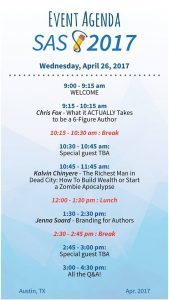
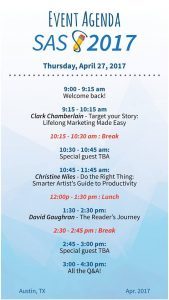
Last but Never, Ever Least…
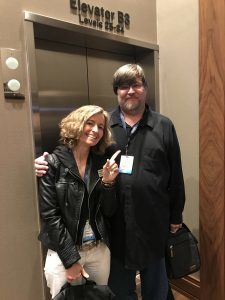
Dave Wright, humoring me for a pic 
May 5, 2017
Patty Jansen, Ebookaroo, and Science Fiction/Fantasy Book Promotions
 If you love science fiction and fantasy, whether you read it or write it, you should know about Patty Jansen and her book promotions.
In a nutshell, Patty gathers up good deals on sci-fi and fantasy (SFF) books all in one place. Some of these books are new releases, others are on sale, and still others are on a free promotion. For example, right now there’s a promotion on SFF series, with all the series books in one place and separated into neat little sub-genres, which is kind of cool. Another example is this Instafreebie science fiction book giveaway, and there’s also this paperback giveaway for all you print lovers (you know who you are).
There are many benefits to being part of Patty’s gig, both for readers and for authors.
For Readers
If you’re a reader, signing up means you get informed when sci-fi and fantasy books go on special, and you can download them without having to go searching on Amazon or another book site. No ads, no requirements, and no cost other than any books you choose to purchase. She makes accessing or downloading the books easy, no matter what platform you read on.
To get these great deals on SFF books, all you need to do is join Ebookaroo, Patty’s email list for readers. That’s it. Here is the page describing how it works, along with the sign-up box.
For Authors
If you’re a science fiction, fantasy, or other speculative fiction author, this means you can request to get your SFF book deals included in any group promotions. Patty and the other included authors promote the deals, so once you’re book is selected, you get cross-promotion from the other authors. She also does special promotions just for audiobooks. And it’s all FREE.
If you want to be part of these author-run promotions, you’ll need to join Patty’s email list. This page explains how it all works and gives you the option to join.
It’s win-win for everyone involved. Join up and let the SFF madness begin.
Happy reading, and writing.
The post Patty Jansen, Ebookaroo, and Science Fiction/Fantasy Book Promotions appeared first on cahartmanfiction.
May 2, 2017
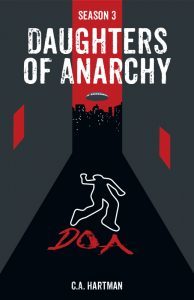
Daughters of Anarchy: Season 3 is Published!
 Greetings, all.
Quick announcement: for those of you who’ve been waiting for the third season of Daughters of Anarchy, I’m happy to report that it’s done and published. It’s available in eBook form on all the major retailers (iTunes, Kobo, Amazon, and Barnes and Noble), and the print version is ready to roll as well if you’re a love-the-feel-of-paper or an I-hate-the-glare-of-eReaders sort of person.
One beta reader called DOA the best of the series so far. It’s definitely the most violent. Episode 8 is pretty freakin’ intense.
I’m working on the fourth (and last) book of the DOA series, and hope to release it in good time.
If you haven’t begun the Daughters of Anarchy series, check out Season 1 today and see if it’s your cup of Joe. If you like your dystopian science fiction with a strong dose of crime thriller and a hint of noir, and you like your badass female protagonists, you’ll dig DOA.
Download away, and enjoy!
Cheers,
Christie
The post Daughters of Anarchy: Season 3 is Published! appeared first on cahartmanfiction.
April 18, 2017
Corporate Power, Police Brutality, and Taking a Stand: The United Airlines Incident
 Well, folks, we have ourselves another debacle in the news. I know, which debacle, right? This time, I’m referring to the United Airlines incident where a man was literally dragged from his seat by authorities, causing him bodily injury and huge controversy for all involved.
I’ve thought a lot about this incident for days. Like most tragic situations that reach viral levels in terms of public reach, this one illustrates several problems that need addressing. It also brings up numerous social issues.
A lot of controversy over the United incident was the fact that David Dao, the man who was dragged from his seat, refused to leave the plane when asked to after they needed the seats to transport crew. Airlines bump people because they overbook and for other reasons, and the rules and regulations around that are complicated. Long story short, Dao got bumped after he’d boarded and taken his seat rather than before because the airline needed to transport four crewmembers. They needed four seats, no one volunteered, and after a lottery selected four people, three left, Dao refused, and shit got ugly.
A lot of the controversy here boils down to whether or not he should have complied, and whether United had legal means to force him out of his seat. This NPR article states that United has revised their rules, and its first line reads “United Airlines crew members will no longer be able to bump a passenger who is already seated in one of the airline’s planes,” implying that they could before. I did some research on the legality of the case and have seen differing analyses, some stating that the guidelines for removal cover only denial of boarding or, if boarded, more stringent reasons for removal (i.e. violence), with others stating that United had the right to remove him, period. To combat public outrage, this YouTube video offers more details on United’s decision to remove him, and justification for their choice.
That’s the thing with these situations. We want a clear answer, but we don’t get one. Even the legal experts disagree. That’s why there’s controversy, and it’s up to the courts to decide later.
That brings me the social Issues this incident brought up:
Corporate Power
One reason the public is so riled up about this incident is it brings up questions about consumer rights. When you pay for a flight and get seated, you assume that you’ll get what you paid for. Yet, the airlines have considerable power because they have to consider public safety, we still have 9-11 concerns impacting our flights, and, well, because airlines are big businesses and we live in a culture and economic system that protects the interests of big business.
I think a lot of people are angry because it seems crazy that a person could pay for an airline seat and get forcibly bumped. We all know people get bumped, but for most of us it’s something they volunteer to do (with compensation, of course). We assume that if we don’t volunteer, we keep our seat. Clearly, that’s not always the case.
To change these sorts of rules and protect your airline seat (or what have you), you need regulations. Regulations are imposed by the government. The battle between free market and government regulation is an important one, one we disagree on in this culture. People gripe when the regulations aren’t strict enough (like in this situation), but they gripe when government imposes regulations that inconvenience us (like paying taxes).
Police Brutality
Then there’s this: the way the officers handled the physical removal of Dao from the airplane, causing him injuries and generally scaring the crap out of people. Police brutality is a major issue in our country, and it brings up another important social issue: just as we must consider how much power we give corporations, we have to consider how much power we give law enforcement.
Excessive force is a common problem in the US. The general culture of law enforcement here is pretty authoritarian. I find this strange. We’re a democracy, a government ruled by the people; we’re all about individual rights and liberties. Yet, we have a law enforcement system that can and will rough you up, beat you, or kill you for being noncompliant. There’s a constant “Don’t fuck with cops” and “Don’t talk back to or argue with a cop” culture here for all of us, and god help you if you’re black. I have a big, outspoken, and very intelligent black friend who says that nothing scares him in life, except cops. And he has the terrifying experiences to justify that fear.
Why is this? We’re taught to value individual rights, to question authority and government, to look down on dictatorships and police states that rob individuals of their liberties… but you can’t question a police officer? You have to do what you’re told, even if the officer is in the wrong? You have to risk being brutalized? I once did research on whether it’s okay to call a cop a pig or some other insult; it’s totally legal to do so, but there are many cases of people getting ticketed or arrested for it.
Overall, when the public goes up in smoke over some injustice, I often feel glad. It’s a sign that we won’t tolerate oppression, that the voice of the people has power, that we’ll never wind up in dystopian conditions like those in George Orwell’s 1984. Yet, some of the outrage at this incident annoys me. There are plenty of examples of corporations exploiting the public (and doing so because they’ve got the money and influence to mold the law in their favor) and there are plenty of examples of police brutality, many of which are more terrifying and with larger ramifications than this one. Yet, many people remain apathetic until the injustice becomes something that could affect them personally and/or happens to someone privileged. In other words, this event involved a man being denied his plane seat (something that could happen to the average person) and it involved someone of relative privilege (a doctor) instead of someone lower on the socioeconomic ladder. If an unarmed black man is shot by police, it’s his fault; but a doctor misses a few appointments on Monday, it’s a fucking tragedy.
I think Dao should have gotten off the plane. Did he deserve to be brutalized? Absolutely not. He’ll sue, he’ll win, and rightly so. However, if I were in that situation, even with murky legalities, even with my anti-authoritarian beliefs, I would have complied. I would done so for the sake of peace, for the sake of the other passengers, for the sake of the future flights affected by mine being delayed, for the sake of the crew and everyone else. I would have then done my research and taken any necessary measures, even boycotted United if necessary.
Some things are worth taking a stand over, worth defying authority, worth even risking injury. In my opinion, this wasn’t one of them.
If you disagree, no problem. That’s what it means to live in a democracy.
The post Corporate Power, Police Brutality, and Taking a Stand: The United Airlines Incident appeared first on cahartmanfiction.
April 14, 2017
Book Promotion Sites for New Science Fiction and Fantasy Authors
 When it’s time to run a book promotion, you’ll find yourself with a lot of choices. Whether you’re in KDP Select and using those 5 free days, or trying to get eyes on your permafree book, or even promoting a discounted backlist book, it can be tough to choose a promotion site that will get you good return in terms of downloads.
Every promotion site differs with respect to its requirements for accepting books for promotion (e.g. some require lots of reviews while others none at all), the audience it promotes to (some specialize in certain genres), the size of its audience (and accordingly, its pricing), and what book platforms it will share links to (some prefer only Amazon, others go wide).
Here, I list a handful of book promotion sites I’ve tried more than once and from which I’ve achieved good results. By “good results” I mean that downloads were decent (ranging from 200 to over 1000 in one day) and the cost per download was somewhere in the $0.04 – $0.09 per download range (with most falling in the middle). Keep in mind that this list includes sites that I’ve tried and had good success with when promoting science fiction. Results can vary quite a bit depending on author, book, genre, etc.
eReader News Today (varies) – One of the better known promotion sites. ENT has a $30 free book promo as well as a $60 Indie Book of the Day. I’ve only tried the former (IBD is only for 99c books and is competitive). I got a lot of downloads plus an impressive slew of reviews the first time I tried them along with FKBT.
Free Kindle Book and Tips ($25 for a free book) – Requires 8 Amazon reviews, 4 of which need to be verified purchases. They want an average rating of 4 stars or more. However, FKBT only promotes Amazon books, not other book sites.
BookSends ($50 for a free book) – Requires only 5 Amazon reviews (good for newbs or new books). However, Like FKBT, Booksends only promotes Amazon books, not other book sites.
ManyBooks ($29) – Another good site for a great price, especially if your books are wide (not just on Amazon). Requires 10 Amazon reviews. Book must be free or discounted by 50%.
Book Barbarian ($50) – This is a relatively new book promotion site that specializes in sci-fi and fantasy books. In other words, your target audience. I tried them recently with excellent results. Need 10 reviews, 3.5-star minimum rating. This one books up, so think at least a month in advance.
FreeBooksy ($70) – What sets FreeBooksy apart from the others is they don’t require a specific number of reviews, which makes them ideal for newer authors or new book series that haven’t found their audience yet. You pay for this with a steeper price — a sci-fi promo is $70. However, the cost per download is as good as any other site I’ve listed here. There are cheaper or even free sites that don’t require reviews, but in my experience you won’t get a fraction of the downloads.
Fussy Librarian ($18) – A popular, low-priced site. This yielded my weakest results (less downloads, highest cost per download), but I think it’s a good site that others have reported great results. Fussy is popular and you have to schedule your promo at least a month in advance. Fussy has a 10-review minimum.
Let me know your opinions, and which sites have worked well for you.
The post Book Promotion Sites for New Science Fiction and Fantasy Authors appeared first on cahartmanfiction.
March 29, 2017
The Dystopia of Dystopias: George Orwell’s 1984
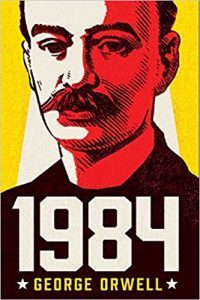 Well, in the time of Trump, why not join the masses in a read of George Orwell’s 1984? I quickly saw that the current political climate, disturbing as it is, bears little resemblance to what goes on in Orwell’s book. Yet, I think it and other dystopian novels are worth a read now and again to remind us of what can go wrong if we the people forget that government exists to serve us, not the other way around. All it takes is a mixture of fear, ignorance, and a need to look to some powerful leader for salvation instead of the people, to allow the next tyrant into power.
Pros: 1984 is well-written in terms of style (better than some other classic sci-fi books), and I found myself looking up several of the words he uses, something I rarely need to do. It’s intelligent and rich with ideas about governing the masses and the masses being governed. There are some gem quotes:
“Orthodoxy means not thinking–not needing to think. Orthodoxy is unconsciousness.”
“Proles and animals are free.”
“There was a direct, intimate connection between chastity and political orthodoxy.”
“Talking to her, he realised how easy it was to present an appearance of orthodoxy while having no grasp whatever of what orthodoxy meant. In a way, the world-view imposed itself most successfully on people incapable of understanding it.”
“They [the High] are then overthrown by the Middle, who enlist the Low on their side by pretending to them that they are fighting for liberty and justice.”
“That it sought power because men in the mass were frail cowardly creatures who cold not endure liberty or face the truth, and must be ruled over and systematically deceived by others who were stronger than themselves. That the choice for mankind lay between freedom and happiness, and that, for the great bulk of mankind, happiness was better.”
And, of course, that doozy of a last line.
I’m guessing Orwell was not a high-serotonin sort of dude.
I admit it took me a long time to get through the book, but not because it’s the darkest book I’ve ever read. The character development is decent but the story dragged, bogged down in exceedingly long paragraphs filled with an excess of ideas. I found the part where Winston reads the book (which means we do too) SO dull. 1984 feels more like a description of a dystopian world with a bit of a story thrown in for good measure. More story would have made it amazing.
The post The Dystopia of Dystopias: George Orwell’s 1984 appeared first on cahartmanfiction.
C.A. Hartman's Blog

- C.A. Hartman's profile
- 26 followers

