Rewan Tremethick's Blog
September 30, 2025
Book Review: Snuff (Discworld #39) by Terry Pratchett
Sir Terry Pratchett is my favourite author, the Discworld my favourite series, and the City Watch books my favourite subset of those novels. Snuff, therefore, had a high bar to reach.
So, did it?
Unfortunately, the answer is ‘not really’. There’s just something that feels fundamentally…off about this book. It’s like an imitation Discworld novel; all the elements are there, but they’re made of cheaper material, less well put together.
And there’s a great tragedy in that, because what’s possibly happened here is that Sir Terry’s early onset Alzheimer’s was beginning to affect his writing and storytelling.
For example, the wry social commentary is still there, but in this book it’s largely delivered in the form of one character lecturing another. There’s a whole scene where Vimes berates a group of wealthy young women who are just sitting around waiting for a husband. There seems to be no reason for it, beyond the most minor of payoffs (more a punchline) at the end.
It also relies too heavily on the same few comic themes to keep it going: Willikins, the butler, is an ex street ruffian and so incredibly dangerous; husbands are henpecked; the children’s author writes lots of books about poo.
And then there’s the Summoning Dark, which Vimes ‘acquired’ in the previous book, Thud!, and here plays a rather Deus Ex Machina role of magically providing solutions where they’re needed. It’s hard not to see it as little more than a narrative shortcut.
It also takes a while for anything to actually happen. In fact, looking back on it, it seems that the opening of the book was added later in attempt to at least vaguely frame what was coming up so the reader had some sense that things were going to happen. By the time stuff has started to happen, we’re so late in the book that it doesn’t really have time to unfold properly and feels under-developed. We get a crime with a loose motive, a villain who isn’t really the main villain and isn’t present for most of the book, an early climax and some overly-neat tying up of loose ends.
In fact, I felt like everything went Sam Vimes’s way too easily. He won fights effortlessly, had clues pretty much handed to him, was always the one doing the outsmarting.
In the interest of balance I should point out that Snuff is very highly rated on places like Goodreads. In fact, Googling it to check which number it was in the Discworld series brought up a Reddit thread of people saying how it was their favourite Discworld book. Each to their own, and all that.
For me, Snuff is the weakest of the City Watch books – a fact made all the more tragic given that it’s the last of the City Watch books.
We all know that Sir Terry was taken from us too early, and in doing so Alzheimer’s robbed us of who knows how many fantastic Discworld books. But reading Snuff makes it clear that, actually, ‘the embuggerance’ started taking Discworld from us long before Sir Terry passed away.
Follow me onInstagramBlueskyThe post Book Review: Snuff (Discworld #39) by Terry Pratchett appeared first on Rewan Tremethick.


September 10, 2025
Book Review: Galaxy in Flames by Ben Counter
Let’s just start with a little context setting, given that this is book III in the series.
If you’ve read my review of Horus Rising, you’ll know what first enticed me to read some of the lord surrounding Games Workshop’s Warhammer 40,000 tabletop game. A core pillar of its iconic setting is the treachery of the Warmaster Horus*, who split the Imperium into civil war, leading his traitorous Astartes Space Marines against their loyalist brethren.
*If you know nothing about Warhammer 40,000, you may consider this a pretty big spoiler. But the series is called The Horus Heresy, so I don’t think it counts.
I wanted to know how the Emperor of mankind’s most loyal ‘son’ and top commander could fall so spectacularly into darkness.
Then, if you’ve read my review for the follow-up, Galaxy in Flames, you’ll know that I didn’t quite get the gradual, conscience-wrenching turn to dissent that I was hoping for.
That disappointment continues in Galaxy in Flames, where any nuance around who’s in the right is crushed under the trappings of Hollywood villainy. The bad guys are all evil now. Horus favours a black suit of armour, complete with a massive claw on one hand. He threatens his subordinates with death, casually orders murders, refuses to have his judgement questioned. His subordinates are the same. They are fiercely loyal and go along with everything that he says.
Again, this is disappointing. To summarise my thoughts on the narrative so far: the Great Crusade depicted in these three books is built upon a creaking tower of hypocrisy. The Space Marines slaughter their way across the galaxy, barely any less brutal or civilised than those they claim to be enlightening. They are trying to stamp out religion, while simultaneously being a pseudo-religious order themselves, full of oaths and superstition and ritual.
They’ve continued killing and dominating for two hundred years, never once questioning their mission, or adapting their approach in the face of the increasingly sophisticated cultures they are encountering.
All of this created the perfect scenario in which Horus, Warmaster and commander of the Great Crusade, could begin to doubt the righteousness of his mission and therefore the will of the Emperor himself. We could have seen him and his legion torn apart as they struggled to choose between their loyalty to the Emperor and their trust in everything they’ve been taught, and what their own heads and hearts (which is a double plural – Space Marines have two each) were telling them.
We could have had a situation where it wasn’t actually clear who was in the right and who was in the wrong. Both sides could have been acting justifiably. A bit like in Captain America: Civil War, where two heroes, in doing what they each think is right, end up in conflict with one another. Instead what we get is “evil forces are at workTM”.
And Galaxy in Flames has to continue that. Disappointing, but that’s where we are.
My bad – up until now it probably sounds like I hated this book. I didn’t – I really enjoyed it, barring the crushing disappointment of a hugely missed opportunity that actually happened in the previous book.
The rest of the novel still offers a great deal. It kept me gripped and, like the previous two volumes in the series, I absolutely flew through this one. Once again we have a new author picking up the setting and the lore and a vast set of characters. Ben Counter does a great job of taking over from Graham McNeill, who himself took over from Dan Abnett, and continues these stories while mostly keeping things consistent.
The story of Galaxy in Flames is a tragic one. It’s where the Warmaster’s betrayal is unveiled and friends become enemies, as bonds of loyalty and friendship are ripped apart.
This book is a little more focused than the other two in that it mostly happens in one setting. Several legions of Astartes warriors are sent to pacify a rebellion, only to find themselves betrayed in turn. There’s a lot of heart-wrenching moments in this book when characters that you’ve grown to know well and care about over two previous books become pitted against each other.
It’s only lessened by what I said earlier, in that it’s very clear now who the bad guys are and who the good guys are. Returning to Civil War for a moment, that film felt like watching all your best friends have a massive row. This, by comparison, is just your classic good-versus-evil; it’s just that the ‘good’ isn’t that great to begin with.
But Galaxy in Flames is a strong offering in terms of the interplay of motivations and loyalty, the way characters struggle as what they thought they knew is undermined or just plain blown up. Ben Counter continues the tradition of this series in bringing a lot of nuance and depth to what I wrongly expected was just going to be a series of sci-fi action blockbusters. While I may feel a bit let down by the way the main premise has evolved, I’m still hooked on the Horus Heresy and I’m sure the next couple of volumes will be arriving on my doorstep soon.
The post Book Review: Galaxy in Flames by Ben Counter appeared first on Rewan Tremethick.
August 24, 2025
Book Review: The Last Murder at the End of the World, by Stuart Turton
Stuart Turton writes books that are difficult to review. They’re incredibly easy to enjoy (see my review of The Devil and the Dark Water); very difficult to explain.
What can I tell you about The Last Murder at the End of the World that won’t undermine the wonderfully twisty-turny narrative? How can I possibly tell you why I like a book like this in a way that doesn’t contain spoilers?
Curse you, Turton! I’m trying to do you a favour here – you really are your own worst enemy.
This book is about a lot of things. It’s about greed; it’s about freewill; it’s about prejudice; it’s about what it means to be human; it’s about compliance and control; it’s about hippies.
It’s about the last pocket of human existence, who survive on an island that is protected from the destructive fog that has covered the rest of the Earth. To touch the fog means near instantaneous, horrendously painful death.
So when a murder triggers the collapse of the barrier, leaving the villagers just hours to find the killer, things get a little tense. There’s just one problem: everyone on the island has had their memory of the past few hours wiped. They go to bed on a normal night and wake up to absolute chaos.
This book is packed full of interesting characters and wonderful twists and turns. It’s a narrative that keeps unfolding and builds an interesting conclusion. The equally bleak and hopeful world reminds me in some ways of the video game Horizon: Zero Dawn, a wonderful, mystery-ridden post-apocalyptic narrative with real soul.
Intricately plotted and intriguingly puzzling, as all of Stuart Turton’s books are. However, for me I felt that one key pillar of the central mystery – or rather, why the mystery is even a mystery in the first place, if that makes sense – seems rather trivial. It’s perfectly justifiable, but to discover most of the complexity of the set up comes from that seems a little underwhelming.
That’s always a problem with these kinds of mind-bending stories, though. Making the reveal as good or better than the setup is a mighty challenge. Stuart Turton pulled it off brilliantly in his first two books, and it’s fair to say he does again. There are so many moving parts and so much intrigue that one somewhat lacklustre element doesn’t undermine the entire thing.
Once again, Stuart Turton’s brilliant imagination is being thoroughly showcased in this dystopian novel. I must admit I found the opening a little bit slow, and somewhat lacking the intrigue of his other two novels, but when the plot kicks off – and it really does – I was absolutely hooked. He is one of the most imaginative and inventive authors that I’ve read, and I can’t wait to see what he comes up with next.
Follow me onInstagramBlueskyThe post Book Review: The Last Murder at the End of the World, by Stuart Turton appeared first on Rewan Tremethick.
August 12, 2025
Book Review: The Warm Hands of Ghosts, by Katherine Arden
Stories really are a funny thing, aren’t they? It’s thanks to stories like The Warm Hands of Ghosts that I can vicariously experience some of the worst things that have happened in the history of humanity in all their enormity. And have a good time doing so.
Thanks, fiction!
The Warm Hands of Ghosts is a historical fantasy set during World War One, in the mud and corpse-filled battlefields and the overburdened hospitals further back from the frontlines. Laura is a decorated nurse who has been sent back to Halifax, Canada, after being seriously injured when the hospital she was working at was bombed by the Germans.
However, she is drawn back to the front lines after being sent some of her brother’s effects. Freddie had enlisted, and the fact Laura has his things suggests he’s been killed in battle. Why then, can nobody give her a straight answer as to his fate? Freddie, meanwhile, after escaping from a collapsed pillbox with a German soldier named Winter, finds himself being lured into the power of the mysterious fiddler known as Faland.
Can Laura find her brother, and what will be left of him if she does?
I’m not usually big on historical fiction. Especially not about either of the World Wars. Those were topics that were done to death in school history classes, although I of course respect the reason why it’s important every generation learns of their horrors.
That’s interesting context for this review. The Warm Hands of Ghosts is a wonderfully powerful, deep, and disturbing look at the realities of war, about the invisible damage it inflicts upon people, and the toll it takes on human lives. There’s a spark of hope laced throughout the narrative – why else would Laura keep on searching? – but Katherine Arden does a fantastic job of bringing the realities of the conflict to life in gruesome yet necessary detail.
The fantastical elements of the book are subtle and integrated perfectly with the reality that Arden describes. This was war on an unprecedented scale, full of horrors hitherto unimaginable – why wouldn’t evil take many forms? How could ghosts not stalk the battlefields and surrounding landscapes? She’s used a blend of historical figures and entirely fictitious characters to create a compelling and believable story. The characters are well-rounded, and this novel is a master class in writing dialogue. Interactions between the characters surgically sharp, but never sterile.
The novel builds to a satisfying conclusion that manages to not only offer a spark of hope, but simultaneously acknowledge the long-lasting impact and horrific legacy of the Great War. This may be fantastical, but it’s no fairy tale.
While I won’t be diving back into historical fiction straightaway, when I do Katherine Arden will be at the top of my list of authors to read.
Follow me onInstagramBlueskyThe post Book Review: The Warm Hands of Ghosts, by Katherine Arden appeared first on Rewan Tremethick.
July 24, 2025
Book Review: False Gods, by Graham McNeill
False Gods had a big set of shoes to fill. The sequel to Dan Abnett’s Horus Rising continues the story of Horus, the Warmaster, as he struggles under the weight of his responsibility in a galaxy that insists on questioning the righteousness of his Great Crusade.
It doesn’t quite live up to the challenge. Abnett’s prose was rich and detailed, vividly bringing the galaxy of the 31st millennium to life and populating it with interesting and varied characters facing a number of complex moral conundrums.
False Gods feels lesser – McNeill is an accomplished writer, but this sequel is not as well written as its forebear. It also deals with the subject matter in a clunky way, delivering a narrative that feels like it’s skipped over what the main story is actually supposed to be.
Horus is a changed man following the stuff that happened with the Interex at the end of the first book. The Warmaster has become sullen and withdrawn, and Captain Loken, one of Horus’s most trusted friends and advisors, struggles under the weight of his growing doubts about the mission, his role in it, and the motives of the Warmaster himself.
McNeill has deftly picked up the characters, setting and difficult moral and ethical questions of Horus Rising and expands upon them well. While the writing lacks the artistry of the first book, the themes and the characters move forwards without the feeling that there is a different writer at the helm.
There are, however, a few big issues with the way the story is told that undermine it.
Given all the brilliant groundwork laid out in Horus Rising, there was so much material here to create a really compelling story about a character struggling between loyalty and doing the right thing.
If you know anything about the Warhammer 40,000 universe, you know that Horus becomes the main villain during the Great Crusade (I don’t consider that a spoiler given that this series of novels is called the Horus Heresy). But he makes the jump from sympathetic character to something of a Hollywood villain very quickly in this book, and due to an unsatisfying set of circumstances.
(I should note that I expect these books were all planned out by Games Workshop, so I don’t think McNeill necessarily made a lot of the choices that shaped the book.)
All-in-all, False Gods is still a gripping novel that I absolutely flew through, and I’ll definitely be reading the third instalment in the series to see how the story unfolds.
But what originally drew me to this series was that key question: how could the most loyal and beloved of the Emperor’s followers turn on him? And, if I’m honest, False Gods delivers an underwhelming payoff to that question, despite having so much rich and nuanced material to draw from to create a real tragic story.
This should have been the story of how the Great Crusade split apart under the weight of its own hypocrisy; a story of how Horus came to doubt the righteousness of his mission and reached the unthinkable conclusion that the Emperor is in the wrong.
Instead, the punchline is essentially ‘evil forces are at work’.
A swing and a miss.
Follow me onInstagramBlueskyThe post Book Review: False Gods, by Graham McNeill appeared first on Rewan Tremethick.
July 10, 2025
Why does bad art make us angry?
We’ve all been there, haven’t we? Finished a book, a film, a TV series – or stopped partaking in it part way through – furious at it.
It doesn’t matter why. Perhaps the plot was bad, or the writing poor. Maybe the characters were unlikable, or did something we just couldn’t believe. Whatever the reason, there’s no doubt that really bad art provokes some really strong feelings in us.
But why does art have this ability to enrage us so? If we don’t like a book, shouldn’t we just close it and get on with our lives?
Broken promisesWe very rarely begin a relationship with a piece of art without any prior context or expectations. In the case of a book, it’ll often be the blurb, the front cover, the author, reviews, or a combination of all of them, that get us interested in reading it in the first place.
It could be that the plot sounded gripping, the characters exciting and nuanced, the world rich and vibrant, or simply that the author in question has entertained and enthralled us before. Whatever it is, we’ve been given a reason to expect something good.
So when it doesn’t deliver, it feels like a broken promise. Often, it can feel like we’ve been tricked – especially when what the story delivers is very different from what it was made out to be.
Wasting our timeIt’s not just our emotional investment that fails to produce dividends when we read a bad book. It takes time – in my case, about 4-5 hours for a 400-page novel. The ‘bad’ isn’t always evident at the beginning, either.
Sometimes it takes until later in the book for a twist, reveal, character decision or plot development to change the course of the story and undermine everything that went before. Stories sometimes fall at the final hurdle (just ask Game of Thrones), in which case you’ve invested hours of your time. It makes you feel tricked.
There’s a big opportunity cost to reading a bad book – that is, the things you could have been doing instead. Like reading a better book.
Squandered potentialThe falling at the final hurdle mentioned above does something else beyond simply wasting our time. It’s like we can see an accident happening in slow motion. The author has put so much hard work into building an incredible story and bringing us along on the characters’ journey, only to throw it all away in one clumsy or misguided move.
As the reader, we can see the direction events could have gone in, but instead we have to watch in horror as the narrative swerves off the road and ploughs into a tree. Only this was no accident: this happened by choice.
Insulting our intelligenceSometimes events of a story are so poorly developed or illogical that it seems the only way the author thought it would be OK is by assuming that us – their readers – would be too stupid to know any better. That we’d just buy into anything fed to us, like some kind of narrative pyramid scheme.
But it’s not just how the story develops – it can be the way in which the writer tells the story. For instance, falling back on worn-out tropes or cliched scenarios. Bluntly telling us every detail instead of layering in subtext. Deliberately and clumsily holding back key information just to keep the suspense going. Expecting us to bend over backwards to accept the logic of a situation where there is none.
Art is emotiveOf course, one of the key reasons why bad art makes us angry is the same as the reason great art makes us joyous, thoughtful, overwhelmed, a better person – and so much more: art is emotive. That’s the point.
The fact that bad art makes us angry is simply part of the deal. Sure, a lot of art can be underwhelming and leave us apathetic. But the rage we feel upon being let down by art is not a character flaw. We’re not overreacting (unless we decide to direct that rage at the author, or those who like what we don’t); we’re participating exactly how we should.
The day art is not allowed to play on our emotions, whether positive or negative, is a terrible day for humanity indeed.
Follow me onInstagramBlueskyPhoto by Jevgeni Fil on Unsplash
The post Why does bad art make us angry? appeared first on Rewan Tremethick.
July 3, 2025
Halfway through 2025? Time for a reading update
Yes, yes, isn’t the year going quick? Where’s it disappearing to? Gosh, it’s July already? And all that.
Picture the scene: it’s January and you’ve decided that you’re going to try doing a reading challenge again this year. You gave it up previously, after discovering your neurodiversity, because you wanted to know what you’d actually end up doing if you didn’t try and keep yourself on such a tight leash all the time. But now you felt it was time to try again and see what happens.
We all need a little nudge to keep going, even with things that we love, after all.
My reading goal for this year was a very modest 12 books. One a month seemed doable, and easy to catch up on if I missed a month.
As of the 2nd of July I’m a quarter of the way into book 15 of the year. I’m delighted with that, you won’t be surprised to hear.
But here’s the bit that is a little surprising. I had months where I read nothing at all. The post linked above describes how the AuDHD mind is like a pendulum, swinging between the extremes of intense, narrow focus and wild, broad exploration.
Other than writing, I feel like I don’t have special interests in the ‘usual’ Autistic way. Instead, I have ‘flavours of the month’. I get drawn into something for an extended period, usually occupying the bulk of my free time, only to lose interest after a few weeks and drifting onto something else.
It could be playing video games, it could be painting my Warhammer, it could be learning about a new subject. Right now, it’s reading, and it has been for about five weeks. Case in point: I read five books – over a third of this year’s total – in June alone. Here’s the full breakdown for the year so far:
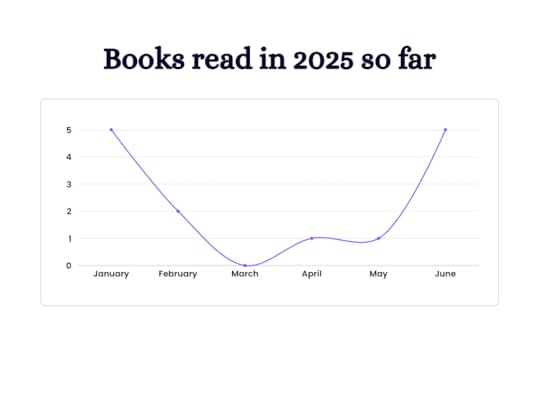
As you can see, it’s very choppy progress. But what’s interesting is that if you average it out, it’s very good progress for me. Bearing in mind that my best reading year to date was 24 books, and without really giving myself much of a shove I’m on track to beat that this year. Even if I don’t read another book for the next six months, I’ve read a decent amount by my standards.
(I’ll be honest though – I am now pretty inspired to hit a personal best.)
The real key here has been to let go of the reigns of my mind, and the assumptions of how I should be doing things, and instead just let it go where it wants to. It is very difficult – who wants to spend a couple of months dedicating themselves intensely to a project and then just leave it halfway through? Moreover, who can do that easily without constantly feeling guilty at abandoning it and worrying that you’ll never return?
But learning to deal with those difficult feelings has been vital, not just for the sake of my mental health but for the sake of allowing me to reach my maximum potential. I’ll say again – I let go of the reading wheel this year, completely. Reading when the mood takes me, giving up when it doesn’t. Telling myself not to feel guilty if I haven’t read anything for days, or weeks, or months. And the result is that I’m doing better than ever.
That certainly makes it easier to keep on going as I have been.
So, what will the final year’s total be? Who knows. It could be 14, it could be 28, it could be any number in between. But what is certain is that the number I reach is the number I’m meant to reach, and whatever number that is, I’ll get there by reading when I feel like it.
Follow me onInstagramBlueskyPhoto by Jan Mellström on Unsplash
The post Halfway through 2025? Time for a reading update appeared first on Rewan Tremethick.
June 24, 2025
Book Review: Horus Rising, by Dan Abnett
I’ve been a Warhammer fan for decades but have never really cared much about the lore. However, eventually curiosity got the better of me and I decided I wanted to know the story of how Horus, the most beloved and loyal ‘son’ of the Emperor of mankind, had turned traitor, leading his legion against their brothers and splitting the Imperium into bloody civil war.
And by the Emperor does this book start things off on top form.
I’ll admit I was surprised. I don’t know much about the lore of the Warhammer 40,000 universe, and the first thing that struck me was the depth of the story. I don’t mean that to sound derogatory – as a lifelong member of the hobby, I’m well aware of its many facets and the rich narrative that surrounds it. But, regardless of that, Horus Rising is far from the action-packed, adrenaline-pumping sci-fi adventure I had expected.
Instead, what I found was a nuanced and thoughtful exploration of loyalty, ethics, brotherhood, war, religion and more.
Some very brief scene setting. For a reason the book doesn’t explain, at some point mankind was scattered amongst the stars. The Emperor launches his Great Crusade, supported by his demigod-like Primarch commanders and their legions of genetically enhanced superhuman Astartes Space Marines, in an attempt to bring the lost human civilisations together under his rule.
By the start of Horus Rising, the Emperor has retired from the conflict and returned to govern on Terra for reasons unknown, leaving the Primarch Horus Lupercal in charge of the Great Crusade under the title of Warmaster. The novel follows the perspective of Gavriel Loken, an Astartes captain who is invited to join the ranks of Horus’s most trusted advisors and confidants. Also along for the ride are a series of ‘Remembrancers’ – artists, poets, dramatists, documentarists, photographers and writers – who have been given permission to record the epic victories and heroic deeds of the Great Crusade for posterity.
And yet that mighty cause starts to fall into question for Loken and the Remembrancers as it continues on its mission to bring the Emperor’s light to the disparate human cultures. Far from a noble endeavour, the crusade is a brutal affair that brings only subjugation or extermination to those who refuse to acknowledge the one true Emperor of mankind.
This is what the novel does so well. It would be so easy to fetishise the Astartes and their campaign. In fact, I’m sure many fans do – but the truth of the grimdark Warhammer 40,000 universe is that the Space Marines and the Imperium that they serve and protect are not the good guys in the galaxy. Space Marines are indoctrinated, manufactured killers serving a tyrannical empire barely any less barbaric than the civilisations it claims to be enlightening.
Dan Abnett captures this wonderfully, putting his wide cast of characters into situations that test their resolve, their beliefs – or lack of – and their loyalty to the limit. He deftly sows the seeds of an epic tale that will engulf the entire galaxy in war. His writing is sublime, rich and detailed, perfectly matching the depth of his narrative. This book is far beyond simply ‘super macho guys with big guns blow up baddies’, although there is of course quite a bit of that too.
I flew through Horus Rising, utterly hooked by the style and artistry of the writing, the depth of the characters and the aplomb with which the author handled its complex subject matter, albeit with maybe a few too many similes and knowing references to what comes later. Those who think Warhammer is just about playing with toy soldiers are wrong – Games Workshop has created an entire mythos that surrounds its tabletop games. If Warhammer isn’t your thing, I’d encourage you to forget the notion of games and rolling dice and painting and just read Horus Rising as a science fiction novel in isolation of everything else.
Because this isn’t a great Warhammer novel. It’s just a great novel, full stop.
Follow me onInstagramBlueskyThe post Book Review: Horus Rising, by Dan Abnett appeared first on Rewan Tremethick.
June 8, 2025
Website update: Making it easier to find the good stuff
Exciting things are happening! For quite a long time, I’ve struggled with how to balance the various different goals I want to achieve and stuff I want to talk about online.
On the one hand, there’s my upcoming fantasy novel. I want to share updates and snippets with the people who love to read it.
On the other, there’s the social commentary. There’s lots I want to say about the world.
Then there’s also just the plain daft stuff. The comedian who was raised on Monty Python, the Goon Show, the Marx Brothers, the Goodies, Eddie Izzard, Bill Bailey, Red Dwarf – and much more.
It felt like it made sense to have it all together, because it all comes from me. My fiction, my commentary on the world, my humour — it’s all a product of the same brain, obviously. It seems reasonable to think that if you like one aspect of it – of me – you’ll like the other aspects as well.
But then there’s the consideration of giving you, my reader, what you want. For example, what if you’re just interested in hearing about my fiction journey, like the sound of what I do, and are waiting to see when the book comes out?
One of the constraints has been that working full-time, having kids, and being neurodiverse, I don’t have the energy, the time, the capacity to run multiple social media accounts and websites. I barely have the energy or the mental bandwidth to do one.
So the question was: how can I make this work for both of us? It needs to allow me to put content out there in a way that moves me closer to my goals. But it also has to work for people who might be interested in me.
I want to make it as easy as possible for me to prove to you that I’m worthy of your time, your energy, your attention. I want to make sure it is worthwhile you doing that. Those things are precious. I understand that, and I want to be responsible with the stuff I’m putting in front of you.
What’s changing?My website is, naturally, the hub for all things Rewan. But I want to separate out those things so that you can easily find what interests you.
To that extent, the blog will be solely focussed on my reading and writing journey. Updates on my progress, information about my projects, bits of fiction, book reviews, and general thoughts on stories – how they work, why they work, why we tell them.
All with a hefty dose of the surreal daftness mentioned earlier. You’d need a long spike and a big hammer to get rid of that.
The social commentary is moving. It’s me talking about our behaviour online, the way we interact with people that we don’t agree with, the internet and the culture that has arisen around it. It is also a bit daft – see the spike thing above.
That’s all going to live on my Medium. Although you’ll notice the ‘Social Commentary’ link in the nav bar.

I tried using Medium at the beginning of 2023 and I used it in the same way I used this blog up until now: a mixture of everything. It never really gain traction, and I sort of fell out of love with the platform.
I’m going back over there for two reasons. One is because it is a good place for me to put my social commentary. It fits well on Medium. I think there’s an audience for it there. Secondly, because being on Medium will boost the visibility of it.
Don’t get me wrong, I’m not expecting to get thousands of views and go viral with any of my articles. But all I want with my social commentary — because I think what I’m saying is important — is just to know that some people are seeing it. Even if it’s just a handful of people. That’s all it needs to be right now.
And what about my Bluesky account? To be honest, I’m still figuring that out. But following me and engaging with my stuff there will help me determine out what’s working and worthwhile. Hint hint, nudge nudge… Photo by Markus Winkler on Unsplash
The post Website update: Making it easier to find the good stuff appeared first on Rewan Tremethick.
May 19, 2025
I miss magazines
I miss magazines.
“But Rewan, magazines still exist; you could read one today,” you may reply.
You’re right. And I do. But what I miss is the magazine as a paradigm. The format still exists, but the world has moved on, and I’m not sure that today’s content economy is better for it.
Exponential growthA couple of years ago I spent a few months writing on Medium. I quickly ended up getting recommendations for articles on how to succeed on the platform. The content of them was not inspiring.
The people who seemed to be succeeding despite having only been writing for 6 months were the ones who had published an article every other day, or even daily, during that period.
There were others bragging about having published 1,000 articles in the past year. That’s almost three articles a day.
And Medium is just one platform, but the advice is the same across all of them. If you want to be visible, if you want to appeal to the algorithm, you want to be publishing something at least once a day.
Inverse relationshipWhat about quality? Ah, well, current theory is that success in writing is a statistics game. Only a small fraction of your audience is going to see your content anyway. So it’s better to throw as much content out as possible in order to appear before more readers. Sure, most of it won’t be great, but maybe it’ll be good enough to entertain those who do see it.
There is, of course, some truth in that argument. Even the best writers have manuscripts, or half-finished manuscripts, articles and who knows what else tucked away in a drawer or buried deep in their hard drives.
Beethoven composed over 700 pieces during his lifetime – are all of them bangers? (The use of the word ‘bangers’ to describe Beethoven’s most famous compositions gives you a hint as to the depth of my relationship with classical music).
But overall it seems that the internet has done two things; drastically increase the amount of content being created, while simultaneously massively lowering the quality bar, assuming there still is one.
You don’t know what you got ‘til it’s goneWhich is why the humble magazine was such a great thing. We didn’t know what we had when we had it.
Think about it. The magazine is a finite, well-defined product. You know what you’re getting and when you’re getting it. If you subscribe to the magazine, there’s no risk of the postal worker hiding an issue in your compost bin because they’ve been paid to deliver leaflets for pizza or political party messages thinly disguised as a local newspaper.
You want it, you subscribe to it, you get it. That’s how it works.
Timebound
The regular, fixed format makes it easier to make time for it as well. You know roughly what time of the month it’s going to arrive, how long it’s going to be, and how long it’ll take you to read it.
Focussed
And then there’s the content itself. First of all, it’s all on the same theme, but there’s a huge amount of variety within that theme. It’s the perfect balance of variety and focus. This is something I think a lot of online writers struggle to achieve, which is why they go for the ‘spray-and-pray’ approach to content in the hope that if they publish enough articles on enough topics, eventually they’ll collect a following of people who like some of their stuff.
Of course, not everyone reads a magazine cover to cover, even the subscribers. But there’s still a difference.
Up to standards
And what about quality? I’ll be honest, I’ve read some truly awful magazines. Let no one accuse me of claiming the magazine is the perfect format and every single example represents the peak of writing. But still, magazines have an editor, or several. They have proofreaders (although, again, based on some I’ve read, I’m not so sure…). They have a pool of writers, all guided and kept within a single editorial style. There is a quality bar.
Relevance
Instead of the ‘publish it, you never know what will be successful’ mentality of a lot of content creators, magazines work on a ‘this isn’t up to our standards’ or ‘this isn’t a good fit for our readership’ basis. This means that readers know roughly what they’re getting. I find it particularly annoying to follow a creator where only 10% of their output, if that, is something that interests me.
Singular
Then there’s the fact all this content is collated and curated for you. Today things have become so spread out. Instead of getting one single thing that contains the wit, wisdom and insights of dozens of writers, we now have to subscribe to dozens of writers individually across a lot of platforms.
It’s all too much. Our social channels and our inboxes are full of notifications, full of content that lots of people are pushing out at increasingly high volumes in order to stay visible and relevant. Yet the spray-and-pray method means a lot of this may not interest you.
A respite for writersIn fact, I wouldn’t be surprised if the magazine sees a massive resurgence in popularity. The content creation economy is on a path to self-destruction. The amount of content available is growing exponentially, and yet the amount of readers isn’t growing that fast, and the amount of time available for consuming content probably isn’t changing much at all.
That’s not to blame content creators: they’re trapped in a prisoner’s dilemma.
Imagine a platform with 100 content creators, each publishing one article per week. Each creator has a share of 1% of the content on the platform.
But then another 100 creators join, each also putting out one article per week. Suddenly everyone’s share is 0.5%. If those creators start publishing another article every week, the newcomers are quickly going to respond, otherwise their ‘share of voice’ goes down, too. So readers are already up to 400 articles a week to sift through, and that’s just a relatively small example involving bi-weekly publishing.
Reversion isn’t always badSometimes with technology, we’re so excited by the fact it’s new and shiny that we wholeheartedly jump aboard without stopping to think about what we’re leaving behind. Compared to the internet, the magazine seems outdated. It’s physical (OMG), monthly (soooo long to wait), finite (these page thingies don’t have infinite scroll) and it costs money.
But as the internet gets increasingly bloated with content, much of it soon to be generated by AI, it turns out that many of what we viewed as a magazine’s weaknesses are actually its greatest strengths. Rather like how we’re shifting back to paper bags, refill stores and vinyl records, maybe we’ll see a shift in interest back to magazines.
It’d do both readers and writers a massive favour.
Follow me onInstagramBlueskyHeader photo by Rhema Kallianpur on Unsplash
The post I miss magazines appeared first on Rewan Tremethick.