Susan Altstatt's Blog
August 6, 2016
Giveaway!



July 14, 2016
THE DEATH OF ICONS OF DESIRE
In 1983, toward the end of Bowie’s “Serious Moonlight tour, Gothic novelist Anne Rice wrote an article for Vogue Magazine, titled “David Bowie and the End of Gender:”
https://exploringdavidbowie.wordpress...
“Whirling on the very edge of the culture, the great rock singers of our time personify our laments, our fears and our dreams. They are the fantasy figures of the romantic artistic vision, set free to evolve on record and in live performance exactly as they please. In a technological society obsessed with the redefinition of masculine/feminine, they shatter conventional notions of sexual charisma--”
I saved the article: it was the first I’d ever encountered which treated rock singers as serious artists, even genius artists, and rock music as anything more than pap.
Now, for the past two months, my efforts to generate content of interest for this blog have been brought to nothing–– to a burbling intellectual standstill–– by the death of Prince. A bit surprising, all considered.
I was a fan of David Bowie. (Among others.) I found his recent departure traumatic enough. But Bowie had been posturing and playing with his death–– trying it on for size–– since he was twenty years old. Something about a man like that dulls the sorrow.
His 1983 Oakland concert was one of two I drew on for the concert in Belshangles. My protagonist Andy has dreaded Tommi getting old, dreaded him outliving his glamour. Dreaded herself irrevocably growing up, and being shamed out of her fan-girl passion for Tommi. All this gets put aside rather abruptly when she hoists an OD’d Tommi off the pavement of an alley into her friend’s car. Now she has to wrap her mind around the possibility of Tommi, her icon of desire, dying––
Our icons die. Bowie never quite out-lived his glamour. He kept his figure. He kept his hair. He kept his voice. He kept his mind. When the time came, he could, and did make videos about his own passing.
But Prince? I didn’t know his music. I took my daughter to see him once in the eighties, at a sit-down concert in the SF Cow Palace. We were so far away, he was a tiny, bright-colored mannequin. I thought he put on a good show.
I was uneasily aware that over a 30-year career he’d appeared not to age a day.
The day after Prince died, some thoughtful friend imported to my Facebook page the live video of “Like a Motherless Child.” Here it is. Watch it. If it’s been taken it down, Google Prince–– Like a Motherless Child––Live! Some fan will have put it up again.
https://www.youtube.com/watch?v=99Q31...
I was stunned. This man’s body was an extension of his mind. His musical instrument was part of his body. He played his band and his audience like musical instruments. Here is what I would call Beauty Incarnate. And until he was dead I never knew.
I’ve since watched many of his videos. Also the scenes of his mourners outside Paisley Park, stout middle age couples, both white and black, people who have loved this man desperately since they were kids, drying each other’s tears and comforting each other. The man they idolized died alone in an elevator,
Since 1983, and especially since 2000, there’s been huge outpouring of serious rock critique and scholarship, which is not antithetical to the love of fandom, but an intellectual outgrowth of it. For instance, ‘Poetry for the Purple One,” by Michael Robbins. Read it.
http://www.chicagotribune.com/lifesty...
High praise indeed. Here’s another by Jane Clare Jones, an academic specializing in feminist philosophy. Her cultural criticism has appeared in The Guardian and The New Statesman, and she is currently completing her PhD at the State University of New York at Stony Brook. She’s mostly interested in what feminist metaphysics has to tell us about sex and sexual politics.
http://www.popmatters.com/feature/wat...
Read any of the present commentary on Prince, and one word leaps out at you again and again. “Beautiful.” Prince was exquisitely, knowingly beautiful. This is what the “gender bender” comments are basically all about, men aren’t supposed to flaunt themselves that way. Men are strong: women are beautiful. And yet, in all the rest of the animal kingdom, it’s the males who put on the show, who have the fancy feathers.
Male rockers put on a captivating show of fancy feathers, starting with Elvis in 1956.
"He was once beautiful, astonishingly beautiful", in the words of critic Mark Feeney. Television director Steve Binder, no fan of Presley's music before he oversaw the '68 Comeback Special, reported, "I'm straight as an arrow and I got to tell you, you stop, whether you're male or female, to look at him. He was that good looking. And if you never knew he was a superstar, it wouldn't make any difference; if he'd walked in the room, you'd know somebody special was in your presence."
And Elvis was followed by a long generation of astonishingly beautiful men, many of whom were cut off in their prime, and will now be young and beautiful forever. The so-called “27 club,” Jim Morrison, Jimi Hendrix, Kurt Cobain, I must add at least two female super stars to the club, Janis Joplin, Amy Winehouse, and outliers to either side, Brian Jones only 26, Marc Bolan 30, and a whole raft of rappers and European artists I never knew.
Overdose. Car wrecks, plane wrecks, suicide, murder. John Lennon was shot by a madman at 40. These deaths somehow complete the image. Now those among that long generation of Rock idols who didn’t “die young and stay pretty” are reaching the age when ordinary people die. There seem to be no young rock gods behind them in the pipeline.
Of three more or less recent passings, Michael Jackson, Bowie and Prince, Jackson, like Elvis and Jim Morrison before him, is rumored to have merely eluded his fan base, and be living somewhere, comfortably incognito.
Of course, the same was said for years of Hitler. More about that later.
Michael Jackson and Prince both died of drugs, all right, not done for kicks, but trying to get a few hours sleep, or a respite from incessant pain. These days, an increasingly common American way of death. David Bowie on the other hand died quietly of cancer, clean and sober, surrounded by his family. As did George Harrison in 2001. We still have two Beatles left. I can’t help wondering how and when we’ll lose them.
Crazy rock-star lifestyle, rock-star fan frenzy and rock-star deaths are not, as some would have it, peculiar to our era. There is exhaustive precedent for all of them, extending back four hundred years, to the time when the concert-going (and ticket buying) public took over the funding of the arts from aristocratic patronage.
To be cont’d.
https://exploringdavidbowie.wordpress...
“Whirling on the very edge of the culture, the great rock singers of our time personify our laments, our fears and our dreams. They are the fantasy figures of the romantic artistic vision, set free to evolve on record and in live performance exactly as they please. In a technological society obsessed with the redefinition of masculine/feminine, they shatter conventional notions of sexual charisma--”
I saved the article: it was the first I’d ever encountered which treated rock singers as serious artists, even genius artists, and rock music as anything more than pap.
Now, for the past two months, my efforts to generate content of interest for this blog have been brought to nothing–– to a burbling intellectual standstill–– by the death of Prince. A bit surprising, all considered.
I was a fan of David Bowie. (Among others.) I found his recent departure traumatic enough. But Bowie had been posturing and playing with his death–– trying it on for size–– since he was twenty years old. Something about a man like that dulls the sorrow.
His 1983 Oakland concert was one of two I drew on for the concert in Belshangles. My protagonist Andy has dreaded Tommi getting old, dreaded him outliving his glamour. Dreaded herself irrevocably growing up, and being shamed out of her fan-girl passion for Tommi. All this gets put aside rather abruptly when she hoists an OD’d Tommi off the pavement of an alley into her friend’s car. Now she has to wrap her mind around the possibility of Tommi, her icon of desire, dying––
Our icons die. Bowie never quite out-lived his glamour. He kept his figure. He kept his hair. He kept his voice. He kept his mind. When the time came, he could, and did make videos about his own passing.
But Prince? I didn’t know his music. I took my daughter to see him once in the eighties, at a sit-down concert in the SF Cow Palace. We were so far away, he was a tiny, bright-colored mannequin. I thought he put on a good show.
I was uneasily aware that over a 30-year career he’d appeared not to age a day.
The day after Prince died, some thoughtful friend imported to my Facebook page the live video of “Like a Motherless Child.” Here it is. Watch it. If it’s been taken it down, Google Prince–– Like a Motherless Child––Live! Some fan will have put it up again.
https://www.youtube.com/watch?v=99Q31...
I was stunned. This man’s body was an extension of his mind. His musical instrument was part of his body. He played his band and his audience like musical instruments. Here is what I would call Beauty Incarnate. And until he was dead I never knew.
I’ve since watched many of his videos. Also the scenes of his mourners outside Paisley Park, stout middle age couples, both white and black, people who have loved this man desperately since they were kids, drying each other’s tears and comforting each other. The man they idolized died alone in an elevator,
Since 1983, and especially since 2000, there’s been huge outpouring of serious rock critique and scholarship, which is not antithetical to the love of fandom, but an intellectual outgrowth of it. For instance, ‘Poetry for the Purple One,” by Michael Robbins. Read it.
http://www.chicagotribune.com/lifesty...
High praise indeed. Here’s another by Jane Clare Jones, an academic specializing in feminist philosophy. Her cultural criticism has appeared in The Guardian and The New Statesman, and she is currently completing her PhD at the State University of New York at Stony Brook. She’s mostly interested in what feminist metaphysics has to tell us about sex and sexual politics.
http://www.popmatters.com/feature/wat...
Read any of the present commentary on Prince, and one word leaps out at you again and again. “Beautiful.” Prince was exquisitely, knowingly beautiful. This is what the “gender bender” comments are basically all about, men aren’t supposed to flaunt themselves that way. Men are strong: women are beautiful. And yet, in all the rest of the animal kingdom, it’s the males who put on the show, who have the fancy feathers.
Male rockers put on a captivating show of fancy feathers, starting with Elvis in 1956.
"He was once beautiful, astonishingly beautiful", in the words of critic Mark Feeney. Television director Steve Binder, no fan of Presley's music before he oversaw the '68 Comeback Special, reported, "I'm straight as an arrow and I got to tell you, you stop, whether you're male or female, to look at him. He was that good looking. And if you never knew he was a superstar, it wouldn't make any difference; if he'd walked in the room, you'd know somebody special was in your presence."
And Elvis was followed by a long generation of astonishingly beautiful men, many of whom were cut off in their prime, and will now be young and beautiful forever. The so-called “27 club,” Jim Morrison, Jimi Hendrix, Kurt Cobain, I must add at least two female super stars to the club, Janis Joplin, Amy Winehouse, and outliers to either side, Brian Jones only 26, Marc Bolan 30, and a whole raft of rappers and European artists I never knew.
Overdose. Car wrecks, plane wrecks, suicide, murder. John Lennon was shot by a madman at 40. These deaths somehow complete the image. Now those among that long generation of Rock idols who didn’t “die young and stay pretty” are reaching the age when ordinary people die. There seem to be no young rock gods behind them in the pipeline.
Of three more or less recent passings, Michael Jackson, Bowie and Prince, Jackson, like Elvis and Jim Morrison before him, is rumored to have merely eluded his fan base, and be living somewhere, comfortably incognito.
Of course, the same was said for years of Hitler. More about that later.
Michael Jackson and Prince both died of drugs, all right, not done for kicks, but trying to get a few hours sleep, or a respite from incessant pain. These days, an increasingly common American way of death. David Bowie on the other hand died quietly of cancer, clean and sober, surrounded by his family. As did George Harrison in 2001. We still have two Beatles left. I can’t help wondering how and when we’ll lose them.
Crazy rock-star lifestyle, rock-star fan frenzy and rock-star deaths are not, as some would have it, peculiar to our era. There is exhaustive precedent for all of them, extending back four hundred years, to the time when the concert-going (and ticket buying) public took over the funding of the arts from aristocratic patronage.
To be cont’d.
April 28, 2016
FAR FURTHER THAN ULYSSES
By way of introduction: I freely admit to being the author whose novel was excoriated in Roseanne Sullivan’s March 16, 2016 comment to Jonathan McDonald’s article “What has Rome to do with Iowa City?” in the conservative Catholic literary journal, “Dappled Things.” She had accused me earlier by eMail of writing pornography. I mailed back that there are no explicit descriptions of sex acts or sex organs to be found in Belshangles, and the only conjectured sex act of any kind is between consenting adults in another room with the door shut. Since her accusations were private, I didn’t feel free to mine her inclusion of my book in her own private banned book index for promotional purposes. But now she was posting her criticism to a public forum.
In my last blog post, “Blessed are the Merciful, ” I referenced Dana Gioia’s essay “The Catholic Writer Today,” (see online) documenting the decline into irrelevance of Catholic fiction, which not so long ago was a vibrant part of the English and American literary scene, as well as my attempts to have, first Mr. Gioia, then a little trail of others read Belshangles as an exemplar of modern Catholic imagiative fiction.
I finally addressed my request to Ms. Sullivan, (Who describes herself as a “Wanna-Be Catholic Pundit,”) because I have known her for years, and, knowing her, trusted her to be scandalized and come out swinging. She did not disappoint.
“This article is timely for me,” she wrote, “and reinforcing. I recently was asked to review a novel by a Catholic friend of mine that described experiences of a 15 year old protagonist that horrified me. It had many parts that went far further than Ulysses, which as we all know occasioned an obscenity trial¬––”
But how could I possibly have guessed she would compare “Belshangles”—not to “Fifty Shades of Gray,” or other such trending sensationalist fare, but to James Joyce?? That’s the kind of public critique for which most authors would pay good money. Many thanks! Though I was frankly curious which passages in Belshangles she thinks "go far beyond Ulysses…" In further “comments on the comments” she clarified the issue.
“I don’t have the book (Belshangles) any more, so I can’t quote passages to compare to Ulysses. The juiciest bit of Ulysses I remember (and I didn’t read the whole of that) is the scene at the end where Molly Bloom remembers her seduction and says, “He asked me would I yes to say yes my mountain flower and first I put my arms around him yes and … his heart was going like mad and yes I said yes I will Yes.”
Note that in that passage nothing is clearly stated, what is being asked or what is being felt. And that and other non-explicit passages were considered scandalous because of what they were describing. But nothing is supposed to scandalize us nowadays. What I meant by the Ulysses reference is that we have become immune to scenes that would have been cause for cries of obscenity in past years. Since the Belshangles novel recounts the sensual writhings of a rock star and his lover on stage in the midst of a Bachanalian (sic) scene of 50,000 screaming and crying fans, and tells about a young girl being encouraged by her mother to put a poster of her idol over her bed–followed by the girl basically dropping out of normal life-and about a 15 year old girl gazing lustfully on the naked object of her desire standing on a rock in a stream bed, I am shocked because I personally don’t want to have those kinds of images in my mind, and I wouldn’t wish them on anyone else, no matter how skillfully done--”
I find it ironic that the Joyce passage she quotes is Molly Bloom’s reminiscence of her husband’s marriage proposal, and is often given as one of the most breathtakingly lovely (if eccentric) passages in modern English prose. If you’re curious, “Molly Bloom’s Soliloquy” is readily available online in a dozen places.
Here is the Belshangles scene she claims “goes far beyond.” Andy has taken Tommi to Bright’s Creek, a place which for her has spiritual value. He wants to sit by himself, and assures her he won’t run away, so she lets him, returning some time later.
––I should go back where Tommi was. He’d been abandoned far too long. Wasn’t sure how long, it might be hours. I edged and crawled around a smooth rock shoulder which cut me off from everything upstream. The green race churned precariously close below my heels, so I didn’t look up, till I gained the flat rim of the pool.
Tommi stood at the top of the falls, a naked ivory statue. He had stripped to the skin. White against leaves and stone and water he shone, perilously potent, a grave-faced power out of myths and dreams.
Now here I was, no warning, like I’d been at his hotel. He hadn’t meant to flash me. He’d stripped to swim while I was nowhere visible.
And there he was, too simple-proud to cringe and clutch his crotch. And he wasn’t too thin anywhere. He wore about him a terrible naked human dignity, like Adam before the fall. Like people were designed to look, and never do.
The tears crept down my cheeks. One moment longer, and I would have bowed to him.
“How deep is that?” he motioned to the pool below.
I couldn’t tell him. My eyes clung to his eyes in despair, away from the rest of him.
“Come on, come on.”
“Not very,” I faltered, “about five feet.”
The harm was done. I couldn’t look away from him. He was a white-hot image like a burning iron, charring slowly deeper through my mind.
He snickered. “So much for my Olympic form.” He went in with a whoop feet-first, and spent the next few minutes swirling around the pool with the ice-green current and yelling “Cold! Cold!” In the water he didn’t look much older than me. One of Izzy’s Mod friends, maybe. His hair was slicked down in his eyes: wet red satin.
“Hey, y’come in with me?”
It wouldn’t make much sense to say I didn’t have a suit. What did he care? I still felt stricken and tearful at the sight of him naked. Wounded, somehow.
“Come on, you!
And I couldn’t strip myself. Not in front of all that beauty. He lunged half out of the water like a laughing crocodile. He had my ankles; I couldn’t get away from him. Well, it wouldn’t be the first time I’ve gone in Bright’s Creek fully dressed. Somebody always falls in, accidentally on purpose. Then of course that person has to soak the rest. Once everybody’s in, nothing matters. Like that now.
So we both swirled around the pool, him in his milk-white skin and me in my Belshangles T-shirt and Levi’s. I showed him where the trout hid under the rocks, and he ducked down so see. He splashed me; I splashed him back. He did a lot of laughing. It was good, very good; as good as anything can be. I felt uncommonly, tearfully grateful, and tried to pray the Latin Gloria in time to the chattering of my teeth.
Bright’s Creek is much too cold to have fun in for long. My clothes and shoes acted as a kind of wetsuit; he had nothing. I couldn’t afford to be reminded. Happy as he looked, he was turning blue on the ends.
But getting out posed problems. “Hey,” I said, “I’m getting out.” (The direct approach.) “‘Want to check on something, two-or-three pools upstream beyond your clothes.” (How’s that for tactful?) “I’ll be back in awhile.”
“After I’ve got them on?”
Not tactful enough. “Yeah.”
I still maintain “Belshangles” is modern fairy tale about the power of inalienable love, not obsessive lust.
We have, if we’re honest, a God–given ability to see beauty incarnate in the human form. When I describe Tom naked as like a “grave-faced power out of myths and dreams,” my visual reference would be the Apollo of Olympia, whom I have admired unashamedly, ever since I was an eighteen-year-old freshman, and first made his acquaintance in the library of the Stanford Classics Department. (See left, modestly cropped for fear of scandalizing anyone with a mental image which they may not choose to entertain.)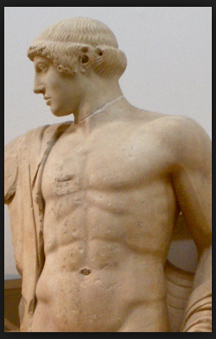
In my last blog post, “Blessed are the Merciful, ” I referenced Dana Gioia’s essay “The Catholic Writer Today,” (see online) documenting the decline into irrelevance of Catholic fiction, which not so long ago was a vibrant part of the English and American literary scene, as well as my attempts to have, first Mr. Gioia, then a little trail of others read Belshangles as an exemplar of modern Catholic imagiative fiction.
I finally addressed my request to Ms. Sullivan, (Who describes herself as a “Wanna-Be Catholic Pundit,”) because I have known her for years, and, knowing her, trusted her to be scandalized and come out swinging. She did not disappoint.
“This article is timely for me,” she wrote, “and reinforcing. I recently was asked to review a novel by a Catholic friend of mine that described experiences of a 15 year old protagonist that horrified me. It had many parts that went far further than Ulysses, which as we all know occasioned an obscenity trial¬––”
But how could I possibly have guessed she would compare “Belshangles”—not to “Fifty Shades of Gray,” or other such trending sensationalist fare, but to James Joyce?? That’s the kind of public critique for which most authors would pay good money. Many thanks! Though I was frankly curious which passages in Belshangles she thinks "go far beyond Ulysses…" In further “comments on the comments” she clarified the issue.
“I don’t have the book (Belshangles) any more, so I can’t quote passages to compare to Ulysses. The juiciest bit of Ulysses I remember (and I didn’t read the whole of that) is the scene at the end where Molly Bloom remembers her seduction and says, “He asked me would I yes to say yes my mountain flower and first I put my arms around him yes and … his heart was going like mad and yes I said yes I will Yes.”
Note that in that passage nothing is clearly stated, what is being asked or what is being felt. And that and other non-explicit passages were considered scandalous because of what they were describing. But nothing is supposed to scandalize us nowadays. What I meant by the Ulysses reference is that we have become immune to scenes that would have been cause for cries of obscenity in past years. Since the Belshangles novel recounts the sensual writhings of a rock star and his lover on stage in the midst of a Bachanalian (sic) scene of 50,000 screaming and crying fans, and tells about a young girl being encouraged by her mother to put a poster of her idol over her bed–followed by the girl basically dropping out of normal life-and about a 15 year old girl gazing lustfully on the naked object of her desire standing on a rock in a stream bed, I am shocked because I personally don’t want to have those kinds of images in my mind, and I wouldn’t wish them on anyone else, no matter how skillfully done--”
I find it ironic that the Joyce passage she quotes is Molly Bloom’s reminiscence of her husband’s marriage proposal, and is often given as one of the most breathtakingly lovely (if eccentric) passages in modern English prose. If you’re curious, “Molly Bloom’s Soliloquy” is readily available online in a dozen places.
Here is the Belshangles scene she claims “goes far beyond.” Andy has taken Tommi to Bright’s Creek, a place which for her has spiritual value. He wants to sit by himself, and assures her he won’t run away, so she lets him, returning some time later.
––I should go back where Tommi was. He’d been abandoned far too long. Wasn’t sure how long, it might be hours. I edged and crawled around a smooth rock shoulder which cut me off from everything upstream. The green race churned precariously close below my heels, so I didn’t look up, till I gained the flat rim of the pool.
Tommi stood at the top of the falls, a naked ivory statue. He had stripped to the skin. White against leaves and stone and water he shone, perilously potent, a grave-faced power out of myths and dreams.
Now here I was, no warning, like I’d been at his hotel. He hadn’t meant to flash me. He’d stripped to swim while I was nowhere visible.
And there he was, too simple-proud to cringe and clutch his crotch. And he wasn’t too thin anywhere. He wore about him a terrible naked human dignity, like Adam before the fall. Like people were designed to look, and never do.
The tears crept down my cheeks. One moment longer, and I would have bowed to him.
“How deep is that?” he motioned to the pool below.
I couldn’t tell him. My eyes clung to his eyes in despair, away from the rest of him.
“Come on, come on.”
“Not very,” I faltered, “about five feet.”
The harm was done. I couldn’t look away from him. He was a white-hot image like a burning iron, charring slowly deeper through my mind.
He snickered. “So much for my Olympic form.” He went in with a whoop feet-first, and spent the next few minutes swirling around the pool with the ice-green current and yelling “Cold! Cold!” In the water he didn’t look much older than me. One of Izzy’s Mod friends, maybe. His hair was slicked down in his eyes: wet red satin.
“Hey, y’come in with me?”
It wouldn’t make much sense to say I didn’t have a suit. What did he care? I still felt stricken and tearful at the sight of him naked. Wounded, somehow.
“Come on, you!
And I couldn’t strip myself. Not in front of all that beauty. He lunged half out of the water like a laughing crocodile. He had my ankles; I couldn’t get away from him. Well, it wouldn’t be the first time I’ve gone in Bright’s Creek fully dressed. Somebody always falls in, accidentally on purpose. Then of course that person has to soak the rest. Once everybody’s in, nothing matters. Like that now.
So we both swirled around the pool, him in his milk-white skin and me in my Belshangles T-shirt and Levi’s. I showed him where the trout hid under the rocks, and he ducked down so see. He splashed me; I splashed him back. He did a lot of laughing. It was good, very good; as good as anything can be. I felt uncommonly, tearfully grateful, and tried to pray the Latin Gloria in time to the chattering of my teeth.
Bright’s Creek is much too cold to have fun in for long. My clothes and shoes acted as a kind of wetsuit; he had nothing. I couldn’t afford to be reminded. Happy as he looked, he was turning blue on the ends.
But getting out posed problems. “Hey,” I said, “I’m getting out.” (The direct approach.) “‘Want to check on something, two-or-three pools upstream beyond your clothes.” (How’s that for tactful?) “I’ll be back in awhile.”
“After I’ve got them on?”
Not tactful enough. “Yeah.”
I still maintain “Belshangles” is modern fairy tale about the power of inalienable love, not obsessive lust.
We have, if we’re honest, a God–given ability to see beauty incarnate in the human form. When I describe Tom naked as like a “grave-faced power out of myths and dreams,” my visual reference would be the Apollo of Olympia, whom I have admired unashamedly, ever since I was an eighteen-year-old freshman, and first made his acquaintance in the library of the Stanford Classics Department. (See left, modestly cropped for fear of scandalizing anyone with a mental image which they may not choose to entertain.)
April 17, 2016
Blessed are the Merciful
Recently I was shown an essay by poet, critic and former chairman of the National Endowment for the Arts, Dana Gioia, titled The Catholic Writer Today, which appeared last year in the Journal “First Things,” and later, somewhat expanded, in “Santa Clara Magazine.” I was most impressed, and thought I fit his profile of the new Catholic imaginative fiction writer pretty well. I addressed myself by email to Mr. Gioia, asking if would read my book. His answer, “No, I will not read your book: my desk is already littered with the unread novels of my friends.” I then made the same request of the local literary pundit who, with glowing excitement, had pointed me at the Gioia article in the first place. She said she had no time; all her time goes into blogging. This conversation was repeated down the line, to anyone I knew with any Catholic intellectual pretensions. So how can the people whose opinions are the most educated be too absorbed writing and blogging about the former glories of Catholic imaginative fiction to read anything new? Flannery O’Connor isn’t with us anymore.
Belshangles is a work of Catholic Imaginative Fiction at a time when influential critics mourn the genre as extinct. However, “New Church” Catholic imaginative fiction need not resemble pre-Vatican II Catholic imaginative fiction very much at all, because the “New Church” doesn’t resemble the pre-Vatican II Church very much at all.
50 years post Vatican II a Pope can flat-out tell the Catholic Church to stop “obsessing’ over sexual issues, contraception, gay marriage, abortion, etc, and instead, spend its energies bringing God’s mercy to the poor, the outcasts, and the marginalized.
I think Rock Stars like Tommi Rhymer are a category unto themselves when it comes to marginalization: they are Idolized Outcasts (or is it Outcast Idols?) because of their perceived lifestyle, drug use, flamboyant sexuality, etc. Andy finds in these risk-taking behaviors reason to fear for Tommi’s wellbeing, and no reason at all not to love him. Here she sums up her oddly DIY religious education as a child of disaffected post Vatican II Catholic intellectuals, and how it bears on her devotion to Tommi Rhymer. She has just seen Tommi kiss his lead guitarist, Harlan, and knows this is a secret that love obliges her to keep.
Later, when Tommi is about to pass out in the alley behind the hotel, she thinks:
I could leave him here with Skye, and go tell––No, I couldn't. How about the party? I could go up there and find help. Nicky or Rollo. A roadie. Somebody. A drug bust might have roped in all those guys by now, to give statements or something. Or maybe they all were high. My idea of Narc Squad operations is courtesy commercial television strictly.
Like my idea how the Church feels about gays. Did anyone ever teach me that? No priest I ever heard preach said shit about that. No, I got the chance to learn it for myself, in all its glory, off the 6:00 O'Clock News.
Not only did Vatican II–– as Dana Gioia complains–– do a number on Catholic Art, Literature, Music, Architecture, etc, it also delivered a slow-acting death blow to the much joked-about Catholic sexual guilt-trip.
Today most Catholic youth (with the possible exception of home-schooled traditionalists) have never been taught, and certainly have never internalized the jaundiced view of human sexuality prevalent in the early twentieth century Church. They can have been to Mass every Sunday of their lives, and never yet heard anything said about that from the pulpit. The brooding sexual guilt that hangs over Catholic writers like Evelyn Waugh or Graham Green is to them quaintly alien at best, and at worst, absolutely repellant. Their views on sex hail largely from rock music.
The present Pope recognizes that the sheep have stopped following the shepherds, and are finding their own way. It has at least occurred to him that the shepherds might try following the sheep, see where they’ve got to, and minister to their needs in situ. And in accordance with that idea, he has proclaimed a Jubilee Year of Mercy for the Church.
Having said all this, I realize the Catholic aspects of Belshangles are something with which many not want to get involved. And I can understand that.
I should point out that I got as far as I did with Belshangles in the Amazon Breakthrough Novel Awards competition without ever mentioning religion or Catholicism in the pitch, in the synopsis or anywhere. But neither did the readers who gave me five stars or the glowing Publishers’ Weekly review say a word about it. I find this downright odd. The Catholicism of it seems to me pervasive; it’s like the elephant in the room. I feel almost certain, that if this book should gain any readership, I will scandalize some traditionalist Catholics, and maybe even some liberals as well. I’m surprised that no secular reader has called my hand on the PC-ness of what is certainly a love story between a fifteen year old protagonist and a man twice her age, who has a well-earned reputation as a libertine.
When asked to characterize my work’s content in one sentence, my first thought was:
Fifteen year old Catholic virgin meets rock star;
fifteen year old Catholic virgin loses rock-star (almost);
fifteen year old Catholic (still) virgin, gets rock star (maybe).
But my friend, the author and blogger on literary subjects said, “Oh no! I wouldn’t use the word Catholic! That’s the kiss of death!” She is a devout Catholic, it was she who introduced me to the Dana Gioia article on the demise of Catholic imaginative fiction.
Years ago, when agents would actually take time to insult authors instead of emailing them brief form refusals, I had one snarl at me, “You’re preaching something!” I asked, “What do you think I’m preaching?” She said, “I don’t know, but I don’t like it!” So I gave some serious thought to whether I actually was preaching, and if so, what? I decided that if I had any message, it was “Blessed are the merciful, for they shall have mercy shown them.” The Hebrew word that gets translated in English as “mercy” literally means “inalienable love.”
At the beginning of Belshangles we hear Andy Falconer asking, and asking, how one gets to meet the stars. And the answer is always, “You have to have something they want.” She can’t imagine in her case, what that might possibly be.
But she does in fact have something, and Tommi gets it. As he says:
Later on he shyly adds, “I could love you for it.”
So, I think if had to sum up what happens in Belshangles with one sentence, I’d go with “Blessed are the merciful.”
Belshangles is a work of Catholic Imaginative Fiction at a time when influential critics mourn the genre as extinct. However, “New Church” Catholic imaginative fiction need not resemble pre-Vatican II Catholic imaginative fiction very much at all, because the “New Church” doesn’t resemble the pre-Vatican II Church very much at all.
50 years post Vatican II a Pope can flat-out tell the Catholic Church to stop “obsessing’ over sexual issues, contraception, gay marriage, abortion, etc, and instead, spend its energies bringing God’s mercy to the poor, the outcasts, and the marginalized.
I think Rock Stars like Tommi Rhymer are a category unto themselves when it comes to marginalization: they are Idolized Outcasts (or is it Outcast Idols?) because of their perceived lifestyle, drug use, flamboyant sexuality, etc. Andy finds in these risk-taking behaviors reason to fear for Tommi’s wellbeing, and no reason at all not to love him. Here she sums up her oddly DIY religious education as a child of disaffected post Vatican II Catholic intellectuals, and how it bears on her devotion to Tommi Rhymer. She has just seen Tommi kiss his lead guitarist, Harlan, and knows this is a secret that love obliges her to keep.
...And it seemed so grossly unfair. This present ache in my chest was no by-product of a religious education. Not of mine, at any rate: this was one guilt trip I never ingested. The only Church I knew after all, was Father Malachi and Saint Ann's Chapel.
The entire Saint Ann's High Mass Chant Choir ate Vesper Dinner at our house on Sunday nights, twenty to twenty-five strong. Some were Stanford faculty and some were students. They talked Old Church theology, art, music, wine, medieval history, sports cars and computer hacking. I talked it with 'em, since none would admit, (not in that company at least) to even a tolerance for rock music. But mostly, they talked New Church politics.
It seems the Catholic Church went supernova six years before I was born: huger and brighter, more involved, more relevant, more media-conscious, more, More, more, until the gassy outer shell just blew off into space, and the rest fell back into the Vatican, an ecclesiastical black hole receding inward faster than the speed of light. American
Catholics (like my parents) got told something unheard of: "Form your own consciences." Half the Catholics in the U.S. went up in a radioactive cloud. But the remnant (like my parents) did what they were told.
Ten years after I was born it sunk in on the higher-ups the format of those consciences was not exactly as foreseen. "OK, folks, this has been a fun experiment. But now, unform your consciences." Meltdown. There go the rest. Descendants of survivors roam the parishes in furtive mutant bands, forming their own consciences.
The Folk-Mass and the High-Mass crews at Saint Ann's don't trust each other very much: your Modern Church in miniature. And the folk contingent runs the Sunday School: power in numbers. I got to be eleven years old and had never had First Communion, just like Saint Bernadette.
Papa looked over the materials the folkies used in their instruction, and at my grade level, when it came to the resurrection of Jesus (one key concept after all), the picture they put in to illustrate it was a two-page full-color glossy spread of––an Easter basket! Green fake grass, dyed eggs, marshmallow eggs and imitation baby chicks all wrapped up in pastel cellophane; and, get this, outside the cellophane, one solitary chocolate rabbit, free-standing on the table top.
When asked if he's a liberal or conservative Catholic, Papa's been known to say, "A Survivalist!"
Needless to say, I didn't go to Saint Ann's Sunday school. He tried to take me out to Redwood Priory. They only do boys. But one of the monks is a family friend; he offered to instruct me. Father Malachi is a genuine Hungarian Refugee, and has seen it all. He's also a counselor at Juvy Hall.
He began on me by saying, "The first question in the Baptism you received when you were very small is 'What do you ask of the Church of God?' The answer is 'Faith.'"
I said "Sounds all right to me," which everybody thought was hilarious for some reason.
"That," he said, "is what I try to give you." And he knew what I was like. No chocolate rabbits. He gave me the Saints. All this wondrous stuff from the Desert Fathers, Catherine of Siena, Francis of Assisi and both the Teresas, right down to Joseph of Cupertino and Margaret Mary Alacoque. People who preached to wolves and were fed by ravens, warriors and wise women and spinners of splendid words, hermits and holy loonies who piped like birds and flew above the heads of the people in church, and the swooning mystical lovers. They were just what I needed: someone to feed on, someone to bleed on, like the song says. I took them off into my blackest privacy and ate them up.
Like I know I was born on the Vigil of Saint Laurence, whom an angry Roman Emperor had broiled on a barbecue. Laurence's last words were, "Turn me over boys, I'm done on this side." I can appreciate Saint Laurence.
But then, into that select and glorious company, with no real qualm, I'd somehow admitted Tommi Rhymer: better than remembered poetry, a man I recited in my head for company. Is that so strange? I know any number of normal kids surviving much the same way, their whole inner lives hitched happily to different stars.
Fantasy Lovers. Icons of Desire.
Consider the gawky, zit-faced, longhaired boys whose every thought revolves around the raunchy doings of Iron Maiden or Motley Crue. And Oh, the dear, priceless dead ones––not quite saints, but I understood the concept––Elvis. Jim Morrison. John Lennon. Jimi Hendrix. Marc Bolan. Lily Langtry, dead since 1929.
I'd played with Tommi Rhymer for three years. Slept with him, showered with him, gone to school with him. When I was brave he was brave with me, and when I failed he took my rap. While to parents, teachers and siblings he was (more or less) invisible. I was twelve, and thirteen, and fourteen: a woman in a child's life with no appropriate place to go, stuck, like a fly in amber. Nobody understood but Tommi. And what was he? Sassy, sexy, witty magician. A child triumphant in a man's life, maybe?
If all the really-real I ever got to share with Tommi Rhymer was this one, lonely and unwelcome secret, at least it would keep safe with me. Value for value received. I owed him that much anyway.
Later, when Tommi is about to pass out in the alley behind the hotel, she thinks:
I could leave him here with Skye, and go tell––No, I couldn't. How about the party? I could go up there and find help. Nicky or Rollo. A roadie. Somebody. A drug bust might have roped in all those guys by now, to give statements or something. Or maybe they all were high. My idea of Narc Squad operations is courtesy commercial television strictly.
Like my idea how the Church feels about gays. Did anyone ever teach me that? No priest I ever heard preach said shit about that. No, I got the chance to learn it for myself, in all its glory, off the 6:00 O'Clock News.
Not only did Vatican II–– as Dana Gioia complains–– do a number on Catholic Art, Literature, Music, Architecture, etc, it also delivered a slow-acting death blow to the much joked-about Catholic sexual guilt-trip.
Today most Catholic youth (with the possible exception of home-schooled traditionalists) have never been taught, and certainly have never internalized the jaundiced view of human sexuality prevalent in the early twentieth century Church. They can have been to Mass every Sunday of their lives, and never yet heard anything said about that from the pulpit. The brooding sexual guilt that hangs over Catholic writers like Evelyn Waugh or Graham Green is to them quaintly alien at best, and at worst, absolutely repellant. Their views on sex hail largely from rock music.
The present Pope recognizes that the sheep have stopped following the shepherds, and are finding their own way. It has at least occurred to him that the shepherds might try following the sheep, see where they’ve got to, and minister to their needs in situ. And in accordance with that idea, he has proclaimed a Jubilee Year of Mercy for the Church.
Having said all this, I realize the Catholic aspects of Belshangles are something with which many not want to get involved. And I can understand that.
I should point out that I got as far as I did with Belshangles in the Amazon Breakthrough Novel Awards competition without ever mentioning religion or Catholicism in the pitch, in the synopsis or anywhere. But neither did the readers who gave me five stars or the glowing Publishers’ Weekly review say a word about it. I find this downright odd. The Catholicism of it seems to me pervasive; it’s like the elephant in the room. I feel almost certain, that if this book should gain any readership, I will scandalize some traditionalist Catholics, and maybe even some liberals as well. I’m surprised that no secular reader has called my hand on the PC-ness of what is certainly a love story between a fifteen year old protagonist and a man twice her age, who has a well-earned reputation as a libertine.
When asked to characterize my work’s content in one sentence, my first thought was:
Fifteen year old Catholic virgin meets rock star;
fifteen year old Catholic virgin loses rock-star (almost);
fifteen year old Catholic (still) virgin, gets rock star (maybe).
But my friend, the author and blogger on literary subjects said, “Oh no! I wouldn’t use the word Catholic! That’s the kiss of death!” She is a devout Catholic, it was she who introduced me to the Dana Gioia article on the demise of Catholic imaginative fiction.
Years ago, when agents would actually take time to insult authors instead of emailing them brief form refusals, I had one snarl at me, “You’re preaching something!” I asked, “What do you think I’m preaching?” She said, “I don’t know, but I don’t like it!” So I gave some serious thought to whether I actually was preaching, and if so, what? I decided that if I had any message, it was “Blessed are the merciful, for they shall have mercy shown them.” The Hebrew word that gets translated in English as “mercy” literally means “inalienable love.”
At the beginning of Belshangles we hear Andy Falconer asking, and asking, how one gets to meet the stars. And the answer is always, “You have to have something they want.” She can’t imagine in her case, what that might possibly be.
But she does in fact have something, and Tommi gets it. As he says:
"I’m quite scandalously well off, y’know. I’m on the top of my pile. I’ve got the whip hand now in everything I do, while I’m still young enough to relish it. Nobody would suppose I need much mercy to get by. Surprise, nobody thinks to show me any. It’s what I call the ‘Tommi, you are God’ syndrome. And I’m not, y’know. Sure. You know.
“On the flip-side, is my image as a ‘Public Sinner’.”
“Don’t say that!”
“Well? It’s true. I worked hard for it: ‘T.P. Rhymer: by appointment, purveyor of vicarious debauchery to a society largely incapable of providing its own cheap thrills. Everybody knows what I deserve: to be ragged on and lusted after all at the same time, by the same people, even. Mercy is not the currency my kind are paid in.
“Which brings me around to you. What have you imagined you were doing?”
“Oh. Rolling with the punches, mostly.”
“I guess. Y’ know, I hit you? Funny, considering the walk I come from, but I never hit a woman in my life before. I’ve not been a very charming guest. I’ve sworn at you. Threatened you. Run out on you. I’ve been ugly and terrified and sick. Really wonderful person, y’know.
“I shit and puked your floor. You cleaned up after me like you––like I was your––I don’t know what. You’ve spread mercy over me at every turn; when I wanted no part of it, you made it stick. And I’m touched. This doesn’t happen to me every day. I don’t usually cry. Oh, I’m used to following Harlan around with a towel. But I got the tables turned on me now, don’t I? Tell me, what am I supposed to do?”
Later on he shyly adds, “I could love you for it.”
So, I think if had to sum up what happens in Belshangles with one sentence, I’d go with “Blessed are the merciful.”
March 9, 2016
Super Review
The following is without a doubt the finest review Belshangles has received, and from a man whose literary taste and judgement I revere.
Super Début
September 1st, 2015
by Terry Ross in Black Lamb, Volume 13, Number 9, September 2015, Portland OR
review of “Belshangles” by Susan Altstatt, Fithian Press, 2015
Fourteen-year-old Miranda “Andy” Falconer is a wonderful creation. Intellectual and intelligent, she’s also resourceful as hell and wise beyond her years. In serious teen-aged love with rock star Tommi Rhymer of the band Belshangles, she contrives, on the spur of the moment, to kidnap her beloved after a concert and keep him captive for two weeks in a remote mountain cabin so that he can break his heroin addiction.
Susan Altstatt’s book — it was a semi-finalist in the 2014 Amazon Breakthrough Novel Awards — is the story of this unlikely but crazily believable abduction. Along the way, poor Andy has to carry her hero, who has passed out, into the cabin, and then, when he wakes up, withstand his wrath and physical violence, outrun him when he tries to escape, see that he is fed and kept warm, and generally cope with his drug withdrawal, which takes more than a week.
This is Altstatt’s first novel, but you’d never suspect it from the writing, which is assured, almost cocky in its confidence. Both of the main characters are fully drawn and full of surprises. Rock star Tommi, although glamorous and scarcely educated, is intelligent, thoughtful, and articulate, and the ancillary dramatis personæ — Andy’s mother and father, her friend Skye, Tommi’s partner Harlan — make brief but vivid appearances. The plot unspools in conventional chronological order, and glimpses of the pasts of both characters are smoothly integrated. There’s not a bit of awkwardness in the showing or telling anywhere; this is an almost absurdly well-written first novel (or second or third, for that matter).
You would also not guess that although her main characters are a female adolescent and a youthful man, Altstatt is no youngster herself. Other authors have gotten themselves into print for the first time when older, but I doubt if any seventy-five-year-old has produced a better first effort than Belshangles, especially one incorporating a good deal of pungent rock ‘n’ roll history. An accomplished painter and theater set designer, Altstatt is also a profound medieval scholar and a devout Catholic, a trait that she shares with Andy, who is fond of muttering Latin prayers to herself in moments of stress. Now Altstatt can add “novelist” to her many hats.
Belshangles is a page-turner, too, as we live every suspenseful moment inside Andy’s consciousness. I won’t spoil the ending for you except to say that when all is done, Andy still loves Tommi. And so do we. But our chief affection is for this brilliantly portrayed girl, who has taken her rightful place among the memorable protagonists of fiction.
Belshangles can be ordered through independent bookstores, through Amazon and other online book dealers, or directly from the publishers at 800-662-8351. I am reliably informed that a sequel has already been written, which would be the second book of a projected trilogy. Let us hope that some smart literary agent will read Belshangles and see to it that Susan Altstatt finds a big-name publisher and a reasonable advance for her next book. •
Posted by: The Editors
Super Début
September 1st, 2015
by Terry Ross in Black Lamb, Volume 13, Number 9, September 2015, Portland OR
review of “Belshangles” by Susan Altstatt, Fithian Press, 2015
Fourteen-year-old Miranda “Andy” Falconer is a wonderful creation. Intellectual and intelligent, she’s also resourceful as hell and wise beyond her years. In serious teen-aged love with rock star Tommi Rhymer of the band Belshangles, she contrives, on the spur of the moment, to kidnap her beloved after a concert and keep him captive for two weeks in a remote mountain cabin so that he can break his heroin addiction.
Susan Altstatt’s book — it was a semi-finalist in the 2014 Amazon Breakthrough Novel Awards — is the story of this unlikely but crazily believable abduction. Along the way, poor Andy has to carry her hero, who has passed out, into the cabin, and then, when he wakes up, withstand his wrath and physical violence, outrun him when he tries to escape, see that he is fed and kept warm, and generally cope with his drug withdrawal, which takes more than a week.
This is Altstatt’s first novel, but you’d never suspect it from the writing, which is assured, almost cocky in its confidence. Both of the main characters are fully drawn and full of surprises. Rock star Tommi, although glamorous and scarcely educated, is intelligent, thoughtful, and articulate, and the ancillary dramatis personæ — Andy’s mother and father, her friend Skye, Tommi’s partner Harlan — make brief but vivid appearances. The plot unspools in conventional chronological order, and glimpses of the pasts of both characters are smoothly integrated. There’s not a bit of awkwardness in the showing or telling anywhere; this is an almost absurdly well-written first novel (or second or third, for that matter).
You would also not guess that although her main characters are a female adolescent and a youthful man, Altstatt is no youngster herself. Other authors have gotten themselves into print for the first time when older, but I doubt if any seventy-five-year-old has produced a better first effort than Belshangles, especially one incorporating a good deal of pungent rock ‘n’ roll history. An accomplished painter and theater set designer, Altstatt is also a profound medieval scholar and a devout Catholic, a trait that she shares with Andy, who is fond of muttering Latin prayers to herself in moments of stress. Now Altstatt can add “novelist” to her many hats.
Belshangles is a page-turner, too, as we live every suspenseful moment inside Andy’s consciousness. I won’t spoil the ending for you except to say that when all is done, Andy still loves Tommi. And so do we. But our chief affection is for this brilliantly portrayed girl, who has taken her rightful place among the memorable protagonists of fiction.
Belshangles can be ordered through independent bookstores, through Amazon and other online book dealers, or directly from the publishers at 800-662-8351. I am reliably informed that a sequel has already been written, which would be the second book of a projected trilogy. Let us hope that some smart literary agent will read Belshangles and see to it that Susan Altstatt finds a big-name publisher and a reasonable advance for her next book. •
Posted by: The Editors
February 27, 2016
Concerning Cabins in the Wilds
I love remote old cabins in the mountains and the desert, I want to move in. sweep them out, tack plastic over their empty windows, deal with the mice and spiders. Bring in food and light and warmth and furniture. The oldest, from the middle of the 19th century, are dugouts, with dirt floors and low walls of rotten logs; these don’t tempt me much. Then come substantial log cabins, and finally wooden, tin-roofed houses with good floors, more than one room and a window or two, built around 1900.
The reasons for their existence only dried up and blew away in the middle of the 20th century, they had known forty or fifty good years. persons somewhere still own them, they are too remote to make pulling them down a priority.
Sad as it seems, most homesteaders gave up eventually, and removed to the city. Their descendants come back every so often to see where their grandparents used to live. Cow camps ceased to exist when 18-wheeler livestock transports, together with their attendant forcing pens and loading ramps replaced the days of herding open-range cattle long distances on horseback.
Log camps were no longer needed when diesel Cats replaced draft horses, log trucks replaced steam engines on branch railroads for hauling, and the logger could jump in his pickup and rejoin his wife and family every evening. The miners and their cabins mostly went away when legislation shut them down at the time of World War II.
The cabin which served as model for Pardee Camp was in relatively good shape when I first saw it in the early ‘60s; there were recent hay bales in the log barn and the house would have been habitable with a bug-bombing and a little TLC.
The property has been listed for sale several times since then. The first time, as I understand. It was bought by persons who became irate when they realized it was inaccessible in the winter, and promptly resold it. Actually, it’s not completely inaccessible, winter access would just require some fortitude and the proper equipment. It is, I believe for sale at present. That view of a cabin at the beginning of this blog is the realtor’s photo of it. I asked my husband if he would consider buying it. He wouldn’t.
The online listing says it has 160 acres of private land, which might imply it was originally a homestead. However, the only name I’ve ever heard attached to it calls it a “camp,” a place seasonally occupied by cowboys. At large somewhere in my house is a folder of photographs from which I intended to paint a panorama of it and its aspen meadow, then never did.
The Altstatt family cabin, on the other hand, stands in the Sierra Summer Home Tract mentioned in the book. It was built in the early sixties by my husband John, his father and brothers. It is as hand-made by owner and rough-and-ready as any homestead. The furnishings derive mostly from the student boardinghouse John’s grandmother ran in an old two-story Victorian in San Jose, with some of my mother’s and grandmother’s stuff mixed in, including the bookcase two-deep with all the Edgar Rice Burroughs and Walter Farley books.
During the years my daughter was rock-star devoted I listened in distress when grownups bedeviled her with “What would you DO with him if you had him?” she answered with dignity and without hesitation that she’d take him to the cabin. That intrigued me. I wondered how she’d get the dear man there, and once there, what the chances were he’d like it. Then I thought, wouldn’t it be cool beyond measure if our family had, for two generations, owned the old cow camp which lies lost in the woods ten miles behind the tract? What if that were the cabin in question?
Andy is rooted and grounded in family, resourceful, hard-headed, self-sufficient family. The story of the cabin is her story. She doesn’t know what a man like Tom wants that she might possibly have. Actually, what Tom craves is family, more than anything in the world.
So this was the genesis of Belshangles, just as Umberto Eco said he wrote “The Name Of the Rose” because he felt like poisoning a monk. (546) I wrote Belshangles because I felt like helping a love-sick teenager take a rock star to the family cabin.
I had worked out an identity for my teenage devotee, and now, thanks to my dream, I knew who her rocker idol was, I knew now how she’d get her hands on him, and how she’d get him to the mountains. But the original question was, what would she DO with him? About that, I hadn’t a clue. I had to wait for Tommi Rhymer to wake up, with a girl he doesn’t know, in a bed he doesn’t remember, in a house he’s never seen, then see what happened next…
A New York agent who read Belshangles in manuscript years ago quipped at me, “Of course, you know this is all fantasy.”
My answer: “You got a problem with that?”
Of course it’s fantasy. But, having said that, it seems to me rehabbing troubled people is not so very different in kind from rehabbing remote cabins. I found the intimate combination of the two appealing.
For most of my life I have been a painter rather than an author. But my love affair with old cabins has remained constant.
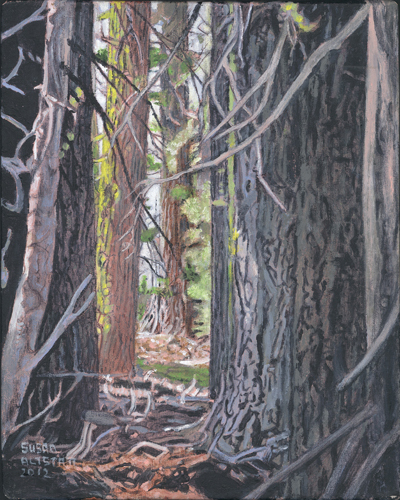
Picture 1: title, “The Woods Behind The Cabin” is as it was four years ago, before the Forest Service logged it in the name of fire prevention.
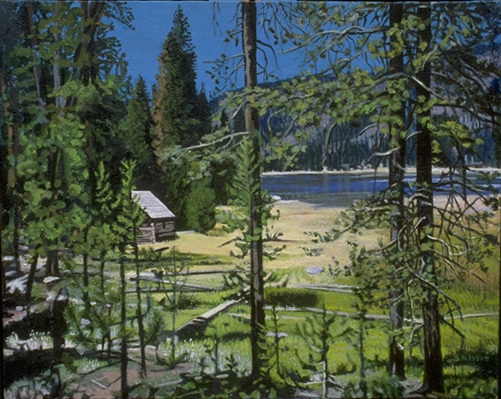
Picture 2: I painted this view of a cabin on the shores of Antelope Lake in the far northern Sierra twenty years ago. I didn’t paint many more Sierra scenes because the clientele which developed for my work was in and around the southern California desert.
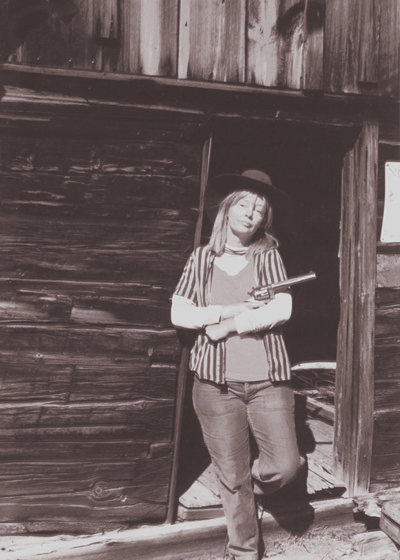
Picture 3: A photo of myself, heavily photo-shopped by the same. I removed my wrist watch, and sepia toned the original color shot to make it look more timeless. The doorway I’m lolling in belongs to a place called Kuck’s Cabin in the Goosenest Ranger District Siskiyou County. This too was probably a cowboy cabin, since Diedrick Kuck, who raised cattle in the valley below during the 19th century, also ran his stock on open range land up the mountain. It stands near a National Forest primitive campground now, hence the notice on the wall informing the viewer that the cabin is Federal property, and that any attempt to vandalize it, remove items from it etc. will not be tolerated. And yes, that is my pistol. And I do know how to use it.
Then there are the little towns, hotels. gas stations, general stores in the desert that died when the ore in the mine played out, or the freeway passed them by.
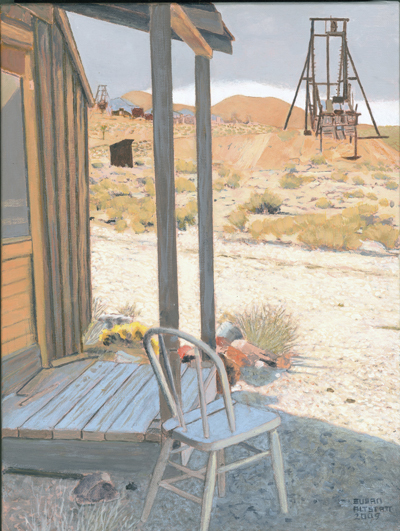
Picture 4 titled “The Mine shut down in ‘63” is an ode to desolation: an uninhabited cabin, an empty chair, a silent mine.
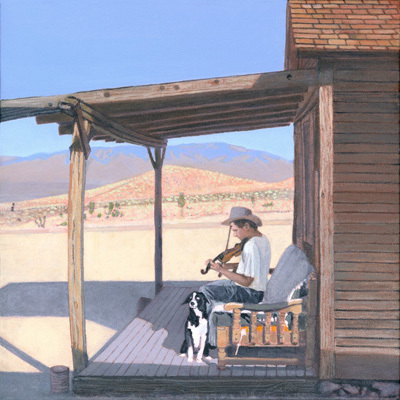
Picture 5: titled “Front Porch Fiddler,” is a study in repopulating the desolate. This cabin with its
scruffy couch is actually next door to the one with the empty chair. The fiddler, his music and his dog are my additions
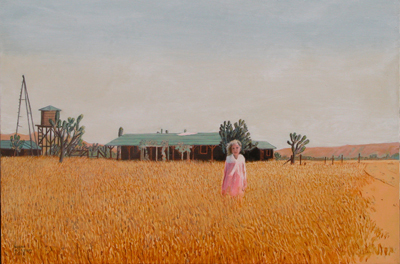
The buildings in picture 6, “Maruba,” were 1920s homesteader cabins in the East Mojave. They were, as near as I can tell, built out of railroad ties. I know where they stood, I’ve been there, but like the wheat field and the little girl in the pink dress, no sign of them remains.
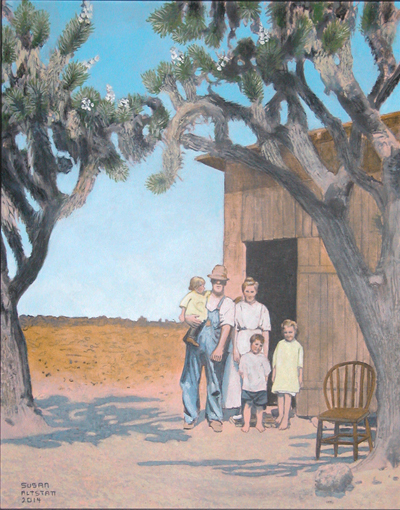
Picture 7 is a Mojave homesteader family, the Maclanahans, standing at their cabin door, sometime around 1905, by the look of the Missus’ dress. This is my favorite attempt at painting from tiny historical black-and-white photographs in an effort to bring the past to life.
The reasons for their existence only dried up and blew away in the middle of the 20th century, they had known forty or fifty good years. persons somewhere still own them, they are too remote to make pulling them down a priority.
Sad as it seems, most homesteaders gave up eventually, and removed to the city. Their descendants come back every so often to see where their grandparents used to live. Cow camps ceased to exist when 18-wheeler livestock transports, together with their attendant forcing pens and loading ramps replaced the days of herding open-range cattle long distances on horseback.
Log camps were no longer needed when diesel Cats replaced draft horses, log trucks replaced steam engines on branch railroads for hauling, and the logger could jump in his pickup and rejoin his wife and family every evening. The miners and their cabins mostly went away when legislation shut them down at the time of World War II.
The cabin which served as model for Pardee Camp was in relatively good shape when I first saw it in the early ‘60s; there were recent hay bales in the log barn and the house would have been habitable with a bug-bombing and a little TLC.
The property has been listed for sale several times since then. The first time, as I understand. It was bought by persons who became irate when they realized it was inaccessible in the winter, and promptly resold it. Actually, it’s not completely inaccessible, winter access would just require some fortitude and the proper equipment. It is, I believe for sale at present. That view of a cabin at the beginning of this blog is the realtor’s photo of it. I asked my husband if he would consider buying it. He wouldn’t.
The online listing says it has 160 acres of private land, which might imply it was originally a homestead. However, the only name I’ve ever heard attached to it calls it a “camp,” a place seasonally occupied by cowboys. At large somewhere in my house is a folder of photographs from which I intended to paint a panorama of it and its aspen meadow, then never did.
The Altstatt family cabin, on the other hand, stands in the Sierra Summer Home Tract mentioned in the book. It was built in the early sixties by my husband John, his father and brothers. It is as hand-made by owner and rough-and-ready as any homestead. The furnishings derive mostly from the student boardinghouse John’s grandmother ran in an old two-story Victorian in San Jose, with some of my mother’s and grandmother’s stuff mixed in, including the bookcase two-deep with all the Edgar Rice Burroughs and Walter Farley books.
During the years my daughter was rock-star devoted I listened in distress when grownups bedeviled her with “What would you DO with him if you had him?” she answered with dignity and without hesitation that she’d take him to the cabin. That intrigued me. I wondered how she’d get the dear man there, and once there, what the chances were he’d like it. Then I thought, wouldn’t it be cool beyond measure if our family had, for two generations, owned the old cow camp which lies lost in the woods ten miles behind the tract? What if that were the cabin in question?
Andy is rooted and grounded in family, resourceful, hard-headed, self-sufficient family. The story of the cabin is her story. She doesn’t know what a man like Tom wants that she might possibly have. Actually, what Tom craves is family, more than anything in the world.
So this was the genesis of Belshangles, just as Umberto Eco said he wrote “The Name Of the Rose” because he felt like poisoning a monk. (546) I wrote Belshangles because I felt like helping a love-sick teenager take a rock star to the family cabin.
I had worked out an identity for my teenage devotee, and now, thanks to my dream, I knew who her rocker idol was, I knew now how she’d get her hands on him, and how she’d get him to the mountains. But the original question was, what would she DO with him? About that, I hadn’t a clue. I had to wait for Tommi Rhymer to wake up, with a girl he doesn’t know, in a bed he doesn’t remember, in a house he’s never seen, then see what happened next…
A New York agent who read Belshangles in manuscript years ago quipped at me, “Of course, you know this is all fantasy.”
My answer: “You got a problem with that?”
Of course it’s fantasy. But, having said that, it seems to me rehabbing troubled people is not so very different in kind from rehabbing remote cabins. I found the intimate combination of the two appealing.
For most of my life I have been a painter rather than an author. But my love affair with old cabins has remained constant.
Picture 1: title, “The Woods Behind The Cabin” is as it was four years ago, before the Forest Service logged it in the name of fire prevention.
Picture 2: I painted this view of a cabin on the shores of Antelope Lake in the far northern Sierra twenty years ago. I didn’t paint many more Sierra scenes because the clientele which developed for my work was in and around the southern California desert.
Picture 3: A photo of myself, heavily photo-shopped by the same. I removed my wrist watch, and sepia toned the original color shot to make it look more timeless. The doorway I’m lolling in belongs to a place called Kuck’s Cabin in the Goosenest Ranger District Siskiyou County. This too was probably a cowboy cabin, since Diedrick Kuck, who raised cattle in the valley below during the 19th century, also ran his stock on open range land up the mountain. It stands near a National Forest primitive campground now, hence the notice on the wall informing the viewer that the cabin is Federal property, and that any attempt to vandalize it, remove items from it etc. will not be tolerated. And yes, that is my pistol. And I do know how to use it.
Then there are the little towns, hotels. gas stations, general stores in the desert that died when the ore in the mine played out, or the freeway passed them by.
Picture 4 titled “The Mine shut down in ‘63” is an ode to desolation: an uninhabited cabin, an empty chair, a silent mine.
Picture 5: titled “Front Porch Fiddler,” is a study in repopulating the desolate. This cabin with its
scruffy couch is actually next door to the one with the empty chair. The fiddler, his music and his dog are my additions
The buildings in picture 6, “Maruba,” were 1920s homesteader cabins in the East Mojave. They were, as near as I can tell, built out of railroad ties. I know where they stood, I’ve been there, but like the wheat field and the little girl in the pink dress, no sign of them remains.
Picture 7 is a Mojave homesteader family, the Maclanahans, standing at their cabin door, sometime around 1905, by the look of the Missus’ dress. This is my favorite attempt at painting from tiny historical black-and-white photographs in an effort to bring the past to life.
January 21, 2016
Blogging Belshangles
Belshangles
Susan Altstatt here.
I have an MA from UCLA in Theater Arts. There, I won a Samuel Goldwyn Award for playwriting. If I’d stayed there, I probably could have entered the world of Hollywood screen writing without much difficulty. Instead, I moved back to Stanford. The Classics Department wanted me for a doctoral candidate, and gave me a full fellowship. Unfortunately, it soon became clear to me that academia is crueler than Hollywood. I quit rather abruptly, got married, and raised three girls.
But I never stopped writing, mostly historical fiction, which I made no attempt to publish, and painting, which I sold, but not in any organized fashion. Then, when my eldest daughter went off to UC Santa Barbara, I started painting and writing again in earnest. I tried submitting what I wrote to competitions, seeing if I could get prize money or an advance to spur my efforts on.
What I learned was that the manuscript that wins the contest money is, by definition, either The Vietnam Book or The World War II Book. (Incidentally, that still proved true in the ABNA competition I was in last year, of the five surviving semi-finalists in General Fiction, there was the World War II book, the Vietnam Book, two Chick-Lit books and Belshangles. The World War II book took it.) I learned I was not going to get anywhere with a massive historical novel about the 15th century conversion of the last pagan nation in Europe (Lithuania,) no matter how excited I was with it, and no matter how replete with the essentials (Sex, violence, and religion!) it might be. What’s more, I knew I was not, in order to compete, going to write my own Vietnam Book or World War II Book, I’ve never been to war. So, what subject of current interest could I write about?
HOW ABOUT SEX, DRUGS, AND ROCK-AND- ROLL? Rock concerts I’ve been to.
From 1982 to 1987 I lived under the imperative of taking my Number Two Daughter to rock concerts. Her elder sister had required no such transportation duties of me; by the time she knew concerts existed she already had friends with similar music tastes and drivers’ licenses. But Number Two Daughter’s penchant for rock music and rock stars started early, when she was eleven. She was (and is) a very forceful person: self-determined and independent enough to get on public transportation and go. But I quickly got sucked into ferrying her (and her friends whose parents were less obliging than I) to rock concerts. I had the time of my life. I was small and blond, dressed like the kids and could be mistaken for one of them if you didn’t look too closely. My own teen years had offered nothing as splendidly seductive as this. What I saw and heard entranced me.
The men I saw on stage were outsized Byronic heroes, and the intensity with which the girls (and boys) at their feet adored them was outsized also. The kids I knew were intelligent and came from intellectual families where both parents had graduate degrees and were Silicon Valley scientists. Their fandom had elements of the scholarly: they amassed huge collections, every version of every song their heroes had written, every book or article written about them, every photograph taken of them. I found myself fantasizing how a girl like this might meet her rock idol under circumstances that would allow her to form a genuine lasting relationship with him, not just a brief regrettable hookup. My girl, Andy Falconer, puts it this way:
From myself, my daughters, and their friends I could create a fictional protagonist. What I needed was a fictional rock idol for her to love. I mulled this over for a time, without much success. Then one night, I was subjected to an extraordinarily detailed and vivid dream, essentially the hotel scene, Chapter III of Belshangles. Tommi Rhymer and Harlan Parr walked into my life, uninvited and unannounced, and picked a fight with each other. They were not intentionally modeled on specific English rockers living or dead, though they certainly share characteristics with a number of them. I have no memory of creating or naming them. They just sprang fully armed from my sub-conscious, like Athena from the head of Zeus. I would think this incredibly hokey, had I not heard other successful authors confess the same experience. I’d been looking for a leading man, and to my total amazement, got two for the price of one. But once Tommi and Harlan had taken up residence in my brain, they wouldn’t shut up. I was like Coleridge’s wedding guest transfixed by the ancient mariner’s story: I “could not choose but hear.” And soon I could not choose but write.
After having said all this, I feel I should weigh in before the week is over on the death of David Bowie. David Bowie was not Tommi Rhymer and vice versa. However, the concert in the first two chapters of Belshangles is drawn closely as possible from the two “Bill Graham Presents a Day on the Green” concerts I attended in 1983. One of them headlined The Police’s Synchronicity Tour, the other David Bowie’s Serious Moonlight.
It was Bowie at whom I stared up in awestruck adoration from the mosh pit, and whose stage I got hauled under when one of my teen companions fainted. I have experienced only two performers who could hold a crowd the way he did. The other was Lawrence Olivier, whom I saw play Macbeth at Stratford on Avon when I was eighteen. I chased him across a midnight parking lot to get his autograph. Both those men put up their own fair show of Beauty Incarnate. Thank you, and rest in peace, Ziggy Stardust.
Comments, anyone?
Susan Altstatt here.
I have an MA from UCLA in Theater Arts. There, I won a Samuel Goldwyn Award for playwriting. If I’d stayed there, I probably could have entered the world of Hollywood screen writing without much difficulty. Instead, I moved back to Stanford. The Classics Department wanted me for a doctoral candidate, and gave me a full fellowship. Unfortunately, it soon became clear to me that academia is crueler than Hollywood. I quit rather abruptly, got married, and raised three girls.
But I never stopped writing, mostly historical fiction, which I made no attempt to publish, and painting, which I sold, but not in any organized fashion. Then, when my eldest daughter went off to UC Santa Barbara, I started painting and writing again in earnest. I tried submitting what I wrote to competitions, seeing if I could get prize money or an advance to spur my efforts on.
What I learned was that the manuscript that wins the contest money is, by definition, either The Vietnam Book or The World War II Book. (Incidentally, that still proved true in the ABNA competition I was in last year, of the five surviving semi-finalists in General Fiction, there was the World War II book, the Vietnam Book, two Chick-Lit books and Belshangles. The World War II book took it.) I learned I was not going to get anywhere with a massive historical novel about the 15th century conversion of the last pagan nation in Europe (Lithuania,) no matter how excited I was with it, and no matter how replete with the essentials (Sex, violence, and religion!) it might be. What’s more, I knew I was not, in order to compete, going to write my own Vietnam Book or World War II Book, I’ve never been to war. So, what subject of current interest could I write about?
HOW ABOUT SEX, DRUGS, AND ROCK-AND- ROLL? Rock concerts I’ve been to.
From 1982 to 1987 I lived under the imperative of taking my Number Two Daughter to rock concerts. Her elder sister had required no such transportation duties of me; by the time she knew concerts existed she already had friends with similar music tastes and drivers’ licenses. But Number Two Daughter’s penchant for rock music and rock stars started early, when she was eleven. She was (and is) a very forceful person: self-determined and independent enough to get on public transportation and go. But I quickly got sucked into ferrying her (and her friends whose parents were less obliging than I) to rock concerts. I had the time of my life. I was small and blond, dressed like the kids and could be mistaken for one of them if you didn’t look too closely. My own teen years had offered nothing as splendidly seductive as this. What I saw and heard entranced me.
The men I saw on stage were outsized Byronic heroes, and the intensity with which the girls (and boys) at their feet adored them was outsized also. The kids I knew were intelligent and came from intellectual families where both parents had graduate degrees and were Silicon Valley scientists. Their fandom had elements of the scholarly: they amassed huge collections, every version of every song their heroes had written, every book or article written about them, every photograph taken of them. I found myself fantasizing how a girl like this might meet her rock idol under circumstances that would allow her to form a genuine lasting relationship with him, not just a brief regrettable hookup. My girl, Andy Falconer, puts it this way:
“A really vast percentage of young girls survive their early years in love with horses. Then they discover boys, and the horses languish. Boys of a similar stripe pack their juvenile libidos into cars and motor-cycles. Most withdraw enough in time to marry the erstwhile horsey girls. But some stick with the cars.
Boys of a certain other kind love heavy-metal rock stars and read Soldier of Fortune. Most grow up, but a few go off to die in Africa. And girls of certain kinds love rock-stars too. (Usually different rock-stars.) When they get out of school they marry someone else.
Then one or two, much like their counterparts who really do make mercenary soldiers–– one or two marry rock stars. A statistical necessity after all, since rock-stars marry.”
From myself, my daughters, and their friends I could create a fictional protagonist. What I needed was a fictional rock idol for her to love. I mulled this over for a time, without much success. Then one night, I was subjected to an extraordinarily detailed and vivid dream, essentially the hotel scene, Chapter III of Belshangles. Tommi Rhymer and Harlan Parr walked into my life, uninvited and unannounced, and picked a fight with each other. They were not intentionally modeled on specific English rockers living or dead, though they certainly share characteristics with a number of them. I have no memory of creating or naming them. They just sprang fully armed from my sub-conscious, like Athena from the head of Zeus. I would think this incredibly hokey, had I not heard other successful authors confess the same experience. I’d been looking for a leading man, and to my total amazement, got two for the price of one. But once Tommi and Harlan had taken up residence in my brain, they wouldn’t shut up. I was like Coleridge’s wedding guest transfixed by the ancient mariner’s story: I “could not choose but hear.” And soon I could not choose but write.
After having said all this, I feel I should weigh in before the week is over on the death of David Bowie. David Bowie was not Tommi Rhymer and vice versa. However, the concert in the first two chapters of Belshangles is drawn closely as possible from the two “Bill Graham Presents a Day on the Green” concerts I attended in 1983. One of them headlined The Police’s Synchronicity Tour, the other David Bowie’s Serious Moonlight.
It was Bowie at whom I stared up in awestruck adoration from the mosh pit, and whose stage I got hauled under when one of my teen companions fainted. I have experienced only two performers who could hold a crowd the way he did. The other was Lawrence Olivier, whom I saw play Macbeth at Stratford on Avon when I was eighteen. I chased him across a midnight parking lot to get his autograph. Both those men put up their own fair show of Beauty Incarnate. Thank you, and rest in peace, Ziggy Stardust.
Comments, anyone?