Anna Castle's Blog
June 27, 2019
Anthony Bacon
Anthony Bacon (1558-1601) was Francis Bacon’s full brother and one of the few people we know  he truly loved. They were close friends throughout Anthony’s life. That’s his only known portrait on the cover of my new book, The Spymaster’s Brother.
The ideal biographer
Francis Bacon is the subject of at least half a dozen biographies. There are so many books about him and his works they have a collective noun, Baconiana. Anthony is only famous because of Francis, but he was lucky in his biographer, Dame Daphne Du Maurier. Yes, the woman who wrote Rebecca and the Jamaica Inn. She was a passionate history buff who became interested in Anthony’s years in France when researching her own Huguenot ancestors.
 The Golden Lads is chiefly about Anthony, while The Winding Stair picks up Francis’s life after Anthony’s death in 1601. Du Maurier studied collections of letters in archives, going so far as to have hundreds of Anthony’s letters transcribed. I wish she had published them. She and her son tracked down long-buried details about Anthony’s prolonged stay in Montaubon, an important contribution to history. Her sources are impeccable and she writes with a novelist’s flair. This makes her books more enjoyable, but also slightly suspect. Was there a letter describing Lady Bacon’s frustrations as the new step-mother of six teenagers, or is Du Maurier filling in the emotional history with her writerly imagination? Since I haven’t read Anthony’s letters and won’t unless someone publishes an edition, I can’t answer that question. So I read these biographies with pleasure and an extra serving of salt. (They are quite enjoyable books. Recommended!)
Early history
Anthony’s father was Sir Nicholas Bacon, the Lord Keeper of the Great Seal for Queen Elizabeth I. He was among those most trusted Protestant gentleman who formed her early government. The queen would probably have elevated Sir Nicholas to the peerage for his service, but he died too soon. Still, he was widely respected. His name opened many doors for his sons.
The Bacon brothers’ mother was Lady Anne Bacon. She was one of the five daughters of Sir  Anthony Cooke, renowned for their intelligence, education, and devotion to the Protestant cause. Lady Bacon was particularly admired among Calvinists at home and abroad for her astute translations of religious tracts. She also fostered radical Puritan preachers in her home, men who might have been hanged if they’d had a lesser protectress.
Lady Bacon and her two brilliant boys were very close throughout their lives. She never stopped chiding them with fierce affection about their diet, their behavior, and their friends. They over-indulged their servants. They stayed up too late. Were they praying twice daily, together with their household? Her letters are peppered with such questions, along with dietary advice. They usually end with a note about the fresh strawberries or pigeons being delivered along with the letter.
Anthony was born in 1558, three years before Francis. He was Anne’s third child. The first two were girls, Mary and Susan, who lived only briefly, but were greatly mourned. His birthdays must have been celebrated with more than the usual joy. We don’t have details of his childhood, but he and Francis seem to have been best friends from the beginning. So much so that when Anthony was sent to Cambridge at the normal age (for a gentleman’s son) of fifteen, twelve-year-old Francis was allowed to go with him. They lived with the headmaster, John Whitgift, who later became the Archbishop of Canterbury. The Bacon boys were densely connected to the powerful men and women in England.
A Protestant gentleman abroad
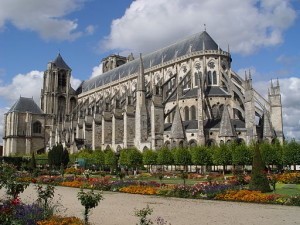 Cathedral in Bourges
Sir Nicholas Bacon died in February, 1579, leaving Gorhambury and some other properties to Anthony. Anthony sailed for France that autumn, leaving his lady mother and his steward in charge of his estates. He had applied to his uncle, Lord Burghley, for permission to travel. (You had to have a passport, then as now. But back then you applied personally to a specific individual in the government, explaining where you going and why you wanted to go there.) His family and servants bewailed his absence in many letters. Anthony never listened to such complaints or even to advice from well-wishers like Sir Francis Walsingham. No doubt he learned to tune out the sound of advice from long practice in his mother’s company. He seems always to have been completely self-directed.
He stopped in Paris and visited Bourges, a university town with a magnificent cathedral. He was shocked by the licentiousness and corruption he found there. It was nothing like Cambridge! He moved on to the godly community in Geneva, where he lodged with Theodore Beza. He met everyone who was anyone in the Calvinist circle, including the many visitors from other countries. Religious tourism was always big in Europe. Anthony Bacon made a favorable impression on one and all.
He was denied permission to visit Italy. Things were heating up south of the Alps, with Spain preparing to invade and the Inquisition setting up shop in Venice. Anthony went west instead, to Toulouse, Lyons, Montpellier, and Marseilles, spending a few months in each place, making friends, seeing the sights, and spending, spending, spending. He was the despair of his thrifty steward and his anxious mother. Even Francis, who was little better, chided him about expenses.
He fell ill in Marseilles; Du Maurier suspects malaria. Anthony suffered from recurring fevers for the rest of his life, in addition to gout and a supremely delicate digestive system. He continued to write letters, however, to his family and friends as well as to Sir Francis Walsingham and Lord Burghley. He was a keen observer of people and political situations and wrote with the Baconian gift for clarity.
He also wrote poetry, none of which has survived. He seems to have been more cultured in the way of a courtier than Francis, more well-rounded with respect to the arts. He played the lute and the virginals, for example. I don’t think Francis played any musical instrument, nor did he have much tolerance for the cocktail party atmosphere of noble halls and ballrooms. Anthony, on the other hand, apparently loved hanging out with the French upper crust. Combine that with his intelligence, his learning, and his well-trained memory, and you have a very valuable political reporter.
Trouble in the south of France
Anthony became great friends with Henri of Navarre, who was crowned King Henry IV of France in 1589. Henri was a Protestant and an important ally of England. Anthony set up housekeeping in Montaubon in January 1585. This was a capital of French Protestantism and thus the perfect spot from which to report on events in France. All was well, for a while. The climate agreed with his troublesome health, he had friends in high places, and a congenial household. He ignored repeated requests from his mother and Sir Francis Walsingham to return to England. He liked the south of France — who doesn’t? — and was having too much fun to come home. Until he was charged with sodomy.
 Philippe Du Plessis Mornay
This is the secret Du Maurier unearthed from the archives in Montaubon. Not a whisper of this calamity reached England, though Francis had hints. Anthony had rubbed some important people the wrong way; chiefly Philippe du Mornay Plessis-Mornay and his haughty wife. This provoked Du Plessis to poke his long French nose into Anthony’s domestic arrangements.
His household included a number of young pages, like any well-staff manor in those days. His favorite page was Isaac Bourgades. Another page declared before the Council for the Prosecution at Montaubon that Isaac had pursued and ‘mounted’ a third, younger page. This one quit. Another servant confirmed the story and further declared that Anthony frequently abused his pages in this fashion, bribing them to keep silent about it.
Du Maurier believes in the sex, but not the abuse. Nowadays, of course, we find the idea of a 28-year-old having sex with a child abhorrent. That was true then too, but the age of acceptable engagement was lower. We don’t know how old those pages were, but it is safe to assume they were under 18. My sense of that period is that 15 or 16-year-olds would be considered fair enough, provided the acts were consensual. Sexual relations occurred on a continuum with fewer well-defined and labeled points than we have today, in our rather sex-obsessed culture. People shared beds as a matter of course. Pages in the attic, perhaps; grooms above the stable.
I’m with Du Maurier. I can easily imagine Anthony dandling pretty boys on his knee, teasing them with sweets, and rewarding them with trinkets. I can’t imagine him hurting or threatening anyone of any age. He and Francis were both known for being indulgent, undemanding masters whose servants tended to take advantage of them. But I can believe that he created an atmosphere in which someone felt licensed to abuse a young boy.
The charge was very serious, and must have been terrifying. Sodomy was a crime punishable by death in France (and England) in those days. In England, you would hang; in France, you’d be burned at the stake. Charges were brought sometime before the summer of 1586. In September, Henri of Navarre intervened in Anthony’s defense. Charges were heard again November 17, 1587, and then the record falls silent. Anthony stayed on in Montaubon, trapped by debt. It must have been hard for him, although the cause of his absence could not have been generally known. The Du Plessis’ were there. He wrote to his family in England blaming illness for his long stay in Montaubon. He lingered there until 1590, when he moved to Bordeaux.
The death and birth of a spymaster
Sir Francis Walsingham, the Secretary of State, died in April, 1590, leaving Anthony without a spymaster. Anthony continued to do his work, which consisted largely of writing letters. He helped to free English spy Anthony Standen from prison. He reported on events in France from his own observations. He also had correspondents picking up tidbits and sending to him, to be sifted, analyzed, and crafted into reports.
It wasn’t until he learned that his enemy Du Plessis was headed for England that Anthony packed up his possessions and said farewell to France at last. Du Maurier believes he was afraid Du Plessis would tell people, especially the queen, about that old sodomy charge and his stint in jail.
He arrived in England on February 4, 1592. He had been gone for twelve years. He lived with Francis for a few years in Bacon House at Gray’s Inn, where they entertained their friends with frequent suppers, passing out beaver hats as party favors. I wish I could’ve been at one of those suppers, but of course, women were not allowed.
 Robert Devereux, 2nd Earl of Essex
Anthony had become disaffected from his uncle, Lord Burghley, the queen’s Lord Treasurer. Burghley expected work from his useful nephews, like sharing of foreign intelligence, cryptography, translations, position papers, etc. But he never paid them in any way: not money, and not in sustainable government positions.
Anthony decided soon after his return from France to throw in his lot with the ambitious Robert Devereux, the Earl of Essex. By 1595, he was the earl’s Secretary of State, living in Essex House, and managing all of his lordship’s foreign affairs. Francis retained a bit of distance, never leaving Gray’s Inn. But Essex became his major patron as well during these years.
Essex committed treason against the queen in 1601, leading an armed band through the streets to make an attempt on Whitehall. The ever-pragmatic Bacon brothers would certainly have advised him against such madness. Francis was forced by her Majesty to participate in the prosecution of his patron. Anthony must have been very ill. He died soon after in the home of Essex’s widow, Frances Walsingham, the daughter of his old mentor.
He was buried in the yard at St. Olave’s Church on Hart Street. That’s around the corner from the Tower Hill tube station. There’s no marker; I looked high and low, inside and out. Francis must have been walking a very straight line at that time, trying to stay out of jail himself. And he was probably deeply in debt, as usual. Otherwise, he would surely have provided his most beloved brother with some sort of monument. Luckily, Dame Daphne Du Maurier had a deep streak of curiosity, so Anthony lives forever in her excellent book. And now I’ve contributed in my small way to his legacy.
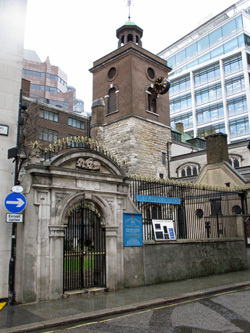 St. Olave’s Hart Street


June 15, 2019
Launch: The Spymaster’s Brother
The sixth book in the Francis Bacon mystery series is out today. Yay! It should be available nearly  everywhere ebooks are sold. Print catalogs will take a few weeks to propagate.
Anthony Bacon is home with a wealth of foreign secrets — and a few of his own.
Though seldom strong enough to leave his rooms in brother Francis’s house, Anthony’s gouty legs never hinder his agile mind. He’s built the most valuable intelligence service in Europe. Now the Bacon brothers are ready to offer it to the patron with the deepest pockets.
Before they can open the bidding, Francis finds a body lying in the weeds near Gray’s Inn. The abandoned coach beside it belongs to Anthony. The clues point to his personal secretary. Worse, the murdered man was heard spreading rumors that could destroy Anthony’s reputation — and his market value.
Francis thinks his brother ordered the deed done. His assistant Thomas Clarady thinks the secretary did it, with or without such orders. As Tom investigates, he hears one story after another about what happened that night. Which version is the truth? The closer he gets to finding out, the more danger gathers around Anthony. Will Tom and Trumpet, his very pregnant confidante, sort through the lies before disaster strikes?
Here’s a blog post I wrote about Anthony a while back.
May 27, 2019
Bacon’s Essays: Of Followers and Friends
Francis Bacon’s essay “Of Followers and Friends” was first published in 1597. It was somewhat amended for the 1625 edition (the year before his death.) In 1597, things were getting tenser and tenser between his patron, the Earl of Essex, and Queen Elizabeth. In between writing advice letters, Bacon published a bit of philosophy (The Colours of Good and Evil) and this first edition of his immortal Essays. He also laid out the gardens at Gray’s Inn Walks. (They’ve changed in the past 400 years.)
Segmenting your followers
(Italics & bolding here are mine.)
“Costly followers are not to be liked; lest while a man maketh his train longer, he make his wings  shorter. I reckon to be costly, not them alone which charge the purse, but which are wearisome, and importune in suits.”
This is timely advice. I’ve been cleaning up my newsletter this month. Subscribers who never open anything (vain followers?) cost me money, which thus clips my wings by limiting some other thing I might do. And heaven knows we don’t want followers (think Twitter or Facebook) who are argumentative (wearisome) or constantly asking you for favors, advice, or anything.
Funny how things come around, huh? In the 80’s, none of us ordinary Susies had followers. Now, pretty much everybody has at least a few.
“Ordinary followers ought to challenge no higher conditions, than countenance, recommendation, and protection from wrongs.” These are the ones you want. They just want you to acknowledge them (countenance) and recommend them from time to time. The Earl of Essex could get people out of jail if he wanted to. We can defend our social media followers from trolls, perhaps, or from being grossly misunderstood by another poster.
“Factious followers are worse to be liked, which follow not upon affection to him, with whom they range themselves, but upon discontentment conceived against some other; whereupon commonly ensueth that ill intelligence, that we many times see between great personages.”
Party politics creates this situtation a lot. You don’t like the candidate you’re voting for much, but you really hate the one you’re voting against. So the one you vote for can’t count on you for anything. You’re acting purely oppositionally.
 Trumpets of commendation
“Likewise glorious followers, who make themselves as trumpets of the commendation of those they follow, are full of inconvenience; for they taint business through want of secrecy; and they export honor from a man, and make him a return in envy.”
Bacon’s not a fan of publicity. He thinks most ‘business,” by which he means negotiation more than transaction, should be handled out of the public eye — in ‘secret.’ And it is true that having every word that falls from some politician’s lips repeated ad infinitum in the press can make that person seem foolish, or wishy-washy. Maybe that’s a valid portrait, but it doesn’t aid good governance.
“There is a kind of followers likewise, which are dangerous, being indeed espials; which inquire the secrets of the house, and bear tales of them, to others. Yet such men, many times, are in great favor; for they are officious, and commonly exchange tales.”
Some politicians love flattery and negative gossip about their opponents so much, they don’t realize they’re harboring a spy for the opposite side.
Descent into opacity
From about the midpoint, I find it very hard to figure what Bacon is talking about. He liked to be opaque; his mother scolded him about it. And these essays would have been read by educated men like his brethren in the Inns of Court or Lord Essex’s retainers. They would read them and discuss them with great enjoyment after supper.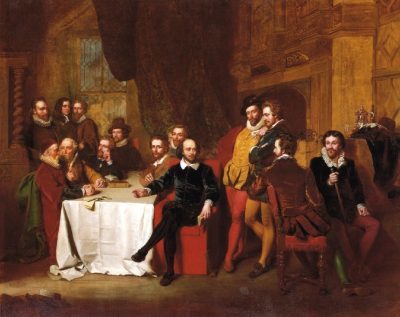
You and I, alas, must slog through as best we can. Whately is some help.
He starts by allowing that followers of men who are meant to be followed, as soldiers follow officers, are perfectly fine, provided that they don’t get carried away with “pomp or popularity.” (‘Popular’ was not a praise word for Francis Bacon; on the contrary.)
“But the most honorable kind of following, is to be followed as one, that apprehendeth to advance virtue, and desert, in all sorts of persons.”
Take out most of the commas and this makes more sense. It is honorable to follow someone who knows how to advance virtue and to deserve being followed. Yes, indeed.
“And yet, where there is no eminent odds in sufficiency, it is better to take with the more passable, than with the more able.” Well, color me stumped! ‘Sufficiency’ probably means ‘adequate competency,’ or something similar. ‘Passable’ could also mean ‘adequate’ — it means that today. Or it could mean ‘authorized, legal.’
I think this means, All things being equal, the more authorized option is better than the more exciting one. But I could be wrong.
“And besides, to speak truth, in base times, active men are of more use than virtuous.” This is pretty obvious once you understand that ‘base times’ means ‘times of trouble.’ You want that multi-talented mercernary when things go sour more than you want that virtuous philosopher.
Making use of your followers
“It is true that in government, it is good to use men of one rank equally: for to countenance some extraordinarily, is to make them insolent, and the rest discontent; because they may claim a due.”
Don’t play favorites, especially not among those of equal rank. Always good advice.
“But contrariwise, in favor, to use men with much difference and election is good; for it maketh the persons preferred more thankful, and the rest more officious: because all is of favor.
The older meaning of ‘officious’ is just ‘dutiful.’ He’s saying, reward the ones who work hard and use their talents toward your ends, because the rest will see that that’s the way to win your favor.
 Henri III and the Duke of Guise. Lots of ill-advised favoritism going around at the French court in those days.
“It is good discretion, not to make too much of any man at the first; because one cannot hold out that proportion.” You can’t keep it up, he’s saying, but generally, respect has to be earned. And favors should be earned too, or they lose their value.
“To be governed (as we call it) by one is not safe; for it shows softness, and gives a freedom, to scandal and disreputation; for those, that would not censure or speak ill of a man immediately, will talk more boldly of those that are so great with them, and thereby wound their honor. Yet to be distracted with many is worse; for it makes men to be of the last impression, and full of change.”
Favoritism is a real problem in Bacon’s day. Probably in ours too, although it doesn’t come up much for the self-employed novelist :-). Also, our business and non-profit orgs have tons of rules about it. They don’t stop it from happening. The Favorite gets away with murder (scandal and disreputation). The Favorite might also talk boldly about the boss, claiming that private knowledge, which will ultimately end up making the Boss look like a Fool.
But being surrounded by an entourage is worse. It makes you more likely to have your head turned by whatever was said last, so you’re always changing your mind.
A (very) few words about friends
“To take advice of some few friends, is ever honorable; for lookers-on many times see more than gamesters; and the vale best discovereth the hill.”
Outsiders see more of what’s going on than insiders. You can’t really the hill while you’re standing on it, but from the valley, you can see the whole thing.
“There is little friendship in the world, and least of all between equals, which was wont to be magnified. That that is, is between superior and inferior, whose fortunes may comprehend the one the other.”
This is kind of sad, but then these are some of the worst years in Bacon’s life. He’s getting nowhere, career-wise, in spite of the Earl of Essex’s best efforts. The earl is blocked at every turn by the wily Sir Robert Cecil, Bacon’s cousin and chief obstructor. Bacon was arrested in the street for debt the year after these essays were published. (You didn’t make much money from publication in those days either.) Bacon’s best friend was his brother Anthony, whose health was declining. His next best friend was the Earl of Essex, probably, but you can’t pal around with an earl, unless you’re one yourself.
Bacon had kinder things to say Of Friendship in an earlier essay.
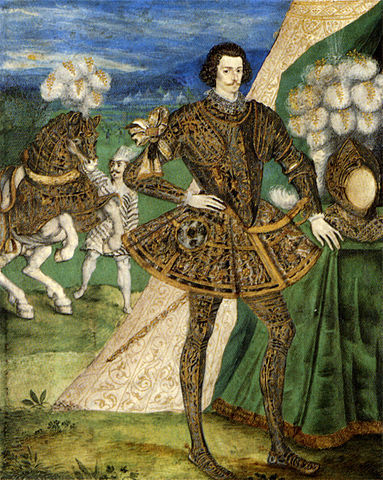 The Earl of Essex, attributed to Nicolas Hilliard
May 20, 2019
Come with me to the Docklands museum!
The London Museum of the Docklands is a delightful place to spend a few hours learning new 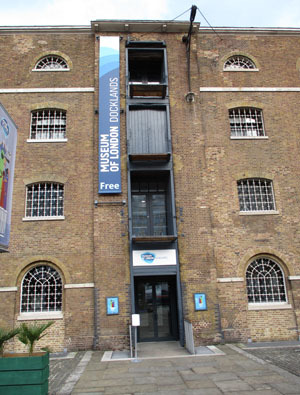 things, one of my favorite activities. They offer well-curated exhibits about shipping and trade from the late 16th century to the present, including an extended section on slavery. Each exhibit included curious objects in glass cases, as one would expect, but there were also lots of maps and paintings of the docklands from the period in question, along with excellent notes.
I took the tube to Canary Wharf and followed the ever-present signs directing tourists to the fun stuff. The streets here are lined with tall, new office buildings. Lots of people in suits walking briskly to and fro. I stupidly went out to forage for lunch at noon and found every single eatery jam-packed with those people in suits. I ended up eating at a burrito place, though one does not normally travel from Texas to London to eat Mexican food. Ah, the irony.
Where we were
The modern Canary Wharf area spans the old parish of Poplar, Limehouse, and the Isle of Dogs. In 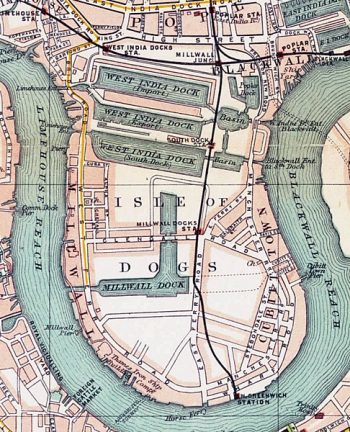 Elizabethan times, the Isle of Dogs was desolate marshland. Poplar was nothing; blink, and you’d miss it. Limehouse was a village with a bustling strip along the riverside. A couple of pubs have survived from that time to this: The Grapes and, closer to Wapping, the Prospect of Whitby. The characters in my latest Francis Bacon mystery, The Spymaster’s Brother, stop in at the Grapes.
In Victorian times, Limehouse was notorious, with narrow, filthy streets, big warehouses, and dodgy taverns. You took your life in your hands, wandering through those alleys at night. Naturally, Sherlock Holmes knew that terrain like his own violin.
Instruments of destruction
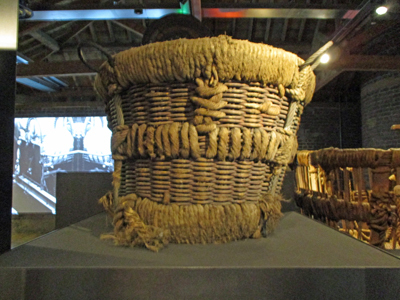
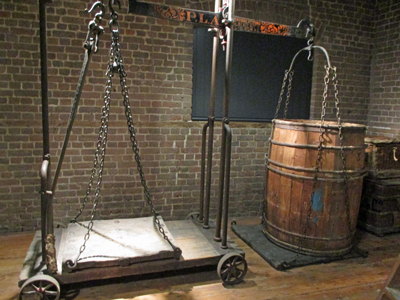
The museum calls them tools for weighing and measuring, but we writers of murder mysteries know better. You could sabotage some of these things, I’ll bet, though the curator failed to provide that sort of detail. You could certainly use them to cause seemingly accidental deaths. And then there are all these giant hemp baskets to hide the body in! You could probably nail your victim’s corpse inside a big barrel and set it where it will be loaded on the next ship to China. SO many options!
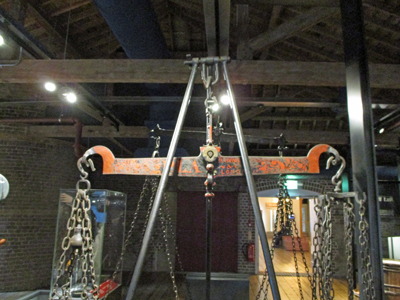
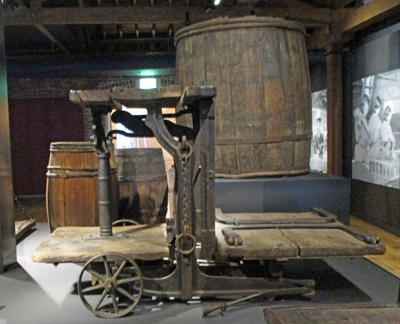
I love these old barrels, for some odd reason. I’m thinking about a young woman — a teenager, really — who hides in such a barrel to smuggle herself onto a ship, to travel to London to consult the great Sherlock Holmes. She’s clutching the tattered copy of The Strand which someone read to her, telling a tale about the brilliant detective. Somehow, she ends up consulting my Professor Moriarty instead, lucky for her!
Life on the docks
I love the way they intersperse art from the period with the artifacts. Look at these sailors carousing in a Wapping alehouse. I’m pretty sure you won’t this sort of rowdy behavior at the Prospect of Whitby nowadays!
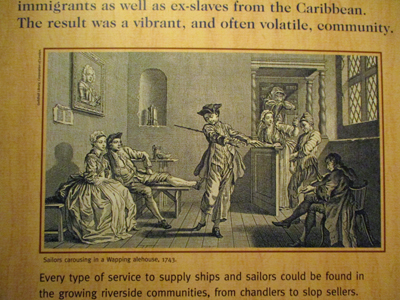
I take pictures of these things partly so I can share them with you, but also because it’s easier than taking notes. When I get home, I can look up the image and see who owns it. This one comes from the Guildhall Library. Hm.
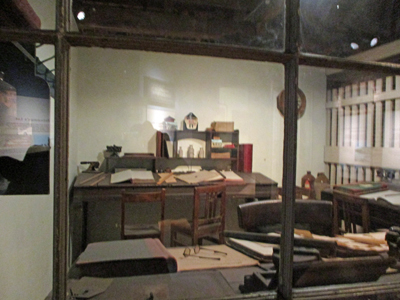
They set up a few tableaux as well, so we can imagine our warehouse clerks and customs officials at their jobs. These exhibits are fun to look at, but hard to photograph because of the shiny glass and the somewhat dim lighting. But I try, because someday Moriarty is going to have to go down to this office to sneak a peek at some records while Angelina distracts the clerk.
At last, the whole story is told
All the museums I visit have updated their exhibits to include a period of English and American history that was suppressed for a long, long time. We’re talking about slavery, a great disaster perpetrated by one group against another. We’re still struggling to repair the damage wrought by those centuries of shame. Getting the story straight is part of that process. Here’s some of them well-written exposition from the Docklands exhibit.

This part of the exhibit was full of people, so I didn’t take pictures of the stuff, sorry. They also had a typical dock-workers home that kids could play in. Some kids were cheerfully demolishing it, so I didn’t get pix of that either. And then there were rows of boxes filled with fragrant stuff that you could open and sniff and try to guess which was what. They had vanilla, nutmeg, cinnamon… all the spices that came to England through the docklands. I opened all the boxes and found no opium, so it wasn’t perfect. (They never have opium in these exhibits!)
All along the waterfront
I take pix of the cards under paintings I want to study at home, like this one.
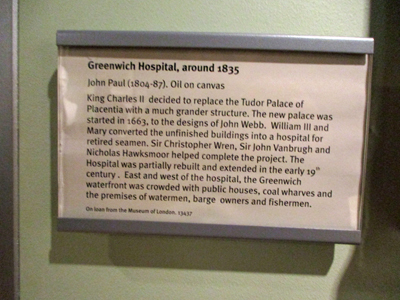
I found this one in Wikipedia, just as I hoped.
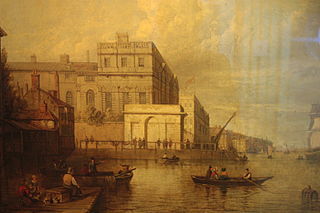 Greenwich Hospital by John Paul, 1835
And here’s another look at the life of the folk who lived and worked in the docklands.
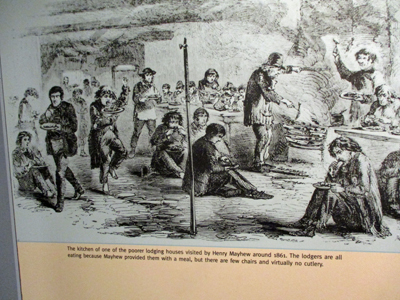
The caption says, “The kitchen of one of the poorer lodging houses visited by Henry Mayhew around 1861. The lodgers are all eating because Mayhew provided them with a meal, but there are few chairs and virtually no cutlery.”
Henry Mayhew wrote London Labour and the London Poor (1851), the result of his deep dive into the lower reaches of London life. I have a copy on my shelf, as it happens. If and when my Moriartys take their own dive into those precincts, I’ll read at least some of it. Pretty stiff stuff.
Where ideas come from
Sometimes people ask writers, “Where do you get your ideas?” One of my answers is, “In museums.” I looked at this exhibit and my mind exploded. What do you think: Moriarty Smells the Coffee? I think I may have to go to Jamaica for this one…
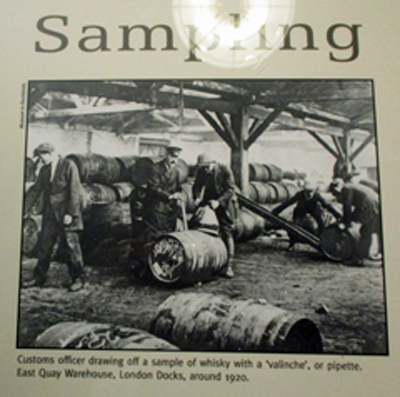 Customs officer drawing off a sample of whisky, around 1920.
March 14, 2019
Three nights at the theater
Two nights in London last month; one night in Austin last year. The performances in London inspired me to share them all with you. Each was fabulous in its own way and wonderfully relevant for both of my series, the Elizabethan and the Victorian. The theaters themselves were a big part of the fun.
The theaters
The Sam Wanamaker Playhouse
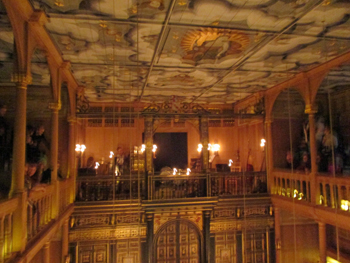 The minstrel gallery by candlelight
This is the indoor theater at Shakespeare’s Globe in London (another experience to put on your bucket list.) The SWP is a recreation of a 17th-century theater, loosely modeled on Blackfriars Theatre, which was possibly the first indoor theater in England.
The Blackfriars Theatre was opened in 1596, over the objections of Francis Bacon’s aunt, Lady Elizabeth Russell. I’ve blogged about her before and probably will again. There’s a great book about this conflict: Laoutaris, Chris. 2015. Shakespeare and the Countess: The Battle that Gave Birth to the Globe. London: Penguin Books.
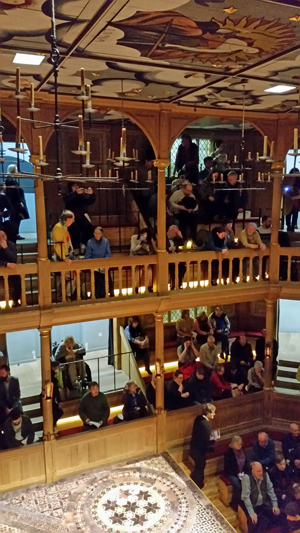 Note the dress-up hiking clothes. The guy in the black suit works there.
The Wanamaker Playhouse is lovely, lovely, lovely. It’s an intimate space, very vertical so you look down onto the projecting stage. The actors use all the space, often emerging from the stalls or the aisles, sometimes sitting next to a startled — and delighted — person in the audience. It officially holds 340 people. I guessed 150, which shows you how bad I am at guessing quantities. We sit on lightly padded benches with barely enough room for purses under our knees. There’s a cloakroom, so you don’t have to bring your layers in with you.
People were not dressed up, in case you’re wondering. Standard costume seemed to be what I call dress-up hiking clothes, which all tourists seem to wear everywhere nowadays.
Scottish Rite Theater
 Scottish Rite Theater from the parking lot
I have lived in Austin since 1974, and I didn’t know about this theater until a local writer pal recommended this particular performance on her Facebook page. Ya think ya know a place…
The theater was built in 1871, so I have no excuse, though t is unassuming on the outside. It started out as a German opera house, then became the home of Scottish Rite Masons, who created the non-profit theater in 2004. They mostly host children’s plays, which look hugely fun. The Victorian reproduction I saw was an unusual event I sincerely hope they’ll repeat.
Marlowe by candlelight
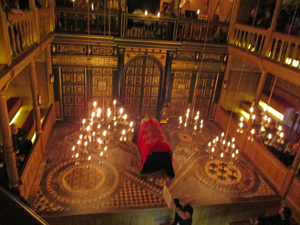 Before the play begins: Edward I’s coffin
This was amazing, and it took me by surprise, even though they say on the SWP website where I bought my ticket that plays are performed by candlelight. This is as close to the Elizabethan experience at Blackfriars as I’ll ever get. If I’d been wearing period garb, I would’ve taken up two spaces instead of one, but the usher told me that Blackfriars Theater was much bigger, so there would’ve been more room.
The candles weren’t just lighting at SWP; they became part of the performance. We started out fully lit, with two big candelabras hanging over the stage and lots of candles in sconces on the pillars in front of the stalls and the musician’s gallery. The gallery stayed lit throughout, but as the play turned to the dark side, actors lowered the candelabras whilst delivering a thoughtful monologue and snuffed out the candles. Spooky!
Then later another actor lit a few of them again. During some impassioned scenes on the floor of the stage, an actor would take a sconce from a pillar and hold it to illuminate their faces. Once or twice toward the end, actors came out with a basket of candles to set at the front of the stage. Footlights!
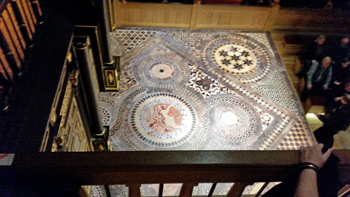 The floor, designed for Edward II, though this pic was taken before Edward I
One thing I wouldn’t have thought of just from pictures and floor plans: the theater grew cooler as they put out more candles. The Swedish lady sitting next to me and I were quite chilly! That’s exactly the sort of detail that makes a whole trip worthwhile.
The play was Edward II, by Christopher Marlowe. I’ve blogged about him before and will again. This play is dark and grim, like all of Kit’s plays. This one was first performed in 1592. It just occurred to me that I will definitely blog about this play again next year, when I publish Now and Then Stab, which will be the 7th book in the Francis Bacon mystery series. That title is a quote from Ed II. That ticket was tax-deductible in all directions :-).
The performance I saw in February consolidated several characters and cut several scenes that didn’t carry the central conflict. The result was a play more about prejudice than about favoritism; a modern perspective. Marlowe balanced the two. In a nutshell: King Edward had a favorite, a lover named Gaveston. He showered money and titles on this upstart, neglecting his queen, the other noblemen, and his subjects. Naturally, this caused resentment, also distaste for the unnatural relationship between the two men. Nobles remonstrated Edward; he refused to mend his ways. So they rebelled and ultimately murdered him. Gaveston dies too, of course.
Apart from re-aligning the major theme, the alterations kept the show down to two hours. Which I appreciated, because it was cold as the dickens that night and I had to walk about 6 blocks to the tube station. Safe as houses, though. Even this old Houston girl felt comfortable (apart from the cold) walking those well-lit streets. Next time, I’ll bring a sweater in addition to my raincoat.
Actors turn a hash into a feast
Sunday night’s fun was a “reading” of George Peele’s play, Famous Chronicle of Edward the First. This was published in 1593, so it must have been performed sometime before that. Before or after Marlowe’s hit play, I wonder?
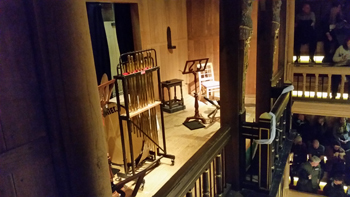 The minstrel gallery. For Edward II, they had brilliant musicians playing a variety of period instruments.
I downloaded The Works of George Peele, edited by A. H. Bullen (Boston: Houghton Mifflin and Company, 1888) to read on my phone whilst riding the tube hither and tither that day. Don’t we love the internet and the kindly people who scanned these classic works to make available through Google Books? (We don’t thank Google because they rarely acknowledge the librarians who preserved, catalogued, and scanned these works for us.)
I actually never got past the introduction, which is excellent; very informative. Recommended, especially when you’re stuck waiting in line or somewhere like a subway where you can’t get a signal. At some point I jotted down this quote to share with you, because it is the perfect description of that wacky hodge-podge of a play. Bullen said, “It is tiresome, windy, bombastical stuff, but it held the stage.”
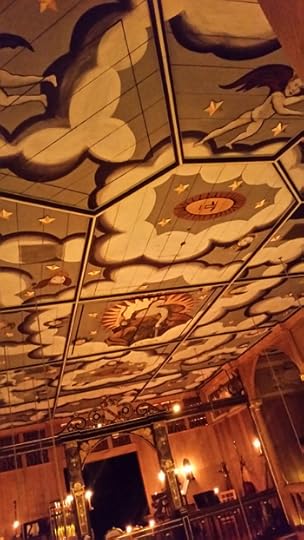 More of the amazing ceiling.
Only because the actors were so enthusiastic about what amounted to an improvisation of a long dead and quite terrible play. They performed in street clothes with highlighted sheafs of paper in their hands. They’d had a read-through earlier that day — their entire acquaintance with the play. I had expected this reading to be a scholarly, somewhat dry event. I grossly underestimated the talent, inventiveness, and spirit of the London actor!!
Edward was played by Jason Hughes, who played DS Jones on Midsomer Murders. He was totally convincing as the imperious king, and the rest of the cast was equally delightful. They climbed all over that theater, using the whole space. They had minimal props like a crown or a bench, which they carried in and out as needed. Electric lights were on and it was always fairly bright. The usher told me that actors love these readings, because it’s only a day’s commitment, but they get to really exercise their acting skills in the company of a little group of equally engaged colleagues.
The play is dreadful as literature, but Bullen was right: it held the stage, meaning it was entertaining. It’s like a song hits of the 1590s. Here we have a scene where a messenger delivers troublesome news to the king. Then later, for no discernible reason, Evil Isabel the Queen poisons somebody (the king? her son? I can’t remember) by pouring poison in his ear. (Hm, we wonder who else saw this play back in 1592?) The next scene bears no relation to what came before or what comes after, but it was fun, in and of itself. This is what you get when you write without a theme.
The plot is ridiculous and the set speeches the very definition of bombastical. But the actors were having so much fun, we did too. We laughed and laughed! Perhaps not the effect George Peele was looking for, but if he was a typically pragmatic Elizabethan, he would have shrugged and said, “It likes me well enough.”
Boo! Hiss! The Victorian experience
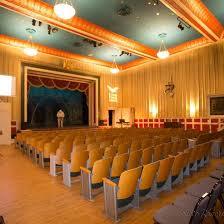 Scottish Rite Theater, from their website
The Hidden Room Theater calls itself “A theatrical curiosity shop in Austin, TX. We make time machines.” And that’s all I can find out in a general way. They’re not a place; they’re a group who now and then conjures up a unique theatrical experience.
The one I got to enjoy was a performance of Shakespeare’s Richard III. The script and staging were taken from the original book of John Wilkes Booth. Yes, you read that correctly! So this was a 21st-century recreation of a Victorian production of a Jacobean play. Pure experiential ambrosia for a writer of historical fiction set in those periods!
The Beth Burns, the director, spoke to us at the start of the play to explain a bit of the context. She encouraged us to enter into the recreation by performing the role of a good Victorian audience. We should boo, she said, and also hiss, and call out things like “He’s lying!” or “Look out!”
 The dastardly Richard III, from Austinot.
It was a riot. Nobody must ever have fallen asleep at the theater in Victorian times. You’re too busy participating!
Judd Farris played Richard. He also played us like a well-tuned violin. He would creep out onto the stage, sort of hidden from the other actors by the curtain, and grimace at us with his hunchbacked wickedness gleaming in his eyes. We would hiss and boo and stamp our feet. That just made him all the more wicked!!! We cried “Kill him! Kill him!” and eventually they did. We cheered lustily.
I am longing for them to do this again with another play. Any other play. The worst play from the 19th century would be an evening of great entertainment in these people’s clever hands.
Sorry I don’t have pictures of the actual performances. But only a barbarian — or a theater critic — takes photographs during a play.
February 27, 2019
Bacon’s Essays: Of Negotiating
This promises to be a useful essay. Bacon must have engaged in and witnessed a great deal Of Negotiating in his long career at court.
Letters are good
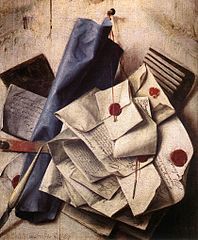 Quodlibet, by Cornelius Gijsbrechts. 1675
“It is generally better to deal by speech than by letter; and by the mediation of a third than by a man’s self.” He doesn’t elaborate, but having a mediator speak for you makes you seem more important, and also avoids the hazard of emotional excess.
“Letters are good, when a man would draw an answer by letter back again; or when it may serve for a man’s justification afterwards to produce his own letter; or where it may be danger to be interrupted, or heard by pieces.”
Modern advice is to get everything in writing. Don’t make deals over the phone; make them by email so you have dated copies of everything. Not making deals in places where you’re liable to be interrupted is just plain common sense.
Unless your face favors your cause
 Would you buy a used car from this man? I would.
“To deal in person is good, when a man’s face breedeth regard, as commonly with inferiors; or in tender cases, where a man’s eye, upon the countenance of him with whom he speaketh, may give him a direction how far to go; and generally, where a man will reserve to himself liberty, either to disavow or to expound.”
I guess your face would breed regard if it’s a well-known face — or an especially handsome one. Or maybe it’s a patrician sort of face, with a patrician habit of expression.
We would say “delicate matters” instead of “tender cases.” If you need to assess the immediate effect of your plea or argument on the person you’re negotiating with, you have to be there, watching their face. You can alter your course on the spur of the moment. “No, no, that’s not what I meant. Let me explain it again.”
Choose your instrument
“In choice of instruments, it is better to choose men of a plainer sort, that are like to do that, that is committed to them, and to report back again faithfully the success, than those that are cunning, to contrive, out of other men’s business, somewhat to grace themselves, and will help the matter in report for satisfaction’s sake.”
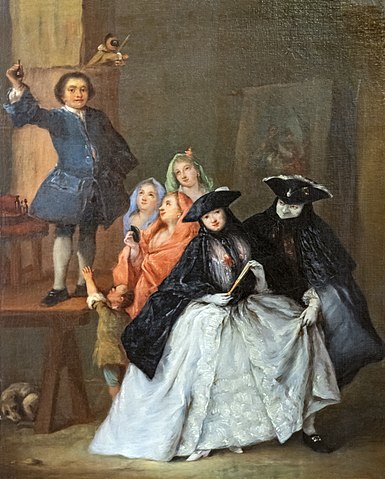 The Mountebank, by Pietro Longhi (1701 – 17785.) Not the guy you want to negotiate for you, but I couldn’t resist this painting. Lots of persuasion going on here!
You definitely want a rep who will pursue your project, rather than their own. Let’s say you’re getting divorced and you’re negotiating ownership of the lake house. You want your lawyer to argue in favor of you getting that house, not letting your spouse win on condition that they let the lawyer buy it later at a bargain price.
“Use also such persons as affect the business, wherein they are employed; for that quickeneth much; and such, as are fit for the matter; as bold men for expostulation, fair-spoken men for persuasion, crafty for inquiry and observation, froward, and absurd men, for business that doth not well bear out itself.”
He must have a lot of men available to negotiate. If you have the choice, choose a bold man to expostulate (to reason earnestly), a persuasive man to persuade, a crafty (clever) man to observe the situation while negotiating, and an absurd man for uh… No idea what this means! Some business that really doesn’t stand up to scrutiny, I guess. Your absurd negotiator will distract your opponent from the inadequacies of the thing being negotiated.
“Use also such as have been lucky, and prevailed before, in things wherein you have employed them; for that breeds confidence, and they will strive to maintain their prescription.”
Hire people who have success in the thing you’re hiring them for. More common sense. Also, you definitely want a person who is confident about their abilities, not a mealy-mouthed foot-shuffler. And you want people who take pride in their abilities and thus aim to succeed on that account, as well as to fulfill your request.
First sound from afar
“It is better to sound a person, with whom one deals afar off than to fall upon the point at first; except you mean to surprise him by some short question.”
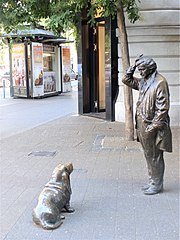 Peter Falk as Columbo with his dog. Budapest.
Get a general sense of where the person stands with regard to your matter before negotiating. Except for the short question gambit. Bacon seems to love this little verbal tactic, which I think of as the Columbo Maneuver. You pretend you’re walking away or interested in something else, and then you turn and ask a very pointed question. “By the way, wasn’t that your car in front of the office yesterday?” Zappo!
“It is better dealing with men in appetite, than with those that are where they would be.”
The more your opponent wants what you have, the stronger your position. A person who already has everything they want can walk away at any time.
“If a man deal with another upon conditions [prerequisites], the start or first performance is all; which a man cannot reasonably demand, except either the nature of the thing be such, which must go before; or else a man can persuade the other party, that he shall still need him in some other thing; or else that he be counted the honester man.”
In truth, I don’t know what this means. If there are pre-conditions to the negotiation, like let’s say, the house must be freshly painted, then if you go look and if it’s not painted, you’re done. First performance makes or breaks the deal.
You can only set such conditions if they make sense. You can’t stipulate that a house be furnished before it’s built. But then it seems like he jumps to another topic with the stuff about persuading your opponent that you can employ them in some other fashion so they won’t feel bad if they lose.
Discover yourself
“All practice is to discover, or to work. Men discover themselves in trust, in passion, at unawares, and of necessity, when they would have somewhat done, and cannot find an apt pretext.”
Yes to the discovery of self part, but how that relates to not having a good excuse to get their thing done, I couldn’t say.
“If you would work any man, you must either know his nature and fashions, and so lead him; or his ends, and so persuade him or his weakness and disadvantages, and so awe him or those that have interest in him, and so govern him.”
Phew! At last, some more common sense, clearly stated.
 A pair of cunning characters
“In dealing with cunning persons, we must ever consider their ends, to interpret their speeches; and it is good to say little to them, and that which they least look for.”
Cunning persons, and persons who wish you harm: consider their goals in order to evaluate what they say to you. Engage them as little as possible and say the thing they least expect.
“In all negotiations of difficulty, a man may not look to sow and reap at once; but must prepare business, and so ripen it by degrees.”
Be patient, build slowly, let things grow. Always good advice. But I’m not finding a juicy quote in this essay. He’ll have to come back and give it another polish.
January 22, 2019
Happy Birthday, Francis Bacon!
Baron Verulam (Bacon’s title at the time of his death) would be 458 today. Celebrate by doing  something philosophical. Go out and study something in the natural world, to try to understand how it became the way it is, what it does, and how it affects the world around it. A tree, a bird… Or compare the warmth of warm things, like wool, sunlight, and a dog’s belly. How are they the same and how are they different?
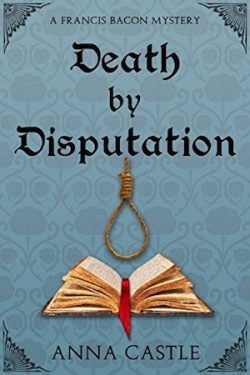
You could also whisk over to the online bookstore of your choice and snag a free copy of the second book in my Francis Bacon mystery series, Death by Disputation. This amazing global phenomenon will persist only until midnight Central Standard Time, Friday, January 25.
You’ll find links to a bunch of bookstores below the cover image. Click on the image to go to the universal link, which supposedly remembers your favorite store for you.
Universal: https://books2read.com/death-by-disputation
Amazon https://www.amazon.com/Death-Disputation-Francis-Bacon-Mystery-ebook/dp/B00RC56VCW
Amazon UK: https://www.amazon.co.uk/Death-Disputation-Francis-Bacon-Mystery-ebook/dp/B00RC56VCW/
Amazon AUS: https://www.amazon.com.au/Death-Disputation-Francis-Bacon-Mystery-ebook/dp/B00RC56VCW
Amazon CA: https://www.amazon.ca/Death-Disputation-Francis-Bacon-Mystery-ebook/dp/B00RC56VCW
Amazon DE: https://www.amazon.de/Death-Disputation-Francis-Mystery-English-ebook/dp/B00RC56VCW/
Nook https://www.barnesandnoble.com/w/death-by-disputation-anna-castle/1121667252
Kobo http://store.kobobooks.com/en-US/eboo...
Kobo UK: https://www.kobo.com/gb/en/ebook/death-by-disputation-1
Kobo CA: https://www.kobo.com/ca/en/ebook/death-by-disputation-1
Kobo AU: https://www.kobo.com/au/en/ebook/death-by-disputation-1
Apple US: https://itunes.apple.com/us/book/deat...
Apple UK: https://itunes.apple.com/ca/book/id1073505854
Apple CA: https://itunes.apple.com/gb/book/id1073505854
Apple AU: https://itunes.apple.com/au/book/id1073505854
January 7, 2019
Pix & notes: The Thames
The characters in both my historical mystery series often find themselves on or near the Thames, the great river that runs through London. My Professor Moriarty rows for exercise. He’s a member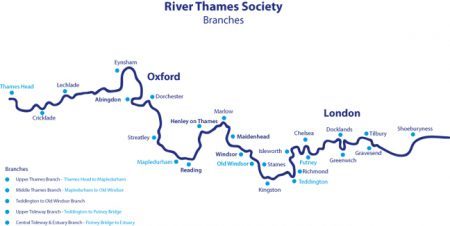 of the London Athletic Club (founded in 1863.) I’ve had him rowing from the Stamford Bridge to Putney and back, about 4 miles. Rowing is good for thinking, one would think, and can be a solitary sport, which is why I chose it for him. He rowed for Cambridge too.
The Thames was the major metropolitan thoroughfare for my Elizabethans. I have them walking a lot, because I can’t deal with horses, narratively speaking. Horses are people in themselves, requiring names, appearances, and personalities. Then you have the grooms, stable boys, and someone to hold the beasts when you reach your destination. All these people expect tips and need names. Many paragraphs squandered just to get across town! So, no horses. Besides, most of the places they go — courts, palaces, theaters, prisons — are near the river.
Where’s that wherry?
When my Elizabethans venture any farther from Gray’s Inn than Westminster (or strike northeast into the City), they take a wherry.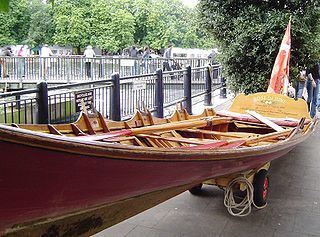 I find one reference in my google results saying you might pay 3 pence for the trip. Presumably that would depend on how far you were going and how many people you were with. The standard craft could hold 5 passengers and two oarsmen.
Wherries were manned by members of the Company of Watermen and Lightermen. Lightermen moved goods on and off lighters — flat-bottomed barges.
John Taylor was a wherryman who wrote poetry, some of which has survived. Someday I must drag this man into a book. Francis would not appreciate a wherryman spouting poetry at him as he journeyed up or down the river. Not sure I would either. Imagine a cab driver regaling you with his latest oeuvre on the way home from the airport. But go read one of Taylor’s poems and decide for yourself.
Up a winding river
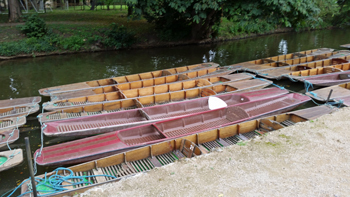 The river begins in Gloucester at a place called Thames Head. I’ve never been there. I have been to Oxford, for a short visit. I took this picture outside the Oxford University Physic Garden, which I now learn is on the River Cherwell, not the Thames, although the Thames is also more canal-like at this stage. If you hopped into one of these boats and headed downstream, you would eventually find yourself in London.
The Thames is 250 miles long; not as long as the Severn, but wholly within England. (The Severn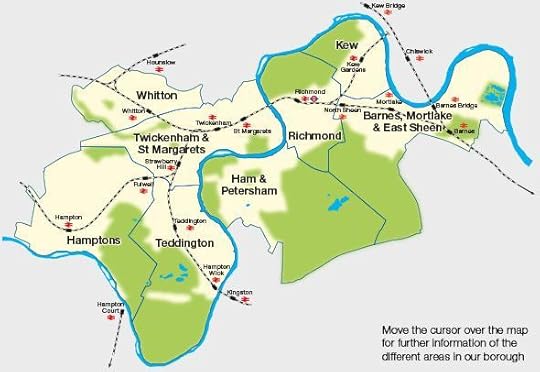 runs through Wales as well.) It’s a tidal river, meaning the sea pushes in at high tides and rushes out at low ones. The difference between high and low is 23 feet! The river is tidal all the way up to Teddington, which is west of Richmond Palace and east of Hampton Court. This map shows train stations, not vanished palaces, unfortunately.
If I were a wherryman, I would charge more to row into the rush of an incoming tide. Such things were probably regulated, this being an essential service. Although they weren’t very good at enforcing their many regulations.
On the Agas map, I count seven places labeled ‘Kay’ (quay) or W (wharf) on the north bank east of London Bridge. There are ten to the west, not counting private palaces like the Savoy or Bayard’s Castle, which have their own piers, quays, or wharfs. (I fail to grasp the difference between these things.) The ones on the map are public wherry-landings, I think. You can walk down and flag your boat, like hailing a cab. You always have to get off at London Bridge and walk over to the other side to catch another wherry. It was very dangerous to “shoot the bridge” — navigate between the narrowly-spaced piers. Nobody would do this.
London Bridge was the only bridge over the Thames below Kingston-upon-Thames until 1729. It’s about 13 miles by car on the A3, which is not at all what I wanted to know when I tried to google up the distance. There’s a definite bias toward utility and against curiosity on the Internet; have y’all noticed that?
Using the Thames Path Distance Calculator, I get roughly 29.3 miles. That’s a heckuva hike! I would have to stop twice along the way, making it a three-day walk. A sturdy young lad in Bacon’s day could do it in two, but of course he wouldn’t. He’d take the direct road, or beg his master for money for a wherry.
The river is tidal for most of that distance, so if the tide was going out and you were rowing downstream, you could make the journey in, uh… I have no idea. This is the kind of micro-fact that I long to know, but can never figure out. If you know, please write and tell me. Seriously! I spent quality time trying to figure out how far up and downriver Moriarty could row in his scull in thirty minutes or so, and I would love to know how long it takes Francis Bacon to get from Westminster to Blackfriars, for example, under different tidal conditions.
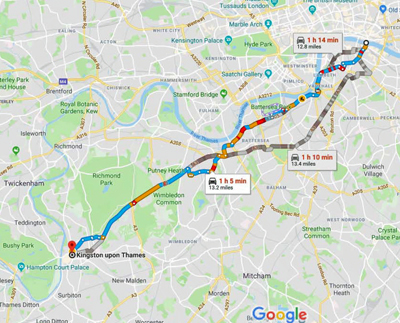 29.3 miles walking along the Thames Path.
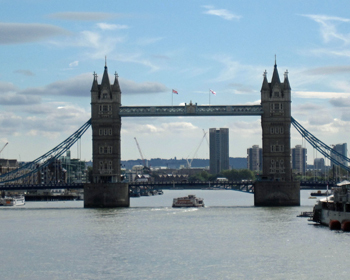
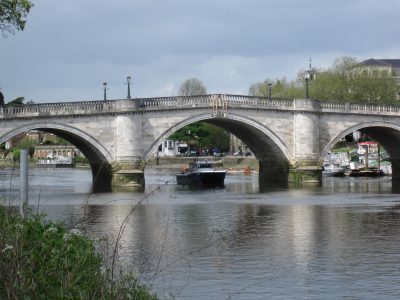
There are now 32 bridges between the Tower and Kingston Upon Thames, including railway-only bridges. Only 16 of them had been built by the time of my first Moriarty book (1885.) Here are the Tower Bridge (1894) and the Richmond Bridge (1777), photos taken by me in the new millennium.
December 17, 2018
Bacon’s essays: Of Gardens
Bacon loved gardens and designed the walks at Gray’s Inn himself. It’s another long essay, but to my taste much more interesting than Of Buildings. I can’t build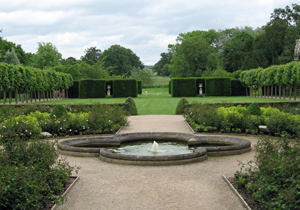 myself a two-story tower, but I can plant flowers for each season. If you like gardens, I recommend you read the whole thing. I’m just going to do an impressionistic reading here.
“God Almighty planted a garden. And indeed it is the purest of human pleasures. It is the greatest refreshment to the spirits of man…”
That’s the most frequently quoted quote. Like all great thinkers (ahem), Bacon must have loved to walk and think. For that, you need a smooth path and refreshing vistas for eyes worn out with writing and reading by natural light or candle light.
A plant for all seasons
“I do hold it, in the royal ordering of gardens, there ought to be gardens, for all the months in the year; in which severally things of beauty may be then in season.”
Remember that New Year’s Day was January 1st, but the fiscal/customary year began on March 1st. Elizabethans weren’t tuned to quite the same calendar we are, paying vastly more attention to the Catholic/Anglican religious calendar. Also remember that he’s assuming that a head gardener with a staff of under-gardeners and boys will do all the actual work.
At the end of the calendar portion, he adds this caveat: “These particulars are for the climate of London; but my meaning is perceived, that you may have ver perpetuum [a perpetual spring], as the place affords.”
Late-November to mid-January
 Rosemary
“[Y]ou must take such things as are green all winter: holly; ivy; bays; juniper; cypress-trees; yew; pine-apple-trees; fir-trees; rosemary; lavender; periwinkle, the white, the purple, and the blue; germander; flags; orange-trees; lemon-trees; and myrtles, if they be stoved; and sweet marjoram, warm set.”
‘Stoved’ must mean kept warm in bad weather with little braziers. Pamper that myrtle!
Mid-January through February
“…the mezereon-tree, which then blossoms; crocus vernus, both the yellow and the grey; primroses; anemones; the early tulippa; hyacinthus orientalis; chamairis; fritellaria.”
 Fritillaries
Mezereon tree appears to be Daphne mezereum. It puts out pink blossoms on bare stems, like a fruit tree, but it’s poisonous. Fritillaria is an early-blooming bulb, like a downward-hanging tulip. Very pretty!
I’m not finding charmairis, but it must be some kind of iris. They bloom in Feb in Austin and there’s a hundred varieties.
March & April
 Carnations
“For March, there come violets, specially the single blue, which are the earliest; the yellow daffodil; the daisy; the almond-tree in blossom; the peach-tree in blossom; the cornelian-tree in blossom; sweet-briar. In April follow the double white violet; the wallflower; the stock-gilliflower; the cowslip; flower-delices, and lilies of all natures; rosemary-flowers; the tulippa; the double peony; the pale daffodil; the French honeysuckle; the cherry-tree in blossom; the damson and plum-trees in blossom; the white thorn in leaf; the lilac-tree.”
The cornelian-tree is Cornus mas, the Cornelian cherry dogwood. South Britain is north of its range, but in a walled orchard against a sunny wall… It has yellow flowers and a nice natural fan shape.
I don’t know what flower-delices are. All I’m getting is some stupid perfume. Gilliflowers are carnations; useful in case you have to rescue someone underwater. Wallflowers are a real thing! Aka erysimum, in nature they grow on cliffs. I love garden walls covered in flowers! I have pix, but not from March or April. Really need to take a trip in the early spring.
May & June
“In May and June come pinks of all sorts, specially the blushpink; roses of all kinds, except the musk, which comes later; honeysuckles; strawberries; bugloss; columbine; the French marigold, flos Africanus; cherry-tree in fruit; ribes; figs in fruit; rasps; vineflowers; lavender in flowers; the  sweet satyrian, with the white flower; herba muscaria; lilium convallium; the apple-tree in blossom.”
Flos africanus is a type of marigold. Ribes are a class that includes currants and gooseberries. Vineflowers is vague; all I get are lots of lovely flowering vines. Googling “herba muscaria” gets me lots of versions of this essay! “Muscaria” yields “amanita muscaria,” a pretty but deadly mushroom. I doubt he means that.
“Lillium convallium sounds like a spell in Harry Potter, used to cover people all over with flowers, like the Beatles did the Blue Meanie. OK, now I really want a picture of that, instead of a nice bugloss, which is an upright stem with many small purple flowers clustered along it. (This is from the movie, The Yellow Submarine, in case you didn’t know. A great cartoon flick!)
July & August
 “In July come gilliflowers of all varieties; musk-roses; the lime-tree in blossom; early pears and plums in fruit; jennetings, codlins. In August come plums of all sorts in fruit; pears; apricocks; berberries; filberds; musk-melons; monks-hoods, of all colors.”
Musk melon looks like what a Texan would call a honeydew. (“Honey, dew you?”) If ‘burberries’ are ‘barberries,’ I would put them in the winter. Not sure about that one.
September to mid-November
 Medlar
“In September come grapes; apples; poppies of all colors; peaches; melocotones; nectarines; cornelians; wardens; quinces. In October and the beginning of November come services; medlars; bullaces; roses cut or removed to come late; hollyhocks; and such like.”
Melocotones are peaches! You thought they were an eighties nightclub act. Web says, from the Spanish, but my Spanish calls a peach ‘durazno.’ Bullace is a variety of plum.
Medlars are sort of apple-like fruits, mentioned in literature a fair bit. They ripen after a frost, which is pretty unlikely in London in the autumn, even in Bacon’s day, when it was a bit cooler.
Perfume the air
“And because the breath of flowers is far sweeter in the air (where it comes and goes like the warbling of music) than in the hand, therefore nothing is more fit for that delight, than to know what be the flowers and plants that do best perfume the air.”
 Viola cultivars
Right now I’ve got beebrush and kidneywood turning my backyard into a vanilla factory. Love it! And Bacon’s right, it’s such a sweet pleasure to catch a fragrance on the breeze, and turn your head and wonder where it’s coming from.
First we work through the ones that aren’t so great.
“Roses, damask and red, are fast flowers of their smells; so that you may walk by a whole row of them, and find nothing of their sweetness; yea though it be in a moming’s dew. Bays likewise yield no smell as they grow. Rosemary little; nor sweet marjoram.”
On to the good stuff.
“That which above all others yields the sweetest smell in the air is the violet, specially the white double violet, which comes twice a year; about the middle of April, and about Bartholomew-tide.”
That’s 24 August, for the heathen among us. I warned you about their calendar! Now he ranks the rest of the fragrant plants, with the detail of a man who noticed small things.
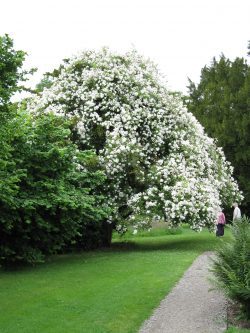 Rose overtaking a tree
“Next to that is the musk-rose. Then the strawberry-leaves dying, which yield a most excellent cordial smell. Then the flower of vines; it is a little dust, like the dust of a bent, which grows upon the cluster in the first coming forth. Then sweet-briar. Then wall-flowers, which are very delightful to be set under a parlor or lower chamber window. Then pinks and gilliflowers, especially the matted pink and clove gilliflower. Then the flowers of the lime-tree. Then the honeysuckles, so they be somewhat afar off. Of beanflowers I speak not, because they are field flowers.”
I remember walking across a field in Greece that was full of wild thyme. Delicious!
“But those which perfume the air most delightfully, not passed by as the rest, but being trodden upon and crushed, are three; that is, burnet, wild-thyme, and watermints. Therefore you are to set whole alleys of them, to have the pleasure when you walk or tread.”
Construction matters
“[T]he contents ought not well to be under thirty acres of ground; and to be divided into three parts; a green in the entrance; a heath or desert in the going forth; and the main garden in the midst; besides alleys on both sides. And I like well that four acres of ground be assigned to the green; six to the heath; four and four to either side; and twelve to the main garden.”
Hm, 30 acres… the original campus of the University of Texas occupies 40 acres. For perspective, or the total lack of same, Audley End’s famous parks and gardens occupy 100 acres. Capability Brown designed the park, a century and a half after this essay.
“….nothing is more pleasant to the eye than green grass kept finely shorn…” Unless you’re the one doing the shearing! But he has a point. One of things I love about England are the layers upon layers of shades of green, based on the green, green grass.
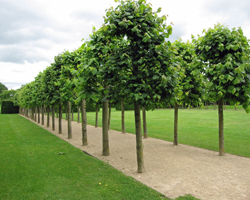
“But because the alley will be long, and, in great heat of the year or day, you ought not to buy the shade in the garden, by going in the sun through the green, therefore you are, of either side the green, to plant a covert alley upon carpenter’s work, about twelve foot in height, by which you may go in shade into the garden.”
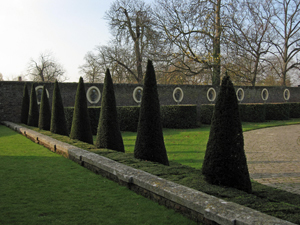 Ham House
OK, no idea what that means, can’t visualize it. All the hedges I’ve seen (and I am true hedge-o-phile) are made entirely of plants. No carpenter’s work in there. Although the gardens in the older houses, like Shakespeare’s New Place, do have quite a bit of carpentry, in the form of arbors and lattices for espaliering plants.
“For the ordering of the ground, within the great hedge, I leave it to variety of device; advising nevertheless, that whatsoever form you cast it into, first, it be not too busy, or full of work. Wherein I, for my part, do not like images cut out in juniper or other garden stuff; they be for children.”
Not a fan of the topiary! Everybody else likes them, I suspect.
“Little low hedges, round, like welts, with some pretty pyramids, I like well.”
Adornments
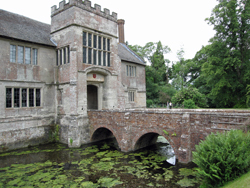 Baddesley Clinton. In case you were thinking about putting in a moat.
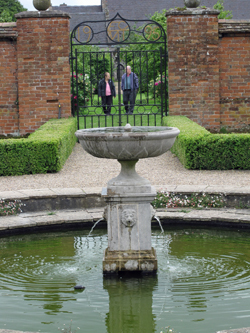
“For fountains, they are a great beauty and refreshment; but pools mar all, and make the garden unwholesome, and full of flies and frogs.”
He’s not wrong about that. Come farther south, and you get mosquitoes. The frogs can’t eat all of them.
“Fountains I intend to be of two natures: the one that sprinkleth or spouteth water; the other a fair receipt of water, of some thirty or forty foot square, but without fish, or slime, or mud.”
Yah. 30-foot-square cistern, basically, kept sparkling clean at all times. Those were the days.
 Coughton Court
“the main matter is so to convey the water, as it never stay, either in the bowls or in the cistern; that the water be never by rest discolored, green or red or the like; or gather any mossiness or putrefaction. Besides that, it is to be cleansed every day by the hand. Also some steps up to it, and some fine pavement about it, doth well.”
“But the main point is the same which we mentioned in the former kind of fountain; which is, that the water be in perpetual motion, fed by a water higher than the pool, and delivered into it by fair spouts, and then discharged away under ground, by some equality of bores…”
It’s all a lot trickier without water running under pressure, isn’t it?
The natural wildness
When Bacon says, “desert,” he doesn’t mean the Sahara. He would have read about such a bizarre expanse, but never seen the like. He meant “untended.”
“For the heath, which was the third part of our plot, I wish it to be framed, as much as may be, to a natural wildness. Trees I would have none in it, but some thickets made only of sweet-briar and honeysuckle, and some wild vine amongst; and the ground set with violets, strawberries, and primroses. For these are sweet, and prosper in the shade. “
No trees! What kind of a natural wildness is that?
 Texas in the spring
“And these to be in the heath, here and there, not in any order. I like also little heaps, in the nature of mole-hills (such as are in wild heaths), to be set, some with wild thyme; some with pinks; some with germander, that gives a good flower to the eye; some with periwinkle; some with violets; some with strawberries; some with cowslips; some with daisies; some with red roses; some with lilium convallium; some with sweet-williams red; some with bear’s-foot: and the like low flowers, being withal sweet and sightly.”
He seems to want basically a lumpy garden. It might be nice to gaze upon from a window, I guess. Or you could skip the mole-hills and plant a nice wildflower field. Those are all the rage in central Texas.
 Coughton Court
“For the side grounds, you are to fill them with variety of alleys, private, to give a full shade, some of them, wheresoever the sun be. You are to frame some of them, likewise, for shelter, that when the wind blows sharp you may walk as in a gallery. And those alleys must be likewise hedged at both ends, to keep out the wind; and these closer alleys must be ever finely gravelled, and no grass, because of going wet.”
Instructions to improve the walking experience. Very sensible.
“For the main garden, I do not deny, but there should be some fair alleys ranged on both sides, with fruit-trees; and some pretty tufts of fruit-trees; and arbors with seats, set in some decent order; but these to be by no means set too thick; but to leave the main garden so as it be not close, but the air open and free. For as for shade, I would have you rest upon the alleys of the side grounds, there to walk, if you be disposed, in the heat of the year or day; but to make account, that the main garden is for the more temperate parts of the year; and in the heat of summer, for the morning and the evening, or overcast days.”
He’s got it covered, all seasons and all weathers.
“For aviaries, I like them not, except they be of that largeness as they may be turfed, and have living plants and bushes set in them; that the birds may have more scope, and natural nestling, and that no foulness appear in the floor of the aviary.”
Nowadays, we make an effort to plant flowering shrubs, perennials, and grasses that attract and provide habitat for native birds and butterflies, My yard had more birds when I was more consistent about the bird baths. Get past all this construction and I’ll get that rolling again. Love my mockingbirds above all native creatures!
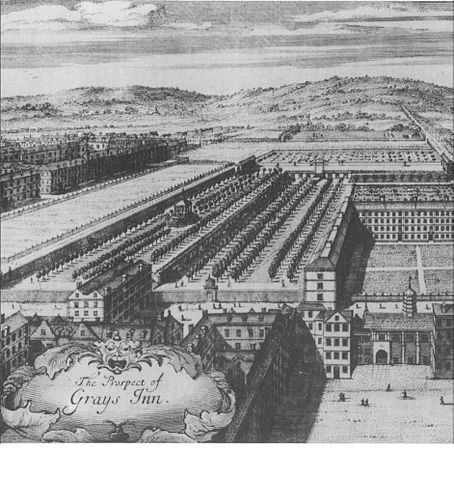
We’ll finish with a drawing of the Walks Bacon designed for Gray’s Inn. So symmetrical!
November 19, 2018
Bacon’s essays: Of Building
It does not surprise me that Of Building is a long essay. Never ask a homeowner about house construction!
Form follows function
 Burghley House, Stamford, Lincolnshire
Architect Lewis Sullivan, credited with the saying in this heading, must have been a fan of Francis Bacon. Bacon put it less succinctly: “Houses are built to live in, and not to look on; therefore let use be preferred before uniformity, except where both may be had.”
“Leave the goodly fabrics of houses, for beauty only, to the enchanted palaces of the poets; who build them with small cost.”
I think he’s saying, don’t waste money on things like marble counter tops (modern luxury) or gold-embossed ceiling decorations (old school). That’s always been my policy, and I’ve rehabbed three old houses. But Bacon wasn’t speaking to the likes of little old bourgeois me; he was speaking to his peers in what antiquarian George Eland called the Age of Swank.
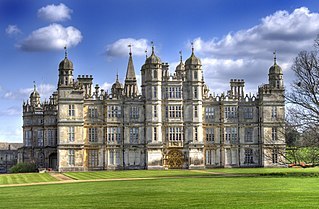
Many a magnificent palace was built in the late sixteenth ~ early seventeenth centuries. Many of them survive, and I’ve had the pleasure of visiting a few. Happily, that makes this long essay easy to illustrate.
Location, location, location
Subtitled, the more things change, the more they stay the same.
 Gamekeeper’s cottage, Peak District
“He that builds a fair house, upon an ill seat, committeth himself to prison. Neither do I reckon it an ill seat, only where the air is unwholesome; but likewise where the air is unequal; as you shall see many fine seats set upon a knap of ground, environed with higher hills round about it; whereby the heat of the sun is pent in, and the wind gathereth as in troughs; so as you shall have, and that suddenly, as great diversity of heat and cold as if you dwelt “in several places.”
Or perhaps as they say about Lubbock, in the only place in the world where you can be up to your ass in mud and still get dust in your eyes.
“Neither is it ill air only that maketh an ill seat, but ill ways, ill markets; and, if you will consult with Momus, ill neighbors.” Momus is the god of satire and mockery. Not everybody has such a god, but it seems like a wise option, especially if you’re planning a career in comedy.
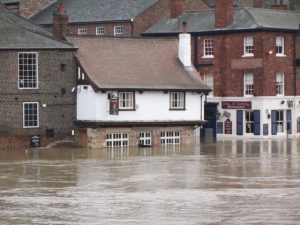 To close to the Ouse in York
“I speak not of many more;” Bacon says, proceeding to deliver a long list. “… want of water; want of wood, shade, and shelter; want of fruitfulness, and mixture of grounds of several natures; want of prospect; want of level grounds; want of places at some near distance for sports of hunting, hawking, and races; too near the sea, too remote; having the commodity of navigable rivers, or the discommodity of their overflowing; too far off from great cities, which may hinder business, or too near them, which lurcheth all provisions, and “…maketh everything dear…”
“Lurch” is a fun word to add to our vocabularies. No, not the butler in the Addams family. OED says, “To be beforehand in securing (something); to consume (food) hastily so that others cannot have their share; to engross, monopolize (commodities); in later use, to get hold of by stealth, pilfer, filch, steal.”
There’s a lot of lurching of tools & valuable construction materials in my neighborhood these days.
You won’t find perfection, says Bacon the consummate realist. But keep the list in mind so you’ll know which trade-offs you’re making. I, for one, am not too close to the sea (hurricanes) nor any river or creek (seasonal flooding.) Hot in summer? Well, it is Texas. Location won’t help you there.
Make like a bird and… migrate
“… if he have several dwellings, that he sort them so, that what he wanteth in the one, he may find  in the other. Lucullus answered Pompey well; who, when he saw his stately galleries, and rooms so large and lightsome, in one of his houses, said, Surely an excellent place for summer, but how do you in winter? Lucullus answered, Why, do you not think me as wise as some fowl are, that ever change their abode towards the winter?
Interior design
“We will therefore describe a princely palace, making a brief model thereof. For it is strange to see, now in Europe, such huge buildings as the Vatican and Escurial and some others be, and yet scarce a very fair room in them.”
I wish I had a model! Doesn’t look like anybody’s made one.
“First, therefore, I say you cannot have a perfect palace except you have two several sides; a side for the banquet, as it is spoken of in the book of Hester, and a side for the household; the one for feasts and triumphs, and the other for dwelling.”
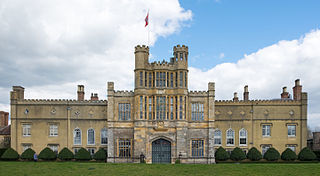 Coughton Court
I don’t get the part about Hester and Google isn’t helping, but Bacon seems to be recommending parallel sets of formal and household rooms. Huge houses do this, I think. It’s obvious that nobody actually lives in the houses in Architectural Digest, for example. They live in some wing off the back.
These sides ought “to be uniform without, though severally partitioned within; and to be on both sides of a great and stately tower, in the midst of the front, that, as it were, joineth them together on either hand.” Gotta have that tower, or the whole design falls apart. Except that nobody seems to have taken this advice. Look at eg “Jacobean stately homes.” Nary a tower to be found!
“On the other side, which is the household side, I wish it divided at the first, into a hall and a chapel (with a partition between); both of good state and bigness; and those not to go all the length, but to have at the further end, a winter and a summer parlor, both fair.”
It’s OK to separate the hall and chapel with a mere partition, because if people are in one, they’re not in the other. In fact, they tend to move from chapel to hall en masse.
“And under these rooms, a fair and large cellar, sunk under ground; and likewise some privy kitchens, with butteries and pantries, and the like.” Kitchens with fires and ovens are still going to be outside, I think, in separate buildings. I don’t know when they moved into the basement.
“As for the tower, I would have it two stories, of eighteen foot high apiece, above the two wings; and a goodly leads upon the top, railed with statuas interposed; and the same tower to be divided into rooms, as shall be thought fit. The stairs likewise to the upper rooms, let them be upon a fair open newel, and finely railed in, with images of wood, cast into a brass color; and a very fair landing-place at the top.”
Well, all right then. Maybe he’s thinking about Coughton Court in Warwickshire, or similar, though he never went that far from London. The gatehouse dates from 1530.
Neither paved nor shorn too short
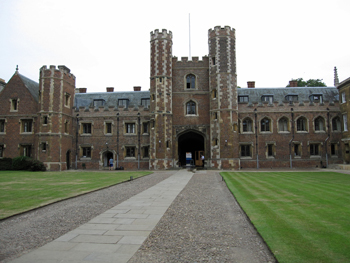 Can never remember which college. St. John’s?
“Beyond this front, is there to be a fair court, but three sides of it, of a far lower building than the front. And in all the four corners of that court, fair staircases, cast into turrets, on the outside, and not within the row of buildings themselves. But those towers, are not to be of the height of the front, but rather proportionable to the lower building. Let the court not be paved, for that striketh up a great heat in summer, and much cold in winter. But only some side alleys, with a cross, and the quarters to graze, being kept shorn, but not too near shorn.”
Now he seems to be talking about colleges at Cambridge, which he did see. Newish in his time; big building spree inspired by the Dissolution. Gotta put that money somewhere everlasting!
“Cast it also, that you may have rooms, both for summer and winter; shady for summer, and warm for winter. You shall have sometimes fair houses so full of glass, that one cannot tell where to become, to be out of the sun or cold.”
That’s a modern problem! Architects have a fetish for big glass walls, even for people who live in the urban core in places with both great heat and fierce cold winds. No sense in it!
“Beyond this court, let there be an inward court, of the same square and height; which is to be environed with the garden on all sides; and in the inside, cloistered on all sides, upon decent and beautiful arches, as high as the first story. On the under story, towards the garden, let it be turned to a grotto, or a place of shade, or estivation.”
Wikipedia tells me that estivation is a state of animal dormancy. I know the guy liked to take naps, but seriously? He must just mean, get out of the sun for a while.
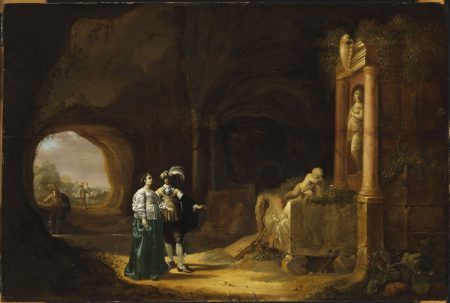 I could totally estivate in here in the summer
“Upon the ground story, a fair gallery, open, upon pillars; and upon the third story likewise, an open gallery, upon pillars, to take the prospect and freshness of the garden. At both corners of the further side, by way of return, let there be two delicate or rich cabinets, daintily paved, richly hanged, glazed with crystalline glass, and a rich cupola in the midst; and all other elegancy that may be thought upon.”
There’s more, but I can’t take it. I’m overthrown by the elegancy of it all. We’ll end with a picture of Ham House, about which I have blogged, built in 1610. Bacon would certainly have seen this one. It’s just down the river from his hunting box in Twickenham.