Charlie Lovett's Blog
July 18, 2019
Some New Book Reviews
 Since I launched my podcast, Inside the Writer’s Studio, in 2017, I have focussed on that medium for talking to you about writing, authors, and books. I’ve recorded 41 episodes now, and if you haven’t listened it, I hope you will. But now that the podcast is well established, publishers send me books to see if I’d like to have the authors on the show. They send me lots of books and pitch more authors than I can possibly interview (I interview one author on each episode and we have two episodes a month). Sometimes, I love the book, but jus don’t have space to fit the author into the schedule. So, I’m going to use this space for an occasional book review for those books. It’s also worth reminding you that I have a new novel coming out in early fall of 2020, so as the time draws near, I’ll keep you posted on that as well. But for now, here’s a review of a book that will keep you turning pages all night long.
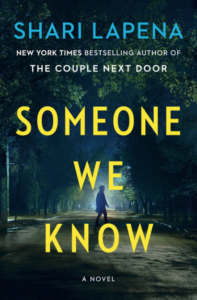 Review: Someone We Know by Shari Lapena
If the measure of a good mystery is the reader’s wanting to turn the page, then I have no choice but to give Someone We Know five stars. Only the necessity for sustenance kept me from reading this novel in one sitting; the necessity for sleep didn’t enter into the equation at all. This was a one-day book for me and it was the most enjoyable day of reading I’d had in a while. Lapena weaves a web of intrigue that keeps you guessing until the very end, which is exactly what we want from our mysteries. Yes, if Someone We Know were just a great page-turner, it would absolutely be worth your attention.
But my day of enjoyable reading was followed up by the next day and the next when I couldn’t get this book out of my head; days when I kept thinking about the ideas it had delved into. Turns out, Someone We Know is more than a page-turner. Yes there is a brutal crime, yes there is a seemingly ordinary neighborhood in which each neighbor realizes one of the others is a killer, but the book doesn’t stop there.
As the pages turn on, the secrets of this neighborhood are revealed one by one. Ordinary houses in an ordinary suburb hide one dark secret after another, and all the missteps and wrong deeds of the neighbors are related in some way to the vicious murder that takes place in the opening pages. We know that in the end the murderer will be found and brought to justice—that’s what happens in a murder mystery. But what about everyone else? What justice will there be for all the people who have been wronged and might never have known it unless the façade of the neighborhood had been peeled back by a murder investigation?
Someone We Know might deal with murder in a conventional way, but it asks uncomfortable questions about justice—questions that kept me thinking for days after I had finished. In the end, I realized that there was not one but two central questions in this thrill ride: we find ourselves asking, when it’s all over, not just who committed the crime, but who is guilty. The first question is easily answered by the final twists and turns of the story. The second is a good deal more complicated, and is left to the reader to ponder. After all, the next time, it might be someone you know.


September 17, 2018
My Encounter with a Superhero
 My absence from blogging has been due in part to my presence in podcasting. For the past year or so, I’ve been recording and posting my podcast Inside the Writer’s Studio, in which I talk with writers about their lives, their craft, their business, and their latest work. With over 2500 downloads so far, the podcast has gone from a small outreach project for Bookmarks to a show with listeners across the US and around the world. I love talking with other writers and reading their books in depth and with a thought towards an upcoming interview.
My latest podcast was one of my favorites. I’ll admit, with no small children in the house for the past decade or two, I had not encountered Captain Underpants until about a year ago, when my nephew Will heard I was starting a podcast. “If you could interview Dav Pilkey,” he said, “that would be awesome.” Will was right.
Dav is the author of the million-selling series Captain Underpants and Dogman, and his books have been credited with getting a whole generation of reluctant readers exciting about books and reading. When I heard he was coming to this year’s Bookmarks Festival of Books and Authors in Winston-Salem, I made two phone calls. First, I called my brother and told him he had to bring Will to hear Dav Pilkey. Second, I called Dav’s wonderful publicist to see if Dav would be willing to come on my show.
Those two phone calls led to an interview in which I chatted with Dav Pilkey after he had just appeared before 3000 screaming kids at our local minor-league baseball park. But the best part of the interview was that Will had come from Atlanta for the occasion, and I was able to include him in our discussion. He got to ask Dav some questions, and share some of his own homemade graphic novels with his idol.
I don’t remember the first time I met the author of a book I had already read and admired, but I know this—I was a lot older than ten. I love that we live in a world where kids—Will and those 3000 other school children—have the opportunity to see and even meet the men and women who have inspired them to read.
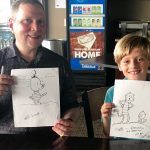
As I was packing up my equipment after the interview, I looked across the room and there were Will and Dav chatting away like old friends. Dav spoke to Will as he would to a peer. “We’re just two guys who draw graphic novels,” seemed to be his attitude. Before we left, Dav said to Will, “Let’s each draw a picture of a the Petey the Cat.” They picked up their pens and a minute later had both drawn the same character. But Dav took it one step further. Not only did he inscribe his drawing with a message for Will and give it to my nephew, but he asked Will to do the same. As we left, Will was walking on air, knowing that his idol Dav Pilkey was now carrying a Will Lovett original drawing with him.
I’ve met a lot of generous and kind authors during the past few year, but Dav Pilkey reached a whole new level. I watched all day as he treated kids like equals and gave unstintingly of his time to sign thousands of books (every one of those 3000 kids, most of whom attend Title I schools, got a free signed book to take home courtesy of Bookmarks). When he found out Bookmarks was raising money to put over 300 new books in every public school library in our school system, he donated $8000 to the cause, $1000 for each of the schools who came to see him at the ballpark. He gave away more in gift certificates to Bookmarks to encourage kids to read. All that was amazing. They way he interacted with my nephew—that was the definition of a superhero.
During the fall publishing season, Inside the Writer’s Studio publishes new episodes on the 10, 20, and 30 of each month. Coming soon—Anne Bogel, aka The Modern Mrs. Darcy; Newberry Medal winner Kelly Barnhill; Middle grade writer Alan Gratz, and more.
January 4, 2018
Some Thoughts on My Holiday Gifts
 I don’t like to complain about the generosity of my truelove in this season of giving, however:
Pears are not in season, so I have had to buy several bags of Purina Partridge Chow to feed my twelve partridges. Also, did you know that partridge guano does not wash out of upholstery?
It turns out that turtle doves are just high class pigeons and pigeons, as we all know, are basically rats with wings. I have twenty-two of them. This explains why the maids are more often running through the house screaming and batting turtle doves out of their hair than they are milking.
French hens? French hens are chickens, nothing more or less. So I have thirty chickens underfoot. Thank God they are not laying (see below re: geese), but that doesn’t mean they are not leaving “gifts” all over the floor. I have rolled up all the carpets to protect them from these farmyard menaces.
Calling birds might be all well and good if I only had four of them, but I have thirty-six and they call twenty-four hours a day! Want to be awoken at three a.m.? Fear not, the calling birds will take care of that. Ditto two, four, five, etc.
True, I now have a collection of forty gold rings, but with the price of gold I have been forced to increase my insurance coverage, plus I am starting to look a bit like a mobster.
Did you know that one goose will lay one to two eggs a day? And I have forty-two geese! Forty-two! I literally cannot make omelets fast enough. I asked the lords if they would help me in the kitchen but they will not stop leaping for five minutes. They have knocked over every lamp in the house and half the ladies dancing have broken bones as a result of lordly collisions.
I used to have a swimming pool—a lovely spot where I could relax, paddle around a bit, or just sip a pina colada while lying in the sun. I now have a swannery. There are forty-two swans swanning about in my back yard and I can’t touch any of them because technically they all belong to the Queen. And swans may be graceful and beautiful gliding across a distant river, but in your back yard they are basically noisy, angry poop machines.
The forty maids-a-milking were a gift, but the buckets, milking stools, and COWS are apparently “sold separately,” so I have made a substantial investment in order to have eighty buckets of milk a day. I had some hope that I might train my twelve drummers to churn butter, but no, all they will do is beat the bongos day and night. No wonder the calling birds are always awake.
On the one hand, thirty-six ladies dancing means I can have my own set of Radio City Music Hall Rockettes, and who wouldn’t want to begin every day with those high kicks. But the ladies are all staying upstairs and since the rugs are rolled up (see above, re: French hens) and they all wear taps on their shoes—well, you can imagine the racket. Not that I am sleeping anyway (see above, re: calling birds).
The arrival of thirty lords actually gave me hope, as I figured they could help with cleaning up after the partridges, chickens, calling birds, pigeons, swans, and geese but first of all they say, “We’re lords, we don’t do menial labor,” and secondly, they are all afraid of birds, which only makes them leap more violently around this place.
I’ll be honest, when I heard that twenty-two pipers were moving in, I immediately thought, “Hooray, plumbers!” This is what lack of sleep does to you. Turns out these are not pipers as in “someone who can clean all the swan, goose, pigeon, chicken, and partridge droppings and feathers out of my pipes,” but pipers as in “people who will make the shrillest sound known to man any time the birds quiet down enough the suggest the possibility of sleep.” They do, at least, pipe in the same key in which the calling birds call.
So here is what I have done—I have given the keys to the house to the drummers. There are only twelve of them, so they are outnumbered by maids, ladies, lords, and pipers—not to mention by the one hundred and eighty-four birds on the premises, but perhaps they will find some way to deal with this. I’m going to Antigua.
October 9, 2017
Inside the Writer’s Studio
 Earlier this year, when I was discussing with the staff of Bookmarks how we could reach more people with our literary programming, I hit on the idea of starting a podcast. Long a fan of James Lipton’s Inside the Actor’s Studio, I floated the idea of a similar platform for discussion, Inside the Writer’s Studio, in which I would talk to writers about their lives, their craft, their business, and their latest work. I’ve been interviewed a lot over the years, mostly by journalists, and while I enjoy these discussions, I find that they often circle back to the same few questions again and again. I thought that a writer interviewing other writers might be able to dig a little deeper.
Happily, the Bookmarks staff agreed and we began making plans to launch a new podcast. I bought some recording equipment and then sat down to emulate my favorite aspect of Inside the Writer’s Studio. That show always ends with Lipton asking actors the same ten questions—originally thought up by Bernard Pivot. I wanted to do something similar, but to use questions specially designed for writers. After consulting with my wife and the Bookmarks staff, I came up with a set of questions to end each episode.
I’ve recorded four episodes now, and I learn something every time. Two have been recorded in front of live audiences at Bookmarks new gathering place and independent bookstore in downtown Winston-Salem. Recording in this space presents its challenges, but the slightly echoey sound quality is made up for by the reactions of the audience. I’ve recorded one episode via Skype and one on the grounds of the annual Bookmarks Festival in September. Knowing that I will be interviewing an author on the podcast makes me read their book with great care and thought—something I genuinely enjoy. And the podcast has led to fun moments—especially when I interviewed Robin Sloan. Robin was one of the first authors to blurb my first novel, The Bookman’s Tale, but we had never met. Our first conversation was in front of the microphone and we had a great time.
You can listen to the podcast here, and I encourage you to leave a comment on iTunes if you like it. In the coming months I’ll be talking to Emily Wilson about her new book on Eleanor Roosevelt and to debut novelist Samantha Silva, whose upcoming novel Mr. Dickens and His Carol is closely related to my own The Further Adventures of Ebenezer Scrooge. I know those will both be great conversations. I’m hoping to post at least one or two episodes each month, so be sure to subscribe or to check back often. Until then, as we say on the podcast, may you read with wonder and write with passion.
July 8, 2017
A Grand Opening
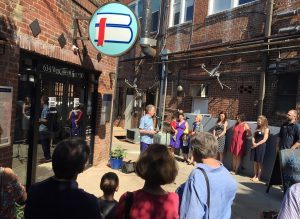 Below is the text of the remarks I made at this morning’s grand opening of the Bookmarks bookstore and community gathering space. Whether you live in Winston-Salem or elsewhere, be sure to stop by and visit this amazing space and check out the great literary events happening there all year round.
My name is Charlie Lovett and I am the president of the board of directors of Bookmarks, Winston-Salem’s literary non-profit. On behalf of the board, our staff, and our volunteers, I’d like to welcome you to the grand opening of Bookmarks’ new home. The building you’re about to experience is so much more than a bookstore. This is a gathering space to form community around the literary arts.
With our custom-designed event space and the ability to attract authors on tour we will double our number of events and our outreach, including our authors in schools program and our soon to be popular semi-weekly story-time. Most bookstores are designed to be retail spaces and the area for author events is, at best, an afterthought. But let me tell you, when authors see our event set up at Bookmarks they are going to be gob-smacked. Thanks to our architect, Winston-Salem native Glenn Fulk and our builders LMI, we have one of the best author presentations areas I’ve seen, and I’ve seen a lot of them. Bookmarks already has a reputation in the industry for hosting great author events, and that reputation is about to get a whole lot better.
When I joined the board of Bookmarks a little over four years ago, we had two part-time employees and operated out of Ginger Hendricks’ basement. Just over a year ago, the board of directors sat in my living room debating whether or not we wanted to take the step of creating this new space—a space where people could buy and read and talk about and be inspired by books. Our long-range plan, developed by Board President Emeritus Philip Mulder, called for such a place, but it seemed an awfully big leap. We decided to take the first step of forming an exploratory committee, and we never looked back. Thanks to a tremendous outflow of support from individuals, corporations, and foundations, many of whom are listed on our donor wall, we were able to reach this day. But last April, I don’t think any of us dared to dream we could do something on this scale.
Bookmarks is always growing and looking for new ways to reach our entire community and spread the joy of books and reading. That will continue to happen. We’re still receiving orders from publishers, so every day we will have more books on the shelves. We’re scheduling more events, and will be sharing books through audio and e-book platforms. So enjoy today, but come back often to see what happens next.
None of what you are about to see could have happened without the support, care, and planning of the board of directors and the incredible energy, professionalism, vision, and hard work of our full time staff Ginger Hendricks, Jamie Southern, and Beth Seufer Buss.
A few months ago, Ginger and I went to fundraising seminar. One of our exercises was to write down what we would want our organization to accomplish if money were no object. I said I wanted to see Winston-Salem become a city of books, a must-visit destination for the book tourist (and yes, that is a thing).
We live in a community that can take dreams and turn them into reality. Today we have visitors from Asheville, Durham, Atlanta, New York, Alabama, Louisiana, and Davidson, and those are just the ones I know about. So if you’re lucky enough to call Winston-Salem home, please welcome our visitors. It’s something we’ll be doing every day at Bookmarks.
I was speaking to Emily Wilson recently, and she called Bookmarks and its new space “The most transformative thing to happen to Winston-Salem since the School of the Arts.” It’s true that today, July 8, 2017, in this City of the Arts, the literary arts take their rightful place beside the performing and visual arts.
It is perhaps appropriate that Emily, a great Winston-Salem writer, should mention the School of the Arts, because it was another great Winston-Salem writer, John Ehle, who was one of the moving forces behind that institution. In fact, today we stand on the shoulders of not just Emily and John and Penny Niven and Maya Angelou, but of all the writers and readers who have called this city home. And from that height we are able to shout to the skies that as of today, Winston-Salem is a book destination and it is a city of the literary arts.
April 13, 2017
An Afternoon of Fairy Tales
 These days I write a monthly column for a neighborhood magazine in Winston-Salem. As a huge supporter of the literary non-profit Bookmarks (I am currently president of the board of directors) I cover all sorts of Bookmarks events from author visits to summer reading programs to our annual book festival. I’m going to start re-posting some of those articles here, for readers who may not live in my neighborhood but would still like to know about some of the cool things that can happen when books are involved. This is from the April column:
Do you remember the first time someone read you a fairy tale? I’ll bet many of you, like me, can’t remember the first time you met Cinderella or Red Riding Hood or Goldilocks. It seems as if we have always known them.
Everyone knows I love books, and there are thousands of fantastic books of fairy tales. I am especially fond of those from the golden age of illustration (the late nineteenth and early twentieth centuries) by artists such as Arthur Rackham and Maxfield Parrish. But there is also something truly wonderful about telling a child a fairy tale. Just about all of us—parents, grandparents, or simply neighbors and friends of children—can remember the plot of a few fairy tales well enough to craft a bedtime story. When my daughter, Lucy, was a toddler, I used to tell her a highly modified version of “Goldilocks and the Three Bears” in which the eponymous heroine was named, not surprisingly, Lucylocks. I especially liked the bit where she got stuck in Papa Bear’s recliner.
For more than ten years after I moved back to Buena Vista, I spent a lot of time with fairy tales as I wrote plays for third graders to perform at Summit School. From Twinderella to Porridgegate to Snew White, I was able to craft new stories out of familiar characters—and to third graders those characters of Red Riding Hood and the Big Bad Wolf, of the three bears and the three little pigs, were always familiar, dwelling in some sort of cultural memory. To those we added, among others, Cinderella’s twin brother Bob, a septet of dwarves with names like Sloppy and Spiffy, and celebrity appearances by “characters” such as Sigmund Freud and Ludwig van Beethoven. Those plays have now been performed in thousands of productions by schools and amateur groups across the country and around the world, so I like to think I’ve had a small role in keeping fairy tales alive and perhaps giving children a fresh perspective on their favorite characters.
And that’s really the wonderful thing about fairy tales—because we know them so well, because they are simply structured yet rife with archetype, we can interpret them, illustrate them, adapt them, stage them, and embrace them in a nearly limitless number of ways.
On Sunday, April 23, we’ll have a chance to see fairy tales in action in a new way as the Winston-Salem Symphony and Paperhand Puppet Intervention (check out some of their amazing work at paperhand.org) collaborate on a Discover Concert for Kids called “Enchanted Fairy Tales.” Life-sized puppets, masks, and movement will combine with live music for an afternoon of magical delights. Visit wssymphony.org for ticket info.
The concert begins at 3:00 at Reynolds Auditorium, but you’ll want to show up at 2:00 for lots of family fun beforehand. Bookmarks will be on hand with author and illustrator Kyle Webster. Kyle designed last year’s Bookmarks Festival t-shirt (based on the cover of his delightful book Please Say Please). His illustrations have appeared in The New Yorker, Time, The New York Times, and elsewhere. He teaches Life Drawing, Portraiture, and Digital Painting at the UNC School of the Arts. We hope to see you there for a fairy tale afternoon.
March 23, 2017
Writing About Faith without Getting Preachy
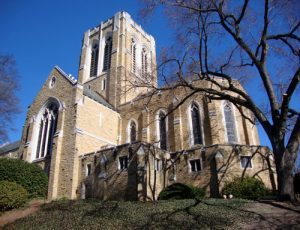 I had the privilege to talk about The Lost Book of the Grail at St. Philip’s Cathedral in Atlanta, Georgia this past Sunday morning. Let me say right off the bat that, although the novel is set in a cathedral and there is a lot of ecclesiastical history and activity within its pages, I made a concerted effort to be sure the book was not preachy in any way. While its characters sometimes struggle with issues of faith or worship, the book takes no authorial stance on these issues. I’m not trying to tell my readers what to believe or what not to believe. I think I succeeded in this effort because I heard recently from a reader who told me she almost didn’t buy the book. She is not a Christian and not a fan of organized religion. However, on advice of a friend, she read the book and told me she enjoyed it very much.
All that being said, the book does, necessarily for its setting in an English cathedral community, take up issues of faith and belief here and there. I think some of these spots might make for good discussions in book clubs (or in churches for that matter), and I pointed the more obvious spots out to my audience at the cathedral on Sunday. I present them here without comment—other than the foregoing and the following! Because these are out of context, it’s important to remember that they are the words and ideas of characters, not the author (it’s easy to get those confused). I don’t necessarily agree with all that my characters think and say—that’s part of what makes them interesting to me. Anyway, whether or not you have read The Lost Book of the Grail, these excerpts might make for some interesting conversations—but please don’t let them scare you away. There are also about 300 pages in which the characters are not talking about religion; they’re just having a rip roaring adventure.
_____
The argument that had engrossed Arthur and Gwyn on their first meeting had gone something like this: The dean did not understand how Arthur could come to services at the cathedral nearly every day yet profess he didn’t actually believe in the doctrines of the Christian church. Arthur argued that the dean should be pleased to have nonbelievers in her pews—what better place for nonbelievers? Arthur guessed her argument stemmed not so much from the apparent inconsistency of his beliefs and his actions as from her assumption that a nonbeliever in the pews was a rare bird. But Arthur suspected it was not nearly as rare as Gwyn thought, or perhaps wished. He imagined that any number of regular attendees, especially at the main Sunday morning service, if put to the test about their reasons for darkening the doors of the cathedral on a regular basis, might say all sorts of things about music and preaching and architecture and fellowship, but would very carefully skirt around the issue of faith.
The beauty of Evensong—the voices of the choir ringing off the ancient stones of the cathedral—did not make Arthur believe in God, but it did make him want to believe.
“You know, Arthur,” said Bethany, “you can decide to believe. That’s all it takes sometimes is a decision.”
He always felt moved when he entered the cathedral—such a space, with its soaring vaults and ancient arches, could never seem commonplace to him. But he usually felt the history of the building—from the Saxons to the Normans, from one bishop to the next, from the Reformation to the Civil War—the wonder of Barchester Cathedral to Arthur was the way it connected him to a thousand years of the past. Tonight’s feeling was different. Tonight the cathedral felt mysterious and laden with . . . well, Arthur supposed, laden with religion. In his unbelief, he thought much more about the political and artistic history of the cathedral than about the fact that for more than a millennium, people of faith had poured forth that faith on this spot. Tonight, Arthur felt as if he were swimming in a pool of that ancient belief.
“You’re so confident, aren’t you,” said Arthur. “It amazes me how you just don’t have any doubt.”
“Oh, God, Arthur, is that what you think?” said Bethany. “That believing means not having any doubt? Of course I have doubt. Every time I turn on the news and see man’s inhumanity to man I have doubts about God; every time I read some scholarly article about the ‘legendary’ King Arthur I have doubts about the Grail; and God knows I have serious doubts about love. But doubt is what makes belief and love gritty and dirty and complicated and worthwhile and life changing.”
“I wish I could have your faith. I wish I weren’t so weighed down by reason.”
“Faith doesn’t replace reason, Arthur,” said Bethany. “Faith begins where reason leaves off.”
March 16, 2017
Arthur’s Favorite Arthur
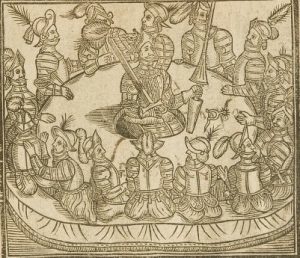 When readers first see Arthur Prescott, the hero (or at least protagonist, or at least co-protagonist) of The Lost Book of the Grail enter the library of Barchester Cathedral, we are introduced to Arthur’s favorite book in the library. With Arthur’s interest in the Holy Grail and in stories about the knights of the round table, it’s not surprising that this book is a copy of Thomas Malory’s Morte D’Arthur, in this case published under the title The Most Ancient and Famous History of the Renowned Prince Arthur King of Britaine. The edition to which Arthur is so drawn was published in 1634 by William Stansby.
Arthur particularly admires the frontispiece (pictured here) in which King Arthur pops up through a hole in the middle of the round table and is surrounded by knights wearing the armor (and the mustaches) fashionable in 1634, not that available in the days (mythical though they may have been) of Camelot. I chose this particular edition of the King Arthur stories for a reason. One of the themes of The Lost Book of the Grail is the way in which stories survive (and in some cases do not survive) over time. The Stansby Morte D’Arthur is a great example of a famous story that almost got lost forever.
Before the Stansby edition there were several printed editions of Mallory, but they all survive in a very few copies (some in only one or two). Stansby is the earliest edition that is more widely available, and very likely the edition that saved King Arthur—for after the Stansby was published in 1634, Malory did not appear in print again for 182 years. It’s easy to imagine, with such a hiatus, that the stories could have been lost altogether, especially if they existed only in incredibly rare editions. But, when the Romantics became interested in medieval romances, the Stansby was waiting for them, and the Camelot stories were revived. It’s a great lesson in the importance of printed texts—they really do a remarkable job of preserving stories over long spans of time.
Sadly, I had to refer to a scan of the Stansby when I was doing my research for The Lost Book of the Grail. I did this sitting at a computer terminal at the library at nearby Wake Forest University. Imagine my surprise when a rare book librarian from Wake Forest, not even knowing that I referenced this edition in my novel, asked if I would like her to bring an actually copy of the Stansby to my book launch. For some reason, the online catalogue had not recorded the fact that, just over my head while I was struggling to read a poor scan, was a copy of the actual book I wanted to see.
I’ll be in the rare book room at Wake Forest today to talk about my new novel, and you can bet I’ll spend a little time with the Stansby Morte D’Arthur. We owe it a lot.
March 11, 2017
Getting the Music Right
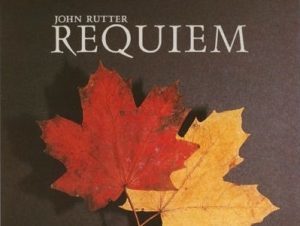 As I’ve been on tour with The Lost Book of the Grail I’ve been showing a collage-like image of a lot of the different books, magazines, places, and even furniture that inspired details in the book. One item in that collage is a CD of John Rutter’s Requiem. I almost always get a question about this—why is Rutter a part of my book?
Because the book is set in an English cathedral, and the main character, Arthur Prescott attends many of the services and has a special fondness for listening to the choir, music was always destined to be a part of the novel. But I didn’t want to just have Arthur go to Evensong and listen to the choir; I wanted to mention the specific music he hears. My thought was not only to establish his personal taste, but also to give obsessive readers another layer to unpack. If you seek out the music I mention in the text you may find yourself saying, “Ah, I see why he chose to mention that piece here.”
The case of Rutter’s Requiem is a special one. I’ve sung the piece several times, most memorably at Carnegie Hall in New York just a couple of months after 9/11. I have felt tears in my eyes as I listened to my wife sing the soprano solo on the “Pie Jesu.” So it’s a piece which holds special meaning for me.
In The Lost Book of the Grail there is a funeral, and I could think of no better setting for the requiem mass than John Rutter’s. Though it was written more as a concert piece, I looked carefully at both the service and the movements of the Rutter Requiem to determine how one might use all of them in the context of an Anglican funeral. In the end, the “Pie Jesu” became the anthem, and during that anthem, which I describe in some detail, Arthur comes to a revelation. I think it’s the sort of music that can lead us to revelations. So, when you’ve finished the book, have a listen.
March 7, 2017
Blogs, Blogs Everywhere!
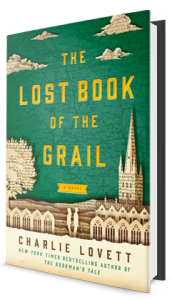 It seems like I have been writing blog entries and articles right and left, but with the recent publication of The Lost Book of the Grail, a lot of those pieces have been for other people’s blogs. So, in lieu of a new blog here today, I will direct you to some of the many short pieces that have appeared on other websites and which discuss some of my inspirations, research, etc. for The Lost Book of the Grail.
My first piece for Salon.com went up on their website on Sunday. It’s an article I wrote some time ago and honed for this publication, about a strange experience I had with the Ladies Home Journal and the Holy Grail. If that teaser isn’t enough for you to check out “My Brush with the Holy Grail,” then you’ll probably want to skip to the next article.
Over at Signature Reads, I wrote a piece about the chained library at Hereford Cathedral—the largest surviving chained library in the world. The first scene of The Lost Book of the Grail was inspired by two historical realities—the Nazi bombings of English cities during World War II and the existence of medieval chained libraries. “Welcome to the Largest Surviving Chained Library in the World” will tell you what I found out about the latter during my research.
I always enjoy writing blog entries for Marshal Zeringue who runs two interesting blog sites. At “My Book the Movie,” authors get to imagine their dream cast for a movie of their book. Over at “The Page 69 Test,” we take a look at page 69 and discuss whether it is representative of the book, and if so how. Both of these are great mental exercise, and I never cease to be amazed at what a perfect capsule of my books can be found on page 69.
Thanks for all the support of the book so far. The reviews have been great and I hope you enjoy not just The Lost Book of the Grail, but also these articles that let you peek into some of the research and experiences that led to the book (and also, let me know your dream cast for the movie!)