
Lucas Bale's Blog
November 19, 2015
In the Eyes of the Dead (A Maquisard's Song, Book One)
It's been a while, I know. Apart from a recent post on someone else's series, the last time I posted about anything I've been working on was July. It's November now. So I'm sorry about that – it's been a testing few months. However, I have not been idle. I've been working on a great deal. Firstly, I have been going over the final edits on a Beyond the Wall novella, Atonement, which is currently with David Gatewood for editing. It will have its first outing in Crime and Punishment, an anthology I am editing and curating with Alex Roddie, due to be released at the end of November. It will be released as a standalone shortly afterwards.
Additionally, of course, I am working on the fourth and final book in the Beyond the Wall series, Into A Silent Darkness. Release date to be determined, but I would think early next year. There are a couple of other projects too, but I won't talk about them here. I'll scribble another post for you soon about those.
A Maquisard's SongThe main reason I'm posting is to keep you updated on A Maquisard's Song, the new series I am working on at the moment. This is by far my most ambitious series to date. The opening book will be called In the Eyes of the Dead and, unlike The Heretic, will be a full-length, epic novel to open an epic series. At the moment, the first draft manuscript is 56,000 words (with a likely final word count of around 135,000).
If you thought the Beyond the Wall setting was detailed, the landscape for Maquisard is lavish, even sumptuous, by comparison. The dramatis personae are among the most exciting, compelling, and surprising I have ever created and I am really enjoying working with them. So much work has gone into this series over the last six months, picking apart every detail of the worlds I am creating – socio-economic structures and race, religious and spiritual issues, ecology, technology at various stages of a civilisation's advancement; as well as the themes to be explored: occupation and annexation of other species, collaboration in a time of war, genocide, the role of artificial and super intelligence, as well as genetic and nano-modification in our society and others. Dozens of documents, post-it notes, folders tabbed and highlighted, to draw together a setting that will do justice to the story I am creating. The way in which Empires are born, rule, then fall, and the effect on individuals within those vast, sprawling nightmares. The worst of what people will do to each other when faced with a threat to their existence – the meaning of loyalty and honour in an interstellar setting.
There are questions I want to ask (not all of them here, but this gives you an idea):
When does fighting for freedom become terrorism? Is it the cause that drives it, or the manner of the conduct of a guerrilla war? Does it matter who you are fighting for?
Who becomes a freedom fighter? What damage does it cause to the psyche of those who engage in it? Does the freedom fighter fall in love with the lifestyle – become addicted to the power, control and violence? Can they extract themselves into a normal life again?
What rights to soldiers have in war? The tragedy of their use as pawns in a much larger game. This is especially true of what are essentially slaves – those created for that single purpose, but who are still sapient with beliefs and a destiny. The choices they are forced to make, who to fight for, loyalty vs morality. Loyalty is tested when a civilisation descends into civil war. The functional belief of some in the Empire and what it stands for, as well as the inviolate nature of the chain of command.
How should we treat collaborators? When does the military justification for killing a collaborator weaken so it becomes murder? Is murder ever justified? Do we need to understand the collaborator’s position – one of fear, acquiescence and cowardice? Are they ever really combatants and, if so, don’t they deserve the type of protections afforded by the Geneva Conventions? What justice do they deserve – some form of due process? Does war change the concept of justice?
The whole of that first book is outlined and the next book has its own structure in place too. The overarching story is complete and now I am writing the whole thing as fast as I can. In the Eyes of the Dead is proving to be the most complex, emotive, and dramatic work I have ever done. Kameron Hurley said of The Mirror Empire, "Just because you think up a dark kernel of a swell idea doesn’t mean you have the technical skill to pull it off, and this book required a very long apprenticeship and a great deal of editing and feedback from a variety of folks to make it work." The writing and storytelling to be found within In the Eyes of the Dead really demonstrates how far I have come since I published The Heretic in June 2014.
What's also special about this one is that I intend to write two, separate and standalone series in the same setting. They will cross-over in places, but neither will require the other to exist. In the Eyes of the Dead will be the first book in what I will call an epic, darker space opera drawing in espionage thriller elements as well as classic, epic science fiction. That series will be at least three books.
The Dark DescentThe second series in the same setting, working title The Dark Descent, will be a first person, present tense military science fiction story with an emphasis on fast-paced and thrilling drama. Of course, the same thematic undertones will be present, as with all my fiction, but this will be action-packed, heat-pumping and powerful. My short from No Way Home, entitled To Sing of Chaos and Eternal Night will form the basis of the first novel in that series. That's the style I'll be writing in – far more immediate and personal.
So there you have it, what I've been doing and what is to come. I hope you're as excited as I am. 2016 promises to be my best year by far.


November 2, 2015
Studying a Setting: The Orbit Series, by J. S. Collyer
When J. S. Collyer released the classic-styled space opera, Zero, last year, it received considerable acclaim. The second book in the series, Haven, has just been released. Setting has always been critical to storytelling, not just as a backdrop to the story, but also as a character or plotline of its own. Iain M. Banks relied more on setting than story or character to convey his message in the Culture novels and, in some ways, something similar could be said of Kameron Hurley's Bel Dame Apocrypha series. In short, setting in science fiction and fantasy is critical. So, I asked J. S. Collyer to tell me a little about the series, and more importantly, how she went about creating the setting for it.
The Orbit Series is your debut work. Zero, Book One, has received glowing reviews and done really well. Haven, Book Two, has just been released. Introduce us to the series.
The Orbit Series follows the story of Kaleb Hugo, a high-ranking, well-connected soldier in the military establishment called the Service that rules over Earth and its orbiting colonies in the not-to-near future. Book 1, Zero, begins when Hugo makes a controversial decision and loses his position in the establishment that has been his whole life but is re-assigned to a special ops vessel the ‘Zero’. The Zero is crewed by a rag-tag group of orphans and misfits who look to their wry, wrong-side-of-the-tracks commander Ezekiel Webb for leadership whilst executing undercover work for the Service. This shift in positions and perspective, both in Zero and again in Haven, leads Hugo to re-examine the way the world works and his own position in it whilst trying to fight for what he believes is right. His perception of risk and relationships shift hugely as he discovers more and more about himself and those around him during the course of his missions.
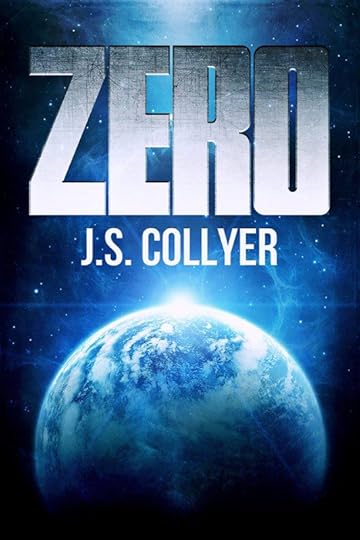
What feel are you going for with the Orbit series? Is it a classic space opera, high melodramatic adventure, or does it have more in common with hard science fiction or military science fiction?
I would say it has more in common with TV shows like Firefly and Farscape than any hard-hitting or universe-spanning book series. I try to keep it light-hearted in that the narrative is fun and relatable, the characters grounded and realistic and the settings easily visualised. I like a really immersive experience from my fiction which comes from relating to the characters and experiencing their story along with them. My themes revolve heavily around the characters and their relationships and experiences. For me, the setting full of lasers, space stations and star ships are an added bonus that provide a super-human backdrop to a very human story, so I’d say classic space-adventure with feels than anything else.
I want to talk about setting. First of all, walk us through the setting for both books.
The setting is the future of our own world but not so very many years away. Think hundreds rather than thousands. I envision an over-populated Earth with wide areas of uninhabitable areas that are the result of a Whole World War several generations ago. Humankind has expanded onto cities on the moon and into two ‘strips’ of orbiting space station colonies – the Lunar Strip consists of 5 space stations (Lunar 1 – 5) and the Sunside Strip has five more (Sunside 1 -5).
The Lunar strip is older, more ramshackle, and populated by descendants of Old America and Europe, the first groups of people to flee Earth. The Sunside colonies are newer, better equipped, richer and with stronger ties to the Service, the first military establishment that was strong enough to unite more of the ‘Orbit’ (Earth and its colonies) than any other force in history. Despite the strength and hold of the Service, humanity is still a sprawling, fractured species, desperate for space to live and resources to live off. They mine asteroids harvested from the asteroid belt for minerals and parts of the Orbit use dangerously flammable fuel to run their machines as they have no other options. Crime and conspiracy and power struggles are rife, though the Service tries its best to keep things under control, for better or worse.
By the second book, humanity is starting construction of a new colony on Mars which promises to be the new start everyone is hoping for, but in reality sparks a whole new mess of revolution and unrest.
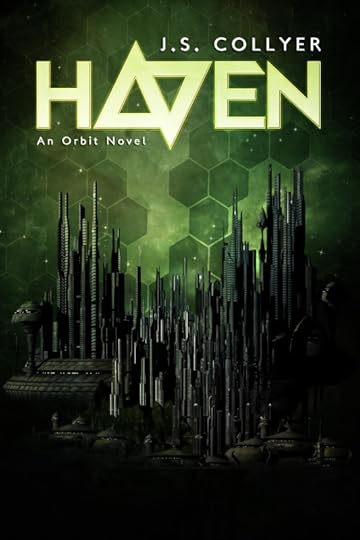
How do you go about designing the setting, and how much of it developed as you wrote Zero? Did you develop it even more in your own mind as you were writing Haven?
The Orbit is developing all the time. The more my characters travel through and explore it, the more I learn about it myself. The premise of Earth and space station colonies was all I started out with and has been done before. The individual idiosyncrasies of the colonies, populations and levels of society all came together as I wrote, gaining (I hope original) colour and texture with each book.
Where did your inspiration come from for the setting? What research did you do to build its realism?
My inspiration came from some of the Japanese anime I used to watch in the 90s. They seem to have a grungy, post-apocalyptic style all of their own which is gritty, over-the-top outlandish and yet grounded and dirty and real. In terms of research, I read up on our own solar system, the basic properties of the moon, other planets, asteroids to get an idea of the logistics of living and working in such environments and I also did some basic research on military ranking systems as well as guns, bombs and other weaponry. However, the main focus of these books will always be the characters and their emotional journey so, though I did read up on things to keep the realism in check, don’t expect paragraphs of technical knowledge or explanation on any of their gadgetry, computer systems or ship workings.
How important is realism to you? How hard do you want the science fiction in the series to be?
I find realism extremely important, and that’s emotional and character realism as well as that relating to the setting or objects, because no matter how far-fetched the setting or premise, I can get on board and with almost anything if it reads realistically. Anything that smacks as unbelievable catapults me right out of a story and I struggle to commit to the narrative once I feel like it could never actually happen, or at least not happen in the way the author has articulated.
I also like realism delivered through seamless background details, character reactions, actions and motivations. I don’t like paragraphs of explanation or descriptions of spaceships, societal systems or other-worldly transportation methods. Lots of people really like detail and I appreciate that. Many scifi and fantasy fans love like knowing all the ins and outs and imagining every detail of the fictional world. But for me, as I’ve said, it’s the characters and their journeys that’s the draw of a story, not how technically accurate their communication technology is. So as much as I like believable and technically accurate details where they matter, the Orbit series is not what would be classed by many as ‘hard’ science fiction because of the focus on the humanity rather than the technology.
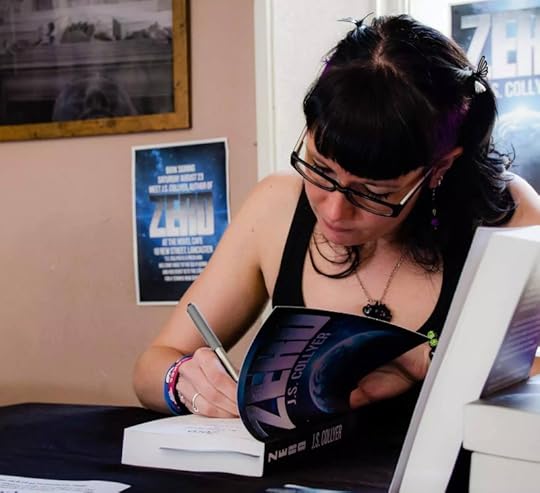
Kaleb Hugo and Ezekiel Webb are your lead protagonists. If the Orbit series were picked up Bad Robot or SyFy, who would you love to see cast in the roles?
I’ve daydreamed about this so many times! I’m a very visual story teller so to me they do feel almost more like films than books. I ‘see’ everything happen clearly when I write so things like mentally designing sets, scouting locations and casting actors is a very satisfying indulgence I allow myself once in a while.
Casting my protagonists is fun but tricky. Trying to narrow down so many wonderful actors who I think could lend themselves to Hugo’s hard-nosed but good-hearted integrity and Webb’s snide and cynical but open honesty is quite difficult. I also have a very clear physical depiction of both these characters in my heads but like to leave that open to interpretation as I think their physical appearance is up for debate, but their characteristics are not.
For Hugo I would love to see the likes of Idris Elba or Daniel Craig in the role, someone who can pull off gravitas but the capacity for a hot temper and strong emotion. As for the slightly younger, cheekier and yet dry and cynical Webb, it would have to be someone like Jay Baruchel or Cylian Murphy.
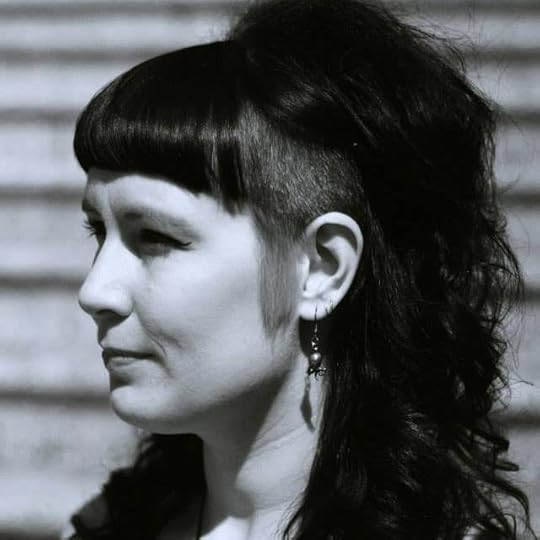
Book 1 in the Orbit Series is called Zero and has been described as ‘James Bond meets Firefly’. It is out now on Amazon: http://a-fwd.com/asin=B00MRACF86
Haven, book 2 in the series, which has been described as ‘cinematic, full of breathtaking moments’ and is out now for Kindle and as Paperback: http://myBook.to/havenjscollyer
Details of all publication and more thoughts on writing, publishing and promoting SciFi on J S Collyer’s WordPress: http://jcollyer.wordpress.com
August 3, 2015
Collected Artwork, Video and Images from Ridley Scott's The Martian
It's a poorly kept secret that I loved Andy Weir's breakout novel, The Martian. If you haven't yet read it, you really should. I suspect you'll love it as much as I did. I'm thrilled by the upcoming film, directed by one of my favourite directors, Ridley Scott. Initially, I was uncertain of Matt Damon cast in the role of Mark Watney, but two trailers I've now seen dispel those doubts utterly. I have no doubt it will be one of the blockbuster events of the year when it is released. Haven't seen the trailer yet? Here it is.
The hype is growing, the media circus gathering pace. So I thought I'd share some of my favourite artwork and on-set images.
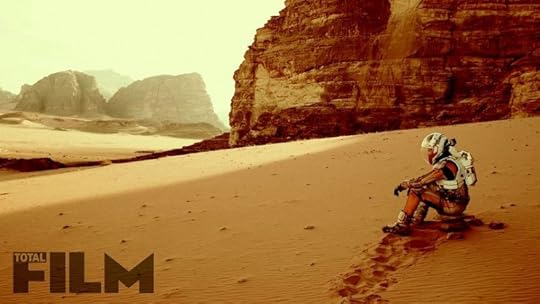
The reality of the task facing Weir was stark. He had to have Watney right there, but also the desperate efforts to save him going on in parallel. He solved the problem of creating his narrative voice through a device which is not particularly inspired – a ship’s log – but is nevertheless clever for two reasons. Firstly, it allows Weir a simple narrative voice, that of his protagonist, and the ability to see into his mind clearly. We identify with him completely and quickly. We are with him. We want him to survive. We are him. Secondly, we don’t know, from the outset, if he survives. The log is a permanent record and remains whether he survives or not. So, uninspired? Or simply taking advantage of the most effective way to tell his story? Does it matter – Weir uses a device which works.
And he uses it to great effect.

Initially, the POV shift to third person NASA took the story in a direction I was unhappy about – the strength of this book was Watley's narration and our insight into his character through his thought processes. His humour came through, his unwillingness to give in. Segueing to the third person from the first person is a technique I find contrived and disconcerting – if I am viewing events through the eyes of a (first person) non-omniscient narrator, to then see them through the eyes of an omniscient narrator in the third person simply does not work. Additionally, I was not convinced the story needed it, but the reality is it does build tension and it gives us a much-needed break from the sometimes too technical "this-is-what-I-did-next" Watney (nice as he is). So, I am willing to forgive the first-person/third-person contrivance because it drives the story nicely and I genuinely don't think Weir could have achieved what he did achieve – narrative flow and strong tension – any other way in the context of the story he was telling and the way he was telling it.

That’s the big challenge. It has all the bells and whistles of NASA and the b-side of the story, the rest of the world trying to get this guy back. But the other half of the movie is me and Ridley on Mars, so that part’s different. You start there, there’s that mystery – what happened, how did he get left there? The mission part is the b-side, trying to figure out how to get back. So, structurally it’s different to anyone that’s ever been done.
— Matt Damon on portraying Watney's struggle to survive

One of the things I love about the build-up to the film is the docu-style trailers – taking the gritty, utterly realistic feel the book had and translating it to the film's underlying themes and milieu. Almost making the film feel, as the book did, like non-fiction.
The technical aspects of the story are integral to suspension of disbelief. Watney (and so Weir) has to explain it to us because this is a story about fumbling for the final threads on frayed fabric, and somehow painstakingly sewing them into an escape plan. Every single thing Watney does needs scientific explanation otherwise the drama of his escape evaporates. Yet Weir manages to convey this in Watney's engaging, conversational tone so we don't despair at the detail. We love it. The quote I began this review with is the most telling example of the entire book: "Yes, of course duct tape works in a near-vacuum. Duct tape works anywhere. Duct tape is magic and should be worshiped." So simple, so obvious, so much said in the sort of tone which implies 'What, you didn't know that?'
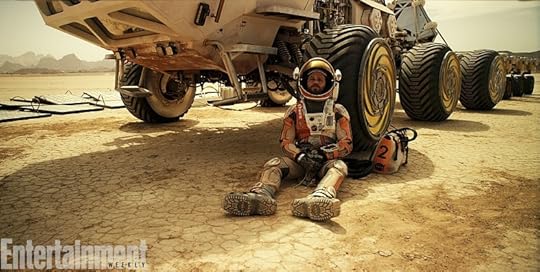
The book is great, it created an amazing character who’s such a problem solver. He has such a great sense of humour that you root for him. It has a similar character to other films we’ve loved, like Sandra Bullock in Gravity, like Tom Hanks in Castaway. It’s a character that’s lost at sea somewhere and is trying to find their way back home. I think we can all imagine being lost somewhere and trying to get back, we can all relate to that.
— Jessica Chastain
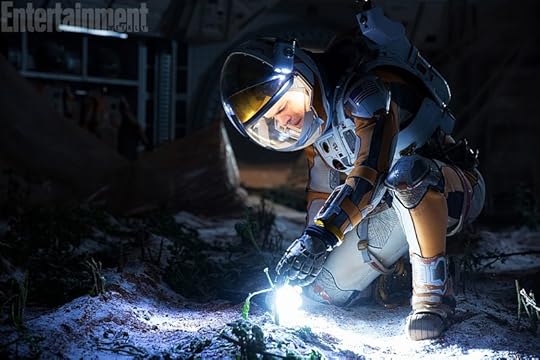
Chastain is right. Characterisation of Watney in the book is excellent – we believe him from the very first words. "I'm pretty much fucked. That's my considered opinion." In those eight words, we are told everything we need to know about Watney's personality. The subtle dig within the words "considered opinion" suggested his expertise and what he now thinks of it. We immediately know he's in trouble. We are compelled to read on, we simply cannot but read on. "I don't even know who'll read this. I guess someone will find it eventually. Maybe a hundred years from now." First person convention blown – we don't know if he's getting out of this. We see this log, and his scattered, dried bones beside them, being handled by astronauts years, even decades from now. All bets are off. This is serious. This is Into the Wild.
I think it will be great.

July 15, 2015
The Heretic on Audiobook and Deirdre Gould on her Audiobook Experiences
The first three chapters of The Heretic audiobook are done. I am now going through the process of listening to Adam's take on the book, his tone and accent for each character and getting ready to approve his work so he can get on with the rest.
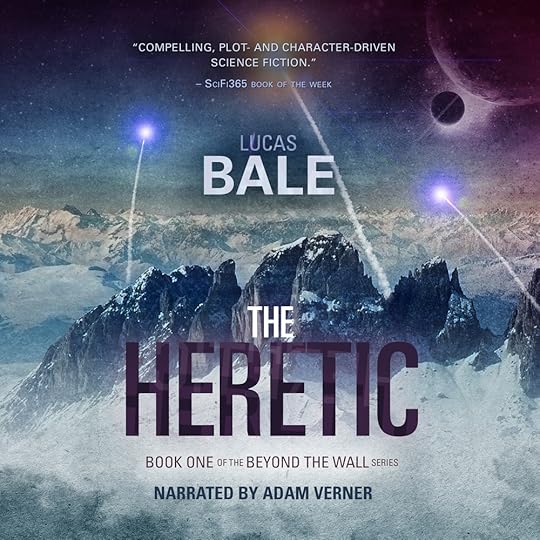
I'll admit to some trepidation about all of this – to some nervous tension at the thought of listening to my own work being narrated in the same way as I've been listening to Hyperion, Dune and more these last few weeks. I wondered if there might be some terrible weakness in the prose that would be horribly exposed before me as Adam narrated.
Of course there isn't. I'm surprised, but gratified, to listen to words that work. As the story unfolds, Adam has in fact made it leap off the page.
Below is the fifteen minute sample Adam sent me to get the process started. The first chapter of the book in its entirety. Have a listen, if you like – I think you'll enjoy it.
In addition, to continue with my guide to ACX and audiobooks for indies, I asked Deirdre Gould, bestselling author of After The Cure, to tell us about her experiences with ACX and audiobooks. Having read this myself, I have to say there is some wonderful advice in there – about coping with the process of having your book narrated, choosing a narrator, and not getting too caught up in small details. Among yet more great advice. It's an eye-opening and extremely useful (and frank) post. If you are planning on doing audiobooks, I suggest you read it, and my earlier post that covers the basics.
It wasn’t very long into my adventures in publishing that I knew I wanted to try an audiobook version. Both my husband and my father are avid audiobook fans. It’s hard to persuade them to read a paperback or ebook anymore – they’d even rather listen to kindle’s very robotic text-to-speech if there is no audiobook version available. And I knew there were thousands of other readers out there like them. So I started researching how to create an audiobook almost from the beginning. But the publishing process, for me, was not a raging success out of the gate. It’s been more of a slow growing burn.
I wanted to give audio a fair chance to succeed. If I’d jumped in earlier, it may have fallen flat on its face just because of the limited visibility of my series. It wasn’t until book three was released that it started to really pick up steam. Again, Simon Whistler’s book [Audiobooks for Indies] had some great advice about when an audiobook is right, and when it might be a bit too early. When I started selling at a decent clip early this spring, I decided to give audio a shot. Just like Lucas, I needed to decide between royalty share and paying upfront. I went with royalty share for very specific reasons.
I wanted to give audio a fair chance to succeed. If I’d jumped in earlier, it may have fallen flat on its face just because of the limited visibility of my series.
I knew whoever I found would probably be new or building their portfolio, and that was okay with me. I actually wanted someone who was learning the industry, because I was too. It’s the first book in a series and I really wanted to partner with someone who would learn along with me, someone who would grow with each book, just like I would. A partner in fumbling if you will. Instead, I got insanely lucky with Miles Taber. He might be building his audiobook portfolio, but he is anything but fumbling. Miles was one of the first narrators to audition for me on the very first day. I’d heard that I should wait at least a week before contracting with anyone to see if ACX would attach a stipend, and I knew my book ticked all the boxes for them-- except that it was permafree at this point. So I waited and in the meantime, contacted some female narrators, just to see what the difference would be. I listened to lots of auditions during that week. My husband also listened to them and kept me from being too nitpicky.
I actually wanted someone who was learning the industry, because I was too.
Even though I ended up choosing to work with Miles, I’m still really glad that I listened to those other narrators and that I had someone impartial listening with me. If you are anything like me, it’s going to be hard to let go and accept that the way you told yourself the story in your head is not the way someone else is going to read it. There are going to be pronunciation differences. There are going to be emphasis shifts. Your narrator might even interpret your characters completely differently than you expected. It was something I knew intellectually, but I was not in any way prepared to actually hear. There are auditions that are so over the top you’re going to cringe. There are auditions that are so deadpan you’ll want to fall asleep. And there are auditions where the narrator was having technical difficulties. But most of them are going to be good. Or not just good, really great. But unless you have that neutral party listening, you might miss it. You’re going to get picky. Of course you are. You spent hours, weeks, maybe years writing this thing. It’s natural. But at some point, it’s not doing your book any service. Some of the auditions that I thought were over the top? My husband loved them. Some of them mangled the pronunciation of every name (and I don’t have any new species or planets like some fantasy or sci fi books, just some pretty vanilla names) and my husband didn’t even blink. I started to realize that, sure, I could micromanage the narrator I picked, get every tiny emphasis I wanted, make certain every last name was pronounced the way I’d been raised to pronounce it. Sure, I could do that (and drive us both crazy) but I can never control how a person reading my book tells it in their own head. I can’t reach in and make the reader follow my script. So I let it go and started really enjoying myself.
Now, that’s not to say I didn’t pick the narrator that seemed to “get” my book the most or didn’t reflect my own tastes. Miles had an audition that was very understated and went at a slower pace than the others – something that I appreciated, but maybe someone else would find maddening. And I’m not saying that every author is going to be as laissez-faire as I’ve become (or that they should be), but if you really can’t let go, you might be happier with a self narration instead.
So I finally contacted Miles when it was clear that no miraculous ACX stipend was coming through (what I didn’t know at the time, is you can write to ACX and make a case for your book, I thought if it didn’t just happen, it wasn’t going to, but I’ll know now for next time) and he agreed to a straight royalty share. I have no doubt I will not get that lucky again (nor do I want to take advantage of Miles or anyone else). If I can’t make the audiobook fly off the shelves when it’s released, I'll be prepared to offer either money up front for the next books or a royalty share plus some as Lucas discussed. But enough about the money – everyone else can talk about that. I want to tell you about what it’s like to hear your story instead.
I started to realize that, sure, I could micromanage the narrator I picked, get every tiny emphasis I wanted, make certain every last name was pronounced the way I’d been raised to pronounce it. Sure, I could do that (and drive us both crazy) but I can never control how a person reading my book tells it in their own head. I can’t reach in and make the reader follow my script. So I let it go and started really enjoying myself.
Sure, I listened to the text-to-speech version of my book. I do it every time during edits. With her clipped computer voice and expressionless delivery. And I read pieces aloud to myself during editing as well. But neither of those even comes close. When Miles sent in the first two chapters of the audiobook for me to approve, I sent it to a couple of people before I’d even listened to it. As Lucas said above, I was worried I was going to be hyper-critical, either of Miles or of my own book, even though it had stood up to dozens of readthroughs during the publication process. I was prepared to cringe and hide under my desk for a few days, especially because the opening of the book is probably one of the most emotional and shocking scenes in the entire book. I knew if he could pull off that chapter without making me nauseatingly embarrassed, that I wouldn’t need to worry about a single sentence afterward. So I made sure I was alone in my office and I made sure my headphones were plugged in and NOT the speakers and I pressed play. And what happened next was sheer magic.
It’s the closest I have ever, or will ever get to reading my own book as if I’d never seen it before. Even if it was ever optioned for a film, it would never ever be as close to that experience as hearing the audiobook. It was like I was borrowing someone else’s experience of it. For both the good and the bad. If the auditions led me to realize I couldn’t control how my book was read, the first fifteen minutes convinced me that I didn’t want to control it. Miles made it more than it ever was on the page. More real, more emotional, more powerful. It was like seeing alchemy working. Whatever this book was, I knew it wasn’t mine anymore. That it hadn’t been mine for thousands and thousands of ebook and paperback copies. That it was something far more than I’d ever imagined, and I didn’t need to be ashamed of it at all. Actually, if there is ever a “definitive version” in readers’ heads, it will probably be Miles’s version, because he read it to them. The first two chapters gave me goosebumps. And they made the other people I sent it to immediately call back and ask for the rest of it.
I’m not worried for the rest of the book, I know it’s in good hands. My only dread now, is that some superstar seller is going to snatch Miles away and I won’t be able to get him to do the other four books. When I was holding auditions I told my readers that it was like shopping for the perfect wedding dress, except more exciting (I’m not really that into wedding dresses). In a lot of ways, I think that’s still true. You want to find that perfect voice, that perfect delivery for your book. And you want it all at the perfect time, at the perfect price. So you put up a tiny, tiny bit of your book for someone to read and you analyze and analyze. “This guy’s good, but I hate the way he makes the villain laugh.” or “I wish she realized it was pronounced tomayto and not toemahtoe.” or “How could he miss that this was the most important sentence? Why does he think it’s THAT one.”
The thing is, if you can’t break out of that picky cycle, you’re going to pass by the dress that really is perfect for you, because you’re looking for what’s wrong with the dress instead of remembering that it really isn’t about the dress at all in the first place. That this tiny section of your book isn’t what it’s about. If you can take a step back and realize that the first time you let someone else read your book, whether it’s into a microphone or in their own head, it stopped belonging to you, you’re going to find the entire experience, and your book, is better than you even dreamed it would be.
p.s. I know you all want Miles to narrate your books now, but I called dibs. Just kidding, here’s his ACX profile.
July 2, 2015
Beyond the Wall Gets the Audiobook Treatment
Until a few weeks ago, I hadn't seriously considered audiobooks, either as a reader or as a writer, but then I was slow to move to Kindle too, at first. A few authors had suggested I have the Beyond the Wall series produced for Audible, Amazon's audiobook producer and distributor, but I wasn't convinced and forgot the idea. How little I knew!
Once I completed and published A Shroud of Night and Tears, I decided to take a little break from writing and do some reading – some sci-fi classics (I wanted to blow through the Culture, and re-read Dan Simmons's Hyperion and Frank Herbert's Dune) as well as some work I'd never heard of, but which had been recommended to me. I missed hiking terribly, too – so much of this year has been consumed by the work I've been doing on Beyond the Wall, No Way Home and shorts for other anthologies that there has been little time for hills and mountains. So, I struck upon the idea of combining both – reading books I had been wanting to read for a long time, and hiking. That meant audiobooks.

I was pleasantly surprised, in truth. Some audiobooks are less well produced than others, even the classic stuff like Iain M. Banks's Culture series can be a little blandly done at times. Some are more lavish, like Hyperion, which has multiple narrators, and Dune, which not only has multiple narrators, but subtle sound effects in places too. There's nothing really wrong with the audiobook versions of the Culture series, I'm enjoying them, but I was certainly taken by some of the narrators I found in Hyperion in particular – Marc Vietor and Victor Bevine were fantastic.
I had thought my attention would wander, and perhaps once or twice it did, but in general I found the books very easy to follow – at least as easy as reading, sometimes (curiously) even easier in the right rhythm. And I was out hiking too, getting fit again and enjoying Denmark's rugged coastline. This is what I've found to be all important as an author – balancing writing and reading, balancing getting outside and remaining at my desk. Balancing work with pleasure. Or, more particularly, learning to combine where you cannot balance.
Intrigued by audio now, and I'll admit keen to hear someone else's take on reading my books, it wasn't long before I started looking at producing The Heretic and the rest of the Beyond the Wall series as audiobooks. But the audiobook world is complex and demands a little work to understand its nuances. It's different in many ways to self-publishing ebooks and print-on-demand paperbacks. As we have long-since grown accustomed to, Amazon also rules the world through Audible. Although, being exclusive with Audible also, at the moment, means distributing through the iTunes Store too. I'm glad of that.
Royalty rates are different as well. Simpler, in one sense – they're just 40%. A while ago, it was different, better for authors, but there's no point discussing that. It's 40% now, like it or lump it. Less, if you decide not to be exclusive – then it's 25%. Pricing is simpler too – you don't, they do. Period.
ACX is Audible's audiobook marketplace where authors, agents, publishers, and other 'Rights Holders' can post available audiobook rights. At ACX, those audio rights will be matched with narrators, engineers, recording studios, and other producers capable of producing a finished audiobook, as well as with audiobook publishers. In truth, the reality is that the only engineers, recording studios and producers most authors will be paired with are the narrators themselves who do everything, or subcontract the work out. Authors won't have to do much more than get an audiobook cover arranged. Of course, you'll need to find a narrator, contract with them, tell them what you want, approve their work and ensure all along you're still getting what you want. More on that in a little while.

Joining ACX is not easy. You need to be a US or UK citizen, with an address in the relevant country and Tax Identification in the relevant country. Fortunately, I fulfil these criteria. If you do not, there are workarounds. Contact me and I'll explain. Once you are accepted, you claim your books from Amazon, then you put them out there, hoping for auditions. I could go into the ins and outs of this process, but Simon Whistler does it far better in his book, Audiobooks for Indies. The first thing I advise you to do, if you are interested in producing an audiobook and selling it on Audible, is to buy this and read it cover to cover. There is no simpler, clearer, and more comprehensive guide to the process that I am aware of.
The principal issue for me was whether to royalty share (i.e. share royalties with the narrator for a period of seven years, 50/50 split of that 40%) in return for no upfront costs at all, or front up the whole of the money Per Finished Hour (PFH). Good narrators charge around $200+ PFH, but I am sure you can find cheaper ones. Of course, the narrator takes care of everything, including the quality of the recording and so on. You get what you pay for in this world, unless you're lucky enough to stumble on a rare talent as yet undiscovered and looking to make a name for him or herself.
Only that isn't the principal issue anymore. What might happen is that the good narrators, the ones normally charging $200+, often don't want a royalty share without something more. I found it was royalty share + $100 PFH. But these were experienced, approved Audible narrators with great voices and tremendous vocal range and variety. That is to say, the people you want. I found a substantial difference in quality between most of the non-approved narrators and the approved narrators, the latter of whom inevitably seemed to charge more. Non-approved more often than not means fewer audiobooks under their belt.
Remember, when you put your book up for audition, you've got to make it attractive to narrators, especially if you're going for the royalty share option. You got to sell it to them, make them think it's worth their time and investment. That box where you can add additional material and notes to your request for auditions needs to brimming with reasons for narrators to audition.
Audible offer stipends to books they think will sell well. As with all Amazon algorithms, the true ingredients are kept secret, but clearly whether an audiobook will sell well is a major consideration. Much weight will be placed on sales of the ebook version and reviews, I am sure. Fortunately for me, Audible offered The Heretic a stipend. So I went looking for a narrator.

Through Marc Vietor and Victor Bevine, by virtue of Marc's work on Douglas E. Richards's NY Times bestselling books, I eventually found Adam Verner. Adam narrated Brain Web and Mind's Eye (Marc Vietor narrated other books in the series). Adam has also narrated books for bestselling authors like Bobby Adair, Stephen R. Lawhead and Dee Henderson. His voice is perfect for Beyond the Wall, and his audition for The Heretic was virtually spot on. Almost exactly what I was looking for when I started searching for narrators. There's work for us to do, of course – working on the accents for the main characters, pronunciation of certain setting terms, and the tone of voice characters will take based on what I know about them. But the foundations are solid and his delivery is compelling and exciting. We start work this coming week and we both hope to be able to see the audiobook available in July at some point. Then we will start work on Defiance and A Shroud of Night and Tears.
I'll need to begin by giving Adam the manuscript from which he will work, but also any notes I want him to be aware of. As I said, that will include accents for the characters and any other material Adam, as an actor, will need to 'get in character'. Additionally, he'll need a pronunciation glossary. Simon Whistler suggests sending a recording of the words being pronounced rather than a sheet – this seems like good sense to me. There may be more, but that should get him in a position to do the first fifteen minutes. Once that's produced, I need to check it over, make sure he's on the right track. This is critical, because once that first fifteen minutes is approved, going back is tough and can be expensive (Audible/ACX allow two sets of revisions of the full material as of right – more revisions might cost additional sums and you can't expect to change things that you agreed in that first fifteen minutes). So, once that position is passed, you need to be relying on the narrator to do their job, liaising with them, approving their work as it comes out and ensuring it's what you want. But in truth, no narrator wants to be micro-managed.
Most narrators seem to be happy with reviewing each chapter as it comes, or reviewing the whole thing at the end. Adam and I will discuss this at the outset. I imagine, this being my first audiobook, I'll want to review each chapter at the outset. Then, with Defiance, Adam will know my style better, and I'll know his. No doubt the process will be easier. I'll want to look for errors (missed sentences and mispronunciations), background noise or clipping and microphone pops. Anything odd. ACX allows you two rounds of corrections. They check every recording once you submit it, and anything they find the narrator will need to fix.
To get a little bit more detail, I asked Adam to say a few words, so over to him...
First off, thanks to Lucas for choosing me to narrate his book! I can only imagine how hard it is to turn over any modicum of creative power over your work of art, and I’ll endeavour to do him justice!
Lucas has done such a great job of breaking down the process of working through ACX that there’s not much I can add. I can add my perspective and I do agree that the royalty-share model as featured through ACX is a very tricky pony. Most full-time professional narrators such as myself rarely, if ever, work on a royalty-share model – it usually just does not make financial sense. I’ve only done 3 royalty share books out of the 175+ I’ve narrated. One of those is the excellent YA horror novel by Clive Barker The Thief of Always (you should buy it! Yummy royalties…) Paying a regular per-finished-hour rate will open up your book to a whole new level of professional narrators.
The Heretic drew me, however, because of my love of space opera! I grew up reading the Golden Age pulp greats, Clarke’s books, Asimov, Heinlein, Bester, Simak, etc. It’s funny Lucas should mention the books he did, I recently re-read the Hyperion series and I love all the Culture books. There’s nothing like a great space yarn with vivid characters!
The best thing authors can do for their narrators is provide good character descriptions and any pronunciations needed, then let them do their work! It’s a great collaboration like no other. I’m looking forward to discovering the twists and turns of Lucas’s imagination! See you on the other side…
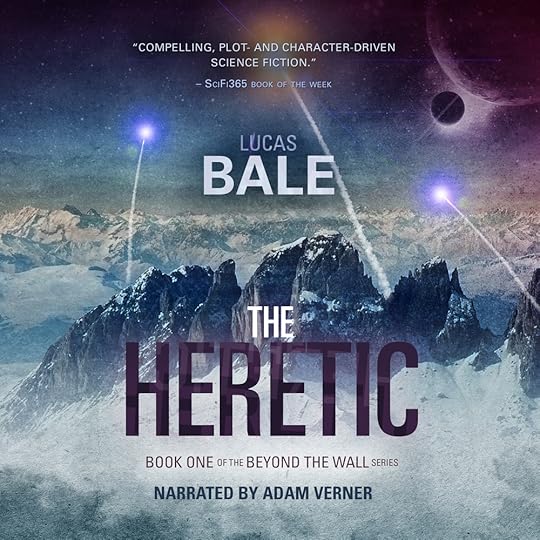
So that's it. This first stage of the process. I'll let you know how it goes. But before I do, here's the audiobook cover and check back next week when Deirdre Gould and Chris Fox will be giving you their perspective on Audiobooks:
June 9, 2015
Chukotka Solo Release and a New Cover for an Old Friend
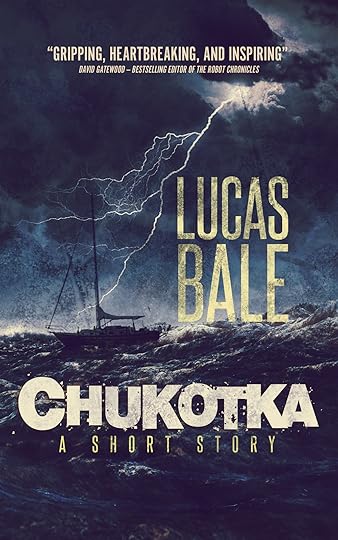
Short one today. Chukotka will be released as a standalone short story next week. Some of you may remember it first appeared in David Gatewood's Tales of Tinfoil anthology. However, with a revised Afterword and a brand-new cover designed by the fantastic Adam Hall, I am releasing it on its own.
By turns gripping, heartbreaking, and inspiring, Chukotka is a tale of survival against the elements—and of a fragile trust formed between two men from vastly different worlds. Bale’s characters come to life, and they will stay with you long after the final paragraph.
— David Gatewood, bestselling editor of The Robot Chronicles and Tales of Tinfoil
Chukotka could hardly be said to be science fiction. The conspiracy theory element within the story is supportive rather than central. Indeed, the story is less about whether the High Frequency Active Auroral Research Program (HAARP) was ever a facility that could control weather, and more about people affected by the blind, unfeeling reach of government, in all its guises. HAARP was a useful symbolic device to portray that reach. For me this story is an allegory for the themes that surround most, if not all, conspiracy theories. It is about fear of the unknown; mistrust and paranoia born from a lack of understanding. It is about prejudice and lack of communication. It is as much about tension between young and old, and between individuals from different cultures, as it is about tension between the United States and Russia.
Here's the blurb, in case you don't know anything about this story. It's a short story which could be read in an hour or so. It runs to around 50 ordinary paperback pages.
Two Alaskan cold-water surfers sail the Bering Strait in search of the gnarliest waves. A dying Chukchi hunter leaves his village for the desolate Siberian tundra, seeking to prove his usefulness to the wayward youth of his people. When the perfect man-made storm provokes the towering black waves of the Bering, and surges over the frozen Russian wilderness, it throws together old and young, East and West, forcing them to confront their prejudices in a desperate fight for survival.
Courage is thrust upon us by necessity. Gripping and realistic, Chukotka captures the bitter struggle and confusion that arises as the Bering Strait reels beneath an unnatural storm. It is both engrossing and compelling.
— Peter Cawdron, bestselling author of Anomaly and Xenophobia
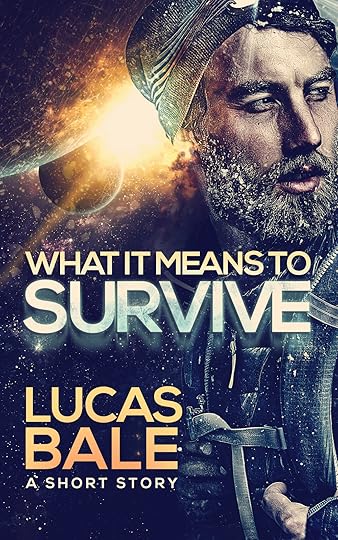
At the same time as releasing Chukotka, I'll be updating the cover for What It Means To Survive. Again, Adam Hall has done amazing work on this cover and I absolutely love it. Let me know what you think. (And click on it to be taken to the book's Amazon page.)
Here's the blurb for good measure.
McArthur's World is a frozen planet which has been bled dry by mineral mining corporations for three decades. When there is nothing left but ice and snow, the last freighter lifts off carrying away every remaining human being. When it crashes in a wilderness no one has ever returned from, there are only two survivors: a miner who wants to get back to the children he has not seen for two years, and the woman who forced him to come to McArthur's World in the first place.
They think they're alone, until the shrieks in the darkness come.
This story means a lot to me, and it's been well-received. I wrote it when my fiancée was diagnosed with cancer. So I thought it was high-time it deserved a decent cover.
May 27, 2015
It's Been A Year
I released my first book, The Heretic, on June 7th, 2014. A while ago, in a guest post for Michael Bunker, I wrote a little about how I got started in self-publishing and what I saw as my future in it. Looking back now, having recently re-read that post, I don’t actually disagree with any of it. Looking back at what I expected in June 2014, however, I am perhaps a little conflicted as to what success really meant to me then, and what it means to me now. What people have been saying about me, comparing me to Heinlein, Niven and Banks, matters. It matters a lot. Whether others will agree, I don't know, but I will get better with every book and repay the faith people have had in me.
I consider it a privilege to follow the development of a rare talent. Lucas Bale will become one the SF genre’s outstanding writers.
I wrote three novels this year – The Heretic, Defiance and A Shroud of Night and Tears. Three parts to my epic, hard science fiction space opera, Beyond the Wall. One of them won an award. I wrote a standalone short story when I found out my wife had cancer. It was the only way I could cope with the news. She beat the cancer and that was the best thing that ever happened to me. My boys still have a mother and I still have a partner. How quickly we realise, after events like that, what a fickle, precious thing life is.
Following that news, I wrote three more shorts, all of which have been included in anthologies (No Way Home, which I curated, and Tales of Tinfoil) or are about to be (The Time Travel Chronicles). I have been invited to contribute to two more anthologies and I am in the process of curating my second anthology, Crime and Punishment, with the same authors who contributed to No Way Home. I am researching and planning for a series I’ll be writing with Alex Roddie, writing as A.S. Sinclair, and I will be finishing up Beyond the Wall and starting a new series myself, nominally entitled A Maquisard's Song.
I had no idea I would be this busy.

Robert Heinlein and Philip K. Dick are in a dark, smoky bar having a drink. The door opens, the men turn to look, raise their glasses in a toast to the young gentleman entering the bar. Lucas Bale is that young gentleman. Bale’s writing is classic sci-fi.
Every author hopes their books will break out. Few imagine it will happen, fewer still expect it. Most are realists and many have been querying for years, perhaps longer, before they decide to self-publish. For some, it is a last resort; for an equal number, I would hazard a guess, it is the first choice. So it was with me. I didn't query at all before I published. I started out, following this post in Publishing Perspectives (something of a catalyst moment for me) by reading Hugh Howey’s blog. It still remains one of the seminal collections of posts on self-publishing. He has a list in a sidebar, that links to the posts I read – “Favourite Posts for Writers”. I must've read those posts half-a-dozen times. I may go back to them after I finish writing this. Nothing else captures what it means to self-publish better than they do.
The writers who take this seriously are the ones making money. ... They approach this like a little more than a hobby. It’s a second job, one that you can love and work hard at at the same time. Pros read up on grammar. They read books with an eye to what works and what doesn’t. They commune online at places like KindleBoard’s Writers’ Cafe. They set goals for how much they’ll publish in a year. Five years from now, these pros will have 10-20 works available. They only need to sell 250 – 500 books a month to earn a supplemental income. Ten books a day across twenty titles. That’s the longterm goal.
— Hugh Howey
What Hugh says there is precisely what my philosophy has been this last year. Every word of it. It's about providing an excellent experience for the people who give you not only their money, but something infinitely more important – their time. Next year, my aims are just the same. I will finish Beyond the Wall with Book Four in the series, Into A Silent Darkness. I will write more shorts for Samuel Peralta's Chronicles series, and release not only Crime and Punishment, but another anthology we have in mind too. I'll start work on A Maquisard's Song and release the first book at least. And there's that hard science fiction project with Alex Roddie too – think Andy Weir's The Martian crossed with Interstellar. Finally, I'll be doing something with dieselpunk and multiverses, set in the 1940s, with Mike Hicks, Elliot Brandis and a few others. Classic, sci-fi adventure.

There's been a lot of naysaying negativity in publishing in 2014/2015. Is the sky falling in on self-publishing? James Scott Bell, whose books taught me in part how to write fiction, thinks very little has changed about the way in which we walk, just the terrain we walk on. We must still write books, and that has always been hard no matter how they were published. Kameron Hurley recently wrote a blog post which was, inexplicably I might add, the subject of some vitriol that essentially said that she, Hurley, had achieved so highly because she had worked hard for it – she found time to write even on the busiest days. I've worked hard. Most days, I write 2,000-3,000 words or more. On many I reach 5,000+. I edit assiduously because I believe in my work and want others to enjoy it. I don't want to put slush out there. I am learning, improving and building. But it's hard work. Some are falling away from the game because of that – fair enough. It is hard and if you can't live with that fact, perhaps it's not for you.
It’s just a path. It’s a choice. It’s one I make every day – do I want to watch more Spartacus, or hit that deadline for Uncanny Magazine? Do I want to sleep in an hour or make my deadline for EMPIRE ASCENDANT? Do I want to go hiking on Saturday, or go hiking on Sunday instead and spend all day Saturday writing my 5,000 or 10,000 words?
— Kameron Hurley
When I first read about self-publishing, back in January 2014, the overwhelming advice from successful outliers (the authors who had made it to bestseller status) was to write good stories, have them properly edited and source great covers. Those three things are the key to success in the vast majority of cases. There are strategies that form the basis of a tactical approach to discoverability (and on this I disagree with Bell) that are essential to publishing in any market – platform, direct marketing and indirect marketing.
Platform is, to me, mailing list, blog, and author pages with distributors. It is also, to a limited extent, a social media presence. Platform is the place that readers come to engage with you, as well as just to find you. Nothing is more important when it comes to discoverability. Platform is a slow-build, as all foundations are. It takes effort and commitment. Nothing else gives you a better, firmer foundation. All authors need platform. And you need to be a human being about it too. Constant "Buy My Book" messages does not a platform make.
Direct marketing, again to me, is advertising and getting the word out directly. It’s almost impossible to market a book effectively without paid advertising. There will always be exceptions, of course, and I discovered one recently. A young author, debut science-fiction novel, very nice cover, well-written, properly edited, no marketing strategy. Yet it got picked up somehow and found itself at #600 in the Amazon US Kindle Store. Huge. Well done! Richly deserved, from what I could see of the book and the author is a lovely guy. He doesn’t know how he did it; he has no chance of replicating that and may well get frustrated if his next book does not do as well. He sure as hell won’t stay there with no strategy in place.
Indirect marketing is everything else – Facebook, twitter (and whatever else is the social media du jour) comments on posts of any kind, interviews and podcasts. It is the most difficult to define, and the most time-consuming. It is everything you do in order to be a human being on show, rather than a marketer. It is about making yourself visible whilst at the same time having fun and being yourself. Anything else is both unsustainable and as see-through as glass. It is how you present yourself to the world – as a professional author and a person. People buy books from authors they like. No matter how good they are, people rarely buy books from indie authors who are unpleasant. I comment where I am interested in the topic, I tweet to make people laugh or tell them something I have found interesting. I post to inform, share, support others and have fun. Community is critical. To that end, I'll be at my first convention this year, Fantasticon 2015 in Denmark, as a speaker, and as a panelist. That, I imagine, will be great fun! Hugo and Arthur C. Clarke award-winning Pat Cadigan will be there, as will a hero of mine since I was a boy, Ian Watson.
Community. We’re social animals, by and large. We like company. Authors are no different and I learned quickly that bouncing ideas off people is invaluable. Manuscripts need editors, but they also need alpha and beta readers – people who will give you honest opinions from their own, unique perspective. I use authors and readers alike. I have at least seven for each book I write. I have chosen them carefully over the course of this year because they are the most important part of my book’s building process. Editing is important, yes (so is actually writing the thing). But I don’t think anything is more important than alpha- and beta-readers. They catch the plot holes, the inconsistencies, the small things. They tell you if it is good. I set up a speculative fiction writers group last year. I didn’t know it at the time, but that’s what it was. It was a group intended to beta-read for each other, to share ARC reviewers and, eventually, I curated my first anthology with that group. It grew, took on more indie SFF authors, and the second anthology comes out later this year, following that successful first. I recently joined Facebook, and again, this is all about community for me. Engaging with other authors (my personal profile) and allowing readers to see me (my author page).
The last twelve months have had highs and lows. All authors have them. Trenches besieged with mud and disease that drag you down to the bottom of a whiskey bottle. Sun-kissed summits with crystal-clear blue sky. They all pass. The only constants are writing and marketing. The business. Reviews, at first, were the main protagonists in that game of peaks and troughs. Five stars were eye-widening joy; three stars (even two stars, shhh), were heart-rending despair and fury. And the one-star trolls? What can you say to those? The temptation to vent online was short-lived for me – people are entitled to their opinions, even where they have made factual errors. Free speech is a fundamental freedom. I corrected misleading statements on occasion, never commenting on the review itself, and have been applauded for my courtesy. That's an accolade I enjoy. Reviews now matter less to me – they are crucial social proof, but I am less saddened by those who do not like my books. Not everyone will. I’m a professional producing something of value to those who want it.
I prefer now, to read the emails of fans who want to engage with me. I love that. Never stop. I’ll always answer. Leave reviews, please, we need them, but I won’t be upset if you didn’t like something I wrote. You are entitled to your opinion. But please don’t pick up on a single typo and tell me my book is poorly edited. I pay four-figure sums to ensure they are, in fact, very well edited. Even Scalzi’s books have typos.
If you don’t fully appreciate having 8 strangers in your life who read your shit, you aren’t a desperate enough writer. Be more desperate. Not to sell your work, but to have it read and enjoyed. This is the goal, and keep it in mind: Write something enjoyable and see that it gets read. One line at a time. One chapter at a time. One short story at a time.
— Hugh Howey
I queried some agents too, five if I recall, to test the waters. It was around the time I realised some of the outliers had done the same. None replied. I've always found that rude, actually. I am an adventure travel magazine editor in my other life – I get queried all the time. I reply to all of them. In these days of email, there’s no excuse. Even a standard reply to say, ‘thanks, but no thanks’. But hey, we’re not all the same. Will I do it again? Who knows. What can traditional publishing offer me except a lower cut of my royalties?
What did this year teach me? That you need a thick skin in this business. That you need to produce quality work. You need to get that work out there and do everything you can to make it visible. When luck comes, and you make a lot of it yourself I assure you, you need to see it and juice it. Above all, you need to remember that success is fleeting. There’s always someone else writing behind you and your readers want more from you.
May 4, 2015
A Shroud of Night and Tears – May 27th, 2015
It's been a while coming, I know. I released Defiance in November 2014, and I had intended A Shroud of Night and Tears for early May 2015. However, as books unfold, particularly those longer works, storylines crystallise and characters take courses that sometimes surprise you. Writing a book is an organic process and ideas emerge as you write that were never going to present themselves until you were knee-deep in the prose. It's magical, really.
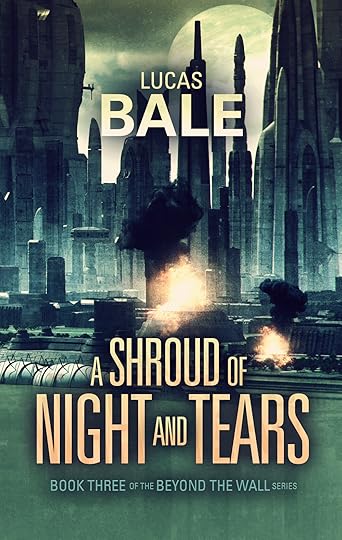
So, as I wrote Shroud, I found myself beginning to explore places that I hadn't realised existed – dark corners of the Beyond the Wall universe that had hidden themselves even from me. When I began planning (or should I say, plotting) Shroud, I extended that process to include the fourth, and final, book in the series, Into A Silent Darkness. In essence, whilst planning and structuring, I was effectively plotting both. In fact, by the time Shroud is released in three weeks' time, Into A Silent Darkness will already be 20,000 words to the good, including its shocking, and harrowing, opening sequence. Yet that planning couldn't predict some of the turns the prose took (for both books) and there were times where I just had to go with it.
I've been thrilled at the growth in interest in Beyond the Wall in the last few months. I'm excited to see how readers react to the way in which I draw all the threads together – I know many of you have been hugely eager to read the next instalment for that reason alone. I wrote a post, not long ago, on why I chose to tell the story the way I did. I want every reader to think that the choices I made were the right ones for them, and their experience of the unfolding story.
So, the most important date is the release date, which will be Wednesday, May 27th, 2015. Mark your diaries!
Shroud already has its own Goodreads page, and there will be a Facebook launch party on the day of the release. I can't say who'll be there, but there will be some great indie speculative fiction authors in attendance and I have no doubt they will be giving stuff away. I will too. I'll update you in due course, but stay tuned to my Facebook page for details.
There's some more news too, but I'm not allowed to say anything until Wednesday – pretty big news, I'd say, and an email I couldn't quite believe when I saw it. I've even taken a screenshot of it for you. Again, I'll put that on Facebook too, so check back there when you get a moment on Wednesday.
Here's the blurb for Shroud:
If war shapes the universe, truth destroys it.
A criminal becomes a leader, hiding a tiny colony of survivors from the savagery of men driven wild by a ruthless regime.
A smuggler harbours refugees from a brutal attack on their defenceless village, including a young boy who, wracked by loss, now seeks revenge. A preacher with a hidden agenda controls their destiny.
A servant of the Magistratus, a lawman who once believed in justice, now seeks the truth of the planet his masters will kill to hide. A stim-addicted navigator, haunted by her past, also wants answers. Why she was chosen to work with a salvage crew destined to die in that same wild, remote part of space.
And a spy is blackmailed into informing against those he serves as he realises their involvement in a conspiracy that could bring about the end of the Magistratus.
All of them will be drawn together by hidden forces, their lives soon to be shattered by cataclysmic events they can neither predict nor escape.
The truth waits in the shadows.
April 24, 2015
Apocalypse Weird's New Tier One Authors, including Me

It came upon me suddenly, my involvement in all this Apocalypse Weird universe. I saw The Red King, read it and loved it as much as I love anything Nick Cole writes. I followed what some of the other authors were doing, especially in the lead-up to that mammoth February release that even The Guardian wanted a piece of. I managed to keep in touch with what Michael Bunker, E. E. Giorgi, Kim Wells and Stefan Bolz were doing because I've been in touch with them for a little while. But I didn't have time to devote to the auditioning process – I had Shroud to write, No Way Home to curate, Chukotka to write for David Gatewood's Tales of Tinfoil anthology – there was no way I could get involved and the places would be filled before I did. Or so I thought.

It was Chris Pourteau who suggested I pitch to Nick Cole directly and this I did. I had an idea the moment I read The Red King – a shadowy, hellish figure that would be perfect. A backdrop of desolate, glaciated mountains and wind-swept buddhist stupas. A remote, nightmarish prison high in the Chinese Himalaya, near the border with Nepal. I saw the Tong, the Triad and the skeletal face of an ancient evil wrapped up in the most mystical place left on Earth. A gateway to another place, where an antediluvian force lay waiting – as though time meant nothing to it. I wanted to send the apocalypse to Nepal. Nick liked my pitch.
Today, on Facebook, the new Tier One authors were unveiled – Michael Patrick Hicks, a personal friend of mine, Alex Myers, Blue Cole, Angela Cavanaugh, Eamon Ambrose and Bob Williams. And, of course, me. It was a huge announcement for me – a project that excites and enthrals me with some of the most talented indie speculative fictions voices around. A shared world with a vision of the future that has only been revealed thus far through a chink in the curtain. I was bubbling with ideas and desperate to get planning. I sent A Shroud of Night and Tears to David Gatewood today, so I don't mind taking a little time to seize that enthusiasm and let the muse sing its song.
I have the characters in mind – a man flying half-way across the world to collect the dead body of his brother. A reluctant member of a tong, a secret criminal society, desperate to escape. Flawed, human, compelling.
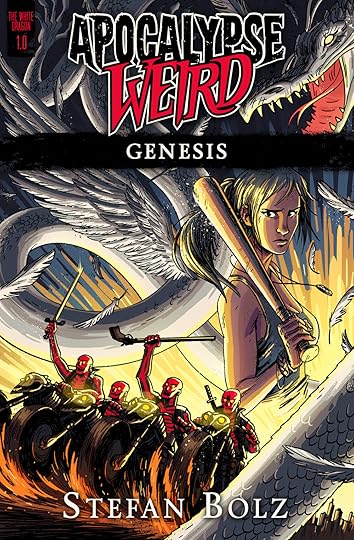
Mike Corley's covers are amazing. One of my favourites is Genesis, for The White Dragon series – Stefan Bolz's AW debut. I can't wait to see what he'll come up with for Nepal. I have a tentative name for my series, and even a tentative title for the book, but it's way too early – I've got so much more to do before I get to that stage.
This is true adventure, a unique blend of the paranormal, the apocalyptic and what it means to be human. It is Stephen King meets Neil Gaiman. It is exciting, fresh and innovative. It is exactly what I've been looking for since I was eleven years old and I read Talisman. I can't wait.
April 18, 2015
Tales of Tinfoil – Background to an Anthology
What is Tales of Tinfoil?
It is a dark and fictional reimagining of every conspiracy theory that ever lived. It is the JFK assassination, Area 51, the moon landing, the surveillance state. It is a French spy posing as Abraham Lincoln, it is a video game designed by the CIA, it is “Suicide Mickey.” It is Adolf Hitler and it is Elvis Presley.
In this bizarre and wonderful short story collection, today’s top fiction authors pull back the curtain on the biggest conspiracies of all time. Who really killed JFK? What happened in Roswell, New Mexico? Is Elvis still alive? With stories that run the gamut from touching to thrilling to utterly deranged, Tinfoil will take you on a tour of paranoia you won’t soon forget.
Twelve short stories, twelve conspiracy theories, twelve twisted rabbit holes.
Hold on to your hats.
It was around February 2015 when my editor, David Gatewood, asked me to contribute a story to his upcoming anthology, Tales of Tinfoil, which was released yesterday, April 17th, 2015. I was knee-deep in writing the first draft of Book III of the Beyond the Wall series and I wasn't sure I had the time. But David has curated and edited some amazing anthologies, including Synchronic and several of the Future Chronicles series, so I was never going to say no. I was always going to find time. When I saw the stellar line-up of authors, and a cover design from Jason Gurley, I was even more excited. Of course now I had to come up with a story.
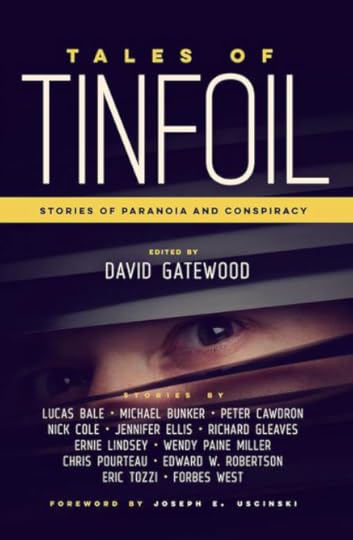
Tales of Tinfoil is an anthology based around conspiracy theories. Its full title, Tales of Tinfoil, Stories of Conspiracy and Paranoia, gives a flavour of the stories inside. In fact, the hugely irreverent and enjoyable Facebook Group that accompanies the series tells you even more. David intends a series of Tinfoil books, the second and third being Hoaxes and Mysteries. I'm signed up for both.
For this one, all I needed to do was find myself a conspiracy theory and write a story around it. As I alluded to in my afterword, I knew other authors would take a traditional route to a story about conspiracies, one focusing on the conspiracy itself, but I wanted to approach it from a different direction. I kept the conspiracy theory itself in the background, but made sure it was an ever-present, dark storm cloud above throughout. I also made sure there was an actual conspiracy underpinning the inciting incident that led to the events of the story.
However, for me, Chukotka is an allegory for the themes that surround most, if not all, conspiracy theories. It is about fear of the unknown; mistrust and paranoia born out of a lack of understanding. It is about prejudice and lack of communication. It is as much about tension between young and old, and between individuals from different cultures, as it is about tension between the United States and Russia. To Umqy, the hedonistic Americans brought this on themselves, taking to the Bering Sea in a storm like this one. Yet if he knew the truth about their situation, as the reader does, he would not judge them so harshly. To Scott, Umqy is an Eskimo (which would in fact probably be an insulting moniker to bestow on a Chukchi) and just as likely to murder him for his boots, so to speak, as to hand him over to the Russian authorities who would parade him on Russian TV. Yet to the Chukchi, hospitality to strangers is how they have survived the harsh landscape of Siberia. These conflicts are the soul of the story.

It was the harsh landscape of Siberia that kindled the inspiration for the story. It's a place that has held an amazing fascination for me since I read about the gulags there, and read two amazing books (whether they be true or not) about surviving in that harsh wilderness – As Far As My Feet Will Carry Me, By Josef Bauer, and The Long Walk, by Slavomir Rawicz. I love stories of survival, so Alaska (one of my favourite settings and the location of the former HAARP installation – see below) led me to the Bering Sea and then to Siberia. I loosely read both these books again and then the story began to form in my head. I saw an old hunter, lost in the past and desperate to recover his dignity after the loss of his wife to illness (tuberculosis, which was prevalent in the Chukotka peninsular for some decades) and he becomes ill (and old) himself. And I saw a direct opposite in an American adrenaline junkie out for some gnarly waves. The contrasts between them almost write the story itself.
But what about the conspiracy theory itself? What about HAARP? The High Frequency Active Auroral Research Program was intended to research radio transmissions in the ionosphere with a view to various applications, some military. The ionosphere can distort, reflect and absorb radio signals, and thus can affect numerous civilian and military communications, navigation, surveillance, and remote sensing systems in many ways. For example, the performance of a satellite-to-ground communication link is affected by the ionosphere through which the signals pass. And, as even HAARP officials themselves acknowledged, while the signals along the ground are well below adopted safety levels, the signals transmitted above the antenna array may have sufficient strength to interfere with electronic equipment in aircraft flying nearby. These facts, coupled with the involvement of the Department of Defense, have led to wild speculation about both the objectives and results of HAARP, even extending to theories about the missing Malaysian Airlines flight MH-370.
HAARP has also been the subject of speculation about its effect on the weather—and whether it might actually be able to control weather. In this story I enjoyed using that speculation, but science has almost certainly debunked it. Of course, whether you believe the explanations offered by experts in their field is a matter for you.
So the book is out and doing really well. Readers love it. It's surging up the charts. In preparation for the launch of Tinfoil, Hank Garner interviewed myself, Chris Pourteau, Michael Bunker, Wendy Paine Miller and, of course, David Gatewood in a round-table discussion. It was the most fun I've had online for a long time and these are great people. It's a brilliant discussion and well-worth listening to. Talking to these people, authors I've admired from afar for some time, was surreal and bewitching.
Additionally, there is a launch party on Facebook. The first one I ever did of these, for No Way Home, was a roaring success and Tinfoil is likely to be even bigger such are the followings of Messrs. Bunker, Cole, Lindsay et al. I'll be hosting from 5pm Eastern Time. Come and join us – I may even give away a book or two.
I couldn’t put this story down. It was fascinating, and not only because of the somewhat hidden conspiracy theory, but because of the exceptional characters. Umqy and his final fight for recognition is a fantastic story on its own, let alone Scott’s remarkable story of survival. Added to that the mystery of the storm that brings the two of them together and this is an extraordinary tale that just has to be read. This is one of the stand outs for me.
— Goodreads Review of Chukotka
All in all, I loved being a part of this. Working alongside authors I've admired since I began self-publishing – Michael Bunker, Nick Cole, Ernie Lindsey and Edward W. Robertson – is a real privilege. Working with David is always a joy. My story has been well received and inspired the emotions I was looking for in readers. One was moved to tears, another described it as "gorgeous and terrifying". My readership is growing and my involvement in these sorts of projects is not only immensely rewarding, but it increases the readers who see my work. That can only be a good thing. As myself and Chris Pourteau chatted about in the round-table with Hank and the others, the short story form is experiencing a resurgence and long may it continue.


