J.B. Markes's Blog
January 2, 2016
#19. Shootout at Roulement Ridge by Einar Mercier
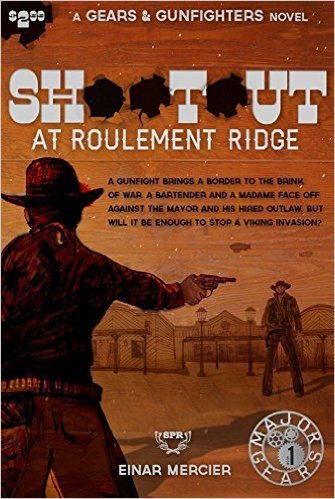
Taking place in an alternative timeline/universe where bloodthirsty Vikings control all territory north of the Mason-Dixon—er, Mason-Pierre line, where the old west runs on steam, and where you can shoot a man dead just for looking at you the wrong way, it’s everything you wish your real life could be.
Vikings, cowboys, and steampunk. What could go wrong? Get Shootout at Roulement Ridge on Amazon Here! Being the first book in a series of Gears and Gunfighters novels, this work shows a lot of promise for those who are looking for something a little bit different. It has the grittiness and over-the-top “high noon” drama that you’ve come to expect from any western that’s worth the page or film it’s printed on, coupled with fantasy/sci-fi elements of advanced (or unconventional) technology.
Everything moves on gears, from the metallic warhorses used by the cavalrymen, to many of the guns and rifles, to artificial implants used in medicine. Yet through it all, the story clings to its western roots. This is not a hi-tech world, despite the many miracles of metal and steam that bring the reader so much wonder. The world still feels very much disconnected, making the themes of outlaw justice much more believable, despite the convolutions of the plot in the latter pages of the novel.
 The only real irk I have is the convenience of the converging events, which make sense as you are reading them, but break your immersion somewhat as you see all of the action being funneled into the climax. Moreover, there are many unanswered questions by the end of the novel which will undoubtedly carry over into book two in the series. I would have liked a little more closure in the first novel.
The characters are archetypal: the outlaw turned (sorta) lawman, the kid gunslinger, the retired gunslinger who thought he left that life behind, the working girl with a heart of gold and a few surprises up her sleeve. They are mostly well-received and show sufficient development throughout the story.
If you are looking for an imaginative world where anything is possible, look no further. My enjoyment of this story really stems from its possibilities. I’ve never considered myself a fan of this genre, but I gave it a chance and I’m glad I did. And you should, too.


December 5, 2015
#18. Heart of Mystery by Mark Laporta
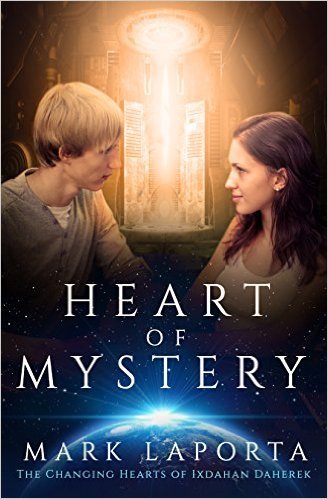
Follow Ixdahan Daherek, a species-confused galactic secret agent with an apparent knack for saving the universe, in the second book of the Changing Hearts of Ixdahan Daherek series.
If you have ever wanted to learn more about Snaldrialoorans, Hegraahlensiens, Ybitrians, or Vrukaari, now is your chance! Get Heart of Mystery on Amazon Here! Ok, first off, this is a solid read. It is clean both in copyedit and content (it is targeted toward a younger audience) and has everything you would expect from a middle-grade story. The writing style is clear and the author’s voice is authoritative and rather likeable. That being said, it’s not my cup of tea, but probably not for reasons you’d expect.
Perhaps one of the selling points of the work is the often humorous alien idiomatic phrases and metaphors that are peppered throughout the text. You don’t have to look far to find some gharnixwahn who doesn’t know a Klegherian rock sloth from a carton of quinzhaaliahr juice. And I get it…that’s the genre and people enjoy it, but it puts me off. Aliens with names twelve letters long, with languages that revolve around the letters Q and X, really slow down my already comfortable reading pace. But then again, most of the aliens have evolved to use telepathic communication, which I suppose eliminates the need for efficiency we take for granted in our own daily interactions.
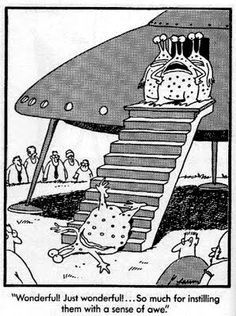 The characters, while generally likeable and having very clear cut personalities, are slightly too old for their behaviors. They speak and act like people half their age, and I believe they would have been more believable if they had just been written as younger. For instance, I’ve never heard a college student refer to herself as a “kid”—or even a teenager, for that matter, though I suppose a 19-year-old would technically be one. Also, the opposite sex isn’t usually “gross” when you’re 19. Just saying.
Quibbles aside, the book is fast-paced with an imaginative, if a bit over-the-top, plot. Some of the technology that comes with advanced sentience is quite interesting. I particularly like the evolution of mentallic communication capable of crossing light-years of space, and the tech barriers that have been put into place to regulate its use and abuse.
Also, the author took special care in creating the different alien biologies, with each species having its own variations of spacesuit to allow it to survive outside of the atmosphere of its homeworld. Some of them breathe ammonia or methane and it’s nice to see the change from everyone speaking English and breathing the same oxygen. These little details go a long way toward world-building and giving the feeling of “real” to your work.
If you’re looking for a light-hearted space opera for younger readers, this series fits that niche perfectly.
October 25, 2015
#17. Io Deceneus - Journal of a Time Traveler by Florian Armas
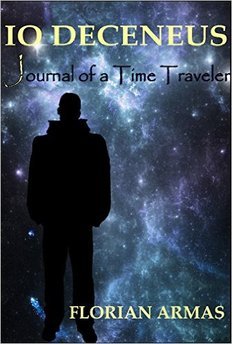
A human from Earth gallivants to and fro on a distant planet, manipulating their history and society in order to fulfil his side of a contract he probably shouldn’t have signed.
Political intrigue abounds. Get Io Deceneus on Amazon Here! This is a very difficult book to review, and I feel more like I am working through my own thoughts than giving any real critique of the work. Moreover, there are a few scenes that break down to the author soap-boxing about our current Earth society/economy/political system, which I will leave unaddressed. (I’m onto you, Mr. Author!) But here we go!
I liked this book, or perhaps more accurately, I enjoyed the author’s writing style once I got to the point I could understand what the hell was going on. The first quarter of the book I felt as if I was lost at sea without a life raft. The author certainly doesn’t pamper his potential readers, and it’s a race to catch up from the very first page. I feel this was intentional, to put the reader into the same scattered, disoriented mindset as the protagonist. Unfortunately, by the end of the book, our hero Deceneus ends up with much more information than we do, despite us living within his head the entire story. The tale is told in first-person, which is often a turnoff, but in this case it flowed nicely, as if someone was merely sharing a story from memory.
This is a time travel story, but unlike most time travel stories, the protagonist is in absolutely no control of his travels. There are some real god-from-the-machine situations where the hero is backed into a corner and the timeline gets completely replaced by powers unknown rather than have him get destroyed, which becomes quite anti-climactic when overused. We get told the timeline has been replaced with little or no explanation, which I believe is supposed to add to the mystery of it all, but when the mystery never becomes clear it leaves the reader feeling a bit unsatisfied. Or perhaps I missed something through all the Faction 1, Faction 2, Faction 3, Saurians, Munti, Erins, Baramuntis, Baragans, Nogi, Anogi…who am I leaving out? Oh ya, the Gates, the Black Eye, the Black Hats, the shadow-whatsits… must be a few more I’m missing, right? I’m just happy I remembered the names of the ones I did.
 There are a seemingly unlimited number of interested parties working behind the scenes on this tiny little planet—the reason for which becomes clear eventually—so there is a lot of intrigue. First and foremost, this is a story centered around politics. Everyone has an agenda and a back-up plan. To this end, the story really serves its purpose, as you never know where anyone stands until it is all said and done.
 This works well on an individual basis--not so well with the larger organizations. As mentioned, there are mysterious factions referred to by number: Faction 1, Faction 2, etc. A few times there is much discussion about this faction or that faction, but I couldn’t bring myself to care about faceless organizations. What does it matter which faction is doing which thing, when all of them want you dead? Is so-and-so with Faction One? Is he with Faction Two? Oh, right, he wants to kill me, I guess I should focus more on that.
So let’s focus on the superbly written characters and the page-to-page narrative. The main character develops quite clearly from an insecure know-nothing to a boastful, but insecure know-nothing with good sword skills. It’s a harsh description, perhaps, but we can’t blame him for knowing nothing when he always seems to know more than we do. He is likeable in all the ways he should be, and at no point does his character become inconsistent or otherwise unbelievable. There are quite a few other characters, making it a bit difficult to keep everyone straight, but it adds much depth to the world the author has created.
The writing itself is skillful. It flows one great description to the next, making it a breeze to just pick up and enjoy, without worrying too much about where the story is heading. I have leveled so much negative criticism, it might seem as if I hated this story, but it’s quite the opposite. Each mini-adventure is worth reading just for the artful prose and the overall life-or-death tension it provokes. It’s staggering just how much world(and universe)-building has been stuffed into one novel. This story is unique enough that it shouldn’t be overlooked by any fan of sci-fi, or fantasy for that matter.
August 26, 2015
#16. Hawkwind’s Tale (The Northnest Saga, Book 1) by Katherine A Smith
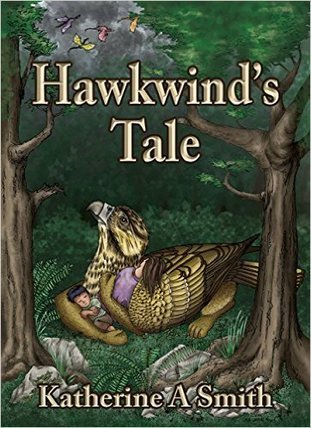 Born and raised as a defender of the human settlement of Northnest, the young griffin Hawkwind is forced into the wilderness after seeing her home fall into the hands of hostile wizards.
Tasked with protecting the last remaining members of the royal line—four small children—Hawkwind must find a new place for all of them in a hostile world. Get Hawkwind's Tale on Amazon Here! This is a great tale of loss and redemption, featuring a non-human main character carrying the responsibility (and guilt) of losing the home she was charged with defending against all enemies. The invading wizards and drakes serve a pivotal part of the story, but the main adventure follows Hawkwind as she tries to reintegrate into griffin society. She undergoes a series of trials to prove her worthiness of joining a griffin aerie, and there is plenty of monster, magic, and mishap along the way.
The greatest strength of this story is the departure from the human hero. There are only four humans in the story—all of them children—and they are interesting as supporting characters, but the real action centers around the griffins, and we gain much insight (perhaps a little too much) into griffin society through the eyes of Hawkwind, who is herself a stranger to many of their customs. The griffins truly identify as birds, and they have all the mannerisms that come along with it, frequently preening themselves and each other, and covering each other with their wings in order to comfort one another. All in all, the author’s attempt at capturing the feel of being a griffin is a complete success.
While somewhat essential to the storyline, there is much dialogue and description surrounding the mating habits of the griffins. There is much admonition of pair-bonding in favor of spreading it around, to the point that those wishing to pair for life are generally ostracized from griffin society. On a related note, I personally learned more about griffin sex than I ever cared to know. There is nothing vulgar or explicit about the interactions within the story, but they are revisited frequently enough that I had to brace myself for more talk of “chick-pains”, the griffin word for an orgasm that has a high chance of conceiving a chick.
(Oh, why did I write this paragraph?)
 Allow me to switch gears a bit and say how much I really did enjoy this story. It has its flaws. It could use a good copy edit to catch the occasional misused word and the few pages where the character named Karo is called Taro with no explanation. The conclusion drags on a bit as the reader is forced to sit through chapters of griffin congress (I can barely tolerate the human version). Nevertheless, I was always excited to pick up where I left off and see what happened next.
 It’s an exciting tale with a unique perspective, but perhaps what I love most is that the story builds anticipation for the future of the human children. Will the princess regain her kingdom? Will her brothers become great warriors or wizards? Will humans and griffins ever live side-by-side again, as they did in Northnest before the attack? I’m eagerly awaiting the next installment. Pick this up if you are looking for a fantasy tale a little different from the norm--or if you ever wondered about griffin chick-pains.
July 16, 2015
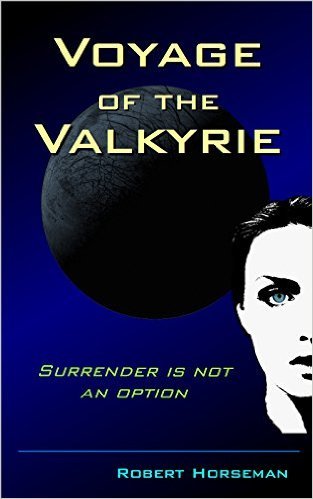
#15. Voyage of the Valkyrie by Robert Horseman
 Note: This is one of my top picks. I highly recommend this book to any lover of science fiction.
Ensign Mackenzie Pickett is fresh out of space academy and ready for duty. She soon learns her new duty station will be anything but ordinary—from top secret experimental technology to space pirate human traffickers bent on capturing and selling her entire crew to the highest bidder.
Undermanned and outgunned, Mac and company must find a way to rescue their stolen shipmates before it is too late.
Get Voyage of the Valkyrie on Amazon Here! What a great bit of traditional science-fiction! This author excels at rendering unlikely situations in believable detail. The terminology used, as well as the descriptions of the different decks and facilities of the ship, really make you feel like you are on board a military vessel. There is sufficient futuristic technology and theorycraft to keep any sci-fi reader interested, but I was a bit relieved to discover I wouldn’t be continually bogged down with the constant gratuitous jargon that has become the norm these days. The careful use of language maintains the reader’s immersion and instills greater appreciation for the story’s plot and characters.
Mac has the perfect personality for a recent academy graduate—confident in her education, yet uneasy when it comes to real service. She is resourceful and determined to make her mark, yet knowingly unprepared for the responsibility of command, and this mix of competence and modesty is what makes for a likeable heroine. Her love interest Cale, a fellow ensign in the United Defense Alliance, provides both the comic relief and serves to bring out Mac’s personality. The last major character Rae (an artificial intelligence) makes things more interesting. I found myself looking for a little more character development for her, but the story doesn’t suffer from its relative absence.
 The plot cycles between suspense and action, involving both ship-to-ship battles and hand-to-hand conflicts, all of which are inventive to say the least. While the scenarios are interesting, the main focus seems to be on the morality of Mac’s decisions. Unfortunately for Mac, morality is a mere afterthought, as she is so focused on victory and what must be done that she has little to no time to reflect on future consequences of her actions. At times her quick decisions make her seem a bit uncaring or unrepentant, but the story resolves quite appropriately to this end.
All in all, this is a great work of sci-fi that shouldn’t be missed by any fan of the genre.
July 12, 2015
#14. Bound By Water by Jonathan D. Yelland
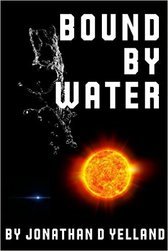
The humans have finally got what’s coming to them, having been completely conquered by a malevolent alien civilization.
Follow Captain Alice Lee and her crew of the ESS Shadowrunner as they survive on the run, hoping and searching for a way to turn the tide of galactic war. Get Bound By Water on Amazon Here! Another great sci-fi series debut, Bound By Water catches the reader’s interest in a big way, focusing on the events following the end of the world as we humans know it. Despite their superior technology and military tactics, the entire human civilization is quickly made into a slave race by the alien empire known as the Glomens, whose victory was achieved by superior numbers and overwhelming force of arms. It was interesting to see the humans with the technological advantage for a change, for all the good it did them. This is another suspenseful lost-in-space tale that never loses its sense of urgency.
Those looking for a deeper message beneath the space opera surface may be a bit disappointed. The tired theme of human persistence despite all odds is a bit heavy-handed, but the pages turn quickly as the characters are thrown from one imaginative scenario into the next. There are ship-to-ship conflicts as well as man-to-man. There are even a few interesting encounters that seem to occur primarily within the minds of the combatants, which is difficult to explain except to say that these beings exist as microorganisms and interact by thought alone. Their symbiosis with their host organisms reminded me a little of how the Jedi Knights of Star Wars do business, except with more direct communication between the two.
 I have only two real criticisms of an otherwise stellar work. The love story plot lines could have been completely removed, in my opinion. I understand that one of the author’s selling points is a lack of sex, profanity, and violence in his work, but the dialogue between the two lovers was so cheesy it sounded as if it were a couple of elementary school students talking. (I want to be your boyfriend. Do you want to be my girlfriend? Okay, let’s be boyfriend/girlfriend.) Rather cutesy talk coming from a space marine--and the characters' internal dialogue didn’t fare much better. I hate to sound so harsh, but I do believe the story was actually made weaker (characters less believable) by this clunky subplot. Thankfully, this part of the story is rather short and can be forgotten just as quickly.
The author’s voice was clear and easy to understand, but more than once my immersion was ruined by strange punctuation choices. I seem to recall a few paragraphs where every single sentence ended in an exclamation point. It’s difficult to keep up that level of energy in a serious reading voice. This book is in dire need of a good copy edit. It’s a shame because I truly enjoyed everything else.
I found the story extremely engaging. By far its strengths are the fast pace of the plot, the ambiguity of the friend/enemy dynamic, and the interesting situations that really make you wonder how the characters will solve the problems they encounter. I expect great things from this author as his series progresses and the characters get a little more depth. It’s a fast and easy read to be enjoyed by any fan of science fiction. Pick up a copy today.
May 15, 2015
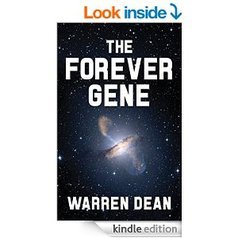
#13. The Forever Gene (The Scions of Earth Book 1) by Warren Dean
 Note: This is one of my top picks. I highly recommend this book to any lover of science fiction.
Attracted by human ingenuity, a race of benevolent aliens pays a visit to Earth in order to barter technologies that humanity may not be ready to receive. Get The Forever Gene on Amazon Here! The Forever Gene is a slow-burning but compelling first contact story that examines the upper and lower reaches of human ambition and keeps you nodding along with the narrative. So many works in this genre lose their appeal once the aliens start blasting everything, and I was grateful that the author took things in a different direction. In fact, time and again the story takes unexpected turns, leaving the reader guessing about the true motives of the “Faerie Folk”, the cutesy and slightly annoying term concocted by the humans to refer to the alien ambassadors.
For all purposes, the Faerie Folk seem well-intentioned, despite the distrustful humans and aggressive militaries that welcome them. The alien race has an offer to exchange technology that will save humanity from inevitable extinction in return for humans sharing their advances in genetics. The exchange would be mutually beneficial, as both cultures depend on these advances in order to ensure the continued survival of their species.
The reactions of the humans and global society as a whole are quite believable in the context of the story. Governments scramble to maintain control of the populace and make desperate attempts to keep one step ahead of rival superpowers. And with the genetic advances allowing humans to live forever, there is no longer a need for an afterlife or religion in general, a concept that has dangerous societal repercussions. It quickly becomes apparent that the humans are their own worst enemies.
 The story is told through multiple points of view, including a geneticist, a reporter, a prime minister, a prison inmate, a Faerie Folk translator, and (my favorite) a Russian colonel working on the moonbase. Readers may be put off by the frequent shifts in point of view, but I found myself loving each and every character introduced. All characters, whether human or alien, have distinct personalities and I often wondered about what they were up to offstage (and where they will be in the sequel).
The technology of future Earth is relatively mild as far as sci-fi goes, instead opting for a more realistic progression of current technology, giving further credibility to the whole story. The alien technology, though far superior to our own, is well described and I particularly liked the segment of the book detailing the maiden voyage of Earth’s first starship.
It is work like this that gives me great hope for the future of self-publishing. I’ve said it before: At the base of all great sci-fi and fantasy is the human element. If you are a fan of science fiction, this is a must-read, but readers who don’t particularly care for sci-fi will find it enjoyable as well. Check it out.
April 4, 2015
#12. Fortune (Wilton’s Gold #1) by Craig W. Turner
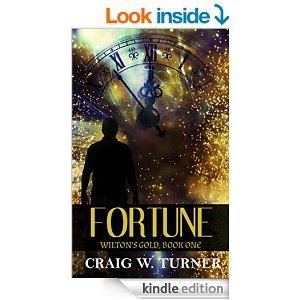 While researching the possibilities of food replication (yes, like on Star Trek), Dr. Jeff Jacobs stumbles across the secret to time travel. Using a time device of his own creation, he conducts various reckless and unethical “experiments” before learning what all of us non-physicists already know—time travel is dangerous.
Will the world survive Jacobs’s meddling? Or will he do us all a favor and accidentally erase himself from the timeline altogether?
Get Fortune on Amazon here! Despite my somewhat scathing intro, I thoroughly enjoyed this book. It is well-written with a relatively clean copy-edit as far as indie authors go. I was interested in the characters, even if several of the heroes were almost assuredly universally unlikable (more on that in a sec). It’s obvious the author gave a lot of thought to the scenarios. I particularly liked the idea of having an email conversation with your future self, or having a somewhat strange infatuation with a person you yourself are responsible for creating, just as a god or goddess expects love and devotion from beings of his or her own creation.
The author admits being heavily influenced by the Back to the Future series, of which I am also a big fan. That movie defined my youth and I wore those VCR tapes out watching them back-to-back over and over again. Though not quite as whimsical as the Doc/Marty duo, the banter between the main characters does tend to keep the mood light. But the pages turned, and although I didn’t care if Jeff, Erica, or pretty much anyone else lived or died, I certainly wanted to know what happened next. I picked up this book expecting a fun read, and it’s exactly what I got.
 "Great Scott! We could use this to rob... everyone!" So let’s talk about these characters. Setting aside the fact that the first thought in our protagonist's head is to go rip off people in the past, Jeff is either a monumentally stupid physicist or a relatively bright criminal. (No offence, criminals!) He is careless, lazy, selfish, and a bad kisser. On the other hand, Erica is whiny, sanctimonious, and inexplicably suicidal. The characters make bizarre choices, opting to take the hard way over the easy way every time. (Hint, Hint: you have a time machine… you can travel to ANY time to fix the problems. You don’t have to choose the most dangerous time to do everything.)
 The story is given a violent shove to get the characters in place. Erica is a little quick to uncover Jeff’s scheme, stressing suspension of disbelief to its breaking point. When something (slightly) unusual comes up in your everyday life, you don’t usually skip to time travel as an explanation; neither do you confront people and accuse them of doing so.
But the occasional awkward character interaction aside, I couldn’t put this book down. If you are a fan of time travel, you will find this story enjoyable. Even better, the first story wraps up nicely and creates a lead-in to what is sure to be an interesting series. If you have time, check it out. If you don’t have time, make time. And if you have a time machine… Quick! Go back in time and write this book before the author does! Rob him blind!
March 13, 2015
#11. Trees for the Forest by Denise Siegel
 A post-apocalyptic tale of the virtues and vices of human ambition, Trees for the Forest pits a band of scientists against the religious zealots responsible for the catastrophic climate change that wiped out the Earth population.
Will the Earth be forever desolate? Can the scientists somehow reverse global warming? Are we all going to Hell in a handbasket? Read the book. Get Trees for the Forest on Amazon Here! It was refreshing (if a bit unsettling) to see the end of the world come at the hands of good old-fashioned global warming for a change, as opposed to the usual nuclear war or zombie virus that has been so overused over the past few decades. Add to this a strong female cast, a bit of Native American spiritualism, and the bio-engineering of organisms capable of surviving the harsh new environment (one of which is large enough to shelter an entire population of humans within its body), and you’ve got one of the most original sci-fi novels you’ll ever pick up.
The familiar theme of science vs religion is prevalent throughout the book, at times a bit much. Most of the Christians in the story are the worst type of people imaginable. I can imagine losing quite a few Christian readers halfway through the book because of this, and pissing off the rest by the very end, but overall the story holds together. This is more of a disclaimer than a rebuke, as if you aren’t being challenged in one way or another, then you just aren’t reading the right stuff.
Indeed, it is impossible to talk about Trees for the Forest without addressing spirituality in some form. The scientists tasked with healing the planet have their own shaman to guide them, and at times the two “warring” ideologies coalesce into a narrative much broader, truer and more universal than any one religion. This is further compounded by the humanoid lizard creatures referred to as the Geney, a genetically-engineered slave race who developed their own myths and legends in order to describe their existence.
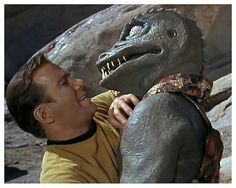 Artist's rendition of what it might look like if Star Trek's Captain Kirk were to wrestle a very tall Geney. All of this is wrapped up in the main character, Psyche—the quintessential scientific mind. As much as it is a story of survival in a sun-baked world, it is the story of personal growth as she comes to grips with her own hatred of the political and religious systems that brought about the current state of affairs. But in the end we see that science, religion, and politics are on both sides of the fight, the only difference being how the individual chooses to use them.
The work is not without its flaws. The occasional typo or odd-formatting can be overlooked, but I was a bit turned off by the bizarre first-person point-of-view switching back and forth to third-person with no warning, often one paragraph to the next. Despite these potentially jarring occurrences, I won’t linger here because the story is strong. If you're a fan of sci-fi looking for something different (and I always am), this won’t disappoint.
February 4, 2015
#10. Exurbia: A Novel About Caterpillars (An Infinite Triptych Book 1) by Alex McKechnie
 Note: This is one of my top picks. I highly recommend this book to any lover of science fiction.
Taking a break from indie fantasy see what the latest indie sci-fi has to offer. Plus I received my first ever advance copy review request! So let’s do this!
An emissary from a distant overbearing interstellar colony arrives on the Earth-like planet Exurbia in order to stop those pesky humans from creating a potentially universe-destroying artificial intelligence machine.
Get Exurbia on Amazon Here! Exurbia has a lot going for it. It has all the elements that make for great sci-fi. No, I’m not talking about aliens in exploding bikinis. I’m talking about work that questions blind faith in technology, challenges our notions of what it means to be human, and addresses religion’s (or spirituality’s) perceived irrelevance by our ever-increasing understanding of the natural forces around us... Also, it has a dog named Mr. Covert Woof—and if that’s not worth the read all by itself, then nothing is. Set 500 years in the future, at a time when humans have colonized the far reaches of space, the Man is still keeping the Little Guy down. A governance known as the Syndicate Galactica uses its superior technology to enforce rule over the human colonies spread throughout the galaxy. They repeatedly warn the humans that creating a “wire-mind” (A.I.) will result in catastrophe, as any being with a god-like intelligence will invariably dominate all other forms of life. (They know the score. They've seen Terminator series. )
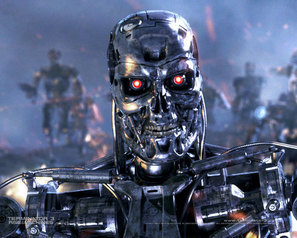 It's actually a little known fact that once machines become self aware, they care nothing about the destruction of humans, but spend most of their time taking selfies and posting them on Skynet. But on the other side are the proponents who believe this “wire-mind” will be able to aid us in our quest for knowledge, perhaps even leading us to some unforeseen stage in human evolution. In Exurbia, the humans refer to this as “the Up.” It’s such a clumsy word, but it really is a great choice for such primitive beings trying to make sense of things.
Perhaps the best way to demonstrate what’s so great about Exurbia is to take a look at a few of the characters. Representing the siren’s call of technological progress is Stefan Jura, a physicist who secretly longs to see the creation of a “wire-mind”, seemingly for the sole purpose of witnessing a new age. We invite God into the equation with Seer Fortmann, a revolutionary with an almost religious fervor to see it done. He describes the coming world in such biblical terms, and on at least one occasion he actually describes the process of creating a “wire-mind” as building God. And as a control subject (literally) we have my favorite character 261, a.k.a. The “Moralising” Imp (quotes added for the British-ness of spelling), a man who has been genetically altered for almost machine-like impartiality. It’s fun to watch him sway one way or another without regard to human emotion.
Exurbia presents a new perspective on science-fiction, one where, for humans, advancing technology is but a stepping stone to higher spiritual enlightenment. We are pushing evolution into new territory here with the idea that human technology (perhaps sentient machines) will someday be able to project us into the next stage, a state of being that might be altogether alien to our current form.
As an anthropology major (high-fives to all the cool guys!), I can’t help but be drawn to this kind of story. Sorry, creationists, but yes, evolution is real. And no, evolution isn’t something that happened. It happened, it’s happening, and it will continue to happen in the future. It is a fundamental property of life to evolve, but what exactly constitutes life? And assuming we survive the threats to our global civilization, where will human beings be in another million years, after our populations are separated from each other by light-years of cold, dark space. So why do you need to read Exurbia? It was a breeze to read, equal parts entertaining and thought-provoking. It’s well-written and perfectly paced. The characters are likable. Overall it was an interesting concept and the author developed it well. This novel is exactly why we need indie authors, and it makes me excited about the future of the self-publishing industry. Agree or disagree with the overall message, the story will open up some fresh topics for your consideration, and that’s what it’s all about.
So what do you think? Are humans ready for the Up?