Tez Brooks's Blog: TezBrooks.com
April 5, 2026
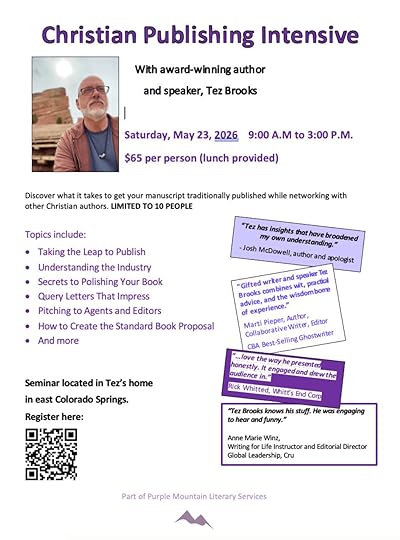


March 30, 2026
Adult-o-Nomics wins 1st Place in Personal Growth
March 2026 – The Blue Lake Christian Writers Conference hosted the Christian Indy Author Awards (a nationwide contest) where Tez’s book, “Adult-o-Nomics” won 1st Place in the Personal Growth category. The book was written for young adults ages 16-25 who are preparing for or already have moved into their own place away from their parents or college dorm. It contains 500 tips (one-liners) for adulting. Topics include family relationships, employment, dating, finances, shopping, cleaning house, auto maintenance, safety, and more. The book is currently available on Amazon and makes the perfect gift for graduates.

The post Adult-o-Nomics wins 1st Place in Personal Growth appeared first on tezbrooks.com.
March 16, 2026
NEW BOOKS BY TEZ COMING IN AUTUMN 2026
When Animals Preach: Spiritual Truths from God’s Creation
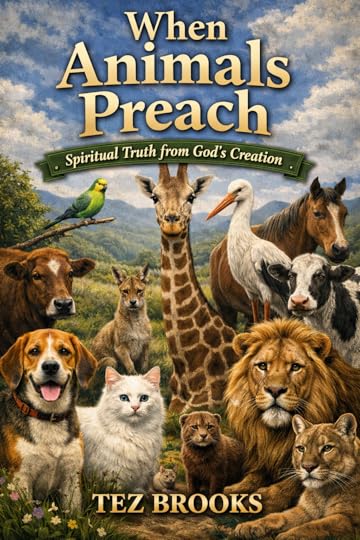
Animals have always been one of God’s classrooms. From Scripture’s earliest pages, God invites us to observe—to watch ants, birds, sheep, lions, and sparrows—and discover spiritual truth woven into the natural world. Animals do not speak aloud, yet their design, behavior, and instincts quietly point to the wisdom, character, and faithfulness of our Creator.
When Animals Preach invites readers to slow down and look closer. Through vivid storytelling, real-life encounters, and biblical reflection, these devotions uncover spiritual truths revealed through the creatures the Lord made. Each entry connects an encounter with an animal or the unique traits of an animal with timeless lessons about faith, perseverance, humility, restoration, and trust in God.
This book is not about discovering hidden messages or mystical experiences. Nor should it replace studying his Word. These devotions merely confirm what we already are taught in Scripture. You’ll observe what God has made and allow those observations to deepen our understanding of his truth. Whether you are a longtime believer or just beginning your faith journey, When Animals Preach offers thoughtful, accessible devotions that remind us God is always teaching—and creation is never silent.
A Clearer Word: A 30-Day Devotional for Prophetic People
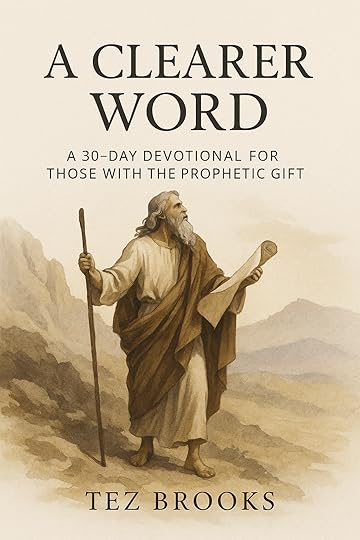
A Clearer Word is a 30-day devotional designed to disciple believers who are prophetically gifted or who regularly operate in the gifts of the Spirit. Rooted firmly in Scripture (ESV), this devotional calls readers to maturity, humility, theological alignment, and deep intimacy with God as they grow in prophetic ministry.
Rather than sensationalizing spiritual gifts, Tez Brooks emphasizes biblical balance: hearing before speaking, character before platform, accountability before influence. Each day includes a Scripture passage, a focused teaching, a prayer, and a practical exhortation aimed at refining both the message and the messenger.
This book addresses common tensions in prophetic ministry:
Hearing God clearly in a noisy worldDistinguishing divine impulse from human emotionAvoiding pride, titles, and spiritual performanceTesting prophetic words within biblical and pastoral accountabilityUnderstanding timing, tone, and restraintPrioritizing Scripture over subjective revelationGuarding against using prophecy as spiritual fortune-tellingBrooks draws from three decades of personal experience in prophetic ministry, offering sober guidance rather than hype. He reinforces that prophecy is primarily forth-telling—confirming what God is already stirring—rather than predicting the future. Throughout, he consistently anchors the prophetic in biblical authority, local church accountability, and Christ-centered humility.
Pastoral, grounded, and corrective when needed, this devotional challenges spiritually mature readers while remaining accessible to newer believers. It avoids mysticism and spectacle, instead calling prophetic people to deeper intimacy, reverence, and responsibility. A Clearer Word equips prophetic believers to move from impulse to discernment, from excitement to endurance, and from gifting to godly maturity.
The post NEW BOOKS BY TEZ COMING IN AUTUMN 2026 appeared first on tezbrooks.com.
March 2, 2026
Why Some Writers Don’t Need Another Conference—They Need Clarity
Writer’s Conferences are so helpful. It’s there we learn craft, understand the industry, network with friends who can propel your writing, and so much more.
Conferences offer connection, encouragement, and access to information that’s hard to find elsewhere. I’ve taught at them, attended them, and benefited from them. But somewhere along the way, conferences can become a substitute for clarity—and that’s where problems begin.
When a writer feels stuck, overwhelmed, or unsure, the instinct is often to gather more information. Another workshop. Another panel. Another expert voice. The hope is that the next event will unlock momentum.
Sometimes it does.
Often, it just adds noise as you drink from the firehose, go home and throw your notes and all the business crds you collected in to a drawer—promising yourself you’ll use them next time you write. Clarity doesn’t come from accumulation. It comes from discernment.
I’ve coached many writers who know a lot about publishing but are still unsure what they’re actually supposed to be writing. They understand the industry but haven’t yet named their assignment. Without that clarity, more information only deepens confusion.
Conferences can’t tell you:
which story you’re meant to steward right now.how much capacity you truly have in this season.what pace is “faithful” for your life.Those answers come from paying attention—to the Holy Spirit, to your life, to the fruit and resistance you’re experiencing.
Another hidden cost of constant learning is procrastination disguised as preparation. It feels productive to register for events, take notes, and network. But learning without application can become avoidance. After all, if you’re always preparing, you never have to risk finishing, right?.
But hey, at some point, clarity requires commitment. Not to a career plan, but to a direction. One project. One season. One faithful step, that’s all. You don’t need certainty about the next ten years. You need enough clarity to take the next action.
That might mean writing instead of attending. Revising instead of pitching. Resting instead of striving. Forgive me any of you conference directors, but it might even mean skipping a conference—not because learning is bad, but because obedience looks quieter right now.
The writers who grow most steadily aren’t always the most connected or informed. They’re the ones who stop chasing permission and start practicing faithfulness. They choose depth over breadth. Completion over accumulation.
If you’re considering another conference, ask yourself:
What am I hoping this will solve?Is there something I already know but haven’t done?Would clarity come faster if I stayed home and listened?Sometimes the most faithful next step isn’t more input—it’s trust. Clarity doesn’t shout. It settles. And once it does, the path forward becomes surprisingly simple.
The post Why Some Writers Don’t Need Another Conference—They Need Clarity appeared first on tezbrooks.com.
February 9, 2026
Why God’s Timing Rarely Matches Publishing Timelines
One of the quiet burdens writers carry is the fear of being behind the curve when it comes to getting their book published.
Behind peers. Behind opportunities. Behind the version of life we thought we’d have by now. Publishing culture doesn’t help. Christian publishers are no different—for them it’s often business more than ministry. Let that sink in. They need to make money too. They have to keep the business going by acquiring books that will produce most successful sales. It’s not personal.
But the Lord doesn’t measure success by timelines. In scripture, delay is often part of formation. Moses spent decades in the desert. David was anointed long before he was crowned. Even Jesus waited years before beginning public ministry. Delay wasn’t absence. It was preparation.
Publishing timelines are built around marketing and capacity. God’s timelines are built around people—that difference matters.
When we internalize industry expectations, we begin to assume that progress must be visible to be real. If doors haven’t opened yet, it doesn’t mean we missed something. Growth is not always external. Often, the most important work happens before anyone is watching.
You may be developing discernment. Or resilience. Or humility. Or patience—qualities that don’t show up in a bio but are essential for longevity.
Another truth worth mentioning is comparison and how it distorts reality.
Two writers can start at the same time and move at wildly different speeds, and both can be exactly where the Lord intends. One path isn’t superior to the other. It’s simply different. The danger comes when we borrow someone else’s pace or success and try to force it onto our own life. Your other responsibilities matter. Your season matters. Your capacity matters.
If you’re caring for family, working full time, or navigating health or transition, God is not holding you to an imaginary standard set by the publishing world or your fellow writers. He is attentive to your obedience within your real life.
Being “on time” with God often looks like being slow by human standards. I’m not saying you can now make excuses for being lazy or procrastination. I am saying it’s ok to give yourself grace if you can’t regularly sit down and write. Write when you can, not when it’s impressive. It’s ok to say no to expensive writing software or conferences or author memberships that cost too much.
Trust that unseen seasons are not wasted.
The irony is that writers who last—the ones with depth and steadiness—are often those who stopped rushing early on. They learned to listen. To wait. To write from fullness rather than anxiety.
If you feel behind, ask yourself a different question: Not “why hasn’t this happened yet?”
But “what might God be forming in me right now?” Sometimes the delay isn’t a detour. It’s the road!
And when the timing does come—because it often does—you’ll arrive with more than a manuscript. You’ll arrive with wisdom, clarity, and the ability to carry whatever doors open next.
You are not late. You are becoming.
The post Why God’s Timing Rarely Matches Publishing Timelines appeared first on tezbrooks.com.
January 12, 2026
What’s the Deal with Blue Lake Christian Writers Conference?
I am excited to be speaking at the Blue Lake Christian Writers Conference this March 18–21, 2026! It’s a fantastic chance to learn, connect, and get inspired, all in a beautiful location just an hour from Destin, Florida. With only about 100 attendees, you won’t be overwhelmed. Grab your spot now at BLCWC.com!
The post What’s the Deal with Blue Lake Christian Writers Conference? appeared first on tezbrooks.com.
January 6, 2026
What I Wish I’d Known Before Publishing My First Book
When I started pursuing publication, I believed effort guaranteed outcome.
If I worked hard enough, learned enough, revised enough—surely the doors would open. I didn’t expect ease, but I did expect cause and effect. Faithfulness in. Publication out.
That’s not how it works.
Publishing is not a spiritual merit badge. It’s a business shaped by timing, trends, relationships, and mystery. Knowing that earlier would have saved me a lot of unnecessary self-doubt.
The first thing I wish I had known is this: rejection is not a verdict on how good my writing is. It’s a data point. Sometimes it’s about market fit. Sometimes timing. Sometimes a subjective preference from an editor having a bad day that has nothing to do with your quality of writing. Too many writers confuse “no” with “never” or, worse, “not from you loser!”
Another hard-earned lesson: a good manuscript does not automatically make a good book. Writing and publishing are related, but they are not the same skill set. A book must serve a reader, not just express a writer. As a college kid, I wrote what mattered deeply to me but didn’t always ask who it was actually for. Clarity came later—and with it, stronger work.
I also wish I’d understood sooner how long everything takes.
Books move slowly. Publishing decisions move slowly. It can take two years after submission before you see your book for sale. Career momentum moves slowly for authors. The pace can feel especially disorienting for writers who are wired to be productive or faithful with time. Waiting can feel like failure when it’s really just process.
What surprised me most, though, was how much identity gets tangled up in the outcome.
When publication becomes proof of worth, every setback feels personal. When it becomes obedience, the pressure shifts. You still care—but the weight lifts. You do the work. You steward the opportunity. And you release the results.
I also didn’t realize how important a community of writers would be. Not crowds. Not platforms. But a few trusted voices—people who understood both the craft and the calling. People who can speak the truth in love, critiquing for your betterment and success. Writing alone is possible. Sustaining a writing life alone is impossible. We need those honest mirrors that are grace-filled and encouraging.
Finally, I wish someone had told me this plainly: Your first book is allowed to be part of your formation, but not your legacy.
It doesn’t have to say everything. It doesn’t have to open every door. It doesn’t have to define you. Don’t let it be your “one and done.” Sometimes it exists simply to teach you how to finish, how to listen, how to revise, how to trust God with your next book.
Looking back, 16 books later, I’m grateful for what I didn’t know. Some lessons can only be learned by walking them.
But if you’re early in the journey, let this encourage you: confusion doesn’t mean you’re a bad writer or a wannabe. Slow progress doesn’t mean you’re failing. And obedience that looks ordinary is still obedience.
Keep writing. Keep learning. Keep trusting the Lord with the long arc of your work.
The post What I Wish I’d Known Before Publishing My First Book appeared first on tezbrooks.com.
December 19, 2025
When the Calling Feels Heavier Than the Joy
I’m thankful for this Christmas season where things slow down a bit for me—both in my calling as a missionary and a writer.
Lately I’ve been overwhelmed with all the writing I have to finish as a freelancer. Combine that with my ministry duties and that makes a perfect atmosphere for stress. There are seasons when the work still matters—but the joy feels thinner than it used to.
Enter Advent. Praise God. This year, I’ve noticed my mind drifting toward expectation of this celebration. Probably because I’m so busy.
Everyone is busy. Busy with your career, busy parenting, busy with housework, car repairs, serving your church, the list never ends.
If you’re like me, you are faithful to show up. You write. You teach. You serve. You keep saying yes where obedience seems clear. And yet somewhere along the way, the lightness you once felt has been replaced by weight. Not rebellion. Not burnout. Just heaviness.
That doesn’t mean you’ve missed God’s will. It may mean you’re walking it.
We don’t talk enough about the middle seasons—the ones after the excitement but before the fruit is visible. Early calling often comes with adrenaline and clarity. Later calling comes with responsibility, limits, and a deeper awareness of cost. The work hasn’t changed, you have.
Scripture is honest about this. Faithfulness is rarely described as thrilling. It’s described as enduring. Steady. Rooted. Often unseen. There are long stretches where obedience looks less like passion and more like perseverance. That’s not a failure of faith.
It’s maturity.
As someone who is both a missionary and a writer, I know one of the quiet lies writers and ministers absorb is that joy should always accompany calling. As if when joy fades, something must be wrong. But joy isn’t always the fuel. Sometimes it’s the fruit that comes later—after the plowing, after the waiting, after the obedience that felt heavy at the time.
There’s also a difference between joy and relief. Many of us confuse the two. Relief comes when something ends. I love accomplishing a task and checking it off my To-Do list. But joy comes when something aligns. You can lack relief and still be aligned. You can feel tired and still be exactly where God has placed you.
The danger isn’t heaviness. The danger is interpreting heaviness as a signal to quit without discernment, without prayer.
Before making any drastic changes, it helps to ask better questions:
Is this season asking for rest, or for refinement?Am I tired because I’m disobedient—or because I’ve been faithful for a long time?What expectations am I carrying that God never gave me?Sometimes the weight doesn’t come from the calling itself but from the layers we’ve added: comparison, urgency, self-imposed timelines, or the pressure to prove fruit rather than trust the Lord with it.
Jesus never rushed his assignments. He never confused crowds with confirmation. And he regularly withdrew—not because the calling or anointing lessened or disappeared, but because communion mattered more than constant output.
If your calling feels heavy right now, resist the urge to romanticize that earlier version of yourself. You are not weaker for feeling the cost. You are merely more aware. Awareness handled well, leads to wisdom.
You may not need a new direction. You may need permission to carry the calling differently—more gently, more honestly, more surrendered.
The joy may return in a different form. Quieter. Deeper. Less performative.
And even if it doesn’t come immediately, obedience is not wasted. Christ is never careless with the weight he allows you to carry. This Christmas, remember this and rest. Because his yoke is easy and his burden is light (Matthew 11:28-30).
Sometimes faithfulness feels like heaviness first—and joy comes later, once you realize you didn’t walk away.
The post When the Calling Feels Heavier Than the Joy appeared first on tezbrooks.com.
October 1, 2025
Are Absent Fathers Doomed to Fail Their Kids

Q: Why are some men tempted to become absentee fathers? What are some of the consequences for their children if they do so? As I interviewed men in my research for The Single Dad Detour I ran into guys who said they were tempted to be absent. I think this comes from the insecurity men can develop as a single dad. There’s already an expectation from the world that they are going to fail, coupled with just the normal low esteem that comes with a failed marriage. It can make a guy feel like maybe their child would be better off without him in their life.
What happens is actually the opposite. Studies show more boys end up in prison who don’t have a father around. And little girls are more apt to be promiscuous teens without the influence of a dad. It’s imperative we encourage dads to cast down those lies the Devil tells us and to be intricately involved in our kid’s lives. Q: Some believe the court system can be unfair to men in divorce and custody decisions. What advice do you have for those men on fighting resentment and bitterness? While many states have become more progressive and friendly toward the father having custody, there are still many judicial systems that are old-fashioned. When that happens we can fight for our rights as fathers and still have a Christ-like manner about us. Especially when dealing with our ex-spouse. Jesus was angry when he knocked over the merchant’s tables in the temple…yet he was without sin. Too often we forget to model Christ in the midst of defending our rights. Our anger toward the courts can get misdirected to others. We often need to lay down our rights…Christ did this too. That being said, when bitterness and resentment rise up—and it will—we must fight that with prayer and forgiveness. Easier said than done. It’s so important we throw ourselves at the foot of the cross every day. Q: Men are “fixers” by nature, but it can be tempting for them to fix parenting problems without the Lord’s help. You had one such moment after Christmas shopping with your daughter once. Tell us about that.I had been shopping with the kids and had my fill of the holiday crowds and traffic. I just wanted to get home. My daughter was crying in the back seat because she didn’t get to have her photo taken with Santa at the mall. My impatience was building but I didn’t expect it to boil over like it did. Her whining wouldn’t stop so in a moment of exasperation I screamed out “Be quiet! “Santa’s not real, he’s dead!” The crying stopped as she blinked in disbelief. I knew I had messed up as soon as I said it. I could see by the look in her eyes, my words slapped her in the face. No Father of the Year Award this year I suppose. My daughter started her crying again but this time it was more of a high-pitched squeal. “Nooo, Santa’s not dead!” I remained silent all the way home. Considering how I might cover over my mistake. But there was no hiding my outburst and all I could do to make it right was apologize. When we got home I hugged her and asked for forgiveness. She sunk into my chest as we rocked back and forth. I realized that night I must make it a habit to initiate an apology when I screw up. Even more, I learned I’m a pathetic father without God’s graceand help. Q: How can a dad have a strong spiritual impact on their children even when not living when them all the time?Your kids are watching you no matter where they live. For kids who watch their fathers, there’s no mistaking what their dad is passionate about. It’s going to be obvious. Kids observe when you react to things in your flesh, rather than respond with Christ’s character. I messed up a lot. I showed my anger, my selfishness my pride…but I tried to live a life of repentance. I think if we make the Lord part of our every day conversations our kids will be able to discern that our Christianity is more than a hobby, it’s a relationship with the Creator. Q: What is the number one thing you want single dads to get from reading The Single Dad Detour? I’d like them to walk away encouraged to keep going strong. That the Lord is on their side. I want to challenge them to step up yet still offer hope and the grace to be able to laugh at themselves when they aren’t perfect. There’s too much pressure as it is. If dads can celebrate what they’re doing right, while still leaning desperately on the Savior for hope, it will make the road they’re navigating much easier. QUESTION FOR READERS: Tell us what you feel like you are doing right as a single dad.
The post Are Absent Fathers Doomed to Fail Their Kids appeared first on tezbrooks.com.
September 15, 2025
Is Christian Nationalism Biblical?
Christians have always found themselves championing two causes: following the Carpenter with a cross and cheering the candidate with a crown. But what if trying to build God’s kingdom through politics becomes the very thing that keeps us from it?
I hear the phrase Christian Nationalist being thrown around a lot lately. Do we really understand that phrase? Living in a Christian nation sounds ideal, but is it? Perhaps the fiercest battles for God’s kingdom aren’t fought at the polls, but in the human heart.
Lately I have pondered, if the Son of God left his throne to become a fragile, ordinary man, then humility isn’t just something he asks of us—it’s something he modeled.
Think about it; the Creator of galaxies wrapped himself in skin, walked dusty roads, and ate meals with fishermen. That means our calling isn’t to climb higher, but to bow lower. To cry out, “Come, Lord Jesus!” For he is our only hope; it’s surely nothing else.
Am I suggesting that embracing adversity means we should cower and tolerate mistreatment? No, we should stand for what’s right, even in the face of persecution. What outspoken Christians do is inspiring to me and millions of others. But let’s clearly define the difference between a “nationalist” and a “Christian nationalist.”
Nationalism is an ideology centered on patriotism and loyalty, but Christian nationalism is a specific form of religious dominance that advocates fusing Christian and national identities. A key difference is the role of religion: while a nationalist merely loves his country, a Christian nationalist (much like Islamic leaders) believes the nation should be defined by and be governed according to religious principles.
While this might sound nice for us believers, we must understand that Christ’s kingdom doesn’t come through voting or military victories. It doesn’t grow by legislating morality or seizing political office. In fact, Jesus told His disciples the opposite: the greatest in his kingdom will be the servant of all. He flipped the script. The first will be last–the last will be first.
So, when we hear teachings about Christian dominionism—the belief that Christians must control government, culture, and society to establish God’s rule on earth—we should pause. It may sound bold, even patriotic. But Scripture tells to merely influence our culture by being salt and light to bring about change. The Bible consistently shows us that Jesus initiated his kingdom and said it’s like a mustard seed that grows. Christ will complete his kingdom at his second coming. Until then, we are living in the now and the not yet. Meaning the kingdom is already here in our hearts (Luke 17:20-21), not as a physical territory. But it can’t be finalized until he comes to reign. Until then, we are to serve, not dominate.
Can we vote against ungodly laws? Of course, and we should. We are not meant to passively embrace every pagan legislation in the name of love and acceptance. But we also don’t want to create a nation that fines or imprisons those who don’t obey God–that’s what some Middle Eastern nations do. It’s about a heart change (being born-again), not Christian Nationalism.
Without the gospel and salvation, we are merely asking the nation to mimic the children of God rather than become children of God. When we replace heart transformation with demands for morality, we undermine the gospel. It’s a foreign gospel. No one is getting saved; they are just forced to comply.
A Kingdom Not of This World
Pilate once asked Jesus if he was a king. If there was ever a moment for Jesus to rally his followers and declare an earthly revolution, this was it. Instead, he answered, “My kingdom is not of this world. If it were, my servants would fight… but now My kingdom is not from here” (John 18:36). When the Pharisees asked him when this kingdom would come, Jesus replied, “The kingdom of God does not come with observation; nor will they say, ‘See here!’ or ‘See there!’ For indeed, the kingdom of God is within you” (Luke 17:20-21).
Those verses dismantle the domineering dream of ushering in God’s reign on earth through policies or political systems. It’s very prideful and points people to us and our self-righteousness rather than pointing people to Christ. If Jesus wanted his followers to seize control, he would have said so then. Instead, he pointed away from earthly kingdoms and toward a spiritual one.
You can’t map it on a globe. You can’t point to a Capitol building and say, “There it is.” The kingdom is spiritual—it begins in the hearts of believers.
In the Old Testament, Israel was a theocracy ruled directly by God. But when Jesus came, everything shifted. Under the New Covenant, believers live under earthly governments. Paul told the church in Rome, “Let every soul be subject to the governing authorities. For there is no authority except from God” (Romans 13:1).
Keep in mind, Paul wrote this under Nero, a violent persecutor of Christians. Yet he never told believers to overthrow the empire. His counsel was to respect leaders unless they directly opposed God’s commands. That’s when we can stand up and refuse to do so. That’s an individual act we are to do, to show our devotion to God’s precepts. (See the story of Rahab in Joshua chapter 2, or Daniel chapters 3 and 6, or Peter in Acts 4 and 5).
We are to fear God more than human authorities, and if this leads to a quiet and peaceful disobedience, so be it. But be prepared to accept the consequences of your disobedience and suffer in the name of Christ. Yes, we do need to get godly leaders into places of high authority, not to create a bubble of moral uprightness but to be a light to the world that points to Jesus as the answer.
What Jesus Actually Commanded
Before ascending to heaven, Jesus made His mission clear, “Go therefore and make disciples of all nations…” (Matthew 28:19-20).
As a full-time missionary for the past 24 years, may I remind you that our mission is disciple-making, not empire-building. Paul echoed this when he urged Timothy, “Preach the word! Be ready in season and out of season” (2 Timothy 4:2).
Notice the verbs: preach, teach, baptize, love, serve. You won’t find “seize power” anywhere in Jesus’ commands. When asked about paying taxes, Jesus answered, “Give to Caesar what is Caesar’s, and to God what is God’s” (Mark 12:17). This wasn’t political wordplay. It was a dividing line. Governments belong to this world, but God’s kingdom is eternal.
I try to live this out well by paying my taxes and respecting the law, but my hope isn’t in Washington D.C., nor is it in my ministry efforts. It’s in Christ. I’m a citizen of two kingdoms—but I know which one is more important and eternal.
The Danger of Christian Nationalism
Christian nationalism is seductive because it promises security, power, and influence. But it reduces the gospel to a political ideology. While it is a noble cause, it implies that faith is only real if it dominates. It is salvation by another means than Christ, a distraction from truth.
A fellow believer once confessed to me that he felt hopeless because his candidate lost an election. He said, “I just don’t see how Christianity can survive now.” That concerned me, because the gospel has thrived under emperors, dictators, monarchies, democracies—every government system imaginable. But Christians are still around today—even after several attempts of mass genocide. That’s because Jesus doesn’t need a president or a king to validate his kingdom. He already reigns.
The early church had no voting rights, no lobbyists, no political parties. Yet their influence transformed the Roman Empire. How? By radical love. Even earlier than that, God’s people in the Old Testament rescued abandoned babies, cared for the sick, forgave their enemies, and showed kindness when cruelty was the norm. We can do the same today. Love your neighbor. Pray with a co-worker. Forgive those who wrong you. Your quiet faithfulness speaks louder than any political rally.
Citizens of Two Worlds
Paul reminded us: “Our citizenship is in heaven” (Philippians 3:20). That doesn’t excuse us from earthly duties. We still vote, pay taxes, and pray for leaders. But our ultimate allegiance is to Christ.
I think of some of the public school teachers I know. They don’t always agree with district policies, but they view the classroom as their mission field. They pray over the students’ desks before they arrive. These teachers offer encouragement and model Christ’s love. Their influence doesn’t come from power—it comes from God’s presence in their lives.
Christian dominionism is not biblical. The gospel doesn’t need government endorsement. It doesn’t need power to thrive. The teachings of Jesus point us to humility, servanthood, and spiritual transformation.
So, if your ministry is in the limelight, use it! Count the cost but don’t stop, don’t cower (even if it means certain death). People desperately need a Savior and you know the only solution. Proclaim it!
My prayer for us is “Lord, help us remember your kingdom is not of this world. Forgive us if we have placed too much hope in human leaders or systems. Help us stop trying to create heaven on earth but to live faithfully as aliens, your ambassadors—humble, loving, and bold in sharing the gospel. May our actions reflect your reign in our hearts. Teach us to trust that your return will set all things right—we humans cannot. Until then, make us a floodlight in a world that desperately needs you.”
Ballots, presidents, or armies will not bring the kingdom of God. It will come when Christ returns in glory to make everything new. Our calling is clear: live humbly, love deeply, and share the good news boldly while crying out, “Come Lord Jesus. Our only hope!”
Reflection Questions
In what ways are you tempted to put more hope in politics than in Christ’s return?How might you live as “salt and light” in your workplace, school, or community this week?When you think about Jesus’ words, “My kingdom is not of this world,” how does that change the way you view current events?What small act of humility or service could you offer someone today that reflects Christ’s kingdom?How might you change what you post on social media, knowing that 1 Thessalonians 4:11-12 teaches us to live quietly and mind our own affairs?The post Is Christian Nationalism Biblical? appeared first on tezbrooks.com.