Michael Howard's Blog
October 9, 2020
Christians on Trial
Christians are hereby charged with betraying Christ by supporting politicians who epitomize the opposite of Him.

To understand this charge, we have to decipher the overarching spirit of the Bible and Christian tradition. We must contemplate with discernment, looking deeper than literal interpretations of narrow topics.
Exegetes have concluded through this approach that the core of Christ-likeness is:
Upholding of the least among usLoving those that society does not loveInclusivity
Christians should support politicians that uphold these ideals, as far as is reasonably practicable.
But instead, many conservative Christians support the antithesis.
They support politicians who:
Sell exclusivist prosperity. Usually this rears its head as populist nationalism.Downplay the dignity, worth and human rights of sectors of societyWant to deregulate capitalism with little or no safeguards for the poorDisplay bigotry in the name of challenging political correctness
These Christians are hereby charged with betrayal of Christ. They, and those who sometimes find themselves on the fence, may confess… and cast one good vote for their repentance.
It is easy to discern Christ-likeness pervading the Gospels. Jesus consistently contests privileged authorities and favours the marginalised – characters like the prostitute, the Samaritan and the prodigal son. His sermon on the mount makes explicit the spirit of his life.
Christ is all about solidarity with people across societal divides. He always defends outcasts and foreigners, so much so that the rich and powerful of his tribe are threatened and have him executed.
Christ’s radically inclusive and unconditional love is central to the mystical concept of the Trinity, three persons in one God, unity in diversity.
Christian mysticism, like all mysticism, reveals that we all share the universal pain of the human condition. We can see ourselves in the beggar and the murderer, in the refugee and the alcoholic. Once we’ve seen that reflection, we cannot but seek tolerance, mercy and understanding in our leaders.
Christ’s defence of the weak extends to our fragile planet. Christ-likeness laments the suffering and extinction of species, and the destruction of the environment.
Christ-likeness is also imbued with a sense of hope and enthusiasm that human compassion and ingenuity can heal us, our societies and our planet. This hope and enthusiasm makes for progressive thinking and progressive activism.
However, this progressiveness appreciates traditional wisdom in religions, and knowledge gained through scientific endeavours. Never will the Christ-mind discard wisdom or scientific consensus willy-nilly for reductionist dogma or pseudo-progressive woke-ism.
Solidarity with the other, or unity in diversity, ultimately means transcending self, nation, race or other identities that our egos cling to. It means dying to self… like Jesus died. In this ultimate poverty, the Christ-mind is free from the anxiety and paranoia of self-preservation, and can truly face the perceived risks of loving the other unconditionally.
We hear accused Christians say this is too high an ideal for modern society. Besides, we don’t have to aspire to it because we’re saved by faith alone. Being saved by faith alone – isn’t that the main Christian message?
Actually, no dear brethren, it’s not. In fact, the concept of salvation by faith alone only gained prominence about four hundred odd years ago when Martin Luther rightly rejected the church’s selling of indulgences. Since then it’s often been corrupted to excuse Christians from carrying the cross of Christ-likeness.
Christians in the dock, we put it to you that we who claim to follow Christ do have to aspire to be like him. We must embrace the disruptive inconvenience of loving unconditionally.
We must support leaders that manifest, as far as is reasonably practicable, unconditional love for all, especially those we would conveniently love less. Those our natures do not find agreeable.
We must vote for politicians who:
Make the plights of immigrants, the poor and the oppressed top priorityAre committed to creating fairness in society that induces law and order, instead of squaring off against breaches with violence Deliver justice with mercyAddress underlying racial ills rather than reacting heavy-handedly to symptomsInspire charity over self-promotionDo not address tough challenges with reckless certainty, bravado and insolenceAre pro all life, and don’t reduce being pro-life to being pro-unborn life.Take seriously and act to defend human rights of all sectors of societyTake seriously and act to defend and protect the natural environmentalHeed traditional wisdom to solve persistent challenges instead of buying into the latest fads and conspiracy theoriesListen to scientific consensus on problems like global warming and pandemics, and promote technological and scientific solutions
Dear Christians, Jesus would weep if he saw the rising insensitivity to immigrants and refugees among conservatives worldwide. He’d weep at the misunderstanding of Black Lives Matter, and multi-generational impacts of colonial dispossession. And how he’d sob at the site of militant groups on stand-by on the streets, trigger fingers itching to blow the brains out of fellow human beings.
Poor Jesus. Even getting out of the city, walking on the mountain, or sailing on the lake would not dry his tears. Because he’d see coal mines and coal-fired power stations, steel mills and fossil fuel refineries, pumping pollution faster than ever to the greedy beat of outdated industrialist lobbyists and politicians who surely epitomize the opposite of Christ.
He’d see thousands of square kilometres of animals jam-packed into feedlots and single-crop fields destroying nature. All so prosperous western nations can feast. Free market gluttony disguised as benign capitalism, justified by the heretical theology of prosperity.
He’d realise there is no place for him in this world. And Jesus would dust the dirt from his feet and leave.
The post Christians on Trial appeared first on Michael Howard.


October 8, 2020
Christians on Trial
Christians are hereby charged with betraying Christ by supporting politicians who epitomize the opposite of Him.
To understand this charge, we have to decipher the overarching spirit of the Bible and Christian tradition. We must contemplate with discernment, looking deeper than literal interpretations of narrow topics.
Exegetes have concluded through this approach that the core of Christ-likeness is:
Upholding of the least among usLoving those that society does not loveInclusivityChristians should support politicians that uphold these ideals, as far as is reasonably practicable.
But instead, many conservative Christians support the antithesis.
They support politicians who:
Sell exclusivist prosperity. Usually this rears its head as populist nationalism.Downplay the dignity, worth and human rights of sectors of societyWant to deregulate capitalism with little or no safeguards for the poorDisplay bigotry in the name of challenging political correctnessThese Christians are hereby charged with betrayal of Christ. They, and those who sometimes find themselves on the fence, may confess… and cast one good vote for their repentance.
It is easy to discern Christ-likeness pervading the Gospels. Jesus consistently contests privileged authorities and favours the marginalised – characters like the prostitute, the Samaritan and the prodigal son. His sermon on the mount makes explicit the spirit of his life.
Christ is all about solidarity with people across societal divides. He always defends outcasts and foreigners, so much so that the rich and powerful of his tribe are threatened and have him executed.
Christ’s radically inclusive and unconditional love is central to the mystical concept of the Trinity, three persons in one God, unity in diversity.
Christian mysticism, like all mysticism, reveals that we all share the universal pain of the human condition. We can see ourselves in the beggar and the murderer, in the refugee and the alcoholic. Once we’ve seen that reflection, we cannot but seek tolerance, mercy and understanding in our leaders.
Christ’s defence of the weak extends to our fragile planet. Christ-likeness laments the suffering and extinction of species, and the destruction of the environment.
Christ-likeness is also imbued with a sense of hope and enthusiasm that human compassion and ingenuity can heal us, our societies and our planet. This hope and enthusiasm makes for progressive thinking and progressive activism.
However, this progressiveness appreciates traditional wisdom in religions, and knowledge gained through scientific endeavours. Never will the Christ-mind discard wisdom or scientific consensus willy-nilly for reductionist dogma or pseudo-progressive woke-ism.
Solidarity with the other, or unity in diversity, ultimately means transcending self, nation, race or other identities that our egos cling to. It means dying to self… like Jesus died. In this ultimate poverty, the Christ-mind is free from the anxiety and paranoia of self-preservation, and can truly face the perceived risks of loving the other unconditionally.
We hear accused Christians say this is too high an ideal for modern society. Besides, we don’t have to aspire to it because we’re saved by faith alone. Being saved by faith alone – isn’t that the main Christian message?
Actually, no dear brethren, it’s not. In fact, the concept of salvation by faith alone only gained prominence about four hundred odd years ago when Martin Luther rightly rejected the church’s selling of indulgences. Since then it’s often been corrupted to excuse Christians from carrying the cross of Christ-likeness.
Christians in the dock, we put it to you that we who claim to follow Christ do have to aspire to be like him. We must embrace the disruptive inconvenience of loving unconditionally.
We must support leaders that manifest, as far as is reasonably practicable, unconditional love for all, especially those we would conveniently love less. Those our natures do not find agreeable.
We must vote for politicians who:
Make the plights of immigrants, the poor and the oppressed top priorityAre committed to creating fairness in society that induces law and order, instead of squaring off against breaches with violence Deliver justice with mercyAddress underlying racial ills rather than reacting heavy-handedly to symptomsInspire charity over self-promotionDo not address tough challenges with reckless certainty, bravado and insolenceAre pro all life, and don’t reduce being pro-life to being pro-unborn life.Take seriously and act to defend human rights of all sectors of societyTake seriously and act to defend and protect the natural environmentalHeed traditional wisdom to solve persistent challenges instead of buying into the latest fads and conspiracy theoriesListen to scientific consensus on problems like global warming and pandemics, and promote technological and scientific solutionsDear Christians, Jesus would weep if he saw the rising insensitivity to immigrants and refugees among conservatives worldwide. He’d weep at the misunderstanding of Black Lives Matter, and multi-generational impacts of colonial dispossession. And how he’d sob at the site of militant groups on stand-by on the streets, trigger fingers itching to blow the brains out of fellow human beings.
Poor Jesus. Even getting out of the city, walking on the mountain, or sailing on the lake would not dry his tears. Because he’d see coal mines and coal-fired power stations, steel mills and fossil fuel refineries, pumping pollution faster than ever to the greedy beat of outdated industrialist lobbyists and politicians who surely epitomize the opposite of Christ.
He’d see thousands of square kilometres of animals jam-packed into feedlots and single-crop fields destroying nature. All so prosperous western nations can feast. Free market gluttony disguised as benign capitalism, justified by the heretical theology of prosperity.
He’d realise there is no place for him in this world. And Jesus would dust the dirt from his feet and leave.
The post Christians on Trial appeared first on Michael Howard.
August 10, 2020
Why are Bad Times Good for the Soul?
There are two opposite poles to consciousness: self-consciousness and unitive-consciousness.
Self-consciousness is constrained by an organism’s thoughts and emotions. It is being inside your physical and sensory identity, separated from the outside world. Unitive consciousness is a sense of unity or oneness with the world that transcends personal identity.
Anyone who has experienced unitive consciousness knows that it comes with a blissful sense of expansiveness, freedom and escape from the constraints of self. It feels like being true self. And that true self is termed the ‘soul’.
But we’re not always motivated to know our souls.
In good times, our thoughts and emotions are pleasant. We’re comfortable with our progress in the world, and there are no major causes of suffering around us. We are happy, so there’s no need to move beyond the constraints of our self-consciousness. That is why it is said that it is harder for a rich man to get to heaven than for a camel to pass through the eye of a needle.
But if bad times come along – say relationships fail, businesses go broke, or a pandemic alters the world – thoughts and emotions can become tormentors. We can get stuck in chemical loops of regret, disappointment, fear, anxiety and sadness. We may even find our very identities, with their attachments and senses of achievement, in disarray.
In these times, our intentions are most definitely to get past the pain, to find relief, and be free of this suffering. And an intention to leave our identities, is all that is required for consciousness to drift toward unitive.
It’s amazing grace.
Or, as Sheryl Crow sings in ‘Redemption Day’: Oh what mercy sadness brings.
The post Why are Bad Times Good for the Soul? appeared first on Michael Howard.
Why are Bad Times Good for the Soul?
There are two opposite poles to consciousness: self-consciousness and unitive-consciousness.
Self-consciousness is constrained by an organism’s thoughts and emotions. It is being inside your physical and sensory identity, separated from the outside world. Unitive consciousness is a sense of unity or oneness with the world that transcends personal identity.
Anyone who has experienced unitive consciousness knows that it comes with a blissful sense of expansiveness, freedom and escape from the constraints of self. It feels like being true self. And that true self is termed the ‘soul’.
But we’re not always motivated to know our souls.
In good times, our thoughts and emotions are pleasant. We’re comfortable with our progress in the world, and there are no major causes of suffering around us. We are happy, so there’s no need to move beyond the constraints of our self-consciousness. That is why it is said that it is harder for a rich man to get to heaven than for a camel to pass through the eye of a needle.
But if bad times come along – say relationships fail, businesses go broke, or a pandemic alters the world – thoughts and emotions can become tormentors. We can get stuck in chemical loops of regret, disappointment, fear, anxiety and sadness. We may even find our very identities, with their attachments and senses of achievement, in disarray.
In these times, our intentions are most definitely to get past the pain, to find relief, and be free of this suffering. And an intention to leave our identities, is all that is required for consciousness to drift toward unitive.
It’s amazing grace.
Or, as Sheryl Crow sings in ‘Redemption Day’: Oh what mercy sadness brings.
The post Why are Bad Times Good for the Soul? appeared first on Michael Howard.
February 13, 2019
The Meaning of Marriage
(6-minute Read) I’d had a tough day on business in Cape Town. Now, the evening breeze off Camps Bay cooled me and my second beer. The tranquil remains of the day eased my thoughts into my favourite pastime – contemplating self-transcendence.
 Love and marriage, go together like a horse and carriage… so the song says.
In particular that evening the question, “Is marriage
still important?” occupied me. I had posed the question in a Facebook poll, and
the votes were neck and neck. Although I’m a ‘yes’ man, those who voted ‘no’ had
strong arguments that I couldn’t deny, like:
People can commit to each other with or without marriageWe should make conscious decisions on whether a relationship should continue or not – not be obliged to continue because of a contract. Once a relationship no longer feeds your soul, nothing should keep you from choosing your peace and walking away.Any commitment to love gives life purpose and meaning, so why should marriage be more important than a host of other loving relationships?Why should choosing to love one person in a contract be better than loving anyone we connect to in the moment?Marriage is an outdated, patriarchal institution. Humans grow and change – we are setting ourselves up to fail by expecting to stay in a relationship with one person.I do not define myself by any one person. I have no desire to lose my identity, so I will never marry. I have found everything I want on my own. Marriage is only a piece of paper. If a person wants to leave, or cheat, or destroy the relationship they will anyway. The paper just drags the pain out. If you love someone so much why would you decide to get the government involved.Marriage has absolutely nothing to do with love or romance.
Two beers and funeral
A phone beep invaded my cerebral escape into these
heartfelt opinions. The invader was a message notification. Without touching
the screen, I could see the short sentence from my mother… and my heart sank: “Grandfather
has just passed away.”
A week later I had all the answers that confirmed my ‘yes’
to marriage. Who would have known I’d get them at a funeral, not a wedding.
I sat in a Maronite Catholic church surrounded by his
eight children, thirty grandchildren and nearly fifty great-grandchildren, plus
their husbands, wives, friends and extended families.
 The windows of his soul
 “Quite a legacy,” someone remarked in their eulogy.
A coffin at centre-stage, with his ninety-eight year old body in it seemed morose, and I wondered, “Are funerals still necessary?”
Suddenly, there was no such wondering about marriage. A
knowing came over my heart, clearer than any logic, confirming to me, beyond any
doubt: “Marriage is still important.”
Marriage is still important
You see, my grandparents had been married for nearly
seventy years. The love they manifested in that church was deeper than any
romance. It was a heightened human capacity to self-transcend that grows and
deepens through decades of love, morphing into fear and anger and
disappointment, and all of life’s pains, circling back to a deeper love again.
Their marriage was the epitome of our ability to be selfless. It was a spiritual movement. The gathering was testament, not just to a single life, but to a sacred union.
Theirs was not merely a piece of paper. It was the abiding road map to an ever-more meaningful life, culminating in death, and a mystical reunion. It was their vocation, chosen before God, in an old Maronite church, in front of a community of sincere subscribers to a sacramental tradition.
I learnt that marriage is a mystical sign of Christ’s
selfless love from that Maronite community. They live their marriages with no
doubt at all that they are unbreakable bonds until death do them part. They
believe marriage is one of seven sacraments of the Church, signs of God’s love,
and metaphors for returning His love in selfless gratitude.
This mystical meaning overcame me at my grandfather’s
funeral as the Syriac consecration resonated around us. My heritage was right
here. My future extrapolated from here in this entanglement of two people.
As I sank into the moment, time and space retreated to
just a dot – just a temporary emanation of an eternal energy realm. And their marriage,
all marriages, were the most profound manifestations in this physical realm of
that eternity, given to help our feeble natures rise to know the unknowable.
Given to help us transcend ourselves.
But what about the faults
George Orwell said, “A man who gives a good account of himself is probably lying, since any life when viewed from the inside is simply a series of defeats.”
I knew some of the faults and defeats of my grandfather – though no doubt not all. I knew the patriarchal society he grew up in, and that some of that skewed chauvinist programming still clouded my own married mind.
The dire shortcomings of the institution of marriage were
not to be denied. I know too many people who have been failed by marriage, by
spouses, and by priests and counselors. I’ve grown up in a patriarchal culture,
and I never want my daughter beholden to any man.
But none of the ways we humans manage to defile things changed what i felt so suddenly. In the communion of my grandparents’ family, I was inebriated by the spirit of their union.
In defeat of imperfect humans, and imperfect marriages, we journey across our moment in time, to a distant shore, from where love shines back upon our departure point.
Even accepting all its valid criticism, marriage is still important. We should not throw the baby out with the bathwater.
The psychology of marriage
He was his own man, his own unique mix of good and bad,
not defined by her. But together they made something greater than either of them
individually. Perhaps they’d both lost some of their identities over the years.
But who says our identities are so great anyway?
Is it not in giving to the other, in transcending self, that we find our true identity – our connectivity beyond isolated self? Is marriage not the ultimate ground for this self discovery, precisely because of the onerous challenge it is for two people to stay together no matter what?
My experience tells me the answer to the above questions is ‘yes’. You see marriage is very often far from a bed of roses. But it is one of the best ways I know to go beyond self-actualisation, to self-transcendence, where ultimate non-dual consciousness resides.
But is marriage the only way?
I had my affinity for marriage re-branded existentially upon my heart. But what about the criticisms on my Facebook timeline? They required an answer from my brain. I had to respond to the ‘no’ comments because they are quite relevant in our world today.
So, I went about trying. But I couldn’t.
Because I know too many wonderful people whose marriages have ended, despite their best intentions. I kept thinking of the excellent young people who choose not to marry, and who find meaning and purpose – and compassion and love – never having walked down the aisle with another.
My words arguing for marriage’s importance seemed futile and dry. After all words don’t ultimately change a person’s mind. One only answers questions about importance and meaning through one’s own perceptions and experiences.
I realised we can make any path meaningful depending on
how we view it. If we view our path as a perpetual revelation of beauty and wonder, where the very
effort of the journey is a joy, and magic presences throng the roadside or cry
salutations to us from hidden fields, giving up new secrets to us at every step*,
we will be living to the fullest, whether married or single.
For me personally, on a whistle stop tour from that beer in Camps Bay to a funeral, I came to appreciate my marriage anew. Thank you Grandfather. And Granny. May your souls rest in peace, forever embraced by the spiritual reality you lived for in marriage.
* From Practical Mysticism by Evelyn Underhill
The post The Meaning of Marriage appeared first on Michael Howard.
December 11, 2018
Divine Surgery
They may have roots in early childhood. Or they’ve festered since adolescence, or maybe just yesterday. I’m talking about emotional pains caused by incidents that hurt so badly the wounds have never fully healed.
All the blights on our original innocence, big or small, affect our thoughts and emotions for the rest of our lives.

Common treatment
One way to reduce the pain is to keep busy, entertained or distracted. This method covers up and ignores the causes lurking underneath, staying away from the deeper experience of self. It is a very common antidote.
According to a controversial 2014 study, a high proportion of people would rather give themselves an unpleasant electric shock than spend 15 minutes alone with their thoughts.
A lot of us drug ourselves with herbs and chemicals to numb the pain. Or we are addicted to emotion-suppressing behaviour patterns.
These hiding and suppressing tactics aren’t dealing with the issues. They’re just buying time. But eventually the tumours have to be removed, or illness sets in.
True healing
The only solution is to go under the knife. To dig down to the source and remove the growth. This knife is well known, but we don’t easily surrender to it.
The healing knife is exactly what we avoid – it is being alone with our selves, getting to know ourselves deeply, leaving nothing hidden or suppressed.
The surgeon is the practice of meditation and mindful living. Meditation is practised to let go of mental and emotional programs. Mindfulness is to stay watchful over programmed reactions re-emerging during the day.
There is no doubt that these practices are psychologically therapeutic. The evidence abounds in thousands of peer-reviewed articles in positive psychology literature. But healing depends on full commitment.
Full commitment
A little bit of meditation here and there, and a few mindful thoughts, won’t relieve the pain of the human condition.
For the vast majority of middle-class rate racers, the time and awareness required for lasting beneficial affects is simply not doable. The knife of surrender merely scratches the surface, and the old wounds return to hurt like before.
In our busy lives we are forced to function where emotions are unconscious drivers and habitual thoughts dominate. Here, on the outer edge of ourselves we are sharp and tuned to the world, like the fittest animals surviving and thriving in nature. That’s the zone we have to be in to keep on keeping on. And when we’re used to being there, it seems life’s only joys reside there too.
If we had to choose to let go of the mental and emotional programs that drive us, we would fall into an unfamiliar realm of self that seems dark and perilous. If we loitered there long enough to see the real light in this darkness, we would fall behind in our lives. How would we continue to pay the bills? What would our friends and relatives say about our wilting flowers of material success?
And surely delving deeply into meditation and mindfulness spoils our fun.
Few of us choose to fully commit to our mental and emotional healing. We neglect our deeper selves. We choose to carry on patching up a façade of contentment by piling up distractions or medicating the pain. That’s the way of life we are accustomed to if we’ve grown up under the influence of the West.
Cultural lie
The Western value system says we have to be productive. We have to be building investments and futures, and making and doing. We are completely brainwashed into thinking that hard work is a moral value and ‘economic expansion’ a societal virtue.
There’s a pervasive suspicion that simply being in the moment, doing nothing, is lazy and good-for-nothing. Being happy with less is unambitious – not to be encouraged.
This perspective hasn’t come about by accident in the West. It started with the industrial revolution. The working class had to be hard-working or the relentless expansion of the European military-industrial complex would not have been possible. The wealth of the richest few percent would never have outstripped the combined wealth of the rest of us.
I’m not saying it’s a conspiracy of the global elite. I am saying it’s the perfect storm of human nature and capitalist macro-economics creating a world order that incarcerates the vast majority of us in lifestyles that keep us disconnected from our deeper selves.
Without the Western paradigm, every corporate company would grind to a halt. Imagine if middle class people decided to deconstruct their first-world, consumer materialist lives. Imagine if we were content with where we are right now instead of working doggedly to upscale constantly.
Global gross domestic product would collapse.
But we’d be happier. First we’d have to face the pain of going under the knife… then we’d be immeasurably happier.
Not so radical
I’m not calling for a society of hippies, sitting around smelling bad and smoking weed, singing revolutionary songs or spiritual ditties. We may not find it necessary to totally change our livelihoods – although some might.
I’m calling for balance. We must work as much as required to meet our basic needs, and no more. There’s a comfort cut-off point – striving for more than that is unhealthy. All it does is keep us trapped in the cycle of wants – distracted and disconnected.
We have to devote our lives but there’s not necessarily a radical change. Just a gentle commitment to growth. Divine surgery is prolonged, and painful at times. But a certain gentle forward momentum carries us through when suppressed pains come up. This is what defines the divine therapy – it has positive go-forward beyond our understanding or ability.
As the knife cuts away the pain, we are free to live our true human birth-right, spending more of our time just being. We can love unconditionally, imagining and floating on hours of nothingness, inebriated by silence or mid-afternoon laughter, and snacks on picnic grass under hundred year-old trees.
The underlying anger, disappointments and sadness of our lifetimes lose their grip… as we surrender to the knife of divine surgery.
The post Divine Surgery appeared first on Michael Howard.
December 8, 2018
The Ape Way
 The Ape Way
Six million years ago there were no humans. There were only apes. Our ape digestive system evolved to eat in a certain way.
The Healthy Ape Way
Apes are still similar to six million years ago. So if you want to know what we evolved to eat, look at modern apes.
A few key aspects of their diets are:
They only eat about 2% meatFruits and nuts are their main staple, with some roots and shoots thrown inLike all animals in the wild, they go hungry at times – there is not always food readily availableThey are constantly moving, in search of their next meal.
But we’ve change a bit in six million years. Once we split off from the apes and hit the savannas, we had to learn new survival techniques, and with that came new killing techniques. Probably a million years ago or so we were totally adept at throwing rocks and deadly projectiles in well organised hunting parties. So we started eating more meat.
Then about twelve thousand years ago, we became farmers, growing crops of maize, wheat, rice and potatoes.
With these changes in our diet, our digestive systems changed. But a million years is nothing on the scale of life’s multi-billion year journey to us arriving at our last ape parent. Our digestive systems haven’t changed much from the basic essentials we had as apes. We were fundamentally designed to eat like apes. So that’s how we should eat for optimal health.
But to be honest, the ‘healthy eating’ debate is a mine field of diverse opinions. It’s the least effective of my arguments to eat the Ape Way.
There are at least another two more convincing reasons.
The Ape Environment
First there’s the environment and our impact on it.
A recent study by the European Commission found that European meat consumption contributed more to deforestation than any other consumption in Europe. In fact, land for cattle grazing, and for growing crops to feed livestock, accounted for 57% of Europe’s global destruction of forests.
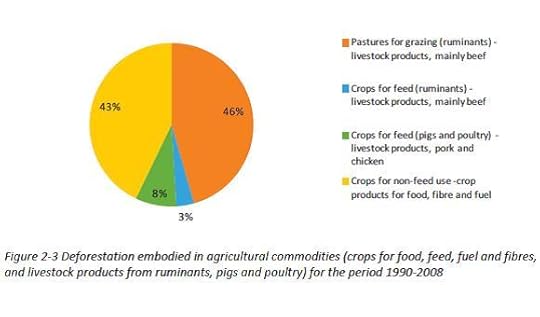
There are a host of other negative environmental effects associated with animal agriculture related to water consumption, disposal of animal waste, use of antibiotics and hormones, and even the one no one truly knows whether to believe or not – the problem of cattle flatulence causing global warming.
There’s one unavoidable conclusion: If we all ate the Ape Way, our species’ collective impact on this Earth would be a lot lighter – figuratively and literally.
This doesn’t just mean less meat. Yes, less meat is vital.
But almost equally important is to stop being addicted to food excess in general. The only hope for our abiding personal fulfillment, and for the conservation of our environment, is for us to have minds less greedy – to go hungry sometimes, like we were designed to.
The topic of our state of mind links to the most compelling reason to eat the Ape Way. This reason has nothing to do with apes. Instead it has to do with our most human potential: our potential for compassion.
The Compassionate Ape
Some estimates are that fifty six (56) billion farm animals are killed every year to feed humans. That excludes fish and sea creatures. The land of the free, and its friends across the Atlantic, lead the way in this slaughter, but the rest of the world is not far behind.
The average city-dwelling meat eater doesn’t see the destruction of 56 billion sentient beings behind the neatly packed, red, juicy products displayed under florescent lights, next to the manager’s special offers on an array of flesh.
One hundred thousand times every minute, the diabolical business of meat obliterates the basic desire of an animal to live .
Shocking if you’re a farm animal! The human meat addiction, nurtured by big business, kills 100,000 land creatures per minute.
But shocking too if you’re a so-called enlightened human being. We should be outraged at ourselves – outraged that the prevailing lie on our need for meat has reduced a vast section of the human species to unconsciousness at best, and psychopathic violence at worst.
We buy that meat off the shelf, by the kilogram, and we go to our suburban homes to cook it, and eat it, and laugh with friends and wine. And after… we scoop the left-overs into the bin. Not a second thought.
We’ve lost our most human, and most wondrous, capacity – the capacity to be conscious, and connected and compassionate. No, we haven’t lost it – it has been stolen by the forces of consumerism.
The main reason to eat the Ape Way is that eating meat should be an expression of gratitude. It should be a mindful celebration of the cycle of life, and our short time in it. We must eat vastly less meat so that we can appreciate every ounce of the life it came from.
2% amounts to 10 or 15 meat meals per year.
These should be special times. Times when we celebrate in a different way to the common way. Instead of our typical celebrations of excess – excess food, excess noise and excess groping for fleeting illusions of happiness – let us take a moment of celebratory silence over our food gift, and relate to creation and our humble place in it. Let us be thankful for the small portions on our plate, and experience the joy of less.
And maybe, let us be moved to tears of compassion. Then even 2% meat might not be palatable.
The post The Ape Way appeared first on Michael Howard.
October 25, 2018
Stop Purity Culture
 Stop Purity Culture
(5-minute Read) A friend posted an article on Facebook about the ‘purity culture’ prevalent in religion, and particularly in American evangelical Christianity.
I was struck by how religious corruptions of modesty have made women into devilish creatures walking around tempting decent men. This religious abomination divides men and women respectively into self-righteous agents of God’s will, and inferior beings not to be trusted. It’s no wonder misogynism is rife.
Still the Dark Ages
I thought most of this had been left in the days preceding the enlightenment. But not so, I feared. It is still implicitly pervasive, if not explicitly stated, in our cultures, especially where religion plays a major role in shaping them.
As I looked at the post, another Facebook user – not one of my friends – commented, as if to confirm my fear. He wrote to the affect that it is not helpful to go to the other extreme. He wrote that we should not be telling women that using their bodies for fun is the right thing to do, as this results in decent men rejecting them due to their past promiscuity.
Now, I’m a peaceful person – or at least I am committed to trying to be peaceful. But this comment got me fired up for a whole lot of reasons.
What Was He Thinking?
Firstly, who are the ‘we’ he refers to that should not be telling women things? Are ‘we’ the men? And are the women then just compliant sub-men, waiting for us to tell them what is right and wrong? I reject that vehemently – so that little word ‘we’ waved like a red flag in front of my eyes in the Facebook comment box.
I had to ask, firstly, why he felt men should (and could) ‘reject’ women, and secondly, what defined this ‘decency’ he claimed.
He responded with a long rant about me demonising someone (him) who holds sex sacred, and rolled out a whole litany of arguments defending his views. His views, and his self-righteous tone, were so foreign to my mind set that I didn’t know where to begin to respond – so I didn’t. I decided to write this blog article instead. Besides, we were off the topic of my friend’s original post.
Since my friend’s posted article was in a religious context, let’s stay in that context.
The Problem of Self-Righteousness
Self-righteousness is common among religious people. It has its roots in the strong man archetype – the domineering ruler over the Earth, and patriarchal leader of the family. The male god. But self-righteousness doesn’t only appear in misogynistic men today – it rears its ugly head whenever bigots place themselves above other tribes. And it’s not only a religious phenomenon. It’s an ego-perseverance thing.
The perfect contemporary example of the violent, self-righteous and powerful man is Samuel L. Jackson in Pulp Fiction. You know the scene – the one voted the fourth best movie speech in history – where he quotes Ezekiel 25:17* just before he and John Travolta pump some poor dude full of lead.
* Note: most of the speech is not in Ezekiel 25:17. The speech is actually a string of phrases taken out of context from other places in the Bible. But the last two sentences are Ezekiel 25:17. The whole thing is often erroneously believed to come from the Old Testament.
Jackson’s famous words are: “The path of the righteous man is beset on all sides by the inequities of the selfish and the tyranny of evil men. Blessed is he, who in the name of charity and good will, shepherds the weak through the valley of darkness, for he is truly his brother’s keeper and the finder of lost children. And I will strike down upon thee with great vengeance and furious anger those who would attempt to poison and destroy my brothers. And you will know my name is the Lord when I lay my vengeance upon thee.”
Dramatic stuff. It gets the blood pumping for anyone who feels inclined to attack an outsider – to attack that which is perceived as a threat to personal and/or group identity. Self-righteousness is glorified as the way to get ahead and to win. It’s as much a foundation of nationalism, racism or any other ‘ism’ as it is at the heart of sexism.
Pulp Fiction’ Quentin Tarantino leaves us with the message that self-righteousness has to go. Jackson’s character has a change of heart towards the end of the movie.
But unfortunately, it’s the impassioned speech, building up to explosive violence that sticks in our popular culture – as evidenced by it being rated so highly by the voting public.
The Worst Kind: Against Women
Let’s turn specifically to the subject of self-righteousness against women. My friend’s article shows it’s still very prevalent in Christian ‘purity’ circles. It underlies women’s tolerance of misogynistic men, and men’s presumptions that they have a right to judge a woman’s sexuality and how she chooses to express it.
But what did Jesus say about women and their sexual wrong-doing.
Consider three Bible verses:
John 8:1-11. The adulteress.
Luke 7:36-50. The weeping woman.
Matthew 21:31. Publicans and prostitutes.
I won’t repeat the verses here, but they tell us the following through one of the wisest voices in history:
Don’t judge or condemn anyone for you have no idea what is in their heart and what they’ve been through. Rather view everyone with understanding and compassion.
Look rather at yourself. Consider your wounds and the aspects of yourself and your life that have lead you to where you are. Apply the same compassion.
Hold up unconditional love as paramount in your life. And with this comes unconditional forgiveness.
Be careful not to be deceived by hypocrites. In the Matthew verse above, Jesus tells the chief priests, the teachers of the Law and the Jewish authorities in the Temple that prostitutes are ahead of them on the way to the kingdom of Heaven. This is surely the ultimate indictment against self-righteousness, which is always hypocritical because none of us is perfect. It’s a pity this speech is not voted amongst the best of all time.
So, in conclusion, let us stop looking down on others. Let us focus on, and manifest, the streams of unconditional love and peace that exist in all our religions, and all our hearts. We are all wounded – those who stop looking outward and accept their own wounds with love and forgiveness, will be healed. This is a powerful psychological dictum today… and it is as ancient as the earliest wisdom traditions. Love can heal our own psyches, and it can heal our societies.
Follow the conversation on Facebook.
The post Stop Purity Culture appeared first on Michael Howard.
August 9, 2018
The Veil
What’s your veil? What keeps you deluded? Is it a chemical addiction? An attachment to someone? Or a religion? Maybe it’s positive psychology, pep talks and the law of attraction. Or just your day to day bump and grind that has you motivated and inspired.
What is it that keeps you going in this insane world? What drives you to keep living your life, without imploding into a heap of existential meaninglessness?
Are you aware that absolutely everything you spend your time doing or believing, is aimed solely at keeping you from imploding.
If you stop, you’re in trouble. We all are.
Because when we stop and look beyond the veil, the suffering and pain is too much to bear. The experience of our failures and faults is devastating to everything we pend our lives trying to create. The full illumination of our sick world cripples us with sorrow and compassion.
When you get a peep through the veil, a troubling question arises: what is the meaning of this sick world, this short and painful existence of a self? This question is deeply upsetting to ‘normal’ life, because it lays the human condition raw and festering… and we have no answer.
So we draw back and stay content in our delusion again, we stay secure behind whatever veil has come to keep us from confronting that disturbing question.
Ah, but doing good and spending my time in the right ways gives me peace, you argue.
Spending my time ‘right’ may be good at giving me a sensory experience of meaning.
But it does not address the existential question, what is the meaning of it all?
So in a way, spending my time ‘right’ is like thickening the veil of delusion.
We can live busy, fruitful and successful lives, all the while keeping ourselves docile, drugged, avoiding the real angst that is unavoidable and unsolvable. In fact, the most successful ones in this world are often the most deluded.
We can, and most often do, spend entire lifetimes never asking the existential question, what is the meaning of it all?
And those that do ask, and suffer under the weight of this agonisingly unanswerable question, we cast aside as unsuccessful, antisocial, depressed or simply weak-livered. They are the poor, the weak in spirit. They have not found the way to live right, because they have not thickened their veil and deluded themselves into happiness.
Blessed are the poor in spirit, for it is harder for a rich man to get to heaven than for a camel to pass through the eye of a needle.
I’ve seen it too many times. The rich – the ones with a good veil – are unprepared for the most inevitable thing in life. Their death. I’ve seen devout religious believers on their death bed clinging to this life, unable to accept their imminent departure from it.
And I’ve seen those that are ready to go. Their’s is the kingdom of heaven. In their eyes I see true peace. The peace that come from looking beyond the veil.
I don’t know what they see. But whatever it is, I am preparing to see it too.
I’m preparing by spending time staring through the veil of things that keep me busy. I sit as often as possible contemplating life and death, pain and suffering, and, in deep humility, my flawed and intrinsically selfish human condition. I open myself completely to the possibility of nothingness – the possibility that it is all really and truly meaningless. I accept the unbearable sadness.
Then, a funny thing happens. A peace and love mysteriously comes over me. In the silence, staring into the cloud of unknowing behind the veil, an altogether different sense of existence dawns upon me, usually only for a brief moment. I can only use the language of people who have experienced it before me to describe it:
non-dualism
or
mystical union
or
true self
or
love
or
God.
Those are the words. But they too can become a veil.
Forget the words. Forget everything. Just let go. Sit in the silence of not knowing.
And wait on the grace of the mystery beyond the veil to come upon you.
Then you will be free. Free of your veil, and free of the pain you thought you could not bear.
And when you rise from your silence, you will be energised to live every moment in full joy and gratitude, courageous and indifferent to self, ready to follow and serve, in humble acceptance of your smallness in the awe of the mystery of this unknown existence.
The post The Veil appeared first on Michael Howard.
July 2, 2018
Praying Wrong
 How To Pray
(5-Minute Read) – I can’t even tell you how many times I heard, “We’re praying for Gina.”
But my wife still deteriorated. She still couldn’t seem to find peace, and she died too young after ten years of suffering.
Were all of us praying wrong?
Does God answer prayers?
I’ve heard the argument that God may not answer your prayers, not because he loves you any less, but because it’s his choice and only he knows his reasons. That’s not a very satisfactory answer. It implies there is something that qualifies one to be answered, for whatever reason, while another is unfortunately denied. There’s no all-loving ring to that.
It sounds more like a lotto. A game of chance. You could get answered, if you’re fortunate. Or maybe not if the dice doesn’t fall right.
Or God decides based on some criteria that we don’t know, but somehow must grade or rank people and their requests in some way. It all sounds a bit contrived and juvenile. Surely God is a more nuanced and awesome concept than that. Surely we cannot judge whether God answers prayers like we would judge how a person responds to a question. Isn’t the question ‘does God answer prayers’ ridiculous to begin with?
Making God in our image
Many people seem to believe in a god who blesses this one and doesn’t bless that one. In their schema, God just never gave Gina his blessings for some reason.
That’s not fair. That sounds too human – to subject to our human type of biased judgement.
Surely, a loving God is above this differentiation. Surely he either spreads bliss to all, or he gives it to none. Or, he simply has nothing to do with that level of creation.
A God of infinite love would not ‘approve’ of any petitions since they’re all made by ego-consciousness. Praying is asking for blessing in one or another form for ourselves, our families or our communities. It is always based on personal emotions and thoughts, on judgments of what is right and wrong, good and bad. It presumes to know God’s mind, and appeals to him as a judge hearing our case.
The focus is all wrong
It suits many people to think of God as the judge. The almighty one who is generous to those who beg. Some have discarded that ‘white-haired old man’ image of God for a more sophisticated reward system. These more contemporary, humanistic perspectives think of God as within us, a generous synchronicity in the universe that rewards those who manifest what they want through their own positive thought.
It doesn’t matter how we frame it.
What it boils down to is that many of us think we deserve something and that we’ll get it if we beg, and if we do A, B and/or C. If we don’t get it we’ve done something wrong that has put us out of favour with the giver, or we’re doing something incorrectly that’s causing un-manifestation.
The problem is we’re seeing the world and our place in it from a personal ego perspective. We are wanting things, asking for things and believing that we will have things. Our attention is habitually turned upon ourselves and our lives. We think our problems and challenges are priority number one in absolute terms, and we think the solutions we seek are significant in themselves beyond our lives.
But this is not true. Our problems and challenges are not priority number one to anyone but ourselves. The solutions we seek are not very significant in the grand scheme of things. Our perspectives are highly limited at best, and totally incorrect, at worst.

Thy will be done
I’ve come to the conclusion that there’s only one ‘how to pray’.
It is, “Thy will be done.”
And what it really means to me is there is not an answer to prayers in the sense of some assessment of a request and decision on whether to grant it or not. There is merely nature with all its imperfections. There are people with all their glory and their darkness. What will be, will be. And everything is as it is meant to be.
“Thy will be done,” means I have no desire to ask for anything. I want nothing. Instead I am totally accepting. It means I have no desire to have anything my way. I have no ‘my way’.
Paradoxically when we discard prayer from the perspective of self, we discover contentment. Everything is nothing and nothing is everything. We forget ourselves and become instead vehicles of compassion for the world and the suffering in it. We become truly God-like in our self-sacrificing solidarity with creation. A connected life evolves – a life of involvement in the imperfections, and gratitude for the perfections. A life that is free of blessings and curses. An experience of beautiful emptiness that can only be filled by the divine.
In the words of Khalil Gibran:
And I cannot teach you the prayer of the seas and the forests and the mountains.
But you who are born of the mountains and the forests and the seas can find their prayer in your heart,
And if you but listen in the stillness of the night you shall hear them saying in silence,
“Our God, who art our winged self, it is thy will in us that willeth.”
The way it is
Gina had a genetic mutation. She was not loved less. She was not cursed. Not all the prayer in the world, nor the ‘miraculous’ waters of Lourdes could change her faulty genes. She couldn’t manifest a change if she’d had ten lifetimes to try.
There is no God in the sky, or within us, or anywhere that received her petitions and decided whether or not to intervene with a miracle.
What there is, is Love beyond us and within us. We learn the infinite beauty of this Love through pain, suffering and imperfections in this world, not through all the things our egos desire. We learn this Love through a selfless and ego-less relationship with it. This Love, call it God if you like, is not definable, not nameable and not knowable in any symbolic way. We know it only through silence. Through letting go. Listening not talking. Accepting not asking.
Gina died and went into the metaphorical arms of Love. Her suffering – what some adjudged to be her curse – was her salvation.
I don’t pray much anymore… there’s no need. Everything is nothing, and nothing is everything, in the arms of Love.
My novel “On The Fifth Night” takes you into ‘the arms of Love’. Click here to get an e-book or paperback.
The post Praying Wrong appeared first on Michael Howard.