
K.V. Flynn's Blog
December 4, 2014
K.V. Flynn Answers some Romance Questions!
Hey, took a break from writing (and skating) to visit a blog this week. Therese asked me a lot of questions about love and romance, which isn't really a part of ON THE MOVE or anything. But some nice things to think about--because we love books, and what people do for us, too. So check out what I had to say!
She sent along four questions, which I answered sometimes as my middle-school me because I'm writing my prequel, On the Rim, and that's where my head is all day long! Romance is a different sort of thing for 9-14-year-old boys, I think—it’s either not interesting or there’s that growing tension between hanging with your pals or taking time with a cute girl. Some of her readers are moms of skaters and young men--maybe some of my readers here are, too! Who knows? I always think that my book is good reading for anybody's teens.
1. What book left me feeling all sad and missing it, when it ended? When I think about that bereft feeling of loss at the end of a story, the first thing that comes to mind is watching Iron Giant with a kid friend of mine who was about nine at the time. Maybe because the movie was also about a nine-year-old or maybe because it was just awesome storytelling, but we both watched the film and loved it, walked out into the hall outside the movie theater, and burst into tears. Two guys just standing there blubbering and sad that the Giant had been blown apart...even though, hopefully, his parts were finding one another again and would come back together! We also read The Book Thief together and I know I cried reading the ending, it was sad, too. Really wonderful story. And I keep going back to be in the magical baseball fantasy world of Michael Chabon’s Summerland—otherwise I’d be too sad to leave that one, too.
2. Most loving thing I've ever did as a kid? Okay, so my mom gave my dad a Weimeraner puppy before I was born and it sat on the sofa with her every night, she says, until I came along. Grace was her name, and she was ten months old when I arrived and became officially in charge of me. When we moved to the country a year or so later and I’d take myself out for a walk, she would follow alongside my two-year-old self just making sure I didn’t topple into the pool or get lost in the cherry tomato field next door. She lived to be over sixteen years old, and it was really tough for everyone when she had to be put to sleep. So I asked my stepmother, who is a very cool painter, to silkscreen one of her paintings of Grace on to a silk lamp for my mom for Christmas that year. She still has it on her desk so Grace can watch over her, now that I’m not there.
3. Most loving thing done for me as a kid? My mom read to me literally every night before I went to sleep until I basically left for college. Sure, we missed a few evenings, and some nights in middle school and high school I stayed over at my dad’s. But we had a LOT of reading time together. Definitely the best books of my life. Yes, all the Harry Potter books and the Narnia Chronicles, most of which we did not even understand. Hunger Games rocked our world. So did Auntie Mame and Huckleberry Fin and Absolutely True Adventures of a Part Time Indian and Rumble Fish and That was Then This is Now. I can’t list them all but each one was like a magical thing we shared together, and a story that gave me a place to dream into as I fell asleep.
4. Most was my most romantic song as a teenager?...School’s Out For the Summer…School’s Out FOREVER! It means, tons of straight free time to be with your best buddies, sleep in, and skate until the shadows grow long.
I hope you guys (or moms out there) will check out On the Move for teen readers. Especially if they’re skaters!
I love to hear from them, too, so feel free to talk back!
KVFlynnOnTheMove@gmail.com, or check me out on Facebook/OntheMoveBooks or onthemovebooks.tumblr.com.
And please find my book here:
AMAZON: http://goo.gl/W0A2Zg
Barnes & Noble: http://goo.gl/KuY8EI
SMASHWORDS: http://goo.gl/WM0s59
KOBO: http://goo.gl/45hFgD
She sent along four questions, which I answered sometimes as my middle-school me because I'm writing my prequel, On the Rim, and that's where my head is all day long! Romance is a different sort of thing for 9-14-year-old boys, I think—it’s either not interesting or there’s that growing tension between hanging with your pals or taking time with a cute girl. Some of her readers are moms of skaters and young men--maybe some of my readers here are, too! Who knows? I always think that my book is good reading for anybody's teens.
1. What book left me feeling all sad and missing it, when it ended? When I think about that bereft feeling of loss at the end of a story, the first thing that comes to mind is watching Iron Giant with a kid friend of mine who was about nine at the time. Maybe because the movie was also about a nine-year-old or maybe because it was just awesome storytelling, but we both watched the film and loved it, walked out into the hall outside the movie theater, and burst into tears. Two guys just standing there blubbering and sad that the Giant had been blown apart...even though, hopefully, his parts were finding one another again and would come back together! We also read The Book Thief together and I know I cried reading the ending, it was sad, too. Really wonderful story. And I keep going back to be in the magical baseball fantasy world of Michael Chabon’s Summerland—otherwise I’d be too sad to leave that one, too.
2. Most loving thing I've ever did as a kid? Okay, so my mom gave my dad a Weimeraner puppy before I was born and it sat on the sofa with her every night, she says, until I came along. Grace was her name, and she was ten months old when I arrived and became officially in charge of me. When we moved to the country a year or so later and I’d take myself out for a walk, she would follow alongside my two-year-old self just making sure I didn’t topple into the pool or get lost in the cherry tomato field next door. She lived to be over sixteen years old, and it was really tough for everyone when she had to be put to sleep. So I asked my stepmother, who is a very cool painter, to silkscreen one of her paintings of Grace on to a silk lamp for my mom for Christmas that year. She still has it on her desk so Grace can watch over her, now that I’m not there.
3. Most loving thing done for me as a kid? My mom read to me literally every night before I went to sleep until I basically left for college. Sure, we missed a few evenings, and some nights in middle school and high school I stayed over at my dad’s. But we had a LOT of reading time together. Definitely the best books of my life. Yes, all the Harry Potter books and the Narnia Chronicles, most of which we did not even understand. Hunger Games rocked our world. So did Auntie Mame and Huckleberry Fin and Absolutely True Adventures of a Part Time Indian and Rumble Fish and That was Then This is Now. I can’t list them all but each one was like a magical thing we shared together, and a story that gave me a place to dream into as I fell asleep.
4. Most was my most romantic song as a teenager?...School’s Out For the Summer…School’s Out FOREVER! It means, tons of straight free time to be with your best buddies, sleep in, and skate until the shadows grow long.
I hope you guys (or moms out there) will check out On the Move for teen readers. Especially if they’re skaters!
I love to hear from them, too, so feel free to talk back!
KVFlynnOnTheMove@gmail.com, or check me out on Facebook/OntheMoveBooks or onthemovebooks.tumblr.com.
And please find my book here:
AMAZON: http://goo.gl/W0A2Zg
Barnes & Noble: http://goo.gl/KuY8EI
SMASHWORDS: http://goo.gl/WM0s59
KOBO: http://goo.gl/45hFgD


November 17, 2014
YA/MG Diversity: The Characters of ON THE MOVE
Hey, ON THE MOVE is out in paperback and Hollie at READ.RANT.REVIEW invited me to blog a bit about Diversity in the YA/MG book world.You can read it here: http://ow.ly/E2ejJ. But this is what I shared with her:
Thanks, Hollie, for inviting me to guest blog here on diversity in YA/MG fiction. Excellent. Maybe because of the multi-cultural cast of teenagers in my new book On the Move? Or maybe because... it’s an interesting subject to talk about!
So here’s the thing. I actually think that diversity in all contemporary media is pretty important on a lot of levels. It’s good storytelling. It’s representative of the world we live in. It’s aspirational so it sets great example and inspiration for young readers figuring out the many roles and realities they can grow into. And, as was reported in the recent Columbia University Latino Media Gap study that I helped with, “as stories often carry more weight in the public’s mind than other forms of communication, the absence and stereotypical nature of existing stories also promotes a lack of empathy and, at times, outright violence against” unrepresented or under-represented races, cultures, and non-majority components of our community. So we’ve gotta check that with what we write and how we read.
Gauging from the discourse at Read.Rant.Review, your readers are passionate about this, too. But unfortunately—and this may surprise you, but I’ve looked at and worked on many studies that bear this out—diverse representations are not actually considered a pressing public “good,” where the American consumer is concerned. It is hard to translate our commitment to seeing multi-cultural characters and images into concrete social change, and difficult to activate a passion for diverse YA fiction into actual diverse YA fiction. Yes, yes, our parents and teachers like us to read all about everybody. And we have awards and stuff around positive images from GLAAD to NAACP to ALMAs and beyond. All awesome.
But you still get amazing strong actresses like Anne Athaway and Jessica Chastain in big movies like Interstellar “saddled playing brilliant women who are nonetheless ruled by their, you know, lady feelings, before ultimately capitulating to the men around them” (The Wrap review). You still find that, according to USC and GLAAD, the 100 most watched television shows and highest-grossing films last year underrepresented nonwhite characters in speaking roles, with the percentage of Latinos being particularly out of step with the real world. You have YA fiction dystopias from Hunger Games to Divergent to, well, name one, that are weirdly mostly all Caucasian. And we get a whole GamerGate scene around someone advocating with intelligence for less mysogeny in video games while the haters tell us to keep feminism out of MMOGs.
The better news is that the hip leaders on the YA fiction landscape get the fact that diversity is a smart investment. The tricky thing, though, is that this idea isn’t yet widely shared. (Yeah, even deep in the 21st century... as America swifty becomes minority majority in many staes... go figure.) Some of this is actually about the money guys, as most creators and distributors of fiction intersect with companies or power structures that disseminate or recognize their stories. Unfortunately, even with all the lipservice paid within publishing houses and motion picture/tv studios to multi-cultural stories, to hiring more women and minorities, to making media on all platforms look more like the audiences who consume it, “diversity is not yet a true institutional value. In the words of one executive: ‘Diversity has never been an intrinsic part of the institutional fabric. Diversity is like a Christmas ornament that you bring out and after it’s over, you put it away’ (Interview, Washington, D.C. television executive). Or as one diversity officer bluntly put it, ‘Diversity officers are managers of discontent and get paid well to do it’ (Interview, Hollywood guild representative)” (Latino Media Gap, Columbia Center for the Study of Ethnicity and Race).
The reason we still have a problem with diversity in fiction—whether YA novels or movies or tv, webseries or games—is different on the level of readers and critics and buyers/consumers than on that of the artists who generate fiction content. We both have a powerful role to play. You can buy or not buy stuff, analyze and critique with your readers and cohort while voicing your support for stories that get it right, plus you can always boycott advertisers who support cultural devaluations or misrepresentations because that’s been connected on occasion to incremental change. All of these strategies have been shown to have varying levels of success in impacting diversity in future work.
Writers, on the other hand, have the power to create juicy, complex characters and representative worlds. Unfortunately, writers also often stand as the frontline resistance to change. In the Columbia University study, we discovered that, “In media, poor representation of minorities is directly attributed to the homogeneity of writers and decisionmakers. As network diversity executives have told us, ‘ask a writer to add diverse people to the script and the white writer will flip out and say “the character is everything, I can’t change him.” When the writer says, “I don’t feel it,” the showrunner generally sides with him. At best, you will get a diverse sidekick character or “fruit salad: background where the characters do not make significant contributions to the story.’” This happens in publishing and editorial rooms, too.
My personal approach to creating the On the Move trilogy, though, was different. I write about teen skateboarders in a Southern California beach community and summer camp. It’s a naturally diverse environment. Middle school friends of the narrator include a Native American kid and his older cousin, a Mexican-American boy and his family, and a Black skater who they meet at camp. The narrative levers don’t involve familiar stereotypes like, as critic Debbie Reese describes it, the Native character being “the sidekick who will be the first to die.”
Of course not! As she goes on to say about Obbie, “He's the real deal. That is, a Native kid who is grounded in his identity as a Native kid. It is a natural part of who he is--which is, one of several boys who hang out together. They are skateboarders.” The same can be said of the other diverse teens in the book, such as Latino eighth grader Mateo: his story has nothing to do with familiar issues like immigration or the border; he just plays drums, goes to school, skates, and has a kick-ass sister who’s a strong surfer and makes chocolate-chip pancakes. I wanted the young women friends and relations of the central boys in this book to be bright, strong, and resourceful, too.
Now, I hear around Read.Write.Review from blogger Saundra Mittchell and others that there is some probing as to YA being a niche “women’s art” and a “novelty creation only for girls.” She suggests that, to raise young men well, we should get them to read more feminine-centric YA fiction, and work against a boy reader’s notion that “it’s a hardship for men to have to relate to anything that doesn’t specifically cater to them.”
I think this is a sticky tactic when it comes to supporting diversity in YA fiction: books absolutely open horizons, but it’s great to crack the door with stories and arenas that super interest a reader... I chose to write for teen boys because there’s a bit of a paucity of excellent series in the tradition of “girls” YA fiction that focus on 12-15-year-old males. And I certainly believe, as Columbia’s Prof. Negron-Muntaner said on the Huffington Post, that there actually is a "growing and profound disconnect between the characters you see on screens and TV, and who is sitting next to you on the bus, teaching your children how to read or coming to your rescue in case of a fire." So, for me, artistic activism comes from reflecting the multi-cultural world we live in, in an entertaining way. And I think that we will build boys’ “attraction to literacy” by giving them books about scenes they happen to love just as much as girls enjoy other stories.
I find that it is fun to write about real teens and the world they live in, so that’s a plus for authors including this in their work. I think diverse fiction makes for the best stories, too. It’s these books that are going to really connect with MG and YA readers ultimately because they’re honest, complex,amusing, engaging. I believe that they will endure, and have impact on those readers who immerse themselves in multi-cultural worlds. And I agree with the most progressive thought leaders in diverse fiction: given YA audiences today, this is also solid business.
Thanks for having me. And I hope you’ll have your readers check out On the Move by K.V. Flynn on Amazon, B&N, Smashword—wherever they love finding books—in eBook or paperback!
Amazon: http://goo.gl/W0A2Zg
Barnes & Noble: http://goo.gl/KuY8EI
Smashwords: http://goo.gl/WM0s59
Thanks, Hollie, for inviting me to guest blog here on diversity in YA/MG fiction. Excellent. Maybe because of the multi-cultural cast of teenagers in my new book On the Move? Or maybe because... it’s an interesting subject to talk about!
So here’s the thing. I actually think that diversity in all contemporary media is pretty important on a lot of levels. It’s good storytelling. It’s representative of the world we live in. It’s aspirational so it sets great example and inspiration for young readers figuring out the many roles and realities they can grow into. And, as was reported in the recent Columbia University Latino Media Gap study that I helped with, “as stories often carry more weight in the public’s mind than other forms of communication, the absence and stereotypical nature of existing stories also promotes a lack of empathy and, at times, outright violence against” unrepresented or under-represented races, cultures, and non-majority components of our community. So we’ve gotta check that with what we write and how we read.
Gauging from the discourse at Read.Rant.Review, your readers are passionate about this, too. But unfortunately—and this may surprise you, but I’ve looked at and worked on many studies that bear this out—diverse representations are not actually considered a pressing public “good,” where the American consumer is concerned. It is hard to translate our commitment to seeing multi-cultural characters and images into concrete social change, and difficult to activate a passion for diverse YA fiction into actual diverse YA fiction. Yes, yes, our parents and teachers like us to read all about everybody. And we have awards and stuff around positive images from GLAAD to NAACP to ALMAs and beyond. All awesome.
But you still get amazing strong actresses like Anne Athaway and Jessica Chastain in big movies like Interstellar “saddled playing brilliant women who are nonetheless ruled by their, you know, lady feelings, before ultimately capitulating to the men around them” (The Wrap review). You still find that, according to USC and GLAAD, the 100 most watched television shows and highest-grossing films last year underrepresented nonwhite characters in speaking roles, with the percentage of Latinos being particularly out of step with the real world. You have YA fiction dystopias from Hunger Games to Divergent to, well, name one, that are weirdly mostly all Caucasian. And we get a whole GamerGate scene around someone advocating with intelligence for less mysogeny in video games while the haters tell us to keep feminism out of MMOGs.
The better news is that the hip leaders on the YA fiction landscape get the fact that diversity is a smart investment. The tricky thing, though, is that this idea isn’t yet widely shared. (Yeah, even deep in the 21st century... as America swifty becomes minority majority in many staes... go figure.) Some of this is actually about the money guys, as most creators and distributors of fiction intersect with companies or power structures that disseminate or recognize their stories. Unfortunately, even with all the lipservice paid within publishing houses and motion picture/tv studios to multi-cultural stories, to hiring more women and minorities, to making media on all platforms look more like the audiences who consume it, “diversity is not yet a true institutional value. In the words of one executive: ‘Diversity has never been an intrinsic part of the institutional fabric. Diversity is like a Christmas ornament that you bring out and after it’s over, you put it away’ (Interview, Washington, D.C. television executive). Or as one diversity officer bluntly put it, ‘Diversity officers are managers of discontent and get paid well to do it’ (Interview, Hollywood guild representative)” (Latino Media Gap, Columbia Center for the Study of Ethnicity and Race).
The reason we still have a problem with diversity in fiction—whether YA novels or movies or tv, webseries or games—is different on the level of readers and critics and buyers/consumers than on that of the artists who generate fiction content. We both have a powerful role to play. You can buy or not buy stuff, analyze and critique with your readers and cohort while voicing your support for stories that get it right, plus you can always boycott advertisers who support cultural devaluations or misrepresentations because that’s been connected on occasion to incremental change. All of these strategies have been shown to have varying levels of success in impacting diversity in future work.
Writers, on the other hand, have the power to create juicy, complex characters and representative worlds. Unfortunately, writers also often stand as the frontline resistance to change. In the Columbia University study, we discovered that, “In media, poor representation of minorities is directly attributed to the homogeneity of writers and decisionmakers. As network diversity executives have told us, ‘ask a writer to add diverse people to the script and the white writer will flip out and say “the character is everything, I can’t change him.” When the writer says, “I don’t feel it,” the showrunner generally sides with him. At best, you will get a diverse sidekick character or “fruit salad: background where the characters do not make significant contributions to the story.’” This happens in publishing and editorial rooms, too.
My personal approach to creating the On the Move trilogy, though, was different. I write about teen skateboarders in a Southern California beach community and summer camp. It’s a naturally diverse environment. Middle school friends of the narrator include a Native American kid and his older cousin, a Mexican-American boy and his family, and a Black skater who they meet at camp. The narrative levers don’t involve familiar stereotypes like, as critic Debbie Reese describes it, the Native character being “the sidekick who will be the first to die.”
Of course not! As she goes on to say about Obbie, “He's the real deal. That is, a Native kid who is grounded in his identity as a Native kid. It is a natural part of who he is--which is, one of several boys who hang out together. They are skateboarders.” The same can be said of the other diverse teens in the book, such as Latino eighth grader Mateo: his story has nothing to do with familiar issues like immigration or the border; he just plays drums, goes to school, skates, and has a kick-ass sister who’s a strong surfer and makes chocolate-chip pancakes. I wanted the young women friends and relations of the central boys in this book to be bright, strong, and resourceful, too.
Now, I hear around Read.Write.Review from blogger Saundra Mittchell and others that there is some probing as to YA being a niche “women’s art” and a “novelty creation only for girls.” She suggests that, to raise young men well, we should get them to read more feminine-centric YA fiction, and work against a boy reader’s notion that “it’s a hardship for men to have to relate to anything that doesn’t specifically cater to them.”
I think this is a sticky tactic when it comes to supporting diversity in YA fiction: books absolutely open horizons, but it’s great to crack the door with stories and arenas that super interest a reader... I chose to write for teen boys because there’s a bit of a paucity of excellent series in the tradition of “girls” YA fiction that focus on 12-15-year-old males. And I certainly believe, as Columbia’s Prof. Negron-Muntaner said on the Huffington Post, that there actually is a "growing and profound disconnect between the characters you see on screens and TV, and who is sitting next to you on the bus, teaching your children how to read or coming to your rescue in case of a fire." So, for me, artistic activism comes from reflecting the multi-cultural world we live in, in an entertaining way. And I think that we will build boys’ “attraction to literacy” by giving them books about scenes they happen to love just as much as girls enjoy other stories.
I find that it is fun to write about real teens and the world they live in, so that’s a plus for authors including this in their work. I think diverse fiction makes for the best stories, too. It’s these books that are going to really connect with MG and YA readers ultimately because they’re honest, complex,amusing, engaging. I believe that they will endure, and have impact on those readers who immerse themselves in multi-cultural worlds. And I agree with the most progressive thought leaders in diverse fiction: given YA audiences today, this is also solid business.
Thanks for having me. And I hope you’ll have your readers check out On the Move by K.V. Flynn on Amazon, B&N, Smashword—wherever they love finding books—in eBook or paperback!
Amazon: http://goo.gl/W0A2Zg
Barnes & Noble: http://goo.gl/KuY8EI
Smashwords: http://goo.gl/WM0s59
October 26, 2014
5 Groovy Things I Learned + 5 Excellent ON THE MOVE Skate tricks
I visited Book Lover’s Life last week to talk about five groovy things I found out while researching my new book, ON THE MOVE. And five top skating moves from my characters and their pros. Okay? Excellent. Let’s do it.
1. PEAK Skate Camp is based on a real place up in the San Bernardino Mountains. So, in addition to reading online about it and its awesome sister camps around California and Oregon, I also drove a bunch of kids up there one summer to check it out for myself. It’s a loooong drive from where I live in Southern California but once you hit the base of that mountain and start climbing up towards the tall trees, the lake, and the ring of campsites that ring the water, you are super excited to get there. For a teen skater, the place is heaven: the fantastic courses, the excellent pros, the fresh air, and, like in the book, that unbeatable ramp where you can shoot right out of camp and into the water.
2. Green technology, like the characters in On the Move find at Grass Lake Skatepark, was great to research. First, I discovered all those neat advances in solar charging applications, but then also things like the sidewinder and the soccer ball power source for lights and the jump ropes that can recharge your phone…very cool.
Next I learned all about the glowbugs and the Global High Frequency Network that’s been set up for emergency management and disaster relief—it was totally new territory for me, so fascinating for On the Move and its characters.
3. It was harsh to imagine something as horrible as the War in my book. But I needed to do the research on what would happen and how this kind of disaster might rain down. Where the airports and other targets would be, what would happen to the air, how people could be evacuated to safety. Part of the research was rad, though, because I did go to the Rose Planetarium in New York City and see that movie Levi describes, Cosmic Collisions, about what caused the extinction of the dinosaurs. I learned a lot about fire and smoke and how we can bring on an Ice Age to our planet in a hurry…
4. Speaking of evacuation, I did a lot of research on the geography and local highlights in order to write how On the Move’s characters get from summer skate camp all the way up through to Washington state on their own. What were the roads? The mountains? The towns along the way?
5. And, most important of all…where are the coolest skateparks to visit?! This is a skate safari, after all! A teen skater’s dream. Sure, it’s the scary variety since my kids are alone and things are so uncertain. But since I, as the writer, could send my skaters anywhere, I did tons of research to be sure they hit the most rockin’ spots they could! Livin’ the life! JHF… Just Have Fun!
Okay, new fiver list for your readers. This is about skate tricks. I love seeing these in pictures, so I’m going to slip some in. Book Lover’s Life can decide if they stay, okay?
BONELESS
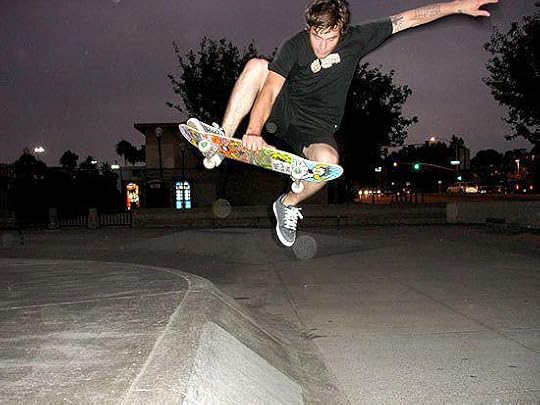
Josh Harmony’s Boneless, when he was on Toy Machine team
As readers of On the Move will learn, a Boneless is an old school trick, and Callum learns to do one at PEAK summer skate camp. You can start slow when you’re learning, but pretty soon you’re gonna need some speed for this trick.
Like in the picture, you grab right behind the front wheels of your board, then take your front foot off the board and plant it fast on the ground. Use that leg to jump!
Then, while you’re in the air, you put that front foot back on the board so you can land with your knees bent and your feet above the truck bolts.
FRONT KROOK
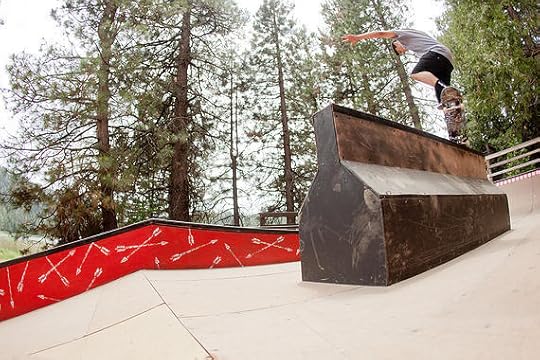
Edgar Barrera, Frontside Crook
So here I want to show you an example of the Front Crook trick in a team picture taken up at Element Skate Camp this past summer. Isn’t Edgar Barrera awesome?
You do it by rolling up the rail you plan on crooked grinding. You’re gonna do it with your front foot behind the front bolts unless it’s a high ledge that you have to ollie high to land on. Ollie like you’re doing a backside 50-50, but put your weight , so you smack your nose down on the edge. If the ledge or rail is waxed, and if you’re really leaning forward, you’re going to grind farther. But don’t look down at your board! Just keep your eyes forward. Do a tiny nollie at the end or pop off mid-ledge with a big one!
FRONTSIDE HALF CAB BOARDSLIDE FAKIE
Dakota Servold does his Frontside Half Cab Boardslide Fakie. Unh, huh.
I like how Dakota describes learning this trick. First he was doing front board fakies. Then he worked his frontside half gaps. This trick combines the two.
What he says is, “You gotta know where you’re popping first and make sure you don’t miss your popper, or sh*t’s gonna go real bad. Make sure you don’t flip, because that will not be tight. Just make sure you pop first and then turn, and make sure you’re looking at the spot you have to pop first for sure, because if you miss your pop on this trick, it’s not fun at all. So learn those, you little bros, then take it to the rails and the curbs and then handrails, then into the wild.” You heard it from the man…
BACKSIDE SMITH
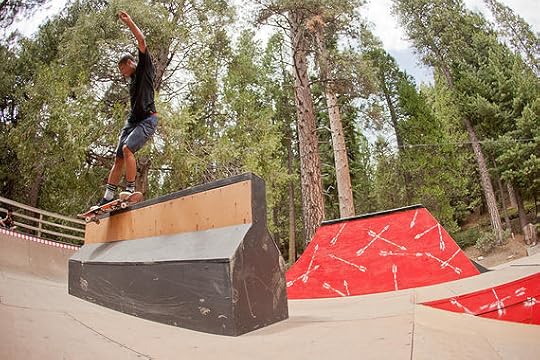
Dominick Walker, Back Smith, Element 2014
In this trick you are grinding your back truck on a rail or an edge while the front one hangs so the edge of your board rubs down the lip. Boarder Mike Smith invented it and it’s a way tough grind. I heard the back Smith was the brainy idea of deaf super shredder Monty Nolder down in Tampa, Florida.
BACKSIDE FLIP
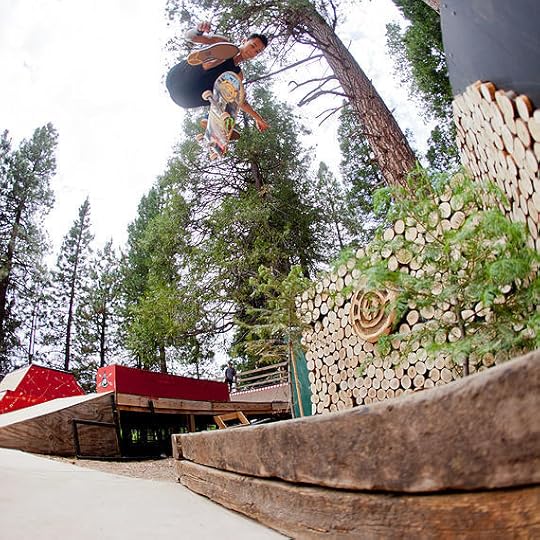
Nyjah Huston, Backside Flip
Isn’t the Element camp dope? Look at those trees! Last summer, Nyjah Huston was caught there doing this Backside Kickflip like the pros do at PEAK camp in On the Move. This trick is another combo, of course: a kickflip combined with a 180-degree ollie. With practice it becomes one of every street skater’s go-to moves! Using your toe you do an ollie, you turn your hips as you rotate 180. Your shoulders turn first, then your board will rotate behind it. Yeah, you’re turning toward your blind side right in the middle of the trick so it takes lots of practice to feel it for real. But then you’ll be flipping with the best!
1. PEAK Skate Camp is based on a real place up in the San Bernardino Mountains. So, in addition to reading online about it and its awesome sister camps around California and Oregon, I also drove a bunch of kids up there one summer to check it out for myself. It’s a loooong drive from where I live in Southern California but once you hit the base of that mountain and start climbing up towards the tall trees, the lake, and the ring of campsites that ring the water, you are super excited to get there. For a teen skater, the place is heaven: the fantastic courses, the excellent pros, the fresh air, and, like in the book, that unbeatable ramp where you can shoot right out of camp and into the water.
2. Green technology, like the characters in On the Move find at Grass Lake Skatepark, was great to research. First, I discovered all those neat advances in solar charging applications, but then also things like the sidewinder and the soccer ball power source for lights and the jump ropes that can recharge your phone…very cool.
Next I learned all about the glowbugs and the Global High Frequency Network that’s been set up for emergency management and disaster relief—it was totally new territory for me, so fascinating for On the Move and its characters.
3. It was harsh to imagine something as horrible as the War in my book. But I needed to do the research on what would happen and how this kind of disaster might rain down. Where the airports and other targets would be, what would happen to the air, how people could be evacuated to safety. Part of the research was rad, though, because I did go to the Rose Planetarium in New York City and see that movie Levi describes, Cosmic Collisions, about what caused the extinction of the dinosaurs. I learned a lot about fire and smoke and how we can bring on an Ice Age to our planet in a hurry…
4. Speaking of evacuation, I did a lot of research on the geography and local highlights in order to write how On the Move’s characters get from summer skate camp all the way up through to Washington state on their own. What were the roads? The mountains? The towns along the way?
5. And, most important of all…where are the coolest skateparks to visit?! This is a skate safari, after all! A teen skater’s dream. Sure, it’s the scary variety since my kids are alone and things are so uncertain. But since I, as the writer, could send my skaters anywhere, I did tons of research to be sure they hit the most rockin’ spots they could! Livin’ the life! JHF… Just Have Fun!
Okay, new fiver list for your readers. This is about skate tricks. I love seeing these in pictures, so I’m going to slip some in. Book Lover’s Life can decide if they stay, okay?
BONELESS
Josh Harmony’s Boneless, when he was on Toy Machine team
As readers of On the Move will learn, a Boneless is an old school trick, and Callum learns to do one at PEAK summer skate camp. You can start slow when you’re learning, but pretty soon you’re gonna need some speed for this trick.
Like in the picture, you grab right behind the front wheels of your board, then take your front foot off the board and plant it fast on the ground. Use that leg to jump!
Then, while you’re in the air, you put that front foot back on the board so you can land with your knees bent and your feet above the truck bolts.
FRONT KROOK
Edgar Barrera, Frontside Crook
So here I want to show you an example of the Front Crook trick in a team picture taken up at Element Skate Camp this past summer. Isn’t Edgar Barrera awesome?
You do it by rolling up the rail you plan on crooked grinding. You’re gonna do it with your front foot behind the front bolts unless it’s a high ledge that you have to ollie high to land on. Ollie like you’re doing a backside 50-50, but put your weight , so you smack your nose down on the edge. If the ledge or rail is waxed, and if you’re really leaning forward, you’re going to grind farther. But don’t look down at your board! Just keep your eyes forward. Do a tiny nollie at the end or pop off mid-ledge with a big one!
FRONTSIDE HALF CAB BOARDSLIDE FAKIE
Dakota Servold does his Frontside Half Cab Boardslide Fakie. Unh, huh.
I like how Dakota describes learning this trick. First he was doing front board fakies. Then he worked his frontside half gaps. This trick combines the two.
What he says is, “You gotta know where you’re popping first and make sure you don’t miss your popper, or sh*t’s gonna go real bad. Make sure you don’t flip, because that will not be tight. Just make sure you pop first and then turn, and make sure you’re looking at the spot you have to pop first for sure, because if you miss your pop on this trick, it’s not fun at all. So learn those, you little bros, then take it to the rails and the curbs and then handrails, then into the wild.” You heard it from the man…
BACKSIDE SMITH
Dominick Walker, Back Smith, Element 2014
In this trick you are grinding your back truck on a rail or an edge while the front one hangs so the edge of your board rubs down the lip. Boarder Mike Smith invented it and it’s a way tough grind. I heard the back Smith was the brainy idea of deaf super shredder Monty Nolder down in Tampa, Florida.
BACKSIDE FLIP
Nyjah Huston, Backside Flip
Isn’t the Element camp dope? Look at those trees! Last summer, Nyjah Huston was caught there doing this Backside Kickflip like the pros do at PEAK camp in On the Move. This trick is another combo, of course: a kickflip combined with a 180-degree ollie. With practice it becomes one of every street skater’s go-to moves! Using your toe you do an ollie, you turn your hips as you rotate 180. Your shoulders turn first, then your board will rotate behind it. Yeah, you’re turning toward your blind side right in the middle of the trick so it takes lots of practice to feel it for real. But then you’ll be flipping with the best!
September 12, 2014
On The Move is published this Month!
Yes, publication month is finally here!
You, too, can now read ON THE MOVE while you're on the move... with your eReader, iPad, iPhone, computer. You name it.
Where?
Amazon: http://goo.gl/JfHH4A
Barnes & Noble: http://goo.gl/Yme3aE
iTunes: http://goo.gl/nt6U03
Smashwords: http://goo.gl/1JEFYx
Amazon UK: http://goo.gl/KOywL4
Kobo: http://goo.gl/xtE0MN
Overdrive—coming soon
Or just click the links on my Goodreads page.
What's it about?
Callum Vicente and his four best middle school buddies live in a Southern California beach town, and narrowly miss being grounded for life after they sneak out of town on the bus for a great skateboard day just before promotion from 8th grade. Their pal Justice ends up with a wicked broken leg, but their parents soon forget about it because weird, tense things are happening in the news. So Callum, Levi and his bff Apollo are soon deep into their best summer ever at PEAK skateboard camp where they learn tricks from the pros, grind on endless street courses, and careen off one awesome ramp straight into the lake. It is mad fun until the War breaks out: the teens watch major cities blown up on TV, have no idea what’s happened to their parents, and then lose virtually all communication with the outside world.
Stranded, the boarder buddies strike out on their own to find their families, travelling north through all of California and Oregon, following a network of underground message boards and savvy riders who they find holed up in skate parks along the way. They pick up their school buddy Mateo Beltran and hitch a ride with their Native friend Obbie, on his way to safety on his dad’s reservation in Washington state, and even get some surprising help as they try to figure out a world gone crazy while they are On the Move.
Check it out! Let me know what you think! KVFlynnOnTheMove@gmail.com
Leave a review!
Skate on...
K.V.
You, too, can now read ON THE MOVE while you're on the move... with your eReader, iPad, iPhone, computer. You name it.
Where?
Amazon: http://goo.gl/JfHH4A
Barnes & Noble: http://goo.gl/Yme3aE
iTunes: http://goo.gl/nt6U03
Smashwords: http://goo.gl/1JEFYx
Amazon UK: http://goo.gl/KOywL4
Kobo: http://goo.gl/xtE0MN
Overdrive—coming soon
Or just click the links on my Goodreads page.
What's it about?
Callum Vicente and his four best middle school buddies live in a Southern California beach town, and narrowly miss being grounded for life after they sneak out of town on the bus for a great skateboard day just before promotion from 8th grade. Their pal Justice ends up with a wicked broken leg, but their parents soon forget about it because weird, tense things are happening in the news. So Callum, Levi and his bff Apollo are soon deep into their best summer ever at PEAK skateboard camp where they learn tricks from the pros, grind on endless street courses, and careen off one awesome ramp straight into the lake. It is mad fun until the War breaks out: the teens watch major cities blown up on TV, have no idea what’s happened to their parents, and then lose virtually all communication with the outside world.
Stranded, the boarder buddies strike out on their own to find their families, travelling north through all of California and Oregon, following a network of underground message boards and savvy riders who they find holed up in skate parks along the way. They pick up their school buddy Mateo Beltran and hitch a ride with their Native friend Obbie, on his way to safety on his dad’s reservation in Washington state, and even get some surprising help as they try to figure out a world gone crazy while they are On the Move.
Check it out! Let me know what you think! KVFlynnOnTheMove@gmail.com
Leave a review!
Skate on...
K.V.
August 6, 2014
Worldwide Blog Hop Posted on 5 August 2014 by K.V. Flynn
It’s blog time, krew. And today, it’s not about skating (surprise!). This is part of a worldwide blog hop for readers and writers called “The Writing Process World Blog Tour.”
How did I get here? Well, another YA writer named Katy Naas invited me. Her debut novel is called THE VISITORS, a science fiction piece that mixes romance and action. It’s about 17-year-old Noah whose planet, Verdant, is visited by “humans” including 16-year-old Jady. Katy wears many hats: Christian; wife; mother to her young son Aven, and her four-legged sons Shakespeare and Poe; teacher of middle school reading and high school English in southern Illinois; and now—her lifelong dream realized—author. From a young age, she was always an avid reader and writer with a big imagination. She spent much of her childhood searching for ghosts and UFOs to no avail—but hasn’t given up the hunt just yet. Though she grows older, her true literature love is and has always been young adult fiction. She creates both futuristic and realistic stories about teenagers, and feels so fortunate to work with them daily as a teacher. Find her at: http://katynewtonnaas.wordpress.com/
And what about me? Me, well, maybe you know this already, but… K.V. Flynn is a writer who lives in Southern California, kind of near Manhattan-Huntington-Malibu Beach. His action-adventure book ON THE MOVE about 14-year-old skater friends who are stranded at skate camp when a War breaks out comes out on Sept.2. Follow the news about it at www.OnTheMoveBooks.com. His favorite ride is an 8.25" Krooked deck, Indy trucks, and 53 mm Spitfire wheels. He is half Spanish and half Irish. K.V. has a dog, and has been watching "Pretty Sweet" by Chocolate Skateboards, "Stay Gold" by Emerica, and "The Deathwish Video" by Deathwish Skateboards. What about you!? He and his bros regularly cruise Venice, Stoner, Skatelab, and Van’s. Talk back: KVFlynnOntheMove@gmail.com.
Here is what we’re answering today:
Q. 1/ What are you working on?
First, the prequel to ON THE MOVE. It’s called ON THE RIM, and is about the same great 14-year-old skater friends from Surfside High. But it takes place during their last year in middle school, starting with Get-Your-Stuff day, when they apply for the big score of the year: the Eighth Grade Europe Trip. Callum, Levi, Obbie and Levi plan and prepare until the big day arrives: Spring Break and they’re off to Germany and Spain. Sure, there are castles to see and chocolate to try but they’ve also mapped out the top skate spots to hit, no matter what. What happens when they get separated from their group, though? They have to find their way back to their ride home through a network of skaters and parks, starting with Europe’s best—and scariest—in Marseilles, France. I did a little research trip/skate safari this summer to get inspired. I’ll blog my pix and videos on that later.
Also, I’m writing a new short story called Taurus Twenty13 about a pair of budding engineers who risk getting barred from graduating high school with their Class of 2013 when they corral a group of 13 skaters, stoners, musicians, jocks and artists in order to pull of The Best Senior Prank Ever. Seriously. Ever.
Q. 2/How does your work differ from others in your genre?
ON THE MOVE is the first book in a middle grade/YA trilogy, and it really lives inside the world of skateboarding and boys’ friendships. Also, this is a totally multi-cultural group of buddies: Obbie’s Native American, Mateo’s Mexican, their camp friend Martin is African-American, and narrator Callum is half Spanish. And, because these guys experience a huge War, they also pick up on a cool underground network of retro tech, green living, secret clues, and skater support like no other you’ve read about before.
Like all the great teen adventures—think #Maximum Ride, Pendragon, Ender’s Game, #Demonata and #Cirque du Freak—the boys in this book are strong, smart, funny, resourceful, and tight. Also, unlike many YA books, the boys experience a very real, world-changing event that challenges what they know and where they’ll go. But their skills, their brains, and their love of skateboarding guide them through the chaos and complications—plus, most of the time, they have a blast doing it!
Q. 3/ Why do you write what you write?
I think that there are never enough MG or YA books about and for boys. But I’ve loved the ones that have been written, and know how much kids 10- to 15-years-old like to find and read and share them, whether for school reports or vacation fun or just to talk about with their friends. I write about 13-14-year-old boys because I agree with #Paper Towns author #John Green: “13 is the most interesting time: a time of deep confusion and yet enough intellectual ability to do really interesting things. We’re most creative in that period. You still have an imagination and you’re figuring it all out.”
I write about ordinary kids in extraordinary situations who use all that they are to figure it out and find their ways home, while JHF (Just Having Fun) along the way.
Q.4/ How does your writing process work?
Writers write. We write a lot. We write well and we write badly. We write down what we see and hear, whether it’s random events encountered in the world we inhabit or whether it’s listening to the chatter of characters having a yack in our brains. I carry a notebook and like to write things longhand sometimes—it’s like taking dictation and I love the feeling that flow as characters tell me what they’re thinking and saying. But I also love to type. I’ve played piano since I was three-years-old and I am always happy with a keyboard of some kind under my fingers. I also like the re-reading and editing process, where you take a bunch of junk you’ve written, read it out loud like it’s telling you a story, and then tweak, rearrange, rewrite, or scrap it and start over until you capture the rhythm and vision that is perfect for your scene.
I also don’t think you have to have any interest in writing to like this book. Plus, I think that lots of people are good writers, including kids—they just have to write it down and read it back to fix it so it says what they mean. Yes, that’s a pain, but it’s as simple as that!
Now I get to introduce 3 new authors who will each be posting about their books on August 12:
Lou Spirito is a screenwriter, playwright and memoirist who recently published the award-winning GIMME SHELTER: A Damaged Pit Bull, An Angry Man, and How They Saved Each Other. Find Lou’s new blog next week at http://tannerthepitbull.blogspot.com
Andy Lewter is an author at Astraea Press of the paranormal YA series, Gifted. Read about her and her book next week here: https://www.facebook.com/AndyLewterAu...
Mya O'Malley’s new love story At First Sight is released today, 5 Aug! She’ll be posting about her novel next week at http://www.myaomalley.com/.
How did I get here? Well, another YA writer named Katy Naas invited me. Her debut novel is called THE VISITORS, a science fiction piece that mixes romance and action. It’s about 17-year-old Noah whose planet, Verdant, is visited by “humans” including 16-year-old Jady. Katy wears many hats: Christian; wife; mother to her young son Aven, and her four-legged sons Shakespeare and Poe; teacher of middle school reading and high school English in southern Illinois; and now—her lifelong dream realized—author. From a young age, she was always an avid reader and writer with a big imagination. She spent much of her childhood searching for ghosts and UFOs to no avail—but hasn’t given up the hunt just yet. Though she grows older, her true literature love is and has always been young adult fiction. She creates both futuristic and realistic stories about teenagers, and feels so fortunate to work with them daily as a teacher. Find her at: http://katynewtonnaas.wordpress.com/
And what about me? Me, well, maybe you know this already, but… K.V. Flynn is a writer who lives in Southern California, kind of near Manhattan-Huntington-Malibu Beach. His action-adventure book ON THE MOVE about 14-year-old skater friends who are stranded at skate camp when a War breaks out comes out on Sept.2. Follow the news about it at www.OnTheMoveBooks.com. His favorite ride is an 8.25" Krooked deck, Indy trucks, and 53 mm Spitfire wheels. He is half Spanish and half Irish. K.V. has a dog, and has been watching "Pretty Sweet" by Chocolate Skateboards, "Stay Gold" by Emerica, and "The Deathwish Video" by Deathwish Skateboards. What about you!? He and his bros regularly cruise Venice, Stoner, Skatelab, and Van’s. Talk back: KVFlynnOntheMove@gmail.com.
Here is what we’re answering today:
Q. 1/ What are you working on?
First, the prequel to ON THE MOVE. It’s called ON THE RIM, and is about the same great 14-year-old skater friends from Surfside High. But it takes place during their last year in middle school, starting with Get-Your-Stuff day, when they apply for the big score of the year: the Eighth Grade Europe Trip. Callum, Levi, Obbie and Levi plan and prepare until the big day arrives: Spring Break and they’re off to Germany and Spain. Sure, there are castles to see and chocolate to try but they’ve also mapped out the top skate spots to hit, no matter what. What happens when they get separated from their group, though? They have to find their way back to their ride home through a network of skaters and parks, starting with Europe’s best—and scariest—in Marseilles, France. I did a little research trip/skate safari this summer to get inspired. I’ll blog my pix and videos on that later.
Also, I’m writing a new short story called Taurus Twenty13 about a pair of budding engineers who risk getting barred from graduating high school with their Class of 2013 when they corral a group of 13 skaters, stoners, musicians, jocks and artists in order to pull of The Best Senior Prank Ever. Seriously. Ever.
Q. 2/How does your work differ from others in your genre?
ON THE MOVE is the first book in a middle grade/YA trilogy, and it really lives inside the world of skateboarding and boys’ friendships. Also, this is a totally multi-cultural group of buddies: Obbie’s Native American, Mateo’s Mexican, their camp friend Martin is African-American, and narrator Callum is half Spanish. And, because these guys experience a huge War, they also pick up on a cool underground network of retro tech, green living, secret clues, and skater support like no other you’ve read about before.
Like all the great teen adventures—think #Maximum Ride, Pendragon, Ender’s Game, #Demonata and #Cirque du Freak—the boys in this book are strong, smart, funny, resourceful, and tight. Also, unlike many YA books, the boys experience a very real, world-changing event that challenges what they know and where they’ll go. But their skills, their brains, and their love of skateboarding guide them through the chaos and complications—plus, most of the time, they have a blast doing it!
Q. 3/ Why do you write what you write?
I think that there are never enough MG or YA books about and for boys. But I’ve loved the ones that have been written, and know how much kids 10- to 15-years-old like to find and read and share them, whether for school reports or vacation fun or just to talk about with their friends. I write about 13-14-year-old boys because I agree with #Paper Towns author #John Green: “13 is the most interesting time: a time of deep confusion and yet enough intellectual ability to do really interesting things. We’re most creative in that period. You still have an imagination and you’re figuring it all out.”
I write about ordinary kids in extraordinary situations who use all that they are to figure it out and find their ways home, while JHF (Just Having Fun) along the way.
Q.4/ How does your writing process work?
Writers write. We write a lot. We write well and we write badly. We write down what we see and hear, whether it’s random events encountered in the world we inhabit or whether it’s listening to the chatter of characters having a yack in our brains. I carry a notebook and like to write things longhand sometimes—it’s like taking dictation and I love the feeling that flow as characters tell me what they’re thinking and saying. But I also love to type. I’ve played piano since I was three-years-old and I am always happy with a keyboard of some kind under my fingers. I also like the re-reading and editing process, where you take a bunch of junk you’ve written, read it out loud like it’s telling you a story, and then tweak, rearrange, rewrite, or scrap it and start over until you capture the rhythm and vision that is perfect for your scene.
I also don’t think you have to have any interest in writing to like this book. Plus, I think that lots of people are good writers, including kids—they just have to write it down and read it back to fix it so it says what they mean. Yes, that’s a pain, but it’s as simple as that!
Now I get to introduce 3 new authors who will each be posting about their books on August 12:
Lou Spirito is a screenwriter, playwright and memoirist who recently published the award-winning GIMME SHELTER: A Damaged Pit Bull, An Angry Man, and How They Saved Each Other. Find Lou’s new blog next week at http://tannerthepitbull.blogspot.com
Andy Lewter is an author at Astraea Press of the paranormal YA series, Gifted. Read about her and her book next week here: https://www.facebook.com/AndyLewterAu...
Mya O'Malley’s new love story At First Sight is released today, 5 Aug! She’ll be posting about her novel next week at http://www.myaomalley.com/.


