Phoebe Prince's Blog: HD Lynn, author
December 16, 2016
BOOK REVIEW: The Vagrant
The Vagrant by Peter Newman
It’s been a while since I’ve had a story stomp on my heart every chapter, but this story will make you feel miserable and weirdly hopeful the entire time. I dare you not to feel for these characters, and the best part is they’re all slightly strange characters for a dystopian sword and sorcery story. (Yes, this is definitely a ‘dystopian sword and sorcery’ even though that feels like a strange genre. The sword and sorcery elements are obvious and never played coyly, and this story reminded me a lot of China Mieville’s New Crobuzon series so powerfully that if you like that series, you’ve got to give this one a try.) The title character (the Vagrant) is an especially sad twist on The Man With No Name trope, and you get the impression early on that he has no idea what he’s doing. Yet, he’s the most competent human/infernal oddity in this entire series. Basically, this world is screwed. Oh, and he’s hauling around a baby and a magic sword, and you don’t know how he got either of them until the end. Harm as the side-kick is probably the closest thing to a ‘standard’ fantasy character, and his personal quest not to be a shit person out of default (because this world is REALLY shitty) is moving, too. I even felt pity for blobs of infernal demon flesh. That’s an impressive feat of storytelling right there. Every twist in this story was really gripping, and while there are many depressing moments, there’s definitely one that made me stop reading because I couldn’t handle my emotions. (If you read this, you will KNOW what it is.) In a story where it’s easy to feel for so many characters in such a crap-sack world, it’s (weirdly) the angels (the seven) that are the least likable characters. This, too, is a feat of story-telling, even if it’s a subtle one.
The world building is a new take on the war between angels and demons. The flashbacks are interspersed with the main plot and told in an omnipresent tone, which I liked. First, eight years ago, we see how the Usurper is made. Then, we see how the Usurper fucked up everyone and everything in spectacular fashion. (It’s also not-so-subtly-implied later in the novel that the Empire of the Winged Eye and The Seven have done shit all to help the people who’ve been caught in this devasting demon invasion. This is why the angels come across as the least sympathetic characters, IMHO. Hell, people turn to a necrotic demon death cult for help because only one of the seven even gave enough of a damn to fight.) The flashbacks help illuminate the present events and serve to make them sadder and more poignant. It was a great way to tell a backstory that would’ve been unnatural for the main characters to tell, and it helped me understand what was going on in the present–it made the story matter.
The understated prose works well, too, and fits with the sparse, barren world the story takes place in. I described this book to my friends as ‘fantasy The Road‘, but the ending was more uplifting, so everyone doesn’t die. There’s also so much snarky dialogue in fantasy stories today and in general that I was impressed to read a book that was so compelling with so little dialogue. Basically, I loved this story and ordered the sequel IMMEDIATELY (although this book can be read as a standalone).
Rating: 5 stars. I squirmed uncomfortably through this entire book. Basically, I loved it.



November 29, 2016
BOOK REVIEW: Into the Abyss
Into the Abyss by J. Langland
I pulled this book from a recommendation thread on r/Fantasy, and the premise was entertaining. Tom, a normal boy in our world, goes to a party and gets summoned into another world–as a powerful demon. Tom’s soul is effectively ripped from him, he dies, and he’s bound as a demon slave in Astlan. Being a powerful demon yet a slave is a contradiction, and this story is riddled with uncomfortable moments for Tom while he comes to terms with not being human (yet still obviously remembering and thinking of himself as human) and with being a pawn in a magical war where both sides (there are 2 powerful wizards at war) are afraid of him.
The story turned out not to be clunky, either, which was a fantastic surprise. It gets a bit unwieldy as it goes on by adding too many uninteresting POVs but most of the characters in Into the Abyss matter (at least in the first 3/4 of the book…the army generals and wizards that get introduced as POV characters later are forgettable and boring). Tom as the main character is definitely interesting, and he has to deal with the duality of being a human and a demon, and he finds himself slotted into the default ‘evil hell spawn’ role rather he wants to be or not. The wizards of Astlan don’t understand where demons come from (aka normal souls from other dimensions). When Tom becomes a demon, he has trouble with controlling his master’s missives and his demonic impulses. Jenn, a young wizard, starts out as a more interesting character, but she becomes a less interesting character as she (a supposedly intelligent and otherwise compassionate woman) is played as a bit of a fool when she irrationally and instinctively distrusts Tom. This is maybe my biggest character complaint–there are characters that do act irrationally For The Plot. Jenn is the biggest violator, but even the better characters like Tom and Rupert get in on the action. The maligned and traitorous wizard, Gastrope, is maybe the most rational character because he has a reason to distrust Tom (he almost murdered him and scared the shit out of him), but Gastrope is the character that makes active attempts to come to term with Tom and (spoiler) Rupert being demons.
Now, let’s get to the MVP character of the story–Rupert. I would’ve read a story 1/2 this length that was just about Tom and Rupert, and their big brother/little brother relationship is seriously sweet. Rupert was a born demon, and he appears to be a major exception to the ‘ripping souls from other dimensions’ rule of how demons are made in Astlan. Rupert disguised himself as a wizard when he started to turn into a demon, and it’s Rupert that teaches Tom to shapeshift from demon to human. There’s a truly touching scene where Rupert reveals his demonic self to Tom, who realizes he and Rupert are the only two people in Astlan who really understand each other. Rupert talks about how he ran away when he started to become a demon, and then Rupert drops a bomb–he thinks Tom is his father because they do look exactly alike. (If you think about it, there’s a magical in-story reason this could be, even if the book doesn’t address it.) This adds levels of questions and confusion to the plot, and Tom, being somewhat sympathetic and simultaneously spineless, decides to let Rupert believe he’s Tom’s son.
After a series of okay-but-sometimes-boring plot developments, Tom & Co. find themselves in Freehold, where the political situation has spiraled out of control. The two wizards are still at war, but there are archdemons involved, too. There’s also a McGuffin book, which doesn’t figure too much into the early plot but the wizards are really interested to open it and control the astral planes. The most interesting development is that the Rod of Teirnon, a religious army of a literal warrior God, converge on Freehold to route out the demons. The Rod is led by Talerius, their Knight Rampant, and there’s a truly climactic battle at the end of the story between Tom and Talerius. As with much of this story, there’s a bit too much padding around the fight, but it’s amazing, and unlike with some books I’ve read recently, the ending doesn’t disappoint.
Rating: 4 stars for the story, even when it does feel a bit unpolished and a bit unwieldy.


November 27, 2016
BOOK REVIEW: Gilded Cage
Gilded Cage by Vic James
The concept of Gilded Cage is pretty basic–aristocrats are magically gifted and commoners are not. The Jardines are a magically powerful family, and the story revolves around their household and the Hadley family, all of whom end up as slaves at the Jardine estate. The world building is deceptively simple, and while that can make the story a bit sloppy at times, it lends itself well to supporting multiple POVs. The story mostly weaves between the POVs of the Jardine and Hadley family. The most prominent POV in the story is that of Luke, and while I thought I wouldn’t enjoy his sections early on, I actually really liked his character and became devastatingly attached to him, which is what kept this story going for me. I didn’t dislike Silyen or Abi, but I wasn’t nearly as interested in Abi as the naive slave girl with a crush on her master or Silyen as a master manipulator. Silyen styles himself as a Chessmaster, but there was little in this book (beyond an initial ploy with his aunt and the Chancellor) that actually showed off his ‘grand plan’. A lot of what happened seemed to heavily be coincidental and maybe going in a direction Silyen could use, but his plans seem to rely on ‘reading’ other people or ‘guessing’ their actions correctly. This was really lazy characterization for me, and during Silyen’s POV section, we weren’t given many clues to his plans, which he presumably thinks about a lot, so I just didn’t believe him as this master strategist.
Gilded Cage wants to be a dystopian Victorian novel, and in its worst moments, it desperately tries to ape the cleverness of Johnathan Strange & Mr. Norwell. At its best moments, it has the appeal of Downtown Abby while it vacillates between the complexities of the aristocrats and the slaves. The characters have to intrigue you or else I don’t think you’ll like this story. There’s not a lot there to the world building, and it relies on characters telling you a lot about themselves and their views on the world. Bouda, who isn’t a likable character at all, is used masterfully as a juxtaposition to characters like Abi and Luke. Without the vacillating POVs, this story looks a lot flatter and could’ve become repetitive and boring. The POVs are kept kind of limited, though, and certain characters aren’t given any or very little time solely in the service of trying to deliver a plot twist at the end. Oh? The end? It doesn’t really work. It relies on feeling sympathy for a non-POV character, and at that point, not even Luke freaking cared about Jackson, so that took some of the punch out of what happened, too. There were so many characters introduced, and the situation seems so entrenched for the slaves that either something big needed to happen at the end to make a real change in the world of the story, and it doesn’t. I had a hunch that this might be a ‘building’ type of book where we meet the characters and get a cliff-hanger ending, which is exactly what happens. The read itself wasn’t disappointing but be prepared to get let down by the ending even if (and especially if) you enjoyed the book up til that point, which I did.
Gilded Cage does all the things that a story should do to support multiple POVs. I’ve been having trouble reading stories with lots of POVs that don’t tie together well, but the simple premise of Gilded Cage makes all the disparte characters slide together with ease. The characters are woven together well but expect any character lacking a POV chapter to be used in a surprise plot twist. That’s the downside of too many POVS–any character that doesn’t get one is a ‘plot’ character, but there are enough interesting characters in Gilded Cage to mostly mask this. Hopefully, in the rest of this series, more of the characters will get their own chapters so the plot can continue organically. For as weak as the world building can feel, the characters are all interesting and most of them get abused frequently, so I felt genuine pity for most of the characters, all of whom are trapped in various situations that they can’t quite comprehend how to escape. Silyen seems to have A Grand Plan to change this, but while his motives are clear-ish, the execution of said plan seems haphazard at best and entirely coincidental at worst.
Rating: 3 stars. I devoured this book, but I hope that the world building gets better as the series goes on.


November 23, 2016
BOOK REVIEW: A Mortal Song
A Mortal Song by Megan Crewe
The premise behind A Mortal Song is amazing and makes it worth the read. Sora is a mortal girl who has been switched at birth with a kami (magical/goddess) child princess. This isn’t to protect Sora but the kami princess, who’s destined to save the kami at Mount Fuji with her amazing god powers. The story is told from the POV of Sora, the girl who grew up thinking she was a princess and is now getting replaced by a human girl. The worst part is that Sora has to train her replacement in the ways of magic before a horde of demons overruns the mountain and kills her adopted family, whom she loves even though they’ve lied to her her entire life.
The premise is a heartbreaker, but the characters (especially Sora) never really gelled for me. Sora is a strange character for me. She had a lot of concrete details in her backstory, and I understood her motivation the entire time, but there was always something ‘thin’ about her. It was like she never thought about anything besides the plot. This story never forgets The Plot, so maybe that’s what actually caused me to feel uninterested in the characters. There were a lot of moments where it just felt like it was ‘going through the motions’. In fact, this reminds me a bit of how I felt about Heroine Complex, which was a story with a kickass concept that never really went beyond the conceptual idea for me. (I will say I thought the two main characters in Heroine Complex were more well-developed than the main characters in A Mortal Song. The world building of Heroine Complex ultimately grated on me more while A Mortal Song had elegant elements in how it built its world.) I would have preferred the story be a bit more twisty–maybe dare I say it…more of a hot mess–to breathe some life into it. The sections in Tokyo did drag, and for being at the center of the story, Sora often didn’t feel like a main character. Everyone else in this story seemed to sideline her, which is part of her story as being the human child, but it made for a less interesting read than the ‘kid with secret powers’ story. Maybe I’m too fixated on that narrative, but I like my main character to feel like the freaking main character. A Mortal Song sometimes didn’t feel like Sora’s story.
I’m not the type of reader to point out or loathe ‘love triangles’. I tend to accept them as part of the story, but I really hated how forced the love stories were in A Mortal Song. I didn’t feel much for either Takeo or Keiji, and the story always wanted to make these relationships more important. Maybe it’s that I really wasn’t feeling Sora as a character, which was why I didn’t quite get attached to either of her romantic interests. I’m going to contrast this to Uprooted, where I was ridiculously attached to the main character’s relationship; that come organically because I got the main character. If A Mortal Song could’ve made me care more about Sora, the rest of the story would’ve interested me more. Overall, this is a great YA fantasy piece, and if you like world-building and Asian mythology, this book could be a winner for you.
Rating: 3 stars. Solid idea, but liked-not-loved the characters. Sora seemed really rigid for a first person POV character and none of the other characters ‘stepped up’ to become more interesting.


November 22, 2016
BOOK REVIEW: Dark Currents
Dark Currents by Lindsay Buroker
I loved The Emperor’s Edge, so I dug into Dark Currents almost immediately. Dark Currents picks up where The Emperor’s Edge left off–Amaranthe and Co. are still criminals with hearts of…ugh, gold. Maybe. And only when Amaranthe is in charge. They’ve moved into a pump house and are ‘staying low key’ while simultaneously trying to gain recognition for their ‘good’ (and often bungled) deeds.
The characters are really making this series fly for me. You’ve got Amaranthe, who is the team leader, and her POV is the prominent one. Unlike in Emperor’s Edge, Books, the professor/librarian with the least convincing reason to join a criminal group, is the other POV in Dark Currents. I loved Sespian’s POV, so I was a bit disappointed to get Books instead, and while Books has a romantic subplot with the new character, Vonsha, I wasn’t as connected or invested in their relationship like I was with the one between Amaranthe and Sespian. Books was also the character that I thought the least interesting in The Emperor’s Edge, so I wasn’t excited about his POV. This is, however, setting up a trend of highlighting different characters on the team in the next several books. The upside of the Books POV is that we get to see his developing (and often hilarious) relationship with series character MVP Maldynado. That was the biggest improvement in Dark Currents–it’s a lot funnier than the initial installment. The team has more chemistry together, and Books and Maldynado get their own buddy cop style moments, and I loved all of them from the beginning where they investigate the dead bodies all the way to when they’re ingloriously lying their way into visiting Vonsha. The other big development is that the story touches on the Sicarius/Amaranthe relationship long before I thought it would. They get some moments together to discuss the unique and weird status of their partnership and not-quite-friendship and even-less-existant-romance. These are touching scenes, and they underlay the tension in the final chapters of the book. Without those small moments, Sicarius’s final ploy wouldn’t seem such a betrayal.
There’s such deep world building going on in Dark Currents, too, but it’s not highlighted often. Instead, the world building is the solid backbone upon which these characters are the attached ribs. You don’t notice the spine of the story, which is fine, and it keeps the slower moments in Dark Currents from collapsing. There’s tension from foreigners entering the empire, and when bodies wash into the city and the water supplies are poisoned, it looks like foreign enemies of the empire are to blame. Amaranthe and Co. travel to the countryside to discover what (and who) has poisoned the water source. What they find is magic (ahem…the mental sciences) is to blame, and the shamans that built the devices have a personal grudge against (you probably guessed it by now) Sicarius because everyone but Amaranthe hates him. The plot isn’t as great, and it struggles from slower moments, but there’s a cohesion between characters and world building that keeps the mundane details like property values and water poisoning interesting. There is just enough that happens between Amaranthe and her team (and introducing the new character, Yara, another–the first!–female sergeant) to keep this story rolling along and establishing itself as a long-term and need-to-finish series.
Rating: 5 stars, despite some sophomore slump in pace


November 21, 2016
BOOK REVIEW: Paternus
Paternus by Dyrk Ashton
I skimmed my way to the end of this book to see if there was something in this story that would save it for me, and it’s never a good thing when I find myself skimming. It means I’ve become disinterested in the story, and that’s exactly what happened in Paternus. The parts with Fi and Zeke were at least interesting, but I ended up not caring about much of anything else in this story. That surprised me because the premise is great with the Firstborn and the old gods coming back. It’s not a terribly original premise, but if it’s done well, it’s one that I enjoy reading. As a mythology nut, I really like to see authors and stories that put their own twist on old myths. Paternus lacks no ambition in reinventing myths, and it’s the main draw of the story, but for all its pretense at originality, Paternus lacked substance in its world building. The big twists are obvious and the story takes way too long to get to the obvious points, and there’s very little emotional reason for wanting to reach those twists, which is the main problem of the story for me. Simple plots are great when the story provides something else unique (characters usually and voice always) to draw me towards the conclusion. That never really materialized in Paternus like I thought it would. All of the characters are pretty dry, honestly, and this story probably suffered from being too ambitious with its world building and maybe not ambitious enough with it. I kind of connected with both Fi and Zeke and got their characters, and I found myself skipping other parts of the book just to read their chapters, and as the story went on, it became more and more about them, so it’s worth finishing to keep up with their arcs. That said, these were some of the driest and least authentic characters (especially the side characters) I’ve encountered in fantasy, and it probably has a lot to do with the writing style. There’s a lot going on in Paternus, and some of it is good, but a lot of it is…well, dry. Boring. Everyone says a lot but no one does a lot, and even when they do things, it’s all For The Plot. So much failed to feel authentic, and when the story got better towards the end I unfortunately didn’t care enough and wasn’t invested in it by those parts. All the parts with the Firstborn were a huge let down for me. It’s a lot of ‘and this god is like this and this god does this’ and it’s so much talking and so very little story telling.
Rating: 2 stars for cool ideas but too many ‘meh’ characters.


November 20, 2016
BOOK REVIEW: Freeks
Freeks by Amanda Hocking
I think awkward flirting and adorable family bonds must be a sweet spot in books right now, but that’s GREAT because I’ve found lots of those books that have recently that focus on tight family relationships. For me, paranormal romance and fantasy romance works the best when there are other strong relationships in the story that balance out the romance, making the entire story feel more authentic. Enter Freeks, which is something of the love child between The Night Circus (a book I was surprisingly ‘meh’ about) and Grey/Dark Shadows/Beautiful Creatures (ah yes, I do really have a paranormal sweet spot that I need to be scratched every once and while, hmm?)
Enter Mara, a traveling carnie/circus worker in a freak show with people with actual paranormal powers. (A note: this book is set several decades in the past, which negates cell phones and the ease of newer communication, which would’ve riddled this story’s plot with holes, especially the opening when Blossom disappears. It’s amazing what ‘go call her on the cell’ can do to a story.) Mara has no powers (or at least she thinks she doesn’t) for most of this book. She is, of course, wrong. Her mom is a necromancer and communes with the dead, and her mom’s boyfriend and head of the circus, Gideon, is a psychic. When the beat-up trailers and wagons roll into Caudry for a high-paying gig, their powers start doing strange things, and everyone realizes they’ve stumbled into a magical mess that might require running from the town and ruining the circus.
Freeks wastes no time in introducing townie and adorable love interest, Gabe, who meets Mara when she’s walking through Caudry and admiring the old mansions. Gabe’s sister, Selena, is having a birthday part, and Mara is invited in off the street. Adorable flirting ensues, but the savvy paranormal reader (if you’re reading this blog, I assume you might count yourself among this number) knows there’s something off about Gabe. If you can guess it (which you might be able to), you know where this story is heading. That said, I loved a lot of the scenes between Mara and Gabe because the stress at the circus, and how Mara clearly cares more for her family than a boy she just met, which helps make their relationship feel real-yet-also-adorable.
When a monster attacks the carnival, a series of employees gets hurt. No one can figure out who sent the monster or what it’s after, and the town’s people are belligerent at worst and diffident and disinterested at best in the well-fare of the carnival workers. There are some obvious hints as to what the creature might be and who might be benefitting from it killing the carnival workers, and none of these things are subverted too heavily. There was one true surprise for me (Gabe really doesn’t know anything! He’s not actually a love lead villain!), but after ravenously reading this book, the ending fell a bit flat. It was weirdly anti-climactic and rushed after the detail that went into building the world and relationships of Freeks. Still, a ‘meh’ ending didn’t ruin a solid paranormal story.
Rating: 4 stars. I loved the characters, the family bonds, and the adorable flirting, but the ending let me down a bit. It was a bit too predictable and neat.


November 17, 2016
BOOK REVIEW: Goldenhand
Goldenhand by Garth Nix
Let’s get this out of the way: this is the book where Garth Nix stops teasing us with the Nick/Lireal relationship. That alone should be why you read this. If you’re not an Old Kingdom fan coming into this book, I can’t say it will convert you. I also don’t think this can be read without reading the original trilogy because there are so many sweet, sweet moments for the fans in this book. I am, if you cannot tell, a fan.
November 16, 2016
BOOK REVIEW: The Emperor’s Edge
The Emperor’s Edge by Lindsay Buroker
I love stories about athletic women. It’s a serious sweet spot for me, and Amaranthe is competent and strong from the start. She’s written with enough vulnerability that she doesn’t feel like a generic action girl.
There was also a certain vulnerability to Sespian that I liked, too. Incredibly earnest and a bit goofy, he genuinely wants to make the world a better place, which makes rooting for him against his advisers easy. I also dug Sespian’s crush because it felt teenage boy real. The theme of my reading week has been ‘awkward crushes’, and unfortunately, this plot ends up on the metaphorical backburner.
The world of The Emperor’s Edge is going to interest a lot of you. It has this neo-Roman quasi-American feel to it. There is the Emperor and a strong military presence with a strict caste system. One of the main conflicts is between the military and the business class, and while there’s some touching on the Turgonian Empire’s foreign issues and wars, it’s largely left untouched in the first book. Amaranthe is an Enforcer, part of the military, but she’s unusual in that she’s a woman, which aren’t usually recruited to the military. This makes Amaranthe an easy scapegoat when the notorious assassin, Sicarius, returns prior to the emperor’s birthday, and someone needs to be blamed for his assassination (or more likely, needs to be sent to get murdered by him). Amaranthe unwittingly has a token from Sespian with her, which allows Sicarius to take an interest in her, and then she returns to the Enforcers, and then, she’s tortured in a secret, underground bunker, and then she’s left for dead…and it’s only the first fourth of the book. My biggest complaint is that this book never slows down, and I thought the plot in the later part of the book (Amaranthe trying to crash the economy through counterfeiting) would be boring compared to the action-packed first half, but it wasn’t.
The counterfeiting plot introduces us to the other members of Amaranthe’s ‘team’. This is where I was hooked. I freaking love stories with odd-ball teams and ragtag misfits, and I ended up caring for (and enjoying) most of these characters and their illegal adventures together. Books is kind of the most boring character, even though he’s recruited first, but then we get the #1 comic relief, Maldynado, who’s a self-worker/rich boy/lazy-disinherited-son. If this book had only included Amaranthe, Sicarius (well-written enough to be interesting…it’s hard to do that with more taciturn characters), Sespian, and Maldynado, it would’ve been a good book, but there’s an ex-gang member/illegal magic user and former slave/pit-fighter in the mix, too.
What I really loved about this story (and am continuing to enjoy about this series) is that there are little scenes that really stick in my mind and tug at my heart. There is a lot of complexity to this story (hey, world-builder fans, you’ll love it!), but there are also these well-crafted personal moments. For example, Amaranthe and Sespian’s flirting is adorable, and I was all about their meet-cute. Amaranthe’s mission with Maldynado to the fighting pit was truly heart-breaking, and there’s a moment where she feels so strongly for the slaves and realizes what a horror the business villain organization, Forge, is in the larger scheme of the world. Then, there’s The Big Reveal (and no, I’m not spoiling that because it’s not what you think it is and it’s worth it), which is the moment I was waiting for the entire novel. There’s no ‘neat’ wrap-up in this novel (it is the first of a series), but Emperor’s Edge successfully launches a set of characters into a complex world. (And yes, I am reading more.)
Rating: 5 stars. There is so much here, but the plot and characters are all genuinely interesting. It’s action packed without feeling like it’s cheating you on emotional moments. Sign me up for more.


November 11, 2016
2-for-1 BOOK REVIEW: Into the Green and Wolf Moon
I’m trying a few different things with my book reviews lately. I’ve purposefully backed off the book tours at the moment (no time, really) and have found myself trolling through more ‘what I need to catch the fuck up on’ book lists. Incidentally, I’ve fallen onto a trend of reading similar books of late, and I found two Charles de Lint books at the bookstore that I wanted to read and hadn’t. De Lint is in the pantheon of my favorite authors, so I bought both. As with Clariel and Uprooted, there are several similar yet completely opposite things about both Into the Green and Wolf Moon.
Ala last time, I’ll talk about my (spoiler) least favorite book first. Into the Green is classical Charles de Lint high fantasy. If you like Eyes Like Leaves, Into the Green is a similar (if slightly inferior) book. Angharad is Summerborn, and the story begins in tragedy when her tinker family (including father, mentor, and husband) all die of the plague. Angharad is the sole survivor, and the fae folk gave her a magic harp, which she names after her dead husband.Angharad is a thrice magical person: tinker, harper, witch. There are several lovely yet unconnected vignettes of Angharad traveling around the country finding and recruiting other Summerborn. The story picks up about half-way through when a the glascow, a box that releases wizard magic that kills the green, is brought to what is effectively fantasy world Dublin, where rich lords take witch fingers for their powers. The story fell apart for me here because two side characters, Tom and Lammond, steal the story completely from Angharad. This happens sometimes with de Lint–the side characters can (and do) end up with the more compelling story lines, which can sap the story of its strength. That’s what happens in this book, which deflated the ending for me. Lammond was an especially unnecessary character, and I never quite got how he fit into everything. And no, not logically fit, but he didn’t seem to be part of this story in the way the other characters did. Also, Tom’s story is tragic, and I wish more of the story would’ve been Tom and Angharad working together and helping mend each other’s lives. Alas, not quite what this story was.
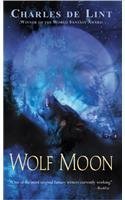
Wolf Moon is classic de Lint. Books like this are why I dig around and keep reading de Lint. Wolf Moon focuses on Kern, a shapeshifter who finds himself hunted by a harper. To save himself, Kern jumps into a churning river and is saved by the fae folk (themes!). When the fae bring Kern to the Tinker (themes!), which is an inn, he finds himself attracted to the innkeeper, Ainsey, and wanting to live among the inn folk. However, the vindictive harper (and ho boy, is he an asshole) follows Kern to the valley where the inn is located. The tension in this story is unreal, and if you’re not a de Lint fan, this would be a decent place to start for his high fantasy books set in other realms. I think the most powerful (for me at least) theme in de Lint’s work is how, even when the world doesn’t understand you and stomps on your sense of worth, that human decency can save the day. In the hands of lesser authors, the ‘decency can save you’ theme would be saccharine, and maybe some people still do find it that way, but good authors can sell this theme and make me feel all the powerful emotions. Wolf Moon is this theme distilled, and every character works in the story, which makes things even worse when one of the dies. Basically, if you’re sold on the misfit family group early on, keep reading.
In high fantasy, there is this ‘sliding scale’ of how you can use a magic system. Agree or disagree with that, de Lint sits solidly on the ‘magic as wonder’ side of story telling. I think this might be why Into the Green didn’t work as well. De Lint isn’t adept at creating the complex magic system that could’ve elevated Into the Green. As a simpler story rooted in myth, Wolf Moon shines because the focus is on the ‘small’ stakes. The real driver is that this insane man effectively had kidnapped an entire family, and that’s where the real terror of Wolf Moon comes from–not magic or shapeshifters. Getting deceived and kidnapped by a charming psychopath. The early vignettes of Into the Green are available in some of de Lint’s short story collections, and they were my favorite parts of the book.
Rating: Into the Green–3 stars. Good short story, ‘meh’ long story
Wolf Moon–5 stars. Loved this story. If you like the characters, it will rip up your insides.