
Discover new books on Goodreads
See if your friends have read any of George L. Mosse's books
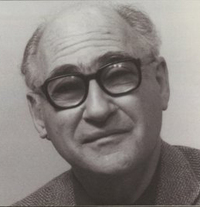
George L. Mosse’s Followers (35)


George L. Mosse
Born
in Berlin , Germany
September 20, 1918
Died
January 22, 1999
Genre


|
The Crisis of German Ideology : Intellectual Origins of the Third Reich
—
published
1964
—
30 editions
|
|

|
FALLEN SOLDIERS: Reshaping the Memory of the World Wars
—
published
1990
—
14 editions
|
|

|
The Nationalization of the Masses: Political Symbolism and Mass Movements in Germany from the Napoleonic Wars through the Third Reich
—
published
1974
—
25 editions
|
|

|
Toward the Final Solution: A History of European Racism
—
published
1978
—
20 editions
|
|

|
The Image of Man: The Creation of Modern Masculinity
—
published
1996
—
14 editions
|
|

|
Nationalism and Sexuality: Respectability and Abnormal Sexuality in Modern Europe
—
published
1985
—
7 editions
|
|

|
Nazi Culture: Intellectual, Cultural and Social Life in the Third Reich
—
published
1966
—
22 editions
|
|

|
The Fascist Revolution: Toward a General Theory of Fascism
—
published
1979
—
7 editions
|
|

|
The Culture of Western Europe: The Nineteenth and Twentieth Centuries
—
published
1963
—
14 editions
|
|

|
The Reformation
—
published
1953
—
18 editions
|
|
“Carl Schmitt could boast with some justice that the Nazi revolution was orderly and disciplined. But the reason lies not so much within the Nazis themselves as in the lack of an effective opposition. For millions the Nazi ideology did assuage their anxiety, did end their alienation, and did give hope for a better future. Other millions watched passively, not deeply committed to resistance. "Let them have a chance" was a typical attitude. Hitler took the chance and made the most of it.”
― Nazi Culture: Intellectual, Cultural and Social Life in the Third Reich
― Nazi Culture: Intellectual, Cultural and Social Life in the Third Reich
“Georges Sorel, to whom fascism is so much indebted, wrote at the beginning of our century that all great movements are compelled by 'myths.' A myth is the strongest belief held by the group, and its adherents feel themselves to be an army of truth fighting an army of evil. Some years earlier, in 1895, the French psychologist Gustav Le Bon had written of the 'conservatism of crowds' which cling tenaciously to traditional ideas. Hitler took the basic nationalism of the German tradition and the longing for stable personal relationships of olden times, and built upon them as the strongest belief of the group. In the diffusion of the 'myth' Hitler fulfilled what Le Bon had forecast: that 'magical powers' were needed to control the crowd. The Fuhrer himself wrote of the 'magic influence' of mass suggestion and the liturgical aspects of his movement, and its success as a mass religion bore out the truth of this view.”
― Nazi Culture: Intellectual, Cultural and Social Life in the Third Reich
― Nazi Culture: Intellectual, Cultural and Social Life in the Third Reich
“La grieta se abrió con la guerra de los Treinta Años. Los campesinos habían descubierto sus instintos agresivos, belicosos y atravesaron las capas de civilización que los cubría. El autor les permite menospreciar a las demás clases de la población y decirles a los burgueses y a los trabajadores: "Yo soy el árbol y vosotros sois las hojas; yo soy el nacimiento en la montaña y vosotros sois los ríos; yo soy el fuego y vosotros sois su reflejo”
― Los orígenes intelectuales del Tercer Reich
― Los orígenes intelectuales del Tercer Reich
Topics Mentioning This Author
| topics | posts | views | last activity | |
|---|---|---|---|---|
| The History Book ...: WOODROW WILSON: A BIOGRAPHY - GLOSSARY (SPOILER THREAD) | 345 | 157 | Jul 11, 2013 08:24AM | |
| The History Book ...: GLOSSARY - HANNS AND RUDOLF - (Spoiler Thread) | 87 | 172 | Mar 29, 2019 10:07AM |