M.B. Scully's Blog
July 20, 2020
Dragon Gods: Frij
It was a cold and windy night, the kind where the sky echoes with the howls of the Wild Hunt, when I saw a reiler work their craft. He worked his loom with the most nimble of claws, and told me of his patron, the deity known as Frij.
Frij is the deity of that special, mysterious branch of magic, the kind no Rhynodd has ever been able to decipher. They are a undecipherable as their craft, moving fluidly from one form to another, their plans known only to themselves, as they traverse the realms following the threads of fate.
—excerpt from the journals of Anachan merc’h Argan, traveller and scholar
Frij presented me with an interesting sort of conundrum. They’re based on a combination of two goddesses: Frigg and Freya. But…there’s some evidence and some theories to suggest that Frigg and Freya are actually the same person. They share a lot of associations and attributes and not much survives about Frigg that it unique to her. It’s possible they were, in fact, a single character in the early Germanic pantheon, and for whatever reason, were separated into two different, yet still very much the same, people. No one is really sure why or how this is.
So I decided to base Frij on what I’d imagine the original Frigg/Freya was, before she got chopped up like so much salami. What I ended up with was an interesting, fluid character who can fit into the various roles played by one such as Frigg/Freya. So be sure to give Frij a look!


July 19, 2020
Dragon Gods: Tyra
An interesting figure in the dragonic pantheon, and one I cannot find much information about, is the goddess known as Tyra. Unusually, given the long memories of dragons, most dragons I speak to know very little about her, save that she is associated with war and justice.
One elder I asked did offer an interesting bit of knowledge: that the mortal realm passes through a cycle of three ages, each led by one of the war gods. First was Tyra, the true ancestor of the gods, and she ruled from the end of the Dark Age until the rise of the dragon kingdoms. Second was Odwyna, who ruled during the Age of Raiders and during the time of the Empire. Third, the present age, is Thårra, who shall rule the pantheon until her age ends, and the age of Tyra returns.
—excerpt from the journals of Anachan merc’h Argan, traveller and scholar
The third of the dragon war gods, Tyra is among the most enigmatic of the dragonic pantheon. Much like Tyr, who she is based on. Tyr is thought to be the oldest of the Germanic gods, and at one point was likely the most important among them. The name ‘Tyr’ itself goes back to the Proto-Indo-European word *deiwós, meaning ‘god’. *Dyeus was the Proto-Indo-European sky god, the most important god, and probably the ‘ancestor’ to the Old Norse Tyr.
Tyr is a fascinating character, and one I definitely recommend you check out! After you take a look at my Tyra, my dragon version of Tyr. Check back in tomorrow for another dragon god, I haven’t decided who to work on yet, possibly Frij. And then I’ll do a little work on my poor neglected Rhynodd.
July 18, 2020
Dragon Gods: Thårra
…but the most popular dragon god is, by far, the one known as Thårra, goddess of storms, war, and agriculture. It is she who is most invoked in times of need. Perhaps unusual for a god, she is quite invested in mortals, not only dragons, and not above getting involved in their troubles. Odwyna may be the deity of monarchs, but Thårra is most certainly the deity of the common people.
—excerpt from the journals of Anachan merc’h Argan, traveller and scholar
So yesterday I talked about Odwyna, my version of Odin if he was a dragon-god in a fictional world created by someone who likes to play fast and loose with real-life pantheons. Today it’s all about Thårra, daughter of Odwyna and my version of Thor if he…well, you get the idea.
Once you start delving into gods, and start looking at the theories and ideas that surround where they came from and what they meant to the ancient Norse people, you start to realise that what you get in the media is vastly different to how things actually were. Not that I don’t enjoy a good Marvel Thor movie! But it’s interesting to see the origins of these more familiar characters. And fun to put my own little spin on them.
I’ve been getting the desire to start drawing some of these guys…and now that I have a working tablet I might get busy with that…for now, enjoy the bit of lore I have written up for Thårra, dragon-goddess of storms.
July 17, 2020
Dragon Gods: Odwyna
It is said that the one-eyed god known mostly as ‘Odwyna’ is the keeper of knowledge among the dragons. Mortals who are deemed worthy may be given snippets of that knowledge, and that is how the dragons came to have their alphabet.
But Odwyna is also known as a goddess of battle, and unlike some of the other dragonic deities, she is not concerned with simple valour or the honour of combat. Rather, she is more closely associated with those terrifying warriors known as jovurgrimm, warrior-priests who claim Odwyna as their patron, and go into a maddened frenzy said to be a blessing, or a curse, from the god…
—excerpt from the journals of Anachan merc’h Argan, traveller and scholar
I’ve already mentioned before how the northern dragons are inspired by early Scandinavian society, so it should come as no surprise that their gods draw heavily from the Nordic pantheon. With some alterations, both to fit the world of Mederra and to fit my own whims.
I’ll be introducing some of the northern dragonic gods over the next few days, starting with Odwyna. Unsurprisingly, she is based on Odin, but not the Odin we know from modern media! I took more from the original Odin, who wasn’t necessarily the nicest dude. He’s an interesting character, to be sure, and it was hard not to fall down the rabbit hole that is the literature written about him.
So take a look at Odwyna, and let me know what you think! Stay tuned tomorrow for her daughter, Thårra.
July 16, 2020
Books of my Childhood
So I’ve been firing up the ol’ Goodreads account (make sure to follow me there for some sweet, sweet book recs), and I’ve been adding in quite a few books that I read ages ago as a wee critter. Got hit with some major nostalgia reading some of those titles. I was always a big reader—there’s one story my dad likes to relate of one time he came home late from work and stopped in the kids’ room to check on us before he went to bed. He noticed the closet light was on and there seemed to be a pair of legs poking out.
It was me. I snuck into the closet to keep reading after lights out and fell asleep over my book. (I can’t say much has changed)
Although I can’t remember exactly what book I was reading in that closet, there are quite a few from my childhood that I enjoyed enough to make me grasp at every moment I could to read. In no particular order, here they are:
Literally Anything by Tamora Pierce
The Song of the Lioness, Protector of the Small, Provost’s Dog, The Immortals…all of her books set in Tortall. I could never get enough of them. A world of magic and knights and castle with some powerful female characters? Sign me the heck up. I just ate those books up, and I’ve gone back and reread quite a few of them over the years. They still hold up, and I find them just as enjoyable as I did when I was ten. Tamora Pierce’s Tortall books ended up being a huge influence in my own writing and on the magic systems in my books. If you haven’t read any of these books yet, what even are you doing with your life.
The Young Wizards series by Diane Duane
Another series I absolutely loved as a kid, and still love today. I actually own almost all the books. This was the time the Harry Potter books were still being published, and I loved any book that portrayed a world where magic lived (albeit secretly) alongside the mundane. It appealed to my desire for magic to exist in the real world.
Redwall series by Brian Jacques
Probably where my love for non-human characters originates. This was just such a wonderful series, full of stories of good vs. evil, courage, inner strength, and some of the most mouth-watering descriptions of feasts. Pretty sure I had several dreams about attending a feast at Redwall. One of the most devastating moments in my childhood was finding out Brian Jacques had died, and that would be the end of the Redwall books. Ah, I have to go reread them now.
Percy Jackson and the Olympians by Rick Riordan
I started reading this series back when there were only a few books out. My siblings were also reading them at the same time, and wars broke out between us every time a new book was published. We all wanted to be the first one to read it. I usually got it, because I read the fastest, but I remember there was one, I think it was The Titan’s Curse or The Battle of the Labyrinth, that I didn’t get to read first. Well, until I snuck into my brother’s room, took the book, and read it in the middle of the night. I would have gotten away with it too, if I had been able to resist bragging about my midnight escapades.
Harry Potter by J. K. Rowling
Rowling might be a bit of a problematic figure nowadays, but these books were my life. I was the kid who made her own wand (we have a video from someone’s birthday, I think, of me ‘casting spells’ at the camera), desperately waited for her Hogwarts letter (even though she lived in the United States), and knew pretty much every bit of lore in the books and movies. I devoured the books as they came out (another series I got to read first because of my reading speed—although my mom got two copies of The Deathly Hollows because we kept arguing over who got to finish the series first). Harry Potter was a huge part of my childhood, and will always hold a special place in my heart.
These are only a few of the books I enjoyed as a kid—even as I was writing, more and more kept coming back. Books I hadn’t thought about in years, but once I saw the cover or recognised the author’s name…just waves of nostalgia. I’ll definitely have to go back and reread some of them.
Are there any books that have really impacted you? Any that stuck with you? Or even some that you’re reading right now and you just love?
July 15, 2020
Empire of the Dragon
The Empire of the North, that great kingdom which has stood for countless generations of Rhynodd, fell during the reign of the Hervald Dagmar, the Unwanted Queen. She was not meant to take the White Throne, that right was to go to her elder sister, the ill-fated Odwyn Strongwing.
When Dagmar assumed the throne following Strongwing’s disappearance, many whispered that her reign would be fraught with misfortune, but none would have guessed that she would bring about the end of an ancient rule.
—excerpt from On the Rise and Fall of the Sfanodd Empire, author unknown
So I’ve mentioned this empire a few times before in past posts, and here it is! The Svanska Empire, a cross between the Roman Empire and the dragons of Skyrim, with a little bit of Scandinavian flavour. It’s basically an empire of Viking dragons.
I’m still a bit hazy on the timeline (eventually I’ll work that out and start putting events/things/people in order), but the period of the Empire is generally an earlier part of the history of the northern continent. Nostos, like most of my stories, takes place quite a while after the fall of the empire, although I have a bit of a novella in the works that’s set right at the end of the empire, and involves some of figures who helped bring about that end. I might put up a summary or something about it.
For now, take a look at the Svanska Empire, and let me know what you think! Make sure to subscribe and follow me on social media to stay updated on all my worldbuilding/writing fun.
July 14, 2020
A People of Myth and Magic
“What’re the Enisirran islands?” Sann flattened his ears. He thought he might have heard the name before, but he wasn’t sure.
“The most beautiful place in the world, my boy,” Hiarnan said, turning back to include Sann in the conversation. They had an even wider smile on their face, matched only by the smile on Bouda’s face. Hiarnan took a sip of their hot drink and sighed rather dreamily. “Oh how I miss her grassy mountains and deep valleys, the music on the wind as it blew through the northern cliffs, the—”
Realising Hiarnan would continue on for some time, Sann looked down at Bouda. “I thought you said you were from Lledhan.”
“That’s where I was born,” Bouda said, shrugging. “But my parents were from Enisirra, and I learned their language first before Lledhaneg. I hadn’t spoken, or even heard it spoken in ages, so I’m not very good.”
“Nonsense, my dear!” Hiarnan gave her a pat on the shoulder that nearly sent her tumbling. “You speak it as if you’ve been speaking it your whole life. The language is in your soul, where it can never be forgotten.”
—excerpt from the tales of Sann’s youth
A cross between Irish and Welsh, the Enisirran people are what I’d imagine the Skyrim Nords would be if they were all druids. They have an interesting relationship with the Svanling, since the revolution that ended the Svanling Empire started in Enisirra. In creating them and their society, I also take a lot of inspiration from my studies in my Celtic Civilisation and Irish Archaeology courses. They’re sort of like distant, lost cousins to the Welsh (or rather, Britons) and Irish of the prehistoric period. Makes for some interesting research, anyway!
I don’t have too much for these guys, but enjoy a peak into the Enisirrans, and make sure to subscribe to the blog or follow me on social media for more updates!
July 12, 2020
Raw Food Diets, or Why it Takes Me Forever to Edit
So in my stories, I always like to strive for a bit of realism. Of course, I gotta rely on some suspension of disbelief. There are certain things that just can’t work in the real world, at least not with our current understanding of the laws of physics and such. But the suspension of disbelief can only take you so far—talking animals in a fantasy story, sure, but talking animals suddenly appearing in a Batman movie, maybe not.
But sometimes this desire for ‘realism’ sends me down some interesting rabbit holes. Take, for instance, the land of Éomarun, the Forest. A mysterious realm where sunlight is but a rumour and nightmares stalk the waking world. And where the trees are sentient enough that if you light a fire within their reach they’ll likely come to life à la the Whomping Willow and strangle you.
So how are the Éomarisc dragons to eat? My world’s dragons are anthropomorphic enough that I can’t just make them ravenous meat eaters who dig into a deer carcass. They like a bit of cookery as much as the any human. So the question then became, what would the diet of a fire-less society look like?
Which is how I ended up researching raw food diets and the evolution of cooking in human history. Interestingly enough, I found out that raw food diets are a thing, and not just for dogs. Strap in, dear reader, we’re taking a dive into the story of food.
Now, why do we, as humans, cook most of our food? There’s a little more to it than just making it safe to eat—after all, humans have been eating food long before we worked out how to use fire to roast it. The whole story of when humans discovered fire and when we started using fire for more than just warmth is quite convoluted. I mean, we’re talking about unravelling mysteries from hundreds of thousands of years ago, if not upward to a million years ago.
As far as we can tell, humans started tending fires in Europe about 800,000 years ago—but that number can change depending on where you’re looking and even what you mean by ‘tending fires’. Before this, humans still ate meat, and seemed to have had a fairly well-balanced diet of meat and plants – all raw. But here’s the thing—raw food, meat or otherwise, is really chewy. Chewing a bite of food to the point where you can swallow it takes a lot of time and energy. Chopping or pounding the food could halve the work of your jaws—this is actually the idea behind dishes like steak tartare and carpaccio. Cooking, now cooking the food, that was the real game-changer. Cooking generally reduced the required chewing force by at least a third and provided much more energy than raw food. This, according to current research, played a big part in our Big Brain energy.
But raw food meals isn’t restricted to the distant past, and I’m not just talking foodie fads. Citatap (pronounced something like chee-ta-tap) is a dish from the Ainu people made by pounding meat or fish—the name itself means “we mince it”. It’s a handy technique for eating tough meat or meat where the bones are too small to be entirely removed.
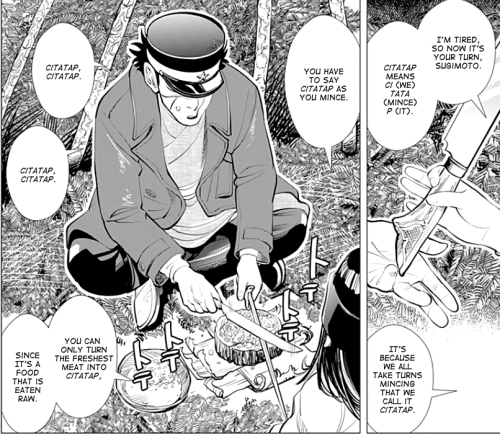 Sugimoto from the manga Golden Kamuy making citatap with Asirpa (ch. 5)
Kitfo or ketfo is another raw meat dish, this time from Ethiopia, made from minced raw beef and a variety of spices. Like citatap, the name means ‘to mince’.
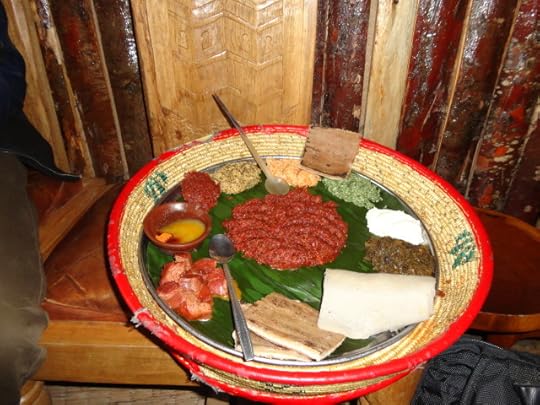 Kitfo
KitfoWe also have çiğ köfte or chee kofta from Armenian, Kurdish, and Turkish cuisines. These are basically raw meatballs made from ground meat, tomato paste, pepper paste, bulgur, pomegranate syrup, and lots of spices.
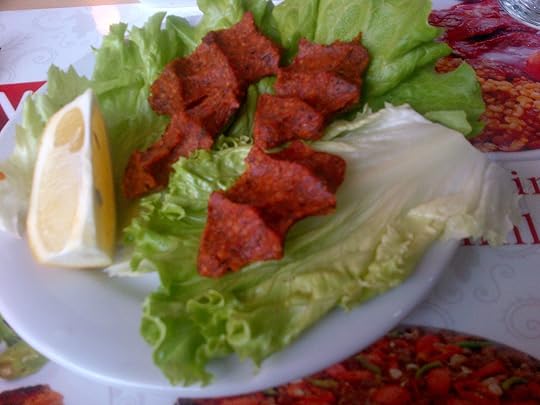 Çiğ köfte from Turkey
Of course, this still leaves the question of food safety. Raw food, especially raw meat, after all can be quite dangerous. Bacteria such as Salmonella, E. coli, and Listeria can only be killed by cooking the food. . For the dishes I outlined above, only the freshest meat is used—we’re talking going straight from butchery to plate. Theoretically, this ensures that the meat has no time to spoil or grow bacteria (not that I’m endorsing the eating of raw meat, it’s still very risky). And when we’re looking at eras where fridges wouldn’t be a thing for at least another few centuries, this is exactly what would be happening, simply because they had limited means of storing food (especially 800,000+ years ago). Plus, I’d imagine that anyone who was susceptible to food poisoning probably didn’t live long enough to pass those genes along to the next generation.
So what does this mean for my little dragons? Well, for one thing, a bit of a change had to be made to their teeth. Carnivorous critters like dogs have teeth designed for slicing meat, while omnivores have a mix of teeth-types: sharpened incisors for ripping and cutting and flatter molars for grinding. So they ended up with a set of teeth somewhat like that of a bear’s.
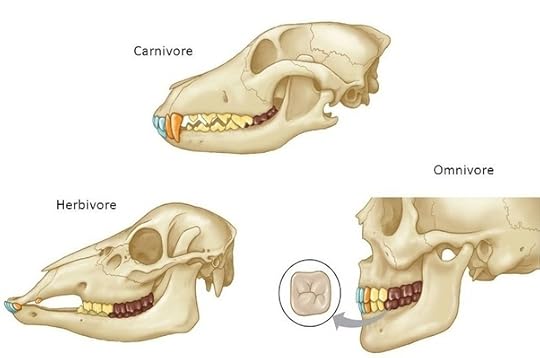 Literally just ripped this from Quora
Next, I had to work out their cuisine, namely what they do with meat. Nothing that needed to be cooked…but also nothing that required the use of fire for preserving (like smoking or even drying, which requires the sun). So basically, if the meat couldn’t be eaten fresh, it had to be salted. Thus, the meat portion of the Éomarsic diet would come from freshly-hunted animals, caught and slaughtered the day it is to be eaten, if it’s not being salted for later. The vegetables would be treated in much the same way. Everything would heavily flavoured with herbs and spices and whatnot, to make some nice flavourful dishes. I actually ended up taking a lot of inspiration from Ainu cuisine, at least in terms of preparation and style.
So that’s how I ended up with raw minced meat/salad eating dragons in a land where fire is forbidden, and down the rabbit hole that is the debate of humans and fire-tending. All for a couple of scenes where Odwyn is treated to a nice Éomarsic dinner, and I was suddenly confronted with the question of “what the hell do these guys eat?”.
This is also why it takes me forever to edit/write things. Even this post, which was supposed to be published at noon but here we are, nearly 7pm, took ages because I had to find some of the sources I had used when I first was looking into all this. And much like my writing, it ended up being a lot longer than expected.
Pointless? Maybe. Interesting? Definitely. At least to me, and hopefully you’ll enjoy a look into my writing/research process.
July 11, 2020
The Humans of Mederra
Per-chance the strangest of all are they who call themselves the ‘Peple of Danuð’, whose lives are but a blynke of the Eye of a Dragon, who are susceptive to the moste basic Diseases and Injures, and yet are the moste Prod, moste Skill-full, moste Strong Peple I have had the fortune of knowing. However so much I learn about them, there is always a surprize to uncover.
—excerpt from the journals of Regna Lliva Gärsdåttir
Although I love me some dragons, I couldn’t forget the humans of my world. Humans in fantasy worlds often get the short end of the stick. Elves are cooler, dwarves are hardier, humans are just boring.
So in a world where there are talking dragons and horses and merfolk and basilisks and all sorts of other cool critters, I wanted to give my humans something to help them stand out. Something that reflects the rather unique aspects of humanity—our insatiable desire to explore the unknown, our determination to conquer the unconquerable, and the wonderful, colourful variety that makes us such an interesting tapestry of histories, cultures, and traditions.
I don’t have much up about the humans, or the ‘Rhynodd‘ (pronounced rhi-noð), as I call them (as my world does have other hominids), but I can at least offer a brief taste of what they’re all about. Keep an eye out for updates as I flesh them out more.
July 10, 2020
A Place of Mystery
Almost as soon as she entered the forest, all light from the outside world vanished. Odwyn paused and glanced over her shoulder. Despite only being a few trees in from the border, she could not see anything of the plains she had just left behind. She looked up. The canopy overhead looked like a solid blanket of black leaves. Even if clouds weren’t covering the sky, it didn’t look as though the canopy would allow any sort of light through.
As her eyes slowly adjusted to the intense darkness of the forest, Odwyn looked around nervously, fluttering her wings a little, although they were of little use to her among the trees. The only forests she knew were small, sparsely populated by short, gnarled trees, bent over almost double from the force of the mountain winds. Certainly nothing like the massive, ancient timbers surrounding her. Even the undergrowth, like a dark, bristling pelt coating the forest floor, was much thicker than anything she had seen in Svanrike.
And then there was the silence.
Even at the top of the most deserted peak in Svanrike, there was noise. The wind whistled and howled and sang through the rocks. Bird calls echoed off the cliffs. Dragons roared in the distance.
Here, there was nothing.
—excerpt from Nostos
Ah, the Black Forest. Harry Potter’s Forbidden Forest on steroids. I was initially inspired by the real-life Black Forest in Germany. Not entirely sure why, as Germany’s Schwarzwald is a wonderful place to visit and the fact that it’s home to the Grimm Brothers fairy tales is probably the most sinister thing about it (have you read some of those tales recently?). It’s also home to top notch spas and beautiful cuckoo clocks.
My ‘Black Forest’, or Éomarun as it is known to its residents, is much less inviting. Ancient trees grown close enough that the sun cannot reach the forest floor, mysterious creatures forgotten by the rest of the world lurking in the shadows…it’s not the most hospitable place. Unless you’re an Éomarisc dragon (like Sann!). You’re born and raised in the Forest, you’re not bothered by the monsters and ghosts that haunt the woods.
But I wanted Éomarun to be more than just a ‘spoopy’ set piece. I wanted to create a living, viable society within an unusual setting. Made for some interesting research. I’m sure the FBI agent keeping an eye on my internet history has some concerns. So enjoy the fruits of my somewhat questionable research: Éomarun.