Ken Johnson's Blog
July 5, 2015
Reflecting Back on the NACRJ #RJConference2015 An Inspired Beginning: Part 1 of 4
The last three or so months have been a whirlwind of activity for me. Not only was my book, Unbroken Circles for Schools, named a 2015 National Indie Excellence® Awards Finalist but I was also invited to participate in the 2015 National Association for Community and Restorative Justice (NACRJ) conference – which they referred to in social media as #RJConference2015.
The NACRJ is one of the preeminent national organizations for Restorative Justice in America pairing together major academic thought leaders with social justice activists, ministries, independent advocates/researchers/critics, and non-profits. This year, the conference had over 500 people not only from all over North America but also the world – a truly international event held here in Florida! Just to be able to attend this event is considered an honor for many. Yet, I was even more blessed for the opportunity to present a panel discussion lecture at a conference – thanks greatly in part to NACRJ’s own Mara Schiff and the support of SYP Publishing.
Philosophers and theologians worldwide contend the journey is more valuable than the destination. After the conference, I can attest to this fact wholeheartedly. However, the journey was a week long, and so profound that I had to write about it in four sections just to get everything in. This is part one of the four-part series on the conference.
The journey to the conference first started with my friend, Josh Zajac, making the offer to share the costs, in addition to driving to and from the event. In all honesty, Josh had no concern about the conference. Instead, he wanted to go with me down to Ft. Lauderdale so he could fish. However, like many of my friends, Josh is not what he appears to be. Philosopher, mad scientist, farmer, tile layer – he is a polymath much like our Founding Fathers. So, on the way down, as we discussed Restorative Justice (RJ), Josh told me the story of a small video of a car traveling down a country road. In the story, the video is sped up so fast one could not see the car anymore. The only perceived truth was seemingly a still frame shot of trees in a country setting. Thus, he contended, truth and perception is part and parcel to context – a very RJ notion to say the least.
With his wise words on my mind, we first went to a pre-conference “meet and greet” where I was able to say hello to many great RJ practitioners such as Kris Miner – an expert in Circle processes. One of the first things asked of me was if I had brought my feather paintings. I guess they are gaining in popularity even in RJ circles!
The next morning, the conference started off with a drumline marching into a crowded grand room of over 500 people. This was followed by a fantastic young singer who lifted us up in song. Our opening plenary speaker, Dominic Barter, soon followed, talking about his work in Brazil and how we all have shanty towns in our lives which need restoration. As he put it, “Walk towards those uncomfortable conversations and see what happens!”
Yet, for me, what I took away from his speech was the story of a couple fighting. Mr. Barter noted that, as the level of miscommunication grew, the couple would yell. It was as if their bodies were recognizing the inability to communicate as deafness and so their voices kept growing into a shout.
In the question and answer session, things took an interesting turn when Alan Murdock inquired of Dominic Barter how to get healing. You see, as Alan notes, he’s “the first victim of Restorative Justice.” I know his story well as Alan and I have corresponded many times. Alan’s story happened a little less than forty years ago when American-based RJ was in its infancy. I was a newborn and he was a small child. Most of America had never heard of this process and many of the “practitioners” were maybe trained from a single book, with little to no scientific research to back up their practices. Despite this, his parents’ church still wished to use this new field for rehabilitation by urging parishioners to take convicts into their own homes – many of which had children. This notion is abhorrent to RJ practitioners today because of the risk of what may happen to children – of what happened to Alan. Over the course of time, Alan feels he has been re-victimized over and over. His parents forgave his offender in front of him without seeking restoration first, or at least giving him a voice; he felt victimized again by his church leaders which ceased contact with him. He was victimized yet again by the state which would not take action; and he felt victimized yet again by RJ leaders who, for whatever reason, were either unable or unwilling to provide him relief and release in a meaningful way. So, for Alan to still seek out understanding, dialogue, and possible closure of some sort was nothing short of commendable as he strives daily to facilitate dialogues into better accountability practices. I must admit, it was out of concern for possible future stories, like Alan’s, which I had in mind when I re-wrote the accountability section of Unbroken Circles for Schools. Simply put, I wanted to ensure nothing less than the highest standards for this practice both for safety and effectiveness.
On that awkwardly contemplative end note to the plenary speech, we adjourned to go to our respective panels and lectures. Along the way to my presentation room, I longed in my heart for the RJ community to hear Alan’s words and find some sort of closure and healing for him while we also worked with him to ensure our best practices are safe, effective, and research-driven.
Soon after, I gave my presentation. The room was packed out into the hallway. (NOTE: To learn more about my lecture, you can download my expanded panel discussion notes here https://independent.academia.edu/Kenn...)
After my panel lecture, I went to a seaside lunch. One of the attendees blessed me by telling how she enjoyed reading my many articles. It’s always a good feeling to hear how someone enjoys reading the words you put into print.
The afternoon plenary was done by Dr. Cornel West, Professor of Philosophy and Christian Practice at Union Theological Seminary. Bro. West, as he prefers to be called, was indeed a lively character who, in his 60s, had to leave the conference early in order to go home for the celebration of his birthday. Bro. West admitted he likes to “get down” and “breakdance” on his birthday – which spurred me later on to call my wife and tell her for my 40th I wished to do the same. Be that as it may, before Bro. West left, he managed to give an entire library of philosophical ideas for the participants to mull over. For instance, he noted, “The condition of truth is always to allow suffering to speak.” He noted how the circle is representative of humanity and our connection with humanity. He noted how justice is love. He gave the importance of stories. According to him, “If you are concerned about injustice you have to allow the voices to be heard.” He gave many disparaging remarks as our society has changed in the wrong directions with hip-hop, President Obama, and even the church not safe from criticism of fault. As he put it, he is “old school” and came from a time when pastors gave transformative and life changing sermons rather than being “CEOs.” He told of blues singers who could sing in tune – something he claims is being lost today. His greatest inspiration seemed to be blues singers who poured out their heart with a smile on their face – hating the harms done, yet loving the people. As he put it, “You have to be hope, be justice, be peace, be the things you want to see!”
But, for me, what I cherished most was his finally breaking down what I consider to be the true rift between the races. For many non-White races and ethnicities, they talk about history and patterns where injustices were done and stories were not allowed to be shared. For us, since I am Native American, the discussion can be perceived as lines on a graph, showing a horrific, multi-faceted trend which cannot be easily articulated in a thirty second sound bite or Tweet. Conversely, the outside, mostly White world, which I also belong to and walk in, wishes to talk in cases of specific incidences, points, and counter points. For them, and even sometimes for me, it is like looking at a graph of points with no lines (of history) to connect them together. The message is easy to articulate and discuss because there isn’t a background story to it. In essence, the inability of the races and ethnicities to communicate is much like a person speaking only German and another only speaking Chinese trying to have dialogue. No amount of discourse will benefit the other if they first do not seek ways to understand each other’s language.
Afterwards, I left to meet up for an organizational meeting with my good friends at the Florida Restorative Justice Association (FRJA). This was my group. I was home with my own people. I am proud of them. Kelly McGrath has done do much with this organization as have Dr. Cindy Bigbie (Director of the Community Connections Program), Dr. Mara Schiff (Florida Atlantic University), Heart Phoenix (Board President for the River Phoenix Center for Peacebuilding), Jeffrey Weisberg (Executive Director for the River Phoenix Center for Peacebuiding), Dr. Sandra Pavelka (Florida Gulf Coast University), and many others. Dr. Bigbie even changed up my view of circles when she paired us up to do a circle inside of a circle for what she called a, “Restorative Justice speed dating” circle session.
Everyone at FRJA has been so positive and so encouraging. However, I was a bit blown away when it was Heart Phoenix who told me, she felt she needed to step up things more and be more active. Being the mother of River Phoenix, and knowing a little of her story, it blew me away at how driven this soul was. Loving and caring, she seemed to have a “no nonsense” air about her – a knowing that life is too short for inactivity in the face of profound injustice. Later, in another panel discussion, she and Jeffrey would talk about negative peace vs. positive peace (i.e., peacekeeper vs. peacemaker), massive weapons of distraction, and Disproportionate Minority Contact (DMC). Indeed, the RPCB is verging out ever further into fields of RJ applications and understanding!
By the end of the day, I felt as if I could soar. Every expectation was shattered by exceeding abundance and dynamic awesomeness. Though physically fatigued from all of the driving beforehand, I still could not sleep as my mind raced with thoughts and contemplative anecdotes I had gleaned.
The NACRJ is one of the preeminent national organizations for Restorative Justice in America pairing together major academic thought leaders with social justice activists, ministries, independent advocates/researchers/critics, and non-profits. This year, the conference had over 500 people not only from all over North America but also the world – a truly international event held here in Florida! Just to be able to attend this event is considered an honor for many. Yet, I was even more blessed for the opportunity to present a panel discussion lecture at a conference – thanks greatly in part to NACRJ’s own Mara Schiff and the support of SYP Publishing.
Philosophers and theologians worldwide contend the journey is more valuable than the destination. After the conference, I can attest to this fact wholeheartedly. However, the journey was a week long, and so profound that I had to write about it in four sections just to get everything in. This is part one of the four-part series on the conference.
The journey to the conference first started with my friend, Josh Zajac, making the offer to share the costs, in addition to driving to and from the event. In all honesty, Josh had no concern about the conference. Instead, he wanted to go with me down to Ft. Lauderdale so he could fish. However, like many of my friends, Josh is not what he appears to be. Philosopher, mad scientist, farmer, tile layer – he is a polymath much like our Founding Fathers. So, on the way down, as we discussed Restorative Justice (RJ), Josh told me the story of a small video of a car traveling down a country road. In the story, the video is sped up so fast one could not see the car anymore. The only perceived truth was seemingly a still frame shot of trees in a country setting. Thus, he contended, truth and perception is part and parcel to context – a very RJ notion to say the least.
With his wise words on my mind, we first went to a pre-conference “meet and greet” where I was able to say hello to many great RJ practitioners such as Kris Miner – an expert in Circle processes. One of the first things asked of me was if I had brought my feather paintings. I guess they are gaining in popularity even in RJ circles!
The next morning, the conference started off with a drumline marching into a crowded grand room of over 500 people. This was followed by a fantastic young singer who lifted us up in song. Our opening plenary speaker, Dominic Barter, soon followed, talking about his work in Brazil and how we all have shanty towns in our lives which need restoration. As he put it, “Walk towards those uncomfortable conversations and see what happens!”
Yet, for me, what I took away from his speech was the story of a couple fighting. Mr. Barter noted that, as the level of miscommunication grew, the couple would yell. It was as if their bodies were recognizing the inability to communicate as deafness and so their voices kept growing into a shout.
In the question and answer session, things took an interesting turn when Alan Murdock inquired of Dominic Barter how to get healing. You see, as Alan notes, he’s “the first victim of Restorative Justice.” I know his story well as Alan and I have corresponded many times. Alan’s story happened a little less than forty years ago when American-based RJ was in its infancy. I was a newborn and he was a small child. Most of America had never heard of this process and many of the “practitioners” were maybe trained from a single book, with little to no scientific research to back up their practices. Despite this, his parents’ church still wished to use this new field for rehabilitation by urging parishioners to take convicts into their own homes – many of which had children. This notion is abhorrent to RJ practitioners today because of the risk of what may happen to children – of what happened to Alan. Over the course of time, Alan feels he has been re-victimized over and over. His parents forgave his offender in front of him without seeking restoration first, or at least giving him a voice; he felt victimized again by his church leaders which ceased contact with him. He was victimized yet again by the state which would not take action; and he felt victimized yet again by RJ leaders who, for whatever reason, were either unable or unwilling to provide him relief and release in a meaningful way. So, for Alan to still seek out understanding, dialogue, and possible closure of some sort was nothing short of commendable as he strives daily to facilitate dialogues into better accountability practices. I must admit, it was out of concern for possible future stories, like Alan’s, which I had in mind when I re-wrote the accountability section of Unbroken Circles for Schools. Simply put, I wanted to ensure nothing less than the highest standards for this practice both for safety and effectiveness.
On that awkwardly contemplative end note to the plenary speech, we adjourned to go to our respective panels and lectures. Along the way to my presentation room, I longed in my heart for the RJ community to hear Alan’s words and find some sort of closure and healing for him while we also worked with him to ensure our best practices are safe, effective, and research-driven.
Soon after, I gave my presentation. The room was packed out into the hallway. (NOTE: To learn more about my lecture, you can download my expanded panel discussion notes here https://independent.academia.edu/Kenn...)
After my panel lecture, I went to a seaside lunch. One of the attendees blessed me by telling how she enjoyed reading my many articles. It’s always a good feeling to hear how someone enjoys reading the words you put into print.
The afternoon plenary was done by Dr. Cornel West, Professor of Philosophy and Christian Practice at Union Theological Seminary. Bro. West, as he prefers to be called, was indeed a lively character who, in his 60s, had to leave the conference early in order to go home for the celebration of his birthday. Bro. West admitted he likes to “get down” and “breakdance” on his birthday – which spurred me later on to call my wife and tell her for my 40th I wished to do the same. Be that as it may, before Bro. West left, he managed to give an entire library of philosophical ideas for the participants to mull over. For instance, he noted, “The condition of truth is always to allow suffering to speak.” He noted how the circle is representative of humanity and our connection with humanity. He noted how justice is love. He gave the importance of stories. According to him, “If you are concerned about injustice you have to allow the voices to be heard.” He gave many disparaging remarks as our society has changed in the wrong directions with hip-hop, President Obama, and even the church not safe from criticism of fault. As he put it, he is “old school” and came from a time when pastors gave transformative and life changing sermons rather than being “CEOs.” He told of blues singers who could sing in tune – something he claims is being lost today. His greatest inspiration seemed to be blues singers who poured out their heart with a smile on their face – hating the harms done, yet loving the people. As he put it, “You have to be hope, be justice, be peace, be the things you want to see!”
But, for me, what I cherished most was his finally breaking down what I consider to be the true rift between the races. For many non-White races and ethnicities, they talk about history and patterns where injustices were done and stories were not allowed to be shared. For us, since I am Native American, the discussion can be perceived as lines on a graph, showing a horrific, multi-faceted trend which cannot be easily articulated in a thirty second sound bite or Tweet. Conversely, the outside, mostly White world, which I also belong to and walk in, wishes to talk in cases of specific incidences, points, and counter points. For them, and even sometimes for me, it is like looking at a graph of points with no lines (of history) to connect them together. The message is easy to articulate and discuss because there isn’t a background story to it. In essence, the inability of the races and ethnicities to communicate is much like a person speaking only German and another only speaking Chinese trying to have dialogue. No amount of discourse will benefit the other if they first do not seek ways to understand each other’s language.
Afterwards, I left to meet up for an organizational meeting with my good friends at the Florida Restorative Justice Association (FRJA). This was my group. I was home with my own people. I am proud of them. Kelly McGrath has done do much with this organization as have Dr. Cindy Bigbie (Director of the Community Connections Program), Dr. Mara Schiff (Florida Atlantic University), Heart Phoenix (Board President for the River Phoenix Center for Peacebuilding), Jeffrey Weisberg (Executive Director for the River Phoenix Center for Peacebuiding), Dr. Sandra Pavelka (Florida Gulf Coast University), and many others. Dr. Bigbie even changed up my view of circles when she paired us up to do a circle inside of a circle for what she called a, “Restorative Justice speed dating” circle session.
Everyone at FRJA has been so positive and so encouraging. However, I was a bit blown away when it was Heart Phoenix who told me, she felt she needed to step up things more and be more active. Being the mother of River Phoenix, and knowing a little of her story, it blew me away at how driven this soul was. Loving and caring, she seemed to have a “no nonsense” air about her – a knowing that life is too short for inactivity in the face of profound injustice. Later, in another panel discussion, she and Jeffrey would talk about negative peace vs. positive peace (i.e., peacekeeper vs. peacemaker), massive weapons of distraction, and Disproportionate Minority Contact (DMC). Indeed, the RPCB is verging out ever further into fields of RJ applications and understanding!
By the end of the day, I felt as if I could soar. Every expectation was shattered by exceeding abundance and dynamic awesomeness. Though physically fatigued from all of the driving beforehand, I still could not sleep as my mind raced with thoughts and contemplative anecdotes I had gleaned.


April 12, 2015
Feather Paintings to Restorative Justice; Recycling Lives
From Feather Paintings to Restorative Justice
Life is all about change. It is said that the human body replaces itself every seven to ten years. Therefore one could contend, life in many ways, is about discarding the unusable and dysfunctional to make way for the new and capable. This may work great for cellular reproduction, but it is a horrible construct for human society.
It’s no secret that I have Native American heritage. While I am extremely proud of my lineage, I don’t let it define my work. So, like many Americans, I have a segregated life where there is a Ken Johnson who is known to the world as a culturalist, a conflict specialist, and also an author. While this side of me is known to crack a joke or two, I make it a point to portray myself as a professional who’s very factual and driven. On the other hand, my family knows the quirky, and sometime eclectic side of me. The man who is a husband, son, uncle, or cousin. They know my overpowering love of pork, the outdoors, and all things fun, strange, weird, and new. But, there’s also a group, which I consider to be my extended family, who know me simply as Awohali Galvlati Ugu – Principal Chief Soaring Eagle. This is the “young man with an old soul” who holds the passed-down knowledge and ways of the Florida Tribe of Cherokee Indians. Knowledge concerning healing plants, history, hunting and fishing tactics, legends and mythology, etc. It is also this side of me that’s known, by some, for my love of feather painting – a Native American art form.
American Indian culture embraces recycling and transformation. So, it should come as no shock that this philosophy is seen in many aspects of our life including, but not limited to, our artwork as well as our old system of justice – which the American version of Restorative Justice is somewhat based upon.
Giving Flight to the Outcasts
I bring all of this up to note how a discarded feather is, in many ways, no different than a wrongful offense taking place. Birds molt (discard) feathers when there’s a change in the seasons, a change in life, or even stress and injury. In many ways, human society, people, and American culture do this as well. When a wrongful offense is committed, our governmental structure oft times steps in to “heal the wound” by first punishing and casting aside the offender while in-turn also ostracizing the victim. This latter functionality is more easily seen in court cases where the offense is “styled” as “State of Florida vs John Smith” rather than “Jane Doe vs John Smith.” In essence, the state acts as a surrogate victim – taking all of the victimization rights from the true victim, while also re-victimizing the person again through an onerous process where they have no say and often receive no justice.
Before I begin to paint on a feather, I first contemplate it. I look at its shape, how it bends, the coloration, its original intended purpose, any outward signs of damage, etc. With my heart, I begin to talk to the feather to learn its story and “ask” what it wants to become. True, this may sound strange, but it is something artists often do. Two feathers from the same location may end up being two different paintings. One might be a colorful pelican perched on a pole along the water while another is a free flowing, bioluminescent jellyfish lighting up the dark depths of the sea below.

In Restorative Justice situations, we facilitators are presented with three different user groups with their own stories, issues, values, and opinions. Naturally, there is a victim and offender but what people never think about is the third party to all of this – the community. Like with the feathers, heart-felt questioning needs to take place with each party. For instance, a victim may actually just want to have a say in the matter and the harms repaired so that he or she can get closure. Meanwhile, the offender may have unmet needs which preclude her or him from atoning for the misdeed and making amends. The community may have suffered due to a loss of productivity from the victim and the wrongful action of the offender, spurring further misdeeds to be done by troubled youths wanting to act out. Like layers of paint on feathers, a careful RJ practitioner can use circles, mediation, conferences, panels, and even justice circles to help bring everything back into balance. Victims are made whole so that they can cast aside that awful title, just as offenders do once they have atoned for their offenses. While having no official title of “victim” or “offender,” the community is made stronger by being made whole and also by reassimilating two parties back into the fold.
Studies have consistently shown RJ practices have a meaningful and transformative impact on the communities that use them. Rather than leaving behind the broken and discarded, it lifts up and makes whole those which are broken. Like feather paintings, RJ gives flight to the outcasts.
Unbroken Circles for Schools
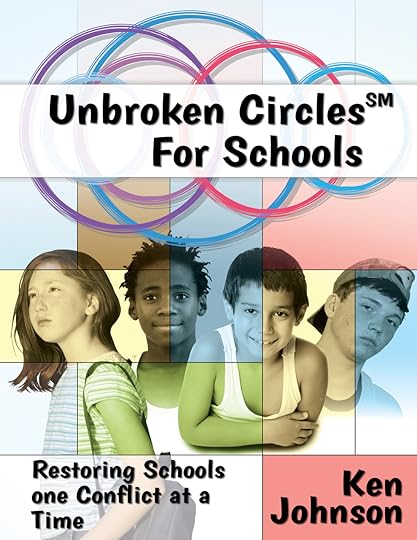
Purchase From: http://www.amazon.com/Unbroken-Circle...
Original Post Source: http://www.sypreflections.com/feather...
Life is all about change. It is said that the human body replaces itself every seven to ten years. Therefore one could contend, life in many ways, is about discarding the unusable and dysfunctional to make way for the new and capable. This may work great for cellular reproduction, but it is a horrible construct for human society.
It’s no secret that I have Native American heritage. While I am extremely proud of my lineage, I don’t let it define my work. So, like many Americans, I have a segregated life where there is a Ken Johnson who is known to the world as a culturalist, a conflict specialist, and also an author. While this side of me is known to crack a joke or two, I make it a point to portray myself as a professional who’s very factual and driven. On the other hand, my family knows the quirky, and sometime eclectic side of me. The man who is a husband, son, uncle, or cousin. They know my overpowering love of pork, the outdoors, and all things fun, strange, weird, and new. But, there’s also a group, which I consider to be my extended family, who know me simply as Awohali Galvlati Ugu – Principal Chief Soaring Eagle. This is the “young man with an old soul” who holds the passed-down knowledge and ways of the Florida Tribe of Cherokee Indians. Knowledge concerning healing plants, history, hunting and fishing tactics, legends and mythology, etc. It is also this side of me that’s known, by some, for my love of feather painting – a Native American art form.
American Indian culture embraces recycling and transformation. So, it should come as no shock that this philosophy is seen in many aspects of our life including, but not limited to, our artwork as well as our old system of justice – which the American version of Restorative Justice is somewhat based upon.
Giving Flight to the Outcasts
I bring all of this up to note how a discarded feather is, in many ways, no different than a wrongful offense taking place. Birds molt (discard) feathers when there’s a change in the seasons, a change in life, or even stress and injury. In many ways, human society, people, and American culture do this as well. When a wrongful offense is committed, our governmental structure oft times steps in to “heal the wound” by first punishing and casting aside the offender while in-turn also ostracizing the victim. This latter functionality is more easily seen in court cases where the offense is “styled” as “State of Florida vs John Smith” rather than “Jane Doe vs John Smith.” In essence, the state acts as a surrogate victim – taking all of the victimization rights from the true victim, while also re-victimizing the person again through an onerous process where they have no say and often receive no justice.
Before I begin to paint on a feather, I first contemplate it. I look at its shape, how it bends, the coloration, its original intended purpose, any outward signs of damage, etc. With my heart, I begin to talk to the feather to learn its story and “ask” what it wants to become. True, this may sound strange, but it is something artists often do. Two feathers from the same location may end up being two different paintings. One might be a colorful pelican perched on a pole along the water while another is a free flowing, bioluminescent jellyfish lighting up the dark depths of the sea below.
In Restorative Justice situations, we facilitators are presented with three different user groups with their own stories, issues, values, and opinions. Naturally, there is a victim and offender but what people never think about is the third party to all of this – the community. Like with the feathers, heart-felt questioning needs to take place with each party. For instance, a victim may actually just want to have a say in the matter and the harms repaired so that he or she can get closure. Meanwhile, the offender may have unmet needs which preclude her or him from atoning for the misdeed and making amends. The community may have suffered due to a loss of productivity from the victim and the wrongful action of the offender, spurring further misdeeds to be done by troubled youths wanting to act out. Like layers of paint on feathers, a careful RJ practitioner can use circles, mediation, conferences, panels, and even justice circles to help bring everything back into balance. Victims are made whole so that they can cast aside that awful title, just as offenders do once they have atoned for their offenses. While having no official title of “victim” or “offender,” the community is made stronger by being made whole and also by reassimilating two parties back into the fold.
Studies have consistently shown RJ practices have a meaningful and transformative impact on the communities that use them. Rather than leaving behind the broken and discarded, it lifts up and makes whole those which are broken. Like feather paintings, RJ gives flight to the outcasts.
Unbroken Circles for Schools
Purchase From: http://www.amazon.com/Unbroken-Circle...
Original Post Source: http://www.sypreflections.com/feather...
January 25, 2015
5-Star Readers Favorite Review
A FIVE STARS Readers Favorite book reviews is up regarding my #socialjustice and #edreform #MustRead#book Unbroken Circles for Schools.
https://readersfavorite.com/book-revi...
https://readersfavorite.com/book-revi...
January 22, 2015
New Author Interview Up
http://amandamlyons.weebly.com/blog/i... check out my latest interview.
November 18, 2014
Vote For My Book In the People's Choice Book Award
My social justice book Unbroken Circles for Schools has been nominated for the People's Choice Book Awards. Cast your vote now!
http://thebookawards.com/awards/unbro...
http://thebookawards.com/awards/unbro...
October 26, 2014
Bullying Prevention Month Promo
October is a month dedicated to resolving conflicts. The 16th was national Conflict Resolution Day. This entire month is national Bullying Prevention Month.
So, for the rest of this month, you can get 25% off my book, Unbroken Circles for Schools, when you enter promo code "Conflict Resolution" at checkout. Just go to www.syppublishing.com.
So, for the rest of this month, you can get 25% off my book, Unbroken Circles for Schools, when you enter promo code "Conflict Resolution" at checkout. Just go to www.syppublishing.com.