Bob Batchelor's Blog
March 19, 2026
THE THINKING GAP: WHY GEN X HOLDS THE ANSWER TO LEADERSHIP'S REAL CRISIS
 Generation X leaders are the most overlooked asset in today’s workplace—and the most needed. Cultural historian and Authentic Leader author Bob Batchelor argues that the talent pipeline isn’t suffering from a skills gap but a
thinking gap
: a collapse in critical thinking, clear writing, and intellectual curiosity that organizations built through decades of rewarding performance theater over substance. Drawing on his research into generational leadership, authentic leadership development, and workplace culture, Batchelor makes the case that Gen X—forged by recessions, dot-com implosions, and a financial crisis that spared no one—brings exactly what today’s organizations are missing: earned perspective, analog-digital fluency, and the discipline to lead without requiring applause. If your company is still chasing the next generational trend, you’re already behind.Keywords: Gen X leadership, generational leadership in the workplace, authentic leadership, talent pipeline, critical thinking skills, workplace culture, Bob Batchelor, The Authentic Leader, employee experience, leadership development
Generation X leaders are the most overlooked asset in today’s workplace—and the most needed. Cultural historian and Authentic Leader author Bob Batchelor argues that the talent pipeline isn’t suffering from a skills gap but a
thinking gap
: a collapse in critical thinking, clear writing, and intellectual curiosity that organizations built through decades of rewarding performance theater over substance. Drawing on his research into generational leadership, authentic leadership development, and workplace culture, Batchelor makes the case that Gen X—forged by recessions, dot-com implosions, and a financial crisis that spared no one—brings exactly what today’s organizations are missing: earned perspective, analog-digital fluency, and the discipline to lead without requiring applause. If your company is still chasing the next generational trend, you’re already behind.Keywords: Gen X leadership, generational leadership in the workplace, authentic leadership, talent pipeline, critical thinking skills, workplace culture, Bob Batchelor, The Authentic Leader, employee experience, leadership developmentThe talent pipeline is broken. We have been too polite to say why.
I’ve been reviewing resumes. Stacks of them. What I keep finding isn’t a skills gap in the conventional sense—candidates lacking a certification or missing a software package. Those problems have solutions. What I’m seeing is something harder to fix.
A thinking gap.
How many of you can relate?
We’re seeing: Candidates who can’t write a coherent paragraph. “Leaders” who have never been taught to ask difficult questions, let alone the right one. Intellectual curiosity—once the baseline of professional ambition—now reads as an exceptional quality on a resume. And then there are the documents so thoroughly AI-generated that the person submitting them can’t explain, in plain language, what they have actually accomplished.
We did this.
We built workplaces that rewarded performative roleplaying over substance, buzzwords over clarity, cosplay over competence. We reap what we sow.
Here is what I know about Generation X: We didn’t get participation trophies. We weren’t given a hand up from the Boomers that went before us. And, we were tagged with a lot of their excesses, while they laughed to the bank.
Gen X graduated into recessions, survived the dot-com implosion, and watched the 2008 financial crisis torch savings and careers. Yet, we kept going—not because resilience was a brand attribute, not for a compelling LinkedIn headline, but because there was no other option. Writing mattered. Intellectual rigor wasn’t a differentiator; it was table stakes. You learned to read a room, manage up, adapt sideways, and still deliver—without being asked twice and without requiring a debriefing session afterward to process your feelings.
The exposure to difficult economic climates and flat-out bad bosses made Gen X tough. Resilience was not optional. The exposure to genuine uncertainty—not curated adversity, but the kind that actually damages careers and bank accounts—produced a particular kind of toughness. We learned to build quiet, durable competence.
Yet for years, the cultural conversation has treated Gen X like background noise. The Boomers held on—stretching careers, occupying positions, controlling generational wealth with both hands, often at the expense of the people below them. I have a Boomer friend who put it plainly: “We are the first generation to not help the next one up.” That’s not an indictment of every Boomer, but it explains why today’s pipeline looks the way it does.
When Gen Xers began stepping into leadership during the dot-com years, the response from their elders was contempt. The flexible offices, collaborative energy, titles they hadn’t heard before, the impulse to reimagine what a workplace could look like—all of it was dismissed as excess. And when the boom collapsed, the Boomers who had been running the venture capital firms and the investment banks walked away with their money. The mess got handed back to Gen X as a character flaw.
That’s a pattern that should be identified and unpacked.
Meanwhile, the generational spotlight swung to Millennials, then Gen Z, and stayed there. Enormous amounts of organizational energy went into decoding what younger workers wanted, adjusting to their expectations, building cultures designed around their preferences. That’s not inherently wrong—every generation deserves to be understood. But in the process, the conversation overlooked the people quietly holding organizations together.
Gen X.
In The Authentic Leader, I wrote about the particular value of what I called “quiet leadership”—the thoughtful, strategic thinkers who lead by example and measured deliberation rather than performance. Gen X is, in many ways, the living embodiment of this principle. These leaders are not chasing the spotlight for the spotlight’s sake. They are focused on doing the actual work. Organizations that figure this out will have a meaningful advantage over those still running toward the next generational trend.
What does Gen X bring that can’t be manufactured?
Analog-digital fluency. Gen X entered the workforce before the internet and adapted as technology transformed virtually every professional practice. That dual perspective—understanding both how things worked before the digital revolution and how they work now—enables a kind of organizational translation that younger workers simply can’t replicate through experience. They have not been in the room when it mattered in both worlds.
Earned perspective on crisis. Not every recession teaches the same lesson, and not everyone goes to school the same way. Gen X has been through enough economic and professional disruption to understand what actually matters when things go wrong: clear communication, steady decision-making, a bias toward action over analysis. These aren’t traits you can workshop your way into. There’s not a free, online certification that will teach the contextual leadership skills to get through these challenges.
Writing as thinking. Gen X entered professional life when the ability to write clearly was non-negotiable. Not just grammatically—functionally. A memo, a proposal, a report had to communicate well. That discipline is inseparable from the ability to think. Writing forces you to think through the larger perspective, test arguments against evidence, commit to a position and back it up with a mix of information and anecdote. The degradation of writing as a professional expectation is a symptom of the thinking gap, not a separate problem. And Gen X—whatever its other limitations—grew up doing this work.
Active listening as a practice. Like clear writing, active listening has become rarer and therefore more valuable. Gen X leaders came of age in environments where you paid attention or you failed. There was no algorithm curating your information stream. You had to sit in a meeting, read the room, synthesize conflicting signals, and respond to what was actually said—not what you’d decided to hear. That habit doesn’t go away.
None of this is to argue that Generation X is without fault or that other generations lack merit. Every era produces capable people and significant failure in equal measure. But the conversation has been systematically imbalanced, and the consequences are showing up in the talent pipeline.
Famed scientist and author E. O. Wilson—a man who genuinely knew something about synthesis—once observed: “We are drowning in information, while starving for wisdom.” The world, he argued, would be run by synthesizers: people who can put together the right information at the right time, think critically about it, and make important choices wisely. Read that again against the resume pile I described at the top of this piece.
“We are drowning in information, while starving for wisdom.” — E. O. Wilson
Gen X doesn’t need to be discovered. It has been in the building the whole time, doing the work while everyone else argued about what to call the meeting. What it needs is for organizations to stop treating generational identity as a novelty and start treating experience as the strategic asset it actually is.
The thinking gap is real. The solution is sitting in your organization, probably managing a team without enough support, probably not asking for recognition they have learned not to expect.
Hire a Gen Xer. Better yet—listen to the ones you already have.



February 13, 2026
Why I Made a Podcast About the History of Advertising — And Why You Should Care
Every semester, I walk into a classroom — or, these days, open an online course — and ask students a version of the same question: when was the last time an ad made you feel something?
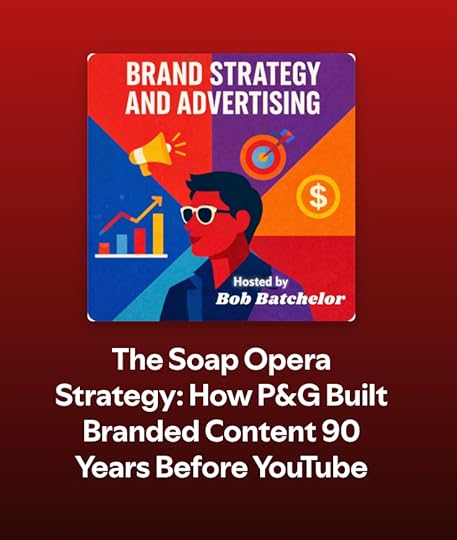
The latest episode of Brand Strategy & Advertising, which examines the role P&G played in advertising history
Not notice.
Not tolerate.
Feel.
Perhaps a commercial that hit you before you could name what it was selling or a slogan that lodged somewhere in your brain and hasn’t left in twenty years. What about a brand that made you want to belong to something?
The room gets quiet. Then people start to register and the discussion begins…
That moment — the pause before the hands — is why I made this podcast.
The Idea That Wouldn’t Leave Me AloneI’ve spent the better part of thirty years at the intersection of American history, pop culture, and brand strategy. I’ve written books about Stan Lee and the Marvel universe, Jim Morrison and the Doors, George Remus and the Prohibition underworld, Kimberly-Clark and the consumer revolution. I’ve edited three volumes on how advertising shaped American life. I’ve taught brand strategy for two decades.
And the thing I kept running into — in every book, every course, every conversation with students and professionals — is that most people have no idea how advertising actually works. Not in the surface sense of “this commercial is trying to sell me something.” Rather, in the deeper sense: how advertising manufactured American desire from the ground up, built the consumer culture we live inside, and made brands powerful enough to survive wars, recessions, and the complete reinvention of media.
There are excellent academic books on this. I’ve edited some of them. But there was no show that did what I wanted to do: connect 125 years of advertising history to the brand strategies operating right now, in plain language, in episodes you can finish on a commute.
So I built it.
What Brand Strategy and Advertising Actually IsThe show is called Brand Strategy and Advertising, and it’s a podcast about the history of advertising in America — from patent medicines and the first national magazine campaigns to P&G’s invention of branded content, Bill Bernbach’s creative revolution, the birth of brand positioning in the 1970s, and the digital disruption that rewired everything in the last two decades.
Each episode runs 12 to 15 minutes. Long enough to go deep. Short enough to be useful.
The structure is simple: every episode takes a historical moment — a campaign, a figure, a strategic shift — and traces its direct line to something you encounter in contemporary brand strategy. Because here’s what decades of research have taught me: the fundamental logic of advertising has changed remarkably little. The channels change. The scale changes. The speed changes. But the core mechanisms — how brands manufacture desire, build equity, and occupy mental positions in the consumer’s mind — were largely figured out before television existed.
“The best advertising history isn’t nostalgia. It’s a user’s manual for the present.”
That’s the thesis. I believe it completely.
Who This Podcast Is ForThe honest answer: anyone curious about how culture gets made.
The more specific answer: if you work in marketing, advertising, communications, or brand strategy, this show will give you context and vocabulary that most practitioners never acquire because they came up in the industry rather than through the history. If you’re a student studying communications, media, or business, this is the background reading that makes your courses click. If you’re a cultural historian or just someone who has ever wondered why certain brands feel like part of your identity, this show is for you too.
I’ve tried to write and record it so that a sophomore who has never taken a marketing class and a brand director with twenty years of experience can both find it valuable. That’s a harder needle to thread than it sounds. I think we got there.
What’s in the First EpisodesHere’s a taste of where we start:
Episode 1: An Introduction: We’re studying 125 years of advertising history to decode contemporary brand strategy. Each episode connects historical case studies—drawn from the three-volume anthology We Are What We Sell: How Advertising Shapes American Life—to current brand practice.
Episode 2: Discover the three major forces that made advertising the heart of consumer capitalism between 1930-1975: how consumption became identity, how every new technology gets weaponized for selling, and how advertising became art.
Episode 3: A deep dive into the hidden strategy behind visual brand identity that most marketers miss. You'll discover why some brands succeed with cartoon mascots, while others fail, why consistency beats cleverness, and what the Michelin Man can teach you about building brands in 2025.
Episode 4: We examine why every economic crisis since the 1930s follows the same predictable pattern, and why understanding Depression-era advertising makes you better at analyzing brands in any economy.
Episode 5: Soap operas, Irna Phillips, and the woman who invented modern television — then nearly lost everything to a brand that decided it could write the rules.
► Listen on Spotify [Spotify link]
► Listen on Apple Podcasts [Apple Podcasts link]
The Larger ArgumentI want to say something that might sound counterintuitive for a show about advertising: I didn’t build this as a celebration.
Advertising is one of the most powerful forces in American cultural history. It built the consumer economy, created the brands that feel like part of the national identity, gave us some of the most memorable art and language of the last century. Advertising has also manufactured discontent, telling people something was wrong with them and then sold them the solution. It edited culture through what it was willing to sponsor and what it wasn’t. Advertising has always been, at its core, in the business of manufacturing desire.
A show about advertising history that ignores that isn’t honest. So this one doesn’t.
My goal is for listeners to come away understanding both sides: the craft and the intelligence of the best advertising work, and the structural logic underneath it that brand strategists need to understand whether they find it inspiring or troubling. Both things can be true. In my experience, the people who are best at this work are the ones who hold both.
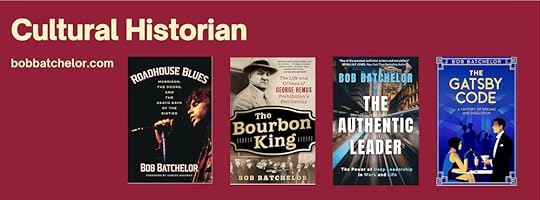
Some of the books authored by cultural historian and Coastal Carolina University Assistant Professor Bob Batchelor
A Little About Where This Comes FromI’m a cultural historian and professor at Coastal Carolina University’s Department of Communication, Media, and Culture. I’ve written or edited more than two dozen books, including Stan Lee: A Life, Roadhouse Blues: Morrison, the Doors, and the Death Days of the Sixties, The Bourbon King: The Life and Crimes of George Remus, and Kotex, Kleenex, Huggies: Kimberly-Clark and the Consumer Revolution in American Business. I co-edited the three-volume We Are What We Sell: How Advertising Shapes American Life… And Always Has, which serves as the primary backbone for this podcast.
My work has appeared in the New York Times, Los Angeles Times, PopMatters, and Time. I’ve been a commentator for NPR, BBC, PBS NewsHour, and the National Geographic Channel.
I also ran marketing and communications at the executive level in corporate America before returning to university teaching. Which means when I talk about brand strategy, I’m talking about work I’ve done, not just work I’ve studied.
One Last ThingThe question I started with — when was the last time an ad made you feel something — is also the question the best brand strategists ask every single day. It’s the professional version of a much older question: what makes people care?
That question has a 125-year answer. This podcast is how I’ve tried to tell it.
New episodes drop regularly. Subscribe on Spotify or Apple Podcasts, and if you find it useful, share it with someone who teaches, studies, or works in the field. That’s the only algorithm that actually matters.
► Subscribe on Spotify [Spotify link]
► Subscribe on Apple Podcasts [Apple Podcasts link]
December 4, 2025
30% OFF AT BLOOMSBURY WEBSITE -- 2025 HOLIDAY SALE
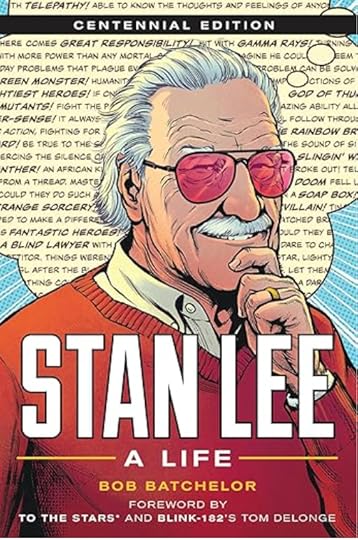
Stan Lee: A Life by award-winning cultural historian Bob Batchelor
“Fascinating…Great work!” — Max Foizey, “Max on Movies,” The Big 550 KTRS, St. Louis
Stan Lee: A Life traces the icon’s journey from Depression-era New York to his reinvention as Marvel’s tireless ambassador, exploring his creative breakthroughs within the currents of American history and media.
“Respectful, well-sourced … may be the best of the bunch.” – Booklist
“Exceptionally well written…an extraordinary biography.” – Midwest Book Review
In Stan Lee: A Life, Batchelor explores how Lee and his collaborators transformed comics through serialized storytelling, moral complexity, and a humanized superhero—innovations that later powered the Marvel Cinematic Universe and cemented Lee’s status as a cross-media icon.
November 19, 2025
STAN LEE ENTERS THE COMIC BOOK INDUSTRY
Many episodes in Stanley Lieber’s early life are shrouded in uncertainty. How the teenager bounded from Clinton High School to Joe Simon and Jack Kirby’s assistant at Timely Comics involves both a bit of mystery and a touch of mythmaking.
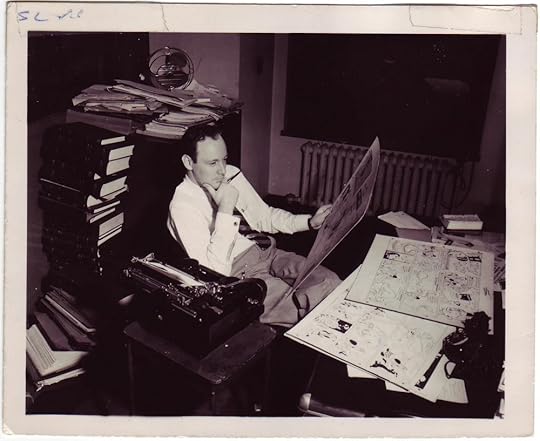
Courtesy of Stan Lee Papers, Collection Number 8302, American Heritage Center, University of Wyoming.
There are several versions of his Timely Comics origin story. One account begins with his mother Celia. Clearly she put her hopes in her oldest son, particularly since her faith in her husband nearly led the family to ruin. Here we have Celia telling Stanley about a job opening at a publishing company where her brother Robbie worked. Without delay, the young high school grad shows up at the McGraw-Hill building on West 42nd Street, but knows little about the company or comic books.
With Robbie’s prodding, Simon explains the business and how comic books are made. He then offers the teen a job. Basically, he and Kirby are so frantic and overworked, particularly with their new hit Captain America, that they just need someone (anyone, really) to provide an extra set of hands.
Robbie Solomon is also at the center of a different account (here the main player), essentially a conduit between Simon and Timely owner Martin Goodman. In addition to being Celia Lieber’s brother, Robbie married the publisher’s sister Sylvia. Goodman surrounded himself with family members, despite the imperious tone he took with everyone who worked for him. Receiving Robbie’s stamp of approval (and the familial tie) made the boy’s hire fait accompli. Simon, then, despite what he may or may not have thought of the boy, basically had to take Leiber on. “His entire publishing empire was a family business,” explained historians Blake Bell and Michael J. Vassallo.[i] Solomon had a strange job – a kind of in-house spy who ratted out employees not working hard enough or playing fast and loose with company rules.
While the family connection tale is credible and plays into the general narrative of Goodman’s extensive nepotism, Lee offered a different perspective, making it more of a coincidence. “I was fresh out of high school,” he recalled, “I wanted to get into the publishing business, if I could.” Rather than being led by Robbie, Lee explained: “There was an ad in the paper that said, ‘Assistant Wanted in a Publishing House.’”[ii] This alternative version calls into question Lee’s early move into publishing – and throwing up for grabs the date as either 1940, which is usually listed as the year of his hiring, or 1939, as he later implied.[iii]
Lieber may have not known much about comic books, but he recognized publishing as a viable option for someone with his skills. He knew that he could write, but had no way of really gauging his creative talents. Although Goodman was a cousin by marriage, he did not have much interaction with his younger relative, so it wasn’t as if Goodman purposely brought Lieber into the firm. No one will ever really know how much of a wink and nod Solomon gave Simon or if Goodman even knew about the hiring, though the kid remembered the publisher being surprised the first time he saw him in the building.
The teen, though bright, talented, and hard working, needed a break. His early tenure at Timely Comics served as a kind of extended apprenticeship or on-the-job training at comic book university. Lieber was earnest in learning from Simon and Kirby as they scrambled to create content. Since they were known for working fast, the teen witnessed firsthand how two of the industry’s greatest talents functioned. The lessons he learned set the foundation for his own career as a writer and editor, as well as a manager of talented individuals.

By Marvel Comics/Marvel Entertainment.The original uploader was Iftekharahmed96 at English Wikipedia..Later version(s) were uploaded by DatBot at en.wikipedia. - Transferred from en.wikipedia to Commons.(Original text : http://marvel-microheroes.wikia.com/w...), Public Domain, https://commons.wikimedia.org/w/index...
NOTES
[i] Blake Bell and Michael J. Vassallo, The Secret History of Marvel Comics: Jack Kirby and the Moonlighting Artists at Martin Goodman’s Empire (Seattle: Fantagraphics, 2013), 98.
[ii] Stan Lee interview, “Interview with Stan Lee (Part 1 of 5),” IGN, June 26, 2000, http://www.ign.com/articles/2000/06/2... (accessed June 1, 2016).
[iii] Lieber’s hiring date never been conclusive. In an unpublished draft of the history of Marvel, Lee wrote “early 1940,” but other publications and places he says or infers 1939. Lee, “History of Marvel (Chapters 1, 2, 3),” Unpublished, 1. Marvel Comics -- History (Draft of “History of Marvel Comics”) 1990 Box 5 Folder 7, Stan Lee Papers.
November 11, 2025
THE GREAT GATSBY IN THE HEADLINES -- $2.99 SALE ON THE GATSBY CODE
When The Great Gatsby surges back into the news, we are reminded once again that America’s most shimmering and elusive novel still haunts the culture—class, ambition, desire, the fragile scaffolding of the American dream.
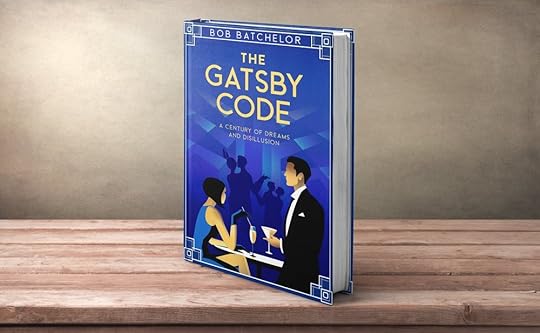
The Gatsby Code: A Century of Dreams and Disillusion by award-winning cultural historian Bob Batchelor
To celebrate the conversation (and help more readers join it), Tudor City Books has dropped the price of eBook to $2.99 on Amazon for a limited time.
If you’ve been meaning to revisit Gatsby’s world—or explore why the novel keeps gripping us a century on—now’s the moment. More than just a literary analysis or criticism, The Gatsby Code is a century-spanning cultural biography of a novel and its enigmatic protagonist. From Gatsby’s humble roots as James Gatz in North Dakota to his glittering rise and tragic fall in West Egg, Bob Batchelor decodes the psychological and sociological layers of Fitzgerald’s antihero and the America he both embraced and exposed.
Bob Batchelor has written a powerful study of The Great Gatsby and its ability to resist the erosion and forgetfulness of time...and discovers a Gatsby we had never seen before—wounded and alone. — Jerome Charyn, author of Maria La Divina, a novel of Maria Callas
Bottom line: Gatsby’s back in the conversation—jump in while the eBook is just $2.99. Get the The Gatsby Code eBook today!
Also in Book News: Stan Lee: A Life (Paperback) Out in Time for the Holidays!Bloomsbury Academic has released the paperback, Expanded Centennial Edition of Stan Lee: A Life—a full portrait of Marvel’s tireless ambassador from Depression-era New York to global icon. Early praise called it “respectful, well-sourced…may be the best of the bunch” (Booklist) and “exceptionally well written…an extraordinary biography” (Midwest Book Review).

Stan Lee: A Life by Bob Batchelor, Foreword by Blink-182 and To The Stars* icon Tom DeLonge
Paperback details: 264 pages • ISBN-13: 979-8881808860 • List: $16.95
Order & save: Use code GLR BD8 at Bloomsbury.com for 20% off.
I write about the people and stories that shape American culture—icons who cross generations and mediums. I’ve published 16 books (and edited 19) on subjects ranging from The Great Gatsby and Mad Men to Jim Morrison and Prohibition kingpin George Remus. My work has appeared in or been featured by the New York Times, BBC, Los Angeles Times, The Guardian, PBS, and NPR. I’m an Assistant Professor of Communication, Media, & Culture at Coastal Carolina University. More at bobbatchelor.com.
October 24, 2025
BOB BATCHELOR’S STAN LEE: A LIFE ARRIVES IN PAPERBACK
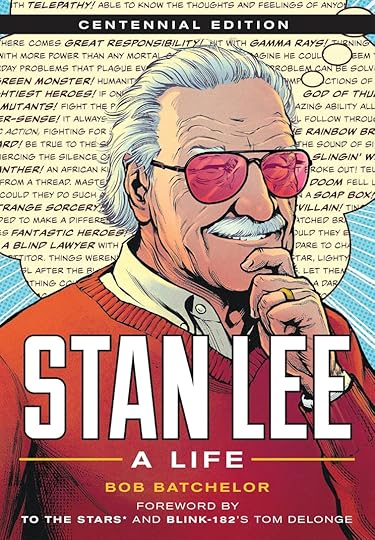
Stan Lee: A Life by Bob Batchelor; Foreword by Blink-182’s Tom DeLonge
Conway, SC, Oct. 23, 2025 – Stan Lee’s extraordinary life was as epic as the superheroes he created, from the Amazing Spider-Man to the Mighty Avengers. His ideas and one-of-a-kind voice and image are at the heart of global culture, loved by millions of fans across the globe.
Bloomsbury Academic will release the paperback of Stan Lee: A Life by award-winning cultural historian Bob Batchelor on October 30, 2025. Hailed as the “definitive” biography of Marvel’s iconic creator and leader, the book offers a full portrait of Lee’s remarkable, nine-decade career and global impact.
Stan Lee: A Life traces the icon’s journey from Depression-era New York to his reinvention as Marvel’s tireless ambassador, exploring his creative breakthroughs within the currents of American history and media.
“Respectful, well-sourced … may be the best of the bunch.” – Booklist
“Exceptionally well written…an extraordinary biography.” – Midwest Book Review
In Stan Lee: A Life, Batchelor explores how Lee and his collaborators transformed comics through serialized storytelling, moral complexity, and a humanized superhero—innovations that later powered the Marvel Cinematic Universe and cemented Lee’s status as a cross-media icon.
About the Paperback EditionFormat: Paperback, 264 pages
Publisher: Bloomsbury Academic
Publication Date: October 30, 2025
ISBN-13: 979-8881808860
List Price: $16.95
Availability: The book is available for preorder at Bloomsbury and other retailers. Customers can use the discount code (GLR BD8) to save 20% ($13.56) at bloomsbury.com/9798881808860
About the AuthorBob Batchelor has established a global reputation for writing entertaining books on iconic figures who transcend their eras and leave a lasting legacy on American cultural history. Noted for deep research and a cinematic writing style, Batchelor is a three-time winner of the IPA Book Award. He has published 16 books and edited 19, on subjects ranging from The Great Gatsby and Mad Men to Jim Morrison and Jazz Age Bootleg King George Remus. His books have been translated into a dozen languages and appeared in or been featured by the New York Times, the BBC, Cincinnati Enquirer, Los Angeles Times, Today.com, The Guardian, PopMatters, and Time. Batchelor has appeared as an on-air commentator for The National Geographic Channel, Wondery, PBS NewsHour, BBC, PBS, and NPR. He is an Assistant Professor of Communication, Media, & Culture at Coastal Carolina University. He lives in South Carolina with his wife Suzette Percival, an antiques and vintage expert who founded the lifestyle brand Spot of Vintage. Visit him at bobbatchelor.com.
Media ContactFor interviews, review copies, and speaking requests, contact Bob Batchelor, bob@bobbatchelor.com
October 9, 2025
REPLAY ON-DEMAND -- "WRITE YOUR BOOK" WITH DONALD THOMPSON & BOB BATCHELOR
Watch the on-demand replay of “Write Your Book,” which outlines the steps from brainstorming through publication.
For more information, check out the conversation I had with EY Entrepreneur of the Year honoree Donald Thompson. Then, see the recent livestream we recorded at https://youtu.be/tGiNRqWGh4Q?si=1wOaFvbLm4dV2KBe

We share expert insights for leaders, entrepreneurs, and executives ready to turn their ideas into a published book. Whether you’re starting with a spark of inspiration or a rough outline, you’ll gain practical advice, motivation, and the tools you need to take the first step toward authorship.
October 7, 2025
DOUBT, FEAR, AND CONFUSION FOR MOST PEOPLE WHO WANT TO WRITE A BOOK
Despite the clear benefits, many executives and senior leaders hesitate to write a book. The resistance is rarely about skill. The real challenge is often focused on fear, time, and clarity.

Photo by Tom Hermans on Unsplash
These mental roadblocks often present themselves in familiar refrains:
“I’m not a writer.”
“I don’t have time.”
“What if no one reads it?”
“It’s too late to start.”
These objections are understandable, but often shortsighted. The truth is, you don’t need to be a professional writer. You need to be a professional with insight: someone who has seen, solved, and led through challenges worth learning from.
The BIG Secret…You don’t have to be a writer to get your ideas into the body of knowledge. As a matter of fact, some publishing insiders estimate that upwards of 60 percent of bestsellers are actually ghostwritten. Therefore, the research and writing can be supported by expert collaborators. In other words, let a professional writer put their expertise to work for your ideas or storytelling.
What matters is your willingness to own your narrative. Savvy leaders never win by themselves, so don’t think that writing your book means holing up by yourself for a year, hovering over the keyboard, and slowly driving yourself bonkers.
Teams make winning possible, so crafting your book with the best available resources should be your goal.
The greatest risk is not writing. Executives who stay silent lose control of their story. They allow competitors, markets, or algorithms to define their leadership brand. Worse, they miss the opportunity to document their unique thinking in a way that benefits their organization and inspires their team.
“Leaders often underestimate how much their story can inspire others. That’s not ego—it’s impact.”
—Kurt Merriweather, Vice President of Global Marketing, Workplace Options, and co-author, The Inclusive Leadership Handbook
Many people view writing a book as a personal win. That’s fine, since everyone will have different reasons for crafting their book. Here’s another way to look at it, though. Think of your book as a strategic tool for clarity, alignment, and growth.
Your book forces you to ask:
What do I really believe?
What do I want to be known for?
How do I want to be remembered?
Answering those questions? That’s where great leadership begins.
For more information about writing your book, ghostwriting, or executive-level thought leadership, visit the team at ExecBrand Authority or email me directly: bob@bobbatchelor.com.

September 25, 2025
TONE AND LEADERSHIP
Tone is how a leader’s intent becomes lived reality. It signals what’s important, sets the boundaries of debate, and determines whether hard truths surface in time to act. People don’t just hear your plans, rather they feel your posture, how you frame trade-offs, acknowledge impact, and keep (or break) promises.
With the proper tone, felt experience becomes culture.

Brett Jordan, Unsplash
Tone is an operating system, not a vibeAuthenticity isn’t a mood or mystique. It’s observable behavior—human language, owned responsibility, and promises kept. When tone and ethics align, organizations allocate power more fairly and earn consent more easily. When they don’t, leaders don’t connect, which leads to skepticism that compounds with every all-hands, email, or media quote that doesn’t match reality.
Ask yourself: “If a frontline employee only had access to your words and your cadence (not your title), would they infer your true priorities?”
What tone does in chaotic environmentsUncertainty increases the premium on tone. People are looking for presence. In volatile moments, tone should do three things:
Reduce fear: Name what’s known, what’s unknown, and when you’ll update.
Create safety: Invite dissent on purpose and thank the first tough question.
Show care: Acknowledge human impact before issuing directives.
Leaders who do this consistently build trust faster than leaders who try to be “right” in every meeting.
Make authenticity observableLeaders who use tone properly (and consistently) build trust faster than leaders who try to be “right” in every meeting.
If you want to create a culture people can feel, make your tone measurable. Here is a straightforward five-move pattern:
Open with a value sentence: “Here’s the principle guiding this decision.”
Acknowledge impact: “This will help X, and it will be hard for Y.”
Explain the why in plain language: no jargon, acronyms, insider language, or euphemisms.
Invite challenge: “What am I missing? Who’s affected who isn’t in the room?”
Close the loop publicly: “Here’s what changed (or didn’t) because of your input.”
Repeat those moves in town halls, one-on-ones, and written updates. Consistency is the point.
Tone builds (or breaks) psychological safetyYour tone either widens or closes the leadership chasm—the gap between how you see yourself and how people experience you. A curious, steady tone turns “risk” into “experiment,” “failure” into “learning,” and “reporting bad news” into “doing your job.” A defensive tone does the opposite. When leaders normalize candor and early confession, teams solve problems faster and innovate more often.
The messaging portfolio: get tone fit for purposeExecutives need a full “messaging portfolio,” not one generic voice. Your tone should flex by audience and context without losing integrity:
Strategy tone: succinct, principle-led, non-defensive.
Change tone: transparent, empathetic, specific on next steps and timing.
Crisis tone: calm, accountable, frequent, free of spin.
Recognition tone: generous, specific, share the credit.
External thought-leadership tone: insight-driven, human, not self-congratulatory.
When these tones contradict each other, people default to the least generous interpretation. Practice the transitions.
A practical lens: the 6-M communication checklistI created the 6-M Communications Model to provide leaders with a easy method for evaluating their efforts. Use the 6-M Model before important messages:
Mindset: What value am I leading with?
Message: What’s the one thing people must remember?
Medium: Is this best said live, in writing, or both?
Mechanisms: What rituals will reinforce this (cadence, Q&A, feedback routes)?
Membership: Who must have voice before/after this message?
Measurement: How will I know the message landed (salience, sentiment, behavior)?
If you can’t answer these quickly, you’re not ready to present the information.
Global vs. local toneEmpathy and safety travel. Tone norms don’t.
What reads as open and warm in one culture can feel intrusive in another. Globally, design for safety with systems (anonymous feedback, structured retros, manager toolkits) and let local leaders tune the tone. Locally, rely more on presence and relationship.
Here are some additional ideas:
Ban euphemisms for bad news. Call a layoff a layoff.
Set update cadences in advance (e.g., every Friday at 3 p.m.).
Stop after-hours email from leaders unless truly urgent; schedule send.
In meetings, pause the over-talker and invite the quiet expert.
Keep a public “decisions log” with the value that guided each call.
These are small moves with outsized cultural effects.
Thought leadership begins at homeIf your public thought leadership says “people first,” but your internal tone is opaque or punitive, you are eroding brand equity from the inside out. Align the external story with the internal experience. The most credible external voice is a leader whose team nods when they read it.
A 15-minute tone workout this weekHere are several ways to practice with tone:
Rewrite one major update using the five-move pattern above.
Run a “tone audit” of your last three all-hands: where did you invite dissent, and where did you rush it?
Ask your team privately: “What’s one thing I could do in meetings that would make it safer to disagree with me?” Then implement it and close the loop.
Your people are listening—and cataloging—every town hall, 1:1, side comment, and press quote. Tone, like power, is always in play. The question isn’t whether you have a tone; it’s whether you’re using it to create clarity, safety, and trust.
Are you thinking about tone when you communicate—or only when you’re being communicated to?
Tone, like power, is always in play. The question isn’t whether you have a tone; it’s whether you’re using it to create clarity, safety, and trust.
September 16, 2025
AUTHORITY ISN'T CLAIMED...IT IS AUTHORED
Pride. Legacy. Authority. Fulfillment. People choose to write books for many reasons.

The primary aspiration I have been discussing with business leaders and executives recently is to carve out a space in thought leadership. Digging a little deeper, some leaders want to share their unique ideas and others have a specific topic they want to explore with other experts.
What I tell them...and I'll explain more here...is that one truth is timeless -- a great book is the most durable asset in an executive's brand portfolio. Authorship (the actual ideas, research, writing, and more to bringing the book to life) converts expertise into proof. No one can erase that or take it away.
Enduring Power of BooksBooks endure. Regardless of how pretty your PPTs are or your wizardry with Excel, those things quickly fade away. A book, though, carries your ideas into rooms (and minds) you haven't entered. For many executives, authorship transforms the conversation from "What do you do?" to "How can we work together?"
Writing forces deep reflection, self-actualization, and strategic clarity. These impulses run the gamut:
What problem do you solve?
For whom?
Why now?
How do you solve challenges unlike -- or better -- than others?
The answers become the spine of your thought-leadership persona, which includes your point of view, language, and narrative arcs. The ideas at the heart of your book also aligns your messaging. Leaders who write books open a new world of possibilities; raise awareness for their personal brands; and demonstrate judgment, coherence, and the courage to stand behind a thesis.
A book also operationalizes and extends influence. I have repeated over and over again the deep content power of authorship and content creation. When you work on a book, you build a content mine that you can tap long into the future, from keynote presentations to bylined articles an internal communications pieces.
As part of a deliberate (strategic) content platform -- owned media, public relations, webinars, branding/visuals, and social media -- you transform your ideas into a steady stream of high-value assets. This is the kind of powerful content that will drive AI summaries, human response, and long-term influence.
Words of AdviceExecutives and other successful leaders often want a large dollop of science with their art. Well, here it is: Treat authorship like any growth initiative and measure it accordingly. But, you have to have a complete go-to-market plan that accompanies your effort.
What can you do? Track pipeline quality and cycle time on deals influenced by the book. Monitor speaking demand and media outreach. Watch talent attraction and leadership recruiting lift as candidates pre-read your principles. Track reputation signals (influence, network expansion) triggered after you publish.
The payoff? ROI may be revenue from the book itself, but the real power is relevance, including business expansion, leads generated, conversations launched, and career expansion/transformation. And, of course there are countless "real-world" consequences...but the other...that is priceless -- trust!
Of course there are countless "real-world" consequences when you write a book...but the other...that is priceless -- trust!
Many leaders express frustration because they don't know where or how to begin. Hmmm, you're reading this because I am expert in the entire process. So...I wouldn't expect any executive or leader to tackle this big a project cold.
Instead, put together a great team -- just like you would if you were addressing any pressing business objective. Strategy sessions translate business objectives into a table of contents. Interviews and voice memos become chapters through a disciplined editorial process. Ghostwriters and editors ensure the manuscript captures your voice. Is this outsourcing or finding a path to scale your ideas with professionals who are as expert in their work as you are in yours?
Is this outsourcing or finding a path to scale your ideas with professionals who are as expert in their work as you are in yours?
The risk is not writing or being stifled into inertia. Silence lets competitors, markets, and algorithms define (or redefine) your leadership story. Trust yourself and trust your story. Leaders who do the authorship work accrue advantage: trust, mindshare, and authority that compounds over time.
Don't wait for permission or the perfect time to begin. Launch your author journey today: a couple notes here, some anecdotes there, or imagine what that cover or table of contents looks like. Your story has value and your stakeholders want to trust you.
So, no matter the reason -- putting your stake in the ground or providing the full picture of your career journey -- get started today. For more information from EY Entrepreneur of the Year honoree Donald Thompson and I, watch the recent livestream we recorded at https://youtu.be/tGiNRqWGh4Q?si=1wOaFvbLm4dV2KBe