Will Jelbert's Blog
October 16, 2020
How to Marie Kondo your words: 3 word tips in 30 seconds
 Since 2000 (with a career break 2011-2015), I have worked full time for a major international company in the UK, Switzerland, India, Australia, and the US. But, almost every weekend—and most vacation days since 2017—I’ve also had a side hustle: writing a book. On Tuesday (10.20.2020) that book will be published under the title "Word Wise".
Here’s the rear-cover blurb from the publisher (Hachette):
“An eye-opening guide on how we talk and write to one another, Word Wise explores 400+ of the most common cases of word trash (filler words, hyperbole, and abstractions) and word power (verbs of action, ear candy, onomatopoeia). Examining social media, the language of Donald Trump, AI language research, and heard-on-the-street lingo […] With wit, practical applications, and a small dose of nitty-gritty grammar, Word Wise will help you communicate more effectively at home, at work, and online.”
3 Word Tips for connecting better (from Word Wise ):
1) Ctrl + F on the word “Just” and delete: A Google executive banned the word “just” from her team’s communications after she realized that striking it from a phrase clarified and strengthened the message.
2) Start requests with “Would you be willing to…”: Research by Loughborough University in the UK shows customers, family, and friends will be more likely to say “yes” to you.
3) Use the word “Laughter”: Researchers at the University of Vermont discovered that reading or hearing it makes us feel happier than any other word in the English language. I know I could do with some more laughter.

If enough of my readers ordered Word Wise by October 20th, there’s a chance it would make the NY Times Bestseller list the following week! Would you be willing to read it? :-)
I will also be giving a 13-minute talk, “Word Wise: How mindful word choices can spark connection” at this year’s (virtual) World Happiness Conference alongside the Dalai Lama in November. Follow me on Instagram @jelbertwill to stay tuned. I appreciate you for the support :-)
Thank you!
Will


August 8, 2020
“Word Wise”: my new book on word trash and word power. Preorder now!
2020, has been for some of us, a year devoid of physical contact.
2020, perhaps more than any other year of our lives, has been the year when our words have mattered most.

With an intention to spread connection--not corona--I am excited to reveal the cover of my new book, “Word Wise”. From Running Press @RunningPressBooks (Hachette Book Group @hachetteus):
“An eye-opening guide on how we talk and write to one another, Word Wise explores 400+ of the most common cases of word trash (filler words, hyperbole, and abstractions) and word power (verbs of action, ear candy, onomatopoeia). Examining social media, the language of a president, AI language research, and heard-on-the-street lingo [...]
With wit, practical applications, and a small dose of nitty-gritty grammar, Word Wise will help you communicate more effectively at home, at work, and online.”
You can preorder now here @ https://www.runningpress.com/titles/will-jelbert/word-wise/9780762499687/ . Preorders count towards the first week of sales for the bestseller lists :). Thank you!
July 11, 2020
Ma Che Bello Questo Libro! The Happiness Animal Out Now In Italian!
 The Happiness Animal’s first language was English, but it quickly learned Spanish, then French, then Russian and now Italian.
Thanks to Montse Cortazar for connecting Armenia Publishers with The Happiness Animal!
La Sagezza Del Koala was published on the 24th June by Armenia and is now available for order at all Italian bookstores.
Get your copy here, now!
French Connection: The Happiness Animal out now en francais!
Tu parles le français?
If oui, then you will enjoy this zest and humor filled renaissance of The Happiness Animal
(spoiler: there are 5 animals). Sans blague!
La Sagesse du Koala is now available to order from all bookstores worldwide, or buy it now, here. 
November 23, 2019
From Russia, with love. The Happiness Animal, Russian edition is out now!
Published by Ves Publishing. The book is now available here:
The Happiness Animal is now available worldwide in English, Spanish, French, Russian,
and Italian.

From Russia, with love. The Happiness Animal, Russian edition is coming soon.
Published by Ves Publishing. The book will be available at bookstores across Russia and online by the end of 2019.
The Happiness Animal is now available worldwide in English, Spanish, French (coming soon), and Italian.

August 14, 2019
A Tale Of False Necessities

I was whatsapping a friend and a
‘I have to go to a wedding’
message popped up next to her RBF profile photo. My response:
“Ok but you want to go to the wedding so I’m curious about you saying ‘I have to go’ rather than ‘I’m going’.”
I have to means I need to and we have few true needs, all of which are covered by Maslow’s hierarchy (of needs). Yep, can’t see going to weddings anywhere in here:

It turns out she wanted to go to the wedding more than she didn’t want to go. No one forced her to go, and she didn’t shit (should) on herself to go — although sometimes we do shit on ourselves to go to weddings that we don’t want to go to and mislabel the shit (should) as a need, to disguise the shit at the core of what we are saying.
Why did she say I need to go to a wedding? Why not, I’m going to a wedding? Why make it shitty?
Perhaps she didn’t want to get vulnerable and tell the truth that she wanted to go. Perhaps she had a thought along the lines of I’m not worthy of saying what I want to do so she created a lie to mask how she felt. She disconnected.
For me, needs are even more simple than Maslow’s. The only thing I need to do is go to the toilet (where I also want to flush my shoulds — but I don’t need to), eat, drink, breathe, sleep, receive and give affection and love, have physical contact with other human beings — more hugs please — and have a place to sleep each night that’s warm and dry enough. True needs are few, wants are common, don’t wants are often even more common, but I want shits outside the toilet to be non-existent.
Today’s word-trash post is brought to you by the words have to (made from recycled plastic bags), need to, and must.
Taken from my book ‘Word Woke’, coming 2020.
May 18, 2018
El Animal De La Felicidad: Spanish Version of The Happiness Animal to be published Sep 2018 (Ediciones Obelisco)

Draft cover of the Spanish version of The Happiness Animal to be published by Ediciones Obelisco in September, subtitle and final design TBC.
February 5, 2018
Living next door to Russia: how the remotest US community stays happy.

You can see Russia from my living room… No really.
It’s about as close as anywhere in the US gets to ‘Hygge’. It’s a place of sharing, equality and close contact and it’s also the most isolated community in the United States. That said, there is occasionally cell phone service.
The location is the Bering Straits, the outermost reaches of Alaska, 140 miles Northwest of Nome [home of the Discovery Channel’s Bering Sea Gold], less than a mile East of the International Date Line and the Russian border.
The only way to get here is an hour and a half ride on a freight helicopter from Nome that delivers the mail, food and other supplies to the Native village once or twice a week, weather permitting, and the weather doesn’t often permit…

Where East is West
So how does an American community keep its spirits up when it’s living on an almost barren pile of rocks that for most of the year is either covered in fog or ice, and is so far from the rest of the US that it’s closer to Siberian Russia? Here’s a rundown of how the Eskimos keep their five happiness muscles in good shape….
Eskimo happiness muscle number 1: Kindness: As we landed, around 20 villagers (Diomede has a population of about 100 of which 95% identify themselves Eskimos) gathered around the helipad, 20 feet above the waves. They grabbed about thirty bags and boxes from the chopper and carried them on their shoulders along a path towards the houses and the school; many hands making light--unpaid--work.

Little Diomede School
As I stared across the 2-mile channel to the cliffs of Russia, Ron walked up to me with a grin. Ron is a well weathered thirty-nine year old Eskimo who smiles often. His father is the school janitor and his mother, the dinner lady. I even saw Ron’s daughter helping her grandfather in the rain to reinforce the sea wall in front of the school.

Ron
Ron told me that as the villagers become more accustomed to food sold at the island’s ‘Native Store’, people now hunt less--although while I was there I met several who had been foraging the cliffs for Eskimo Potatoes. Four of the islanders also have small fishing boats but who catches what doesn’t matter when concept of ownership is as watery as the surroundings...
‘Even if you follow a boat out and you don’t catch anything but the other boat does, they will share their catch with you. If you go to the mainland, the boat captain takes everything but here the whole boat shares’ - Ron
‘I’m going to get coffee. ‘Do you want some?’ asked Ron. He smiled. We walked about 30 feet to Washeteria, the island’s coin laundry, which doubles as a brew station for the locals. Once inside one of the teenagers who wore yet another smile and a hoodie printed with the words ‘Keep One Rolled’, started to fix us a fresh brew.
. 
Along with the Native Store, Washeteria forms the social hub of the island. Alcohol is illegal on Diomede, so this is about as close as it gets to a local bar.
Coffee was a dollar, and Ron offered to pay. A couple of sips in and our chat was cut off--A woman in her early thirties had just walked in and began crying as she looked at her phone. I asked her if she was alright. She said no and walked back outside...

Eskimo happiness muscles 2 & 3: honesty and awareness
‘Something’s happened. They will call a meeting,’ said Ron. Sure enough by the time we got outside, villagers were already starting to shout to each other across the paths between the houses. I heard a father calling to his son to get his brother. Ron thinks someone on the mainland has either died or gone to hospital, but seems unphased and continues. He tells me as he rests on one of the boats that he sometimes feels frustrated that he can no longer hunt because of his back and limited movement in his arms.
When Ron feels this frustration he calls up the Nome police station to exercise his honesty muscle by expressing some resentments. Ron says he was repeatedly pepper sprayed by a cop, who used the spray to wake him up when he passed out on a street in Nome [after a few drinks]. The cop and his partner took Ron to the hospital to wash the spray off, then forced him into the footwell behind one of the seats of the police car, at which point Ron thinks he sustained the injuries to his back and shoulders.They took Ron to Nome jail where the cop pepper sprayed him again. Then back to the hospital for another rinse, then back to jail. Ron says that at this point the second policeman felt left out so he gave him a pepper spraying too.
Throughout the story Ron smiles as he talks with the soft melody of the Eskimo accent.
He reassures me that the ‘bad cop’ is now retired from Nome police and although Ron is still angry with him, he maintains a level of awareness of why the cop did it: As a kid, the policeman was one of the few non-natives in town and the majority picked on him. As soon as he became old enough, he joined the police force and started acting out to validate his ego.
Eskimo happiness muscle 4: tolerance and curiosity (aka the wonder muscle)
Up until a few years ago the islanders tossed their garbage bags into the ocean. But Russian soldiers started to complain that it was washing up on their shoreline two miles away, so now the trash is incinerated or piles up. Big Diomede, the neighboring Russian island, is a military base. The former residents were displaced during the Cold War, when most of the families moved to here to Little Diomede, the others to Siberia. Up here, Russia and the United States mean little other than an invisible border that prevents people from visiting their families.
Ron’s father tells me he and his father were the last on the island to make skin boats--the traditional Eskimo vessel for hunting. The last skin boats were wiped out when they left them on the shore just before the onset of winter. Overnight the sea ice arrived and crushed the boats against the rocks. But life went on and eventually they replaced the skin boats with the four modern boats from the mainland.
Just above the houses are the crosses marking the island’s deceased.
The crosses are superfluous: the ground is so hard the islanders cannot bury their dead. That doesn’t stop them putting the bodies in coffins that rest on the rocks of the hillside.
An as yet unweathered white coffin is clearly visible a couple of hundred yards up the slope to the South East. Inside, a teenager who died after falling out of a boat without a life jacket. Most of the islanders do not know how to swim. I noticed detachment from the concepts of loss and death, whether it was towards skin boats or people. Staying connected to the community and what’s happening in the immediate present--whether that’s the twenty walruses we saw swimming past or the pod of orcas the day before, or whether the helicopter will be coming today or just whether it’s time for another cup of coffee--quickly blow away the mental weather of frustration or loss. And the wind here is strong, most of the time.
I had sent copies of my children’s book Puptrick tells a lie and learns to bark to the school in advance of my trip and while wandering the corridor I overheard the story being read aloud in the classroom. The teacher, Rob invited me into class to talk to the children, many of whom I had already met when I kayaked off the island the day before--who laughed and grabbed me or jumped on my back and asked for my autograph along with a string of questions about where I lived and what it was like and if I was famous.
Eskimo happiness muscles number 5: Courage (and love) Ron smiles and puffs on a cigarette as he tells me a story of a boat on its way back to land, full of fish.The waves began breaking over the side of the boat and it started to sink. One of the Eskimos stuck his head over the side into the water and called the orcas. Ron and Keep One Rolled swear that the orcas appeared and formed a wave barrier along the side of the boat preventing it from taking on more water as they escorted it to shore.
‘So that community has the orcas respect. You just have to respect mother nature’.
As I wandered back into the school, Ron’s mother and father invited me to join the kids for lunch in the school dining area.
 The sign behind the service hatch area where the dinner lady (Ron’s mother) prepares the children’s breakfast and lunches sent over from the mainland.
After lunch the kids wanted me to join them in the gym for PE, which took the format of dodgeball. No fear in any single child. As a Brit, it was pretty new to me. Imagine a 39 year old man being intimidated by a group of under 10’s and you’d be close. That said, during my two days at the school there was no evidence of any bullying, no ostracized kids, probably just because of the levels of contact from living, playing, eating and sleeping all within a hundred yards of each other day in, day out. And when we played dodgeball in the gym, every single child was laughing. All appeared genuinely happy.
The personalities were varied and authentic from the quiet, introspective and bookish to the bold boy who kept asking me to arm wrestle, to the joker, to a girl who pretended to be a cat and leaping from rock to rock while meowing like a feline banshee (you can see and hear her in this video of the kids playing around me as I got my kayak ready for the trip towards Russia) to a girl who laughed almost nonstop. No child was afraid to be different. Difference here is embraced, not feared.

Russia through the window of one the school’s classrooms, which also doubled as my bedroom for the night.
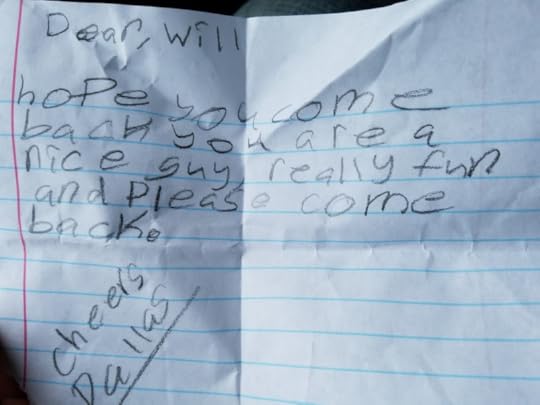
The people of Little Diomede are hardy enough to live on rocks surrounded by sea-ice for a long winter but they are also warm people who accept others and their own fate with a smile and a melody. Outside dodgeball, there’s no competition and little ego. Perhaps, and just maybe, that’s why most people I met on this island seemed if not happy, then at least content. Winter is coming but that doesn’t worry the residents of Little Diomede.
June 14, 2017
‘Happiness animals’ make mental health child friendly…

Thrive Global regular Will Jelbert is no stranger to publishing with his bestselling book, The Happiness animal — or HA — currently # 1 in mental health, emotions, parenting and relationships and inner child categories on Amazon. Don’t be fooled by its cover: this is an adults only book splicing dark stories of addiction, sex, anxiety and suffering with frequent use of Parental Advisory language. But when Will teamed up with Arizona artist and illustrator (and HA fan) Jamie Heusinkveld, their partnership gave gave birth to five illustrated children’s books.
The first book in the series, which tells the story of Puptrick, a dog who tells a lie but then learns to bark truthfully, was released on Amazon this week. The concept of the series is to use five ‘happiness animals’; to represent the five ‘happiness muscles’ that when exercised lead to greater feelings of connection and well being: Honesty manifests as a dog in the first book. In the second, a dolphin splashes and blows its kindness muscle to inspire empathy. Tolerance of others and curiosity are slippery ice navigated by a penguin who overcomes mistrust of the ‘white penguin’ and learns to keep his cool with other penguins. Jamie and Will went down under to find their awareness animal: The wide-eyed Koala learns just how much is enough eucalyptus to eat and what is too much. The final character in the The Happiness Animals series, Lion takes the lead in inspiring courage to face a challenge and to show up for others.
‘Many people have commented that they thought The Happiness Animal was a children’s book [because of the cover and the title], and many people have suggested I write a children’s book. When I heard this enough times, I paid attention. I knew Jamie was the right person to partner with on this project as we both share the same passion for the concepts of the five happiness muscles. As well as being an extremely talented visual artist and illustrator, perhaps most importantly of all Jamie is a mother of two children.
Both Will and Jamie have had their fair share of mental health issues that they’ve had to accept and address to survive, so sharing the importance of exercise for mental wellness has deep meaning for them:
‘The younger we can start to build exercise of these five happiness muscles into our lives, the more resilient and happier we can be from childhood into old age. Let’s encourage our children to be honest, kind, full of wonder, aware, and courageous. Of course we want children to enjoy the stories and to make them visually memorable, but that’s the message behind each one.’ said Will.
Jamie adds, ‘Through age appropriate media, children can understand complex moral concepts. These stories will assist in accomplishing just that. In my parenting experience, a fantastic age to start talking to/teaching children about their happiness muscles is between the ages of 4 to 8. That’s exactly the age group we hope this series of animal tales will appeal to. However, it’s never too early or too late to begin!