Robin R. Cutler's Blog
March 21, 2026
Demanding Women and a Progressive Era Tiger Mom


March 16, 2026
The Eagle is Shreiking Louder Than Ever Before
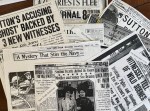
A handful of Sutton case
press coverage. Why was America so caught up in this story?
“There is nothing which will make the eagle shriek louder than the shadow of a muzzle for the press,” John L. Given wrote in 1907.* In that same year, a young Marine Corps Lieutenant died on the grounds of the Naval Academy after a brawl. His mother’s crusade to find the truth about what really happened to her son after the government accused him of suicide became the subject of hundreds of newspaper articles across the United States. As Rosa Sutton put it, “if we do not get justice through the courts, every newspaper in the United States will have the facts as we have them and then see what the opinion of the world will be.” The strength of America’s press corps at the turn of the 20th century is a key reason that the United States Navy re-examined the Sutton case. Regular readers know Rosa Sutton’s story is the subject of A Soul on Trial, my book that will be published in May in a new edition for the first time in paperback and as an e-book.
Among the reasons for this new edition, is the darkening shadow of a muzzle for the press that our nation is experiencing right now. This is not a conservative versus a liberal issue. (Just note what the current administration is saying about the “lowlife” Wall Street Journal.) This is an American issue. Historian Heather Cox Richardson is a reliable source for daily information about what is happening in the news and to your news. One reason her Newsletter is so valuable is that she links to her sources at the bottom. The March 15 issue of Letters from an American reports on coverage of the war on Iran and our own government’s attacks on the media.
As Richardson notes, [Yesterday President] Trump “posted an image titled “PRESIDENT TRUMP IS RESHAPING THE MEDIA,” with three categories: “GONE,” “REFORMS,” and “WINNING.” Under “gone” was the defunding of PBS and NPR, as well as a list of reporters who have been fired since Trump took office in 2025. Under “reforms,” the image claimed Trump was the “Most Accessible POTUS Ever,” and boasted that under CBS’s new ownership by Trump ally David Ellison the station has a “News Bias Ombudsman,” and suggested that CNN would soon be under “New Ownership” as well. Under “winning” was a quotation from The Guardian that “Trump is waging war against the media—and winning.”
“Hours later, Federal Communications Commission chair Brendan Carr threatened the broadcast licenses of media stations. He quoted Trump when he posted: “Broadcasters that are running hoaxes and news distortions—also known as the fake news—have a chance now to correct course before their license renewals come up. The law is clear. Broadcasters must operate in the public interest, and they will lose their licenses if they do not…. It is very important to bring trust back into media, which has earned itself the label of fake news.” Then Carr slipped in his own fake news, suggesting that Trump won “a landslide election victory” when in fact he received less than 50% of the vote, and concluded: “Time for change!”
There have been new posts on this website about the Sutton case, the free press and public opinion in recent weeks that did not post to this mailing list. Take a look if you have time. Do any of you remember Edna Ferber? Here’s why she thought it was so important to VOTE. You don’t have to disagree with everything that’s happening right now to understand that some of the things that are happening weaken our democracy. Let’s let Heather Cox Richardson have the last word: “The Framers of the U.S. Constitution understood that a free press is imperative for a democracy. They established the right to a free press in the First Amendment that begins the Bill of Rights. Silencing critics is the refuge of those who know what they are doing is unpopular and unjustifiable.”
* John LaPorte Given, Making a Newspaper (Henry Holt, 1907), 1.
February 12, 2026
“The world is at sea on a raft in a hurricane” 1940 and 2026

Illustration for Edna Ferber’s Essay, Cosmopolitan, October 1940.
In the old days, magazines such as Cosmopolitan and Good Housekeeping were filled with articles about current events as well as fiction by some of the nation’s best authors. Taking a look at some of these articles reveals what was on people’s minds a long time ago. Emphasis was placed on cultivating character in pre-1950 popular women’s magazines aimed at housewives and single young working girls. The magazines include lots of serious content. And, in October 1940, weighty issues preoccupied most Americans.
That month was just weeks before Franklin D. Roosevelt would defeat Wendell Wilkie and become the only three-term president. And Americans agonized over whether to enter World War II. Germany had taken over France, Belgium, Luxembourg and the Netherlands. October 31st was the deadline for the Jews in Warsaw to move into the Warsaw Ghetto. It was also the day when the Battle of Britain ended between the RAF and the Luftwaffe with a British victory. In America, that September, all men between 21 and 45 had been required to register for the draft. Still, it was Halloween in the U.S.A. and children were free to celebrate with much more enthusiasm than those experiencing real horror in Europe. Their costumes were inspired by movies such as “Snow White” and “The Wizard of Oz.” Popular songs appropriate to the scary holiday included “Ding Dong the Witch Is Dead” and “The Ghost of Smokey Joe,” both released in 1939.
Against this background, Edna Ferber (1885-1968), the Pulitzer Prize- winning novelist, short story writer and playwright— who, even today, has multiple books on Goodreads—published an essay in Cosmopolitan called “Something to Believe In” (Oct 1940). That something was American freedom. It’s fun to imagine what this former newspaper reporter would say today (though her thoughts might not appear in Cosmopolitan. Not that long ago, I noticed the Cosmo covers were so racy, they were covered in a southern supermarket).
“The world is at sea on a raft in a hurricane,” Ferber wrote. And “the everyday behavior of everyday life doesn’t fit this new precarious situation. One thing we’re agreed on. Anybody’s opinion is as good as anybody’s opinion. We can all speak out.” In fact, she continues, Americans “are the only people in the world –In The World!–who can freely speak our minds and our hearts on the streets, at home, in public halls, over the radio, and churches, theaters. It is a thing we’ve always taken for granted. Now, suddenly, it takes our breath away.” Her patriotism is evident as she hopes Americans will speak with one voice “except for a handful of weaklings, spies, traitors and paid henchman, the whole land is thinking one thought. ‘Give me a task to do. Let me help to keep this country a free vital land.'”
But Ferber was worried. Dictatorships were flexing their muscles claiming to be full of vitality, but they were “using brute force.” “True vitality builds. It doesn’t destroy. Vitality gives, it doesn’t take. Vitality feeds and make stronger that’s which it encounters. The one vital form of government in the world today is the American form of government because it’s aim is to build, not tear down.”
She expressed concern that citizens were not doing enough to preserve America’s vitality. Every American “has the right and the voting power to put at the head of this government, as a paid and functioning servant, the man [not man or woman, I note] to be known as President.” Yet not enough people vote. Not enough people care enough to make sure that the people that we place in office are “people of known integrity and ability.” And, she believed, there is far too much cynicism and disillusionment.
Edna Ferber feared for American freedom. “We’ve had it for so long and we’ve held it so lightly that now we take it for granted like air and water and sun.… Liberty is more perishable than life, more transitory and evasive than happiness. It has to be guarded, defended, fought for over and over again.” The United States is “in danger from subversive forces without and within the continent.” Too often, Ferber opines, “we have worshipped material success;” we need to be prepared for some sacrifice and self-denial.
“As surely as I believe that we were born in 1776 and that ours has been a magnificent and unsurpassed achievement in free government by a free people, just so I believe that we should be reborn in 1940. I believe that we shall know pain and sacrifice and self denial and even fear…Out of fear there often springs the flower of heroism.” We all need to “work for the common good, change from the lazy, sneering, contemptuous, soft and careless attitude that has enslaved us for a quarter of a century.” Finally, the author of such Broadway and film classics as Showboat and Giant warns us—then and now: “If we believe that what we have is desirable enough to keep we should keep it. If we’re licked before we start, we deserve to lose it.” The Japanese attacked Pearl Harbor about 14 months after Edna Ferber wrote this article. Americans were ready to speak with one voice.
More than 85 million eligible voters neglected to vote in the 2024 presidential election, That’s one reason why—in this era of great international stress and multiple flashpoints that could lead to wars more harrowing than the last world war, Ferber’s advice remains timeless. One of her quotable quotes is: “It’s terrible to realize you don’t learn how to live until you’re ready to die; and, then it’s too late.” But many of the people who did not vote in 2024 may not have realized what the consequences would be of this omission. As we contemplate the 250th anniversary of 1776, the fighting spirit Americans had to muster in 1940 is becoming more and more evident. We have something to believe in. Citizens are gearing up to exercise their power to vote and to push back in multiple ways against forces that sap our vitality. Today is Abraham Lincoln’s birthday. His 217th. Let’s not forget what he stood for.
Mothers of Fallen Service Members: From Rosa Sutton to Mary Tillman

The story in brief: The death of a young Marine Corps lieutenant in 1907 became a national sensation when his mother, his sister and his ghost challenged the Navy’s suicide verdict.
For the American press and its readers, the lieutenant’s mother, Rosa Sutton, came to represent every mother who had lost a son in the military and sought the facts about his fate. Rosa became a sympathetic figure to her fellow citizens of the Progressive Era who saw her as a grieving mother, and an ordinary citizen up against a powerful government. The Sutton case is an iconic American story; as far as we know it is the first of its kind.
But not the last–
LOOKING AHEAD: An excerpt from the Prologue of the first paperback and e-book of the book about Rosa’s story, A Soul on Trial: (Coming Spring 2026)
Freedom of the press and free speech is no longer a given in the United States, hopefully, just for the duration of one administration. In 2026, the first amendment and democracy are under threat on several fronts.… In October 2025, dozens of newspaper reporters from major news outlets left the Pentagon. These courageous men and women refused to sign an agreement that restricts freedom of the press put forth by the current Secretary of Defense. As was certainly true in 1907, the military is now more determined than ever to control its public image.
In 2006, as I completed the original manuscript of this book, America’s media had begun to follow three Army mothers who sought the truth about the fate of their sons, all of whom died during the War on Terror in the spring of 2004. Two years later, Peggy Buryj, Karen Meredith and Mary (“Dannie”) Tillman had not yet learned the full story about Jesse’s and Kenneth’s fate in Iraq and Pat’s in Afghanistan. They would have a hard road ahead. These mothers’ unrelenting quest for accurate information, and sometimes even their exact words, mirror Rose Sutton’s urgent search; their determination over the past two decades has helped me understand her devastation in a visceral way. None of these mothers initially wanted to go to the media or to appeal to Congress. But those were the two primary sources of support they had. In a similar way, support from Senator Jonathan Bourne and from newspapers across the nation fueled Rosa’s journey. The 21st-century media has been instrumental in helping other military mothers as well. The parallels between these mothers’ campaigns for the truth over time underscores how important a free press has been through throughout American history.
As Peggy Buryj told PBS in 2006, the journey to find out what really happened to Jesse “has just broken my heart worse.” In 2026, Peggy, Karen and Mary still come alive through print and broadcast news stories, videos, three books about the case of Pat Tillman, and masses of online information. We update their stories in the epilogue for the revised edition of A Soul on Trial. Rosa Sutton may well have been the first mother to confront the military in court about her son’s fate. But the courage of Peggy, Karen and Mary continues to inspire many to seek justice.

The cover for the May 2026 release of A Soul on Trial
“It is the mother, and the mother only, who is a better citizen even than the soldier who fights for his country.… The mother is the one supreme asset of the National life; she is more important by far than the successful statesman or businessman or artist or scientist.”
Theodore Roosevelt at the National Congress of Mothers First International Congress on the Welfare of the Child, March 1908.
February 7, 2026
Author Q & A: Does Rosa Sutton’s Fight to Save Her Son’s Soul Still Matter?
The cover for the May 2026 release of A Soul on Trial
For more details about this case see the website tabs for A Soul on Trial. www.robinrcutler.com
Was Rosa Sutton the first mother to challenge the military over the death of her son in a courtroom?
Probably. Scholars and reviewers have said this is a unique story. But many military court documents still lay buried in the National Archives waiting to be discovered. So unless you know of a case like this, the answer may be yes. My History News Network essay discusses this case and its relevance today. http://hnn.us/articles/41493.html
And here are a few other questions I have been asked in interviews with some answers:
How did you come across this story?
After my mother died in 1987, I found a mysterious locket in a drawer with a photograph of a midshipmen and a lock of his hair. Years later, while going through other papers, I discovered the young officer was her uncle, James Sutton, and his death had caused a national sensation.
What convinced you to write a book about it and issue a new edition in 2026?
It took several months for the wonderful staff at the National Archives (NARA) to find the court transcripts of both naval inquiries into the fate of Lieutenant Sutton. The 1907 transcript is full of inconsistencies, and the lengthy transcript of the second inquiry that captivated Americans throughout 1909 is a fascinating window into military justice before World War I.
These primary sources soon made clear that this was an exceptional story of an ordinary citizen, in this case a housewife and mother, exercising her first amendment rights against the nation’s military establishment. Once I began searching for articles about the case, I noticed that headlines about the 1909 inquiry appeared in newspapers across the United States for weeks. As the inquiry progressed, reporters played a major role in shaping the outcome of Rosa Sutton’s efforts to find out how her son died. The 1909 “trial,” as the press called it, was the trial of the decade to many contemporaries. Frequent comparisons were made in the press to the sensational Dreyfus Affair that divided France between 1894 and 1906.
A Soul on Trial takes on a new significance in 2026 when so many of our first amendment rights are under threat. Other reasons for this updated edition are discussed in the new Prologue.
What did you learn about Rosa’s personality? What motivated her to never give up?
One of thirteen children, Rosa learned to speak up for herself in a pioneer family in the Pacific Northwest. She could be stubborn and occasionally suffered from anxiety. She was a feisty, funny, devout and irreverent mother devoted to her five children, especially her oldest son. As a Catholic in 1907, she had been taught as a child that suicide was a mortal sin. So she was horrified by the thought that Jimmie might have committed suicide. Initially, Rosa’s mission was shaped by her Catholicism and her conviction that her son’s ghost had spoken to her and claimed his innocence. But gradually her goals expanded to include achieving a broader form of justice. It’s important to note that Rosa did not try to reach Jimmie after he died by consulting a medium. That would have been frowned on by the Catholic Church. Her psychic experiences baffled her and troubled her family and friends.
Naval officials accused her of being cold and calculating as well as unstable – do you agree?
Rosa’s mission and her goals changed over the course of her three-year crusade to find out what happened to Jimmie. After judge advocate Harry Leonard and Arthur Birney, the attorney for the young Marine Corps lieutenants, accused her of hallucinating and poisoning the nation, her views hardened; she sought redemption not only for her son, but for her own reputation. The exhaustive study of her premonitions and psychic experiences organized by Dr. James Hyslop concluded that she was stable and smart; her premonitions and visions gave researchers much to think about.
Why did this story matter so much over a century ago and what makes it timeless ?
I think it mattered then for the same reasons it matters now. It’s a riveting story of a military mother desperate to find out the facts about what happened to her son. Rosa was a private citizen taking on big government and speaking truth to power. When the first edition of the book came out, I began following three mothers who were initially misled by the Army during our War on Terror. Their sons died in 2004. I have followed their stories over the last 20 years. The parallels in their search to find the truth with this century-old odyssey have helped me understand in a visceral way Rosa’s determination in the face of daunting odds. The role of our expanded media ecosystem in their journeys has been essential, as was the press corps for Rosa.
Also, in 1909, there was a great deal of interest in the paranormal which seems to be true now as well. In fact, Pilgrim Studios produced an episode of “Ghost Hunters” about a search for the ghost of Jimmie Sutton in Annapolis (“A Ghost of a Marine.” 4/18/2012 ). The hunt is popular fantasy transformed into a reality show. The program asks: Is the ghost of Jimmie Sutton still in Annapolis? Particularly Beach Hall, now the home of the Naval Institute where the Naval Academy hospital used to be located. The search is entertaining, if not conclusive.
Did Jimmie Sutton commit suicide or was he murdered?
Well, that turned out to be a far more intriguing and complicated question than I realized when I started looking into this case. A Soul on Trial is a detective story. I hope readers will have fun following all the threads that I found; each reader will be a historian for a time and make up his or her own mind about what really happened in the early morning of October 13th (Annapolis time), in 1907.
PLEASE USE THE CONTACT TAB AT THE TOP OF THE PAGE FOR ANY QUESTIONS OR COMMENTS.
January 17, 2026
“The world is at sea on a raft in a hurricane” 1940 and 2026
Illustration for Edna Ferber’s Essay, Cosmopolitan, October 1940.
In the old days, magazines such as Cosmopolitan and Good Housekeeping were filled with articles about current events as well as fiction by some of the nation’s best authors. Taking a look at some of these articles reveals what was on people’s minds a long time ago. Emphasis was placed on cultivating character in pre-1950 popular women’s magazines aimed at housewives and single young working girls. The magazines include lots of serious content. And, in October 1940, weighty issues preoccupied most Americans.
That month was just weeks before Franklin D. Roosevelt would defeat Wendell Wilkie and become the only three-term president. And Americans agonized over whether to enter World War II. Germany had taken over France, Belgium, Luxembourg and the Netherlands. October 31st was the deadline for the Jews in Warsaw to move into the Warsaw Ghetto. It was also the day when the Battle of Britain ended between the RAF and the Luftwaffe with a British victory. In America, that September, all men between 21 and 45 had been required to register for the draft. Still, it was Halloween in the U.S.A. and children were free to celebrate with much more enthusiasm than those experiencing real horror in Europe. Their costumes were inspired by movies such as “Snow White” and “The Wizard of Oz.” Popular songs appropriate to the scary holiday included “Ding Dong the Witch Is Dead” and “The Ghost of Smokey Joe,” both released in 1939.
Against this background, Edna Ferber (1885-1968), the Pulitzer Prize- winning novelist, short story writer and playwright— who, even today, has multiple books on Goodreads—published an essay in Cosmopolitan called “Something to Believe In” (Oct 1940). That something was American freedom. It’s fun to imagine what this former newspaper reporter would say today (though her thoughts might not appear in Cosmopolitan. Not that long ago, I noticed the Cosmo covers were so racy, they were covered in a southern supermarket).
“The world is at sea on a raft in a hurricane,” Ferber wrote. And “the everyday behavior of everyday life doesn’t fit this new precarious situation. One thing we’re agreed on. Anybody’s opinion is as good as anybody’s opinion. We can all speak out.” In fact, she continues, Americans “are the only people in the world –In The World!–who can freely speak our minds and our hearts on the streets, at home, in public halls, over the radio, and churches, theaters. It is a thing we’ve always taken for granted. Now, suddenly, it takes our breath away.” Her patriotism is evident as she hopes Americans will speak with one voice “except for a handful of weaklings, spies, traitors and paid henchman, the whole land is thinking one thought. ‘Give me a task to do. Let me help to keep this country a free vital land.'”
But Ferber was worried. Dictatorships were flexing their muscles claiming to be full of vitality, but they were “using brute force.” “True vitality builds. It doesn’t destroy. Vitality gives, it doesn’t take. Vitality feeds and make stronger that’s which it encounters. The one vital form of government in the world today is the American form of government because it’s aim is to build, not tear down.”
She expressed concern that citizens were not doing enough to preserve America’s vitality. Every American “has the right and the voting power to put at the head of this government, as a paid and functioning servant, the man [not man or woman, I note] to be known as President.” Yet not enough people vote. Not enough people care enough to make sure that the people that we place in office are “people of known integrity and ability.” And, she believed, there is far too much cynicism and disillusionment.
Edna Ferber feared for American freedom. “We’ve had it for so long and we’ve held it so lightly that now we take it for granted like air and water and sun.… Liberty is more perishable than life, more transitory and evasive than happiness. It has to be guarded, defended, fought for over and over again.” The United States is “in danger from subversive forces without and within the continent.” Too often, Ferber opines, “we have worshipped material success;” we need to be prepared for some sacrifice and self-denial.
“As surely as I believe that we were born in 1776 and that ours has been a magnificent and unsurpassed achievement in free government by a free people, just so I believe that we should be reborn in 1940. I believe that we shall know pain and sacrifice and self denial and even fear…Out of fear there often springs the flower of heroism.” We all need to “work for the common good, change from the lazy, sneering, contemptuous, soft and careless attitude that has enslaved us for a quarter of a century.” Finally, the author of such Broadway and film classics as Showboat and Giant warns us—then and now: “If we believe that what we have is desirable enough to keep we should keep it. If we’re licked before we start, we deserve to lose it.” The Japanese attacked Pearl Harbor about 14 months after Edna Ferber wrote this article. Americans were ready to speak with one voice.
More than 85 million eligible voters neglected to vote in the 2024 presidential election, That’s one reason why—in this era of great international stress and multiple flashpoints that could lead to wars more harrowing than the last world war, Ferber’s advice remains timeless. One of her quotable quotes is: “It’s terrible to realize you don’t learn how to live until you’re ready to die; and, then it’s too late.” But many of the people who did not vote in 2024 may not have realized what the consequences would be of this omission. As we contemplate the 250th anniversary of 1776, the fighting spirit Americans had to muster in 1940 is becoming more and more evident. We have something to believe in. Citizens are gearing up to exercise their power to vote and to push back in multiple ways against forces that sap our vitality.
January 15, 2026
The Power of the Press in the Sutton Case

THE ICONIC MAHAN HALL OPENED IN 1907 AS THE ACADEMIC BUILDING AT THE USNA.. ORIGINALLY BUILT TO HOUSE THE MAIN LIBRARY AND AUDITORIUM WHERE PLAYS AND LECTURES TOOK PLACE, IT NOW IS A LECTURE HALL AND HOME TO THE USNA MASQUERADERS.
“Governmental actions should be neither secret nor unjust. . . . If we cannot get justice through the courts, every newspaper in the United States shall have the facts as we have them and then see what the opinion of the world will be.” Rosa Brant SuttonA Soul on Trial Revised edition coming Spring 2026 in paperback and ebook for the first time
Rosa Sutton’s statement, made in a letter to a marine she thought she could trust, reveals why this story mattered so much a century ago—and why it does now. Government transparency on matters unrelated to national security is central to democracy. In this extraordinary case, the secret element was what was not said at the initial1907 naval investigation into her son Jim Sutton’s death and what was not in the official record. And Americans’ weapons against government reticence have long been its journalists. A lot was at stake as America wondered: Did Sutton die of suicide, murder or an accident?
As the time grew closer to the second investigation into Sutton’s death, the press focused on the question of whether or not the 1907 inquiry had been a cover-up. Rosa declared that “no official conduct should fear publicity,” and by the spring of 1909, this feisty 49-year-old Oregon housewife and mother of five had traveled to the nation’s capital and become the driving force behind what the Baltimore Sun believed was “one of the most remarkable inquiries of its kind ever conducted in the Navy.”
On July 19th, 1909, the first day of the inquiry, a New York Times editorial, “Scandals Will Come to the Surface,” concluded that no matter what happened in Annapolis that summer, justice at this point was “belated, reluctant and coerced.”
Rosa Sutton had opportunities that her own mother would not have had a generation earlier. At the end of the nineteenth century, the nation had become a neighborhood, and its newspapers proliferated. New modes of transportation and communication led to the exploding population of America’s cities. “Public opinion” was no longer confined to the educated middle classes—a vast urban and immigrant population now turned to morning, afternoon, and evening papers for information and entertainment. For reporters, the story of a heartbroken mother confronting a military bureaucracy proved irresistible; the paranormal aspects of the Sutton story only added to its potential to fascinate.
The Sutton case would compete for attention on the new wire services with the Wright brothers’ daring flights, urban calamities, or any one of several grisly criminal trials. In cities across the country the major papers all followed Rosa’s crusade for justice. In New York the case also stimulated the decade-old circulation war between Joseph Pulitzer’s New York World and William Randolph Hearst’s New York Evening Journal.
Then, as now, reporters were guardians of democracy and the legal system was key to making democracy work. A century ago, men and women, including public figures, depended on the newspapers for the most basic information—even information about their own family members. Telephones were still not used widely. In a very real sense, the press corps became a third protagonist in this story. For weeks before the 1909 inquiry opened, local and national newspapers kept the public focused on disparate views of Jim Sutton’s character, his possible romance with a blonde blue-eyed beauty who had retreated to a Canadian boarding house to try to escape publicity, conflicting testimony about what really happened on the evening Sutton died, and the mysterious disappearance of his best friend Lieutenant Edward Roelker,
The 1909 Sutton Inquiry into the cause of Sutton’s death highlighted the distinctions between civilian and military justice a century ago. Naval Justice – spelled out in the Articles for the Government of the Navy – was unfamiliar to most Americans. Until this inquiry that became a “trial” was a headline story across America. Reporters flocked to Mahan Hall in Annapolis for a compelling drama; to them it was the first performance in the Academy’s new Beaux-Arts building to garner national attention.
December 30, 2025
Military Reputations, Public Opinion and the Truth in the Sutton Case
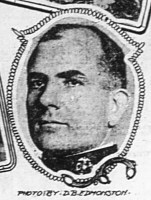
Major Henry Leonard
The influence of a gaping and curious public can have no effect on the conduct of the Judge Advocate in this matter. . . . The hallowed grave of a dead son is no more sacred than the grave of a military reputation and there are a great many military reputations at stake in this hearing. —Major Henry (Harry) Leonard
A 33-year-old hero who had lost his left arm in the Boxer Rebellion, Major Leonard proved to be a formidable judge advocate and an ideal one to handle Rosa Sutton in what was supposed to be an unbiased investigation into the facts surrounding Sutton’s death. As it turned out, Rosa needed to be handled—she was strong minded, a devout Catholic, and just as determined as he was to defend values that were (and are) sacred to a large number of Americans.
The “curious public” egged on by the press was a major reason for the 1909 Inquiry. How much impact did public opinion really have on Leonard’s actions in the summer of 1909? His comments reveal his concern about his own reputation, and also his awareness that his duty was to be impartial. Was that possible? As a Marine Corps officer, his actions were also driven by his loyalty to his fellow marines. So Leonard hoped the Marines’ attorney could attack Rosa Sutton’s credibility. Arthur Birney would go after her mental stability, and, aware that many spectators in the auditorium of what is now Mahan Hall, were empathetic to the military, he proclaimed: “We know what an officer’s honor is to him. It cannot be stained without the same kind of injury which is done to a woman’s honor when it is stained….” Mr. Birney would argue that Rosa Sutton exhibited the “ferocity of a tiger” in going after the marines who were with her son on the night he died without any proof they had committed a crime.
The case became a battle between protagonists who fought hard for sacred reputations and for their own versions of the truth. The need for esprit de corps gave some of the officers and enlisted men who testified in the inquiry a challenge when they were asked to describe what really happened to Lieutenant Sutton. Their stories changed and their memories, in some cases, became sharper two years after the fatal brawl that resulted in Jimmie’s Sutton’s death.
America’s service academies—then as now—are always scrutinized more than other institutions of higher education in this country. Because so many citizens felt they had a stake in what happened in the Sutton case, the government’s representatives fought for the hearts and minds of Americans inside this military courtroom. The Marines’ code of conduct was just as important to them as Rosa Sutton’s spiritual mission–to ensure her son would have a place in Heaven– was to her. The nation’s newspapers shaped the public dialogue about this story, and the lawyers’ closing arguments in the makeshift courtroom in what was then called the Academic Building.
Not long before A Soul on Trial was first published in hardcover, journalists reported on three Army families whose sons had died in the Army under questionable circumstances in 2004. As they tried to learn the truth, these mens’ mothers faced evasive answers in the face of devastating tragedy. Their challenges were an inspiration to me in 2004 and remain so more than 20 years later. A new Epilogue in the 2026 release of A Soul on Trial revisits these three courageous mothers, Peggy Buryj, Karen Meredith and Mary Tillman and explores how they finally learned how their sons died with the help of journalists and the expansive twenty-first century. press. Reporters have kept up with their stories; and the lessons learned over time.
Look for the updated first ever paperback and e-book of A Soul on Trial in the spring of 2026.
November 30, 2025
Not All Memorials are Monumental: Poppies and Poetry in World I and Beyond

Not all Memorials are Monumental, Paris 1917
He called himself Andy. He was an American Army captain from southwestern Virginia on a journey in the French countryside. When he picked up his pen with its fine point on August 21, 1917, to write to Rose Sutton Parker, he had apparently just traveled into the country by auto from one of the finest hotels on the Left Bank. The Hotel Lutetia, completed in 1910, was the proud creation of architects Louis-Charles Boileau and Henri Tauzin. The Art Deco façade has now survived two world wars and its rooms have been home to dozens of artists, literary figures and refugees who fled from the Germans during World War II. https://www.hotellutetia.com/
 Andy’s handwriting on the letter (transcribed below) is elegant and the stationary is as well. He wrote to Rose only using her name on the envelope. Perhaps he did not want to write “My dear Mrs. Parker,” as might have been expected. Rose was then, at thirty-four, separated from her husband, Lieutenant Hugh Almer Parker. She adored Europe and, between 1912 and 1917, spent much of her time in France, England and Spain. And through the decades she kept this letter until she died in 1958.
The captain enclosed a red poppy from the fields of France in his letter to Rose. I am deeply touched at the sight of this flower in perfect, if flattened, condition more than a century later. I take photographs of it, and keep it pressed between two cards in a file.. I have a mug made with a picture of the poppy to remind me to stay resilient amidst challenges we face in 2026, locally, nationally and globally. We grapple now with new kinds of war, with illness, deprivation and violence inside our own country that remains as shattering to the human spirit as it is in time of war. Our current wars are so hard-edged and high-tech. There is no room for pressed flowers in news reports of these jarring conflicts. This letter, like so many others written by hand in the last century, adds a touch of civility and humanity to the situation it describes. Andy is present on the narrow pages of his four- sided hotel stationary in a way that cannot be replicated on a computer. In a few decades, what will remain of the e-mail correspondence or text messages from our troops? We cannot e-mail or text a real flower. Archived digital records are not quite the same.
Two years after receiving this letter, Rose married another man, a Virginia attorney Robert Randolph Hicks. The Hotel Lutetia, where a fleeting bond was created between a black-eyed ebony- haired beauty and an Army captain, remains a four-star hotel to this day.
But who was Captain Andy—is that Andrew? — and did he survive the war? We will never know. Robert W. Service, whose work he recommends to Rose, was a British-born Canadian poet whose brother died in France in August 1916. I’m still looking for the Robert W. Service poem that mentions the poppies. Red poppies sprang up all over the graves of fallen soldiers in World War I. They are memorialized in a famous poem called “In Flanders Fields” (1915) from another Canadian poet, John McCrae. Though foxholes, rodents and vermin have been replaced by IEDs, drones and high tech weapons, the poppy remains a symbol of hope to this day. A poppy is still worn in the United Kingdom and the Commonwealth in late October through Remembrance Sunday in November in honor of military veterans who died in war.
I was only familiar with Service because my mother, Jane Hall, used to recite part of his grizzly narrative poem, “The Shooting of Dan McGrew,” which this eloquent, sensitive captain wanted his new friend, my great aunt and surrogate grandmother to read.* But I appreciated this soldier’s references to poetry as a source of inspiration in the middle of wartime so long ago. And poetry by Ukrainians such as Yeva Tur, and Valerly Puzik, and by Palestinians Refaat Alareer and Mosab Abu Toha continues to inspire us in the most brutal of modern wars.
https://www.poetryfoundation.org/poems/47380/in-flanders-fields
https://www.poetryfoundation.org/poems/45082/the-shooting-of-dan-mcgrew
*Rose and her husband adopted my mother and her brother when they became orphans in 1930.
A TRANSCRIPT OF THE LETTER FROM FRANCE August 1917
Envelope
Mrs. Rose Sutton Parker
100 Boulv. Montparnasse
Paris, France
Hotel LUTETIA Square du Bon Marche 43 Boul. S 43 Boul. Raspail Paris
Aug [ust] 21, 1917
You should see your “cher capitaine” maintenant, seated at a rough table on a chair converted from a box and smelling the smell of stables, pigs et “tout les choses.” Really though this trip is the most wonderful experience of my young life. Sunday morning about ten we left the train and went by auto to the Headquarters 10th French Army. It was a trip of 40 kilometers through a country tres tres jolie. Rolling country, divided into many fields, large trees and excellent roads. The landscape in general is not unlike that of my own Southwest Virginia – you know I came from the mountains, not the flat cotton peanut part of the state – it was hard to realize that the peaceful country colored green and brown by God’s hand was three years ago laid waste by hands of hostile Huns and that only 20 kilo distant great guns were belching forth death and destruction with their tons of lead and iron.
My melancholy, serious thoughts did not last for long and soon I was dreaming just of the country without any thought whatever of people or things, other than very personal and intimate things. I thought about Italy and I dreamed a foolish wonderful dream of two people being sent to that country for special services. In my romantic hours I dream of being connected with plots, intrigues, and of combating secret agents. In the land of dreams I will live in a château and will profess adoration for a beautiful someone who has lots of information and I will buy the secrets of a nation with just smiles. This seems to be the most foolish letter I ever wrote and I write things that I never say. I’m a sort of modest person you know and can’t say very well the things I dream.
Sunday afternoon we went to the front, that is the artillery front, and stood by while cannon thundered and roared. Boom-szzz-a flash then a cloud of dirt and smoke and I wonder how many legs and arms were smashed and thrown up into the air. One of our aeroplanes would fly over and soon several black puffs would appear in the sky. No sound of powder or sight of fire but a realization that death was very near for someone. When a German plane came we could see our batteries fire and watch the explosion of our shelves.
We went to a ruined château that had one time been in “no man’s land.” It must have been a wonderful place before the war. There was an artificial lake that had been surrounded with statuary. Everything was broken and ruined. A marble woman lay on the bottom of the stone steps. Her head lay ten inches from her body, her right arm, shoulder and half her breast was gone. The break was very clean as if it had been cut away with a sharp sword. Her legs and lower trunk lay in the water and was covered with green stuff so I was foolish enough to imagine that her skin was gone in spots and that the green stuff was powder gangrene. People who live in the U.S. and people who live even in Paris don’t know what this war is. What had been a beautiful lawn in front of the house was torn to pieces with shell holes and though I didn’t see any, I imagined pieces of humanity covered and buried in the debris. Have you read the poem (Service’s) about the Red poppies of No Man’s land. [?] I picked this one for you.
This place where I live was the house of the village butcher. I have a bed about 5 feet from the floor. The principal covering is a big red feather bed. We eat at the artillery Hdqrs. Mess 10th Army. I like the open country with the pretty fields and beautiful trees but I hate those dirty little towers.
Yesterday we saw some more anti-aviation batteries and inspected many dugouts. For the most part they are the same. Merely a hole in the ground with some straw. It will be hard for me to live in a hole with a great grey rat – or several – for a bedfellow. And the little grey bugs – a skunk is better than a man in the trenches because God gave him powers for combating such vermin.
You must read the poem “The Shooting of Dan McGrew” because he tells how dirty a man can get “all covered with hair” and “in a buckskin shirt that was glazed with dirt, he sat, and I saw him sway.” That means that the man was dirty but it might be called a “clean earthy dirt” while our soldiers are filthy with vermin.
Lady, pretty soon I’ll have you feeling crawling things and wanting a bath, so I shall stop. Really I have written a very long letter don’t you think?
We will probably return to Paris on Friday and I hope I can see you Saturday evening. We will be in Paris next Sunday.
Sincerely yours,
Andy [post script] The flower seems to stick to the card
Military Reputations, the Press and the Truth in the Sutton Case
Major Henry Leonard
The influence of a gaping and curious public can have no effect on the conduct of the Judge Advocate in this matter. . . . The hallowed grave of a dead son is no more sacred than the grave of a military reputation and there are a great many military reputations at stake in this hearing. —Major Henry (Harry) Leonard
A 33-year-old hero who had lost his left arm in the Boxer Rebellion, Major Leonard proved to be a formidable judge advocate and an ideal one to handle Rosa Sutton in what was supposed to be an unbiased investigation into the facts surrounding Sutton’s death. As it turned out, Rosa needed to be handled—she was strong minded, a devout Catholic, and just as determined as he was to defend values that were (and are) sacred to a large number of Americans.
The “curious public” egged on by the press was a major reason for the 1909 Inquiry. How much impact did public opinion really have on Leonard’s actions in the summer of 1909? His comments reveal his concern about his own reputation, and also his awareness that his duty was to be impartial. Was that possible? As a Marine Corps officer, his actions were also driven by his loyalty to his fellow marines. So Leonard hoped the Marines’ attorney could attack Rosa Sutton’s credibility. Arthur Birney would go after her mental stability, and, aware that many spectators were empathetic to the military, he proclaimed: “We know what an officer’s honor is to him. It cannot be stained without the same kind of injury which is done to a woman’s honor when it is stained….”
The case became a battle between protagonists who fought hard for sacred reputations and for their own versions of the truth. The need for esprit de corps gave some of the officers and enlisted men who testified in the inquiry a challenge when they were asked to describe what really happened to Lieutenant Sutton.
America’s service academies—then as now—are always scrutinized more than other institutions of higher education in this country. Because so many citizens had a stake in what happened in the Sutton case, the government’s representatives fought for the hearts and minds of Americans inside this military courtroom. The Marines’ code of conduct was just as important to them as Rosa Sutton’s spiritual mission–to ensure her son would have a place in Heaven– was to her. The nation’s newspapers shaped the public dialogue about this story, and the lawyers’ closing arguments in the makeshift courtroom in the Academic Building (now Mahan Hall).
Not long before A Soul on Trial was first published in hardcover, journalists reported on three Army families whose sons had died in the Army under questionable circumstances. As they tried to learn the truth, these men’s mothers faced evasive answers in the face of devastating tragedy. A new Epilogue in the 2026 release of A Soul on Trial will revisit these three courageous mothers, Peggy Buryj, Karen Meredith and Mary Tillman and explore how they finally learned how their sons died with the help of journalists and the twenty-first century press.
Look for an updated first ever paperback and e-book of A Soul on Trial in the spring of 2026.