
Pete Hall's Blog
July 10, 2023
Additional Support Materials
Coming Soon! Links to articles, video shorts, activities, and tools for readers.


(Not-So-Young) Adult Discussion Guide
If you’re a coach, parent, teacher, mentor, counselor, or another adult reading “Chasing the Show,” this one’s for you.
Young-Adult Discussion Guide
Thank you for choosing this book! As you turn the pages and consider the
story, you’re most likely going to want to talk about it with someone. Follow
that urge! Here are some questions you might like to consider discussing with a
friend, teammate, parent, coach, teacher, mentor, or any other trusted person.
Also, if you process more effectively by writing things down, get yourself a
journal and write-write-write! That’s one of the strategies I used every day for
years – and it eventually ended up helping me to become an author!
February 28, 2022
Excerpt: Chapter 3
Sometimes it’s nice to get a feel for how a book is written before you purchase it. If that’s the case for you, you might like to read Chapter 3. Here it is:
Chapter 3
“One hundred forty-six!”
Anthony Sumner bursts into Mrs. Andrews’ government classroom,
interrupting the activity and announcing his presence with his usual
flair. Arms raised exuberantly, he marches directly to the whiteboard in
the front of the room, erases the “149,” and scribbles “146” in red ink.
“Happy Monday!” He winks at his teacher, high-fiving a classmate at a
nearby table as he sits proudly at his seat.
“Thank you, Mr. Sumner, for again gracing us with your presence
and your countdown. How in the world would we survive without you?”
Mrs. Andrews has paused her discussion about the limits of the executive
branch to entertain the daily disruption. “If you must share with us the
number of days until baseball season starts, could you at least arrive to
class on time, so you don’t mess with our mojo? Keep this up, and I’ll start
keeping track of the number of days until you graduate.”
Muffled laughter around the room. Anthony is undeterred. “Don’t
you already?” he asks, cocking an eyebrow at his teacher.
“Not publicly,” she retorts. “Now get caught up. We have learning to
do. And stop with the eyebrow.”
This time the laughter isn’t as muffled as before. Anthony digs into
his backpack, extracts his binder, and tries to shift his attention to the
presidency. But that date sticks in his head: February 20. The first day of
baseball practice. His senior year. The magic. The glory. February 20, 146
days from today.
Anthony leans sideways in an attempt to make eye contact with Nick
Greene, his best friend and the team’s center fielder. In stark contrast to
Anthony’s boisterous entrance, Nick is silently attending to his notes,
alternating his focus between his laptop and a printed diagram of
governmental checks and balances. They’ve been friends for years, since
the first day of sixth grade. And now they are virtually inseparable, one’s
Mike to the other’s Marcus.
“One forty-six, man! You ready?”
Nick shifts his eyes uneasily toward the front of the room and shuffles
his materials at his table. Other students straighten up in their seats,
though Anthony seems oblivious to it all. “Nick!” he hisses. “Hey!”
The silence finally catches Anthony’s attention, and he calmly settles
back into his chair, tongue in his cheek as he attempts to subtly attend to
his unopened binder. Mrs. Andrews, as he suspected, is standing directly
behind him.
The giggles of his classmates become hoots as the teacher pronounces,
“Mr. Sumner, I’ll expect to see you for a few minutes after class today,” and
she swirls back to the front of the class. As she resumes her questioning
about presidential power, Anthony steals a glance at Nick. Across the
room, his friend looks back. Anthony shrugs a “What’s the deal there?”
gesture, to which his pal simply nods obediently back toward the teacher.
And into the government lesson they go.
As the final bell rings, the cacophony of high school voices serenades
Anthony from the hallway. His classmates file past him, some jostling,
others whispering “good luck,” and the rest simply ignoring him en route
to third period. Someone drops a book, and Anthony picks it up, hands
it back to its owner, and eyes the empty room. Mrs. Andrews waits, now
seated at her desk. Anthony strolls over and pulls up a chair opposite her
desk, swinging it around backwards and straddling it. “Thank you,” he
says.
“Thank you, ma’am?” Mrs. Andrews looks at Anthony, then the chair
he is perched upon, then back to Anthony. She waits.
Anthony catches the hint like a pop fly in the infield. Gracefully, he
stands, twirls the chair around, and sits properly facing his teacher. “Yes.
Thank you, ma’am.”
“For what, young man?” Mrs. Andrews directs her focus to her laptop,
where she is entering grades, checking her email, or updating her notes
for a future class.
“For letting me keep the countdown in here. None of the other
teachers will let me. You’re the only one that gets how important it is.”
“Why were you late today?” she asks, still typing. “Walking Meaghan
to class?”
“No,” Anthony feels himself blush. “We broke up. Too much drama,
plus I need to focus on baseball. It’s better that way. I was just late, no
reason.”
“That’s honest, thank you. You wouldn’t believe the excuses I hear.”
Mrs. Andrews sighs and looks up at her brash pupil. This is the third
year in a row that they have had a class together. Sophomore year was
World Cultures, last year U.S. History, and now U.S. Government.
He is an intelligent student, keen on how to play the school game, but
academically lazy. He seems to do just enough to get by, just enough to
keep the wolves at bay. It isn’t his scholastic drive that intrigues her, rather
it is his personality. He is playful, yet driven. A lovable scamp. She smiles
and shakes her head simultaneously.
“Have you decided about basketball?” she asks, returning to her
computer. “You know, the college coaches like student-athletes that are
well-rounded and involved all across campus. Another sport might…”
“No way, man,” his animated response demonstrates his happiness at
not being called to the carpet on his tardiness. “I’m a single-sport athlete.
A specialist. I can’t split my training time, anyway. Plus, you give so much
homework, it’d be impossible.” He grins, hoping she’ll see it.
Her unamused look flattens his smile. “Indeed,” she sighs again.
“Well, just remember: If you want to talk through any of this, just let me
know. I’ve done that dance before.” Glancing at the framed team photo
from her own college basketball days, the memories flicker in her mind:
the recruiting trips, the scholarship hunts, the joys of camaraderie on
and off the court, and the many paths that led absolutely, sadly nowhere.
Her slate-gray eyes meet his, and she sees the sparkle that was at once
disarming. “Now go. Can’t be late anymore.”
Leaping up with athleticism and flair, Anthony pushes the chair back
to its table and shoulders his pack. “Thank you, Mrs. Andrews,” he calls
over his shoulder. In a blur, he disappears into the noisy hallway.
February 27, 2022
Ready for the audiobook?
This week, I began the process of recording the audiobook version of “Chasing the Show.” Wait, let me amend that: I began the LABORIOUS process of recording…
Going into the studio for the first time, I thought, “This should be fun. I get to read my own book aloud. How complicated could that be? I used to be a teacher, and I read stories aloud all the time. This is no different.”
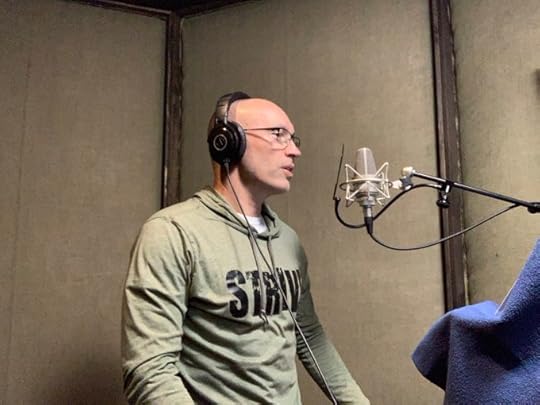 The author in the studio.
Let me go on record by saying, “This is different.”
When you’re reading a story aloud to a live audience, you’re allowed to make little mistakes. Mispronounce a word, pause a bit too long, take a deep breath in the middle of a sentence…no worries, your live audience will forgive you and understand that hey, you’re human, we all make mistakes, and you can backtrack a bit if you need to in order to fix the error.
When you’re recording a story and the audiobook will be out there in the universe, perhaps even the metaverse, for all to hear exactly how it’s recorded, the impact of a mistake – even a tiny mistake – is magnified exponentially. Emphasizing the wrong syllable, using inflection that doesn’t accurately convey the meaning, allowing your voice to crack (like we have a choice!), stumbling over words, mispronouncing one of the character’s names… you name it, once you make that mistake, it’s there forever.
That can cause a lot of stress.
And I make mistakes. Plenty of ’em. Here’s an example of what I’m talking about:
Blooper at the beginning of Chapter 19The good news is this: in the studio I’m using, Spokane Productions, I’ve got a partner, Rob, who is listening to every word and reading the book at the same time, so he can a) catch the mistakes I miss, b) acknowledge the ones I catch, and c) make note of them so he can use his digital program to do his best to fix them later.
Is the audiobook version going to be perfect? No, because I’m no Morgan Freeman. Also because there’s a human part of hearing a story read by the author, and even though I’m doing my darnedest to remain 100% true to the original intent of the book, I know sometimes, well, things happen.
I’m okay with it as long as you are, too.
June 18, 2021
Is it hard to write a book?
Like most things in life, if it’s worth anything, it’s going to require some effort. Writing a book falls neatly into that category: it’s not particularly difficult to string words together, introduce some characters, follow some sort of plot and drop it into a setting somewhere, and eventually have a book. However, if you’re goal is to write something that speaks to people, something that evokes a response, something that stirs folks from the inside, and something that shares a little part of you, then yeah, it’s pretty tough.
The good news? When you’re truly committed to a goal, the degree of difficulty isn’t what determines your success; rather, it’s the level of determination and willpower you pour into the micro-steps required of the journey.
Writing a book requires a long series of small acts. Here are four to get you started:
The big idea. That’s right, it all starts with a big idea. What’s yours? What’s the takeaway for your readers? Sometimes it starts with a question, like What would happen if a 20-acre farm suddenly collapsed into a giant sinkhole? Other times it’s a situation: Billy and his pals threw rocks at Mrs. Johnson’s window on the way home from school one day. They shouldn’t have done that. In my book, the big idea was this: Kids have dreams. How can adults support those dreams while also reinforcing the bigger picture about life?Read a lot. I’ve found that YouTube can be a marvelous way to learn things. That’s how I fixed a leaky pipe, replaced the windshield wipers in my car, and set up a generator at my house for the next big storm we get. However, if you want to learn to write a book, one of the best strategies is to read other books. Lots of them! The more you read, the more you get a sense of how authors share information, how they use language, and how they make ideas flow. So head to the library, grab a stack of books, and dig in!Write a lot. A few paragraphs ago, I mentioned “micro-steps.” Writing – and writing often – is a micro-step. And it doesn’t matter what you write: poetry, thank-you letters, blogs, rules to made-up card games, rap lyrics, short stories…they all count. The more you write, the more familiar language becomes to you, and the more readily you’ll be able to select the right words, the right sentence structure, and the right phrasing to bring your writing alive. I used to write in a journal, about a thousand words a day, most of them junk. Eventually, though, that practice came in handy!Just start. The hardest part of most projects – a homework assignment, a workout, applying for a job, painting a wall, knitting a winter cap – is taking the first step. Some folks will advise you to write an outline, others might suggest a story-board, and more might tell you to clarify your characters and the outcome. I say simply this: Do whatever works for you. Just start typing – you can always change it later, and once you get in the “flow,” it’s amazing what you’re capable of accomplishing!
got feedback?
I love feedback. Whether it’s the sound of “swish” when I shoot a basketball, the smile on someone’s face when I tell a joke with impeccable timing, or the smooth blades of grass when I mow the lawn just right, feedback allows me to know when I’ve done something well.
Feedback also allows me to understand when something hasn’t gone the way I’d planned. The clank of the rim, the grimace following a mistimed punchline, or a patch of unkempt grass tells me, “Pete, you’ve got work to do here.”
This goes for writing, too. I receive emails almost daily from folks who share what this book has meant to them, how much they appreciate certain elements of it, and, yes, folks who communicate (respectfully, of course) where the story may have been improved. And I’m grateful for all of it! My goal as a writer is to engage you, my Readers, in reflective thought…while entertaining you with a story.
So, if you have feedback for me, please share it! Send me an email.
And, if you’re so compelled, please feel free to write a review on one of the sites below. Public reviews are the lifeblood of novels and novelists, so the more stars you’re willing to give Chasing the Show, the better! 
To support me with a five-star, glowing-praise review (if it’s earned, of course), here are some options:
Amazon: https://www.amazon.com/Chasing-Show-Pete-Hall/dp/1628657898/ref=cm_cr_arp_d_product_top?ie=UTF8
Barnes & Noble: https://www.barnesandnoble.com/w/chasing-the-show-pete-hall/1137472126?ean=9781628657890
You can also vote for “Chasing the Show” as the 2021 Book of the Year here: https://forums.onlinebookclub.org/shelves/book.php?id=485485&boty=1
Thank you, and read on!
March 2, 2021
Is it hard to write a book?
Like most things in life, if it’s worth anything, it’s going to require some effort. Writing a book falls neatly into that category: it’s not particularly difficult to string words together, introduce some characters, follow some sort of plot and drop it into a setting somewhere, and eventually have a book. However, if you’re goal is to write something that speaks to people, something that evokes a response, something that stirs folks from the inside, and something that shares a little part of you, then yeah, it’s pretty tough.
The good news? When you’re truly committed to a goal, the degree of difficulty isn’t what determines your success; rather, it’s the level of determination and willpower you pour into the micro-steps required of the journey.
Writing a book requires a long series of small acts. Here are four to get you started:
The big idea. That’s right, it all starts with a big idea. What’s yours? What’s the takeaway for your readers? Sometimes it starts with a question, like What would happen if a 20-acre farm suddenly collapsed into a giant sinkhole? Other times it’s a situation: Billy and his pals threw rocks at Mrs. Johnson’s window on the way home from school one day. They shouldn’t have done that. In my book, the big idea was this: Kids have dreams. How can adults support those dreams while also reinforcing the bigger picture about life? Read a lot. I’ve found that YouTube can be a marvelous way to learn things. That’s how I fixed a leaky pipe, replaced the windshield wipers in my car, and set up a generator at my house for the next big storm we get. However, if you want to learn to write a book, one of the best strategies is to read other books. Lots of them! The more you read, the more you get a sense of how authors share information, how they use language, and how they make ideas flow. So head to the library, grab a stack of books, and dig in!Write a lot. A few paragraphs ago, I mentioned “micro-steps.” Writing – and writing often – is a micro-step. And it doesn’t matter what you write: poetry, thank-you letters, blogs, rules to made-up card games, rap lyrics, short stories…they all count. The more you write, the more familiar language becomes to you, and the more readily you’ll be able to select the right words, the right sentence structure, and the right phrasing to bring your writing alive. I used to write in a journal, about a thousand words a day, most of them junk. Eventually, though, that practice came in handy!Just start. The hardest part of most projects – a homework assignment, a workout, applying for a job, painting a wall, knitting a winter cap – is taking the first step. Some folks will advise you to write an outline, others might suggest a story-board, and more might tell you to clarify your characters and the outcome. I say simply this: Do whatever works for you. Just start typing – you can always change it later, and once you get in the “flow,” it’s amazing what you’re capable of accomplishing!February 24, 2021
Where did you get the idea for this book?
This is one of the most common questions I get as an author, and the answer is pretty simple: most authors, myself included, write about what they know. So the first place I go when I’m seeking inspiration is my memory: Where have I gone? Who have I known? What have I experienced? Seen? Done? The answers to those questions were what helped to develop the content, characters, and story arc in “Chasing the Show.”
One of the big topics of the book is baseball. It’s not a baseball book, per se, though the sport provides the setting for much of what happens in the story. No surprise here: I happen to know quite a bit about baseball, in fact I love it! That knowledge helped to make the baseball scenes come alive. One reviewer wrote, “The level of information about baseball shows that the author has experience in it or did quality research. Either way, it portrayed the book in a brilliant light.”
I know what you’re thinking: If most authors write about what they know, how in the world did J.K. Rowling write about witchcraft and wizards in the Harry Potter series? I personally worry about authors who write zombie romance books. Well, sometimes authors take what they know and add a healthy dose of imagination to it. Often, authors research topics in order to learn more about them – then, in their writing, they can share and explain what they’ve learned in a way that moves the story forward without being confusing. And they can add their own creative ideas to make the characters, settings, and events really memorable.
If you asked me that original question, “Where did you get the idea for this book,” because you’re wondering where to get an idea to write about, here’s my advice: start with your own memory, your interests, your hobbies. I’ll bet there’s a story in there, just waiting for you to write it.
September 22, 2020
Got feedback?
Dear Readers,
First of all, thank you for reading my first novel, “Chasing the Show.” It’s a project that’s been near and dear to my heart for 30+ years.
Second, I began my professional career as a teacher, and remnants from my teaching (and principaling) years stick to me like pebbles in the tread of my shoes. So of course I wrote Discussion Guides – because I believe in the power of dialogue, the impact of connections, and the influence of relationships!
My request here is quite simple: As you access the Discussion Guides, would you send me your feedback? Here are a couple of prompts that might focus your feedback in way that will be more helpful to me and to future Readers:
Which questions were particularly helpful to you? Why?
Which questions did you have difficulty processing or discussing? Why do you think so?
Are there additional events, themes, or applications that you’d like to discuss? If so, what are they? And would you be willing to suggest a discussion prompt I might add into the Discussion Guides?
Is there anything else you’d like me to know about the story, the Discussion Guides, and/or this website?


