Keith Farrell's Blog
March 3, 2017
Bringing Encased in Steel to its Conclusion

We opened Encased in Steel on the 17th of February 2011, meaning that the blog has been running and posting on a weekly basis for slightly more than six years. However, we are now going to draw the blog to its conclusion, and will no longer be posting on a regular weekly basis. There may still be some new updates from time to time, but it will not be a regular thing.
We will continue to host the blog, and the better quality articles will remain accessible and free of charge, although we may...


February 24, 2017
Shelf numbers for books in archives

Facsimile of the Codex Gigas; image from Wikipedia.
You may have observed that when discussing original source material, people will sometimes refer to a source by a series of letters and numbers, rather than using a more readable name. This much more common with medieval sources (particularly handwritten manuscripts) than with printed books, as printed books usually have their own title, whereas manuscripts often exist without a title.
What do these combinations of letters and numbers mean,...
February 17, 2017
Musing on “doing HEMA”
A question that came to my mind recently, after watching a fairly cringeworthy piece on historical fencing by the BBC, was this: is it better to do HEMA badly, or not to do it at all? Phrased differently: is it better just not to do HEMA if you cannot do it well?
My current answer is that it is still worth doing HEMA even if it is not being done well, and we should be encouraging more people to start doing HEMA and to keep doing HEMA, even if the performance is not great in the beginning.
T...
February 3, 2017
Five reasons to study Judo
This guest article has been provided by Tea Kew, of the Cambridge HEMA club.
It’s very common for historical fencers to cross-train in other martial arts. Sport fencing and various other forms of swordsmanship are perhaps the most common, because of their obvious application for the use of swords. The value of training in wrestling is often overlooked. However, most of our early longsword manuals are clear about the importance of wrestling for fencing, and so dedicating some time to studying...
January 27, 2017
Tipping solutions for training swords
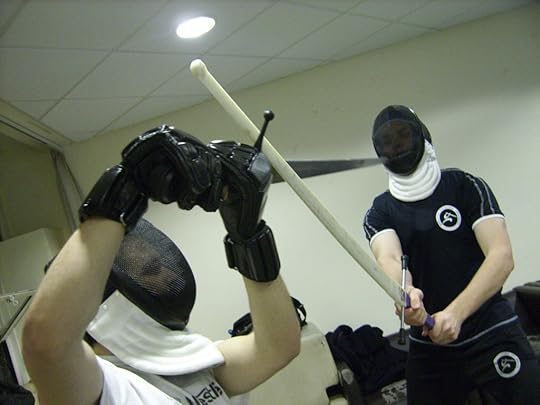
When giving or receiving thrusts with a training sword, some types of points are safer than others!
Training swords tend to be blunt, to allow us to practise hitting each other without risk of injury. To allow for thrusts, the point also needs to be blunt, but there usually needs to be something else done to the point to increase the surface area, otherwise thrusts will still be dangerous. There are many solutions seen in the HEMA community today; some implemented as part of the manufacturing...
January 13, 2017
Making Mutieren work in sparring
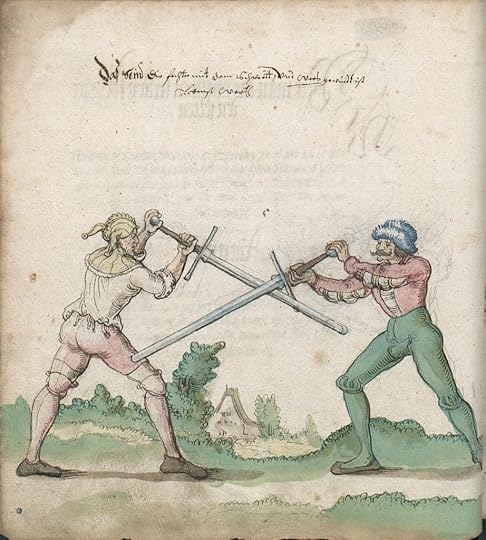
The “Mutieren” technique, shown in the Goliath manuscript: MS Germ.Quart.2020, folio 17v.
Following on from my article about how to make techniques work in sparring, I would like to present a case study from my own recent training. Over the last two or three months, I have begun to have more success at applying the Mutieren during sparring with the longsword.
If you are unfamiliar with this technique, it is somewhat similar to the croisé in classical and modern fencing; winding an attack from...
January 6, 2017
Learning to apply a difficult technique in sparring
The “Mutieren” technique, shown in the Goliath manuscript: MS Germ.Quart.2020, folio 17v.
One of the common problems faced by many practitioners of historical fencing is that while we know and have learned many cool techniques from our source materials, we may not be able to apply these techniques in the heat of sparring. How can we work towards being able to apply all of our techniques at will, even when under pressure? It requires a little bit of thought and effort, and perhaps needs a chan...
December 23, 2016
Fashion throughout history: wearing clothes “incorrectly”

“Handmade White Chaperon” image from an article by Vicky Binns on the Modern Medievalist blog: http://modernmedievalist.blogspot.co.uk/2013/09/profile-in-excellence-vicky-binns.html
It can be all too easy to look at people who wear their clothes incorrectly, to make a disapproving face, and say something like: “kids these days… Back in my day, we wore our trousers properly.” While I don’t mind people wearing their baseball caps in whatever direction (the brim does help to keep the sun from bu...
December 9, 2016
Fencing and driving – 5 similarities
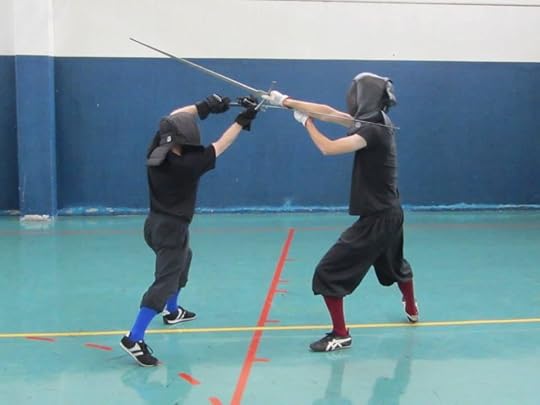
Keith Farrell (left) fencing with Federico Malagutti (right). Not much protective gear, but suitable gear for the type of sparring and to achieve the purpose of the exercise – in this case, trying to perform the right kinds of techniques for the situation, with appropriate setting up and positioning, without the stress of high-intensity sparring and the fear of injury.
I think that fencing with a sword and driving a car involve some very similar skills. If you drive, then you may recognise so...
November 15, 2016
Washing a SPES jacket
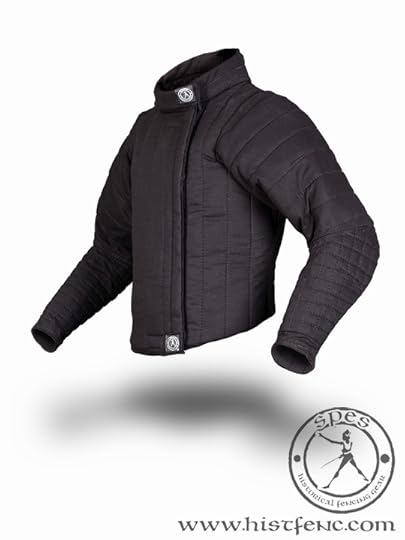
The “Axel Pettersson” jacket by SPES Historical Fencing.
How do you wash your SPES jacket? There are some brief washing guidelines (PDF)on the SPES website, but I feel that more could be said on the subject.
First, why is is worth washing a jacket? There are several reasons: the most obvious, for you and the people around you, is probably the smell of sweat. Other reasons could be to preserve the colour of the jacket and to ensure it does not look too dirty, or to clean it of mould developing...