Michael Decter's Blog
August 9, 2026
A Tribute to Lloyd Robertson
Canada learned recently that Lloyd Robertson, for decades a beloved journalist and news anchor of the evening news, had died at 92 on August 4th.
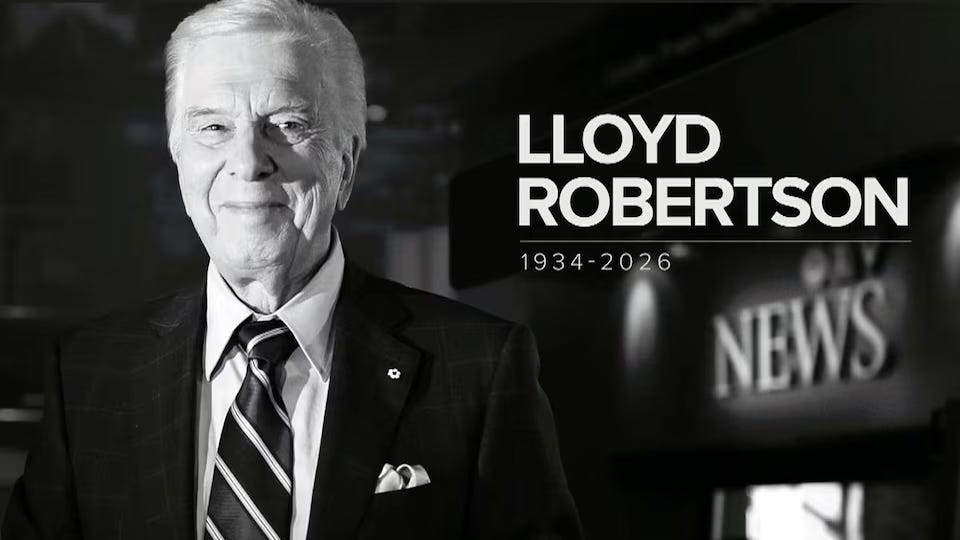
I wondered how I could celebrate the life of this kind, thoughtful and incredibly talented man, someone I had known for many years and deeply respected. So, I’m going to share with you stories of three encounters with Lloyd that I will always cherish.
The Night Lloyd Robertson Taught Me How TV News WorkedThere was a period in my life after I left the Ontario government and the job of deputy minister of health when I chaired a number of health boards. One of them was the Canadian Institute for Health Information.
That role made me a national spokesperson for health data. Several times a year, CIHI as it was known, released important data about the performance of Canadian health care. I was always more comfortable being interviewed by print journalists than I was appearing on television, for reasons that I didn’t quite understand.
One evening I was invited onto the CTV National News to be interviewed by Lloyd Robertson. The occasion was release of report on the future of Medicare. (Canada loves its Royal and Senate commissions; two major reviews of healthcare were the Romanow Commission and the Kirby Committee.)
When I arrived at the studio, Lloyd greeted me warmly and took me into a recording booth. He said, “I’m going to ask you three questions and now you’ll answer them.”
And so, I did.
I was initially quite pleased with my answers until Lloyd said, in a very cheerful voice,
Michael, if I had 6 ½ minutes for you on the National News, we’d be done.
Ah, I thought. All the other news.
“I only have a minute and 30 seconds so we’re going to do this again,” he said. “I’m going to ask you the same three questions and this time you’re going to answer them in one minute, thirty seconds.”
My brain reeled at the task of cutting the important content by two-thirds. Just like television, I thought, to reduce everything to thirty-second clips.
All of this gerbil wheeled in my mind as I stared at the clock with it fast moving second hand. When it hit the top of the dial, Lloyd asked me the first question. I answered it directly. Same with the next two questions. I finished at exactly 1 minute and 30 seconds.
But still I worried, when finished, how many deep insights had been sacrificed.
Lloyd surprised me by saying, “I’ve had them queue up both your 6 ½ minutes version and then the shorter one I’ll use on the news tonight. Why don’t you sit here and have a look at both. I’d like you to tell me how much you think was lost by the shorter answers.”
I was stunned by what I learned. In the long version, I did a lot of wind. Phrases like “on one hand and on the other hand.” In the short version I just answered the questions. After the third time through I had my answer for Lloyd and my lesson about television: the only thing lost was too much verbiage and waffling before I got to what was actually important.
On the way out, I thanked Lloyd for the lesson. He smiled and shook my hand. I understood then why he was so successful at the television news. In every interview since I’ve had Lloyd’s voice in my head telling me to “just answer the question.”
The Afternoon Lloyd Robertson Sang the Beatles and Became a Doctor of LawsIn 2013, while I was Chancellor of Brandon University, the senate agreed to bestow on an honorary degree on Lloyd . You might ask why Brandon University in Manitoba, would honor a son of Stratford, Ontario.
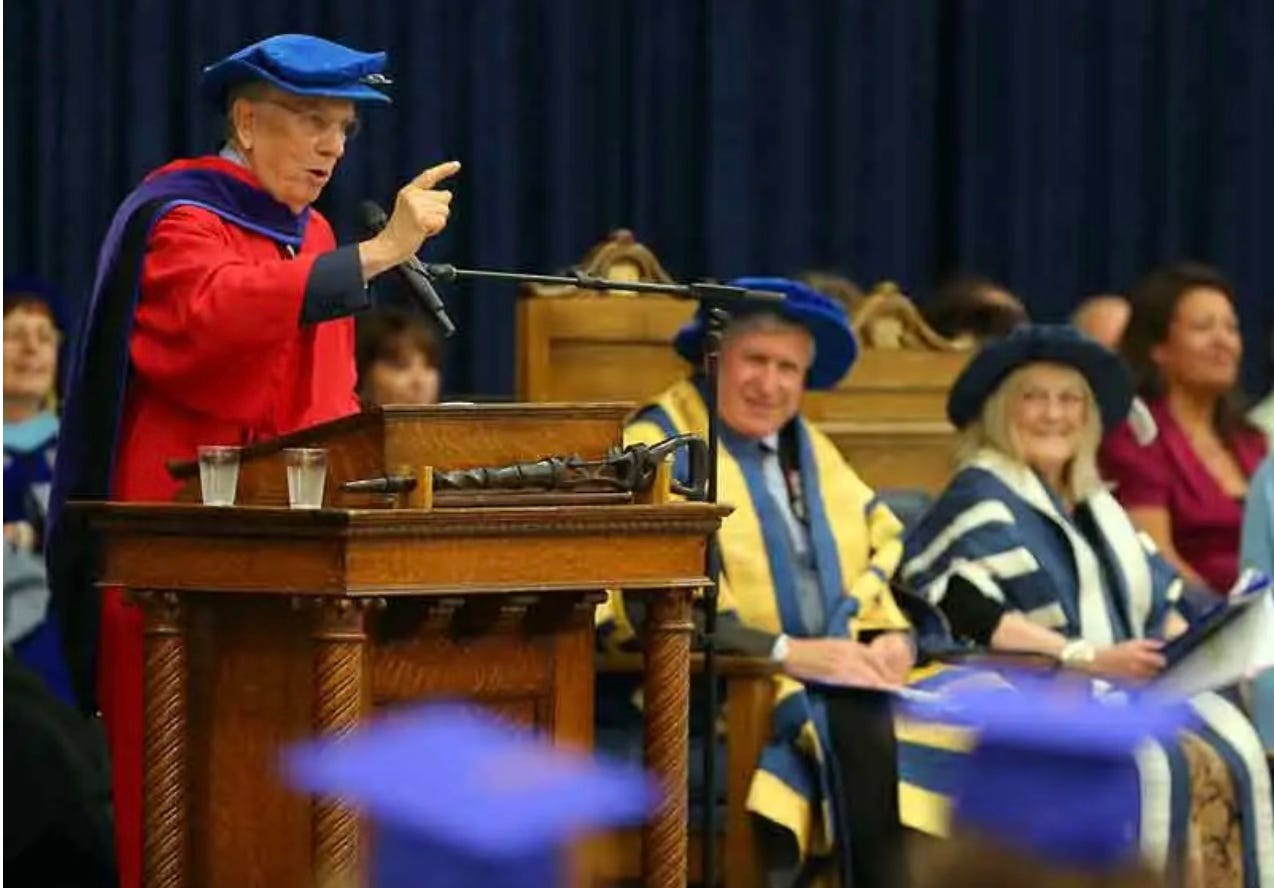
Most readers would not know that Lloyd career began in Manitoba with the CBC. Among the many news highlights he covered was the decisive election in 1957 when Duff Roblin became Premier. That was a Manitoba connection but really honorary degrees are lifetime achievement awards.
A journalist of national stature, Lloyd Robertson had certainly earned that honour.
As it turned out, Lloyd had already been awarded one honorary degree from another institution. But he was particularly pleased to be in Manitoba, and to having me bestow it on behalf of the university.
Those who receive such degrees are expected to “sing for their supper” with a stirring speech to the graduating class. In Lloyd’s case, he more than met that obligation. Literally.
In the middle of a very thoughtful address about how they might consider their future, he broke out into song. Specifically Can’t Buy Me Love by the Beatles.
It surprised me that he sang so well. After a moment of consideration, I realized with his wonderful broadcaster voice it shouldn’t been a surprise that he really carry a tune. I remember looking at the audience as he sang the words, “I don’t care too much for money, money can’t buy me love.”
The message resonated powerfully with the students and their families. Lloyd Robertson, a great Canadian by any measure, was advising students to focus on what mattered most as they pondered the lives about to unfold in front of them.
My Last Interview with Lloyd RobertsonMy last interview with Lloyd Robertson was not on television. Nor was it about healthcare.
In 2022 Cormorant Books published my first novel, Shadow Life. I was invited to do an onstage interview at George Brown College. Its president, Dr. Gervan Fearon, had served ably as the President of Brandon University when I was Chancellor.
I came to have a very high regard for Gervan and his outstanding leadership as president of several colleges and universities. I readily agreed for the onstage interview which I was very excited about.
However, two weeks before the event, I received a worried call from George Brown College who had struck out on an interviewer after asking several on-air personalities who were not available for the event. Shortly before receiving their call, I’d had an email from Lloyd Robertson saying how much he enjoyed reading Shadow Life.
Might Canada’s best television interviewer, now retired, might be willing to interview me on stage?
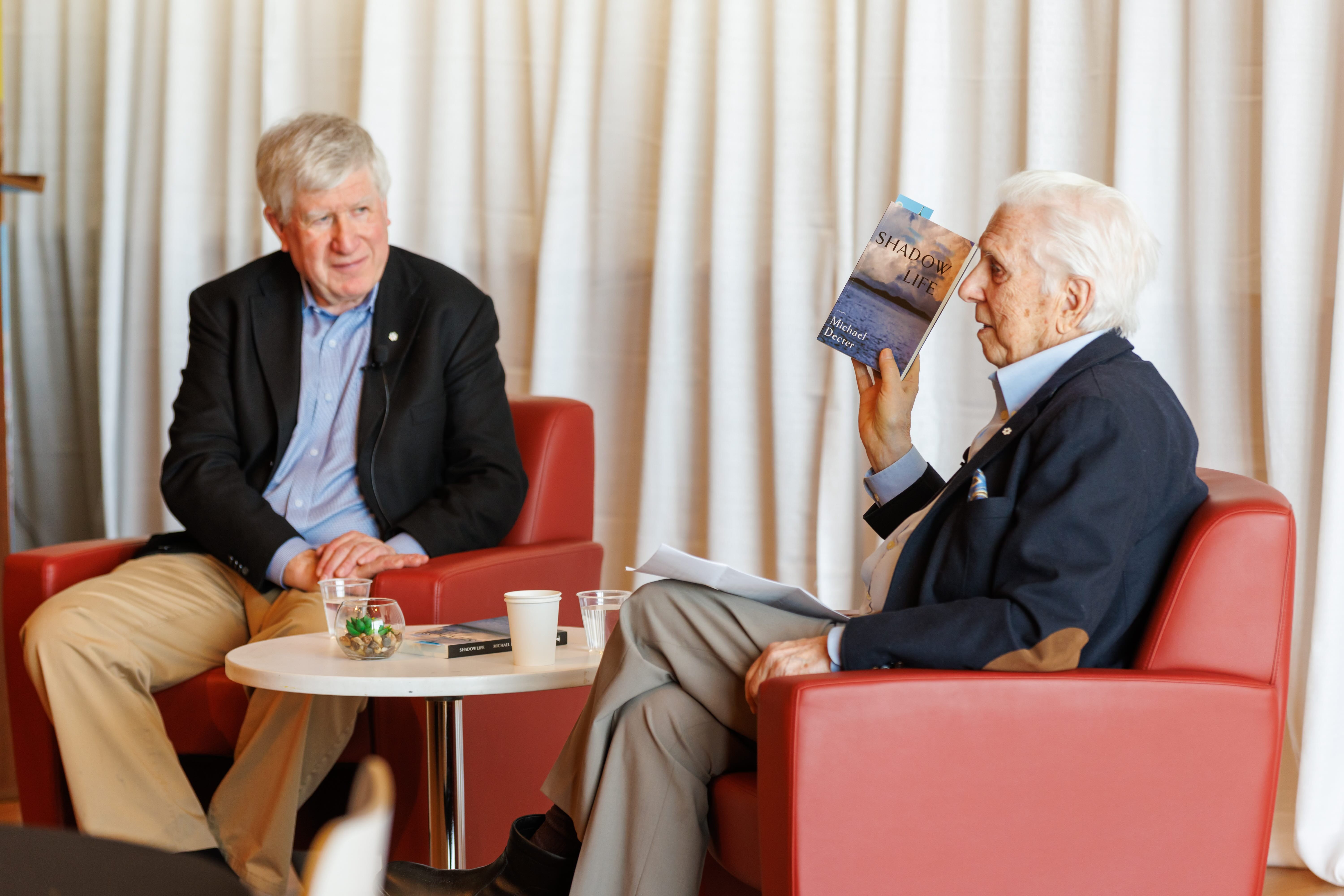
Lloyd immediately agreed. We sat down before a large crowd in the atrium of George Brown College. Lloyd had not only carefully read Shadow Life but his questions revealed a thoughtful comparison of my main character, Matthew, with me. He was insightful and it was a thoroughly entertaining interview.
More Media + Upcoming Events for the Health Book
An honest man here lies at rest
As e'er God with his image blest.
The friend of man, the friend of truth;
The friend of Age, and guide of Youth:
Few hearts like his with virtue warm'd,
Few heads with knowledge so inform'd:
If there's another world, he lives in bliss;
If there is none, he made the best of this.
– Epitaph on my own Friend by Robbie Burns
Mike McCarthy and I continue to enjoy success with the Canadian Health Care Guerilla Guide. Most recently the Winnipeg Free Press published a long and excellent article on the book:

Other upcoming media include The Paikin Podcast (with Steve Paikin, dropping soon), as well as Macleans and Globe and Mail op-eds.
We’re delighted to again be back at Amazon #1 spot in our categories. This was from the past week:

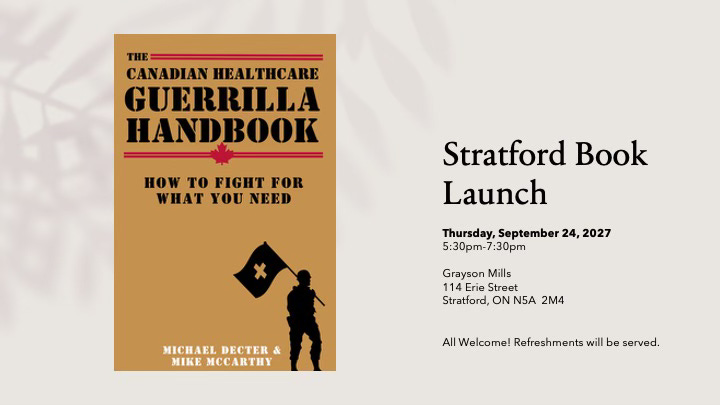
Mike and I are excited to host a Book Launch in Stratford, ON (Mike’s hometown) on September 24th. We hope you will join us!
Upcoming October events include a national webinar with the Ontario SPOR Support Unit, a network of leading 14 Health Research centres and 8 Research Institutes, that will be free and available to all. I’ll share the link once I have it.
We are working to finalize further fall events in Orangeville, Winnipeg and points west. Our hope is to engage Canadians in communities across the countries in conversation about how to get the care they need at a time when our health care system is embattled.
Michael Decter
August 2026


July 1, 2026
The Pleasure and Privilege of Conversation
Canada Day is an opportunity to celebrate the miracle that is our country.
And to celebrate the forty million or so of us who call it home, those who came before us, people who have lived on the land for thousands of years, as well as those who’ve arrived from all over the world to seek a better life.

Canada in 2026 is beset by many issues. Some global, some national, some local. For this one day, though, we should grant us ourselves the right to celebrate the country’s many achievements. And in doing so, commit to dealing with the problems we face as a society with intellect and compassion.
I wish everyone – fellow citizens and residents – a joyous day filled with family and friends. My hope is that Canada returns to a more engaged role in the larger world through diplomacy, development aid and the sharing of Canada’s cultural achievements.
We have much to contribute to the global stage through our literature, our performance arts and the many talented Canadians who act, sing, dance, make and play music, write and create art.
Toronto International Festival of Authors (TIFA)In early June, I had the pleasure of attending the TIFA Motive Crime & Mystery Festival, a long weekend of all things who-done-it.
In 2025, TIFA moved from its long-time home on the Toronto waterfront to the University of Toronto campus. A welcome move, and not just because it’s now within walking distance of my home!
Harbourfront had become a challenging venue to get to, between traffic congestion and high parking costs, or complicated transit connections. A partnership with Victoria University that brings activities to a central part of the city, and near the intersection of the main two subway lines, is great for the festival’s future.
I’ve been an avid reader of crime fiction for many decades. It was fun to attend a Global Authors Club Luncheon to kick off the festival, featuring with three very funny crime writers:
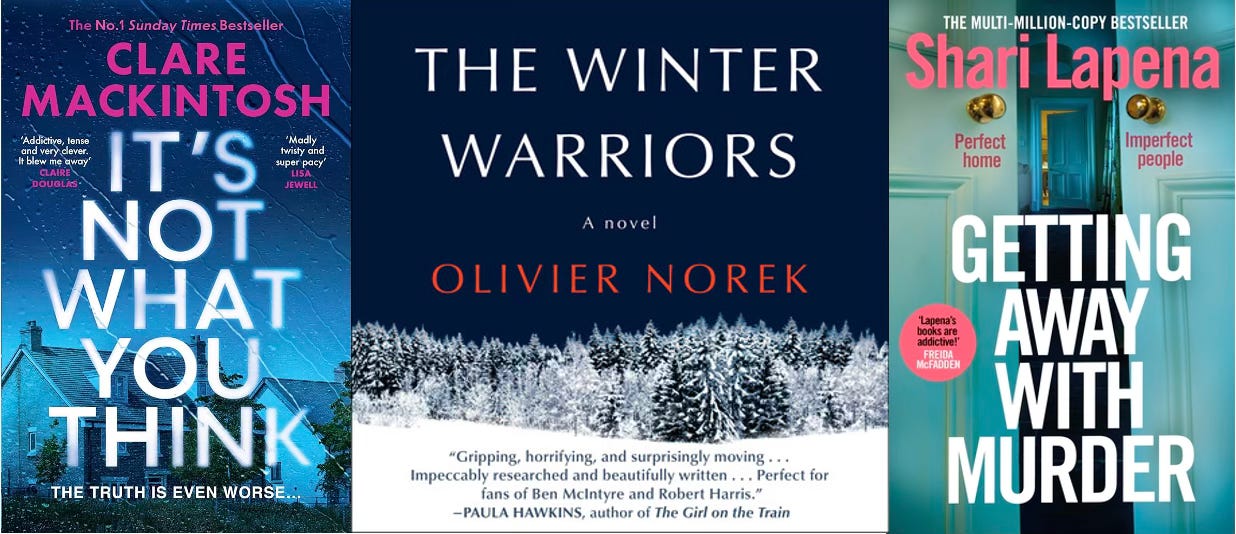
Claire Mackintosh and Olivier Norek are former police officers (England and France respectively, each in high crime areas). It was interesting to hear them talk about how they tackled writing as if the story were a case to solved – detailed outlines to rival the most complicated murder board, layers of clues and red herrings, fact checking all the details.
On the other hand, Canadian Shari Lapena, a former lawyer then English teacher turned best-selling global author, writes herself into the story as she goes. She may not even know who the murderer is when she begins!
After a brilliant welcome by Charlie Baillie, who chairs the TIFA board, the three authors were introduced by Festival Artistic Director and CEO, Roland Gulliver. A lively discussion ensued about both crime writing as a genre and their specific paths.
During the Q&A, Julian Porter led off with a thoughtful question about which writers inspired each of them. Not surprisingly, the influences were wide-ranging. In my experience, the best writers are avid readers first. Across genres, time periods and writing styles.
Inspired by the lunch discussion, I read Shari Lapena’s and Clare MacIntosh’s books and am almost done Olivier Norek’s. Happy to recommend all three. Each have compelling characters, strong writing and surprising plot twists to keep you guessing.
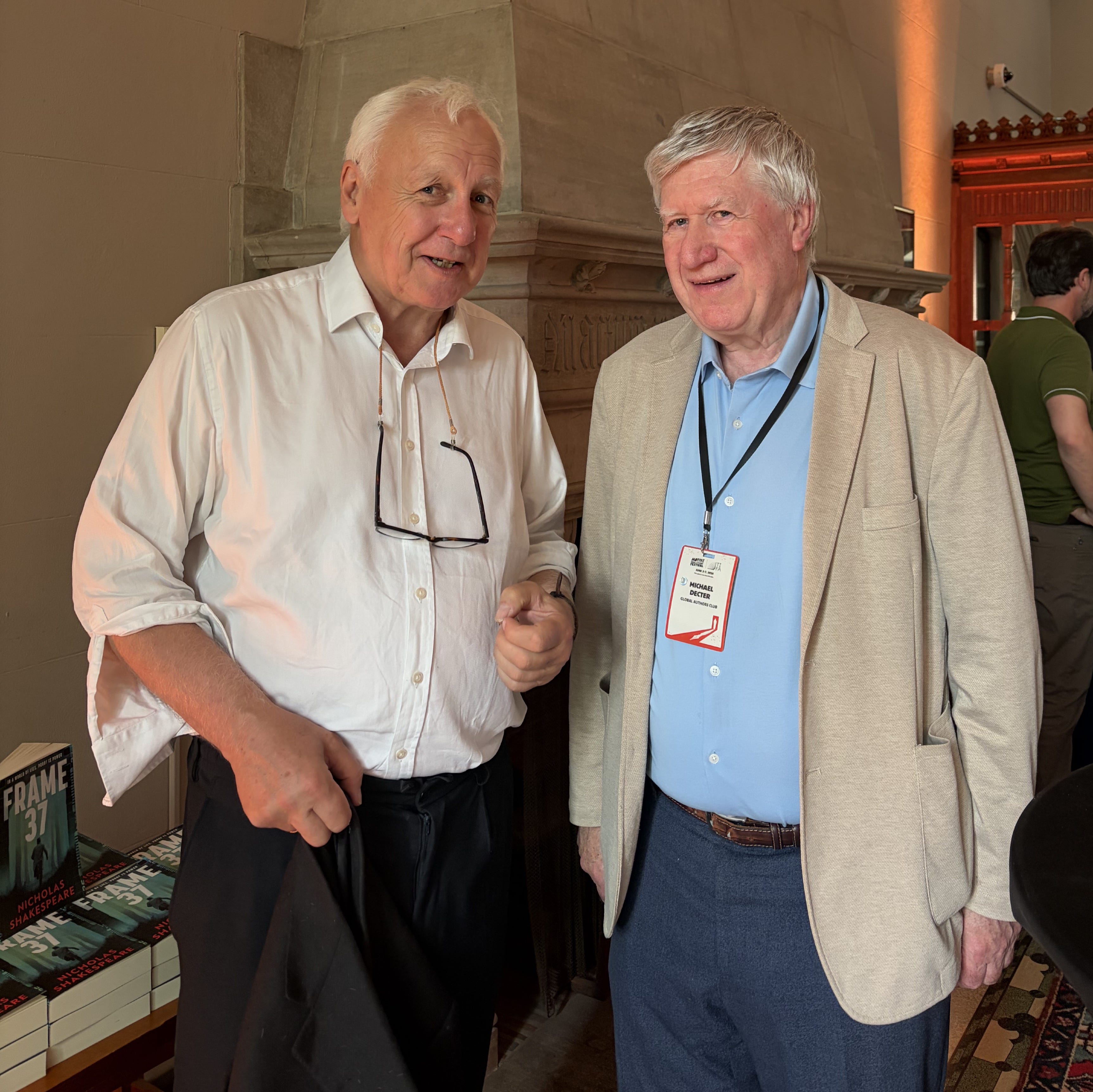
Meeting Nicholas Shakespeare, whose fabulous biography of Ian Fleming I discussed in a previous Substack, was a highlight of the festival. We exchanged stories and memories of the Winnipeg Johnson family which included his wife Gillian and her brother Jon, with whom I attended school.
Nicholas also did a wonderful on-stage interview and discussion with British journalist and radio presenter Stig Abell about the life and writings of Graham Greene. Nicholas’s stories were made more powerful because he knew Greene personally and recounted conversations they had shared.
In his Ian Fleming biography, Shakespeare captures the complexity of the relationships among Greene, Fleming and the actual spy service, MI5, which they both served.
In noting that Ian Fleming wrote a humorous review of Graham Green’s novel Our Man in Havana for the Sunday Times in 1958, he quotes another Greene biographer (named Richard Greene, just to make things more confusing) who believes the funny review may have been an attempt to protect Graham Greene from MI5.
By emphasizing that it was “Wodehousian” and unlike reality, Fleming may have been trying to fend off the trouble that eventually came to Greene for giving too precise a picture of what was going on in the field.
It’s the matryoshka doll version of a book review! One real spy turned author (Fleming) trying to alibi another real spy turned author (Greene) by portraying his writing as “unlike reality.”
Shakespeare and Abell’s discussion triggered a powerful memory from my childhood. In my teen years I read widely. But I turned away from my deep interest in the science fiction writing of Isaac Asimov, Ray Bradbury and others to read Graham Green’s Our Man in Havana.
My Irish mother, Una, was a great reader and fan of Graham Greene’s novels. She insisted I read it. The book is a humorous classic. Published in 1952, it was made into a film in 1959 with the collective writing and acting talent of Graham Greene, Noel Coward, Alex Guinness, Burl Ives, Maureen O’Hara. It was directed and produced by Carol Reed. A decade earlier Reed had produced The Third Man also based on a Greene novel.
Launching The Canadian Health Care Guerrilla Handbook: How To Fight For What You Need.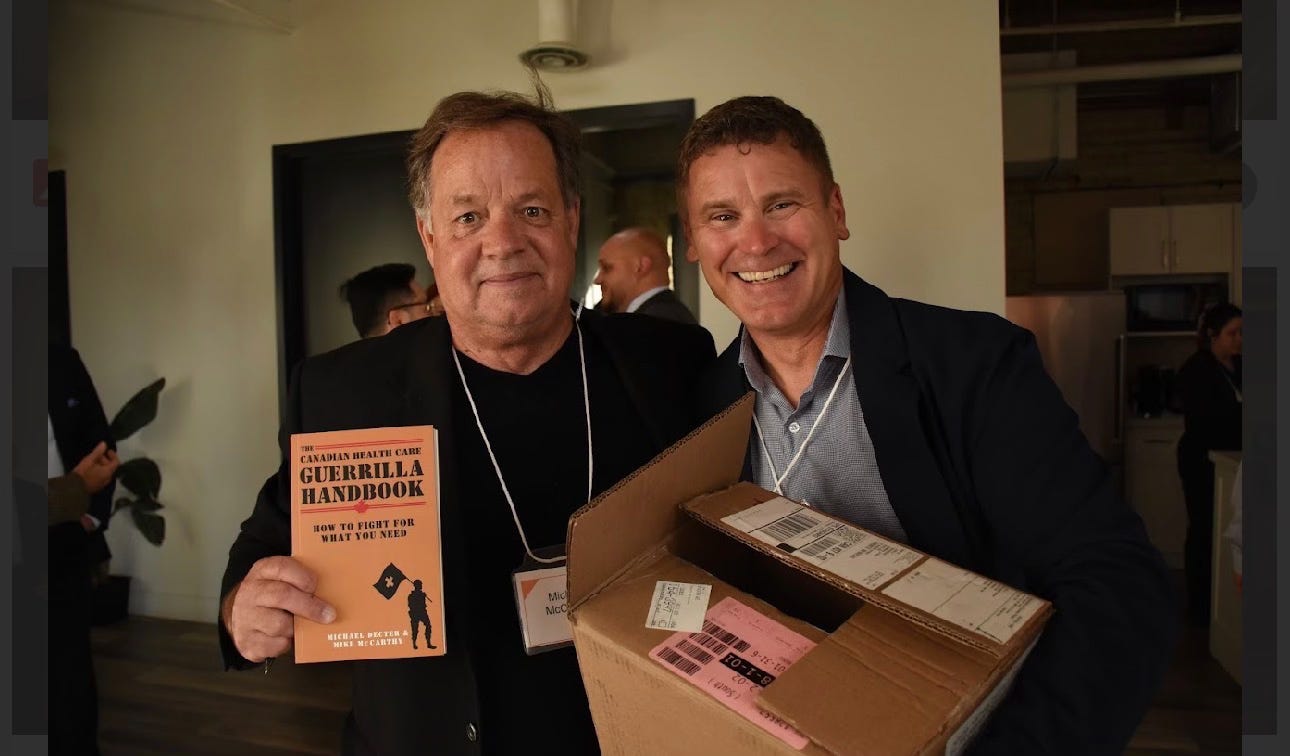
This book, which I co-authored with my friend and colleague Mike McCarthy, was published on May 12. And the first six weeks has been both busy and exciting!
We’ve been fortunate to do three launch events in Toronto. One with Longwoods Publishing as a breakfast at the Hospital for Sick Children. Another at the law firm Cambridge LLP at the invitation of the firm managing partner Chris McLeod, himself a powerful patient advocate. And finally, a launch at the Ben McNally Bookstore, one of my very favourite book shops in town.

As well, I made two trips to Ottawa to speak about the book. The first at a prestigious lunch meeting of 30 notables, what the British would call the good and great. It was an engaged and curious audience with a robust conversation about healthcare systems and health policy.
I returned to Ottawa more recently to participate in an evening book launch at the appropriately named Perfect Books on Elgin Street.
In addition to the events, there has also been much activity on the media and podcast fronts. Mike and I recently did a podcast with long time TVO Agenda host, Steve Paikin, on his new show The Paikin Podcast. The episode is upcoming so subscribe now to hear it when it drops!
Steve’s deep knowledge of the politics and realities of healthcare made for a very insightful discussion.
Other upcoming media include a Toronto Star Op Ed co-authored by Mike and me and a column on patient advocacy by Mike for Maclean’s.
I was on-air for the morning show on Radio Talk 1010 to talk about some of the issues we discuss in the book, and we also really enjoyed the interview with Alexandra Keeler of Canadian Affairs Magazine.
Looking ahead to summer and early fall, we’re working to finalize book launches in Orangeville either at Booklore, Nancy Frater’s terrific bookstore, or perhaps at the public library. And in Stratford.
And of course a western tour including my hometown of Winnipeg and its magnificent McNally Robinson bookstore, which has hosted launches for many of my books. Nothing like going home to the city that first inspired my love of reading.

I’ll never forget the delight I used to feel walking into the Cornish library at 20 West Gate and the generous librarian who let me take home as many books as I could carry.
Sarah Hanlon deserves much credit for her tireless work to arrange events, interviews and posting on social media in support of our book. Mike and I are very grateful.
At the risk of sounding immodest, we were delighted when The Canadian Health Care Guerilla Handbook reached the number one position on Amazon Canada’s ranking among healthcare books.

The book is available numerous websites and bookstores including:
Happy Canada Day, friends! Be well.
Michael Decter
July 1, 2026
April 19, 2026
The Well-Written Lives of Others
When I am writing – or like now preparing for the launch of a new book – I like to have another book on the side. One I am reading. It’s a lifelong habit.
Long ago my sister Ann, also a writer, told me that when I was writing, I should read poetry because it was sparser. I have taken her advice many times and it’s proven quite sound.
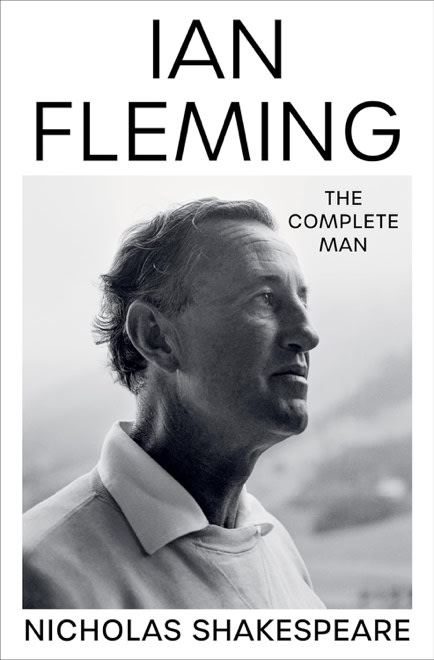
Other genres are cleansing to read, too. Right now my book on the side is a wonderful biography: Ian Fleming The Complete Man by Nicholas Shakespeare, first published in 2023.
It has many things I like in a biography, starting with a fascinating subject. Fleming, best known for the James Bond books, also had a career in the wartime British intelligence service. And a very complicated and interesting love life full of turbulent affairs including with his eventual wife, British socialite Anne Charteris, who divorced her husband, the 2nd Viscount Rothermere, to marry Fleming.
It’s a long book at nearly 800 pages, including sixty pages of source notes. Nicholas Shakespeare has done a marvellous job of research. He has a Robert Caro (famed biographer) level of detail in his stories.
Shakespeare captures every aspect of the complexity of his subject.
Ian Fleming had an intense rivalry with his brother Peter, an adventurer, journalist, soldier and travel writer. In 1946, Fleming bought land in Jamaica for £2000 and had a house built for another £5000. (Roughly $470,000 Canadian today.) He chose Jamaica partly because Peter had never been in the country or written about it – Ian could claim it for his own.
It was this house where he would later write all fifteen of his James Bond spy novellas and novels. He named it Goldeneye.

I puzzled for years over why he chosen that name. Goldeneye of course became a Bond movie (the first not to be based on a Fleming novel). Nicholas Shakespeare uncovered that the name actually came from another favourite author of mine Carson McCullers. She wrote a book Reflections in a Golden Eye. Apparently, Fleming was reading it while at his newly acquired home in Jamaica and decided to name it that.
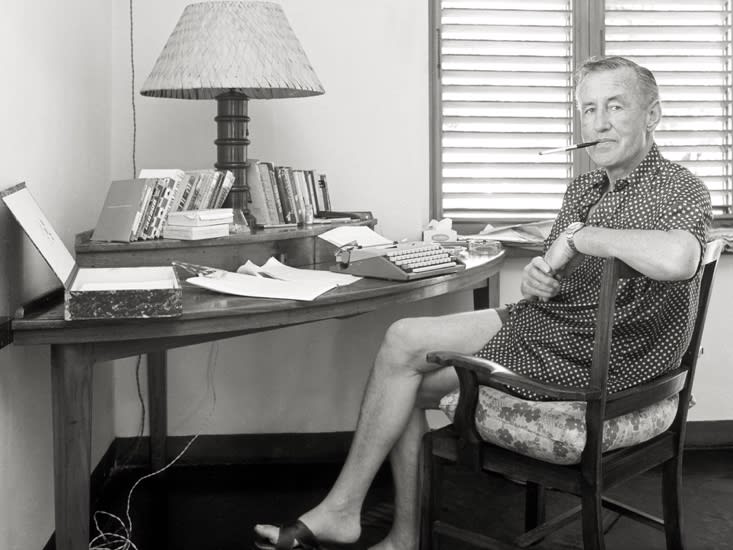
Readers of the Bond books benefitted from two famous fans. Prime Minister Winston Churchill who visited Jamaica and US President John Kennedy who in 1961 proclaimed the books to be among his favorite leisure reading. Sales exploded.
Another remarkable feature of Flemming’s life was his job as editor for the Kemsley newspaper chain based in London. He built Kemsley Imperial and Foreign Services which was known as Mercury – the Roman messenger of the gods.
Brilliantly, Fleming negotiated his contract to include two months seclusion at his beloved Goldeneye to write every year. (Those halcyon years before there was a digital we needed to detox.)
Now that’s a deal I wished I’d be able to make a long time ago. But one probably difficult to strike with the various governments and private sector organizations for whom I worked!
Very early in the book there’s a quote from Noel Coward:
“Very strange people, the Flemings.”
Shakespeare underscores this in a variety of ways. For one, he defies the convention that most biographies start with the birth of the main character. Shakespeare chooses instead to start the book with a long and fascinating prologue – including the reaction of each of Fleming’s brothers to the news of his death and even what they were eating when they heard the news. Then he launches into Fleming’s funeral service.
There’s another reason I like the writing of Nicholas Shakespeare that has nothing to do with the writing itself. I was born and grew up in Winnipeg. We Winnipeggers form a bond from -40°C winters and short, scorching summers. A prairie stubbornness born out of survival.
Nicholas Shakespeare did not grow up in Winnipeg, but he is married to Gillian Johnson, who did. Gillian is a prominent author and illustrator of children’s books (and now an ADHD coach). I believe they live in Oxford, England, but a Winnipegger she will always be.
I went through school with her older brother Jon and worked together one point in my career with her older sister, Janis Johnson, a former Canadian Senator. There were six Johnson children and six Decter children – a normal sized family then, but an oddity in current times.
Nicholas Shakespeare will be in Toronto for an event sponsored by the Toronto International Festival of Authors on June 5. TIFA’s MOTIVE, Crime & Mystery Festival, runs from June 5-7, 2026. Previous years of MOTIVE were terrific, so I’m very much looking forward to the 2026 installation.
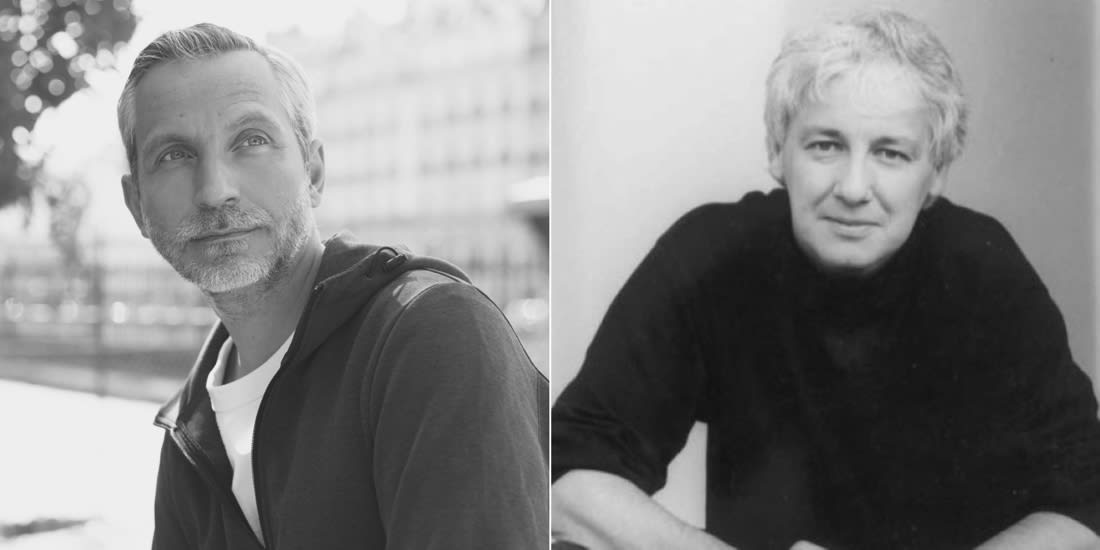
Shakespeare present Frame 37, which follows ex-journalist John Dyer, who must take on a dangerous political conspiracy in order to bring his friend’s killer to justice. And Olivier Norek is at the festival with his new book, The Winter Warriors, a gripping tale of resistance and survival set against the brutal backdrop of World War II, where ordinary individuals are pushed to extraordinary courage. Advance tickets are recommended.
Favourite Biographies and BiographersRobert Caro, who I mentioned above is a favourite.
For those who don’t know him, Robert Caro wrote several books of a biographical nature. His breakthrough book, The Power Broker, was a brilliant analysis of Robert Moses, the man who transformed New York City. His achievements – a massive building program of playgrounds, parks, bridges and expressways – were lauded by some and denounced by others.
Caro describes in incredible detail Moses’s rise to power and its consequences.
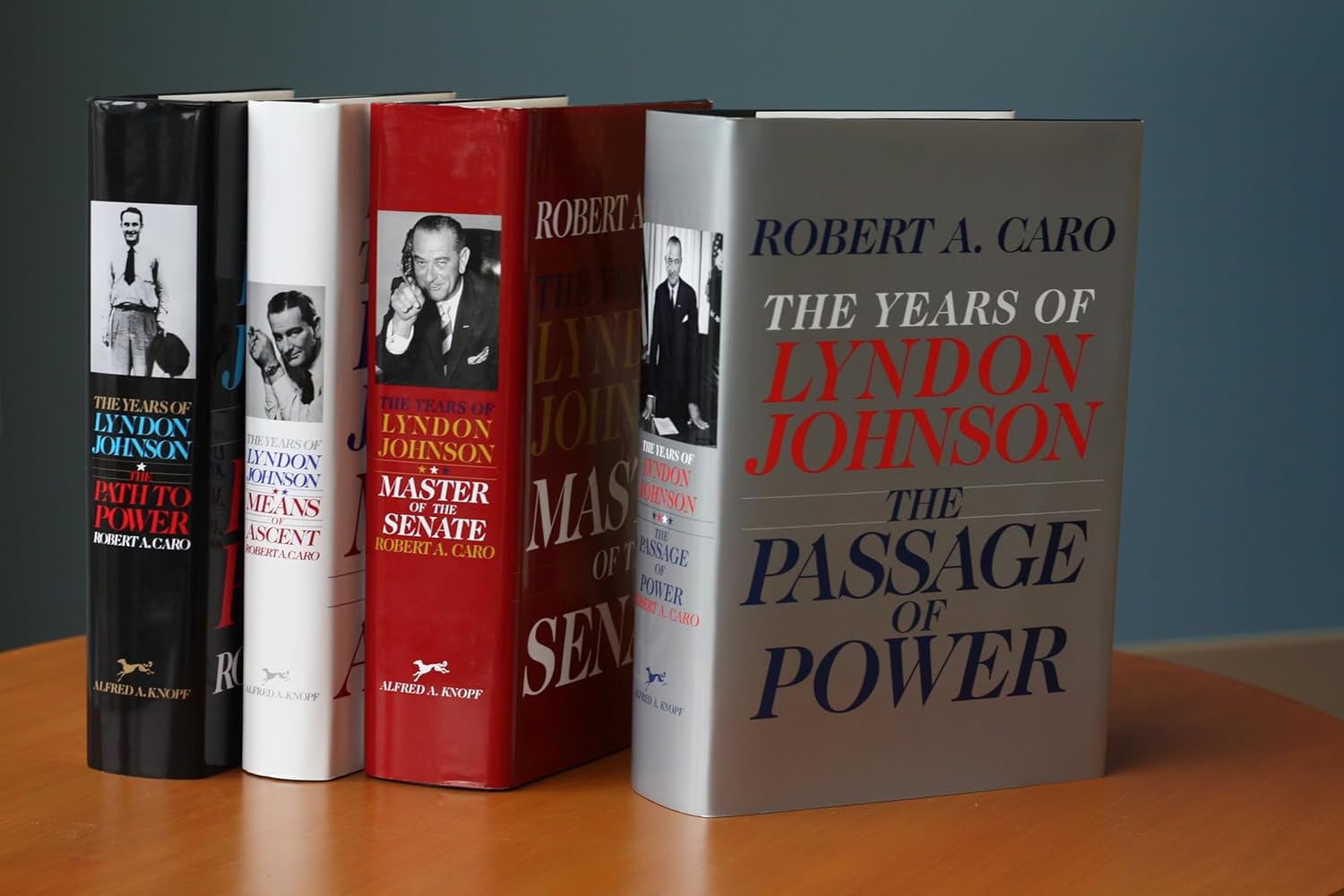
Subsequently, Caro produced a remarkable four volumes of his multi-book biography, The Years of Lynden Johnson. The first volume in 1982 was The Path to Power, followed by Means of Ascent in 1990, Master of the Senate in 2002 and The Passage of Power in 2012. A fifth volume is currently being written, covering Johnson’s time as Vice President and his assumption of the presidency following the Kennedy’s assassination.
Each book is a master work on its own. Together, they are fascinating and powerful insight into three decades of American politics.
“And finding facts – through reading documents or through interviewing and re-interviewing – can’t be rushed; it takes time. Truth takes time.”
– From Working by Robert Caro
Walt Isaacson
Walt and I were classmates at Harvard. He went on to become editor of Time, CEO of CNN, CEO of the Aspen Institute, a Professor at Tulane and a leading biographer.
Among his eleven published books are excellent biographies of Henry Kissinger, Benjamin Franklin, Albert Einstein, Steve Jobs, Leonardo da Vinci and most recently Elon Musk.
Other biographies and one near autobiography I loved include:
Kingmaker, Pamela Harriman’s Astonishing Life of Power, Seduction and Intrigue by Sonia Pernell. [insert image of book or writer]
Huey Long, a biography of Huey Long by T Harry Williams, which won the Pulitzer Prize and the National Book Award. Huey Long, known as the Kingfish, was the 40th Governor of Louisiana then a US senator. A populist left-wing politician, Long championed the rights of the poor. Huey Long was assassinated in 1935, preventing what some saw as his inevitable run for the presidency.
In Other Words, How I Fell In Love With Canada One Book At A Time by Anna Porter. One of Canada’s most accomplished publishers, writers and all-round literary champions, Porter has written a delightful and informative story of her journey.
Upcoming Book Launch EventsTwo weeks and counting until my new non-fiction book co-authored with Mike McCarthy, the Canadian Healthcare Guerrilla Handbook, is published.

I understand copies have arrived in the offices of my publisher Sutherland House Books, and I’m excitedly waiting delivery of author copies in the next few days. An exciting milestone for any writer.
We’re busy lining up events, and I hope you may join us for some of the public ones!
Longwoods Breakfast Event, TORONTO
Thursday, May 21, 2026
SickKids Peter Gilgan Centre for Research and Learning
686 Bay Street, Toronto
FREE. Registration & breakfast: 7:15 AM, Presentation 8-9 AM
Please join Mike McCarthy and me. We’ll discuss the book and take questions from the audience. Ben McNally Books has kindly agreed to be the bookseller.
Perfect Books, OTTAWA
Wednesday, June 24, 2026
258A Elgin Street, Ottawa
5 pm to 6 pm
FREE
Stay tuned for information about events in Orangeville and Stratford in Ontario and Winnipeg, Manitoba as we confirm final details.
And if you’d like Mike and me to speak to your group, please email Mike McCarthy at mmccarthy@grossomccarthy.com or our book’s publicist, Sarah Hanlon at sarahalexhanlon@gmail.com.
See you next month and in the meantime, happy reading!
Michael B Decter
March 1, 2026
Lessons from The Godfather
“Just when I thought I was out they pull me back in.”
Michael Corleone, The Godfather
My many decades relationship with health care began as a child following my surgeon father Percy around hospitals in Winnipeg on Saturday mornings. He would visit all of his post-surgical patients, and I would learn about health care at their bedside.
Since those early days I’ve had many roles in health care including consulting, writing, speaking, chairing many health boards and a stint as Ontario’s Deputy Minister of Health. Other interests have lured me including over three decades and counting in the investment world. But health care always pulls me back in.
I confess I love writing almost as much as I like reading. And I’m delighted to announce that a fourth book on health/health care – my twelfth published book overall – will be published by Sutherland House Books on May 5, 2026.

It’s available for pre-order now! From your favourite independent, Indigo, Amazon or wherever you buy books in Canada and the US.
The Canadian Health Care Guerrilla Handbook: How to Fight for What You Need is designed to arm Canadians with the strategies, stories, and tactics to fight for the care you and your loved ones need. The book reveals how patients have taken on the system and won: from the largest class-action settlement in Canadian history to securing life-saving drugs for rare diseases.
It’s not a book about health policy, which I’ve written about at length in the past. But rather my co-author Mike McCarthy and I were determined to create a survival manual that explains how the system works and step-by-step tools to navigate it. Though we do include a few recommendations for policymakers and a resource guide.
Mike’s full story, in his own words, is in our book. But let me tell you some important things about him here.
First, Mike is a hero of mine. He’s a leader who has survived a lifetime with a serious heredity medical condition, hemophilia. Affected personally by the tainted blood scandal – he was one of the 30,000 people infected with Hepatis C between 1980 and 1990 – Mike led the fight for justice for other victims including the 2,000 Canadians who contracted HIV.
Ultimately the Krever Enquiry, a landmark Canadian commission, would determine this was a largely preventable tragedy caused by a dysfunctional system.
Mike’s fight led to a $2.1 billion dollar settlement of a class action lawsuit. It also led to the removal of the Canadian Red Cross from the blood system as they’d failed in their duty to protect those receiving blood. Mike never blinked through the long and contested battle.
He went on, with his consulting partner Francesca Grosso to found the firm Grosso McCarthy and to spend the last three decades fighting for improvements in Canadian health care. For children with cystic fibrosis, for example, advocacy led to access to a new and successful drug.
My own writing journey began just after my time as Deputy Minister of Health in Ontario. The University of Toronto offered me a place to work by appointing me as a Senior Research Scholar at the Institute for Bioethics. Rob Prichard, then President of the University, was in large measure responsible for my appointment. I was grateful to him then, and I still am.
The Institute was housed in a former church and my office was the top floor. Or as I viewed it, the attic. The Institute was located only a block south of my deputy minister office at the Hepburn block at Queens Park. But all similarities ended with location.
As one might imagine, the deputy minister’s office at health was a very busy place. In fact, my memory is there were eight or ten telephone lines that lit up continually. And staff to answer them.
When I moved to my Bioethics Institute attic to write, there was a dial phone in the attic that never rang. A humbling experience! Any illusion that calls to the ministry were to me gave away to the more accurate realization that they were to whoever held that office.
I worked away on my first book Healing Medicare, Managing Health System Change The Canadian Way (published in 1994) but every few hours I would walk across the room and lift the telephone just to see that there was a dial tone.
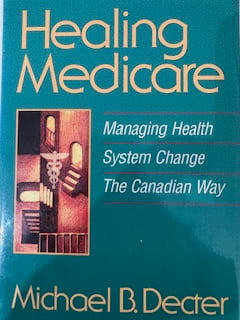
One astute reader of the book described it as ‘grief writing.’ She said I had written about all the things I didn’t get done when I was Deputy Minister.
There was a measure of truth in that although I’ve come to understand that change in Canadian healthcare is a very slow process. The many interest groups are powerful, and there’s an almost irresistible political force that bends towards a status quo with ever more funding.
The alternative of innovation does happen but at a glacial pace and often resisted by many players – those who already get the lions share of money.
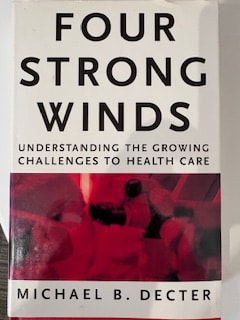
My next health book, Four Strong Winds, Understanding The Growing Challenges To Health Care was published by Stoddart Publishing in 2000.
This book had an interesting origin. Over the years, I had received many invitations to speak at health conferences. When attending, I made a practice of listening to other lectures on “forces” shaping health care.
As Deputy Minister, I was at the centre of the health hurricane on a daily basis. I was curious and over a period of a couple years, my own thoughts became clearer and more focused. Between my own experience, and that which I learned from others, I boiled down what I learned to four forces:
Powerful New Ideas
New Public Expectations Speed, Quality and Appropriateness
Technology Chip Driven Change
Fiscal Constraints; The Big Squeeze
As a fan of Ian and Sylvia Tyson’s music, the title came to mind and fit well with the book’s themes.
When Four Strong Winds was published, it led to many more speaking engagements both in Canada and internationally. Over the following two years, I gave fifty or sixty speeches, where I spoke about these forces and illustrated them with stories and examples.
I enjoyed meeting people across countries and discipline and sharing views about health and healthcare. Four Strong Winds also was adopted by a number of colleges on student course reading lists. This gave it a decade of steady sales.
In 2006 Francesca Grosso and I published Navigating Canada’s Health Care A User Guide to Getting the Care You Need with Penguin Canada.
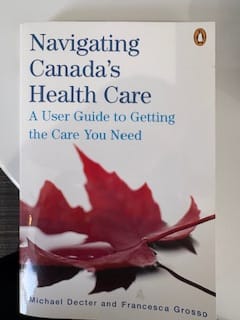
Our hope was it Navigating would assist many Canadians in finding the care they needed within the complexities of Canada healthcare services. We avoided the word ‘system’ despite people’s propensity to call it that.
Because, based on our work and experience, it was clear to us that Canada was not integrated to the point of truly being a system.
Government had agreed to pay for many health services, primarily physician and hospital care. Over decades they had also added varying amounts of coverage for drugs and other health services. What we found lacking and tried to address was how Canadians seeking care could find their way to the right healthcare service.
Francesca did an enormous amount of work on the detail of the book and that more than anything gave it value for the reader seeking care.
And now, back to the future! After writing investment books, a family memoir, a book of political stories and two novels, it was interesting challenge to think through all I’d learned about Canadian health care in different roles over the decades.
And with Mike, distill that into The Canadian Health Care Guerrilla Handbook: How to Fight for What You Need.
I’ll be excited to share more with you about the book as we lead up to its launch in May, including event invites! Our hope is to engage Canadians in discussion about how best to navigate a system that we all rely on, one full of dedicated health care practitioners but buttressed by the financial realities and ever-increasing demand.
If you’d like Mike and me to speak to your group, please email Mike McCarthy or Sarah Hanlon. We look forward to seeing many colleagues and friends from healthcare at these events!
All best,
Michael
January 1, 2026
Woodstock for Readers.
There is a magical quality to attending book festivals or author talks. They are for readers what Woodstock was for a generation of folk and rock music lovers – a place to gather, share cultural touch points, find community.
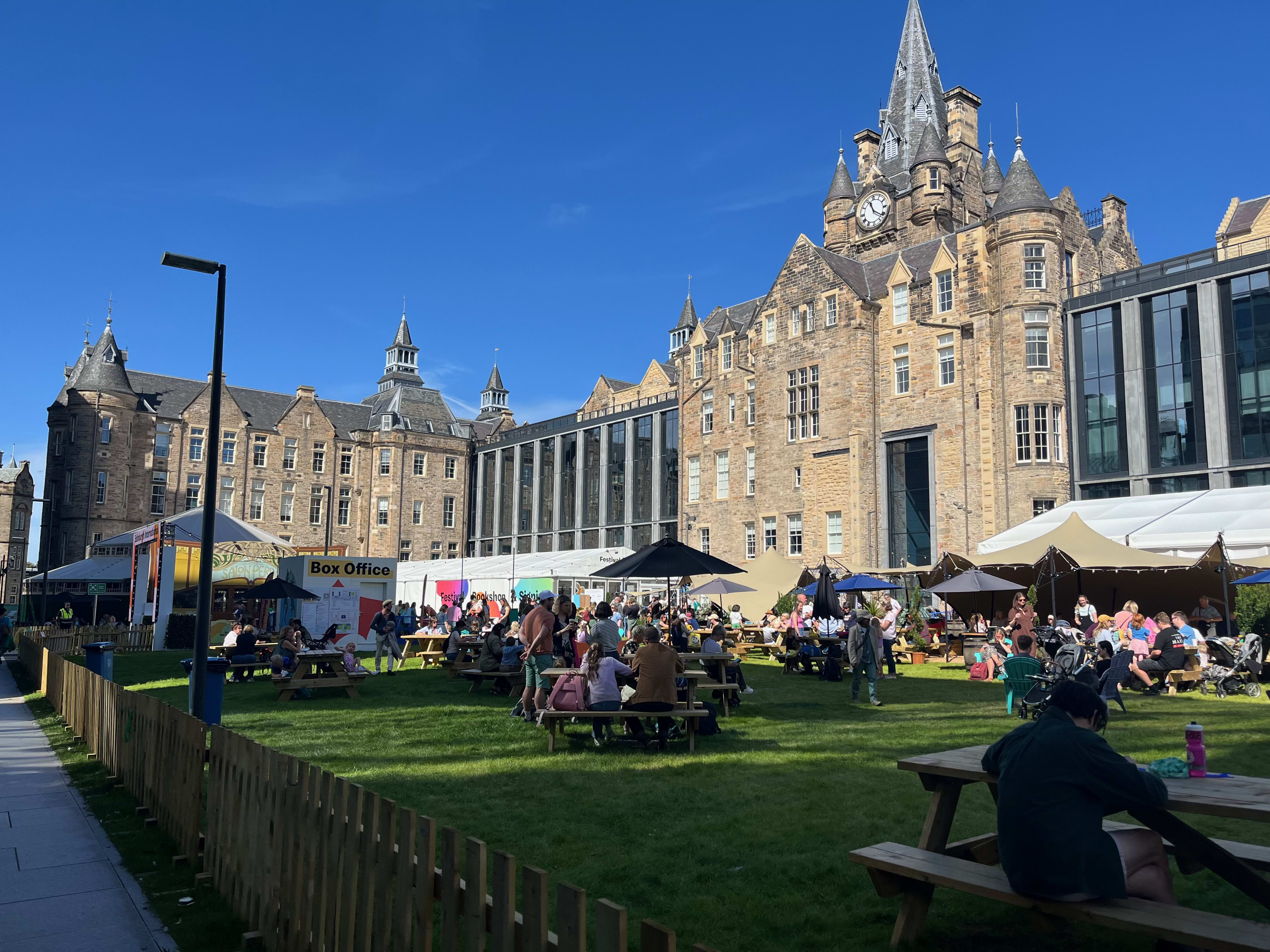
The act of buying a book and reading it is enjoyable in itself (assuming you picked the right book). But the opportunity to actually hear an author read from their own work, be interviewed on stage by a capable moderator or even have a one-on-one chat with the author after the session is extraordinary.
One memorable onstage interview in Toronto many years ago was with one of my favourite authors, John le Carré.
Creator of The Circus (the fictionalized nickname for MI6 headquarters in his espionage novels) and so many memorable characters including George Smiley and his Soviet archrival Karla, le Carré was there in person.
During his on-stage interview, le Carre was asked how he learned to write about evil. He hesitated for only a second, then replied very directly to the audience member who posed the question.
I taught in an English public school. I learned all I needed to know about evil from my students.
New Year’s Day is a wonderful time to look forward to the year ahead. And indeed, one of my most pleasant activities is contemplating which book fairs I may be able to fit into my schedule in the coming months.
Among my top picks are the Edinburgh Book Festival which I’ve attended several times, and which has always inspired me. Other favourites include the Hay Festival held outside the wonderful Welsh village of Hay-on-Wye.
Closer to home, the Toronto International Festival of Authors (TIFA) is one I’ve attended many times over the years. TIFA found renewed vitality and popularity in its move last year from Harbourfront Centre up to the Yorkville area, and I’m excited to see where they grow in 2026.
For those who would like to attend a book festival, perhaps for the first time, I provide below a few of the most interesting book fairs along with their location, main festival dates and website address so that you can find more information about them.
The Hay Festival.Hayfestival.com, May 21-31, 2026
While the Hay Festival organization has grown to produce more than twelve festivals in such far-flung locations as Columbia, Kenya, Mexico, Ukraine and Peru, the main festival takes place in the small village Hay-on-Wye (really Hay-on-the-Wye River) in Wales.
The village is filled with centuries old stone buildings. It’s also one of the world’s great book towns, boasting 50 permanent booksellers.
And for ten glorious days in May, it transforms itself into an epicentre of books and ideas, welcoming tens of thousands of visitors into tented venues, cafés and bookshops built in farmers’ fields a short walk from the village, with sheep grazing next door.
Otherwise known as bookish Shangri-La.
The dozens of year-round bookstores in this small community attracts people from all over the world. I first visited in the 1970s when I was briefly a student at Oxford because I’d heard about the village for years. I’ve returned several times, but most enjoyable of all was attending the festival.
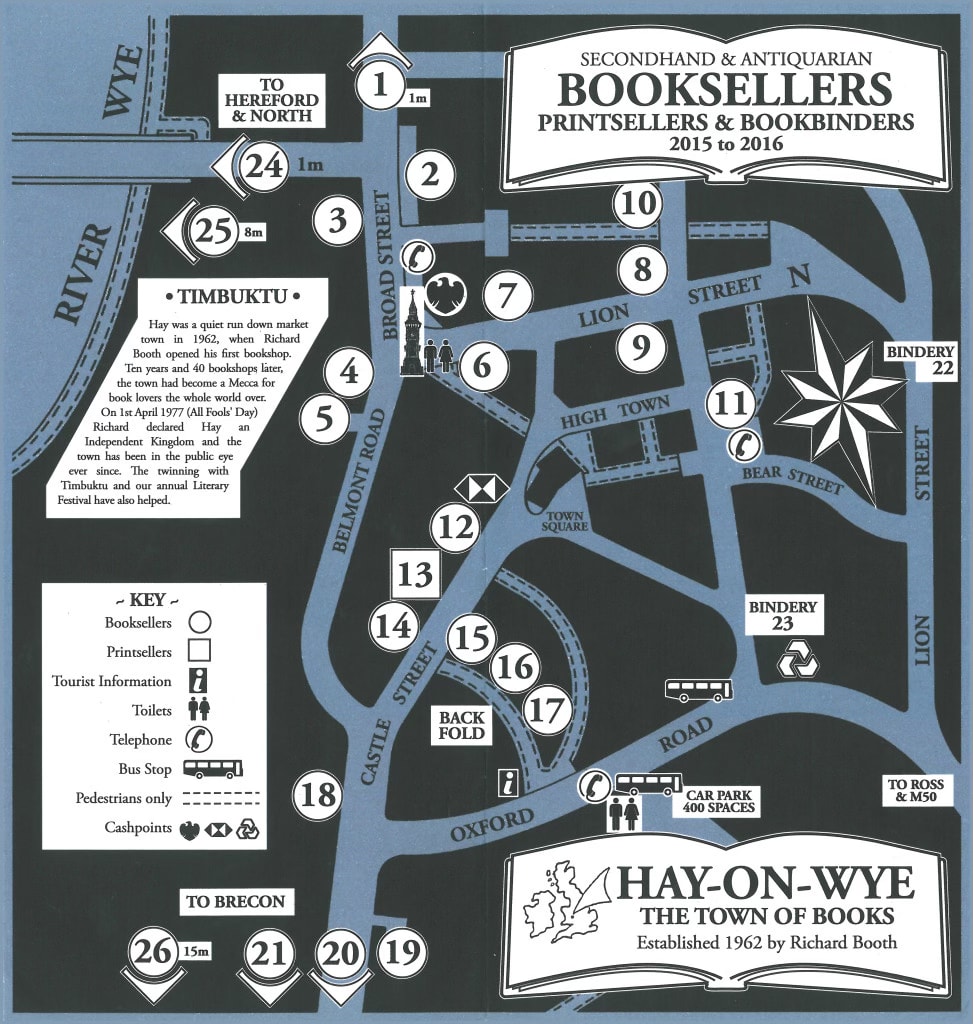
The Hay Festival has been described by the New York Times as “the most important literary Festival in the western world.” Due its thirty-eight-year history, and pastoral grandeur, every writer wants to go there. The festival regularly draws the top writers from around the world, while also making room for new and under-represented voices.
The tented book village contains everything from Pim’s Pop-Ups to Champagne Bars to portable toilets. Little buses transport you to nearby villages and hamlets where you may be staying or want to visit.
One of the things I love most is encountering new-to-me writers at festivals. I often buy tickets not on name recognition but on topic or even a well-written event description. From Ali Smith to Jackie Kay to Val McDermid, I’ll follow the career and by every book by an author who enchanted me with their talk.
That year at Hay, we heard many brilliant presentations or interviews, including author and poet Tamsin Treverton-Jones whose book Windblown: Landscape, Legacy and Loss - the Great Storm Of 1987 cleverly interwove her father (who designed Kew Botanical Gardens) and the ferocious storm. She focussed very much on the destruction of a significant portion of the tree canopy that covered England.
But perhaps most of all from that year, I fell in love with the work of Horatio Clare who I’ve gone on to ready many times since.
Horatio Clare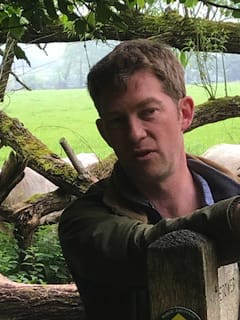
Writer and BBC commentator Horatio Clare grew up in in the Black Mountains, in the Brecon Beacons, the valley very near Hay-on-Wye. His first book, Running for the Hills, detailed his family story.
Clare’s mother decided to move from London to a farm in South Wales where she would raise her children and sheep. But life there became a relentless, hard slog for the family. Their father was present for a time, but hardship, and the mother’s refusal to move back to the city, strained the marriage. His visits became less and less frequent until he came rarely at all. What started out as a romantic visions of rural life, soon became a brutal story of survival.
It was a lonely and difficult childhood for Horatio and his sibling, likely impacting the mental health challenges he has faced in adulthood. But it also must have shaped him as the extraordinary observer of life and raconteur he is. Both her and his father, John Clare, were BBC presenters at different times.
Walking Tour with Horatio Clare.That year, Clare also offered a guided tour of the Valley in which he grew up.
A group of 35 of us set off in a quite luxurious bus for a half hour drive through the Brecon Beacons (officially known as the Bannau Brycheiniog National Park), a stunning mountainous region known for its highest peaks like Pen y Fan, diverse landscapes (moorland, waterfalls and cave) and rich history.
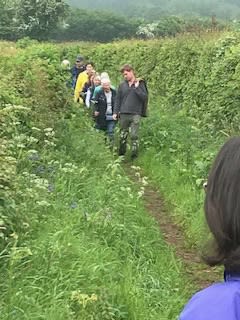
We were then led on a walking tour by Clare himself – on a trail used by human beings for over 2000 years – as he recounted the history of the valley.
At one point, we came upon a large and obviously very old tree. Horatio declared it ‘the hanging tree’. He pointed at the thick branches where grooves have been worn in by executing people for hundreds of years. He estimated it might be as old as a thousand years. Perhaps a little poetic license in the aging, but certainly the landscape has been shaped by endless battles for control of the territory.
I’d go on any tour that Horatio led because his depth of knowledge and his capacity to turn it into a compelling series of stories. This talent is there in his writings and was certainly evident that day walking through the Welsh valley in which his mother tried to raise him and his brother and quite a few sheep.
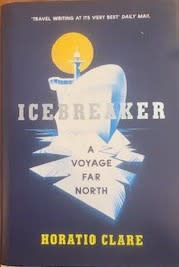
Icebreaker.That year at Hay, Horatio was there with his book Icebreaker. It describes his adventure touring the Arctic as a passenger in a Finnish icebreaker, combining both fact (how icebreakers actually work, Finland’s history, the challenges of sharing a border with Russia, how Finland’s Indigenous peoples are treated) but also his inner thoughts and fears as the icebreaker crashes through the thick arctic sea ice.
The frozen Bay of Bothnia just short of the Arctic Circle is the setting for much of his tale. It follows an earlier bestseller Down to the Sea in Ships, when he rode the container ships of the Maersk line.
 Edinburgh Book Festival.
edbookfest.co.uk, August 15-30, 2026
The Edinburgh Book Festival is one of several overlapping festivals held each year in August in Scotland. These include the Edinburgh Fringe (largest fringe in the world with thousands of shows), the International Festival (theatre, opera, dance, symphony, classical music), the Edinburgh Book Festival, The Royal Tattoo and others.
My experiences at the Edinburgh Book Festival have been remarkable. Many people come from across the UK, but elsewhere in the world as well. There are excellent authors but also highly competent moderators, often journalists including BBC, and the festival is strongly grounded in Edinburgh’s literary community.
It is not unusual to attend a book reading for one prominent Edinburgh-based author and find others in the crowd supporting them. This includes JK Rowlings of Harry Potter fame; Alexander McCall Smith, author many different series including No. 1 Ladies Detective Agency); crime writers Val McDermott and Ian Rankin; novelist and playwright Ali Smith, and others.
These authors also support the festivals, galleries and museums of Edinburgh. Their names are prominent on donor recognition walls.
Since COVID the Edinburgh Book Festival has also offered online viewing. The website has more information.
Alexander McCall SmithSandy McCall Smith is an absolute delight to listen to during an interview. He’s charming and funny and gracious, putting the moderator and audience at ease with his laugh.
Author of several series including the Number One Ladies Detective Agency McCall Smith is said to write as many as 5000 words a day. His literary output, including children’s books, poetry and novels, is remarkable. His books have been translated into 46 languages, sold more than 40 million copies, and received many awards.
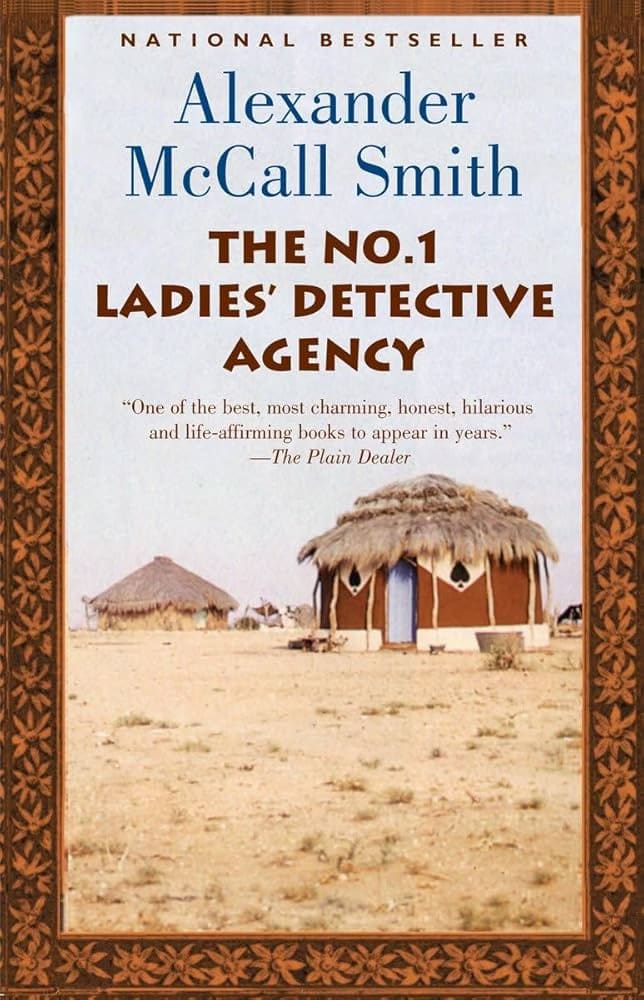
McCall Smith remarked, “in any other town that would make me the number one author but in Edinburgh I have J.K. Rowlings living across the street. Her Harry Potter books have sold well over 600 million copies.”
McCall Smith has a wonderful sense of humor. For the hundreds of thousands of people who frequent the Edinburgh festivals, he was asked to write an article highlighting the city.
In it, he suggested visitors should go to particular posh part of Edinburgh because it was the location of a significant colony of nudists. This was completely fabricated but did resultant in a stampede of lusty spectators. A delighted Smith, on stage at the Edinburgh Festival, was gleeful that this posh area was besieged by tourists seeking nudists.
McCall Smith wrote twenty-five No1 Ladies Detective Agency novels between 1998 and 2024. This is his bestselling series but far from his only one. His 44 Scotland Street series were first published as a serial in the newspaper The Scotsman with a new story daily for six months. There were eventually sixteen books in the series. Well-drawn characters include Bertie, a talented child forced to learn Italian and the saxophone by his pushy materialistic mother Irene.
My favourite McCall moment was when an interviewer asked, “Well, with all of these characters you’ve created, do you just get up in the morning and decide which of your characters you want to be with?”
McCall Smith replied, “Yes, that is exactly right.”
He was giggling at the prospect of his day spent with his characters. I was envious and delighted by the world McCall Smith had created and the obvious joy he gave him.
Toronto International Festival of Authorsfestivalofauthors.ca. Events all year. Main Festival late October/early November
This Festival better known by its initials – TIFA – has been going for 40 years. In the past few years the festival has been reborn, reimagined and re-energized. The credit goes to Roland Gulliver, previously Associate Director at Edinburgh Book Festival.
Gulliver has been supported by a strong board chaired by Charles Baillie. Together, they’ve managed a spectacular comeback.
TIFA had a big following and large attendance in its early years at Harbourfront Centre under the stewardship of Greg Gatenby. But its popularity and attendance declined in later years, in part because of the challenges that location (transportation, parking, funding) faced.
In 2025, TIFA broke away from Harbourfront Centre and struck a partnership with Victoria University (at University of Toronto) to move the festival up to Yorkville. They’ve also secured significant funding from the Weston Foundation as they launch themselves as a fully independent organization.
Recent TIFA events I attended include the launch of Margaret Atwood Book of Lives: A Memoir of Sorts. Atwood fans packed the Winter Garden Theatre, one of Toronto’s glorious and quite large venues.
As I wrote about in my previous newsletter, Atwood is a notoriously difficult person to interview. Partly she’s just ridiculously smart and well-read. But also, her love of the language causes her to dissect badly worded questions or simply not answer them.
Roland Gulliver introduced the event by saying Sarah Polley had withdrawn as interviewer due to illness. Roland made a number of calls seeking an alternative moderator including veteran CBC journalist Carol Off.
“I’d rather go back to Kandahar than interview Margaret on stage in front of a large audience,” Carol said.
The task fell eventually to a nervous Elamin Abdelmahmoud, host of CBC Radio’s Commotion. Elamin spoke at some length describing his approach to the interview and explained that he would start by asking Atwood about her relationship with her mother.
Atwood’s reply which left no oxygen in the question, or the room was, “My mother was Scottish, so we won’t be talking about that.”
Elamin pivoted to a question about Atwood’s numerous boyfriends in her younger years.
Atwood’s answer, “I liked shagging a lot, so I needed a lot of boyfriends.”
I am certain there were more than a few moments in the next hour when Elamin would have happily taken the ticket to Kandahar.
Eventually in a gesture of kindness after a bumpy conversation, Atwood took Elamin’s hands in hers and explained that she could read hands. She calmed him with this gesture of intimacy and friendship.
This was a triumphant evening for Atwood at the height of her literary powers at 87. It was also a coming-of-age moment for Roland Gulliver and TIFA reborn.
My Author Festival Wish ListBecause there is never enough literary festivals, the following are also on my wish list:
The Times Cheltenham Literary Festival: Along with Edinburgh and Hay, one the Big 3 in the UK. (October)
International Literature Festival, Dublin (May)
Nantucket Book Festival on the island of Nantucket off the shore of Rhode Island. (June)
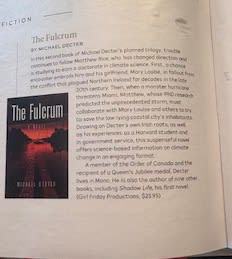
The FulcrumMy second novel The Fulcrum continues to enjoy favourable coverage. Most recently in an excellent magazine, In the Hills, published to celebrate Dufferin and Caledon counties, north of Toronto published their winter list of novels. I was delighted to see the inclusion of The Fulcrum.
Michael B. Decter
October 6, 2025
The Unstoppable Margaret Atwood.
Let me turn to one of Canada’s most successful novelists and determined advocate for a saner world, Margaret Atwood.
Atwood is the globally acclaimed author of 18 novels, 18 books of poetry and numerous other literary works of criticism. Her books have been adapted into television shows – most notably The Handmaid’s Tale.
Thanks for reading Bookends! Subscribe for free to receive new posts and support my work.
And they’ve been awarded many prizes including the Booker Prize (twice), the Giller Prize and dozens of others. Over 40 million copies have been sold in 40 languages.
It has been my pleasure to know Margaret for many years. I met her originally through my involvement with the Walrus Magazine Foundation, where I served as Board Chair for nine years. Most of my work was inspired by the dynamic Walrus Publisher Shelley Ambrose, who led the organization to great success. She also recruited Atwood to our cause.
Atwood is a champion for all things literary and the Walrus was no exception. She became a strong supporter of our annual gala, which provided an important source of fundraising. She believed in the Walrus’s mandate of providing Canadians an opportunity to read long-form articles about issues critical to the country.

One morning several years ago I flew to Ottawa for a meeting. I noticed, after I was seated, that Margaret Atwood was also on the plane. After we disembarked, I offered to share a taxi with her into the city centre. She said she’d be delighted but insisted on paying.
“Let me,” I said. “Someone else is paying for my trip to Ottawa.”
She laughed that unmistakable cackle. “No. I want to stick this to my publisher.”
Her words underscored the great conflicted affection most authors have for their publishers – a mixture of gratitude for bringing their characters and ideas out into the world. And the wicked desire to stick them with every expense they can possibly find.
Once in the cab, Margaret entertained me with the story of her first author tour, I believe for the novel The Edible Woman. When she arrived at Edmonton, she discovered her first event was at the Eaton’s Department store.
Moreover, management had made the decision to situate the author table not in the book section, but under the escalator in the men’s underwear department!
One can only imagine the humor of a young Margaret Atwood sitting at a table surrounded by men’s briefs, with a pile of books titled The Edible Woman available for purchase.

A particular delight of mine is to listen to Margaret being interviewed. It must terrify any interviewer to have this great opportunity. Generally, she listens carefully to the question, then takes issue with its premise or construction, delivering an impromptu masterclass on how to conduct an interview.
Few interviewers rise to the challenge. Her extraordinary command of the English language delivered with delicious precision flummoxes many. Whenever I’m driving and one of these interviews comes on, I’m tempted to pull to the side of the road; I’m worried I’ll laugh so hard I’ll bang into someone else’s vehicle.
So far this hasn’t happened, but I would ask you next time you hear an Atwood interview to listen carefully, particularly at the beginning. She starts in a cheerful, innocent sounding manner. Then, like a literary stiletto, she simply dismantles the premise of the interviewer’s questions.
Her wicked sense of humour was often on display at the Walrus Galas, held in the Fermenting Cellars in Toronto. One of our fundraising efforts was a silent auction, with a vast array of experiential items available. One my duties as Chair was to place starting bids on all the auction items to prompt others to do so as well.
This particular evening, Atwood had donated a priceless item: she would name a character in her next novel after the successful bidder.
I lingered by the auction table. Atwood, standing nearby, looked at me with her mischievous pixie grin.
Collecting Atwood.
“You should bid,” she urged.
“Will you make my named character a mass murderer or a pervert?” I inquired.
Her smile grew wider. “Maybe both.”
Just then a wealthy developer rushed up and made a knockout bid.
“Narrow escape,” I commented to Atwood. She only smiled.
Among my prized possessions are several first editions of Margaret Atwood’s books. A few are what collectors describe as “high spots.”
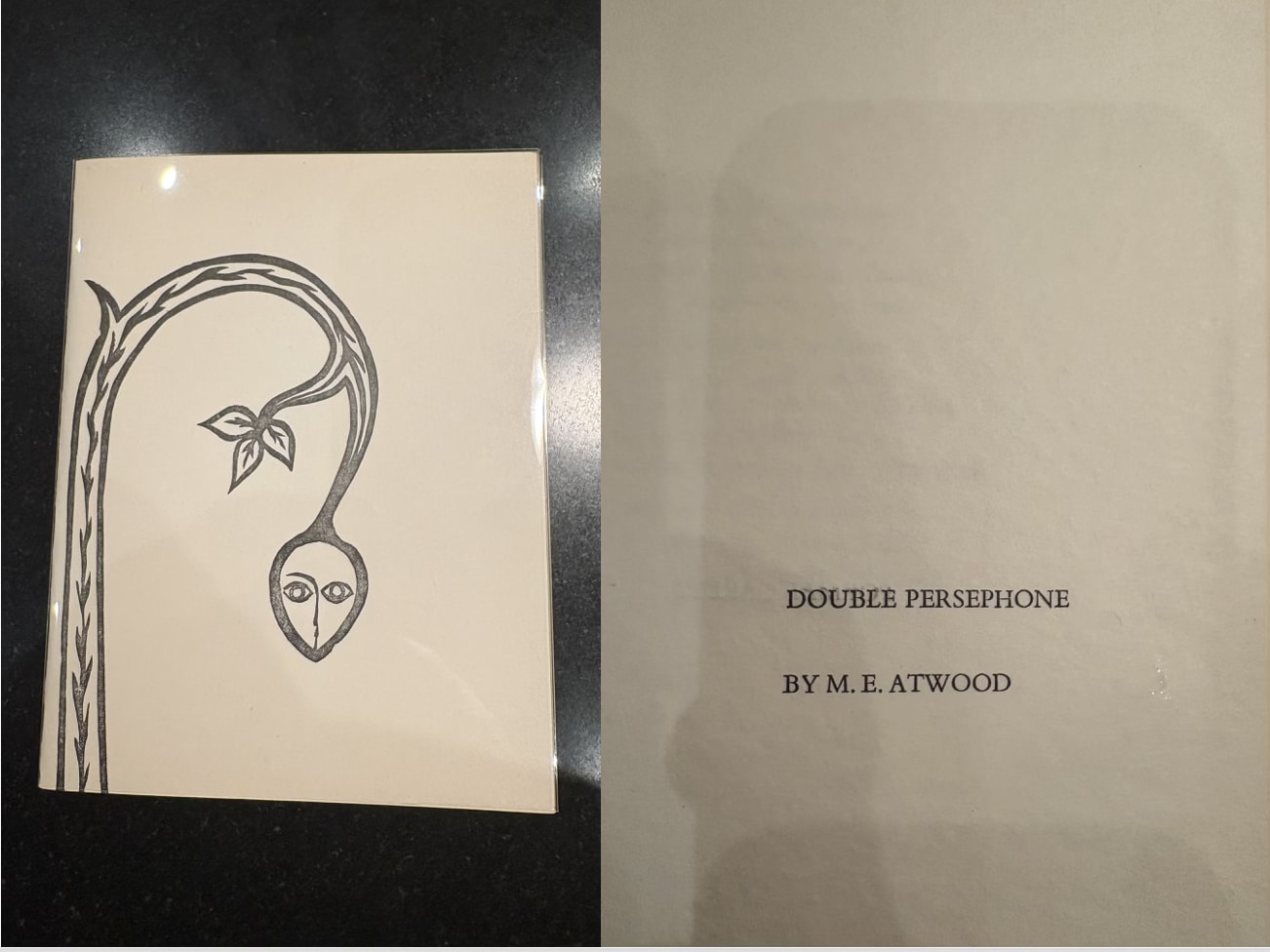
One I’m particularly proud of, Double Persephone, took a good deal of time and an immodest amount of money to obtain. It was her first book of poetry published in 1961. As a first book by an author who later became quite famous, it was particularly difficult to find.
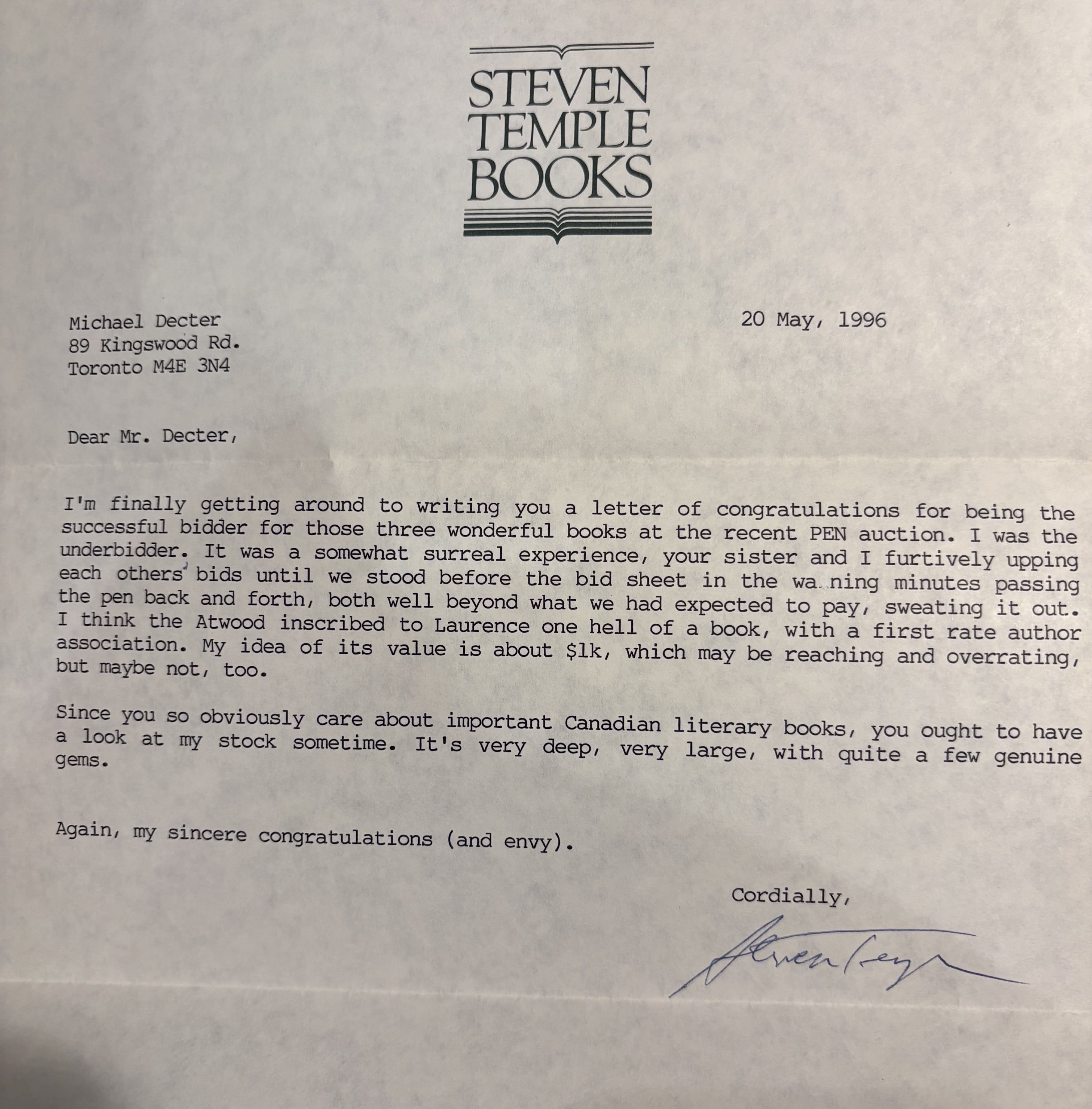
Another high spot came after I asked my sister Ann to attend a PEN Canada auction on my behalf as I was delivering a speech that evening across town.
The daughter of Margaret Lawrence (another prominent Canadian author) had donated a first edition Margaret Atwood book that had the inscription, From Peggy Atwood to Peggy Lawrence.
Margaret Lawrence would have been the elder states-person of Canadian writing at the time, Atwood the brash new entrant.
The connection of two important public figures to the book through the inscription made it what collectors call a ‘double association first edition.’ Ann promised to bid on my behalf.
After the auction, I received a letter from a Toronto bookseller who had apparently been bidding against my sister up until the point that he felt some value boundary was crossed.
He’d asked Ann, “How high are you going to go?”
“I don’t know. It’s not my money, it’s my brother’s,” she replied.
Ann exceeded the limit I’d given her by several hundred dollars, but happily she continued until she won. I was very pleased to have this unique book for my collection.
 The Continuing Adventures of
The Fulcrum
.
The Continuing Adventures of
The Fulcrum
.Recently I was interviewed about my recent second novel, The Fulcrum, Shaun Proulx Show Canada Talks Channel 167. Here is a link to that interview for those who are interested:
https://www.siriusxm.ca/channels/canada-talks/
See you next month and in the meantime, happy reading!
Dan Brown’s new novel The Secret of Secrets is long but captivating. You will finish it wanting to go to Prague where it is set.
I await my pre-orders of Louise Penny’s The Black Wolf, her 20th novel which publishes October 29th and Mick Heron’s Clown Town just published.
Michael B. Decter
Thanks for reading Bookends! Subscribe for free to receive new posts and support my work.
September 1, 2025
The Inimitable Farley Mowat.
Farley Mowat had a powerful impact on me. I read his books growing up. Then, years later, I had an opportunity to know him, and for a time work with him, in the Manitoba Government.
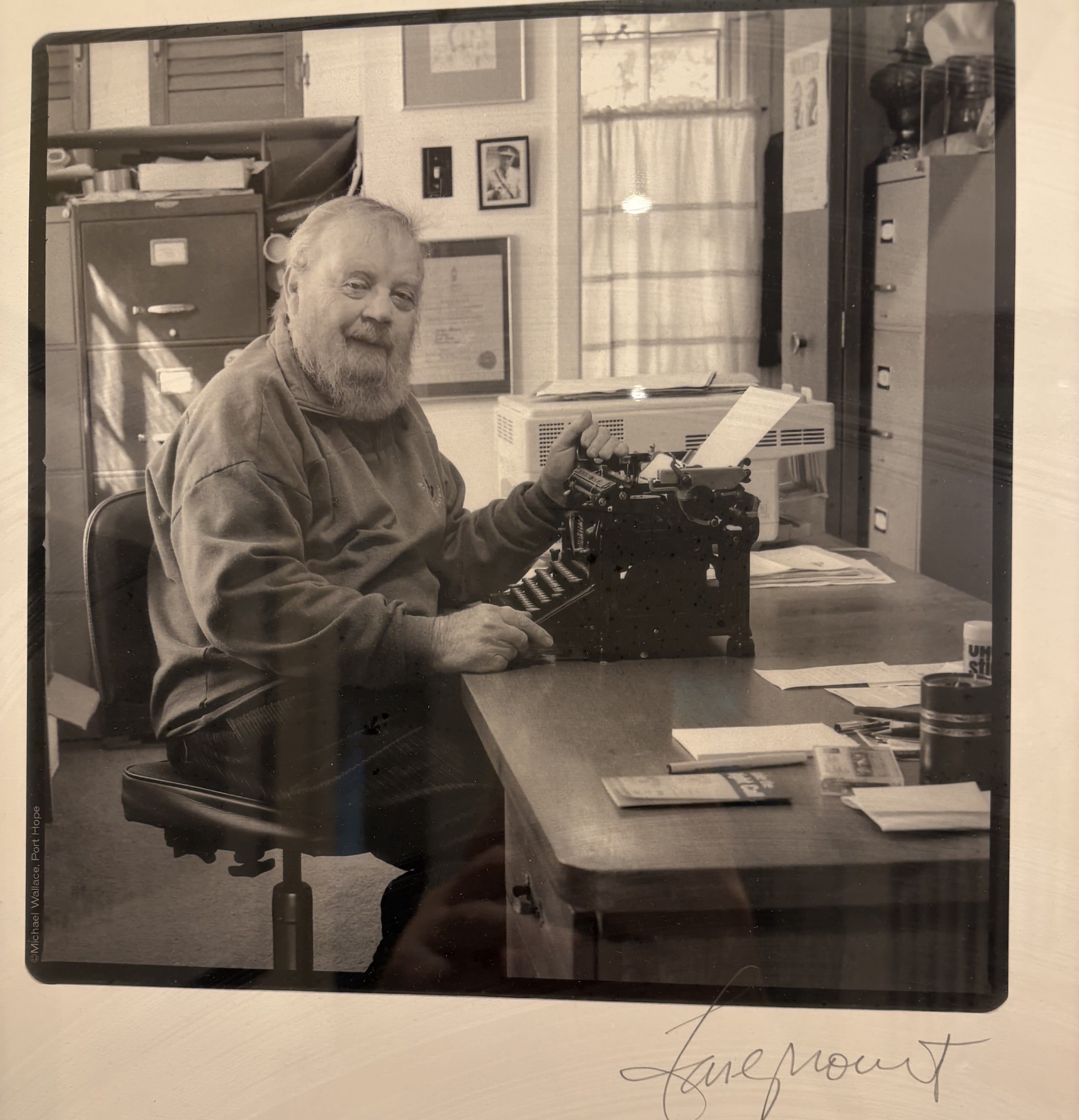
In 2010, I published a book of political stories, Tales from the Backroom (thank you Great Plains Publications!) about my adventures in government and politics. In it, I included a few stories about Farley Mowat. As the book is currently out of print, I excerpt two of the stories below.
Farley Mowat IAbout the last person I expected to become friendly with while working for the Manitoba government was Canada’s best-known environmental campaigner and best-selling author, Farley Mowat. A business loan given by the Schreyer government in 1973 first attracted Mowat’s attention.
The loan was to an Inuit co-operative in Churchill, Manitoba. The purpose: to allow the group to begin hunting the Beluga whales that frequented Hudson Bay near Churchill.
Mowat had just finished his book A Whale for the Killing, about the grizzly fate of a whale trapped in a Newfoundland bay and used as target practice by the Newfoundland cowboy contingent.

He was enraged that any government would sponsor the further killing of the whales. Never mind the NDP. As a long-time supporter, he expected better from them. In his Mowat-like fashion, he laid siege to Premier Schreyer.
Schreyer, a good politician and an intuitive environmentalist, was also a fan of Mowat. He was amenable to Farley’s suggestions. He told Mowat that if he could convince the Inuit co-op that there was more money to be made in building a tourism industry, he would be just as happy to provide the money for that purpose.
 Whale watching in Churchill, Manitoba.
Mowat, good to his word, flew to Churchill and persuaded the community that there was more money to be had bringing wealthy Canadians, Americans and Europeans to see the whales rather than killing and eating them as had been their traditional way.
Surely Mowat has been vindicated by the popularity of whale watching in Churchill. Some thirty years later, the Michelin guide and other major tourist guides, celebrate the whales of Churchill as a major tourist destination.
In the process, he became friendly with Premier Schreyer and became, as we all were in those days (and remain so), completely enamoured by the wondrous Lily Schreyer.
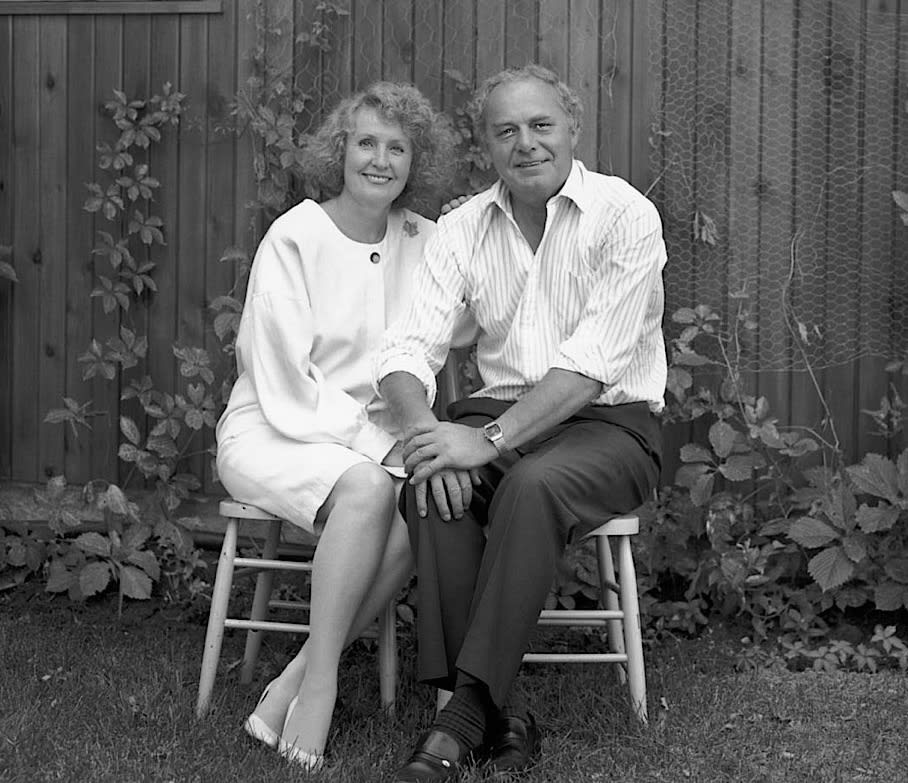 Courtesy Harry Palmer Photographs.
Mowat was so charmed by Ed and Lily that he decided to take up residence. He parked his small caravan in the backyard at their house. The Premier signed him on as a dollar-a-year man for the government and Farley took to pounding out proposals on how to bring about some sensitivity to natural environment.
As a young functionary in the cabinet office, I was assigned the task of being the go-between for Mowat with the departments. My role was to attempt to figure out who exactly should be responding to Mowat’s proposals and to impress upon them the seriousness with which the premier took Mowat’s ideas.
In those days, I had returned from four years in the concrete jungle of Boston and had decided that I must live in the country. To this end, I bought a very small house in the community of Starbuck, Manitoba. I painted the house barn red so that friends could find it and proceeded with some pretty amateurish renovations.
Nevertheless, I extended an invitation to Mowat to visit, which he did with Lily Schreyer in tow. Ed was making a speech somewhere nearby and that was the only explanation offered. There was a compulsory bottle of rum, which we proceeded to demolish.

Starbuck, I should note, is a small community and not one noted for radical tendency of any sort. It was a warm summer evening. Farley decided that he would see if the creek across the road was suitable for swimming. He casually stripped nude, threw a towel over his shoulder and set off. However, I found out later, he stopped at a few neighbours’ homes to seek directions as he was unfamiliar with the area.
Over the next number of months while I lived in Starbuck, I harboured the secret hope that Farley’s celebrity was such that cause had been helped and not hurt by his naked perambulations. The neighbours never said a word about his appearance.
Farley Mowat IIFarley Mowat continued to tour Canada making speeches saying he'd been a dollar-a-year man to the Manitoba government and that the province was so cheap that it never paid him his dollar.
Other than being mildly annoyed, there wasn't much I could do about this assault on the provincial honour until 1981, when I went into the new government of Howard Pawley as the Cabinet Secretary. (The most senior public servant.) Only then could I take action to silence the loquacious Mowat.
Among the perks of my office, if one could describe it as that, was the chairmanship of an obscure cabinet committee, distinguished because it had in fact, no actual cabinet ministers on it. It had the bland, innocent name, the Hospitality Committee of Cabinet.
This committee approved all hospitality grants, grants for visiting conventions of Elks, Women Of The Moose, and other fraternal orders. We had a modest budget, and we also presided over Manitoba’s prestigious Order of the Buffalo Hunt.
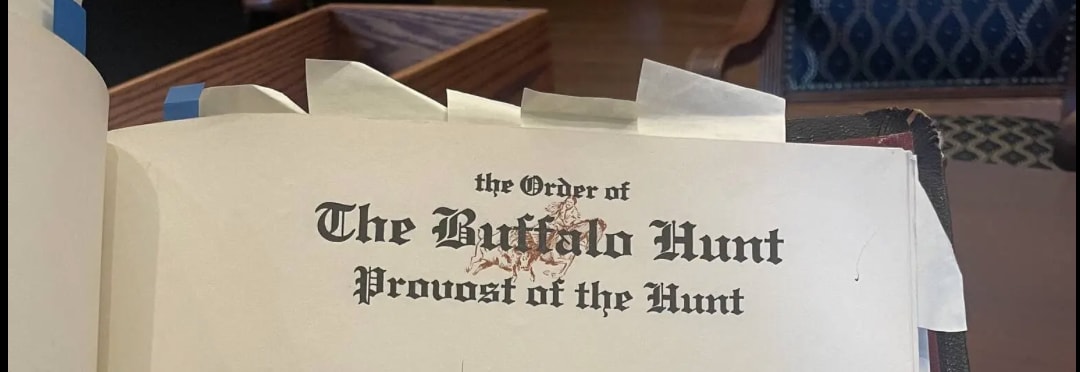
This honour had been given randomly to winning curling teams and visiting dignitaries over the years. It it struck me that in one fell swoop, I could regain Manitoba’s pride and do something nice.
I conspired with the wonderful Rita Kurtz, the publisher’s rep who toured Farley, about when he would be coming to Manitoba next. I prevailed upon Premier Pawley, who heard me out on the story of Manitoba’s honour being tarnished by the Mowat’s rather repetitive assertion that he was owed a dollar that he never saw.
The Premier invited Farley for a very special ceremony at which we presented him with two items: a framed one-dollar bill and recognition of his services to the province.
And we created a new category of the Order of the Buffalo Hunt, entitled Preserver of the Species, in honour of Mowat’s tireless work, not only to save the whales of Churchill, but also many other species.
I think Farley was as delighted at the dollar as by being named as the first Preserver of the Species, Manitoba Order of the Buffalo Hunt. An odd combination when you consider that we pretty much wiped out the buffalo on the Canadian prairies.

Farley and I remained friends although I didn’t see him as often as I would’ve liked. Many years later I had the opportunity to find his old Manitoba manuscripts, wonderful ideas that he typed out on his Underwood typewriter. I felt the right course was to return them to him.
He was reading at Harbourfront in Toronto some thirty years after he had typed these manuscripts. A mutual friend, his publisher Anna Porter, tried to introduce me to Farley backstage at the event. Farley turned - we hadn’t seen each other in a decade - threw his arms around me, gave me a big kiss and said,
You don’t need you to introduce me to my friend, Michael.
This allowed me the perfect location to return the manuscripts to him and to tell a somewhat surprised Anna Porter that Farley was in fact the only living Preserver of the Species, Manitoba Order of the Buffalo Hunt.
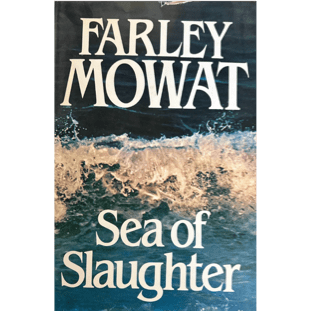
If you want to know the full capacity of human beings to destroy nature, Mowat’s Sea of Slaughter is a book you must read. It takes a journey through over 100 years of the history of Gulf of Saint Lawrence. The destruction of the eco-system of the St. Lawrence River that had been teeming with life.
Set in the period of European settlement, the stories Mowat tells are one of rampant destruction, and extinction of species after species by those determined to enrich themselves by taking nature’s bounty without regard for sustainability or for the consequence of their taking.
Sea of Slaughter was one of many powerful books written by Mowat with rancor towards his own human species and our capacity for carnage.
Farley Mowat was a larger-than-life character in every sense. He wrote over 40 books that were translated into 52 languages. He sold more than 17 million books. His first book People of the Deer was published in 1952, the year of my birth. His occupations included author, soldier, environmentalist, naturalist and philanthropist.
When Farley passed in 2014 at 92 years of age, Canada lost one of its most remarkable citizens.
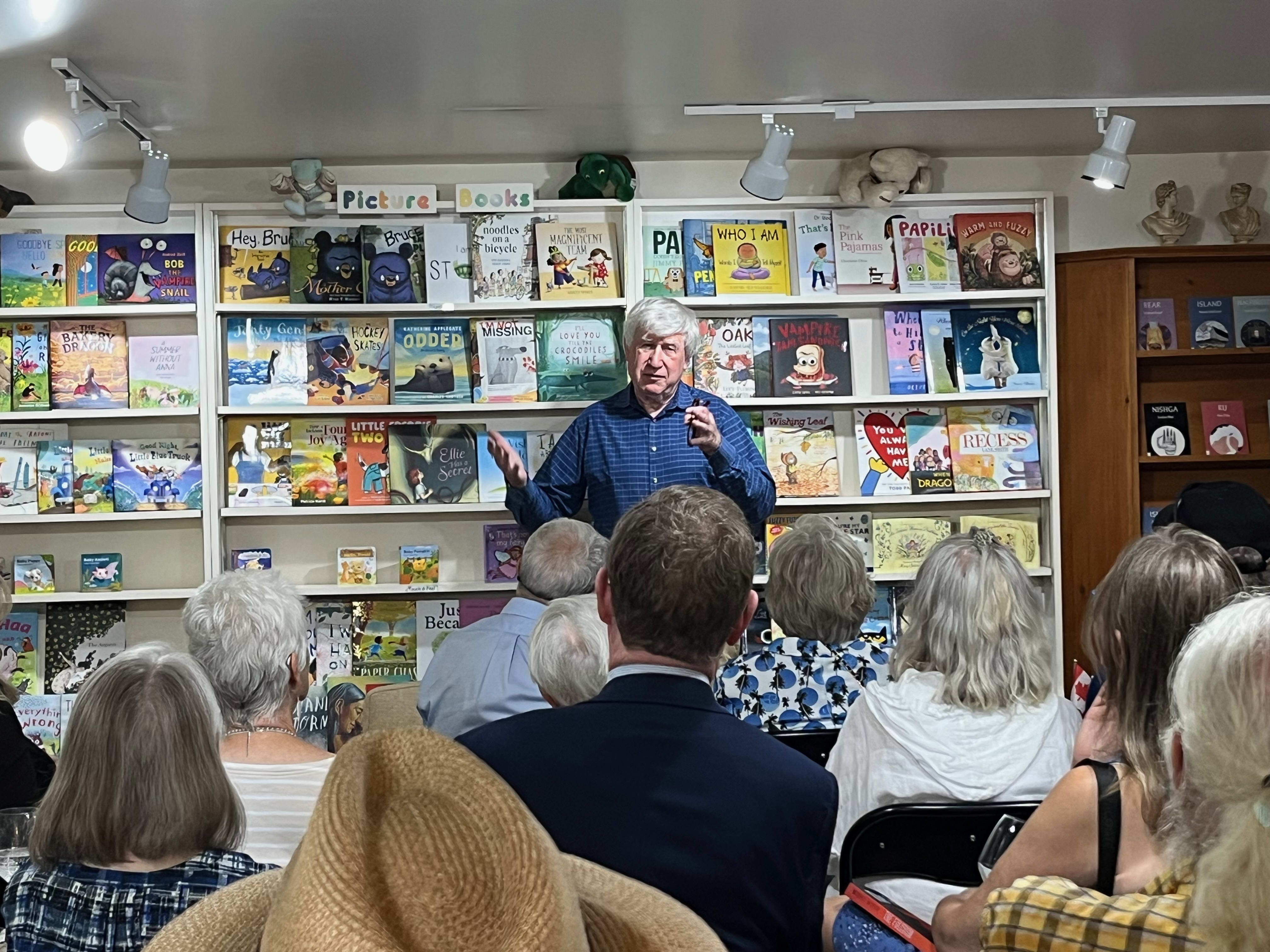
Fabulous Book Launch at Booklore in Orangeville.My sincere thanks to one of Canada’s very best independent booksellers, Nancy Frater, proprietress of Booklore and friend to authors.
Nancy’s curation of the store is terrific, and she’s also very involved in the local community, hosting author talks and fundraising events for Theatre Orangeville. She’s well-read, erudite and fun.
We had a packed house for The Fulcrum event last weekend, and she generously provided food and beverages for the crowd. I’m grateful to her, and to all booksellers and publishers, who do yeoman’s work birthing stories into this world.
August 1, 2025
Two Books That Caused Me To Travel.
Many books have encouraged me to travel but two had such a powerful impact that I travelled very specifically to experience the setting of each of them.
The first to Africa – to Nairobi, Kenya. The second book inspired a shorter but equally memorable journey to Savannah, Georgia in the American South.
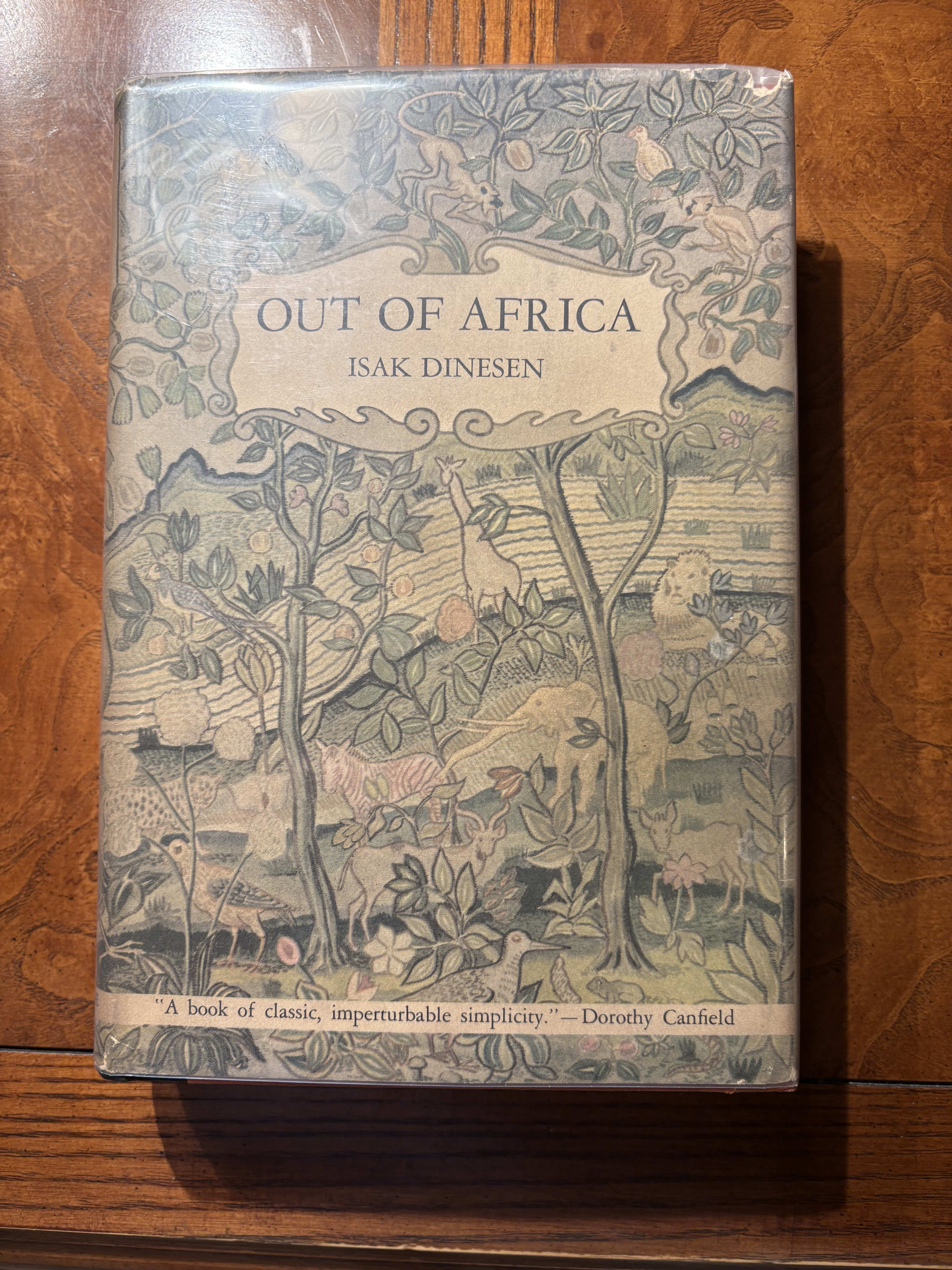
Out of AfricaThe opening sentences of Isak Dinesen’s powerful novel, first published in 1937, have always moved me.
“I had a farm in Africa, at the foot of the Ngong hills. The equator runs across these highlands, a hundred miles to the north, and the farm lay at an altitude of over six thousand feet.”
The moment I read that those lines I knew I wanted to see her farm and the Ngong hills.
Karen Blixen – pen name Isak Dinesen – was married to Baron Bror von Blixen-Finecke, a Swedish aristocrat with whom she moved to Africa. It was a difficult marriage, and after they divorced she had a long relationship with pilot, hunter and adventurer Denys Finch Hatton, who turned out to be her true love.
Karen ran the farm in an age when it was highly unusual for women to do so, and she turned out to be much better at it than Baron Blizen-Finecke who mismanaged it during the marriage.
In 1990, an opportunity to visit came knocking. At the time I lived in Montreal and had a consulting firm. The Canadian International Development Agency, better known as CIDA, asked me to undertake a planning study which meant research and interviews over ten days in Nairobi.
I arrived on a Saturday; the following day found me at the Blixen farm in the Karen District of the city.
In 1964, the Danish government purchased Blixen's former house and gifted it to Kenya to celebrate the country’s newly gained independence from Britain.

The house appeared in the 1985 film adaptation of Out of Africa starring Robert Redford and Meryl Streep. Some say the filmmakers had a hand in restoring the buildings which had fallen into disrepair. The following year the National Museums of Kenya acquired the property and converted the house and grounds into a museum.
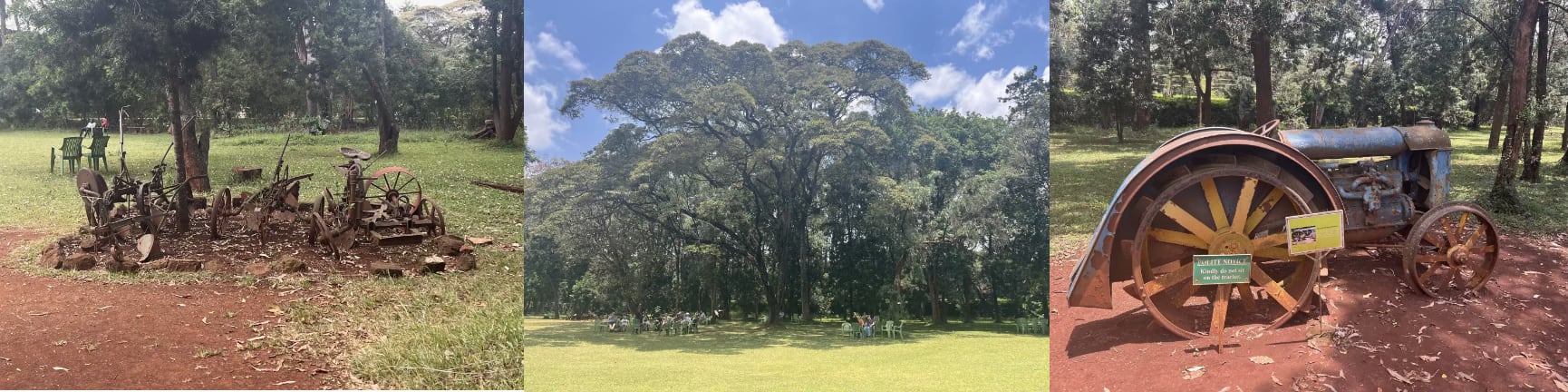
I made a second visit 34 years later in 2024 when I took my family on a safari to Kenya and Tanzania. Our safari ended in Nairobi. I was very happy at the chance to visit the museum again.
The grounds are green and splendid with a variety of trees. Amidst them sits restored machinery, imported from England at great expense to process the coffee grown on the farm. I expected Denys Fynch Hatton and Karen Blixen to step through history and stroll arm-in-arm around the farm, but they did so only in my imagination.
 Midnight in the Garden of Good and Evil
As with Out of Africa, the remarkable non-fiction book Midnight in the Garden of Good and Evil by John Berendt inspired a journey, this time drawing me to Savannah, Georgia to experience the American south.
The combination of the book with a movie starring John Cusack and Kevin Spacey indelibly imprinted Midnight in the Garden of Good and Evil on my mind. And once imprinted, it was only a matter of planning and time before I made the pilgrimage to Savannah.
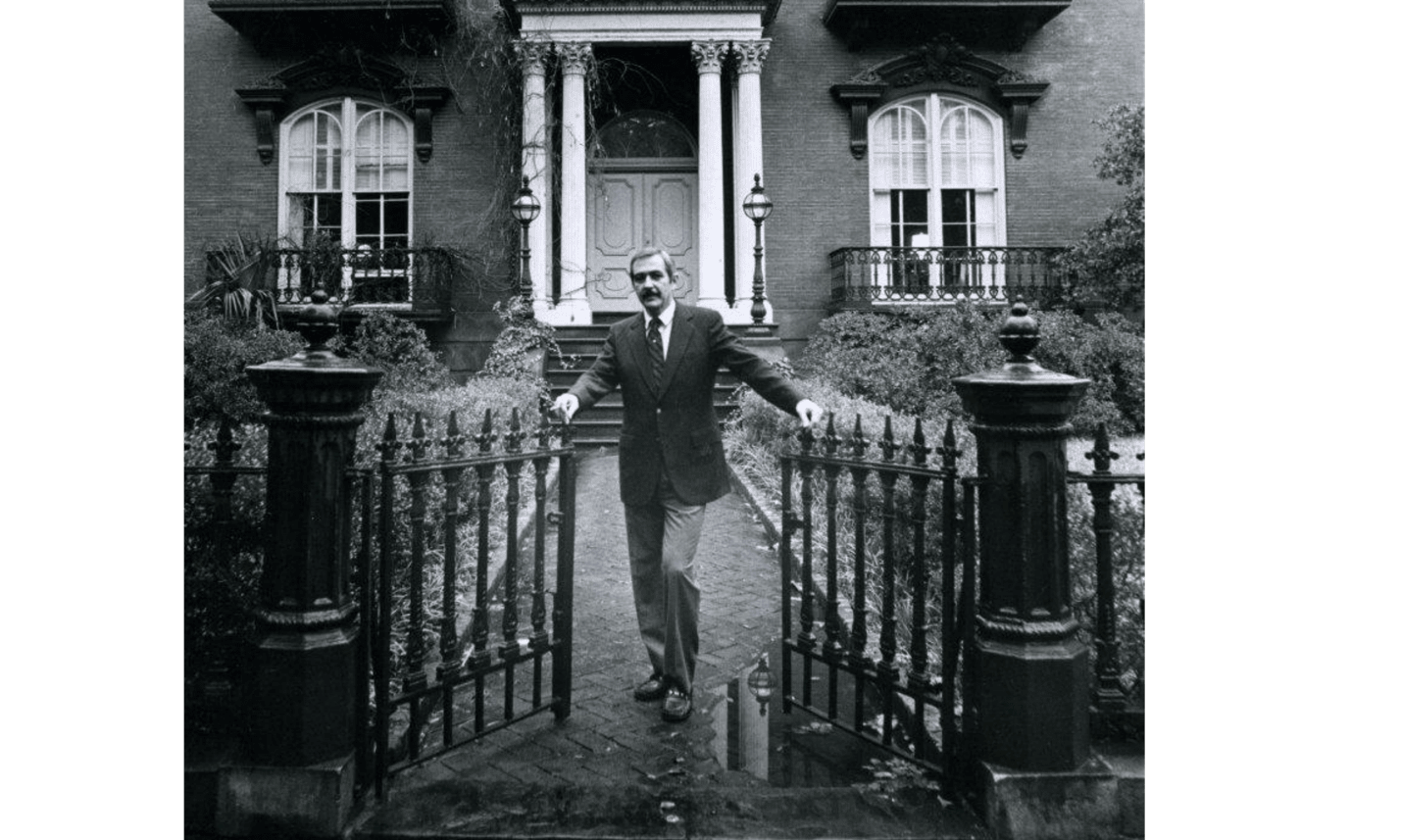
My visit there included a tour of the house in which the book is set – and where the film adaptation was shot – guided by a very knowledgeable docent. The first chapter is entitled “An Evening in the Mercer House” and it’s very true that the house itself became a major character in the book.
Mercer House was started in 1860 for General Hugh Mercer. Its construction halted during the Civil War then was completed in 1868 by its new owner, cotton merchant John Randolph Wilder.
(Mercer was great-grandfather to songwriter Johnny Mercer who wrote "Moon River", "Days of Wine and Roses", "Autumn Leaves", and "Hooray for Hollywood” among 1500 other songs.)
The charming docent showed our small group around the Mercer House and its unusual contents. She illustrated each room with well-told and fascinating stories.
The docent was far too careful to ever mention anything about the sensational murder of Danny Hansford, the young lover of Jim Williams, a prominent Savannah antiques dealer who owned the house and was the protagonist of Midnight in the Garden of Good and Evil.
A tourist who hadn’t read the book could leave the elegance of Garden City none the wiser about the dark deeds that took place there.
The house was used by Savannah Shriners Temple, then left vacant for a decade before Jim Williams bought it in 1969 for $55,000. He set out to fully restore it over two years.
The property is three stories tall, including the basement where William’s restoration workshop was located, a courtyard and carriage house. It takes up a full city block, the only building in Savannah in private ownership to do so. The main room faces onto Monterey Square with large French windows. There’s a classical portico at the rear for on both the first and second levels.

The docent told the remarkable story of the elegant porcelain dishes in the dining room which came from the famed Nanking Cargo.
In 1752, the ship Geldermalsen set sail from Canton, China in the South China Sea on its return journey to the Netherlands. It struck a reef and sank with its cargo of tea, raw silk, textiles, dried wares, groceries, lacquer and porcelain.
100,000 delicate white porcelain dishes were recovered in 1985 after over 200 years at the bottom of the sea. Jim Williams bought some of those dishes at a Christie’s auction in 1986. He was a collector extraordinaire with a deep attraction to the macabre.
In his collection is the dagger believed to have been used to castrate Rasputin during his assassination. (Rasputin was the Russian priest and healer who captured the affection of the Russian Queen, Tsarina Alexandra.)

And if you want to know more about Jim Williams, the Mercer House and the murder of Denny Hansford in the study, you’ll need to read the book!
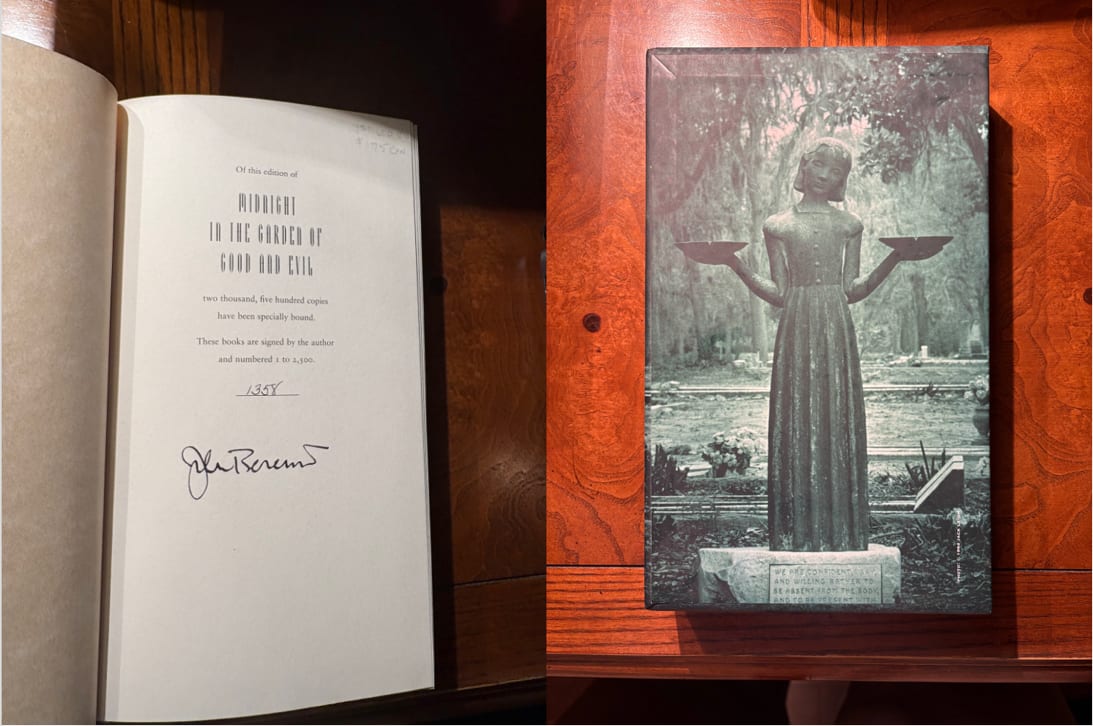
My special edition of Midnight in the Garden of Good and Evil is one of a limited-edition of 2500 copies specially bound books signed by the author numbered from one to 2500. My copy is #1358. It is contained in a lovely slipcover with a green statue from the garden, both on the cover of the book and on the slipcover.
 Update on
The Fulcrum
Update on
The Fulcrum
Much good news about my second novel, The Fulcrum!

Recently, my publisher told me we’re now permitted to claim ‘Best Seller’ status as The Fulcrum ranked number four on Amazon in both categories of Environmental Thrillers and Natural Disasters.
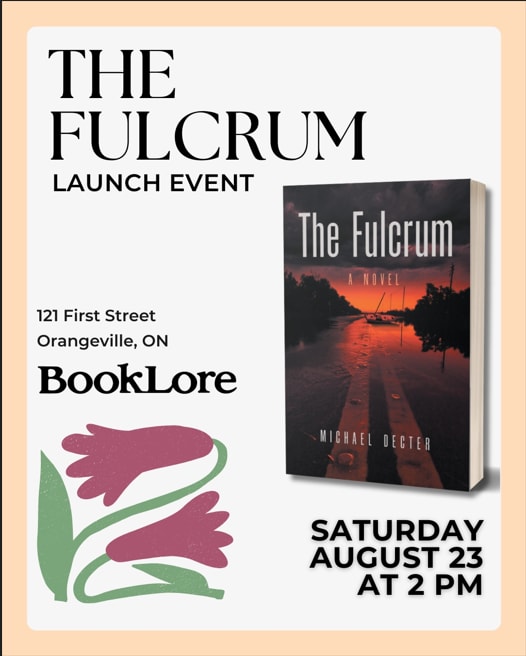
This was very exciting and gratifying, as are the positive reviews that continue to arrive. I’ve also confirmed an August 23rd book launch at the wonderful BookLore in Orangeville. The invitation is below; I hope you’ll join me!
Also delighted to share this review of The Fulcrum by Muriel Smith, Former Deputy Premier of Manitoba
After decades working on public policy and in senior level management, Michael Decter has written a second novel that has something for everyone – and a little bit more. First, there’s a great love story, with some Irish poetry and mystery. Then there’s a plot that offers not only challenges but some surprising engineering feats in the face of a deadly #5 hurricane approaching Florida and cooperation among the powers that be. In short, a lesson as to how we should approach climate change, not with despair but decidedly with ingenuity and “all hands-on deck.”
Happy reading in the lazy summer days of August!
Michael
July 1, 2025
The Fulcrum Launches in Winnipeg, Ottawa and Toronto
Happy Canada Day 🇨🇦.
The Fulcrum’s official publication date was June 10th and I hit the ground running!
First off, my birth town of Winnipeg on June 14th at one of Canada’s most successful indie booksellers, McNally Robinson.
It was such a delight to have family and long-standing friends turn out, including Ed and Lily Schreyer.
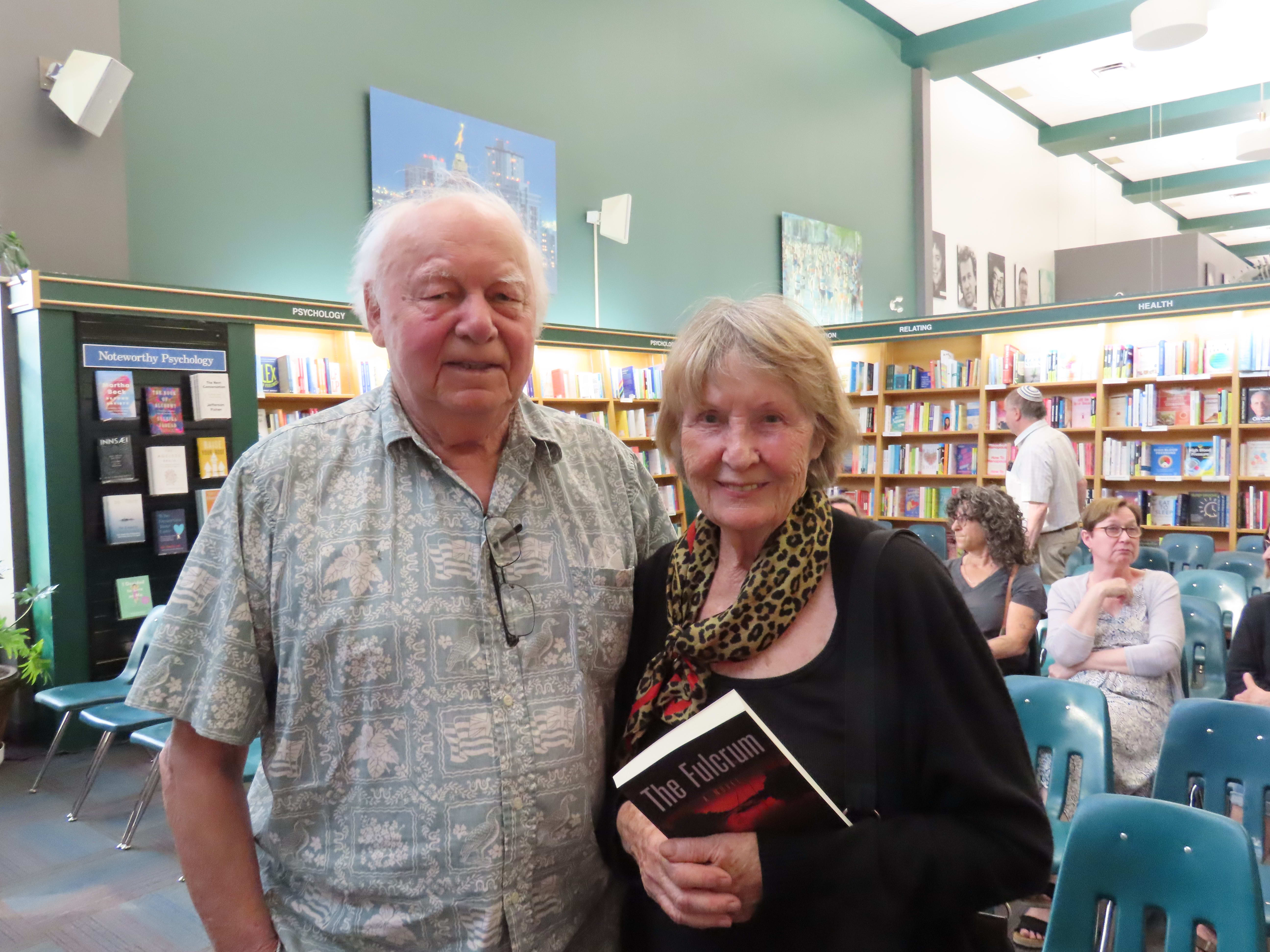
My first job after university was working in Executive Council Office, the central department in Manitoba that supports the premier and cabinet. Ed Schreyer was Premier at the time (later Governor General of Canada, then High Commissioner to Australia). Premier Schryer was very generous towards the young Turks like me who worked for him and we were all in love with Lily.
Next up, the Ottawa launch at Perfect Books. A smaller but enthusiastic house, with the added pleasure of getting to see that day not one but two former Governors of the Bank of Canada – John Crow at the launch and David Dodge for coffee – and talk about Canada’s future.
Then back to Toronto, where I was invited to speak by Chris McLeod at his law firm Cambridge LLP. Every author should be treated as well as Chris treated me. The room was packed, there were delicious refreshments, and I was provided the opportunity to read from and speak about the book, followed by a really insightful Q&A.
Best of all – Chris bought copies for everyone in attendance! It makes an author’s heart sing to know that sixty more people will be engaging with their characters and ideas. I even had a few copies of Shadow Life, my first novel, for those who wanted to read both.
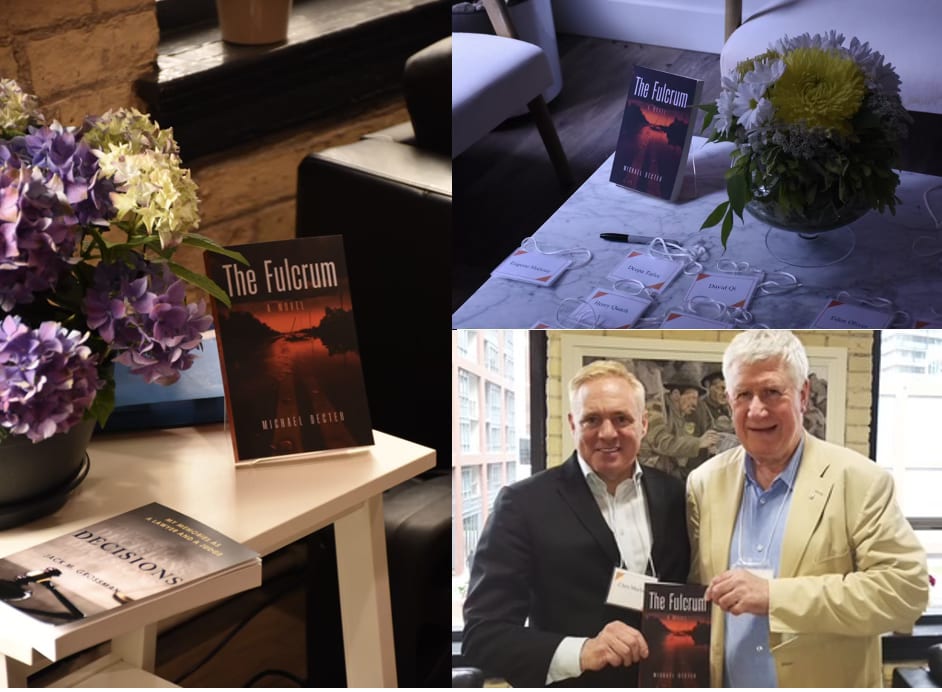
My whirlwind first month tour culminated at one of my all-time favourite book stores, Ben McNally Books. When my office was still down on Bay Street, wandering over to his gorgeous mahogany-lined shelves at lunchtime to buy books was a salvation.
He’s now on Queen Street, still with the same great bookshelves and best of all, an amazing curation of books.
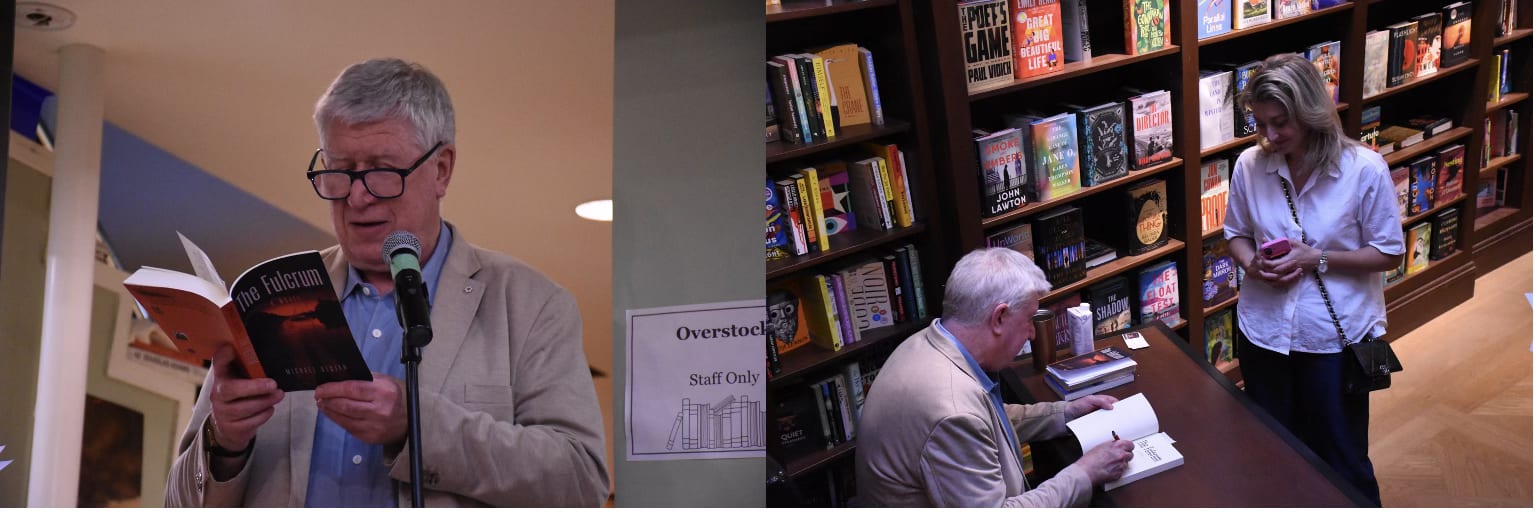
The store was full, spirits were high, and it was lovely to see several people from the Toronto book community come out in support. These included:
Anna Porter, a book publisher for over 40 years and author of 12 books.
Poet and author Molly Peacock.
Poet Moira McDougall.
Novelist and founder/president of Diaspora Dialogues Helen Walsh
Sarah Miniaci – publicist for Shadow Life and now publisher of White Cap Books and Director of Publicity for Sutherland House.
Steven Skurka, lawyer and novelist.
Pratap Reddy, novelist and short story author.
And my sister Ann, who has written and published two novels, and was publisher of McGilligan Books for many years.
At each event, I read a brief excerpt from The Fulcrum, then spoke about why I wrote the book. I paraphrase my remarks below, in case you’re interested!
Publishers always tell authors to hold up their book. When my first book, Healing Medicare, was published, Peter Gzowski invited me on his wonderful show Morningside. I held Healing Medicare up for nearly 25 minutes.
When the interview ended Mr. Gzowski, the ever kind journalist, said to me, “You know Michael, this is radio. Holding the book up did not do you a lot of good.”
I read a brief passage from near the beginning of The Fulcrum when protagonist Matt is driving down to Boston to see his new girlfriend Mary-Louise. He receives a call from his successor at the City of Toronto.
Gordon’s looking for a report called Noah’s Arc that Matthew commissioned when he was city manager. The reported tested Toronto’s vulnerabilities and estimated the impact and mitigation of a few extreme climate scenarios including atmospheric rivers. In the book, the Mayor squashes the report, only to have it leaked, thus exposing the city’s inadequate preparedness.
Matt weighed how technical to get. He could cite peer reviewed studies, recall dismal figures from memory, advocate for the umpteenth time the long-standing scientific consensus. He could throw numbers at Gordon and tell him the planet was well on its way past the temperature increase of 1.5°Celcius, probably even 2.5 or three. But he opted instead for sober realism and practicality – that’s what a city manager needed.
“Extreme events are a certainty, “Matt said, “Bottom line: Forest fires and heavy rains. Take them as a given. The hundred storm. Imagine it happens three times in the next ten years.
“That’s a hell of a lot gloomier than the official government line,” Gordon said.
“I am no longer in government. No need to soft-pedal or mislead the public about what is coming. I can be as honest and blunt as I like.”
Gordon issued a wouldn’t-that-be-nice kind of sigh.
“But listen, as gloomy as it may be,” Matt went on, “don’t fall for the ‘existential crisis’ rhetoric. It’s a trap, navel-gazing. Focus on risk mitigation. Start with the Noah’s Ark study. It spells it out.”
Three motivations compelled me to write The Fulcrum.
First, I like the characters who emerged in my first novel Shadow Life. Matthew Rice, Mary Louise and Professor O’Connell. They all wanted to go on another adventure, so I gave them one.
My second motivation came from Ron House, an astute reader of Shadow Life. He wrote to say he thought Shadow Life had two writers. One was an autobiographer, and the other was a novelist. With this second novel, I wanted to allow the novelist to triumph over the autobiographer. Readers will judge whether I have succeeded!
A third and most important motivation was my deep concern over climate change and the risks to many cities and some entire countries.
I asked myself the question, what if an entire major city faced near destruction from a severe climate event? What would they do?
The Fulcrum is the fictional answer to that question.
Many years ago, I sat beside former Jean Chretien at a dinner. I asked him what he had learned about climate change in his time as our prime minister. He gave a very Chretien answer – both short and insightful:
“Too many economists, not enough engineers.”
Over many years his answer has not only stuck in my mind, but it has resonated. I was born and raised in Winnipeg although I have also lived in Toronto, Montreal, Ottawa and Cambridge, Massachusetts.
When I launched The Fulcrum in Winnipeg two weeks ago, I noted that the 1950 Winnipeg flood came close to destroying the city. The evacuation of its 107,000 residents, nearly the entire population of the city, remains the largest single evacuation in Canadian history.
In the 1960s when I was a high school student, we were excused from classes during spring flood years to sandbag the banks of the Red River.
Duff Roblin was elected Premier of Manitoba in 1957. He had a vision for a massive diversion of the Red River around the east side of Winnipeg to protect the city from flooding.
At first, the project was derided as Duff’s ditch. But it has saved Winnipeg from flooding many times. Later known and celebrated as the Red River Floodway, it was deepened and expanded to handle even more overflow after the flood of 1997.
Hardening of infrastructure is what we must do even as we struggle to find alternative forms of energy generation. Climate change is not a distant threat. It is a clear and present danger.
Now, I have a favour to ask! In our digital age, book sales are driven largely by mathematical algorithms. These algorithms are embedded in places like Amazon and Indigo and they impact how easily you appear when people search for the book. These algorithms are driven in turn by reviews.
If you read The Fulcrum, I’d really appreciate you rating and/or reviewing it. It’s hard to over-estimate how beneficial this is for authors.
If you bought the book at Amazon or Indigo, please review it there. And if any of you are on Goodreads, that’s important too.
Thank you for your support.
Michael
June 1, 2025
Play It As It Lays, by Joan Didion
One insightful reader of my first novel, Shadow Life, observed that the book was a battle between an autobiographer and a novelist. My reply was to confess the truth of it, although it had never been presented to me in quite that fashion.
Instead, I tended to divide plot points into three general buckets: things entirely drawn from my life. Things completely devised by my imagination. Then the (sometimes uncomfortable) anecdote that straddles both.
In The Fulcrum, the novelist seizes more control of the narrative. However, any novelist will borrow from time to time from their own lived experiences.
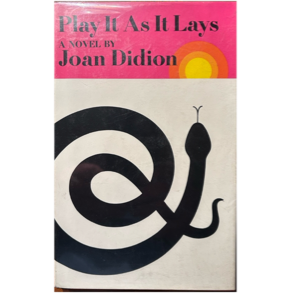
So, this excerpt from The Fulcrum, publishing June 10th with Girl Friday Productions of Seattle, is a true story from my university days:
“Did you know that Matt collects first edition books by twentieth century women authors?” Mary Louise asked.
“Oh, really?” Professor McConnell said. “That’s an odd choice of books for a male economist to collect.”
Matt chuckled. “Perhaps. But there’s a story behind it.”
“Do tell,” Professor O’Connell said, as she poured more Bordeaux and settled more comfortably into her chair. “I love a good story.”
“It all started at this very university,” Matt said. “Sophomore year. Back then you had to leave the Harvard Yard and move to a Harvard House. I was class of ‘74 and one of the first male graduates offered the choice of joining either Harvard or Radcliffe house. I chose North House at Radcliffe.”
“I remember that time,” Professor O’Connell said. “Wasn’t there a name for those who moved to Radcliffe?”
“Male Cliffie,” Matt said and took a sip of his wine. “Some meant it as an insult, but I didn’t regret moving to Radcliffe. I don’t remember any who did. There, the houses all turned out to be gender balanced. While the Harvard houses remained overwhelmingly male.”
“Women,” Mary Louise quipped, her finger circling her wine glass’s rim. “Nothing to do with education or feminism. You just wanted better odds on the pursuit of young women.”
He smiled. “Fair enough. But not the whole story. All in all, it was a much calmer and less testosterone-laden atmosphere than the Harvard houses. And we made lifelong friends, all of us, men and women.”
“And where do books fit into all of this?” Professor O’Connell asked.
He took in his surroundings, still amazed at the collection around him. “Well, to fit in, I thought I should take one of the courses offered at North House. Women in Twentieth Century Literature, it was called. The Radcliffe librarian was teaching it, if my memory serves, but her name escapes me. So here I was, a Harvard economics major and sophomore up to my neck in English literature majors. All of them were young, smart women. All of them were at the graduate level doing their master’s and PhDs. I was always an avid reader, but I was hopelessly naïve too. And uneducated in the ways of the study of literature.”
“Did a tragedy befall you?” Professor O’Connell asked. She pointed at him playfully. “Did you fall in love and have your heart broken?”
“Nothing so predictable,” Matthew said. “Though that would’ve been a more pleasant fate. No, I was the only male in the seminar and a male Cliffie, to boot. Economics majors were oddities.”
“But the way you put it,” Mary Louise said, “there was some indeed some tragedy of sorts?”
“Not a tragedy, I’d say. More an embarrassment, of an academic sort. A humiliation. At the start of term, we were given an assignment: Read and analyze one book each from a reading list. I chose Joan Didion’s novel Play It As It Lays. It had just been published, and the book and author were enjoying significant popularity.”
“Let me top up your glass of wine,” Professor Connell said, as she came around with the bottle. “I expect Matthew may need a bracing drink before he confesses his gaffe to us.”
“Gaffe doesn’t begin to describe the evening of my seminar presentation. I thought I was well prepared. I explained, to the best of my economist ability, the meaning of the book. The silence in the room when I finished made me realize that something was wrong, but I wasn’t sure what. The very first question unravelled my presentation and left me sitting there, trying to hide the redness I’m sure had rushed to my face.”
Professor O’Connell returned to her chair and sat on its edge, as if bracing for the punch line.
“The book featured the main character, a young woman driving her stick shift Corvette with great enthusiasm around California,” he said. “The first question was, did I think that perhaps some of the metaphor of the book was sexual? Not something I’d considered, and yet I immediately knew that I’d missed the whole sex thing. And it was clear that everyone else in the room knew I’d missed it, too.”
Mary Louise and Professor O’Connell both howled with laughter.
“Matt,” said Mary Louise, trying to keep her wine from sloshing and staining in the Professor’s clearly expensive décor. “How could you possibly read Play It As It Lays and not know that it was all about sex?”
“We didn’t have a lot of women driving Corvettes in Winnipeg when I was growing up. It was too cold!”
The two howled even harder then.
“From that day on, I began reading and collecting first editions of twentieth century women. Including, I might add, every book by Joan Didion. That was my way of covering my failing with a commitment to understanding the literature of women.”
“Bravo, a wonderful atonement,” Professor O’Connell said.
“Let me add, it was worth the embarrassment. I’ve enjoyed decades of reading pleasure. Nadine Gordimer, Doris Lessing, the Southern writers Carson McCullers and Flannery O’Connor. Irish writer Edna O’Brien. And more than a few Canadians, too–Margaret Lawrence, Carol Shields, Alice Munro, Margaret Atwood.”
Mary Louise smiled. “It must’ve been a dreadful moment there at the seminar, that dawning recognition.”
“Truly horrible. But an important lesson.”
“Don’t miss the sex!” Mary Louise laughed. “A very important for lesson for life as well literature.”
Like my character Matt, I too have never regretted the momentary embarrassment that ultimately brought me a lifetime of reading pleasure.
High Spots (in a collector’s terminology)In my next newsletter, I will explore the notion of the high spot or notable book for a collector.
My Joan Didion high spot – which took some years to find and acquire – was her first book, Run River, published in 1963.
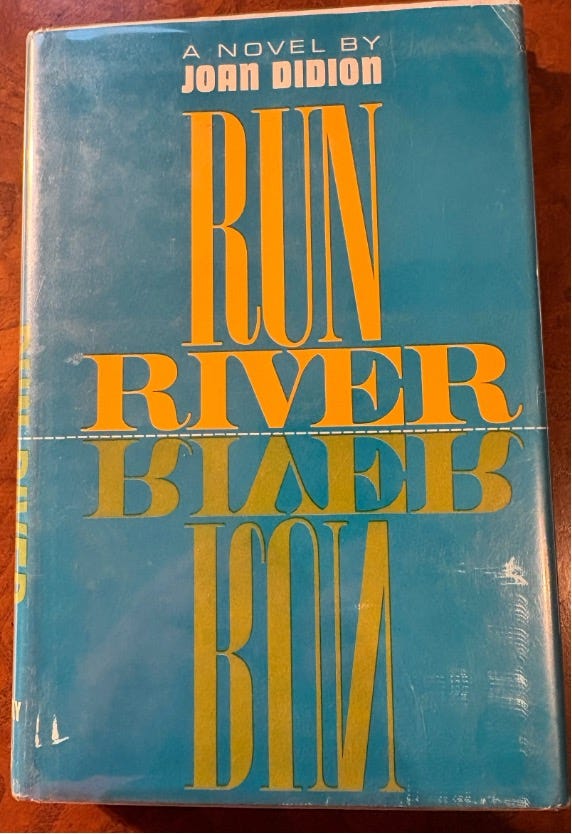
Below is the book description from Bauman Rare Books in NYC where I purchased Run River. You will see the research and care that goes into properly describing the condition of the book and the importance of its author. These notes also do double duty as catalogue entries. It is the research to prepare these notes that distinguish fine bookstores from just used bookstores.
 The Fulcrum Book Launches
June is turning out to be a busy month of book launches and talks, which I’m excited about. Hope you will join in person or digitally!
First up, Saturday June 14th, 7pm both in person in WINNIPEG at McNally Robinson Grant Park, but also on Youtube accessible wherever you live.
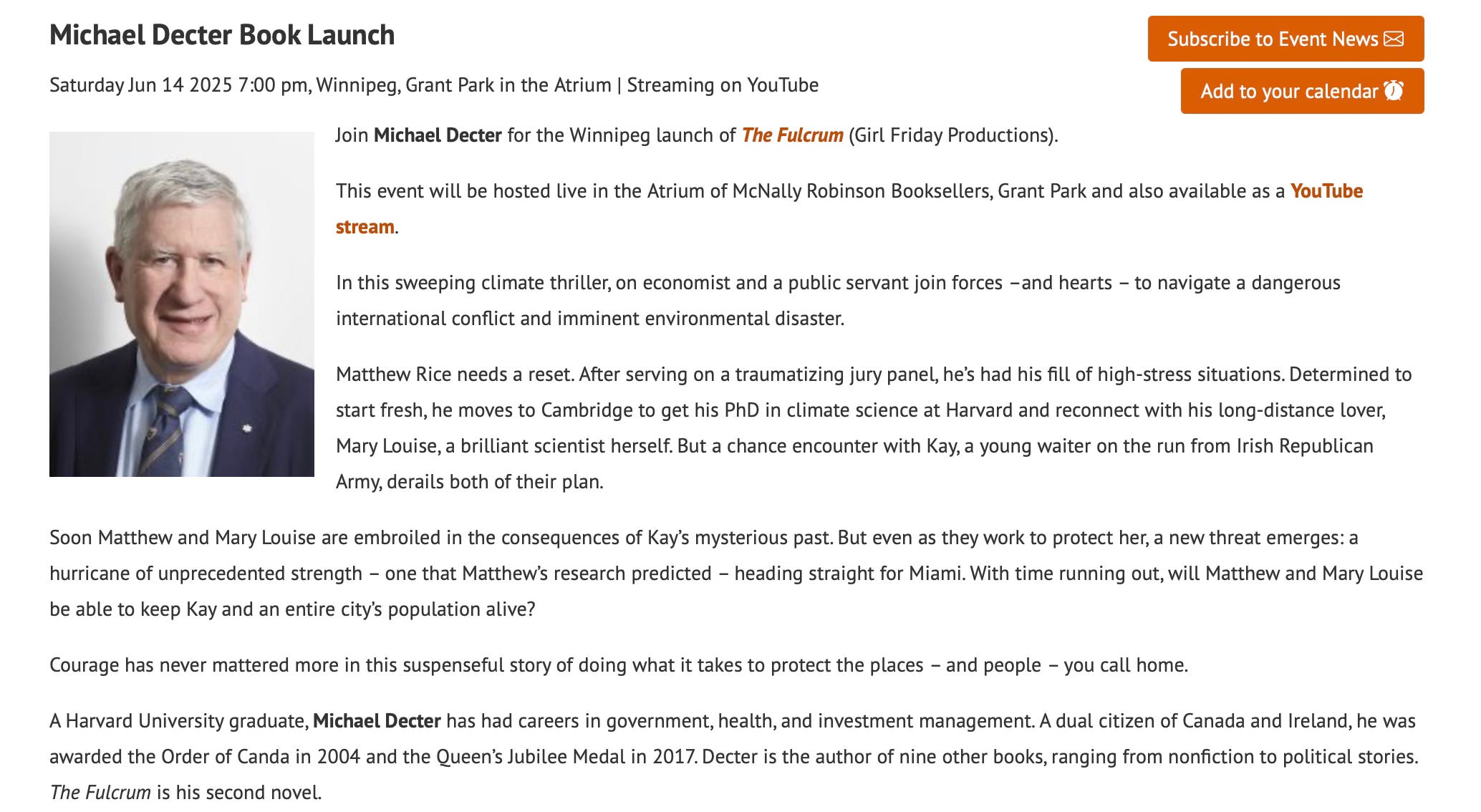
OTTAWA. Tuesday, June 17th, 7pm Perfect Books, 258A Elgin St, Ottawa.
TORONTO. Wednesday, June 25th, 5pm, Ben McNally Books, 108 Queen Street East, Toronto.