Rose George's Blog
August 14, 2018
Nine Pints the book
It seems like five minutes since I was sending in the last proofs of Nine Pints. I didn’t expect reviews this soon. I didn’t expect any at all: surely no author dares to assume they will come and that they might be good. So I’m so happy with these from Kirkus and Publishers Weekly, both highly important trade publications.
Kirkus: “The author packs her book with the kinds of provocative, witty, and rigorously reported facts and stories sure to make readers view the integral fluid coursing through our veins in a whole new way. An intensive, humanistic examination of blood in all its dazzling forms and functions.” The rest of the review is here.
Publishers Weekly: Journalist George (Ninety Percent of Everything) offers an insightful, fast-paced account of the science, politics, and social history of blood. The rest of the review is here.


August 8, 2018
It feels like a derangement
I’ve written about the menopause and depression and me, for the New York Review of Books. It took months to write, for a reason I explain in the piece, but I’m so glad that Matt Seaton, the editor of the NYR Daily, commissioned me many months ago. If he hadn’t, I’d probably never have written about it. Here is the piece on the NYR Daily site, and I will paste it below.
Menopause: the ceasing of menstruation or the period in a woman’s life (typically between forty-five and fifty-five).
I stare stupidly at it. It’s nothing much to look at. It’s only a small pile of clothing: the shorts and tank top that I wear in bed, which I have thrown onto the floor before getting into the shower. I stare stupidly at the clump because I can’t pick it up. It’s astonishing I managed to shower, because I know already that this is a bad day, one when I feel assaulted by my hormones, which I picture as small pilots in those huge Star Wars armored beasts that turn me this way and that, implacable. On this morning, I wake up with fear in my stomach—fear of nothing—and I know it will be a bad day.
For a while, I thought I could predict these days. I have had practice. This is my second menopause: the first was chemically induced seven years ago to treat my endometriosis, a condition that has riddled my insides with adhesions of endometrial tissue, and stuck my organs together. The adhesions are exacerbated by estrogen; the drug switched it off. (The same drug can block other hormones and is also used to treat pedophilia and prostate cancer.) I hated that menopause; it was a crash off a cliff into sudden insomnia and depression and a complete eradication of sexual desire. “The symptoms will last six months,” said the male ob-gyn, with a voice he thought was kind but that sounded only casual. They lasted far longer. The nurse giving me the first injection said, “He keeps prescribing this stuff, but women hate it.”
This menopause is the natural one. I’m two years in. It doesn’t feel natural. It feels like a derangement. With each menopause, I have chosen to take hormone replacement therapy (HRT). The first time because I wanted my sleep back. This time because I spent a year researching menopause for a magazine article, and because I have weighed the risks and judged them acceptable, and because I know what happened last time, when I was broken. The two occasions when I asked for HRT are the only two on which I have cried in a doctor’s office.
Every Wednesday and Saturday, I take two 100mg transdermal patches of estradiol (a form of estrogen). I fix them to my abdomen, swapping sides each time. They never fall off, though I go running for hours at a time and sweat. This is the maximum dose of estrogen, and it took about a year for me to understand I needed this amount, a year of peeling skin, sore tendons, poor sleep, awful sadness, inexplicable weeping, and various other “symptoms” of menopause that you can find listed if you look beyond the hot flashes and insomnia. (I don’t know why Americans say “flash” instead of “flush”; I prefer the British-English word, less fleeting than a flash, a better fit for that rise in temperature, violently sudden and overwhelming, that makes you feel as if you had never been cool or would be again.) Estrogen is more powerful and more wide-ranging than is assumed, and its removal or diminishment brings effects ludicrously understated by “the change.”
A friend gave me access to her university library and I start to swim among papers, sometimes floundering. I learn that estrogen is a gonadal steroid produced by the ovaries and essential to female reproduction. It is a sex hormone but—it is now known—far more besides. There are receptors for estrogen all over the body. In the brain, the densest amounts are in the amygdala, the hippocampus, and the hypothalamus. Estrogen influences serotonin, dopamine, glutamate, and noradrenaline. It is involved in cognitive function. Its diminishment can impair verbal dexterity, memory, and clarity of thought. Recently, scientists discovered that estrogen is also produced in the adrenal glands, breasts, adipose tissue, and brain. This is astonishing. But so is the extent of the unknown.
Peri-menopausal women (whose periods may be irregular, who have symptoms, but who are not yet post-menopausal) are twice as likely to have depressive symptoms or depression than pre-menopausal women. Peri-menopausal women who were vulnerable to depression during the menstrual cycle are more susceptible to depression when they enter menopause or its hinterlands. This is accepted, but there is disagreement about how to fix it. Antidepressants often don’t work. Studies show both success and failure when women are given estrogen to counter depression. Controversy exists over whether the menopausal transition is a risk factor for the development of depression, I read. And, I think, the person who wrote that has probably never been on a menopause forum, where women’s stories and pain would make me weep, if I didn’t feel like weeping already, from menopause.
Because I have a womb—though it is likely of no use for fertility, thanks to the endometriosis—I also take progesterone for ten days a month. This induces the womb to shed its endometrium, which may otherwise thicken to cancer-risky proportions. So I still bleed, and choose to. I knew from my research that the gentlest version of progesterone is micronized, something that my doctor had to look up. I didn’t know that taking it orally, as I had for many months, would bring me profound sadness, fatigue, weight gain, awfulness. That wasn’t something I discovered in my research, and no one told me.
*
I can’t pick up the clothes. I can’t explain the granite of that “can’t” to anyone else, the way it feels impossible to beat. Look at me looking at the pile and you will think, Just pick it up. For fuck’s sake. But I don’t. I look at it, and the thought of accomplishing anything makes my fear and despair grow. Every thought brings on another and that prospect is frightening. All those thoughts. I write that down and I feel stupid and maudlin and dramatic. A privileged freelance writer who does not have a full-time job that requires her presence in an office and can be indulgent of what the medical profession calls “low moods.” In fact, plenty of menopausal women leave their jobs, endure wrecked relationships, suffer, and cope. Or don’t. But I don’t feel maudlin and dramatic in the bathroom, or on any other of a hundred occasions over the past two years. I feel terrified. I have no reason to feel fear. But my body acts as though I do: the blood rushing from my gut to my limbs in case I need to flee, leaving the fluttering emptiness that is called “butterflies,” though that is too pretty a description.
Still, I set off on my bicycle to my writing studio. I hope I can overcome the day. I always hope, and I am always wrong. A few hours later, I find myself cowering in my workspace, a studio I rent in a complex of artists’ studios, scared to go downstairs to the kitchen because I can’t bear to talk to anyone I might find there. I have done nothing of use all day. Every now and then, I stop doing nothing and put my head in my hands because it feels safe and comfortable, like a refuge. I look underneath my desk and think I might sit there. There is no logic to this except that it is out of sight of the door and no one will find me.
Even so, when the phone rings I answer it. I shouldn’t, but I am hopeful that I can manage it and mask it, and I haven’t spoken to my mother for a few days and would like to. It goes well for a few minutes, because I’m not doing the talking. Then she asks me whether I want to accompany her to a posh dinner, several weeks hence. She doesn’t understand when I ask to be given some time to think about it. “Why can’t you decide now?” I say it’s one of the bad days, but I know this is a mixed message: If it’s that bad, how am I talking on the phone and sounding all right? Because I am a duck: talking serenely above, churning below, the weight on my chest, the catch in my throat, the inexplicable distress. I try to explain but I’m also trying hard not to weep, and so I explain it badly.
She doesn’t understand. This is not her fault. She is a compassionate woman, but she had an easy menopause, so easy that she can say, “Oh, I barely remember it.” One of those women: the lucky ones. She doesn’t understand depression, though both her children experience it, because she has never had it. “But you sounded well,” she says, “I thought you were all right.” Now she says, “I don’t understand how your not being well is stopping you deciding whether you want to go to dinner.” Because it is a decision, and a decision is too hard, requiring many things to happen in my brain and my brain is too busy being filled with fear and panic and tears and black numbness. There is no room to spare.
I hang up because I can’t explain this. I stay there for a while, sitting on my couch, wondering how to face cycling home or leaving my studio or opening the door. All these actions seem equally impossible.
It takes a while but finally I set off. I know where I’m going. I have learned. On days like this, there are only two places to be. One is in my darkened bedroom with my cat lying next to me. On days like this, she takes care to lie closer to me than usual because she knows and because she loves me. Maybe my darkness has a smell.
The other place to be is in unconsciousness.
These are the safe places because everything is quiet. On days like this, I wonder if this is what autism feels like, when sensation is overwhelming. Not just noise, but thoughts, sights, all input. It is on the bad days that I realize what a cacophony of impressions we walk through every day, and how good we are at receiving and deflecting, as required. Every day, we filter and sieve; on the bad days, my filters fail.
I sometimes call these bridge days, after a footbridge near my studio that goes at a great height over the busy A64 road. On days like this, that bridge is a danger for me. I am not suicidal, but I have always had the urge to jump. This is a thing with a name. HPP: high places phenomenon. The French call it “l’appel du vide.” So very Sartre of them: the call of emptiness. The A64 is the opposite of emptiness, but still, it is a danger. Today I don’t have the filter that we must all have to function: the one that stops us stepping into traffic or fearing the cars or buses that can kill us at any time. The one that mutes the call of the HPP.
I avoid the bridge. I cycle home, trying not to rage at drivers who cut me off and ignore me. I have no room for rage along with everything else. Thoughts that would normally flow now snag. Every observation immediately triggers a negative thread, a spiral, and a worsening. On a good day, I can pass a child and a mother and think, How nice. Nothing more. Fleeting. Unimportant. On a bad day, I see the same and think of my own infertility, how I have surely disappointed my mother by not giving her grandchildren; how it is all too late, and what have I done with my life, and my book will be a failure and today is lost and I can’t afford to lose the time. It goes on and on. Snagging thoughts that drag me down, that are relentless.
When I get inside my house, I cry. I try to watch something or read, but nothing interests me. This is called anhedonia and is a symptom of depression: the forgetting how to take pleasure. The best thing to do is sleep away the day, as much as I can.
Toward evening, I begin to feel a faint foolishness. This is my sign. Embarrassment. Shame at the day and at my management of it. When I am able to feel that and see that, I am getting better. Now I manage to watch TV, though only foreign-language dramas. Without the filmmaking industries of northern Europe, my menopause would be even bleaker. Foreign words go somewhere shallower in the brain; they are less heavy. But soon I switch it off. I don’t care about the plot. I don’t care about anything. I take a sleeping pill to get the day over with, so the better next day can begin.
Twenty-four hours earlier, I had been wearing a Santa hat, running for five miles through icy bogs on a Yorkshire moor, happy to be doing that for fun, happy to be alive.
*
April 4. Sleep mostly OK; a few days of melatonin after stopping progesterone. Last night I was exhausted but slept badly. Mood difficult but not dreadful. Angry and irritated. No bleed after progesterone. Peeling skin. Weepy and panic now. Can I face people?
Depression, wrote William Styron, is a noun “with a bland tonality and lacking any magisterial presence, used indifferently to describe an economic decline or a rut in the ground, a true wimp of a word for such a major illness.” It was pioneered by a Swiss psychiatrist who, Styron thought, perhaps had a “tin ear” and “therefore was unaware of the semantic damage he had inflicted by offering ‘depression’ as a descriptive noun for such a dreadful and raging disease.”
Black dog. Walking through treacle. Low moods. Nothing I have read of depression has conveyed the crippling weight of it, that is a weight made out of nothing.
I do not have depression according to most authoritative clinical definitions of the condition. Depression is a long-term chronic illness. Mine is unpredictable, and before I got my HRT dose right, it lasted weeks at a time; but usually, these days, it lasts no more than twenty-four hours. My now-and-thens do not qualify as a disease. I do not count as depressed. Instead, I am one of the women of menopause, who struggle to understand why we feel such despair, why now we cry when before we didn’t, why understanding what is left and what is right takes a fraction longer than it used to: all this is “low mood” or “brain fog.” These diminishing phrases, which convey nothing of the force of the anguish or grief that assaults us, are reserved for women and usually relate to menstrual cycles or hormones.
I have never been sunny. People who can rise from their beds and see joy without working at it, they have always been a mystery. I still feel guilty for once asking a cheery person, cheery very early in the morning, why he was so happy—I made it sound like an accusation not praise—and I watched as his face fell and his warmth iced over. I’m still sorry. Cheeriness always seems like an enviable gift. I have always been susceptible to premenstrual upheaval: two days a month when things feel awful as though they have never been anything else. I endured them. Now and then, there have been therapists sometimes and antidepressants now and then, and, for the last few years, running, in whatever wilds I can find. The best therapy. I have managed.
Then I became what I am. A menopausal woman. In the eyes of evolution, that makes me a pointless person. I can no longer reproduce, if I ever could. The grandmother theory of menopause—that women live beyond their reproductive utility in order to care for grandchildren—doesn’t persuade me. Also, I have no grandchildren. I cannot account for how awful menopause can be, unless I think that we were not meant to survive it. A useless evolutionary blip.
*
Thursday 14. Removed old patch, added half a new one. Mood immediately plunged. Awful: anhedonia, anxiety, panic, weepiness. I still ran but stopped to cry in the middle. So sick of this, and I can’t work.
For months, I resisted HRT. I endured as my periods got erratic, as I lost my ability to sleep through the night, as my temperature rose furiously and intolerably at unpredictable moments, all the time. I had forgotten from the first time what it was like to stink, to carry around a fan, to wear so much black so the sweat didn’t show. I had forgotten what a hot flash—such an innocent phrase—felt like; what the night sweats—such an innocent phrase—felt like. I woke up in the night boiling hot and pouring sweat. I use “pouring” deliberately because I was drenched. Sometimes, I woke up freezing because I was covered in cold sweat. Every athlete knows to change clothes as soon as possible because sweat chills so fast. Every night, it was as though I was running several races. I woke up fatigued, stinking, and angry that something so common, something that affects millions of women, is still such a medical mystery. Why do we get hot flashes? We don’t know. Why is sleep broken? We don’t know. Why are we the only creatures to get menopause apart from two types of whales? We don’t know.
I saw my doctor, who prescribed a low dose of HRT and a visit to a specialized menopause clinic, of which there are far too few. The symptoms continued, and were far more numerous than the hot flashes and insomnia to which menopause is usually reduced in common perception. I made a list: at various points, my skin peeled, my ears rang with tinnitus, my posterior tibial tendon swelled, my lubrication disappeared, my eyes dried so it felt as if I had grit in them, my jaw locked. My menopause doctor prescribed a higher dose of HRT, but the troubles continued; I got a higher one still and still they came. Finally, I sat in her office and said I couldn’t think straight. I felt like I was going mad. I became clumsier, dropping things. I forgot everything: names, events, appointments. My partner began to say, carefully, too often, “Yes, you’ve mentioned that,” in the same way I used to say it to my dad when he had dementia. The menopause doctor said, “This is just your age.” I never went back. The year before, aged forty-six, I had had no brain confusion. Forty-seven, and menopausal, I did. And she was a specialist.
I paid to see a private menopause specialist who immediately said I could be on the maximum dose of estrogen, that she couldn’t understand why no one had told me that taking progesterone orally causes many women troubles such as profound fatigue and depression, or that I could take it vaginally in half the dose for less of the time, which would be better (it is). She also prescribed testosterone, a clinical decision that is controversial in the small circle of medical professionals who take an interest in menopause. It is unnecessary, say skeptics, because the ovaries produce enough testosterone, and mine are still there, though sputtering into dysfunction. But it can help, say others, because, in the same way that estrogen is far more than a sex hormone, testosterone can lift energy, mood, life. Perhaps I would get a libido back. Perhaps I would remember what desire feels like, rather than looking at my partner and thinking how lovely he is, but distantly, through a glass pane, as if someone else were thinking it, as if that thought had nothing to do with me.
I took my new boxes of patches, a pump gel of estrogen to top up with on the bad days, my precious testosterone, and went home with hope. It took months, but things stabilized. Now, there is never more than one bad day at a time of these “low moods.” The phrase is belittling. My depression is not simply feeling miserable or glum. I know what that feels like. I know that that can be fixed by fresh air or effort. This depression is dysfunction, derangement. I hate myself so hard. And I miss myself, the woman who didn’t feel like this. The woman who felt uncomplicated sexual desire, whose skin healed quickly and didn’t scar so easily, whose hands did not dry and flake, whose ears didn’t ring; whose bladder didn’t leak. On the good days, I am at peace with my age, with what I have done, with who I am, menopausal or not. I delight in what I can do, and when I run, I hurtle headlong down a steep descent with the joy of a child, aged nearly fifty. But on other days, that woman seems like someone else.
*
Monday 25. First morning I haven’t felt dread and weepiness. Not giddy like before, but like things are possible. But also scared of mood flipping—and it did. Horribly. Weepy, panicking, total anhedonia. I haven’t left the house. At 3:30 I went to bed and woke up at 6. I feel profoundly sad, black, AWFUL. Did it all change after I drank coffee?
Tuesday 26. No coffee. Panic, dread, weepy. Can’t focus, can’t wash up.
I grasp for reason. I look for patterns. I keep a diary for eighteen months. If I can understand the patterns, I can predict the bad days and allow for them. I can plan for them. Tom Cruise in Minority Reporthad “pre-crime” to prevent and disrupt future criminal threats. Perhaps I can have pre-depression. For many months, I think that the bad days come when my estrogen dips on the last day before I get new patches. I stop scheduling things on Mondays and Fridays. But then the pattern changes so that I know it never was a pattern. Sometimes, it’s a Tuesday. Sometimes, a Sunday. I can’t tell. I give up the diary.
I try to take control by being less embarrassed. Once, when I still had flashes and was out at dinner, I got out my fan and a relative said, “Must you?” I don’t understand this reaction. People are not mortified by cancer patients on chemo who sweat and use fans. Is it because menopause is to do with periods? Is it because women’s health must be hidden and quiet? Is it because women do hide it? I can’t think why the irregularities of the hypothalamus should be socially unacceptable. I kept using my fan for as long as I needed to, though I felt faintly uneasy.
The only acceptable place for menopause is in menopause jokes. The humor that masks distress and shame. The woman in a meeting who laughs off her sweating, who talks of “power surges.” The comedians and their mothers-in-law and their flushes or flashes. What if it came out of jokes and into accepted conversation?
For many months, I told people I was “unwell.” Not crippled, not weeping, not disabled. “Unwell.” The implication: that there is something physically wrong. A proper illness, not depression. A definition of depression is heartache, but it is my head that aches. What if I told everyone I had a severe headache? A broken ankle not brain? They would understand better. Then, one day, as I sit at my computer and think of the writing deadline that is today and feel despair, and I try to read serious medical literature and instead put my head in my hands again, I decide to write to the commissioning editor, even though she is new and this may form her opinion of me, and say: I can’t function today. I can’t write. And it is because of depression. Please give me leeway. It shames me to write it, but I do. And I do it again, when needed. So far, every response has been profoundly kind. I should have done it sooner.
Mental illness. Such an odd concept. How strange to put a division between mental and physical illness, as if the brain is not in the body. As if emotions are not regulated by the brain. As if feelings are not linked to hormones. As if all maladies are not of the body. And still mental illness is put in its place, which is in a different category. Not “real” illness. Not physical. Easier to fix, to underfund, to sweep into the dark corner of the unspoken. Imagine the contrary. Have you broken your ankle? Cheer up. Do you have third-degree burns? Chin up. Think yourself better, you with your chronic lymphocytic leukemia. Smile.
*
May 4. Finally felt better yesterday. Tweeted fury about BBC menopause doc and all its “low moods.” Messaged with a doctor who thinks 50mg of estradiol is too low and particularly for someone who was prone to PMT. She also thought I should try testosterone. I immediately went downstairs and put another patch on. Retroactively furious with Dr. X for sticking so firmly to dose, but maybe I played down the depression. Today I slept well. Mood good. A feeling in my stomach that is positivity, like I can do things.
In London, at an event: clever people all around me, and I am on a panel discussing clever things. But I do not feel clever. I feel like a dolt, that when my mouth opens stupidity and cotton wool come out. I meet people I know and like from social media, and am happy to learn that I like them in real life, too. We go for a drink, but I want to leave. There is no reason for me to feel this way: the people are nice, the place is great, the cocktails look tasty. I mostly drink water and leave early and walk through the quietening streets of London and feel so numb I can’t even be bothered to loathe myself. The next morning, I wake gloomy, my head foggy apparently from just one glass of prosecco. The room is hot, the city noises are infuriating. I put new estrogen patches on my abdomen. I smear testosterone gel, two pea-sized globs, on my inner thighs. I go through the motions of other activities and wait. Half an hour later, as I am walking to the station, I feel a quiet flood of good mood. It feels as though the estrogen is lifting me slightly. I picture a tide floating buoys higher and higher in a harbor. Estrogen is hefting and hauling me out of depression, for today.
This is my theory. It is unproven, according to the literature. I wish the urge to better understand the extent of estrogen’s reach, and the devastation its fluctuation can bring, had happened decades ago. There has been more research in recent years, but I doubt that the driver for this knowledge is how poorly menopause is treated or understood; it’s probably that estrogen is implicated in higher rates of Alzheimer’s disease in postmenopausal women. There is money in Alzheimer’s, but not in making women’s lives better.
*
Friday 22. Woke up at 10. Awful, awful, awful. Got up at 12 and ran 10 miles, got back and burst into tears. Profound sadness, depression, weepiness. One of the worst yet. Panic at night.
My mother says, the day after another bad day, “I feel so awful for you. Why can’t they fix it?” They are doing all they can, I say. I don’t really believe this. If women’s health were taken as seriously as men’s, this probably would have been solved a while ago.
The trouble with women is we cope. We always do.
I keep fit. I gave up alcohol for months, reasoning that it plunges me into depression the next day—and I can produce those days all on my own without paying money to make them happen. Over the years, I have taken citalopram, sertraline, black cohosh, red clover, omega 3, magnesium, iron, vitamin D. For a while, I saw a serene herbalist, who mixed dark potions and told me I should eat chickpeas and tofu to get their phyto-estrogens to bind to the receptors all over my body, that these are good estrogens and binding them is something I want to do. But I don’t understand her explanation and imagine only battalions of chickpeas marching around my body seeking docking stations. Many peri-menopausal women with depression are prescribed antidepressants. I hope theirs work, as mine did nothing. I know the iron helps, and I think the magnesium does, too, because when I forget to take it, I start to feel stupider.
In scientific papers, researchers argue about whether women feeling depressed in menopause (pre-, peri-, post-) are actually just experiencing the ups and downs of life. We are brought low, they reason, by the hot flashes and sleeplessness, not by hormonal fluctuations. Or we are diminished by life. At that age, I read, women may have aging parents to care for; grown children and an empty house; empty marriages. Their depressive symptoms are a mourning for who they were and what is to come. They have what is called “the redundancy syndrome.” It’s just coincidence that they are also menopausal. “Research has found,” I read, “that depressed mood and depressive disorder in middle-aged women are related less to menopause than to the vicissitudes of life.”
I bristle at this. Although I wonder. I remember a month away in France when I had not a single bad day. I notice that my mood lifts once my book is written and its huge pressure is also lifted. I wonder: Is my problem not menopause-specific depression, but that the removal of estrogen leaves me less protected against my natural lows? This theory lasts until the next bad day when I remember how elemental it feels. There is no choice involved. I would not choose to feel the way I do. Who the hell would?
*
May 2. I slept fine and took no pills but today was the same. Sad, weepy, furious. I can interact with people but in-between is awful. I went home at 3 and went to bed until 6. I hate this.
Today. Today is a decent day. It has taken me months to write this essay because when I am bad, I can’t write, and when I am not, I don’t want to remember. Tomorrow? My menopausal status is being masked by HRT, so I won’t know when I become post-menopausal until I dare to stop my artificial bolster of hormones. My post-menopausal friends tell me everything is better on the other side. I want to believe them and ask my doctor, a young woman half my age, when I can stop taking HRT and what will happen if I do. She says, “Four years? That’s about right.” Stay on HRT for four years, wean yourself off it, and then see. She doesn’t say that this means I have to plan for a period of life when I can risk being brutalized by depression and insomnia for weeks at a time, not days. When I can crash to the bottom again. Even on a good day, I think that time will be never.
—
June 19, 2018
Orgasm
Jenny, editor at G2: Rose, would you be interested in writing a piece about whether the multiple orgasm exists?
Rose: Er. OK.
Jenny: and whether the G-spot exists?
Rose: OK, why not.
Many sexology papers later — including one that claims to be able to see whether women have had vaginal sex by how they walk — here is my piece on multiple orgasms and the G-spot. And also, yet again, on how little understood female anatomy and sexuality is. I know that science is about questions and questing, and I salute that, but the disparity between how much is known about women and men’s health is always dispiriting.
The piece in full:
The search for the multiple orgasm – does it really exist?
On-screen depictions of sex show women coming again and again, yet in reality many women never climax during sex. Here’s what we know so far about the clitoris and G-spot
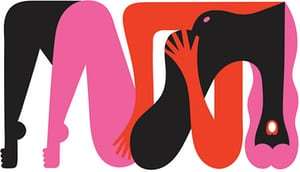 Illustration: Olimpia Zagnoli
I’ll set the scene. There will be a man and a woman and they are having sex. Up against a wall, in a bed, in a car, anywhere. Vertically, horizontally. Clothed or unclothed. None of that matters, because the outcome will be the same. Within a minute, usually, the man and woman will have an orgasm at the same time. It will be visible, spectacular, satisfying. Then perhaps, she will have another and another and another.
This scene will be familiar because it has been enacted ever since sex was allowed onscreen. But it is fiction. Not because women can’t have multiple orgasms. But if they do, it is unlikely to be because of thrusting. That’s if they get an orgasm in the first place.
The orgasm. “A feeling of intense sexual pleasure that happens during sexual activity,” according to the NHS. That much is known. But dive any deeper into the science of women’s genitalia, and how they work, and there will be surprises. We’re still in a black hole of not knowing very much about the sexual health and mechanisms of half the population. A few things that scientists and academics are still fiercely debating: how a female orgasm is triggered, what it does and what it’s for. Things are better than they were in the 19th century, when male gynaecologists examined women while standing behind a cloak. But in the late 1970s, medical men were still having earnest discussions in the pages of medical journals about whether menstruating women emitted a poisonous substance called menotoxin, that made flowers wilt. The US National Institutes of Health only set up a programme to research vaginal health in 1992 – the male orgasm was first researched a century earlier.
There are just nuggets of information for women: a paper from the 1930s establishing that women reported having several orgasms. In the 1960s, studies by the superstars of sexology, Masters and Johnson, and others that found 14-16% of women had multiple orgasms. Or they said they did: proper analysis of even the single female orgasm has only become possible with the advent of diagnostic tools such as the fMRI scanner or EEG, which can see what happens in the brain. Before that, researchers were dependent on what women told them, always an inadequate method (as humans don’t tell the truth about sex). even when – as in one survey by Florida State University in 1991 – the respondents were nurses, chosen for their articulacy about body parts. (Nearly half of the 805 nurses questioned reported multiple orgasms.)
Blood flow to the genitals, an important part of orgasm, can now be tracked. We can watch over 30 areas of the brain light up, including ones that govern emotion and joy, and release oxytocin, a feelgood chemical that enables bonding. We can see the physiological process of orgasm: the tensing of muscles, the acceleration of heart-rate, the blood flowing to the genital area, and then the blessed feeling of release and pleasure. At this point, women and men diverge. For a start, the man is more likely to have had an orgasm than a woman. A recent national study in the US found that 95% of heterosexual men and 89% of gay men said they always climaxed during sex. In heterosexual women, the rate was 65% (but in lesbians 86% ). This is called the “orgasm gap” and it is usually filled by lying: 67% of heterosexual women admitted faking an orgasm in a 2010 study, while 80% of men were convinced their partner never faked it. I look at that gap, and see the clitoris. This mighty, magnificent organ, that has more nerve endings than the penis, exists, as far as we know, only to give pleasure. As possibly the female orgasm does: it has no known reproductive purpose, but there is no clarity. One theory: that the orgasm is a way for the female body to capture more sperm with the contractions of climax. This is called, delightfully,“insucking” or “upsucking.” The role of the female orgasm in reproduction, or even human behaviour, is, wrote one baffled researcher in the journal Socioaffective Neuroscience & Psychology, “a vexed question”.
After climax, or resolution, the man enters a “refractory period,” where he has to recover. This varies from a few minutes in young men to 20 hours in older ones, but however long it is, there will be no response to sexual stimulation. A woman has no such barrier. If she has had an orgasm, and not faked it, she may “plateau”, but within seconds or minutes, or when she feels like it, given the right stimulation – probably (but not only) clitoral – she can feasibly orgasm again. The circumstances required include her environment, her partner (if she needs one), and her knowledge of her own body. It’s surprising, says Professor Linda Cardozo, a spokesperson for the Royal College of Obstetricians and Gynaecologists, “how many women don’t even know what their genitalia are called”. We say vagina (the internal passage leading to the cervix) when it’s the vulva (external genitalia). We see images of women with improbably shaven genitalia, and supposedly female dolls with no external labia. The authors of one study that attempted to understand how women’s genitalia varied in appearance marvelled that “even some recent textbooks of anatomy do not include the clitoris on diagrams of the female pelvis”. When women come to her thinking they are dysfunctional in some way, says Sarah Martin, executive director of the World Association of Sex Coaches, one of the most powerful things she can do is send them away to look at their vulva in a mirror. Using the right words is important too. Vulva, not vagina. Otherwise, says Vincenzo Puppo, a sexologist at the University of Florence, women think of their vagina as “just a hole”.
Martin also tries to get women to relax. Before orgasm, alpha waves in our brains slow down. A recent documentary on the “super-orgasm” – actually multiple orgasms – found that women who had multiple orgasms had slower alpha waves than the average woman. Their brains were quieter, making more room for pleasure. “The thing about sex of all sorts,” says Martin, “is that sex takes place in the body. It’s very hard to think about pleasure if you are worrying instead of focusing on your body.”
What might you be worrying about? Probably whether you’re going to have an orgasm. Only about 20% of women can reach orgasm by penetration alone; the rest of us need clitoral stimulation. The vagina is marvellous, but it is not packed with nerve endings like the clitoris.
You may think differently about the vagina if you believe in the G-spot. Puppo has little patience with it, and labels anatomical illustrations with: “the invented zone for the G-spot”. It is named after Ernest Gräfenberg, who wrote a paper in 1950 about an erogenous zone on the vaginal anterior wall. This was launched into popular perception by an eponymous 1981 book written by two psychologists and a nurse, and by countless articles since. The nurse was Beverley Whipple, who told the Science Vs podcast that her team had investigated by inserting fingers into women’s vaginas and feeling around the clock. “Between 11 o’clock and 1 o’clock,” Whipple says, “we got a lot of smiles.”
What a great thought. Except Gräfenberg never wrote about a G-spot. He did write about women he called “frigid,” and reported that some women were stimulated by inserting hat pins. There is still no good scientific data to prove its existence, although plenty of women believe they have one. “The G-spot,” wrote the neuroscientist Terence Hines in 2001, “will remain a sort of gynaecologic UFO, much searched for and discussed, but unverified by objective means.” The debate matters, says Puppo, because “women who fail to ‘find’ their G-spot, because they fail to respond to stimulation as the G-spot myth suggests that they should, may end up feeling inadequate or abnormal”.
Cardozo is circumspect. “There is some doubt as to whether a particular spot in the anterior vaginal wall is relevant in terms of orgasm. When women have had that part of the anterior wall excised, they have still been able to orgasm.”
The G-spot debate hasn’t prevented cosmeto-gynaecologists from offering procedures such a G-spot amplification, a concept first offered by the Californian gynaecologist David Matlock, who decided injecting collagen into the vaginal wall would enhance sensation for four months and the chance of single or multiple vaginal orgasms. The American College of Obstetricians disagreed, deciding that the procedure had no scientific basis, and anyway, Cardozo says, “the herd of cows that provided the collagen died out”. Now the money-maker is the O-shot (O for orgasm), an injection into the vaginal wall of platelet-rich plasma (PRP) derived from the woman’s blood.
“There is no scientific data on this,” says Cardozo, with some finality, although PRP has worked in dental patients, allegedly enhancing the healing process. You probably want tips for how to get a multiple orgasm here. Or even a single one. I prescribe better research, of course. But also, better talking. Communication is as powerful as lube, whether it’s with a partner or a doctor. For women who think they need to surgically alter their vulva because they are abnormal, the American College of Obstetricians prescribes “a frank discussion” about the wide range of normal genitalia.
I also prescribe a feminisation of gynaecology, but that is already happening: in the US, 82% of residents in gynaecology now are female, and half of the UK’s Royal College of Obstetricians and Gynaecologists’s members are women. I prescribe better knowledge: women can orgasm singly and multiply orgasm, but often it has to be learned.
The clitoris should be placed on equal standing with the penis. All these prescriptions can combine for as pleasing an outcome as an orgasm, single or multiple. Because it matters. The female orgasm may have a reproductive role or not: I’ll leave that up to scientists to debate, and celebrate the fact that they are debating it. Perhaps it’s enough to know that an orgasm feels good, and in these dark times you deserve it, or many.
May 18, 2018
The mountains are calling : an interview with Jonny Muir

If you know me, you know that when I am not writing, I am running. And sometimes, over here, I am writing about running. I also read about running, and I am particular. It’s harder than you think to write interestingly and thoughtfully about an activity that is after all just putting one foot in front of the other, a lot. It helps, of course, when that activity is done in beautiful and wild places. I love to run in beautiful and wild places, and I love to read good writing about doing that. I got to know Jonny Muir online through his blog posts, which are a fine example of a writer who runs who writes interestingly and thoughtfully about running, and about the landscape he runs in. So, in a departure from my usual posts on here (which, I know, have been few and far-between over the last year), and as part of Jonny’s blog tour, here is a Q&A interview with Jonny on his new book The Mountains Are Calling, named for the famous quote by Jonny’s namesake John Muir.
The mountains are calling, and I must go.
I asked Jonny about why he wrote the book, his love of the hills and why we should never underestimate the inspirational power of hill running as a force for good. As well as other stuff.
Why do humans want to go up?
In the book, I describe this as a desire to ‘touch the sky’. It is inherent, isn’t it? Think of a child on a swing shouting ‘higher’. It is wonderful to see the world below shrink as you climb ever higher, knowing you are achieving this through your own will and effort. The sensation of I-was-all-the-way-down-there-and-now-I’m-up-here never grows old.
Hill running is a romantic sport that offers its participants an intrinsic connection to extraordinary landscapes. Does that make it easy to write about?
It certainly helps. The story of hill running, however, is not one of numbers: times, positions, schedules, and so on. It is a story of experience, a story of understanding, respecting and revelling in high places, a story not of conquering mountains but of conquering ourselves. I hope I have captured those notions in The Mountains are Calling.
The Mountains are Calling took you three years to complete. Can you describe the process of writing the book?
Writing any book is a lonely, tiresome, dreadfully-paid, frustrating period of self-flagellation when you wonder why you ever began the process. So it’s much like running a hill race. It was also written as I worked as a full-time English teacher at a secondary school and brought up my two daughters, now aged five and three. Three years ago, I drew up a rough structure for the book and wrote a list of everyone I hoped to speak to. Weirdly, the published book is not too dissimilar to that original plan. The interviews, the research: that is the easy bit. Writing is the real slog. Non-fiction is rarely literary, but it needs to be much more than merely functional. Trying to make my narrative highly readable to a mainstream audience – the niche hill running market will always “get it” – was the unending challenge.
Why did you choose the title The Mountains are Calling?
The book focuses on the people who go to high places and the inspiration they find there. I spoke to dozens of runners, the champions and the backmarkers, and everyone in between. A common theme, a uniting bond, emerged. These people felt “called” to the fabulous hills and mountains of Scotland. To go to the high places is what matters to them: how fast they run, how many summits they touch, whether they are first or last, is irrelevant. To have answered the call, to just be there: that is enough. In that context, The Mountains are Calling seemed the right title.
Do you think fell and hill running has a role to play in wider society?
There are some who take pride in hill running being niche, low-key and, quite frankly, a bit weird. While I am certainly against the unnecessary commercialisation of the sport, I think hill and fell running should realise the role it can play in inspiring people to go to the hills – and particularly young people who seem drawn to these places to run rather than walk. I hear people complaining about “trods” being created on the route of the Bob Graham Round. That more people want to run around the hills for 24 hours can never be a bad thing. That should be the role of our sport, to give people something extraordinary to be inspired by. Look how many people follow Ricky Lightfoot on Instagram: some 11,000. There is inspiration! The mountains are millions of years old; a “trod” leading down Skiddaw won’t trouble them. In the same way, the hills don’t belong to us, the hill runners. We shouldn’t therefore be keeping this sport secret. The sport will undoubtedly attract “incomers” who don’t really know what they are doing, but we all have to start somewhere, and we can’t all be Joss Naylor.
How egalitarian do you think hill and fell running is?
Society is not egalitarian; inevitably hill running mirrors that. I don’t feel qualified to comment on the English scene, but the sport in Scotland is not elitist and is, generally-speaking, financially accessible. In terms of gender equality in prize money, several races in 2017 were publicly pressured to equalise prizes. Hill running is, however, a very white sport.
Did you interview any women runners in your book?
Lots: Helene Whitaker, Jasmin Paris, Kate Jenkins, Joanne Anderson, Alicia Hudelson, Steph Provan, Amy Capper, Angela Mudge, Helen Bonsor, Wendy Dodds, Lucy Rattrie, Renee McGregor. Maybe even that isn’t enough?
If you could step into the shoes of a hill runner at any moment in history, who would it be?
I would love to have understood how Colin Donnelly felt as he moved into the lead of the Ben Nevis Race in 1979. He was only 19 – the first and only teenager to win the race. Or Kilian Jornet as he raced over the Aonach Eagach in the 2017 Glen Coe Skyline to see how it feels to move so fast and freely over that ridge. Or Angela Mudge winning the world championships in the Bavarian Alps in 2000, 30 years after being born with club foot. Having said that, I don’t mind just being me, on my own, on a spring evening, running in the Pentlands on a path I’ve trodden a hundred times.
Who do you admire most in hill running (man and woman) and why?
The exploits of Helene Diamantides (before she was Whitaker) in the late-80s and early-90s were astonishing. She was the equal to any man in a golden era. In terms of the book, Glyn Jones – the first person to complete a winter Ramsay’s Round in 55 hours – is the hero. His motivation was simply to be in the mountains.
You are one of only 105 people to have completed Ramsay’s Round. Why have so few people done it? Is it because the Bob Graham Round is better?
“Better” is obviously subjective. Ramsay’s Round includes some of the UK’s highest mountains, meaning you spend much of the time at greater altitude than the Bob Graham, while Scotland’s more northerly latitude increases the likelihood of inclement weather. Much of the route is pathless and very rough, road support is impossible because there are no roads, and snow and ice can linger into June (as it will this year).Beyond that, the Ramsay hasn’t enjoyed – if that’s the right word – the commercial scrutiny of the Bob Graham. In some ways, doing the Bob Graham has become a cliché. It is what the American ultrarunners want to do; it is what Kilian Jornet wants to do. Do the Ramsay, do the Paddy Buckley, do one of the other big Scottish rounds, devise your own round. There are plenty of alternatives. In conclusion, the Ramsay is “better”!
Any last thoughts?
I just think we are very lucky. To run in the hills is to have unparalleled freedom and joy. In a world of commercial greed and athletes seeking any means to gain an advantage, this is a sport of everyday, thoroughly normal heroes who we can absolutely believe in.
***
About the book
Jonny Muir was a nine-year-old boy when the silhouette of a lone runner in the glow of sunset on the Malvern Hills caught his eye. A fascination for running in high places was born, one that would direct him to Scotland. Running and racing, from the Borders to the Highlands, and from the Hebrides to the hills of Edinburgh, Jonny became the mountainside silhouette that first inspired him.His exploits inevitably led to Scotland’s supreme test of hill running: Ramsay’s Round, a daunting 60-mile circuit of twenty-four mountains, climbing the equivalent height of Mount Everest and culminating on Ben Nevis, Britain’s highest peak, to be completed within twenty-four hours. While Ramsay’s Round demands extraordinary endurance, the challenge is underpinned by simplicity and tradition, in a sport largely untainted by commercialism. The Mountains are Calling is the story of that sport in Scotland, charting its evolution over half a century, heralding its characters and the culture that has grown around them, and ultimately capturing the irresistible appeal of running in high places.
***
The Mountains are Calling is available from Amazon, Waterstones, BookSource etc. You can also buy it from independent bookshops such as Big Green Books, who accept orders on Twitter. @biggreenbooks
April 24, 2018
Nine Pints jackets
It has been a long and hard winter. I’ve kept running (which you can always read about on my running blog here), but my overwhelming memory of the last six months is waking at 6.30, getting washed, dressed, on my bike and down to my studio for 7, then staying there for 11 to 12 hours. My cat forgot who I was; my partner applied for absent-author-partner benefits; my eyes broke. But Nine Pints is now in edit 2 stage. Perhaps I should explain that. Researching a book takes a long time. Writing a book takes a long time. Editing a book takes a long time. I filed my first draft of the book in September. The corrected manuscript — yes, it’s still called that although it is printed — began to return, chapter by chapter, in December. Some chapters only had a few dozen comments. Some had far more than that. Some needed more substantial work. I did that work, and I answered all my editor’s comments, and I rewrote things and cut things, and I forgot what my cat looked like, and I sent the second draft back in mid-March. Now it is with the copy-editor, and will come back for another round shortly. Meanwhile, I fact-checked as best I could every single fact in the book, although I will have missed some. I’ve sent the book out to kind people who have agreed to review it, in the “you have not made any catastrophic errors” kind of reviewing. I need this, as the book draws so heavily on medicine and science.
But meanwhile, Nine Pints has become real. It is in the Portobello Books catalogue, looking fine. I am beginning to get invitations to book festivals, one of my favourite parts of being an author, to talk about it. And the jacket designs have been finalised. My two main publishers, Portobello Books and Metropolitan Books, are entirely independent of each other. I love the fact that with each book they have come up with very different designs, and this has continued with Nine Pints. Portobello’s, designed by James Paul Jones, is an illustration. I think it is striking, and clever, and great.

Metropolitan, meanwhile, have chosen realism. I love this too. It is designed by Nicolette See. I also like that one cover shows the bright red of arterial blood (brighter because it contains more oxygen) and the other the darker red of venous blood.
Why Nine Pints? Because that’s what I probably contain. I haven’t had my blood volume measured, but I know that the average adult human contains between eight to twelve pints, and I calculated mine according to my weight, body mass and height. When I interviewed the eminent haematologist Dr. Harvey Klein, he said, “I’ve seen your TED talk, and you probably have nine pints.” So there.
Publication dates for Nine Pints
UK: October 11, 2018
More here.
USA: October 23, 2018
More here.
January 23, 2018
Stress
I was asked at 10am by the Guardian to write about how stress is shown in the body, by 12pm, while I’m on deadline to finish the second edit of Nine Pints, by next month. So I was appropriately stressed while writing it. But my nose isn’t cold. Even so, interesting stuff about the thermal imaging. I’m surprised at the surprise that faces and noses would be cold: in stressful/dangerous situations, it’s well known that blood moves from parts of the body that need it less to parts that need it more.
Cold noses, damaged DNA and other ways stress messes with your body, here.
Here is the Guardian’s chosen image and caption. May the phrase “frosty snout” be used more frequently.

November 10, 2017
King George
In 2005, I went to Liberia to interview George Weah, the ex-footballer, who was a candidate for presidency. Liberians elected Ellen Johnson Sirleaf instead. But now in 2017 Weah is a favourite to win the presidency. I’d rather he didn’t. My piece was published in The Telegraph.
TIME passes slowly at the court of King George. There is shade, thankfully, under the awning beside the swimming pool, where petitioners wait. It’s still hot and noisy, because this is Liberia, west Africa, where electricity and running water have not been available since 1990 and where even King George has to get his power from a loudly cranking generator.
Even kings cannot instantly fix 15 years of civil war and a wrecked country – unless they become president. That is why George Weah, known to all Liberians as King, local boy-made-good and 38- year-old retired football superstar, is running for the highest office in the land, in elections next month. He might just win.
Weah’s “court” is a surprisingly modest house, hidden behind razor-wired walls on an unpaved road north of Liberia’s capital, Monrovia. The house is not impressive, but the name of the road – Ambassador Weah Ave – is.
It has taken three months of phone calls for me to get here, because, though Weah’s supporters claim he lives in Liberia full- time, he apparently was in America (where his wife and three children live), Paris and Rome.
I am allotted only 30 minutes by his officious Chief of Protocol.
Apart from Charles Taylor, the country’s deposed former president, Weah is the only Liberian most non-Africans will have heard of, thanks to a glorious career as a striker for AC Milan, Paris St Germain, Chelsea and Manchester City. Ask any fan about Weah and they will remember his Wonder Goal from 1996, the year after he was voted World’s Best Player.
He took the ball from one end of the pitch to another in the 90th minute and scored for AC Milan – 14 seconds, 14 touches. His life story has been no less extraordinary. Born in 1966 in the Claratown slum area of Monrovia – his father a mechanic, his mother a street vendor – he was brought up by his grandmother. He played football barefoot on dirt streets. He left school to work as a switchboard technician before being recruited by Cameroon club Tonnerre, then by Europe’s finest.
He reportedly earned $4 million from his winding-down contract in the United Arab Emirates before retiring. For all this and more, Liberians venerate him as King George. He made Liberia famous for something other than civil war.
Weah eventually turns up, walking unhurriedly. Known for speed and strength as a footballer, he’s still an imposing figure, those trademark features – shaven head, goatee and bulging eyes – stony as he waits for my first question.
So, what kind of president would he be? “I will be a noble president. I am a noble man. I will be a noble, virtuous president,” he says.
Those are fine words but, faced with the challenges of fixing a failed state, nobility does not go far. For example: 15 years of civil war so brutal rebels used to string the intestines of their victims across roads to make checkpoints; mass rape and looting; a post-war situation of 100,000 unemployed ex-combatants, dozens of unpunished warlords and a severely traumatised population. There are bad roads, hardly any hospitals, impoverished schools and about a million people – out of a population of 2.3 million – who still are displaced.
This must be the most thankless presidency in the world. Weah, however, thinks he can handle it. “I would sign a treaty with the international community that we would be transparent. They will see a government that stands for the people, that we have noble people,” he says.
For half of our 30 minutes together he talks in this vague way. When I ask him about impunity – a huge problem in a country awash with ex-warlords – he says: “If you are guilty, you will be charged,” thus sideswiping all sorts of deeply complex issues such as truth and reconciliation, post-war reconstruction and the like.
When he is not vague, he sounds coached. “We have a crisis of participation, accommodation and distribution,” he says.
I don’t understand this the first time I hear it, nor the second, when it is repeated word for word at a 2000-strong rally later that day in the suburb of New Kru Town.
New Kru Town is filled with Kru people, one of Liberia’s 17 tribes and the one Weah was born into. It is a nearly automatic powerbase, but he still has to charm them. In the eyes of commentators, he’s one of three serious candidates in a field of 53. “I’ve done only good for my people,” he tells the New Kru Town rally. I’ve met those who agree. He has been a comfort to Liberians during times of war.
“I remember when the bullets were flying,” a Liberian journalist tells me, “and I’d go to a friend’s house and watch Weah on satellite. It was a release.”
More practically, Weah funded the national Lone Star team, providing kit and plane tickets for them to fly to games. He kept doing so even after 1996, when, as a result of Weah saying publicly a United Nations protectorate might be a good idea, Mr Taylor sent his militia round to the Weah house in Sinkor. They ransacked it and raped two of Weah’s cousins but Weah kept coming back, first in a private capacity, then as a UNICEF ambassador.
Weah relaxes only twice during the interview. Once when he mimes putting a condom on an improbably large penis after I ask him about what his HIV outreach work actually involved, and the second, when he talks about his Wonder Goal.
He doesn’t dwell on the subject of football for long. A conversation about Brazilian legend Pele switches suddenly from, “I was blessed to share a seat with him at FIFA level,” to, “Do you enjoy Liberia?” I do. “Do you believe in Liberia’s future prosperity?`’ I do.
“What are things you want to happen to Liberia?’ That Liberians fix their country, I say. He laughs and says, “Thank you very much.”
Jacques Paul Klein, the UN’s head in Liberia until May, has seen Weah do his UNICEF work. “He’s great with kids,” he says, and “he’s a very decent man. But to be president of Liberia? It’s very tough. I wish he’d stood back and found a ticket he could campaign for. I don’t know if he has the intellectual capabilities.”
He is not alone in doubting Weah’s readiness for high political office. Kofi Woods, a Liberian civil rights lawyer, whom Weah asked to be his running mate in the current elections (Woods refused) has said, “I think someone who takes the presidency must not take it to learn. (There is) a crisis of leadership and it needs someone who understands already the depth of human suffering and the difficulties we are confronted with. There’s no time for learning.”
Weah admits he’s had little schooling but his lack of education has in itself became a selling point. His supporters now shout, “Book no book, we will vote for him.” The `book people’, the educated elite, have failed them in the past, so why not try something new? When I ask Weah about his perceived intellectual shortcomings he is riled. “Education?” he says, “How do you define that, anyway? Education is to be noble. Education is to be comprehensive. I believe in my people, I’m productive in society, so that’s my education!”
Rumours in Liberia say Weah is being duped for his money. Even his right-hand man, Sylvester Williams, says gloomily “the campaign’s not going too well. There are some crazy people involved”. Weah does not think he’s being duped. He’s not funding anything, he says: “The money is coming from the Liberian people” – even though 80 per cent live on less than 50 cents a day.
Weah’s critics say he is vindictive. Some of that comes from his refusal a few years ago to play for Lone Star, because he claimed fans had insulted his mother. Lone Star failed to qualify for the World Cup and Liberians did not forget. “He can’t take criticism,” says a source close to Weah who prefers to remain anonymous. “If a journalist writes something he doesn’t like, he takes it personally. You can’t be like that if you’re going to be president.”
There are rumours Weah will stand down at the last minute and transfer his support to one of the other candidates. After all, he’s said in the past he wasn’t interested in being president. This time, however, he appears serious. If his hero Nelson Mandela can do it, why can’t he? He talks like he’s already elected.
“I’ll only run for two terms,” he says, “because I don’t want to be a dictator. Liberia’s problems can be identified and fixed. Trust me.”
Next month, there is every chance Liberians will do that.
October 10, 2017
News
The first draft of Nine Pints has been delivered. This is the limbo period, where I wait for a verdict and edits, and get on with fact-checking my book and wishing I wrote fiction.
Meanwhile, happy World Mental Health Day to you all.
And here is some news about what I’ll be doing in November: I’m giving a keynote speech at the World Toilet Organization summit in Melbourne, Australia, which runs from 20-22 November. I have a lot of affection for WTO. When I started researching The Big Necessity, one of the first reporting trips I took was to the WTO summit in Moscow, Russia. I remembered this at the weekend, when I visited Bradford’s Space and Media Museum to have a look at Tim Peake’s Soyuz capsule. I remembered it, because not only was the WTO summit itself a trip — and where I met lots of people who went on to feature in my book — but so were the additional events. One was a visit to Star City, the Russian space centre. Our Russian Toilet Organization host, Vladimir, must have had very good contacts, because we were given a tour with little difficulty. I asked our host how astronauts went to the toilet on spacewalks, and he said, “nappies.”
I can’t guarantee that the Australian Water Association, which is sponsoring WTO Melbourne, can provide spacecraft as a side event, but I’m looking forward to it nonetheless. See you there, ‘appen.
Here is more info on it.

July 26, 2017
Audiobook!
One week from deadline for the blood book, and I am drowning in erythrocytes and albumin and things. So it is nice to step aside for a minute and remember I once wrote about saline (which actually blood is similar to, too). Some excellent news: Ninety Percent of Everything is now an audiobook! It is narrated by the mellifluous Pearl Hewitt, who was recommended to me by my cousin, the very talented voiceover artist Natalie Cooper. And I owe cousin Natalie a big drink, because from what I’ve heard (my copies are en route), it’s great. I definitely wanted the narrator to be British, even though it’s an American audiobook and sold on Audible US but not UK (sorry), and when I read that Pearl was from the north-east, like Captain Glenn, I was sold. And I was right. Thanks, Captain Glenn.
Some other news: the blood book has a title. Nine Pints.
But no subtitle, yet.
Here is a link to the Audible page for Ninety Percent of Everything, audio version. I’m not sure whether you have to sign in to Audible to see it, so here’s a screenshot.

March 22, 2017
Hiatus
Sorry I haven’t posted on here for a while. Partly this is because I have like many people become someone who greets the news every day with increasing horror and inability to do anything other than avoid it and swallow more mute despair. But also, it’s because my book is due in June and I need to write it. Until then there may be the odd running post over on my running site. But apart from that, so long until the other side.