Mandy Johnson's Blog
September 20, 2026
BREAK THE RULES…AND WIN THE HIRING RACE
What if the best way to win the war for talent is to stop hiring the way everyone else does? When great people are hard to find, the obvious response is to compete harder for the same candidates. The smarter response might be to change the rules.
Target a completely different workforce
When discount airline easyJet struggled to recruit cabin crew, they looked at who they were traditionally hiring – and then looked elsewhere. Instead of chasing younger recruits, they began targeting over-50s, inspired in part by research showing that many people who change careers after 50 report greater happiness.
The result? They doubled the number of cabin crew aged over 50. And they found an unexpected bonus: customers and colleagues valued the life experience the new recruits brought with them.
Sometimes the talent shortage isn’t a shortage of talent. It’s a shortage of imagination.
Change the working week
The small rural West Australian town of Boyup Brook faced a different problem as attracting high achievers became increasingly difficult. So they are now trying something unconventional: a four-day working week. Employees still work 38 hours — they simply squeeze those hours into four days, giving them a three-day weekend. The council says that after 6 months, the trial has already proved successful, with the shire able to recruit for a senior position it had been unable to fill before.
Whether a four-day week works for every organisation is another question. But the principle is worth stealing: If people don’t want the job you’re offering, change the job.
Or you can ignore what people want…
There’s an equally powerful lesson in the opposite direction. A recruiter at a large international retailer told me they had been successfully filling vacancies with high-quality candidates – until Head Office announced that working from home was being scrapped. They advertised the same role the following week. Applications went from 180 to 12. And, according to the recruiter, the quality of applicants fell dramatically.
The high achievers simply went elsewhere – to employers offering the flexibility they wanted.
The hiring lesson?
You can spend more money on recruiters, advertise in more places and complain about the talent shortage. Or you can ask a more interesting question:
What if we changed the rules?
Because sometimes winning the war for talent isn’t about finding more people.
It’s about becoming the kind of organisation more people want to work for.
And that’s a pretty good place to start breaking the rules.
The post BREAK THE RULES…AND WIN THE HIRING RACE first appeared on MANDY JOHNSON.


November 21, 2025
Brutal Facts, Blunt Truths, and a Few Corporate F**k-Ups!
Nothing exposes a company faster than asking a few simple questions—especially the kind that can’t be answered with a pie chart. I recently ran a masterclass for a university executive team starting with my usual introduction:
In the last 12 months:
What were your greatest achievements /wins?What were your greatest disappointments/faceplants?What did you actually learn?What actions will move the company forward/What are you going to do about it?One participant blinked at me like I’d asked him to reveal his internet search history.
“We’ve never had such an open and honest conversation before.”
I wish I could say that was unusual. It’s not. Many organisations would rather perform anything other than an honest self-assessment—root canal, colonoscopy, Monday morning Zoom—take your pick.
Too many organisations still ignore one of Jim Collins’ most important concepts from Good to Great: confront the brutal facts. If you want to survive for decades—not quarters—you must regularly and ruthlessly examine your reality. No spin. No corporate theatre. Just truth.
When was the last time your company performed open-heart surgery on itself? When did you last dissect the wins, the own-goals, the existential threats, and the opportunities staring you in the face? Without euphemisms, PowerPoint clip art, or the traditional corporate hobby of blaming “market headwinds”?
Because yes, honesty hurts. It takes guts to sit in front of your peers and confess to a million-dollar mistake. It takes even more guts to do it in a company culture where honesty is treated like a novelty item—fun to talk about, rarely used.
If you doubt me, pour a glass of wine and read a PLC annual report. Some are refreshingly clear. Others? Let’s just say they’ve earned PhDs in Corporate Gobbledegook – leaders taking victory laps for good outcomes while blaming everything from taxes, consumers, economic cycles, staffing costs, the moon, rising sea levels and—my personal favourite—the weather.
What Happens When You Finally Get Honest?
But here’s the thing: confronting the brutal facts works. I’ve watched it trigger embarrassment, denial, deflection, philosophising, temporary amnesia, and…….actual accountability. The leaders who thrive are the ones who don’t hide. History is littered with the ghosts of once-great companies who didn’t evolve—Kodak, Blockbuster… we know the list. Others, more than a hundred years old, reinvented themselves spectacularly:
Nokia: paper mill → rubber boots → mobile giantAmerican Express: express mail delivery → global financial powerhouseMarriott: 9-seat root-beer stand → international hotel empireShell: antiques and seashells → energy titanSamsung: dried fish and produce → global tech leaderThat’s why they’re still here. Not every business needs to jump industries, but with only 25% now surviving longer than 15 years, adaptation isn’t a luxury. It’s a survival strategy.
And then there’s my favourite case study in brutal honesty: One Global MD I know took introspection to a hilariously brutal extreme. He’d start his annual review session by writing on the whiteboard: “Our Top 10 F**k-Ups This Year.” No hiding. No sugar-coating. And he often put himself on the list. Unfortunately, one year the session was held in a glass meeting room. Staff walking past focused particularly on item #5: “Slash jobs at HQ.” Cue panic, whispered rumours, and a slow-motion conga line of anxious people.
F**k-up #11: Should have closed the blinds!
So—when was the last time you and your key people put your business under the microscope? If the answer isn’t “recently,” then it’s time.
The post Brutal Facts, Blunt Truths, and a Few Corporate F**k-Ups! first appeared on MANDY JOHNSON.
September 16, 2025
Want Better Results? Stop Micromanaging!
The Australian Financial Review recently reported that Safetrac, a leading compliance firm, lost an employee compensation case after secretly turning staff laptops into listening devices to monitor underperformers.
Sadly, this isn’t an isolated case. I’m seeing more and more businesses resort to extreme micro-management. To me, this strategy signals one thing: the organisation has run out of practical ways to manage its people.
It’s also a flawed approach, riddled with potential for error. Take the 2024 Victorian parliament inquiry into workplace surveillance: one member’s AI-recorded conversation was flagged as “negative sentiment” simply because he began with, “Unfortunately it’s been really rainy lately.”
If you’ve been pouring energy into people strategies without seeing the results you want, clamping down harder is not the solution. Counterintuitively, the real key lies in trust – giving people greater autonomy will drive extraordinary performance.
Here are my six steps to create a high-performing workplace. You’ll notice spyware doesn’t make the cut:
1. Set clear expectations upfront: Before you even hire, define success. What must this person deliver in 3 months, 12 months, or 3 years to be considered a great hire? Be specific. Many applicants will claim “excellent communication skills,” but only a handful can “pull together a task force across technical, financial, and sales teams to launch a new product under a tight deadline.” Communicate these expectations at interview.
2. Hire for proven attitude, not just interview charm: Don’t confuse enthusiasm in the room with long-term grit. Look at past performance. Click here to see my five criteria to help you recruit for attitude.
3. Break the business into smaller more agile teams: Small teams that set their own annual vision and plan and hold each other accountable outperform large, manager-dependent groups. My first book Family Village Tribe detailed how retail giant Flight Centre scaled from a single store into a billion-dollar global corporation using this technique. You can read the chapter on small team success by clicking here.
4. Lead through outcomes, not control: When outcomes are clear, leaders can shift from micromanaging to relationship-building. Using monthly one-on-one check-ins, they build trust, track performance of the clearly defined expectations, share information, and offer encouragement and advice for people to reach their potential. This creates an environment of continuous improvement. Click here to read more about one-on-ones, a leader’s greatest management tool.
5. Recognise and reward regularly (and fairly): There are so many ways you can do this – from monthly BBQs or CEO videos to a Hall of Fame wall or annual awards night. The key is to regularly recognise high perfomance and only reward using objective measurement. Subjective awards based on gut-feel or favouritism erode trust faster than neglect.
6. Create a ‘brightness of future’ for all: Not everyone wants a leadership role – and many shouldn’t have one. Growth could mean becoming an expert, mentoring others, moving cross-functionally, or even reaching personal milestones with your support. When people see a future for themselves, they’ll invest in the future of the business.
As former Wallabies captain John Eales once said, “You have a culture by design or default.” Micromanagement is culture by default. It drains managers’ time, blocks skill development, and suffocates initiative.
The alternative is clear: hire the right people, set clear expectations, and let them get on with it. That way, success belongs to everyone – not just the manager.
Mandy Johnson is a best-selling business author, an ex-director of global travel retailer Flight Centre’s UK operation, and one of only a handful of Australians to present at the Asia/Pacific Talent Conference. She has worked with hundreds of companies including Virgin Australia, Teys Beef, the Australian Stockbroker’s Association, Dairy Australia, Ray White Commercial, Coles, Qld State Library and Michael Hill Jewellery and is currently writing her third business book, due out in 2026.
The post Want Better Results? Stop Micromanaging! first appeared on MANDY JOHNSON.
August 12, 2025
How to fill unfillable vacancies
To fill unfillable vacancies often requires a quantum shift in thinking. Take the French government who have launched a major national initiative for the employment of applicants of 50 years and over. Their stated goal was to give new visibility to experienced workers and extend their career paths and the campaign includes conferences, changing the laws and public policy and improving access to jobs via retraining. You may be an ‘oldie’ but you’re now officially a ‘goodie’ in Paris.
With major skill shortages around the world, this type of employment should be a no brainer. Yet it’s not and there are a couple of compelling reasons why over-50s are still an untapped labour market. Firstly recruiters often tend to employ people like themselves. Rugby players may employ rugby players, dog lovers may employ dog lovers and young recruiters may employ predominantly younger applicants. Unfortunately these biases are often incompatible with effective recruitment
The second reason these older workers are overlooked is because companies often don’t recognise that good applicants come in all shapes and sizes. Often their target market is so limited by conventional thinking that the type of people they’re looking for is too small or non-existent.
This is the killer scenario faced by many organisations. They might have made significant improvements to many of their attraction and hiring processes but, for some positions, they still struggle to find good people. The recruiter gives up and the organisation is forced to adjust its business objectives, like the global retailing CEO who told me he’d put all his expansion plans on hold because his company was simply unable to get good staff.
To achieve hiring success, these organisations first need to modify their thinking as to who are the most suitable applicants to fill their vacancies.
Examples of Innovative Thinking To Fill VacanciesWhen the Four Seasons group opened a deluxe hotel in Hawaii, they found it difficult to find trained staff to fill their vacancies and often employed people from the mainland. These imported workers tended not to stay very long, which led to high staff turnover and poor client servicing. Over time, the company realised that they had completely overlooked a large candidate pool that could fill all their positions: hardworking people employed on the local pineapple farms. They began to target these great-attitude workers, trained them in the necessary skills and became the number-one hotel on the island within 12 months.
Or take the fibre-glassing supervisor who realised that females, with their smaller hands, were perfect recruits for the new resin infusion technique that had just been developed. He filled all his vacancies with women and had no competition as other businesses had never even thought about this possibility. The ADF had a similar experience. They made the decision to allow mild asthmatics to join up and increased their potential recruiting pool by 400,000, after years of banning asthmatics.
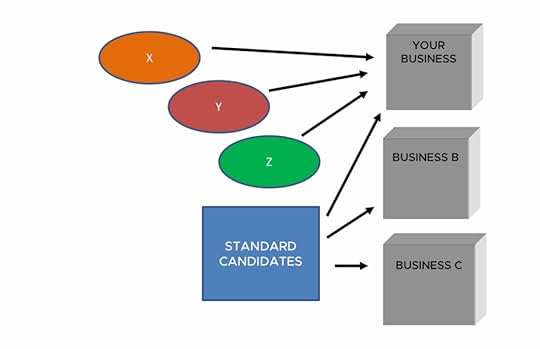
Considering other candidate pools takes hiring out of a small box, opens up a whole new world of applicants (see X,Y and Z in diagram below) and gives a company a real competitive edge. While other businesses are still vying for conventional recruits, an organisation can fill all its positions with applicants its rivals have never even considered. Even better, because these people have been given a new and unlooked-for opportunity in their lives, they tend to be grateful, positive, loyal and committed to excellence to justify this uncommon belief in them.
Here are some examples of other demographics that organisations can target.
School and college graduates – Graduates can fill entry-level positions and be trained in the skills required. For instance, the auditing firm PricewaterhouseCoopers announced in late 2007 that they were head-hunting high-performing 16-year-old schoolchildren because they could no longer fill their accountancy vacancies with university graduates. The ADF introduced a ‘gap year’ program, during which school leavers can come and work for them, in the hope that many will stay on. With a multitude of exciting roles to choose from, a $40000 salary and only one year’s commitment, this has proved a compelling proposition for many school leavers.Other gender or ethnic groups – Many organisations have restrictive rules that preclude some candidates. When the Victorian state police changed their fitness test from six minutes to six and a half minutes, they increased their female recruits from 26 per cent to 41 per cent. Similarly, an English language requirement maybe imperative for face-to-face positions but it’s not necessary for many manual jobs. In these a good attitude to work is the primary need.Mature workers – As baby boomers age, this group is growing. In the past, when wages were based on experience, older workers became more expensive to hire as they aged. Many older people are now more interested in flexible work hours and whether the role/company is a good fit with their personal values. The Australian state of Victoria bolstered police ranks by employing retired officers to work part-time on Thursday, Friday and Saturday nights. Home Depot in the US did a deal with the AARP—an ‘over 50’ association with 36 million members—and now sources most of the staff for its new shops from this pool.Overseas applicants – Ten years ago I would never have considered this an option. Increasing skills shortages now make overseas applicants a growing necessity. I’ve sourced engineers from the UK and boat builders from New Zealand. At the time, the cost of living in Australia was favourable and wages were higher so it was an attractive proposition for them.Boomerangs – Employees who have left an organisation and then return make great recruits because they already have knowledge of and share the corporation’s vision and values. The key to this is not to burn bridges at the time they exit. Have an open door policy so that good people who leave know they can come back whenever suits them. Professional service firm Deloittes recruits as many as one-third of all its new hires from boomerangs and saves the company millions of dollars in hiring and training costs.People already within the company. I love this category because it provides learning, variety and brightness of future for everyone within a corporation. There’s often someone within an organisation who can be trained into a position you’re trying to fill. One of my most successful recruits was Brian, a 19-year-old I employed as a CAD draftsperson after transferring him from his previous position in the IT department. He had no CAD skills but was positive, an excellent communicator and offered to share the cost of the course to bring him up to speed on the desired technology. We decided to give him a go. Not only was he fully qualified in CAD skills within six months but he eventually became one of the company’s most successful project managers because of his great attitude and interpersonal abilities.Role-splitting. In a tight labour market an organisation needs to ask itself whether it really needs to employ a person for a particular position. For hard-to-fill roles there are often parts of the job that can be performed by other recruits. In the US, a lack of teaching staff prompted the development of a lesser skilled Teacher’s Assistant position, which took on all the administration and reduced the number of qualified teachers required.As human animals it’s not surprising that every recruiter has an inclination towards or against a certain type of person. In the current labour shortage however, this could be crippling your business. The greatest challenge for most employers lies in attacking their own biases and changing their own ingrained mindset towards winning the war for talent. Success depends on their ability to alter attitudes, and to carry everyone with them on the road to innovation. This battle within is the real ‘war for talent’. Waging and winning this war is what really counts.
The post How to fill unfillable vacancies first appeared on MANDY JOHNSON.
HOW TO FILL ‘UNFILLABLE’ VACANCIES
To fill unfillable vacancies often requires a quantum shift in thinking. Take the French government who have launched a major national initiative for the employment of applicants of 50 years and over. Their stated goal was to give new visibility to experienced workers and extend their career paths and the campaign includes conferences, changing the laws and public policy and improving access to jobs via retraining. You may be an ‘oldie’ but you’re now officially a ‘goodie’ in Paris.
With major skill shortages around the world, this type of employment should be a no brainer. Yet it’s not and there are a couple of compelling reasons why over-50s are still an untapped labour market. Firstly recruiters often tend to employ people like themselves. Rugby players may employ rugby players, dog lovers may employ dog lovers and young recruiters may employ predominantly younger applicants. Unfortunately these biases are often incompatible with effective recruitment
The second reason these older workers are overlooked is because companies often don’t recognise that good applicants come in all shapes and sizes. Often their target market is so limited by conventional thinking that the type of people they’re looking for is too small or non-existent.
This is the killer scenario faced by many organisations. They might have made significant improvements to many of their attraction and hiring processes but, for some positions, they still struggle to find good people. The recruiter gives up and the organisation is forced to adjust its business objectives, like the global retailing CEO who told me he’d put all his expansion plans on hold because his company was simply unable to get good staff.
To achieve hiring success, these organisations first need to modify their thinking as to who are the most suitable applicants to fill their vacancies.
Examples of Innovative Thinking To Fill VacanciesWhen the Four Seasons group opened a deluxe hotel in Hawaii, they found it difficult to find trained staff to fill their vacancies and often employed people from the mainland. These imported workers tended not to stay very long, which led to high staff turnover and poor client servicing. Over time, the company realised that they had completely overlooked a large candidate pool that could fill all their positions: hardworking people employed on the local pineapple farms. They began to target these great-attitude workers, trained them in the necessary skills and became the number-one hotel on the island within 12 months.
Or take the fibre-glassing supervisor who realised that females, with their smaller hands, were perfect recruits for the new resin infusion technique that had just been developed. He filled all his vacancies with women and had no competition as other businesses had never even thought about this possibility. The ADF had a similar experience. They made the decision to allow mild asthmatics to join up and increased their potential recruiting pool by 400,000, after years of banning asthmatics.
Considering other candidate pools takes hiring out of a small box, opens up a whole new world of applicants (see X,Y and Z in diagram below) and gives a company a real competitive edge. While other businesses are still vying for conventional recruits, an organisation can fill all its positions with applicants its rivals have never even considered. Even better, because these people have been given a new and unlooked-for opportunity in their lives, they tend to be grateful, positive, loyal and committed to excellence to justify this uncommon belief in them.
Here are some examples of other demographics that organisations can target.
School and college graduates – Graduates can fill entry-level positions and be trained in the skills required. For instance, the auditing firm PricewaterhouseCoopers announced in late 2007 that they were head-hunting high-performing 16-year-old schoolchildren because they could no longer fill their accountancy vacancies with university graduates. The ADF introduced a ‘gap year’ program, during which school leavers can come and work for them, in the hope that many will stay on. With a multitude of exciting roles to choose from, a $40000 salary and only one year’s commitment, this has proved a compelling proposition for many school leavers.Other gender or ethnic groups – Many organisations have restrictive rules that preclude some candidates. When the Victorian state police changed their fitness test from six minutes to six and a half minutes, they increased their female recruits from 26 per cent to 41 per cent. Similarly, an English language requirement maybe imperative for face-to-face positions but it’s not necessary for many manual jobs. In these a good attitude to work is the primary need.Mature workers – As baby boomers age, this group is growing. In the past, when wages were based on experience, older workers became more expensive to hire as they aged. Many older people are now more interested in flexible work hours and whether the role/company is a good fit with their personal values. The Australian state of Victoria bolstered police ranks by employing retired officers to work part-time on Thursday, Friday and Saturday nights. Home Depot in the US did a deal with the AARP—an ‘over 50’ association with 36 million members—and now sources most of the staff for its new shops from this pool.Overseas applicants – Ten years ago I would never have considered this an option. Increasing skills shortages now make overseas applicants a growing necessity. I’ve sourced engineers from the UK and boat builders from New Zealand. At the time, the cost of living in Australia was favourable and wages were higher so it was an attractive proposition for them.Boomerangs – Employees who have left an organisation and then return make great recruits because they already have knowledge of and share the corporation’s vision and values. The key to this is not to burn bridges at the time they exit. Have an open door policy so that good people who leave know they can come back whenever suits them. Professional service firm Deloittes recruits as many as one-third of all its new hires from boomerangs and saves the company millions of dollars in hiring and training costs.People already within the company. I love this category because it provides learning, variety and brightness of future for everyone within a corporation. There’s often someone within an organisation who can be trained into a position you’re trying to fill. One of my most successful recruits was Brian, a 19-year-old I employed as a CAD draftsperson after transferring him from his previous position in the IT department. He had no CAD skills but was positive, an excellent communicator and offered to share the cost of the course to bring him up to speed on the desired technology. We decided to give him a go. Not only was he fully qualified in CAD skills within six months but he eventually became one of the company’s most successful project managers because of his great attitude and interpersonal abilities.Role-splitting. In a tight labour market an organisation needs to ask itself whether it really needs to employ a person for a particular position. For hard-to-fill roles there are often parts of the job that can be performed by other recruits. In the US, a lack of teaching staff prompted the development of a lesser skilled Teacher’s Assistant position, which took on all the administration and reduced the number of qualified teachers required.As human animals it’s not surprising that every recruiter has an inclination towards or against a certain type of person. In the current labour shortage however, this could be crippling your business. The greatest challenge for most employers lies in attacking their own biases and changing their own ingrained mindset towards winning the war for talent. Success depends on their ability to alter attitudes, and to carry everyone with them on the road to innovation. This battle within is the real ‘war for talent’. Waging and winning this war is what really counts.
The post HOW TO FILL ‘UNFILLABLE’ VACANCIES first appeared on MANDY JOHNSON.
May 22, 2025
Roadblocks to great recruitment
Attracting, hiring, and keeping great people remains a priority challenge for businesses of all types and sizes across the nation. Yet often corporations create roadblocks that proactively undermine their own recruitment process, and ultimately their own profits.
Two examples of roadblocks popped up during the recent Australian federal election:
1. Non-Compete ClausesI know, reading workplace contract clauses sounds about as exciting as watching dry grass grow, but what if your business inadvertently included a clause that was so biased it filters out great potential employees?
Anthony Albanese’s Labor government recently proposed to introduce legislation to ban non-compete clauses for workers earning less than $175k. These were never meant for junior workers, so I was shocked to hear they were becoming so prevalent in generic workplace contracts, the Labor government felt they had to move to block them. Sort of like stopping a business leader from financial self-harm, I thought.
I would have said no business operating on common sense would entertain this kind of strategy, yet by coincidence, this exact issue hit my desk twice in recent weeks. Two colleagues, independent of each other, contacted me regarding their teenagers’ job offers. The young workers were hoping to secure jobs paying less than $50k, however in both cases, the job contract included a draconian non-compete clause that stated they could not work for a competitor if they left or were sacked.
‘You’re kidding,’ I spluttered. ‘That’s like telling a Dominos worker they can’t go and stack pizzas at Pizza Hut.’
This immediately sounded to me like HR bureaucracy gone mad, or alternatively, a smarty-pants lawyer trying to justify their fees by showing how hardcore they could be in protecting their client’s interests.
Well, the strategy was working in the opposite direction, negatively impacting their clients’ interests. In both cases, the non-compete turned the initial excitement and joy of the job offer into deep anxiety. What if the job didn’t work out, or if they failed in the first few months? Where could they work then, if banned from their chosen field? Instantly, the two young applicants lost trust in their potential new employer, and due to the power imbalance, felt they held no ability to negotiate the removal of the clause for fear of losing the prized job to another applicant that wouldn’t rock the boat.
‘Sign it or fight it?’ they asked me. ‘What should we do with the contract?’
While I could think of a few places I’d like to stick that workplace contract, I restrained my thoughts, knowing these kids really wanted and needed the jobs. Now, I’m not a lawyer, but I do know that an employer can’t impose a restraint of income on a junior worker cycling deliveries around the neighbourhood. Non-competes were meant for senior execs who might, say, nick off with the Colonel’s secret herbs and spices recipe, or who are able to poach clients or critical IP. They’re often used when one company acquires another, ensuring the seller doesn’t set up a competing shop down the down a week after settlement.
For junior employees they are simply an unnecessary roadblock to employment, a damaging own goal to the business. Quite possibly, and at best, the chiefs may have let the HR bureaucrats run and were not even aware such a detrimental clause existed in their brick-sized contract. In both my examples, the two aspirants signed the contracts and took the jobs on offer, for they needed the money. Both confirmed they would leave as soon as they found a better option.
2. THE Work from home mandatePeter Dutton’s mid-election gift to his opponents came in the form of his work from home ban for Canberra’s public servants. If ever there was a sign Australian workers have moved on from such inflexibility, it was demonstrated by the Liberal’s subsequent flip-flopping on the policy. No matter where you stand on this issue – whether you believe all home workers are slackers addicted to Netflix, or if you believe that the non-commute time-saving leads to increased productivity – the fact remains that many great applicants want the flexibility and convenience of working from home, at least some of the time.
An award-winning senior tech leader I spoke to recently said if his company recalled everyone to the office permanently, he would go elsewhere. ‘I have a new baby,’ he explained. ‘My working hours vary between 4 am and 10 pm, but within those times, I can now spend some quality time with little Elodie.’
I met a sales agent who had won her company’s top achiever prize. Her business had all the at-home tech, but due to an inflexible return to workplace policy, her manager still insisted she drive to work during the recent Queensland floods, a thirty-kilometre four-hour round trip due to road closures. She left soon after, joining a direct competitor.
I am the first to champion the power of an effective team and have witnessed the amazing results of close-knit groups working in unison together. Yet it doesn’t have to be one hundred per cent of the time. This kind of all-or-nothing thinking is simply a roadblock to great hiring. The danger for uncompromising employers is that if just one of their competitors is offering some version of work from home, even just one day a month, they lose their hiring edge immediately.
Speaking to a tech recruiter at a large corporation last week, she told me that the CEO’s recent ‘work only from work’ mandate had sent a clear message to candidates – the quality of the people applying to her tech jobs dropped significantly in a single week. And these second-rate applicants require a lot more time and energy to manage, plus are less effective.
So my question to leaders: Is your business consciously or inadvertently creating roadblocks that stop you from attracting and hiring the great people you need to achieve success? Put these kinds of obstacles in place and yes, you may have employment contracts your lawyer loves, or have everyone back in the office, but you’ll be swimming in a far less talented pool.
If it were me, I’d rather work with barramundi than guppies any day!
The post Roadblocks to great recruitment first appeared on MANDY JOHNSON.
Hiring Great people: The Need For Speed
One of the more common phrases bandied about in the business world is ‘hire slow, fire fast’, the strategy that one should select new employees with forensic caution and cut ties with non-performing ones as quickly as possible.Yet this compelling statement has become one of the most misunderstood hiring strategies globally. Regularly deployed out of context, it creates more harm than good, leading to a litany of disastrous HR processes and poor outcomes for the businesses involved.
Take ‘hiring slow’ for instance. I recently talked to a business owner operating in a remote part of Australia who was recruiting for a General Manager. He received an application from an ideal candidate and wanted to interview and offer that week. The recruitment company he was using warned against such impulsive behaviour, advising of the need to complete their comprehensive one-month process of more interviews, psych evaluations and police and reference checks. They didn’t want to make a mistake.
‘They were the professionals,’ the owner told me, ‘So I agreed to their process.’ When these same professionals offered that perfect candidate the job four weeks later, she had already started in the GM role for the owner’s major competitor.
As he discovered, good applicants are like great houses up for sale. They don’t stay on the market for long. Statistics show that the average period of availability for top candidates is ten days whilst the global average time to hire (from ad to employment) is forty-four days, including twenty-three days in the interviewing stage. The disconnect is blindingly obvious. And while many organisations say they struggle to attract great people, their biggest challenge is actually reinventing their process-driven systems that lead to the dropout before interview of top candidates who are available.
Similarly, when it comes to the ‘fire fast’ portion. No argument here; if you identify a bad hire early, pull the ejector lever as quick and compassionately as you can. No-one wants an explosion of underperformers within the workforce. But the ultimate question that is not being asked is: why does a business needs to embed a strategy of firing fast in the first place? What recruitment processes are in place that are leading to all these unsuitable recruits? Could it be, shock, horror, that you might be hiring so slowly that you are missing out on all the best people?
For me, when recruiting for great people, I think of fighter pilot Maverick in the movie, Top Gun heading for the fighter jet and saying, ‘I feel the need. The need for speed!’ He didn’t just lob up one day, jump in a flight suit and roar off. He spent ten thousand hours planning for the day he could hit the skies at speed. Similarly, for anyone recruiting, the better catchphrase would read:
‘Prepare slow, hire fast, fire rarely.’
The Time to Go SlowThe time to be absurdly selective in who you hire is not after the CVs swamp your inbox.Organisations should slow down in the pre-recruiting stage, spending days, weeks or longer, developing well-thought-out processes, preparing to strike when the recruitment process goes live. Some prep work might include defining the role profile, creating a benefits-led ad template, an attractive pitch including your company’s key attractors, a timely and effective candidate screening method, and an inspiring interview process.
The ad is a great example. To me, the ad is a short story, a synopsis, the key first contact that will dictate the quality of the applicants who apply. Yet too often, I see managers knock up a recruitment ad the day before its release, filling the space with generic cliches such as ‘people are our greatest asset.’ A company that will spend weeks preparing a product marketing campaign will often prioritise only a few hours to their critical people mission.
When To Hit TurboPutting detailed thought into these kinds of practices is the fundamental meaning of ‘hire slow’, enabling recruiters to act with decisive speed in the period from advertising to job offer, where swiftness is vital to attracting the best people.
When I helped set up Flight Centre in the UK, the company was an unknown, competing against 800-store travel agency chains for great applicants. I followed the company’s recruitment process, taking three weeks to arrange an interview, and struggled to employ a single decent recruit.
Like Top Gun’s Tom Cruise, it was the first time I felt the need for speed. After placing an ad the following week, I read every CV the day it arrived and immediately contacted the suitable candidates to book an interview. If they were good, I offered them a job within twenty-four hours. I worried that this might reek of desperation but on the contrary, people took it as a positive and I had my pick of the best applicants. In two weeks, I had recruited six people. Six good people!
One of the six, Chris, went on to become the company’s UK Managing Director. At a conference a few months later, he told me he had been offered another three jobs the week after he’d accepted my contract. I asked him if he had been offered all four jobs at the same time, which one would he have taken. Chris smiled sheepishly. ‘Not yours,’ he said.’ One of them was American Express!’
The diagram below shows how speed works by comparing two companies competing for the same new recruits. Company A, who is using speed as a conscious tool, offers suitable candidates a position before other companies have even interviewed, so gets all the good recruits. By the time Company B interviews the applicants, only the unsuitable ones are left. Company B’s only option is to choose the best of the rest, meaning it employs second-rate recruits and guarantees itself one of two things: high, future staff turnover and/or poorer individual results, beginning a cycle of self-destruction.
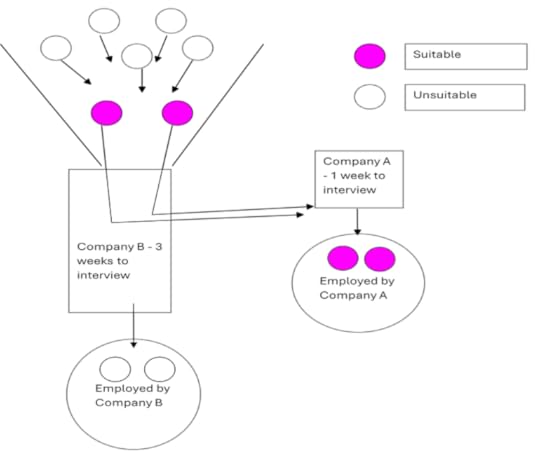
When organisations insist there are no suitable candidates, it’s often because they have moved too slowly in the recruitment process, and the applicants have dropped out or moved on. Or the organisation’s interview process is so long and arduous that many applicants give up in disgust. While recruiters are running endless psychometric tests and background checks, the great hire is at the induction day of another company.
Ironically, executives often want to slow down the hiring process because of their poor recruitment systems. They say, ‘We need to take our time to make sure we get the right person’ and quote the adage ‘hire slow, fire fast’ but this is often because they have no tools prepared and ready to select the right person in any decisive objective manner.
Some Underlying Speed Principles:The most suitable applicants apply within the first five days of advertising – not always, but over 90% of the time.Interviewing applicants quickly gives them a positive dynamic first impression of the company, making them more likely to want to work for you.Good candidates are likely to take the early job offer, the one that exists, than wait to hear from one that may not.By offering a great candidate an offer before competing companies have even interviewed, an organisation can avoid bidding wars.Never make an offer immediately after interview as this leads to drop-outs. (You can ring the next morning.)With research showing that 60% of all applicants quit the recruitment process because it is too long or arduous, there’s never been a better time to lose those excruciatingly slow bureaucratic HR practices. When it comes to hiring, time really is money, so if you are not interviewing and offering a job within 7-10 days you’re missing out on the best recruits.
Anyone else feel the need for speed?
The post Hiring Great people: The Need For Speed first appeared on MANDY JOHNSON.
August 28, 2024
Best Workplaces = Big Profits!
An email popped into my inbox on Friday from a past participant on one of my People and Culture Accelerator Programs. Luke, the owner of Ashley-Cooper Constructions, had written to tell me that he’d placed in the Australian newspaper’s Best Places to Work 2024 competition. As he said, ‘We did pretty well. Finalist in the Top 50 in Australia and top 3 for best place to work for women.’
I was so happy for Luke, who’d been battling to stop competitors poaching his quality tradies during a massive labour shortage. I knew he’d put on an HR Coordinator to develop better employee engagement strategies, and it appeared to have paid off. Not only had he created a better workplace and more engaged staff, but Luke could now use his Best Employer status to attract even more high achievers.
My entire consulting ethos centres on creating these kinds of people-centric organisations. Yet to many business owners this all sounds a bit warm and fuzzy. Why should they change what they do when people should just be happy to have a job and get paid? Work every weekend if they must, what’s the problem? Need a day off to look after a sick child – not their issue! Which sounds fair enough, but this kind of thinking is about as relevant to successful modern workplaces as a floppy disk is to a 21st century worker.
The world of work has morphed since the days of glass-boxed supervision. Good employees have choices, many, many choices, so building better workplaces means that you’ll attract and keep a greater share of these high achievers. The challenge of course, is how to successfully implement such policies without getting caught up in a gobbledegook of well-meaning but useless actions that eat up profits.
After googling the article on the best workplaces review, I saw that the winners all scored 70% or more in employee happiness and engagement. The awards focussed on six key areas: rewards and recognition; information-sharing; empowerment; wellbeing; instilling pride, and job satisfaction. Many business owners pay lip service to these ideals, splattering their websites with these kinds of platitudes. The key difference between the winners and the rest, is that great workplaces can point to specific actioned policies that support every one of their claims. And the key KPIs that flow on from all this people engagement – reduced staff turnover and sick days – directly produce higher growth and profits.
No warm and fuzzy there, my friends. But don’t just take it from me. Mountains of empirical evidence show that Best Employer companies achieve on average four times the profit growth of other organisations. They perform three times better when it comes to comparative stock market returns. The reality is that profits don’t create great workplaces – it’s the other way around.
There is a real bounty on offer then, for those prepared to adapt to this way of work. But where to start? With 50 businesses to summarise, most of the article stuck to general plaudits, but I went drilling for specifics and found some repeat features across the spectrum of winners.
Family. As author of the book Family Village Tribe, I was quite excited to see the term ‘family’ coming up often, detailing close-knit working environments, with regular social events, staff bonding, fun and annual gatherings. Evidence shows that the more that teams socialise together, the more productively they work.
Clear company vision and purpose. There are some unsexy industries on the best employer list, from financial services to aged care, logistics to real estate. Yet the good ones understand who they are, why they do what they do, and what they stand for. They express a clear and believable vision that instils pride in their activities, focusing on their people, product and customers, and their positive impact on society.
An annual and long-term team plan. Where are we going this year and how are we going to get there? What are we going to change? I’ve implemented these in a diverse range of businesses with many doubling their profits in just a few months. It appears that when the team creates the plan, they all make it happen.
A clear set of values. I always find this a tricky one, given that just about every company claims to have amazing values. Again, it’s the ones that live by their claims that count. You can’t purport to be a great employer when you have a staff turnover rate of 40 plus percent. Or when you outsource key services to third party companies to avoid the hassle of dealing with people. Trust, openness and honesty falls into the waste-bin when you’re caught defrauding your people by paying incorrect award wages. (That list is long and now includes some of Australia’s biggest, and once most-trusted, brand names.) I’ve attached a free online course to this newsletter if you need to define your own core values and weave them throughout your business.
Tailored employee packages. Seriously, if your workplace is not implementing policies such as flexibility, work from home, parent-friendly, part-time and casual, or other systems and benefits to align with individual employee wants, you will always struggle to attract and keep the best people. Notably, the past popularity of playrooms, ping pong and foosball tables, day couches, barista coffee machines and free fruit was only mentioned by one of the fifty winners. Nice-to-haves, for sure, but no-one’s hanging around for free slushies if they are expected to work every weekend.
Upskilling. Core skills, training programs, team building, leadership courses. These days, good employees seek professional development and growth opportunities so upskilling is an essential win-win strategy. As the labour market shrinks and HR moves from talent acquisition to talent progression, quality upskilling will be the best way to provide a flow of future leaders too.
Diversity. Many businesses I see stuck in their ways also remain stuck in a monoculture from the past. Luke’s construction business, traditionally male-centric, transformed its staffing policies to target women, and the results have been outstanding, with his company winning Master-Builder’s awards every year for the last four years. Research shows that the most diverse teams are the most profitable, as everyone brings a new way of thinking to the business.
Wellbeing. I already hear the warning bells ringing, as we slide towards the warm and fuzzy. Yet the focus on staff wellbeing has surged since 2020 and is now considered a major strategy of best employer companies. They offer wellbeing programs, health and physical restoration programs, mental rest days, flexible time off, stress leave without pay, and other support services, often discounted through company negotiations. Many of the companies laud the high number of employees who have remained with them for over ten years, due to the flexible nature of wellbeing support on offer. Sometimes, like an elite footballer, we all need a spell on the bench.
Transparent and regular communication. Celebrate success and reduce the need for people to gossip as to what might be going on. By simply creating a monthly newsletter plus an intra-workplace tool such as WhatsApp groups, people stay in the loop, and feel valued.
One-on-one chats. Anyone who has attended one of my masterclasses will know I bang on about leaders having monthly check-ins with every member of their team. This is the single most effective weapon in a business owner’s armoury to stay in tune with your people, their wants and needs, the reasons they may leave, and their fantastic ideas from the floor that create innovation. Best of all, it’s free! But first you need to promote the right leaders – check out this great 2-minute video by Simon Sinek on this topic.
Ultimately, some of you may look at this list and agree in principle but not know where to start. Asking your people how you could fix endemic business problems, or what you could do to improve productivity is a great opener (and if they come up with the strategies, they are much more likely to implement them too). One of my masterclass participants who ran an industrial pump business was plagued by faulty product returns. When the team came up with a plan to address this, his defective goods fell to less than 1% within 3 months.
Or do what Luke did – employ a People Champion to raise people practices above bureaucratic HR policies so they become a key business strategy alongside finance, marketing and product – in effect, grow your own success. And with a bunch of happier people around, you are destined to have more fun along the way.
I feel warm and fuzzy just writing this. Which all goes to show – no matter what business you’re in, you’re now also in the people business.
The post Best Workplaces = Big Profits! first appeared on MANDY JOHNSON.
July 16, 2024
Effective Up-Skilling – Not Just Feeding The Chooks!
The first time I realised that the way I thought about training was very different to many business owners came in a conversation I had with a neighbour some years ago. I told Mick, the owner of a large maintenance business that I’d spent the morning running a seminar. ‘Feeding the chooks you mean,’ he said. Seeing my confused expression he clarified, ‘You know, training. Useless exercise. Never makes much difference. Big waste of money but as employers we must be seen to be going through the motions to keep our people happy.’
I’ve witnessed first-hand training programmes create extraordinary results – businesses doubling their profit, a bike chain increasing sales by 20% in one week, the worst performing offices in a region becoming the best – so I know that quality training can be instrumental in developing people and achieving corporate goals. Yet Mick’s opinion of corporate training is shared by many, and I have come to accept that his scepticism is often entirely justified.
After reviewing hundreds of local, national and global courses as part of consulting projects, there are some excellent providers out there, but they are swamped by the sheer mass of firms peddling mediocrity. High profile universities whose ‘world class’ product consists of monotonous two-hour videos of a lecturer talking into a camera; online companies whose sub-standard modules are more e-Information, than eLearning; external ‘experts’ who have bought into a coaching/training franchise that gives them support tools and formats but can’t substitute for their lack of real business success.
These kinds of defective offerings have distorted the discussion around training and convinced a generation of CEO’s that it’s futile to expend much energy in this area. One frustrated head said to me, ‘We’ve spent five million dollars on training over the last 5 years and we’ve got f**k-all to show for it!’
It is a common complaint, but one we need to fix fast as training is now a key worker requirement. 59% of Millennials say learning and growing are extremely important when applying for a role. 94% say that they will stay in their job if they are given upskilling opportunities. It is not all about the employee though. With the labour market shrinking employers are more dependent on internal applicants to fill roles, making effective skills development vital to business success. Research also shows that companies who offer good training are 17% more productive and 24% more profitable than those that don’t, so the up-side is huge.
So how do you do it? Start with baby steps:
STEP 1: WHERE DO YOU NEED TO FOCUS?
Organisations often feel overwhelmed by the sheer quantity of what they are trying to improve and the associated potential training offerings. They don’t know where to begin, so they often never do. As HR leader of a large retailer, I once asked the store managers what they would like included in our training process. After collating their responses, I had enough information to keep a person busy for about two years.
Start by thinking: what are the core outcomes that are vital to your business success? You are not trying to be the best at everything so what is the minimal training people need to be effective at their job?
Then identify which ones require a specific training course and which can be taught effectively on-the-job, with supplementary systems. Research shows employees retain only a small portion of what managers tell them to do (some estimate this is as low as 20%), so it’s often more practical to create some enduring, helpful reference systems.
Here are some examples – if you just create one a week you will have a vast library by the end of the year:
One page ‘how to’ systems or checklists for common, repeated tasks.Bite-sized instructional videos (under a minute) recorded by your experts and posted on a company intranet or YouTube channel.Quick guides for each software process e.g. how to input payroll data. You can use online tools such as Scribe that document each keystroke, and instantly build visual guides with text, links, and screenshots of each step. (Note I am not plugging Scribe here – it is just one of many online options).Role-based WhatsApp groups where people can post and get answers to simple queries.Systems are especially useful in areas where you are experiencing repeated mistakes. A farmer on one of my masterclasses told me that after the session she created a host of ‘how to’ tools and linked them to smartphone QR codes that she put on posters around her farm. Once employees could access constant reminders as to how to do things well, she cut errors by nearly 90%.
Once you’ve eliminated all the areas you can improve via effective systems, you can then dedicate the time saved to creating training programs for your essential core needs.
e.g. In my first business I introduced:
A half day induction course for new people – to inspire as well as educate, to make a great first impression.A half day for new managers to teach them how to have monthly chats with their people, manage performance effectively and avoid common pitfalls.A monthly 1-hour sales session to grow expertise in the business’s core competency, run by sales high achievers.As the organisation grew and accumulated more resources these sessions naturally became more comprehensive, growing into 3-day courses and a full-blown sales academy. Note I started with three because I found a few inspirational, practical sessions have far greater impact than hundreds of mediocre ones.
STEP 2 – DESIGN EFFECTIVE COMPONENTS:
Once you’ve identified the essential training systems you need to create consider:
What inclusions do I need? Consider activities, inspiration, relevance.Who can design/deliver the training content/systems and process? In-house/external advisers with objective practical achievement in this area?How will it be delivered? Online/face-to-face?How often? Is it a one-off or a regular requirement?In my consulting I see time and again juniors with limited expertise in the subject area, create training modules for the company’s employees. This is sheer madness. With little or no input from relevant business leaders or experts in the role, the programmes developed are generally useless to frontline staff and are often ignored. The management’s response? They make the ineffectual course compulsory and put in a system of policing to make sure everyone does it.
This is what I call ‘training for training’s sake’ – work undertaken to justify people’s employment, rather than any initiatives that make a real difference. It’s letting the tail wag the dog. Effective training requires project management, coordinating experts and achievers both internally and externally, to produce or provide modules with real business outcomes. It also needs to consider who is the key stakeholder/end user and the ultimate litmus test: ‘Are they prepared to pay for it?’
Like the development of a new tech product, the best results occur when the organisation’s business leaders take ownership of cost and outcomes.
STEP 3: EXPLAIN THE WHY TO PARTICIPANTS:
People need to understand the purpose of training. After years of running masterclasses, it is always apparent when someone has been ordered to attend, rather than choosing to come along because of a real need, and this is reflected in their engagement levels.
Make sure that attendees understand how this learning will benefit them, from being more productive/reducing errors, to career enhancement, or simply to increase expertise in their field. (This is also why self-directed learning has the best outcomes).
STEP 4: REINFORCEMENT & MEASUREMENT
Call me old-fashioned but if I pay good money to take my people out of the business and send them on a sales course, I want to know that they will sell more afterwards. The transference of real skills from the classroom to the workplace is what every business leader craves, as opposed to the ‘sheep-dip’ training of the past.
Yet few measure or reinforce training outcomes. Here are some examples of effective measurement:
A participant evaluation score.An increase in performance.Improved staff satisfaction ratings.Increased training take-up of future sessions.Training without reinforcement is like teaching a toddler to wash their hands after going to the toilet and then checking with them 6 months later to see if they are still doing it. It is not very effective!
If you build a culture of continuous improvement there are so many ways you can do this, from 1-on-1 monthly leader chats, project teams focused on each aspect you’re trying to entrench, Town Hall catchups that reward high achievers in the skill, in-house experts running a monthly Q and A class, participants downloading info to their team members post-training, and so on.
Finally remember that upskilling is not just about systems and training modules. I learnt more about sales sitting beside my company’s number 1 salesperson for four hours, than from participating in any module. Other high-impact training activities that leaders can use to upskill can include:
Interesting articles/blogsYouTube clipsTed TalksCollaborative activities across work teams.Fun quizzes*************************************************************************
In a world of constant change, the spoils go to the nimble. Instead of being good at doing some particular thing, companies must now be really good at learning how to do new things. And with most trainers incentivised to drag programmes out as they get paid more for longer sessions, it’s getting harder all the time. So remember, it is not about feeding the chooks, it’s about the pecking order, and only those businesses that shift their thinking around upskilling from a quantity mindset to a high-impact mindset will come out on top.
To fast-track training success, download my free online course for new trainers – The 7 Steps To Effective Training which shares what makes a training session great beyond its actual content, and how to deliver it seamlessly to avoid the usual pitfalls. Click here
The post Effective Up-Skilling – Not Just Feeding The Chooks! first appeared on MANDY JOHNSON.
EFFECTIVE UP-SKILLING – NOT JUST FEEDING THE CHOOKS
The first time I realised that the way I thought about training was very different to many business owners came in a conversation I had with a neighbour some years ago. I told Mick, the owner of a large maintenance business that I’d spent the morning running a seminar. ‘Feeding the chooks you mean,’ he said. Seeing my confused expression he clarified, ‘You know, training. Useless exercise. Never makes much difference. Big waste of money but as employers we must be seen to be going through the motions to keep our people happy.’
I’ve witnessed first-hand training programmes create extraordinary results – businesses doubling their profit, a bike chain increasing sales by 20% in one week, the worst performing offices in a region becoming the best – so I know that quality training can be instrumental in developing people and achieving corporate goals. Yet Mick’s opinion of corporate training is shared by many, and I have come to accept that his scepticism is often entirely justified.
After reviewing hundreds of local, national and global courses as part of consulting projects, there are some excellent providers out there, but they are swamped by the sheer mass of firms peddling mediocrity. High profile universities whose ‘world class’ product consists of monotonous two-hour videos of a lecturer talking into a camera; online companies whose sub-standard modules are more e-Information, than eLearning; external ‘experts’ who have bought into a coaching/training franchise that gives them support tools and formats but can’t substitute for their lack of real business success.
These kinds of defective offerings have distorted the discussion around training and convinced a generation of CEO’s that it’s futile to expend much energy in this area. One frustrated head said to me, ‘We’ve spent five million dollars on training over the last 5 years and we’ve got f**k-all to show for it!’
It is a common complaint, but one we need to fix fast as training is now a key worker requirement. 59% of Millennials say learning and growing are extremely important when applying for a role. 94% say that they will stay in their job if they are given upskilling opportunities. It is not all about the employee though. With the labour market shrinking employers are more dependent on internal applicants to fill roles, making effective skills development vital to business success. Research also shows that companies who offer good training are 17% more productive and 24% more profitable than those that don’t, so the up-side is huge.
So how do you do it? Start with baby steps:
STEP 1: WHERE DO YOU NEED TO FOCUS?
Organisations often feel overwhelmed by the sheer quantity of what they are trying to improve and the associated potential training offerings. They don’t know where to begin, so they often never do. As HR leader of a large retailer, I once asked the store managers what they would like included in our training process. After collating their responses, I had enough information to keep a person busy for about two years.
Start by thinking: what are the core outcomes that are vital to your business success? You are not trying to be the best at everything so what is the minimal training people need to be effective at their job?
Then identify which ones require a specific training course and which can be taught effectively on-the-job, with supplementary systems. Research shows employees retain only a small portion of what managers tell them to do (some estimate this is as low as 20%), so it’s often more practical to create some enduring, helpful reference systems.
Here are some examples – if you just create one a week you will have a vast library by the end of the year:
One page ‘how to’ systems or checklists for common, repeated tasks.Bite-sized instructional videos (under a minute) recorded by your experts and posted on a company intranet or YouTube channel.Quick guides for each software process e.g. how to input payroll data. You can use online tools such as Scribe that document each keystroke, and instantly build visual guides with text, links, and screenshots of each step. (Note I am not plugging Scribe here – it is just one of many online options).Role-based WhatsApp groups where people can post and get answers to simple queries.Systems are especially useful in areas where you are experiencing repeated mistakes. A farmer on one of my masterclasses told me that after the session she created a host of ‘how to’ tools and linked them to smartphone QR codes that she put on posters around her farm. Once employees could access constant reminders as to how to do things well, she cut errors by nearly 90%.
Once you’ve eliminated all the areas you can improve via effective systems, you can then dedicate the time saved to creating training programs for your essential core needs.
e.g. In my first business I introduced:
A half day induction course for new people – to inspire as well as educate, to make a great first impression.A half day for new managers to teach them how to have monthly chats with their people, manage performance effectively and avoid common pitfalls.A monthly 1-hour sales session to grow expertise in the business’s core competency, run by sales high achievers.As the organisation grew and accumulated more resources these sessions naturally became more comprehensive, growing into 3-day courses and a full-blown sales academy. Note I started with three because I found a few inspirational, practical sessions have far greater impact than hundreds of mediocre ones.
STEP 2 – DESIGN EFFECTIVE COMPONENTS:
Once you’ve identified the essential training systems you need to create consider:
What inclusions do I need? Consider activities, inspiration, relevance.Who can design/deliver the training content/systems and process? In-house/external advisers with objective practical achievement in this area?How will it be delivered? Online/face-to-face?How often? Is it a one-off or a regular requirement?In my consulting I see time and again juniors with limited expertise in the subject area, create training modules for the company’s employees. This is sheer madness. With little or no input from relevant business leaders or experts in the role, the programmes developed are generally useless to frontline staff and are often ignored. The management’s response? They make the ineffectual course compulsory and put in a system of policing to make sure everyone does it.
This is what I call ‘training for training’s sake’ – work undertaken to justify people’s employment, rather than any initiatives that make a real difference. It’s letting the tail wag the dog. Effective training requires project management, coordinating experts and achievers both internally and externally, to produce or provide modules with real business outcomes. It also needs to consider who is the key stakeholder/end user and the ultimate litmus test: ‘Are they prepared to pay for it?’
Like the development of a new tech product, the best results occur when the organisation’s business leaders take ownership of cost and outcomes.
STEP 3: EXPLAIN THE WHY TO PARTICIPANTS:
People need to understand the purpose of training. After years of running masterclasses, it is always apparent when someone has been ordered to attend, rather than choosing to come along because of a real need, and this is reflected in their engagement levels.
Make sure that attendees understand how this learning will benefit them, from being more productive/reducing errors, to career enhancement, or simply to increase expertise in their field. (This is also why self-directed learning has the best outcomes).
STEP 4: REINFORCEMENT & MEASUREMENT
Call me old-fashioned but if I pay good money to take my people out of the business and send them on a sales course, I want to know that they will sell more afterwards. The transference of real skills from the classroom to the workplace is what every business leader craves, as opposed to the ‘sheep-dip’ training of the past.
Yet few measure or reinforce training outcomes. Here are some examples of effective measurement:
A participant evaluation score.An increase in performance.Improved staff satisfaction ratings.Increased training take-up of future sessions.Training without reinforcement is like teaching a toddler to wash their hands after going to the toilet and then checking with them 6 months later to see if they are still doing it. It is not very effective!
If you build a culture of continuous improvement there are so many ways you can do this, from 1-on-1 monthly leader chats, project teams focused on each aspect you’re trying to entrench, Town Hall catchups that reward high achievers in the skill, in-house experts running a monthly Q and A class, participants downloading info to their team members post-training, and so on.
Finally remember that upskilling is not just about systems and training modules. I learnt more about sales sitting beside my company’s number 1 salesperson for four hours, than from participating in any module. Other high-impact training activities that leaders can use to upskill can include:
Interesting articles/blogsYouTube clipsTed TalksCollaborative activities across work teams.Fun quizzes*************************************************************************
In a world of constant change, the spoils go to the nimble. Instead of being good at doing some particular thing, companies must now be really good at learning how to do new things. And with most trainers incentivised to drag programmes out as they get paid more for longer sessions, it’s getting harder all the time. So remember, it is not about feeding the chooks, it’s about the pecking order, and only those businesses that shift their thinking around upskilling from a quantity mindset to a high-impact mindset will come out on top.
To fast-track training success, download my free online course for new trainers – The 7 Steps To Effective Training which shares what makes a training session great beyond its actual content, and how to deliver it seamlessly to avoid the usual pitfalls. Click here
The post EFFECTIVE UP-SKILLING – NOT JUST FEEDING THE CHOOKS first appeared on MANDY JOHNSON.