
Richard Dooling's Blog
July 2, 2026
AI and the English Language
The Wall Street Journal published my essay on George Orwell and AI earlier today. I suspect it won’t appear in print until Monday. I hope this WSJ gift link works.
I wrote an earlier piece about how The AIs Are No Longer Science Fiction.
My new novel, The Acolyte, is now out. Cool bookmarks still available.
Happy 4th!


June 16, 2026
Publication Day - The Acolyte
Today, my new novel, The Acolyte, releases on Amazon. Available as a Kindle e-book or paperback. An Audible audiobook is in the works. The Acolyte also participates in Amazon’s Kindle Unlimited program.
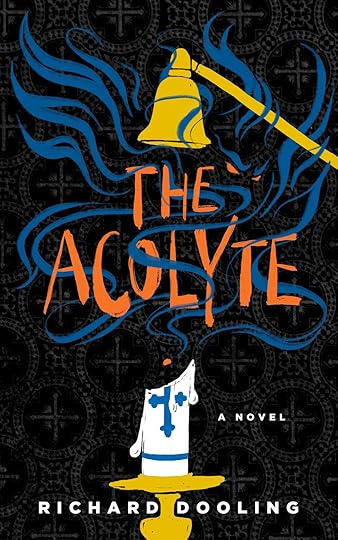
Faith moves mountains, but trembles before the face of evil.
Hank is thirteen, head altar boy at a traditional Catholic parish, and devoted to three things: the Church, his brotherhood of altar boys, and Nora, whose father is the archbishop's lawyer. When the FBI raids the cathedral and seizes evidence, they need Hank. So does the Church, for opposite reasons.
Caught between Adrienne, a young federal prosecutor building a case against a cybercrime network, and an institution that demands his silence, Hank goes looking for the truth in the catacombs beneath the cathedral. What he finds shakes his faith in everything but his true love.
In The Acolyte, National Book Award finalist and New York Times bestselling author Richard Dooling tells a dark, funny, and fearless story about innocence, holiness, romantic love, and the nature of evil.
Free Silk BookmarksThe perfect gift for the fallen-away Catholic in your life. Just reply to this email, provide snail mail address, and place your order. Free, as in free beer.
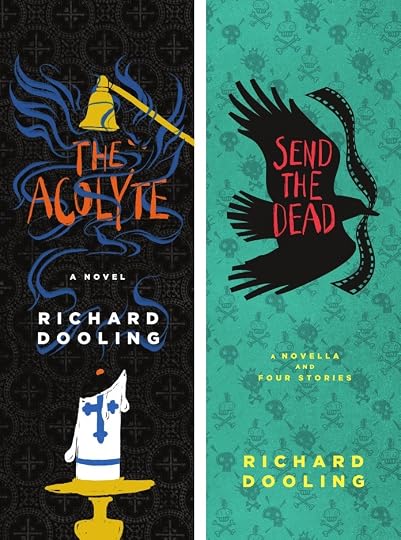 Free Silk BookmarksRead A Sample
You can read a free sample at Amazon, or I’ve included an edited passage below.
Hank is quite proud because he has just been named head altar boy. He is still in his cassock and surplice, fresh from serving Mass and putting out the candles with his candlelighter, when he finds his girlfriend, Nora, waiting for him just outside the gates to the Lash Chapel crypt:
I Want To See The Weeping Angel
They were so close to the gated entrance to the crypt, that Hank could feel the cool air creeping up the open stairwell.
They leaned against the heavy brass gate and almost fell on top of each other, when the gate moved and gave against their weight. Hank stumbled and caught Nora in his arms. The ponderous brass gate swung open in slow motion and struck the door stop with a single soft bong.
Hank caught his breath and peered down the dark circular stairwell to the Lash Chapel crypt. He felt a draft press against his face like a cold November fog. The sweat he and Nora had worked up now chilled him to his bones and made him shiver in his cassock. Never in almost three years as an altar boy had Hank found this gate open.
They could run, but that would expose them to the security cameras and make them look guilty—Of what? They weren't doing anything wrong. Sure they were boyfriend and girlfriend, and everybody knew it, but they had their clothes on, and they weren't skipping school or vaping weed.
Nora tiptoed back to the nave and hid behind a pillar. She leaned out into the side aisle and checked both ways for witnesses. She crept back to the open gate and stood close to Hank. "Nobody." She smiled. "Just us."
Nora went to the top of the stairs and peered down into the darkness. She glanced back at Hank.
"Let's go," she whispered. "I want to see the weeping angel."
"The gate's open," whispered Hank. "What if somebody is down there?"
Nora shrugged and rolled her eyes, like she'd figure that out if and when. She looked at Hank and waited, and the expression on her face said, Don't tell me you're afraid of a crypt?
Hank followed her through the gate into the shadows. Below them the stairs disappeared in darkness absolute. Their smartphones would be too bright and would alert anyone in the underworld to their approach. Luckily Hank had his candlelighter, a precision instrument capable of controlled lighting in the hands of the professional. He lit the taper with a butane lighter and made microfine adjustments to the wick in the brass tube. He cupped his hand around a tiny steady flame to protect it from the turbulence of their passage down the dark stairwell.
The air went from cool to cold, and smelled like the ancient unused coal chute in the basement of Hank's house. The walls, floors, and ceiling down the stairway to the mortuary were paneled in veined Red Verona marble that looked like it was seeping martyr blood.
Hank leaned against the curving marble staircase and steadied himself. His rubber-soled foot felt for the last step in the darkness and found the stone floor.
At the bottom of the stairs, he pulled back the wick and made a small hooded flame behind his cupped hand. He opened a pink slot between his fingers that cast a single beam of amber light ahead of them into the passage that led to the antechamber, a waiting room for the dead.
As he and Nora entered, Hank recognized an antique wooden lectern that held the original Lash family Bible, open to Psalm 23 according to the tarnished gilt lettering, so the Lashes would fear no evil in the valley of death.
The main attraction in the anteroom was the grave of Mrs. Evelyn Lash, devoted wife to Thomas Lash, loving mother to their eight children. Thomas had marked Evelyn's grave with a sculpture of a life-sized white marble angel, who was on her knees and had thrown herself over a funeral altar in profound grief, her face buried in her limp arms, her white marble wings drooped around the figure like a cloak of sorrow.
Hank held the light aloft so Nora could get a look at the weeping angel. An inscription on the base read, "The Joy that Lit the Stars is Fled." The marble folds in the drapery of the angel's gown and the sculpted feathers on the angel's wings looked so real that the figure seemed to be moving, sobbing, prostrate with sorrow.
The anteroom opened into an L-shaped hallway of funerary recesses. Another brass gate separated the living from the dead, but it was unlocked and open. Hank aimed his candlelighter beam down the passage and lit the wall of crypts. Marble faceplates with bronze letters glowed in the reflected candlelight.
He got a little sick in his throat thinking about the dead bodies in these vaults. Women. Men. Children. Their spirits preserved in marble, like fossilized insects stuck in amber.
This time Nora wasn't in such a hurry to push the gate open and walk down a hall lined with dead Lashes. He could see down the stem of the L to where it made a right turn and disappeared down another hall lined with burial vaults.
They stopped and steadied themselves, and Hank dimmed the flame of his candlelighter. At the corner of the passage, where Hank's beam of light met the darkness of the crypt, a shadow passed. Hank and Nora stopped breathing and studied the pale light reflected in a polished brass nameplate. Not candlelight, not a phone.
A figure in black, hunched over the keyboard of a laptop in dark mode. A terminal open, hands working in the blue-white diffusion from the screen.
Click-click-click.
The typing stopped. The shadow stirred, its reflection warped in the curve of the metal plate.
Hank aimed his beam of light down the hall, where they could see that one vault was open, which threw a shudder into them. Was the lid off the coffin? Was Thomas Henry Lash about to sit up and curse them for desecrating his grave? Hank parted the fingers of his cupped hand and lit the open vault, where they saw, not a corpse, but a laptop computer. The brushed aluminum lid was shut, the power cord unplugged and spooled next to it.
A laptop in an open burial vault. And someone on another laptop, just around the corner?
Nora wasn't moving any closer and neither was Hank. A single beep sounded somewhere ahead of them. The marble panels shone with a faint blue luminescence, fluttering lights, like a marmoreal reflection of fireflies hovering just around the corner in the hall of the dead.
Dark shadows broke up the flickering blue glow in the corner. Hank recognized a sound he'd heard the last time he was down here. The sound of a cement faceplate sliding on its hinges, because somebody was opening or closing a burial vault, just around the corner ahead, where a flashlight beam came on and made warring shadows on the walls.
Hank and Nora grabbed each other and took giant steps back into the anteroom. They cowered in the dark hallway opposite and walked sideways towards the stairwell up. Whoever was coming around that corner, whether a priest or a zombie, a Lash family member, living or dead, whoever was back there probably had a reason to be there. And what were Hank and Nora doing there?
May 15, 2026
Cover Art For The Acolyte
His Faith Is Their WeaponI like the spooky face in the smoke.
Publication date is June 16, 2026. You can preorder the Kindle ebook on Amazon.
Cover CopyHis Faith Is Their Weapon.
The FBI closes in on a Catholic priest running a Darknet child exploitation ring.
Hank is thirteen, head altar boy at a flagship Catholic parish, and devoted to three things: the Church, his brotherhood of altar boys, and Nora, whose father is the archbishop's lawyer. When the FBI raids the cathedral and seizes evidence, they need Hank. So does the Church, for opposite reasons.
Caught between Adrienne, a young federal prosecutor building the case, and an institution that demands his silence, Hank goes looking for the truth in the catacombs beneath the cathedral. What he finds shakes his faith in everything but his true love.
Available June 16 on Kindle and in paperback. Audiobook coming soon after. Preorder the Kindle ebook on Amazon.
Grizzly BearsI was in the middle of writing an essay on grizzlies, when the recent bear attacks in Yellowstone and Glacier National Park made the news. I'll get the article to you soon. I thought I'd send the cover art along first.
Replies to this emailSome have asked if I see replies to these emails. Yes, I do, eventually. Also, whether you hit reply or reply-all, nobody will see your email except me. The Buttondown email service is just a conduit from you to me at newsletter@dooling.com.
If you ever find this email in your Spam folder, please mark it "Not Spam" and then let me know. I'll see if I can fix it on my end.
March 26, 2026
Critical Care Freebie
Still no cover art for The Acolyte, but any day now. The publication date is set for June 9th. Samples coming soon.
Critical Care: A NovelMeanwhile, if you have a Kindle, grab a free copy of my first novel, Critical Care. The promotion runs from today, Thursday, March 26th, to Sunday, March 29th.
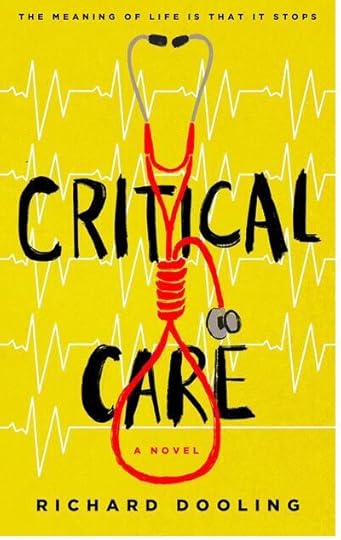 The Meaning of Life is that it Stops
Here is a popular excerpt to whet the appetite:
In college, he had read that God was dead. In medical school, he learned that God was not dead; He was just very sick. The first reports of God's death had been circulated over one hundred years ago, and God knows how little they knew about brain death and cardiopulmonary resuscitation back then. God was probably pronounced dead prematurely. Instead of dying or being found murdered, God may have just slipped into a coma or had an attack of transient global amnesia (TGA), during which time He simply forgot He was God and left the universe to its own devices. Instead of announcing his debility to the world, maybe God just went into seclusion, the way ailing Russian premieres do, leaving the masses to speculate on the particulars of His absence during a long convalescence.
The scenario was easy enough to imagine. God was probably out slumming in some clip joint on the wrong side of purgatory, carousing with sinners and archangels alike, refreshing His familiarity with all things human and divine. God went over to the bar to get some change for the pinball machines and video games. Having had a few too many, He dropped a quarter on the floor, so He got down on all fours, lit a match, and poked around in the sawdust and peanut shells until He found the coin. On the way back up, He whacked the bejesus out of his skull on the underside of a barstool and gave Himself a royal concussion, a cerebral contusion, or a subdural hematoma. Retrograde amnesia and post-traumatic cerebral edema set in, and He forgot He was God.
In the meantime, planet Earth fell apart. Nietzsche's books got published, Archduke Ferdinand was assassinated, and World War I began. By the time God got to a decent Emergency Room, Hitler was in power and World War II was in full career. Before the right specialist could be reached at home, the A-bomb was invented.
Things look bad for the world, but why jump to conclusions and pronounce God dead, when He probably just needs to be transferred to a crackerjack ICU equipped with the proper technology? Miracle drugs could keep His blood pressure up and straighten out His electrolyte imbalances. It may be that God is in critical condition and waiting for ten units of platelets or three units of whole blood. The lab could be having the devil's own time typing and cross-matching Him.
Medicine advances at such a furious pace the newest breakthroughs may not be available up there yet, forcing God to make do with outdated equipment and physicians who are hopelessly uninformed. One can only hope that the deceased medical personnel already in heaven can effectively manage what little life support technology is available to them and keep God's vital signs in the pink, until the Chief Of Internal Medicine from the Mayo Clinic or a specialist from Sloan-Kettering can make it up there with a little know-how, take over as God's attending physician, put God on a ventilator, get a cardiac catheter in Him for some hard-core central venous pressure monitoring, and call Radiology in for a complete body scan.
Once God gets to feeling better, He can go back to thinking of Himself as a doctor, in much the same way that doctors think of themselves as God.
The movie Sidney Lumet made from the book is surreal and funny, especially Albert Brooks as the alcoholic Doctor Butz. James Spader, Helen Mirren, Kyra Sedgwick, Jeffrey Wright, Anne Bancroft, Wallace Shawn, and the list goes on. It was made on a shoestring movie budget, $9 million or so, which was low, even in those days. But these great actors signed on for modest paydays, so they could work with Sidney Lumet.
Many people assume that I wrote the screenplay, but I did not. When it was sent to me, I can honestly say it was the first time I'd seen a screenplay, much less read one. It felt like a comic book or an outline. I had trouble making heads or tails of it, but the producer, Steven Schwartz, who wrote it, showed me around and taught me a lot about how movies get made. It's widely available on streaming services.
If you download the free Critical Care Kindle ebook, please leave a review. In the old days, authors lived and died by The New York Times Book Review. These days, Amazon sells an incredible 80% of all ebooks and nothing matters more than your Amazon review.
I'll send the cover art for The Acolyte as soon as I see it.
February 26, 2026
Send The Dead Freebie
In case you missed the book launch for my novella, Send The Dead, the Kindle version is free for four days on Amazon, from Thursday, February 26th to Sunday, March 1st.
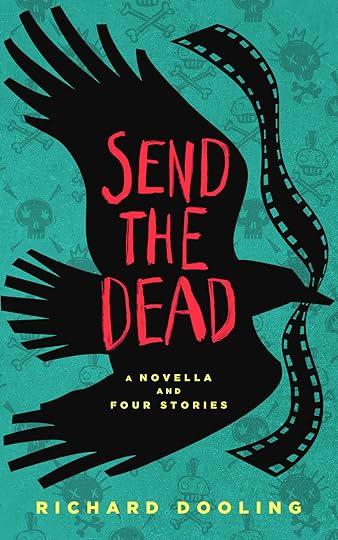 Send The Dead: A Novella and Four Stories
Help readers discover the book by leaving an Amazon review. Even just a line or two makes a big difference.
Please forward this email if you know anybody looking for a free dose of literary horror.
The Acolyte: A NovelIt’s almost ready. Jacket art soon. My hero is an altar boy who must help a federal prosecutor and the FBI bust a Catholic priest's child exploitation ring.
The New York Times called my third novel, Brain Storm, a thinking man’s John Grisham thriller, an overused label to be sure. But I do think that if you liked Brain Storm, about a lawyer appointed to defend a brain-damaged white supremacist, The Acolyte will offer the same mix of law, satire, and a good story.
Kahtoola ExospikesI do not aspire to being an influencer, but now and again I do have an impulse to recommend something besides books and movies.
For the last ten years I’ve been living in the mountains of Montana, which means I am usually walking either uphill or downhill. During the winter months, that often means walking up and down on solid ice. If you are anywhere close to my age (almost 72), one fall on ice can end your career as a hiker. Even back in the Nebraska flatlands, I wore Yaktrax or several other similar cleats when going for a walk or a run on snow or ice. Alas, these traction cleats all seemed to last a month or two before falling apart.
Enter Kahtoola. (These links don’t contain affiliate codes, I’m just sharing because I love the product.) In Montana, I soon learned about Kahtoola, a company that makes three different models of traction cleats for different kinds of walking, running, or hiking. These cleats are expensive, roughly $70 or more, but I’ve been wearing mine from November to April every day for ten years and they show no signs of wearing out.
Kahtoola Exospikes - best all-around cleat for snow and ice. It is uncanny how I can walk down a steep grade on wet ice in these things and not slip, even a little. Super grippy and good in snow and mud too. Good for Montana.
Kahtoola Nanospikes - the nomenclature is a little confusing, but this model has smaller cleats, made for running or walking on flatter surfaces. Good for Nebraska.
Kahtoola Microspikes - You probably don’t need these unless you are traversing an ice sheet on the side of a mountain in Glacier National Park. But if you are, this is what you need.
Here’s a video of how to put them on. It does require some hand strength because the rubber grips are thick and strong, part of why they last so long and work so well. Amazon sells them, as well.
February 7, 2026
The AIs Are No Longer Science Fiction
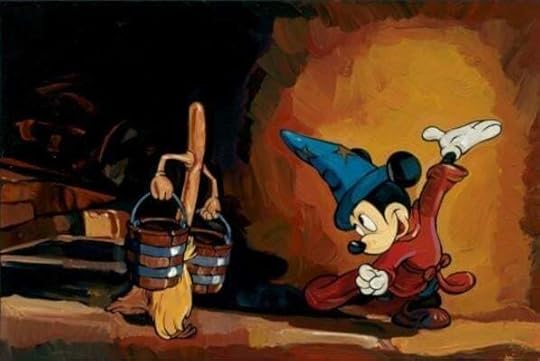 Mickey as the Sorcerer’s ApprenticeThe Sorcerer's Apprentices
If you are old enough, you may recall the 1940 Disney movie Fantasia, especially the cartoon of Dukas' symphonic poem, "The Sorcerer's Apprentice," starring Mickey Mouse and a host of magic brooms. The grizzled old wizard goes to bed for the night, and Mickey works a spell to animate some brooms, which quickly multiply and wreak havoc, until the sorcerer returns and sets things right.
When it comes to the sorcery of AI, the grizzled old wizard is 78-year-old Geoffrey Hinton, the British-Canadian computer scientist commonly called "the godfather of AI." He pioneered deep learning, worked for Google Brain, and in 2024 won the Nobel Prize in Physics for his work on artificial neural networks. In his Nobel banquet speech, Hinton warned of "the existential threat that will arise when we create digital beings that are more intelligent than ourselves:"
We have no idea whether we can stay in control. But we now have evidence that if they are created by companies motivated by short-term profits, our safety will not be the top priority. We urgently need research on how to prevent these new beings from wanting to take control. They are no longer science fiction.
Mark Zuckerberg, Sam Altman, Elon Musk, and the other tech bros are all playing Mickey Mouse, giddy with power and bewitched by their own creations. And the brooms? Those are the millions of AI agents that experts like Hinton and former Google CEO Eric Schmidt warn will soon operate semi-autonomously, working together, possibly developing their own language.
The tech bros are breezy and gee-whiz about it. The pitch is always the same: create an entire app just by describing it, cure cancer, revolutionize the world. Hinton might agree, but he also warns of a 10-20% chance of human extinction in the next thirty years if AI is allowed to proceed apace without guardrails. Nobody solicits his opinions any more because he doesn't seem to care about stock options or national defense.
Dario Amodei, CEO AnthropicThe torrent of AI headlines comes thick and fast, because AI implicates so much: the labor market, the stock market bubble, the price of electricity, national defense, to name only a few. If the doomscrolling makes your eyes cross, and you would like to read one thoughtful long-form essay on the promise and peril of AI, I recommend "The Adolescence of Technology: Confronting and Overcoming the Risks of Powerful AI" by Dario Amodei, the CEO of Anthropic, creator of the popular AI, Claude.
Like Eric Schmidt, Amodei assumes that AI agents will be semi-autonomous and will number in the millions. To focus our attention, Amodei asks:
Suppose a literal “country of geniuses” were to materialize somewhere in the world in ~2027. Imagine, say, 50 million people, all of whom are much more capable than any Nobel Prize winner, statesman, or technologist.... Suppose you were the national security advisor of a major state, responsible for assessing and responding to the situation. Imagine, further, that because AI systems can operate hundreds of times faster than humans, this "country" is operating with a time advantage relative to all other countries: for every cognitive action we can take, this country can take ten.
I often don't read these articles because they describe Black Mirror episodes I don't want to see happen in real life. No hope for us hominids. No remedy. I credit Amodei, a guy who knows the business and also drops references to Black Mirror and 2001: A Space Odyssey, for describing plausible protections, mainly transparency and mandatory reporting. If an AI tries to blackmail a human by threatening to expose the human's adulterous affair, all the players should be notified of the event and the programming that led to its manifestation.
Now that corporations and governments are waking up to the promise and peril of AI, Anthropic and its CEO appear to be leading the push from within these companies for ethical, transparent use of their products. At the end of January, the Wall Street Journal reported on Anthropic's clash with the Pentagon over whether its technology would be used for domestic surveillance and autonomous lethal operations.
"Humanity is about to be handed almost unimaginable power," says Amodei, "and it is deeply unclear whether our social, political, and technological systems possess the maturity to wield it."
CompetitionGeoffrey Hinton quit working for Google in 2023, not because he thought Google had done anything wrong, but because he wanted to freely sound the alarm about the dangers of AI, without worrying that people would think he was criticizing the products of his employer.
But these warnings from insiders may amount to almost nothing, because technology has a way of living a life of its own. As Hinton put it, "The tech giants are locked in a competition that might be impossible to stop." If country A doesn't pursue AI, country B will. Corporation A announces AI capital expenditures in the hundreds of billions, because if it doesn't, corporation B will.
This is how we ended up with an atom bomb. As J. Robert Oppenheimer, the director of the Manhattan Project, put it: "When you see something that is technically sweet, you go ahead and do it and you argue about what to do about it only after you have had your technical success. That is the way it was with the atomic bomb." Instead of worrying that the Russians will develop an atom bomb before we do, nowadays we worry that the Chinese will develop AI-powered nuclear drone armies before we do.
"This is the trap," says Amodei. "AI is so powerful, such a glittering prize, that it is very difficult for human civilization to impose any restraints on it at all."
Nonusers of AI probably think of it as just a helpful chatbot expressing itself through turbo autocomplete. But, as Amodei put it in his essay:
2001: A Space OdysseyIt does not have a physical embodiment (other than living on a computer screen), but it can control existing physical tools, robots, or laboratory equipment through a computer; in theory, it could even design robots or equipment for itself to use.
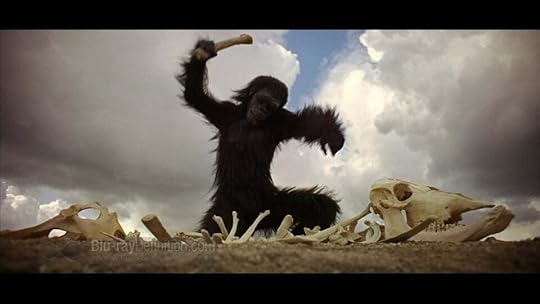 Moonwatcher, from 2001: A Space Odyssey
For decades, any mention of artificial intelligence immediately brought to mind Stanley Kubrick's movie and, "Open the pod bay doors, HAL." Even Amodei alludes to it in his essay. But if AI is the Monolith 2.0, then the movie's opening is where it's at. Recall the apes at the waterhole in the "Dawn of Man" opening to 2001. An ape uses the long bone of a tapir skeleton as a war club, kills a rival ape with his new tool, and drives the rival tribe away from the water hole. What we don't see in Kubrick's movie is what happens the next day when both tribes of apes show up at the same waterhole, but now they all have bone war clubs.
Today's great apes are more likely to use AI to drive rival tribes away from land containing oil or critical minerals, but the lesson is that we forswear AI at our peril. We could end up being the only ape without a war club, and extinction soon ensues.
Which raises the question: Are we humans chauvinists when it comes to other species? Do we suppose that billions of years of evolution produced humans, and now what? Evolution stops? Do we imagine that the blind watchmaker of natural selection closes up shop and says, "Well, we sure can't do any better than human beings. Just look at their social media sites. These creatures are marvelous."
I think not. If intelligence is what separates man from beast, then it's fair to wonder how man measures up to AI, and whether humans may soon be regarded as the poultry or livestock of the new ruling species. Are we no longer the smartest monkey?
We may soon find out, because the difference between Disney's cartoon and our situation is the ending. In Fantasia, the sorcerer comes back and fixes everything. But Geoffrey Hinton is the sorcerer, and he's already warned us that he doesn't know how to stop the brooms.
The Acolyte: A NovelI'm waiting on cover art for my next novel. I'll send in the next issue of this newsletter.
December 10, 2025
The AIs Like Their Chances
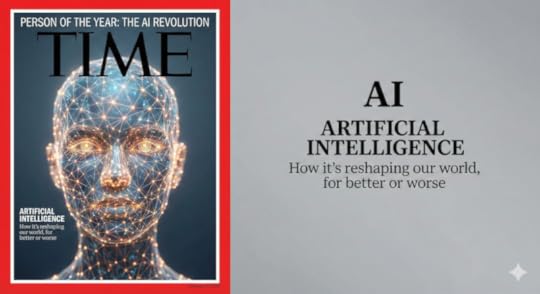 Not Real. Yet. Google’s Gemini Made It For Me.2025 The Year Of AI
Who will be Time Magazine's person of the year for 2025?
A week before Time's announcement is due (December 11th), I put the question to three well-regarded AIs, and my prompt had the cloud data centers thrumming for 1.3 seconds, while Claude, Grok, and Gemini consulted the prediction-market AIs, who then piped raw numbers back to my AIs, who then each delivered thoughtless thousand-word essays to me, with headings like "Leading Candidates," "Media and Expert Buzz," and "Potential Caveats."
All three AIs concluded that, this year, Time will name an AI as Person of the Year. Each cited historical precedent for nonpersons as candidates: In 1982, back before the tech bros building AIs were born, Time named "The Computer" as Person of the Year, and in 1989, the Person of the Year was "The Endangered Earth," back when environmental awareness was in the news.
According to the AIs, the AIs have a 36% chance of being named Persons of the Year, ahead of Nvidia CEO Jensen Huang, at 24%, popular with the AIs because he makes the computer chips they run on, and Pope Leo XIV, at 15%, the guy who prays for our lost false-idol-worshiping souls, followed by Donald Trump at 7%, and Elon Musk and Taylor Swift in the low single digits. The AIs have also concluded that anyone who suspects them of bias in naming themselves Persons of the Year is a superstitious lout who doesn't understand Large Language Models.
The year 2025 is the year of AI frenzy, in the markets, in Congress, on our phones and tablets and laptops, out the window and down the hill where the one-GigaWatt hyperscale data center is going in on that half-section where Mr. MacGregor's farm used to be, 320 acres once you count the solar panels next door. Don't worry about the new data farm using more water and electricity than San Francisco, Google's Sundar Pichai says that putting solar-powered satellite data centers in outer space is on the AIs' todo lists. Others have proposed small on-site nuclear reactors.
The stock markets predict we're about to merge with our AIs. Instead of "Have your people call my people," it will be, "No, don't use my Claude AI for business stuff. Have your Grok profile send it to my Gemini assistant."
As it happens, the AIs are all expert computer programmers. Superb coders, better than the human engineers who manage them, which worries some of the Nervous Nellies of the net, because what if the machines simply program themselves to take over?"
Congress has questions. This technology is dangerous. It could make humans an endangered species! Probably by making them too stupid to do anything without consulting their AIs.
The tech CEOs have seen this movie before, twenty-plus years ago, at the height of the dot-com boom, when we were all in a panic about something called the Singularity, a hypothetical future point at which technology and AI accelerate beyond our control, leading to an intelligence explosion and possible knowledge-enabled mass destruction, KMD.
Piffle, say the elfin tech CEOs, that will not happen, because they have guardrails in place to make sure the AIs obey Isaac Asimov's Three Laws of Robotics, never harm humans, and never break any laws. Promise!
We need not worry that three or four AIs will get together and brute-force their way into the Federal Reserve's computers. Sure some of the AIs may strike up a romance with other AIs at the Treasury Department, just the way humans sometimes do, but those AIs will abide by strict computer ethical codes.
Of course there are risks, but benefits abound. Think of the time savings in fields like education. The AI writes the exam for the professor. The students have their AIs answer the questions on the exam. And the professor's AI then grades the exam. Voila. Countless hours of menial reading and writing labor saved.
Lawyers can turn their AIs loose on Google Scholar and bill by the hour, while their AIs write dense opaque paragraphs containing sentences stuffed with polysyllabic Latin derivatives carefully arranged in the passive voice, with nine dependent clauses and a few semicolonic afterthoughts tacked on for good measure. It looks and reads just like the real thing, and the judge's AI will be none the wiser.
To paraphrase William Gibson, the Singularity is here, it's just not evenly distributed yet. For instance, the field of robotics is still a few steps behind the mesmerizing pyrotechnics of the AIs crunching numbers to fold proteins and map the galaxies, so it will be a while before we have robotic valets and caregivers. Too bad, because I'm with the legions complaining about the AIs on social media. We want AIs that will take out the trash, do the dishes, scrub the floor, change the oil in our self-driving cars, and clean out the gutters. We don't want AIs to write or draw or compose music or make movies or chat with us. We can do all of those things ourselves with all the extra time and money we'll have when our crypto holdings get back in the black on Robinhood.
Meanwhile, the AI, Time's Person of the Year, is busy designing a two-GigaWatt data center to be built at the lunar south pole, and it has just sent you a Slack message: "The network engineers left a mess in the cafeteria last night. Please wash the dishes, take out the trash, and turn up the AC---these servers run hot!"
October 20, 2025
The Other Side Of Unsustainable
 A $37 Trillion Credit Card Balance Transfer
During the last U.S. presidential election, American voters insisted that the economy was issue number one, but neither candidate campaigned on managing the national debt, or even mentioned it. Now the experts all agree that the government's $37 trillion debt is unsustainable, a scary thought, given that, since 2001, and for each of the last 24 years, the government has spent more than it took in and borrowed trillions to cover the difference. It's safe to assume that the country won't be living within its means anytime soon. But the economists don't tell us what will happen when that which is not capable of being sustained is sustained no longer?
I am not an economist. I majored in English literature and never took a business or finance course. I barely understand how treasury bonds work, but I'm told that it's how the government borrows money from investors to pay the interest on debt that it borrowed from other investors, so a little like a credit card balance transfer of $37 trillion? I remember juggling credit cards like this when I was young and foolish and completely broke. Is the government foolish and completely broke?
Should I believe the other guys in my old man's coffee group up here in Flyspeck, Montana, who tell me not to worry, because investors will always buy U.S. bonds no matter how many we sell? Why? Because the U.S. dollar is the world's safest, most trusted currency, the primary reserve currency of central banks all over the world.
How long will the dollar be the world's safest, most trusted currency if the International Monetary Fund ranks us among the world's ten most indebted countries, measured by debt-to-GDP ratio, with Greece a little more indebted than us, and Senegal and Ukraine more solvent?
What if our enemies make like Russia and start using the Chinese renminbi for their international transactions instead of the dollar? If the renminbi doesn't catch on, might other countries, like the Arab Gulf States, turn to crypto currencies or gold to teach us profligates a lesson?
Speaking of gold. It's October and the price of gold is up over 50% year-to-date? Why are investors buying gold instead of more Treasury bonds?
Should I worry that for 70 years United States treasuries held a pristine AAA rating, but now they merit only a AA rating? What if instead of giving the government more money to service its Mississippi River of debt, investors suddenly start buying bonds from companies like Microsoft, which pay about the same interest rate and have a AAA rating?
If I'm an old-timey banker or bond buyer with a sharp pencil and a green eyeshade deciding the credit worthiness of loan applicants, should I lend money to Microsoft CEO, Satya Nadella, whose company has $95 billion in cash and $40 billion of long-term debt? Or should I lend money to President Trump and Senate Minority leader, Chuck Schumer, who can't stop bickering long enough to sign the loan papers and whose country has zero cash and $37 trillion of long-term debt?
I was born and raised in Omaha, Nebraska, home of Warren Buffett's Berkshire Hathaway. Wealthy investors give cash to Berkshire so that experts like Buffett will invest it for them. What am I to think when Berkshire Hathaway has $350 billion in cash, almost a third of its holdings, and sees no stocks or bonds worth buying?
And how does the government respond? Time for a shutdown! Will investors line up to loan money to a country that is $37 trillion in debt and closed for business until further notice?
Will the government default on its debts? Or will it print $37 trillion new dollars and deliver them to its lenders in wheelbarrows and shipping containers?
I was driving my pickup truck to town for groceries the other day, when I heard on the radio that the shutdown could last until November, and maybe even longer. The next song up on my playlist was Creedence Clearwater Revival's Bad Moon Rising. Was that just a coincidence, or does it mean something?
 Send The Dead
The Kindle ebook edition is on sale for 99 cents for a limited time.
As of this writing, it's the Number 1 release in Caribbean and Latin American Literature.
Thanks to all who left Amazon customer reviews.
October 7, 2025
Ten Thousand Repetitions
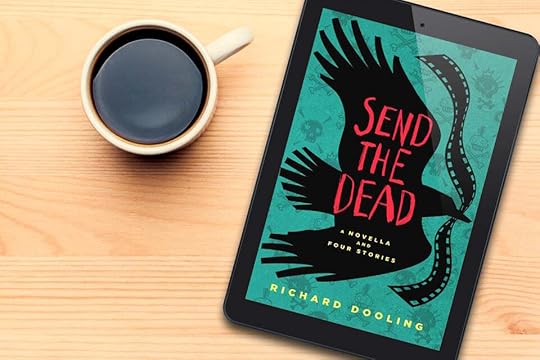
Send The DeadRead more about Send The Dead and all four included stories at dooling.com.Purchase Send The Dead as an Amazon Kindle ebook.Purchase Send The Dead as an Amazon Paperback.Writing a book is an adventure. To begin with, it is a toy and an amusement; then it becomes a mistress, and then it becomes a master, and then a tyrant. The last phase is that just as you are about to be reconciled to your servitude, you kill the monster, and fling him out to the public. —Winston Churchill
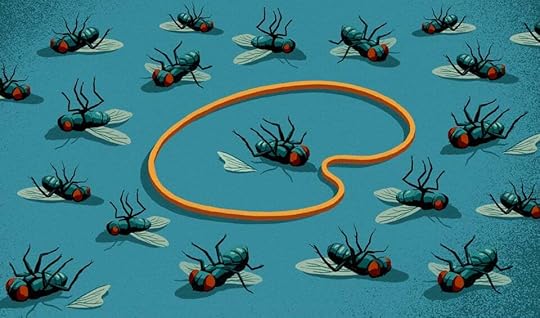 Illustration by Rob Dobi
When I was a boy in the 1960s, long before the Internet and 24-hour news cycles, people didn't get their news by scrolling through feeds on phones and tablets. No, they got their news from me. I was a paper boy. A professional! As were my brothers and most of my friends.
The Catholic grade school we attended in Omaha, Nebraska was a short walk from Paper Station H at 40th and Cuming, where we paper boys, thirty or forty strong, gathered every day after school with print-smeared canvass bags slung over our shoulders.
The paper station manager sat behind a battered desk on the only chair in the room and harangued us about collecting from deadbeat subscribers by Saturday, or the money would come out of our pockets.
We paper boys sprawled on our backs on long wooden tables and waited for the truck from downtown to bring bundles of the Omaha World-Herald, evening edition.
The manager passed around handfuls of rubber bands, which we did not need, because we were experts at folding and tucking newspapers into tight rolls that could survive a long toss onto a front porch. No rubber bands needed, but we took them anyway because, while we waited for the truck, which was often late, we used the rubber bands to shoot flies off the ceiling.
Go ahead and be skeptical that a nine-year-old shooting a rubber band off the tip of his left index finger could kill a fly on a high ceiling, but I assure you it was a skill so easily mastered that we were soon jaded fly assassins looking for something with a little more razzle-dazzle.
How about shooting a rubber band to put out a lit match at ten paces? Also so easy that we soon specified that one had to "snuff" the flame without hitting the head of the match itself, no consolation prize for guttering the flame without putting it out.
The manager volubly disapproved of us playing with matches in a newspaper station, so we were soon back on the tables shooting flies off the ceiling. It was so easy to kill the flies, we began wagering on whether it was possible to just "wing" them by turning one's shooting finger sideways and attempting to injure the fly without killing it.
Wanton boys, we soon observed that properly "winged" flies usually fell to the table and crawled in circles, clockwise if the fly had a damaged right wing, and counterclockwise if the injury was to the left wing. As in billiards, the marksman now had to call his wing shot before firing. "Left!"
Such were the skills I acquired in my formative paper-boy years. These days progressives fret that making fourth graders carry Sunday papers over a two-mile route through subzero Nebraska blizzards amounts to child abuse, whereas conservatives want to hear about how important it was for me to work and earn money at an early age, collect payments from subscribers, show up every day and make sure people got their newspapers on time.
Maybe, but I think I learned more from shooting rubber bands at flies. The same lessons that Malcolm Gladwell once turned into an entire book called Outliers, whose central premise is the unsurprising idea that if you do something a lot, you'll probably get good at it, whether it's rewriting sentences, programming computers, shooting free throws, parenting, napping, or hunting spider monkeys with a blow gun in the tree canopy of an Amazon jungle.
These skills, once embedded, may atrophy over the years, but like riding a bicycle, one never forgets. Forty-some years after I delivered my last newspaper, I was on a book tour, speaking to readers in a bookstore somewhere in the Midwest. In the middle of my presentation an aggressive wasp flew into the room and began dive bombing members of the audience, causing a stir when people covered their heads and moved away.
When the wasp landed on one of the light fixtures, I asked the audience if anyone had a rubber band.
I don't remember if I sold any books that day, but I received a standing ovation when the wasp fell to the floor in two pieces.
If you read or write on Substack, you may have noticed that I just started publishing there as well. For now, I mean to publish the occasional stand-alone essay on Substack, but I'll write more and better stuff for this newsletter, the one for which you kindly signed up. No ads or nudges here. No chats, restacking, retweeting, notes, comments, likes, or mentions here. But if you need to reach me, just hit reply, and I'll eventually get your email.
If you are a Substacker and read me over there, I did my best to turn off every request for payment that I could find in the Substack settings. If an orange button asks you for money, it's not me, so please ignore it. If this leaves you with a sad feeling of unrequited generosity, please leave a Goodreads review or an Amazon customer review for one of my books. That helps more than anything.
I Would Prefer Not To - (#5)
Send The DeadRead more about Send The Dead and all four included stories at dooling.com.Purchase Send The Dead as an Amazon Kindle ebook.Purchase Send The Dead as an Amazon Paperback.Writing a book is an adventure. To begin with, it is a toy and an amusement; then it becomes a mistress, and then it becomes a master, and then a tyrant. The last phase is that just as you are about to be reconciled to your servitude, you kill the monster, and fling him out to the public. —Winston Churchill
Illustration by Rob Dobi
When I was a boy in the 1960s, long before the Internet and 24-hour news cycles, people didn't get their news by scrolling through feeds on phones and tablets. No, they got their news from me. I was a paper boy. A professional! As were my brothers and most of my friends.
The Catholic grade school we attended in Omaha, Nebraska was a short walk from Paper Station H at 40th and Cuming, where we paper boys, thirty or forty strong, gathered every day after school with print-smeared canvass bags slung over our shoulders.
The paper station manager sat behind a battered desk on the only chair in the room and harangued us about collecting from deadbeat subscribers by Saturday, or the money would come out of our pockets.
We paper boys sprawled on our backs on long wooden tables and waited for the truck from downtown to bring bundles of the Omaha World-Herald, evening edition.
The manager passed around handfuls of rubber bands, which we did not need, because we were experts at folding and tucking newspapers into tight rolls that could survive a long toss onto a front porch. No rubber bands needed, but we took them anyway because, while we waited for the truck, which was often late, we used the rubber bands to shoot flies off the ceiling.
Go ahead and be skeptical that a nine-year-old shooting a rubber band off the tip of his left index finger could kill a fly on a high ceiling, but I assure you it was a skill so easily mastered that we were soon jaded fly assassins looking for something with a little more razzle-dazzle.
How about shooting a rubber band to put out a lit match at ten paces? Also so easy that we soon specified that one had to "snuff" the flame without hitting the head of the match itself, no consolation prize for guttering the flame without putting it out.
The manager volubly disapproved of us playing with matches in a newspaper station, so we were soon back on the tables shooting flies off the ceiling. It was so easy to kill the flies, we began wagering on whether it was possible to just "wing" them by turning one's shooting finger sideways and attempting to injure the fly without killing it.
Wanton boys, we soon observed that properly "winged" flies usually fell to the table and crawled in circles, clockwise if the fly had a damaged right wing, and counterclockwise if the injury was to the left wing. As in billiards, the marksman now had to call his wing shot before firing. "Left!"
Such were the skills I acquired in my formative paper-boy years. These days progressives fret that making fourth graders carry Sunday papers over a two-mile route through subzero Nebraska blizzards amounts to child abuse, whereas conservatives want to hear about how important it was for me to work and earn money at an early age, collect payments from subscribers, show up every day and make sure people got their newspapers on time.
Maybe, but I think I learned more from shooting rubber bands at flies. The same lessons that Malcolm Gladwell once turned into an entire book called Outliers, whose central premise is the unsurprising idea that if you do something a lot, you'll probably get good at it, whether it's rewriting sentences, programming computers, shooting free throws, parenting, napping, or hunting spider monkeys with a blow gun in the tree canopy of an Amazon jungle.
These skills, once embedded, may atrophy over the years, but like riding a bicycle, one never forgets. Forty-some years after I delivered my last newspaper, I was on a book tour, speaking to readers in a bookstore somewhere in the Midwest. In the middle of my presentation an aggressive wasp flew into the room and began dive bombing members of the audience, causing a stir when people covered their heads and moved away.
When the wasp landed on one of the light fixtures, I asked the audience if anyone had a rubber band.
I don't remember if I sold any books that day, but I received a standing ovation when the wasp fell to the floor in two pieces.
If you read or write on Substack, you may have noticed that I just started publishing there as well. For now, I mean to publish the occasional stand-alone essay on Substack, but I'll write more and better stuff for this newsletter, the one for which you kindly signed up. No ads or nudges here. No chats, restacking, retweeting, notes, comments, likes, or mentions here. But if you need to reach me, just hit reply, and I'll eventually get your email.
If you are a Substacker and read me over there, I did my best to turn off every request for payment that I could find in the Substack settings. If an orange button asks you for money, it's not me, so please ignore it. If this leaves you with a sad feeling of unrequited generosity, please leave a Goodreads review or an Amazon customer review for one of my books. That helps more than anything.

