
Michael Fitzgerald's Blog
January 19, 2026
Michael was recently part of the Channel 4 documentary, H...
The post appeared first on Professor Michael Fitzgerald.


UPDATE
The post UPDATE appeared first on Professor Michael Fitzgerald.
July 31, 2019
Freud on Trial Book
Sigmund Freud was one of the most controversial writers of the 20th Century. He had Asperger’s Syndrome and so without understanding this condition, it is difficult to make sense of Freud and his writings. He was mainly a literary figure whose theories have very little scientific support. His greatest contribution was that he thought us to listen to patients. This book sets Sigmund Freud in the context of Psychotherapy today and focuses on the pros and the cons of Freud and his theories. Click here to buy your copy on Amazon.
The post Freud on Trial Book appeared first on Professor Michael Fitzgerald.
December 18, 2018
Autism beyond DSM 5 – World Autism Association Lecture, Houston, Texas, USA
This lecture delivered by Prof. Michael Fitzgerald at the World Autism Association in the USA, focuses on many issues not dealt with in DSM 5. It deals with Autism as an endlessly contradictory condition.
World Autism Association, Houston, Texas, November 2018 – Powerpoint Presentation
Autism Beyond DSM 5 – World Autism Association – Houston, Texas, November 2018
The post Autism beyond DSM 5 – World Autism Association Lecture, Houston, Texas, USA appeared first on Professor Michael Fitzgerald.
Challenging DSM 5 Conference – Trinity College, Dublin, Ireland – November 2013
This presentation was about diagnostic problems in the area of Autism and was delivered in Trinity College, Dublin by Prof. Michael Fitzgerald in November 2013
Challenging DSM V Conference – Trinity College Dublin – November 2013
The post Challenging DSM 5 Conference – Trinity College, Dublin, Ireland – November 2013 appeared first on Professor Michael Fitzgerald.
October 23, 2018
Psychosocial factors associated with psychological problems in Irish children and mothers

The results of this study show that for Irish primary school children, the probability of psychiatric illness is positively associated with low IQ and reading difficulties, large family size, being a boy rather than a girl, and having a mother who is dissatisfied with her marriage or her role as mother.
For the mothers of these children, depression is positively associated with having an unemployed husband, and with being dissatisfied with the level of family income, with their relations with their relatives and their neighbours, with the opportunity foe leisure, and with their performance in their role as a parent.
The stress of unemployment, financial difficulties, lack of social support, and inadequate leisure opportunities appears to leave mothers prone to depression, which has the effects of undermining their parenting ability and makes it more likely that their children develop child psychiatric difficulties.
Family unemployment and economic disadvantage significantly effects mothers health.
To read the full article, click here
The post Psychosocial factors associated with psychological problems in Irish children and mothers appeared first on Professor Michael Fitzgerald.
March 28, 2018
April 7, 2017
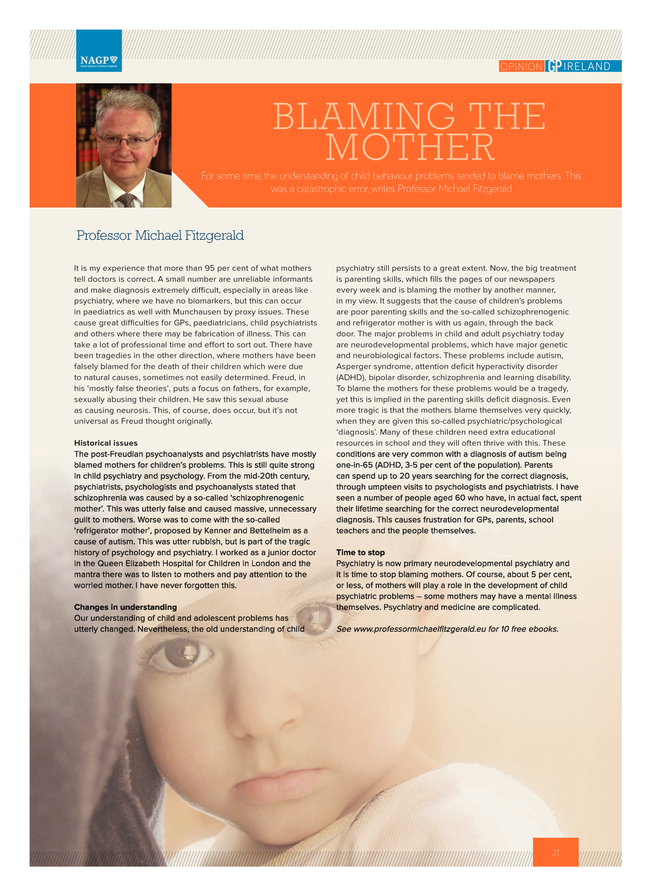
Blaming the Mother
The importance of listening to the mother – Tips on accessing children with behavioural difficulties.
For some time, the understanding of child behaviour problems tended to blame mothers. This was a catastrophic error, writes Professor Michael Fitzgerald
PUBLISHED IN OPINION GP IRELAND
ABOUT NAGP
The NAGP is the voice of General Practice. The NAGP was relaunched as the NAGP in order to represent the interests of general practitioners, to help shape the future of primary care and to engage in activities that improve patient outcomes.
Blaming the Mother Article by Prof. Michael Fitzgerald – Opinion GP Ireland
The post Blaming the Mother appeared first on Professor Michael Fitzgerald.
March 1, 2017
Psychiatric Problems in Irish Children and Adults – From Childhood to Adulthood
A longitudinal follow up study
From Child to Adult
A Longitudinal Study of Irish Children and their Families
Co-Author: Cleary A., Fitzgerald M., & Nixon E.
Publisher: University College Dublin
Criterion Press Ltd.
ISBN: 1 9022 7785 6
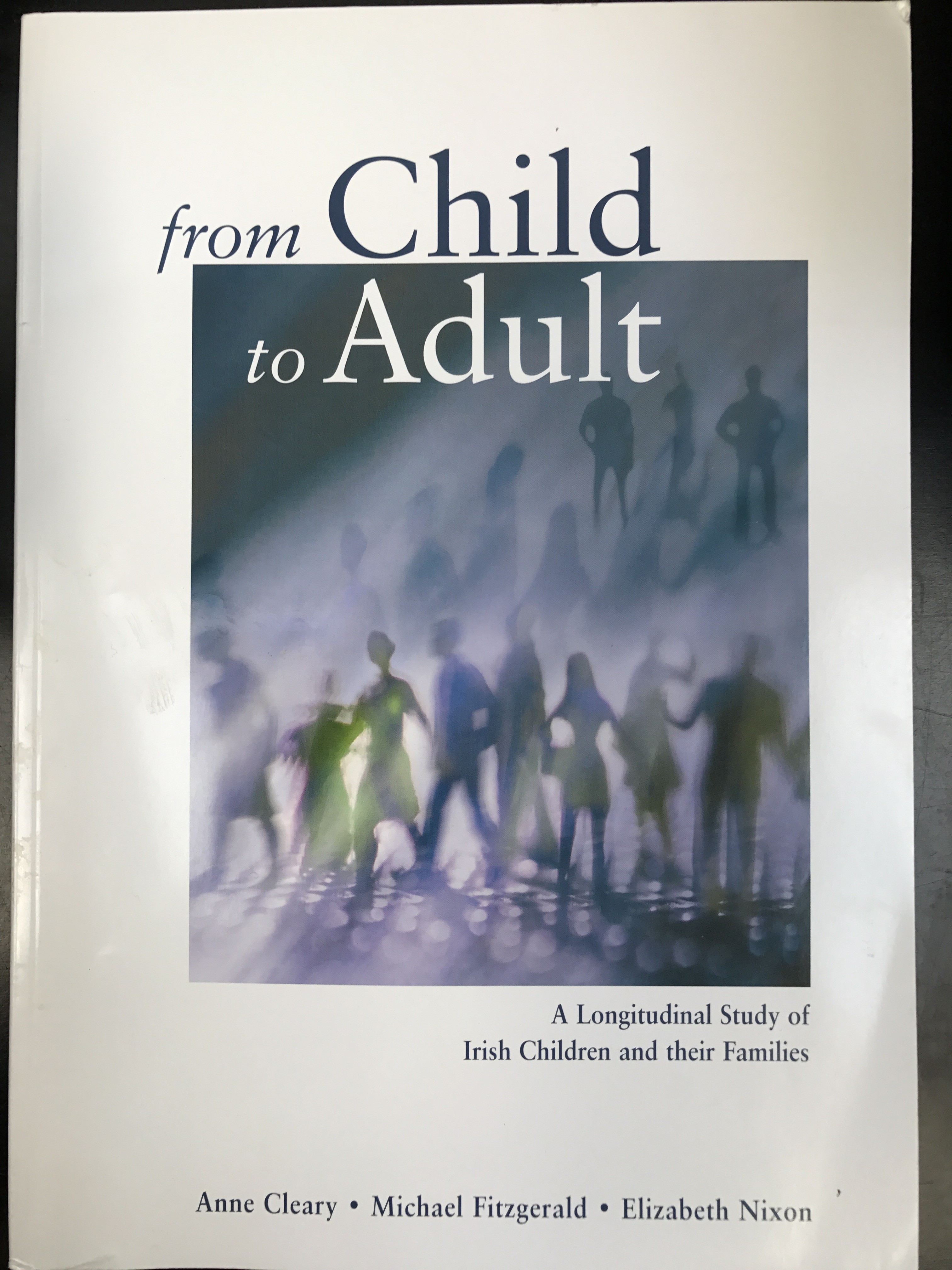
Free book to download on psychological problems in Irish Children and Adults.
A follow up study of children, studied in childhood to adulthood, 21 years, showed symptom levels were high and approximately one fifth of the respondents had probable psychiatric conditions and 55% had used non prescription drugs. Behavioural deviance at age 11 was highly predictive of poor educational outcome at age 21.
A majority of mothers previously diagnosed as suffering from psychological problems when their child was 10 had now recovered. Economic disadvantage exasperated the negative outcomes.
40% of children followed up, regarded religion as important in their lives.
This book is free to download from my website.
Click here for more information about this book and to download it.
The post Psychiatric Problems in Irish Children and Adults – From Childhood to Adulthood appeared first on Professor Michael Fitzgerald.
November 24, 2016
Autism – Serious Diagnostic Problems – Irish Medical Times Article – 4th Nov 2016
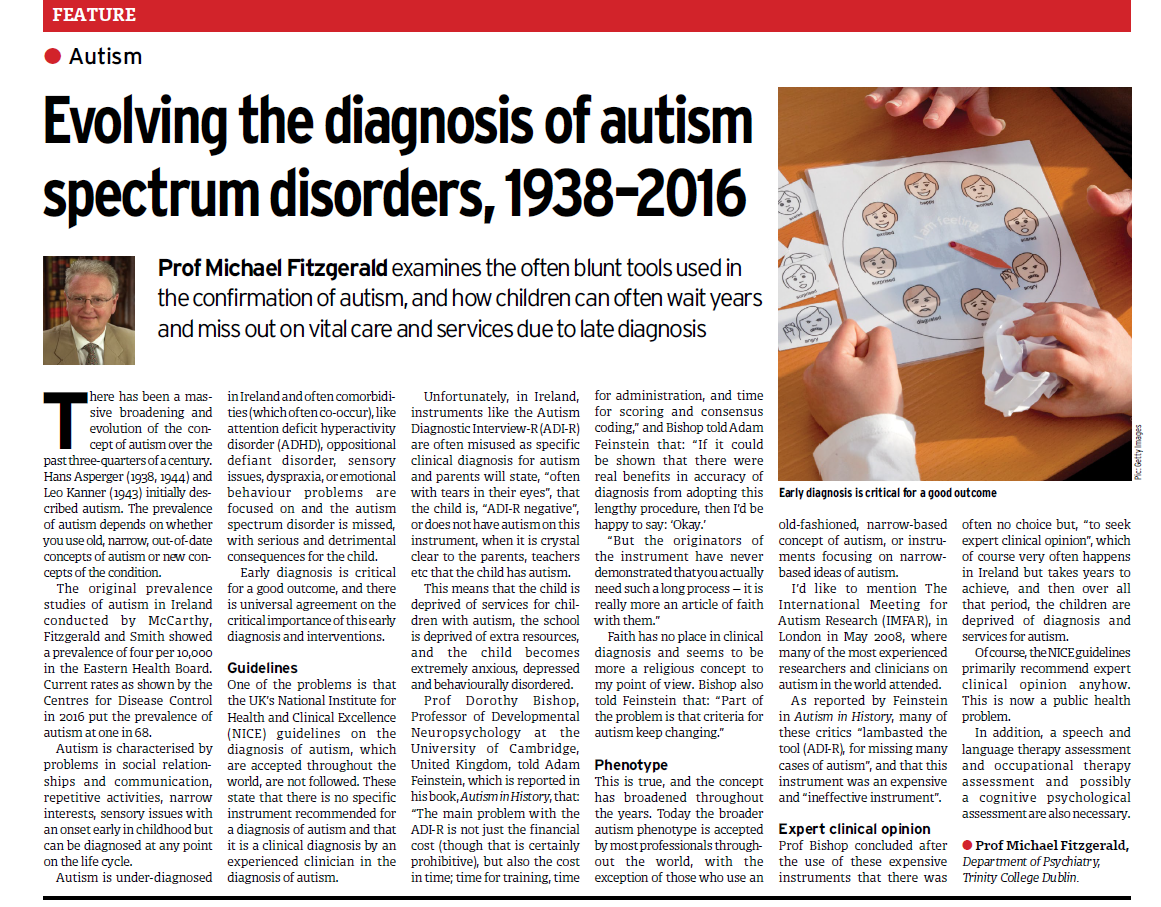 There has been a massive broadening and evolution of the concept of autism over the past three-quarters of a century. Hans Asperger (1938, 1944) and Leo Kanner (1943) initially described autism. The prevalence of autism depends on whether you use old, narrow, out-of-date concepts of autism or new concepts of the condition. The original prevalence studies of autism in Ireland conducted by McCarthy, Fitzgerald and Smith showed a prevalence of four per 10,000 in the Eastern Health Board. Current rates as shown by the Centres for Disease Control in 2016 put the prevalence of autism at one in 68. Autism is characterised by problems in social relationships and communication, repetitive activities, narrow interests, sensory issues with an onset early in childhood but can be diagnosed at any point on the life cycle. Autism is under-diagnosed in Ireland and often comorbidities (which often co-occur), like attention deficit hyperactivity disorder (ADHD), oppositional defiant disorder, sensory issues, dyspraxia, or emotional behaviour problems are focused on and the autism spectrum disorder is missed, with serious and detrimental consequences for the child. Early diagnosis is critical for a good outcome, and there is universal agreement on the critical importance of this early diagnosis and interventions.
Guidelines
One of the problems is that the UK’s National Institute for Health and Clinical Excellence (NICE) guidelines on the diagnosis of autism, which are accepted throughout the world, are not followed. These state that there is no specific instrument recommended for a diagnosis of autism and that it is a clinical diagnosis by an experienced clinician in the diagnosis of autism. Unfortunately, in Ireland, instruments like the Autism Diagnostic Interview-R (ADI-R) are often misused as specific clinical diagnosis for autism and parents will state, “often with tears in their eyes”, that the child is, “ADI-R negative”, or does not have autism on this instrument, when it is crystal clear to the parents, teachers etc that the child has autism. This means that the child is deprived of services for children with autism, the school is deprived of extra resources, and the child becomes extremely anxious, depressed and behaviourally disordered. Prof Dorothy Bishop, Professor of Developmental Neuropsychology at the University of Cambridge, United Kingdom, told Adam Feinstein, which is reported in his book, Autism in History, that: “The main problem with the ADI-R is not just the financial cost (though that is certainly prohibitive), but also the cost in time; time for training, time for administration, and time for scoring and consensus coding,” and Bishop told Adam Feinstein that: “If it could be shown that there were real benefits in accuracy of diagnosis from adopting this lengthy procedure, then I’d be happy to say: ‘Okay.’ “But the originators of the instrument have never demonstrated that you actually need such a long process – it is really more an article of faith with them.” Faith has no place in clinical diagnosis and seems to be more a religious concept to my point of view. Bishop also told Feinstein that: “Part of the problem is that criteria for autism keep changing.”
Phenotype
This is true, and the concept has broadened throughout the years. Today the broader autism phenotype is accepted by most professionals throughout the world, with the exception of those who use an old-fashioned, narrow-based concept of autism, or instruments focusing on narrowbased ideas of autism. I’d like to mention The International Meeting for Autism Research (IMFAR), in London in May 2008, where many of the most experienced researchers and clinicians on autism in the world attended. As reported by Feinstein in Autism in History, many of these critics “lambasted the tool (ADI-R), for missing many cases of autism”, and that this instrument was an expensive and “ineffective instrument”.
Expert clinical opinion
Prof Bishop concluded after the use of these expensive instruments that there was often no choice but, “to seek expert clinical opinion”, which of course very often happens in Ireland but takes years to achieve, and then over all that period, the children are deprived of diagnosis and services for autism. Of course, the NICE guidelines primarily recommend expert clinical opinion anyhow. This is now a public health problem. In addition, a speech and language therapy assessment and occupational therapy assessment and possibly a cognitive psychological assessment are also necessary.
Prof Michael Fitzgerald, Department of Psychiatry, Trinity College Dublin.
The post Autism – Serious Diagnostic Problems – Irish Medical Times Article – 4th Nov 2016 appeared first on Professor Michael Fitzgerald.
Michael Fitzgerald's Blog

- Michael Fitzgerald's profile
- 5 followers

