Skye Cleary's Blog
March 19, 2017
Existentialism & Romantic Love just released in paperback...
My book Existentialism and Romantic Love has finally been released in softcover! (Which means it’s $35 instead of $95.)
In case you’re interested, the link to the publisher’s website is here 


March 10, 2017
Simone de Beauvoir’s political philosophy resonates today...
[image error]
Simone de Beauvoir is rightly best known for declaring: ‘One is not born, but rather becomes, woman.’ A less well-known facet of her philosophy, particularly relevant today, is her political activism, a viewpoint that follows directly from her metaphysical stance on the self, namely that we have no fixed essences.
The existential maxim ‘existence precedes essence’ underpins de Beauvoir’s philosophy. For her, as for Jean-Paul Sartre, we are first thrown into the world and then create our being through our actions. While there are facts of our existence that we can’t choose, such as being born, who our parents were, and our genetic inheritance, we shouldn’t use our biology or history as excuses not to act. The existential goal is to be an agent, to take control over our life, actively transcending the facts of our existence by pursuing self-chosen goals.
It’s easy to find excuses not to act. So easy that many of us spend much of our lives doing so. Many of us believe that we don’t have free will – even as some neuroscientists are discovering that our conscious will can override our impulses. We tell ourselves that our vote won’t make any difference, instead of actively shaping the world in which we want to live. We point fingers at Facebook for facilitating fake news, instead of critically assessing what we’re reading and reposting. It’s not just lazy to push away responsibility in such ways, but it’s what de Beauvoir called a ‘moral fault’.
Since we’re all affected by politics, if we choose not to be involved in creating the conditions of our own lives this reduces us to what de Beauvoir called ‘absurd vegetation’. It’s tantamount to rejecting existence. We must take a side. The problem is, it’s not always clear which side we ought to choose. Even de Beauvoir failed to navigate through this question safely. She adopted questionable political stances: she once, for example, dismissed Chairman Mao – responsible for the murder of over 45 million people – as being ‘no more dictatorial’ than Franklin D Roosevelt. De Beauvoir’s philosophy of political commitment has a dark side, and she personally made some grave errors of judgement, yet within her philosophy, there’s an opening to address this issue.
In The Ethics of Ambiguity (1947) she argues that to be free is to be able to stretch ourselves into an open future full of possibilities. Having this kind of freedom may be dizzying, but it doesn’t mean we get to do whatever we like. We share the earth, and have concern for one another; if we respect freedom for ourselves, then we should respect it for others, too. Using our freedom to exploit and oppress others, or to support the side that promotes such policies, is inconsistent with this radical existential freedom.
With oppressive regimes, de Beauvoir acknowledged that individuals usually pay a high price for standing up to dictators and the tyranny of the majority, but demonstrated concretely – through her writing and political engagement – the power of collective action to bring about structural change. An intellectual vigilante, de Beauvoir used her pen as a weapon, breaking down gendered stereotypes and challenging laws that prohibited women from having control over their own bodies. She authored and signed the Manifesto of the 343 in 1971, which paved the way for birth control and abortion in France. Her most famous work, The Second Sex (1949), sparked a new wave of feminism across the world.
Today more than ever it’s vital to recognise that freedom can’t be assumed. Some of the freedoms that de Beauvoir fought so hard for in the mid-20th century have since come under threat. De Beauvoir warns that we should expect appeals to ‘nature’ and ‘utility’ to be used as justifications for restrictions on our freedom. And she has been proved correct. For example, the argument that Donald Trump and others have used that pregnancy is inconvenient for businesses is an implicit way of communicating the view that it is natural and economical for women to be baby-making machines while men work. However, de Beauvoir points out ‘anatomy and hormones never define anything but a situation’, and making birth control, abortion, and parental leave unavailable closes down men’s and women’s ability to reach beyond their given situations, reinforcing stereotypical roles that keep women chained to unpaid home labour and men on a treadmill of paid labour.
In times of political turmoil, one may feel overwhelmed with anxiety and can even be tempted with Sartre to think that ‘hell is other people’. De Beauvoir encourages us to consider that others also give us the world because they infuse it with meaning: we can only make sense of ourselves in relation to others, and can only make sense of the world around us by understanding others’ goals. We strive to understand our differences and to embrace the tension between us. World peace is a stretch, since we don’t all choose the same goals, but we can still look for ways to create solidarities – such as by working to agitate authoritarians, to revolt against tyrants, to amplify marginalised voices – to abolish oppression. Persistence is essential since, as de Beauvoir says, ‘One’s life has value so long as one attributes value to the life of others, by means of love, friendship, indignation and compassion.’ De Beauvoir is surely right that this is the risk, the anguish, and the beauty of human existence.
This article was originally published at Aeon and has been republished under Creative Commons.


Simone de Beauvoir’s political philosophy resonates today
[image error]
Simone de Beauvoir is rightly best known for declaring: ‘One is not born, but rather becomes, woman.’ A less well-known facet of her philosophy, particularly relevant today, is her political activism, a viewpoint that follows directly from her metaphysical stance on the self, namely that we have no fixed essences.
The existential maxim ‘existence precedes essence’ underpins de Beauvoir’s philosophy. For her, as for Jean-Paul Sartre, we are first thrown into the world and then create our being through our actions. While there are facts of our existence that we can’t choose, such as being born, who our parents were, and our genetic inheritance, we shouldn’t use our biology or history as excuses not to act. The existential goal is to be an agent, to take control over our life, actively transcending the facts of our existence by pursuing self-chosen goals.
It’s easy to find excuses not to act. So easy that many of us spend much of our lives doing so. Many of us believe that we don’t have free will – even as some neuroscientists are discovering that our conscious will can override our impulses. We tell ourselves that our vote won’t make any difference, instead of actively shaping the world in which we want to live. We point fingers at Facebook for facilitating fake news, instead of critically assessing what we’re reading and reposting. It’s not just lazy to push away responsibility in such ways, but it’s what de Beauvoir called a ‘moral fault’.
Since we’re all affected by politics, if we choose not to be involved in creating the conditions of our own lives this reduces us to what de Beauvoir called ‘absurd vegetation’. It’s tantamount to rejecting existence. We must take a side. The problem is, it’s not always clear which side we ought to choose. Even de Beauvoir failed to navigate through this question safely. She adopted questionable political stances: she once, for example, dismissed Chairman Mao – responsible for the murder of over 45 million people – as being ‘no more dictatorial’ than Franklin D Roosevelt. De Beauvoir’s philosophy of political commitment has a dark side, and she personally made some grave errors of judgement, yet within her philosophy, there’s an opening to address this issue.
In The Ethics of Ambiguity (1947) she argues that to be free is to be able to stretch ourselves into an open future full of possibilities. Having this kind of freedom may be dizzying, but it doesn’t mean we get to do whatever we like. We share the earth, and have concern for one another; if we respect freedom for ourselves, then we should respect it for others, too. Using our freedom to exploit and oppress others, or to support the side that promotes such policies, is inconsistent with this radical existential freedom.
With oppressive regimes, de Beauvoir acknowledged that individuals usually pay a high price for standing up to dictators and the tyranny of the majority, but demonstrated concretely – through her writing and political engagement – the power of collective action to bring about structural change. An intellectual vigilante, de Beauvoir used her pen as a weapon, breaking down gendered stereotypes and challenging laws that prohibited women from having control over their own bodies. She authored and signed the Manifesto of the 343 in 1971, which paved the way for birth control and abortion in France. Her most famous work, The Second Sex (1949), sparked a new wave of feminism across the world.
Today more than ever it’s vital to recognise that freedom can’t be assumed. Some of the freedoms that de Beauvoir fought so hard for in the mid-20th century have since come under threat. De Beauvoir warns that we should expect appeals to ‘nature’ and ‘utility’ to be used as justifications for restrictions on our freedom. And she has been proved correct. For example, the argument that Donald Trump and others have used that pregnancy is inconvenient for businesses is an implicit way of communicating the view that it is natural and economical for women to be baby-making machines while men work. However, de Beauvoir points out ‘anatomy and hormones never define anything but a situation’, and making birth control, abortion, and parental leave unavailable closes down men’s and women’s ability to reach beyond their given situations, reinforcing stereotypical roles that keep women chained to unpaid home labour and men on a treadmill of paid labour.
In times of political turmoil, one may feel overwhelmed with anxiety and can even be tempted with Sartre to think that ‘hell is other people’. De Beauvoir encourages us to consider that others also give us the world because they infuse it with meaning: we can only make sense of ourselves in relation to others, and can only make sense of the world around us by understanding others’ goals. We strive to understand our differences and to embrace the tension between us. World peace is a stretch, since we don’t all choose the same goals, but we can still look for ways to create solidarities – such as by working to agitate authoritarians, to revolt against tyrants, to amplify marginalised voices – to abolish oppression. Persistence is essential since, as de Beauvoir says, ‘One’s life has value so long as one attributes value to the life of others, by means of love, friendship, indignation and compassion.’ De Beauvoir is surely right that this is the risk, the anguish, and the beauty of human existence.
This article was originally published at Aeon and has been republished under Creative Commons.
June 30, 2016
Brainpickings on why we love
This morning I woke up to a ...
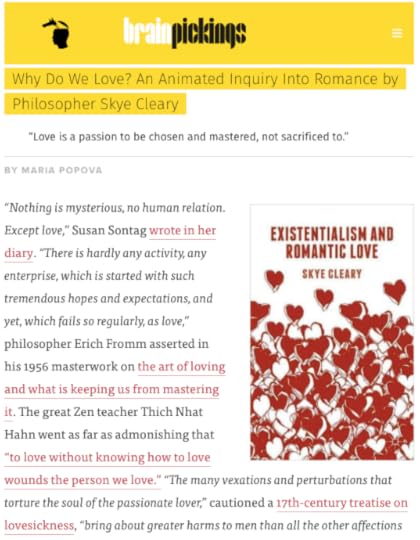
This morning I woke up to a lovely surprise… Maria Poppova of Brainpickings published a review of my book Existentialism and Romantic Love and the TED-Ed animation I scripted. Excited! Read the review here.


June 9, 2016
For the love of animals
My thoughts on aquaria appeared in Aeon today…
“What could possibly be wrong with taking your child to an aquarium? It seems like an innocent enough pleasure. Most children love watching exotic fish swimming behind glass, seahorses, sharks, rays, jellyfish and turtles. A visit to the aquarium is a mixture of entertainment and education, and seems much less morally dubious than going to a zoo to see gorillas, and probably much better than playing point-and-shoot video games. […]
Aquariums can, of course, be centres for conservation and research. But there is a special issue when we take children to visit them. We are setting an example of how we think we should live, and this might be done only by ignoring what’s in front of us, lying just beneath the surface.”
Read the full article on Aeon here.


June 1, 2016
Interview: Grammar Report
Very excited to be interviewed for my high school magazine! Thanks CGGS[image error] You can read the article here.


April 23, 2016
Applied Existentialism
THREE YOUNG and brilliant philosop...
THREE YOUNG and brilliant philosophers — the good-hearted Jean-Paul Sartre, the elegant Simone de Beauvoir, and the debonair Raymond Aron — sat in a bar on Paris’s rue du Montparnasse sometime around 1932. As they sipped apricot cocktails, they discussed how philosophy could be about everyday things, like apricot cocktails. Galvanized by the tipsy banter, Sartre had an epiphany: “Finally there is philosophy.”
This is an excerpt from my book review published today in the Los Angeles Review of Books! It’s a review of At The Existentialist Cafe by Sarah Bakewell. Read the full review here.



March 24, 2016
Cocktail Philosophy: Interview With Matthew Piacentini of...
Matthew Piacentini has just returned from the Reykjavic Bar Summit, a global cocktail bar competition. He is the owner of The Up & Up, a cocktail lounge in New York City’s Greenwich Village. I interviewed Matthew about his cocktail philosophy.
SC: How is the experience of drinking a cocktail different to wine or beer?
MP: Unlike beer, wine, and spirits, cocktails have no utilitarian purpose. For example, spirits were originally medicinal and for thousands of years, beer and wine have been considered safer to drink than water. Cocktail drinking has absolutely no purpose other than pleasure. It’s one of the last bastions of acceptable hedonism.
Also, wine and beer are primarily for drinking with food, while cocktails are to be enjoyed on their own. So, cocktails have to be fully formed things in their own right, and they don’t have to play nice with other things that are going in our mouths.
Read the rest of the article – including the story behind and the recipe for the Hailstone cocktail – on The Huffington Post.
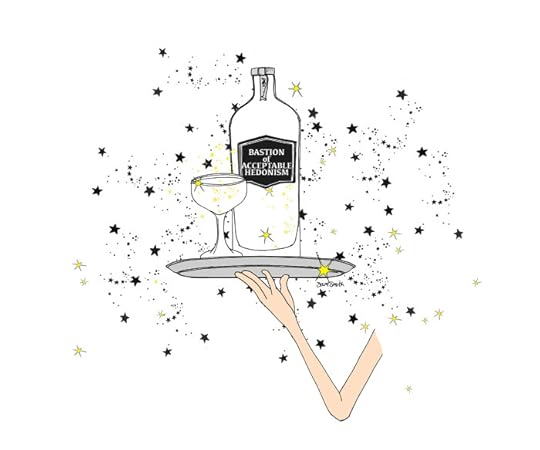
Illustration by Sam Smith of The Pop Heirloom Studios


February 11, 2016
TED Ed: Why do we love? A philosophical inquiry
Ah, roman...
Ah, romantic love; beautiful and intoxicating, heart-breaking and soul-crushing… often all at the same time! If romantic love has a purpose, neither science nor psychology has discovered it yet – but over the course of history, some of our most respected philosophers have put forward some intriguing theories.
My new TED Ed animation outlines a few philosophical perspectives on why we love.
If you’re interested in more about philosophies of love, my book Existentialism and Romantic Love is on Amazon here.
I’m also giving a couple of talks this weekend if you happen to be in New York or Boston.
Friday Feb 12th 6pm: MY EXISTENTIAL VALENTINE at the Cornelia Street Cafe in New York City
Sunday Feb 14th 1.30pm: EXISTENTIALISM, EVOLUTION, & ROMANTIC LOVE at Harvard Humanist Hub, Boston
Happy Valentine’s Day – if you’re choosing to celebrate it!
xxx



February 10, 2016
Existential Questions for a More Meaningful Valentine’s D...
Whether you love or hate Valentine’s Day, at the very least it’s a reminder to reflect on our relationships, and to think about how we can love better. The French existential philosopher Simone de Beauvoir thought about it a lot, often while drinking apricot cocktails and gin fizzes with her hip intellectual posse in trendy Paris cafés. She philosophized with her very famous and ugly boyfriend Jean-Paul Sartre, whom she refused to marry. She spent passionate summers with her hot brooding Chicago lover Nelson Algren, whom she also refused to marry. And in between, she wrote revolutionary and award-winning philosophical books about freedom and feminism. She also wrote about her lovers, who were publicly furious about her habit of kissing-and-telling. Lucky for us, she left us with plenty of thoughts about love. Below are six questions all lovers would do well to ask themselves this Valentine’s Day, inspired by Beauvoir’s philosophy.

Image: “Ever Fallen in Love” © Sam Smith | The Popheirloom Studio New York
Should we celebrate Valentine’s Day?
Existentially, we’re ‘condemned to be free’. We’re free to celebrate Valentine’s Day; however, it’s not good enough to resign yourself to celebrating it because everyone else is doing it, you think you should, or you’re feeling pressured into it. They’re not active choices. Free yourselves from the compulsion to celebrate on February 14. You’re free to celebrate if and when it’s meaningful for you, and in a way that makes sense to you both. It’s up to every couple to decide together.
If you spend the best of your days trying to communicate with others, it’s because others count, and from time to time you need to know that you’ve succeeded in counting for them. You need festive moments in which the present gathers up in itself all of the past, and all of the triumphs of the future…
Are we striving to be authentic?
Don’t try to be someone you’re not. In other words, don’t mold yourself into someone that you think your lover wants. Just be you. If they don’t like the authentic you, then they’re not worth it. It’s better to figure that out sooner rather than later.
Authentic love must be founded on reciprocal recognition of two freedoms; each lover would then experience himself as himself and as the other: neither would abdicate his [or her] transcendence, they would not mutilate themselves; together they would both reveal values and ends in the world.
Are we letting each other strive for authenticity?
Don’t try to force your lover to be someone she or he is not. An obsession with [insert activity/hobby/eccentricity here] may drive you crazy. But we always have choices. Here are three: try it out (attempt to see it from the other’s perspective), let it go and find your own passion, or call it a deal-breaker and move on. We all have our quirks; we just need to work out whether we can live with each other.
An authentic love should accept the contingence of the other with all his idiosyncrasies, his limitations, and his basic gratuitousness. It would not pretend to be a mode of salvation, but a human interrelation.
To what extent are we pursuing our passions and dreams?
Unless being a kept man or woman is your passion (Beauvoir would not approve), then keep striving for your own independent projects. It is hard to have it all, but we have to keep fighting for the freedom to choose and to create the future we want.
On the day when it will be possible for woman to love not in her weakness but in her strength, not to escape herself but to find herself, not to abase herself but to assert herself – on that day love will become for her, as for man, a source of life and not of mortal danger.
How are we figuring out values and aims together?
Pursuing your own dreams isn’t always compatible with a relationship. So talk about it. Work on how you can both support each other to pursue your individual and shared goals together. Be supportive and help each other get there. Either you’ll be stronger in the world together, or better off without each other. Either way, it’ll be ok.
I’m certain, in fact, that this idea of domination is one of the features of the masculine universe that must be totally destroyed, that we must look for reciprocity, collaboration, etc.
How can we give ourselves without losing ourselves?
Be generous, loving, caring, and kind, and expect the same in return. But don’t martyr yourself for your lover, and avoid playing power games. Be equal and act that way. Falling in love is intoxicating. Enjoy it, but don’t annihilate yourself in the name of love.
While she posits herself for herself, she will nonetheless continue to exist for him as well: recognizing each other as subject, each will remain an other for the other.
Skye Cleary PhD is a philosopher and author of Existentialism and Romantic Love.
This article was also published on The Huffington Post here.