Ryan Hauge's Blog - Posts Tagged "inquiry-into-magic"
Chapter 1 - The Last Wizard

The natural place to begin our inquiry is with the most recent noble to have openly claimed to use magic: The Last Wizard, King Bruno Zaberwald. Or more accurately:
His Arcane Majesty,
Bruno of House Zaberwald, First of His Name
Archmage of Pentavia
King of the Huntlands
Lord of the Forest, the Hills, and the Scar
I'm sure you've heard of him. His name probably conjures warm and fuzzy images of your parents going off to war and returning sans limbs, if they returned at all. King Bruno was, after all, the eponymous instigator of the Wizard's War.
Thousands of detailed accounts have been written about the Wizard's War and how it forever changed the landscape of Pentavia, both physically and politically. But for our purposes, I approached my research with a single question in mind: was King Bruno really a wizard?
The obvious answer is, "Of course he was! It's right there in his official title: Archmage of Pentavia." That's true, it is. But you must remember that the Zaberwalds created that title when they seized the Huntlands during their rebellion in 1079 AE. It would be the equivalent of me giving myself the title "Unicorn Slayer." The only thing such a title would prove is that I have an inflated view of my hunting prowess. It certainly wouldn't be conclusive evidence that unicorns exist or that I had ever slain one.
I read every history of the Wizard's War that I could find. Most talked about King Bruno's reasons for going to war, his strategies, or his insanity. Only a few gave accounts of him actually performing magic, and those were usually limited to small tricks like extinguishing a candle from across the room or making bath water boil. The most interesting claim was that when he received news that his three children had been slain, the messenger delivering the news literally choked on his own words.
Those things all sound like magic, but are they? The candle could have been a gust of wind. The boiling bath water could have just been hyperbole. And the messenger could have been poisoned. Or maybe he had been so nervous to deliver the news that he developed acute apoplexy.
The answer is that I really have no idea. I don't even know if the manipulation of fire, water, and death relate to common claims of magicians, and that's going to make this inquiry nearly impossible. If someone was going to investigate whether or not Herovinci Turbine had actually created an airship, I'd advise they begin by looking at the underlying physics and mathematics. If there was no record of anything ever flying, then it would be unlikely that an airship had actually been created.
By that same logic, I've begun my inquiry in the wrong place. Rather than looking at the most recent wizard, I should be studying the foundations of magic. Where did it come from? What are the components of a spell? What are its limits? If I can answer those questions, then maybe I'll be able to determine if King Bruno really was a wizard.
- T.H. Sterling


Chapter 2 - The Age of Gods
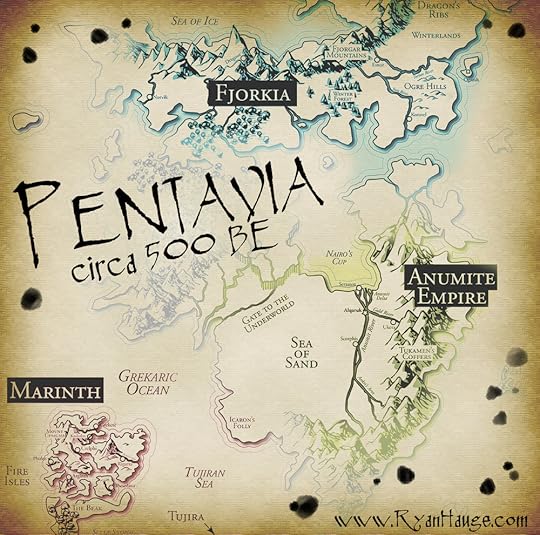
No one knows the exact number of tribes and cultures that inhabited Pentavia thousands of years ago. Some historians estimate it was hundreds. Others say it was thousands. With a lack of written records, we'll never know which is correct. Some cultures were reduced to a blood-stained footnote on the pages of General Marcus Turin's famous book, Taming Pentavia. Others didn't even receive such a courtesy as they were trampled by the marauding horsemen of the Shield.
Three ancient cultures' histories, however, have stood the test of time:
Fjorkia
Up north, the clans of Fjorkia were as harsh and unyielding as the snow-covered mountains they called home. During their short summers, the women would tend the fields and pray to Grognard for a good harvest, while the men would fight wooly dragons, defend their lands from two-headed ogres, and raid their neighbors for food, weapons, and women. Fjorking warriors were known for their ferocity, and they never backed down from a fight. After all, they viewed every battle as an opportunity to die with honor. But they weren't foolish. During the winter, when the snow fell in sheets and the wooly dragon bulls went into musth, the Fjorkings gathered in the safety of their caves and didn't emerge until dragon mating season was over.
Marinth
To the southwest, across the Tujiran Sea, lay the hot, rocky islands of Marinth. There were no wooly dragons for them to contend with, but they had their fair share of challenges in the form of natural disasters (or as they believed, punishments from their vengeful gods) and rival city-states. Despite that, Marinthian culture thrived. Their shipbuilders made triremes that could cross the sea, their generals devised tactics still used today, and their philosophers went on to found the very university I'm sitting in as I write this journal.
Anumite Empire
Finally, to the east in the Rashid Desert lay the Anumite Empire. They were the oldest, longest lasting, and perhaps most impressive of the three early civilizations. Historians credit their early advancement and longevity to a fortunate combination of factors. The desert protected them from invasion, while the annual flooding of the Anumit River replenished their soil with the nutrients required for agriculture. The Anumites wouldn't dispute that they had these advantages, but they would dispute the assertion that they were a "fortunate combination." In their eyes, nature was a gift from the gods.
Before I go any further, I would be remiss to not make note of the proverbial elephant on the page. If you're wondering why humans chose to settle in some of the least hospitable parts of Pentavia, you are not alone. The farmland of Treland is the most fertile on the continent and the weather there is the most moderate and predictable. And yet...the Fjorkings chose not to travel south even to avoid the wooly dragons and harsh winters. And the sea-faring Marinthians suffered through earthquakes and civil war rather than crossing the Tujiran sea and settling on the trade coast. What was in the forests of Treland that kept people away for so long?
That's one of those little bits of history I mentioned that doesn't quite make sense without the existence of magic. Or at least...magical creatures. More about that later, but for now, I'm going to learn everything I can about the Anumite Empire. If magic exists, perhaps it was a gift from their gods.
-T.H. Sterling
Chapter 4 - The River Festival
I know I said I wouldn't write about the River Festival unless I deemed it necessary to our inquiry. Well...I've deemed it necessary.
On the summer solstice, everyone in the Anumite Empire would stop what they were doing and go out onto the streets for a day of feasting and dancing. Traditional dishes included alligator soup, loaves of bread with orange jam, and date mead...tons and tons of date mead. Enough to get the entire empire quite inebriated. Or at least, I have to assume that was the case, because I can't imagine how else they could have tolerated what was to come.
The only people to not participate in the feast were the priests of Tukamen, who were responsible for carrying his statue through Alqaruk to the great river temple of Ankti. And when I say great, I'm not just throwing that word around. I've never seen it, but if the models my architecture professor showed us are accurate, it was truly a marvel of human ingenuity. Not only was it built on piers in the center of the Anumit River, which would have been impressive enough, but it also stood over 500 feet tall. Five hundred feet! That's as tall as the clock tower on Ministry Hall. The only difference is that the River Temple was built thousands of years earlier and was covered in beautiful gardens. Oh, and it also contained a series of water wheels that provided running water to the entire city. Why modern castles haven't copied this design remains a mystery to me.
Anyway, back to the festival.
At nightfall on the summer solstice, the priests would finish the procession by carrying Tukamen to the very top of the temple, which apparently could be seen from every rooftop in the city. Then they'd stand guard to make sure that Nairo didn't sneak in and switch spots with him. I don't know how that would have worked since he was, you know, a stone statue, but whatever. It was something they were concerned about.
So you know how I said the Anumites believed Seraat was the Sun and Mefari was the Moon? Well, they also believed that Ankti was the Anumit River, and the flooding was the equivalent of Tukamen (her husband and also younger brother...weird) getting her pregnant. I guess it kind of makes sense in a really primitive sort of way. Women's bellies swell when they're pregnant...the river swelled when Ankti was pregnant. And instead of Ankti birthing a baby at the end, the flood waters deposited fertile silt on their farm lands that led to bountiful harvests.
But the river didn't always flood. Some years, it would just stay at the same level. Which meant no fertile silt, which meant a bad harvest, which meant famine. Rather than coming up with a rational explanation for it, the Anumites stuck with their pregnancy metaphor. Their beloved Tukamen, god of prosperity, couldn't possibly fail to impregnate Ankti, so the Anumites found a scapegoat: Nairo, god of tricks. As the story goes, Nairo caused the first famine by stealing Tukamen's skin and sneaking into bed with Ankti. And since he's infertile, his union with Ankti was fruitless.
To prevent such a travesty from ever happening again, the Anumites devised the River Festival.
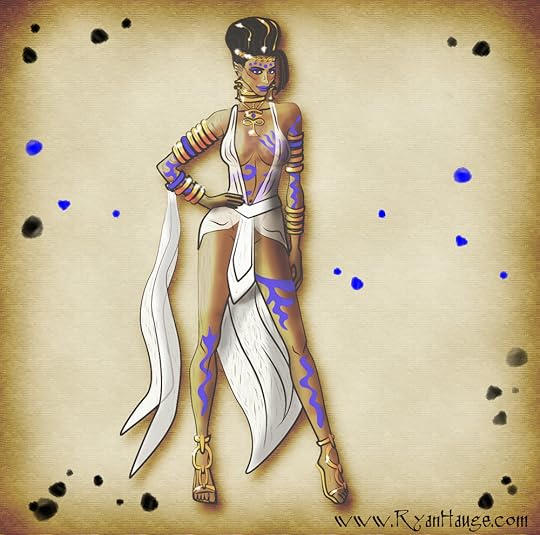
At dawn the day after the summer solstice, everyone in the kingdom over the age of sixteen dressed up as the gods. Men dressed as Tukamen, and women dressed as Ankti. Different styles came and went for the clothes, but a few things stayed constant. Each man always wore a single gold bracelet, and members of both sexes always wore masks of the deity they were representing. Most importantly, the costumes were always crafted using only the finest cloth and jewels. Anything less would have been an insult to the gods.
The festival was celebrated throughout the city (and the entire kingdom), but the focal point was Alqari's Canal - a sunken street that cut through the heart of Alqaruk, connecting the emperor's palace to Ankti's Temple. It was constructed at the perfect elevation such that it would flood at the same time as the fields.
One by one, women over the age of sixteen would ride down Alqari's Canal on a chariot pulled by a giant scorpion. Any man who found her attractive could climb down into the canal and attempt to join her on the chariot. Giant scorpions are notoriously ornery, so getting past them was no easy task. One book I found gave the success rate at a little over 10%. Another was slightly more generous at 15%. Either way, it was a pretty low number. Priestesses of Ankti trailing the chariot would see to the wounds of any fallen men. They'd also take the man's gold bracelet.
Once the chariot arrived at the temple, the woman and any successful suitors would dismount the chariot and climb the 1000 steps. In addition to being in view of the entire city, the top of Ankti's temple also featured two horns capable of magnifying one's voice enough to be heard a mile away at the emperor's palace.
No, it wasn't magic. It was, however, an impressive bit of acoustic engineering.
At the top of the temple, the man (or men) and woman would exchange vows. I couldn't find the exact wording, but the gist of it was that the man would present his golden bracelet to the woman to prove that he was Tukamen. Since Tukamen was supposedly a mountain, the Anumites believed that gold flowed through his veins. Once the woman confirmed that it was gold...
Hold on. Was that bit about Tukamen having gold in his veins clever wordplay by the Anumites or is that myth the reason that we refer to deposits of gold as veins? I'll have to look into that.
As I was saying, the woman would bite into the bracelet to confirm that it was gold, and then she would...
Okay, no. I'm sorry, but I can't focus. I have to know the etymology of gold veins. Ah, the plight of my inquisitive mind.
-T.H. Sterling