D’Arcy Wentworth Thompson on Scaling Laws in Biology
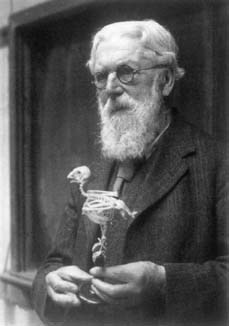
D’Arcy Wentworth Thompson
(1860 – 1948)
Fig. 1: Photograph of D’Arcy Thompson the Scottish biologist, mathematician and classics scholar and pioneer of mathematical biology (Source: http://www-gap.dcs.st-and.ac.uk/~history/PictDisplay/Thompson_D’Arrecy.html
Thompson was born the year after Darwin published his famous book On the Origin of Species. D’Arcy Thompson published On the Growth and Form, 1917 [Link].
He uses the known processes and principles of the physical sciences of his own era and tools of mathematics to attempt to explain biological processes of development as they may relate to evolution. In one chapter in particular, entitled: The Theory of Transformations, he explains and illustrates the simple geometrical equations that underlay even the most complex patterns in Nature had powerful predictive properties.
D’Arcy Thompson demonstrates how these diverse formations may be commonly connected, not so much via Darwinian linear descent; one descending from the other from a singular origin, but from many general and common simple forms (archetypes) which then diverged via the processes of natural laws of shape and form into seemingly complex variations which would call a species, yet all would be united by underlying patterns of fundamentally similar properties. (D’Arcy Thompson 1917, [1945] 1093-1095) Link.
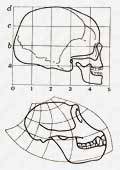
Fig. 2: Transformation of coordinates in ape compared to human skull. Source: ‘About D’Arcy’ Web site Link
On Growth & Form
After easily transforming our coordinate diagram of the human skull into a corresponding diagram of ape or of baboon, we may effect a further transformation of man or monkey into dog no less easily; and we are thereby encouraged to believe that any two mammalian skulls may be compared with, or transformed into, one another by this method. There is something, an essential and indispensable something, which is common to them all, something which is the subject of all our transformations, and remains invariant (as the mathematicians say) under them all. In these transformations of ours every point may change its place, every line its curvature, every area its magnitude: but on the other hand every point and every line continues to exist, and keeps its relative order and position throughout all distortions and transformations.
―D’Arcy Thompson (1942, American Edition reprinted 1945,
p., 1085) Link
Figure 2 above, is given as an analogy by D’Arcy Thompson to help visualise Nature’s flexibility and pattern of growth. They are used mainly by D’Arcy to draw attention to the fact that Nature makes transformation in a highly efficient manner by metaphorically stretching and skewing key origin/starting points (along the fundamental axis of growth on all planes) which changes the whole form in relation to everything else. The details are the filling in or, building up the contours patterns at different scales of the whole. In other words, if D’ Arcy Thompson had access to 3D computing software, he would have been able to input a few simple coordinates and equations/parameters and hit ‘RUN’. He would have produced very different shapes from the same basic template form by simply shifting the orientation (skewing or deforming slightly) the grid prior to the main contour details being filled in.
For instance, Figure 2 shows that the jaw area in an ape and the sloping brain case compared to the human skull. The human skull illustrates that much of the flexible sheet area is filled by the much larger brain-case compared to the grid area for the entire jaw. It is just the opposite in the ape skull example, where the grid is almost entirely filled by the massive jaw area and conversely, the grid area occupied by the brain-case are minimal.
On Growth & Form
From this comparison of the gorilla’s or chimpanzee’s with the human skull we realise that an inherent weakness underlies the anthropologist’s method of comparing skulls by reference to a small number of axes…But it is, in the first place, evident that these axes are merely the principal axes of a system of coordinates, and that their restricted and isolated use neglects all that can be learned from the filling in of the rest of the coordinate network”
―D’Arcy Thompson (1917,. 1084) Link
Overall, the outward appearance of the great diversity of even a single species is rather superficial according to D’Arcy Thompson as seen in the example give below in Figure 3 of the fish.
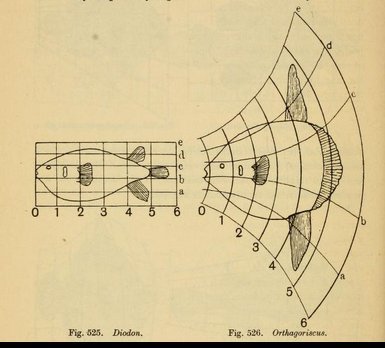
Fig. 3: Transformation of coordinates change the basic shape in every direction proportionally to itself (after D’Arcy Thompson 1917, figs 525-526). Link
Knowing the coordinates on his two idealised axes, Thompson was able to work out the third axes as it was on a predictable pattern. In many ways, he was working in 3D space in his mind, but he could only show these in a rather limited way in 2D. By metaphorically bending and stretching the flexible grids, he observed that these always grew (in magnitudes) scaled up or down in spatial arrangements in proportion to the whole.
Since Thompson’s time, much research has taken place, particularly within embryological studies, that lend good support to his observations of shape and formation of an organism and how this can be applied to describing species development. The best way perhaps to think of the grid analogy in three dimensions, it to visualise a bar magnet creating fields of attraction, or repulsion, or no effect at all. We can’t see the field, but we know it is there from its effects on iron filings. Indeed, if we had enough iron filings and moved these bar magnets around at different 3D grid points, we could change, and sculpt these into many different forms.
Essentially, D’Arcy Thompson’s growth and development grids in many ways represent what has come to be known as the morphogenetic developmental field, which I will explain using the quote below. But first, to explain what such a field, it is perhaps best visualised as being analogous to the patterning field created by a powerful magnet on all points of a 3D hollow sphere and the unorganised analogous iron filings are within. The metamorphic biological field is similarly known by its effects, (like a the force-field of the magnet aligning and arranging the filings) as it cannot be directly seen, but its effects are seen in the patterning and spatial layout of bodies during development which are described in the following science paper: Morphogenetic fields in embryogenesis, regeneration, and cancer: Non-local control of complex patterning by Michael Levin with an opening quote as follows:
“Thus, beyond all questions of quantity there lie questions of
pattern, which are essential for the understanding of Nature.” –
Alfred North Whitehead (1934)
…. A Question of Pattern
Embryonic development results when a single cell (the fertilized egg) reliably self-assembles a highly complex pattern appropriate to its species. This process is known as morphogenesis—the establishment and creation of 3-dimensional anatomy. During later life, multicellular creatures must maintain their pattern—an active process of morphostasis that works to maintain the whole while individual tissues age or are removed by traumatic injury. Some organisms replace large-scale structures during adulthood, illustrating the remarkable plasticity and dynamic control of shape by biological systems. For example, salamanders can regenerate eyes, limbs, lower jaws, hearts, and portions of the brain.
Levin (2012, 1)Link
Another important aspect of Thompson’s observations of growth and form was the concept that: a small change at the beginning can lead to a very big change further down the line. Recall the analogy of the 3D graphic software that of course D’Arcy Thompson did not have access to, but if he did, he would have made endless variations on the same fundamental shape/form by slightly adjusting the initial starting conditions.
This is a well-known concept established by observation within developmental evolutionary biological studies, but interestingly, it is also a well established and observable fact of physics and can be mathematically described. It is a principle within the specific field of Chaos theory, a branch of physics that tries to understand the tendency of systems to become disordered or chaotic and conversely, systems that seem disordered initial, tend to organise themselves. You may have heard of it – it is called the butterfly effect. It is explained in the MIT Technology Review When the Butterfly Effect Took Flight by Peter Dizikes (February 22, 2011) Link
This concept came about as a result of trying to study the very unpredictable and highly complex system (seemingly chaotic and without pattern and certainly with limited predictability – the weather. The problem was that when numbers were rounded off and put into a computation machine to project the outcome of the weather, the actual rounding up of numbers rather than using all the smaller numbers after the decimal place was believed to have no effect or a very minimal one to the end result. However, this very minuscule change at the beginning led to wildly different results depending upon the starting conditions. Therefore, it was given the analogy of a butterfly flapping its wings on one continent could have the potential to create a hurricane in another continent further down the line and coined the butterfly effect. However, as unpredictable as the weather is, it turns out that biological systems are slightly easier to understand and it may all relate to Nature’s incredible ability to be highly efficient and space saving.
About D’Arcy
… the dynamic influence of starting conditions lies in the morphology of shells and horns. These are the permanent, non-living, three-dimensional record of a temporary, two-dimensional living state – the base of the horn, or the mantle of the shellfish. D’Arcy Thompson showed that all horn and shell morphologies could be described in simple mathematical terms readily derived from the incremental nature of growth.
… For instance, geometrical rules of packing determine cell arrangements. These need not be specified, but can arise spontaneously. Yet the packing arrangement may be “useful” in minimising the space occupied by the cells, by maximizing cell-cell contacts, by establishing different categories of cells (“inside” versus “outside”), and so on…
Perhaps the most famous images from ‘On Growth and Form’ are the transformations. D’Arcy showed that gross variation in form between related species could be modeled by the consistent deformation of a sheet.
The consistency of the deformation is the crucial point here: it is obvious that any fish form could be made to look like any other fish form, if it were sketched on a perfectly deformable elastic sheet, and stretched in many directions at once. But D’Arcy Thompson showed that if the sheet were stretched in one particular pattern, then a new species form would be generated. This remarkable and curious observation has not been fully explained even today.
This concept applied, means that even a minor change in the conditions of a developing species may and indeed, seems to have had a profound effect upon how it evolves and what it evolves into in the end. This aspect of D’Arcy Thompson’s research as well as his general principles regarding growth and development as it relates to an alternative form of evolution of the species is summarised above on the website dedicated to the man and his research:
As he observed the principles of self similar repeating patterns on different scales of magnitude (we would describe these today as fractal which I will outline further on in more recent scientific understanding of these fractal systems in terms of more recent research in this area) and he measured them and found that they had predictive and quantifiable proportions which for any mathematician or physicist, is a joy to behold. Moreover, he recognised the universality of these simple constants or invariant qualities throughout the natural world.
For instance, he was impressed by the fact that although biological forms differ widely, that the mathematics to describe them remains the same. Thompson didn’t just describe and catalogue all the natural patterns seen in nature, but explained their simple underlying properties that linked and was common to all. He even had a mathematical description for certain spirals (self-similar patterns) as seen in the form of many shells and applied what he called a logarithmic (I’ll explain this further on) spiral to these predicable forms. These and many other shapes in nature had the property of never changing its essential shape no matter how large or small, the equation was scaled up or down and still applied.
In essence, D’Arcy Thompson’s identification of the simple mathematical equations which underpin the outward complexity of biological life and according to its scaling, or fractal reiterations (repeating self-similar patterns built up in ever more complex detail on every dimensional plane). He also understood the principle of a small change in one part of the system, effects the whole, where everything is context dependent. Thompson pondered this seemingly strange order of nature and noted that the underlying principles of order – were somehow universal and somehow managed to shape and keeps everything as it grew and developed in perfect proportion to itself. This led him to proclaim:
“There is something, an essential and indispensable something, which is common to them all”. NASA (1999, May 28th) (Link).
In other words, none of this was just about pretty patterns and interesting mathematical abstractions, but these had very real applications. It meant that predictions about otherwise unknowable biological complexity could be discovered. Indeed, Thompson’s observations have been picked up in more recent times by NASA scientists who are using his book of life to find extraterrestrial life as seen below. On the NASA website the article is entitled: ‘Who Wrote The Book of Life? Picking Up Where D’Arcy Thompson Left Off’
NASA scientists are using Thompson’s
biomathematical studies of life forms on Earth to postulate about life forms throughout the universe. There are certain universal conditions that will always affect the shape of a life form, wherever that life may be.
“Everywhere Nature works true to scale, and everything has a proper size accordingly,” wrote Thompson. “Cell and tissue, shell and bone, leaf and flower are so many portions of matter, and it is in obedience to the laws of physics that their particles have been moved, moulded and conformed.” … Gravity, for instance, acts on all particles and affects matter cohesion, chemical affinity and body volume. Other influences that are consistent throughout the universe are temperature, pressure, electrical charge and chemistry.
Yes, I noticed that NASA didn’t use Darwin’s On the Origin of Species on their cosmic missions. Anyway, D’Arcy Thompson’s ideas and concepts are definitely finding more recent scientific verification as you will see below. Obviously, these universals of growth and form that Thompson and others proposed are powerful generalisations as they can allow us to effectively see into the otherwise unknown. These bigger principles highlight the underlying properties or biological organisms, which can explain in more simple terms, otherwise, seemingly inexplicable complexity. However, D’Arcy Thompson went further than simply highlighting these patterns of growth and form, but he also came to see it has having consequences for the way we viewed evolution of the species. I wonder if NASA is taking this aspect of his work seriously.
For instance, he states the following regarding this proposition which he offers as an alternative to the Darwinian view, which at that time was certainly not accepted as dogmatically as it is today. Remember D’Arcy is working in the early 20th century prior to the reinstatement of Darwinian theory in its current genetically-driven form. Note also that protozoa refer to the entire kingdom of animals, and quadrupeds are four-limbed animals and that this is a later edition of D’Arcy’s book (1945).
…for eighty years’ study of Darwinian evolution has not taught us how birds descend from reptiles, mammals from earlier quadrupeds, quadrupeds from fishes, nor vertebrates from the invertebrate stock… Our geometrical analogies weigh heavily against Darwin’s conception of endless small continuous variations; …Our argument indicates, if it does not prove, that … the “higher” protozoa, for instance, may have sprung not from, or through one another, but severally from the simpler forms; or that the worm-type, to take another example, may have come into being again and again.
—D’Arcy Thompson, On Growth and Form, 1917, [1942] 1093-1095). Link
D’Arcy not only offered an alternative to the Darwinist model of evolution as he believed he seen a different means of it happening: springing not from a few or single origins, but from many forms that come into being naturally through the forces of nature and diverge from the earlier forms via the same agencies (shared forms with continuous variations and overlays of the same themes according to dynamic natural and universal laws of growth and form), but also because he seen much that was wrong with the Darwinian model of his own time and indeed even in the genetic age.
For instance, his issues with Darwinism, and indeed, many scientists of the time had issues with it, D’Arcy as seen in a paper that he wrote in 1894 entitled: Some Difficulties of Darwinism which is unfortunately not available as it was never apparently published, where we could see more regarding his view of the difficulties with Darwinism, but there is a link to its summary given by an unknown author, in Biology at the British Association, in Nature, Vol. 50, 1296 (1894) p. 435. (Link). There is however, a fairly good discussion in his 1942 American Edition of On Growth and Form: Vol. 1, The Rate of Growth and the discussion of embryology. Interestingly, this edition and the few reprints thereafter are the most extensive of D’Arcy Thompson’s work in containing 1116 pages, the most illustrations and much updated discussion based on evidence that had emerged since his 1917 edition Link
In the section: Of Physics and Embryology, he discusses issues with Darwin’s model that he believes the understanding of Von Baer’s work and morphology in general would resolve and it wasn’t slow either. Historically, there are very specific reasons for alternative views to the Darwinist model of evolution not surviving into our present era (See O’Hare 2016 for full discussion on this – soon to be released book entitaled: The Descent of Darwin with Genetic Modification, A Lesser Known History), but one particular reason that was emerging at the time of D’Arcy’s research that is worth highlighting here, that may have hindered his type of research, was that the broad and multidisciplinary approach (where scientists from different fields of physics, mathematics, embryology and the biological sciences, as well as anthropologists could use their disciplines and expertise to investigate the broader issues of life itself), was becoming increasingly difficult as science departments and scientists became more and more specific in their fields with little or no collaboration between them. This issue is clearly highlighted with some frustration by D’Arcy in Transformations: The Visual Influence of D’Arcy Thompson:
D’Arcy passionately believed in giving students as great a breadth of
knowledge as possible, telling them if you dream, as some of you, I doubt not, have a right to dream, of future discoveries and inventions, let me tell you that the fertile field of discovery lies for the most part on those borderlands where one science meets another. There is a cry in the land for specialization. . . but depend upon it, that the specialist who is not reinforced by a breadth of knowledge beyond his own specialty is apt very soon to find himself only the highly trained assistant to some other man. . . Try also to understand that though the sciences are defined from one another in books, there runs through them all what philosophers used to call the commune vinculum, a golden interweaving link, to their mutual support and interpretation.
Jarron (2013, 83-4). Link
In other words, as D’Arcy tried to relate to his students, there is a bigger picture to be discovered on the borderlands of science and getting distracted in classification and details only clouds the issue as noted a number of times by D’Arcy and as he noted above and in his other writings reveals that this extreme specialisation makes one blind to the greater discoveries. Thankfully, in our more modern era, this is beginning to change. This is seen particularly in the collaborations of scientists such as: Geoffrey West (a physicist working on biological problems in collaboration with other scientists from different fields of biological research) who echoes similar sentiments to D’Arcy as seen in an interview entitled: Yeah, but what about the crayfish? (…Where, the title is a reference within the article to how some biologists still show concern about details of animals rather than the bigger and more overarching patterns embedded in the natural world.
A different mind set
“In general,” … “although this was not true of my collaborators, biology tends to be dominated by a certain type of person in the opposite way to physics. They are always looking at the particular, and everything is an exception.” … [West] does not understand how such people can work in science if they do not believe there are such things as universal laws. “If you had biologists working, for example, in nuclear physics you would have someone working on deuterium and then someone else working on helium and they would not realize they were working in the same field.”
―Cartlidge (2001 – Physicsworld)
Link
And another quote, this time from West’s collaborator Brown as taken from another interview with West and Co., entitled: Of Mice and Elephants: A Matter of Scale:
”Physicists tend to look for universals and invariants whereas biologists often get preoccupied with all the variations in nature,” Dr. Brown said… Dr. West liked to joke that if Galileo had been a biologist, he would have written volumes cataloging how objects of different shapes fall from the Leaning Tower of Pisa at slightly different velocities. He would not have seen through the distracting details to the underlying truth: if you ignore air resistance, all objects fall at the same rate regardless of their weight.
Johnston (The New York Times dated to Jan 12th 1999)
Link
All in all, D’Arcy Thompson’s desire for a broader approach to the bigger questions in many ways is beginning to re-emerge. Moreover, the collaborations of such scientists and their multidisciplinary approach has led to the discovery of exciting, predictable patterning in Nature that can be summarised in powerful, yet simple equations and actually begin to give us a deeper insight into the underlying processes that begin to explain the predictable scalable unity of D’Arcy Thompson’s observations of shape and form.
Geoffrey West and others noted above are also beginning to find answers in the universal patterning of life as seen in the following statement by West:
”Everything around us is scale dependent,’’…
”It’s woven into the fabric of the universe.”…
”It is truly amazing because life is easily the most complex of complex systems,’ …. ‘But in spite of this, it has this absurdly simple scaling law. Something universal is going on.” …
—Johnson (New York Times Jan 12th 1999)Link
This of course expresses the very same sentiments of D’Arcy Thompson, once he got a mathematical insight into the amazing predictability and universality of Nature’s systems. And interestingly, the research of West and others is being taken quite seriously even by biologists such as: Richard Dawkins as noted in a recent interview below:
A different mind set
The work has drawn praise from many biologists, including the popular science writer and Oxford professor Richard Dawkins, who describes it as “a theory of enormous power, explaining a huge range of facts with great economy”.
Cartlidge 2001, July, p. 3: A Different Mindset). Link
These universal patterns in life essentially support and reflect D’Arcy’s own research and collaborations with colleagues (particularly with the physics department) at his own university and is akin, in spirit, to how he suggested science should be done all those years ago as highlighted in Jarron (2013 Link).
NEXT WEEK: continuing with D’Arcy Thompson in the light up more uptodate scaling laws emerging in the field of physics looking at biological complexity – the universal highlighted above.
This ends a series of excerpts which I will be uploading icoming weeks. These are taken from the book: Evolution, how did it happen? If it wasn’t by Darwinian Means in paperback and ebook available from all major outlets late Summer 2016 if not before. See below:
Cover image in progress: any comments or feedback would be greatly appreciated. Email:diggingupthefuturer@gmail.com
Filed under: alternative evolution, alternative science, alternatives to Darwinian theory Tagged: A different view of evolution, Alternative evolutionary science, D'Arcy Thompson, D'Arcy Wentworth Thompson evolution, Evolution Alternative, Geoffrey West scaling laws, non-Darwinian evolution, physics meets biology, scales of complexity, something universal is going on...