
Where is everyone?
Is anyone out there?On February 1st 1985 the Search for Extraterrestrial Life - SETI began operations. Since then they have checked thousands of star systems and found - nothing.
Why is that?There are a number of possible reasons. Let's take a look at some of them.There isn't anyone other than us. Let's see - there are There are several hundred billion other stars in our Galaxy, and more than 100 billion other galaxies in the part of the universe we can see. It would be extraordinary if we were the only thinking beings in all these vast realms. If there isn't anyone else - 'that's an awful waste of space.'There are other intelligent beings but we are the most advanced and the others haven't developed the technology we could detect. How likely is that? There's nothing remarkable about our star. Why should we be the leading civilisation?There are other intelligent beings but they are far more advanced than us and have no desire to contact us or are unwilling to do so. That's possible, after all we on earth conceived Star Trek with it's 'prime directive.The other civilisations are just too far away for us to detect and for them to detect us. Let's see. We've been using radio since 1880. Let's be generous and assume an intelligent race could pick up radio waves generated by our use of alternating current. We started doing that in 1832. Let's be even more generous and round that up to 200 years. Here's a picture of how far radio waves would have travelled in our galaxy in those 200 years - it's the blue dot. Not the black square!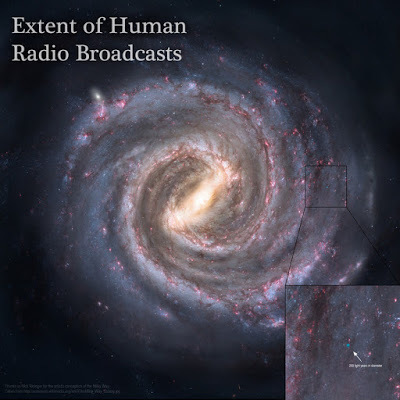 According to some astronomers there are about 14,600 stars in that blue dot. The chances are the aliens won't be aware of us. We can see much further than 200 light years. The further away a star is, the further back in time we look. 200 years ago we were using horses and carts and just starting to use railways. Any civilisation we detect will be ahead of us in technology. That assumes they are wise enough not to have destroyed themselves.)We are just incredibly lucky to have survived extinction level events to the point where civilisation develops. Extinction level events or ELEs happen regularly.
Extinction Level Event Occurance Event Happens on average every:
(years) Years since last one Asteroid impact (10 km+ size) 100,000,000 65,000,000 Supervolcano eruption 4,900,000 26,500 Nearby nova, supernova or gamma ray burst 240,000 12,000 Ice age 100,000 110.000 Geomagnetic reversal 200,000 (varies considerably) 781,000 We could also now add politics to the list of possible ELEs now that we have sufficient technological development for an idiot politician or religious leader to instigate one.Advanced civilisations no longer use radio. That may be true; after all it is limited by the speed of light and the distances involved are vast. The trouble is we have no idea of what to replace radio with. Perhaps one day we will make that breakthrough and suddenly find ourselves eavesdropping on a vast interstellar communication system. My money is on number 5. We've barely started looking though, and number 4 is a possibility.
What does this tell us?We need to keep looking. I'm awfully afraid though, if we don't start pushing out into Space, the life on earth will not survive to ever make contact with aliens.
If this post has helped or entertained, will you help us? Download a FREE copy of our book 'Immortality Gene' from http://smarturl.it/avi It's part of a series dealing with our need to push out into Space.
Even if you never read it (but we hope you will) - it will help our rankings. And your views...?Now it's your turn. Please use the comments to tell us why you think we haven't detected signs of intelligent life in Space. (Yes - I know. We haven't detected signs of it on earth either!)
Why is that?There are a number of possible reasons. Let's take a look at some of them.There isn't anyone other than us. Let's see - there are There are several hundred billion other stars in our Galaxy, and more than 100 billion other galaxies in the part of the universe we can see. It would be extraordinary if we were the only thinking beings in all these vast realms. If there isn't anyone else - 'that's an awful waste of space.'There are other intelligent beings but we are the most advanced and the others haven't developed the technology we could detect. How likely is that? There's nothing remarkable about our star. Why should we be the leading civilisation?There are other intelligent beings but they are far more advanced than us and have no desire to contact us or are unwilling to do so. That's possible, after all we on earth conceived Star Trek with it's 'prime directive.The other civilisations are just too far away for us to detect and for them to detect us. Let's see. We've been using radio since 1880. Let's be generous and assume an intelligent race could pick up radio waves generated by our use of alternating current. We started doing that in 1832. Let's be even more generous and round that up to 200 years. Here's a picture of how far radio waves would have travelled in our galaxy in those 200 years - it's the blue dot. Not the black square!
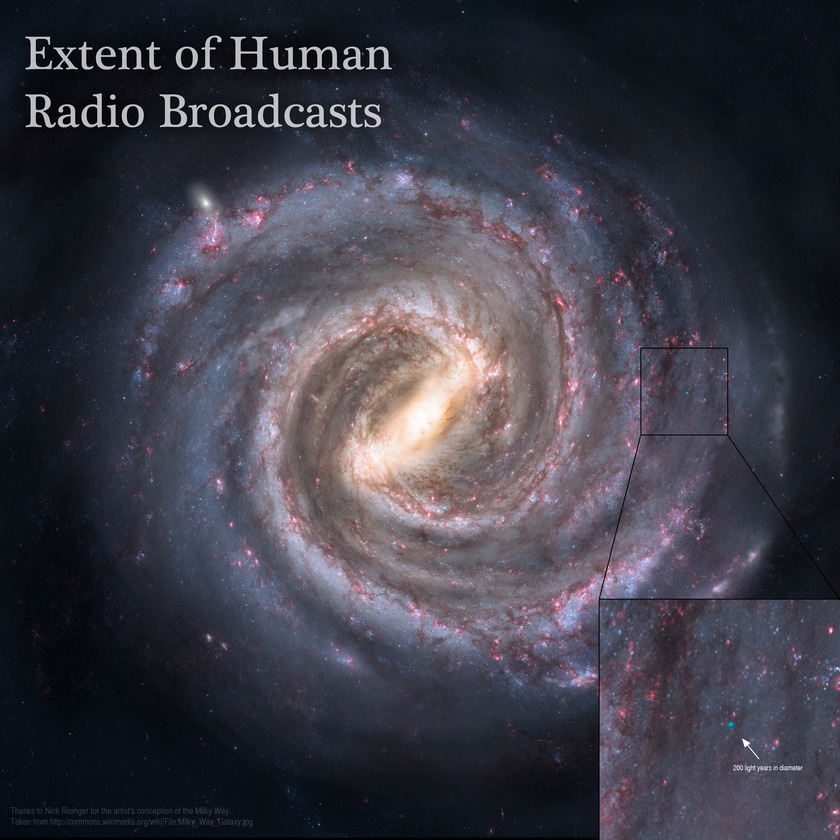 According to some astronomers there are about 14,600 stars in that blue dot. The chances are the aliens won't be aware of us. We can see much further than 200 light years. The further away a star is, the further back in time we look. 200 years ago we were using horses and carts and just starting to use railways. Any civilisation we detect will be ahead of us in technology. That assumes they are wise enough not to have destroyed themselves.)We are just incredibly lucky to have survived extinction level events to the point where civilisation develops. Extinction level events or ELEs happen regularly.
Extinction Level Event Occurance Event Happens on average every:
(years) Years since last one Asteroid impact (10 km+ size) 100,000,000 65,000,000 Supervolcano eruption 4,900,000 26,500 Nearby nova, supernova or gamma ray burst 240,000 12,000 Ice age 100,000 110.000 Geomagnetic reversal 200,000 (varies considerably) 781,000 We could also now add politics to the list of possible ELEs now that we have sufficient technological development for an idiot politician or religious leader to instigate one.Advanced civilisations no longer use radio. That may be true; after all it is limited by the speed of light and the distances involved are vast. The trouble is we have no idea of what to replace radio with. Perhaps one day we will make that breakthrough and suddenly find ourselves eavesdropping on a vast interstellar communication system. My money is on number 5. We've barely started looking though, and number 4 is a possibility.
What does this tell us?We need to keep looking. I'm awfully afraid though, if we don't start pushing out into Space, the life on earth will not survive to ever make contact with aliens.
If this post has helped or entertained, will you help us? Download a FREE copy of our book 'Immortality Gene' from http://smarturl.it/avi It's part of a series dealing with our need to push out into Space.
Even if you never read it (but we hope you will) - it will help our rankings.
 And your views...?Now it's your turn. Please use the comments to tell us why you think we haven't detected signs of intelligent life in Space. (Yes - I know. We haven't detected signs of it on earth either!)

No comments have been added yet.
John Chapman's Blog

Check my other blogs too including my 'Author! Author!' blog - a blog for authors at http://authorbookpromotion.blogspot.c...
...more
- John Chapman's profile
- 246 followers

