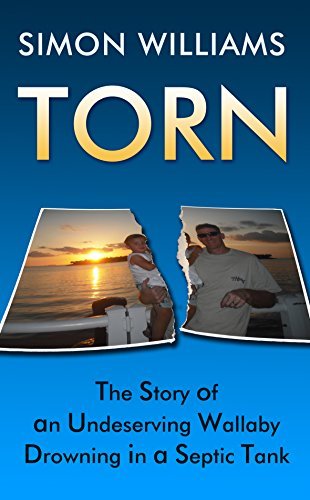
Author Simon Williams Talks About His Life and how the Torn Book Series Saved His Life
My Interview today, is with Simon Willams an Australian born author, who now lives in Miami.
1. Tell us about yourself.
Everything about myself? Christ, can I leave out the really dumb stuff? That won't give me much material. I was born in Australia coming up on a half a century ago. I spent 8 years at boarding school as a child, where I developed a sarcastic sense of humor to avoid getting beaten up by the older kids. I currently live in Miami, married with one child and 2 step children. Other than that, I reveal a lot of what makes me tick in my book, including the really dumb stuff that no one ever talks about.
2. Growing up, was there a book you read that made you desire to write for a living?
My favourite book growing up only taught me to dream of adventure. The Plum Rain Scroll. I didn't desire to write as a living. I wrote purely for my personal satisfaction and the amusement of those close to me. My desire to write a book was born from circumstances in my life that bought immeasurable pain and I considered committing suicide. Writing a book was a way to keep me sitting down at a desk and rather than wandering over to the window ledge. So I desired to write… to live.
3. Did you have another ideal career besides writing?
I enjoy my career in healthcare that I have while I pursue writing. Maybe a pole dancer if I was flexible enough? Allow me to sleep in. A mate from primary school lives in LA and a few times a month he travels the world to work for a TV show called, Island Hunters. All his Facebook posts are of him hanging out of the side of a helicopter over exotic tropical islands. If the pole dancing and writing thing don't work out I will ask him if he wants an assistant.
4. When did you first start writing?
My English teacher in Grade 12 told me I was a lazy student. The class was asked to write a 5-page historical story. I was so pissed at him I wrote 30 pages. It was such a satisfying experience, not only because I could subtly give him the finger without being in trouble for it. My current foray into writing began about 4 years ago, the night I stood on my 20-story balcony and wondered if my life was worth going on.
5. What do you like to do when you’re not writing?
I enjoy my exercise, rugby games and the occasional triathlon or ocean swim. I don't watch television so I do spend a lot of my spare time writing. On a Saturday afternoon, I will go watch mates play rugby then have a beer at the pub. I absolutely adore picking up after my step kids and having my wife complain I don't do enough around the house.
6. What are your feelings on writer’s block?
I solved this problem very quickly when I decided to start writing. I write with a stream of consciousness so I just write anything. I know I will rewrite it a thousand times so I consider it like doing exercise. It doesn't matter if I am running or swimming or doing the rowing machine, I am doing something. I can refine my training as I get closer to an event, but most of the time I just need to be doing some form of activity.
7. What does your process look like? Any necessary rituals to bring the words about?
All I do is think of my starting point. My writing is like hot air ballooning. I know where I start but once I get going I could end up anywhere. My process is then to do anything but write, then the ideas and thoughts just flood into my head. Boredom at work helps a great deal as well. I always have a pen and paper with me or my cell phone to WhatsApp myself a message. The pressure and excitement then just builds through the day. By the time I get a moment to write for the day, I usually have 5 pages of things to work on and by this stage I am desperate to get it on paper.
8. Has real life and writing life ever merged?
My first three books are all real life. They didn't just merge, they shacked up together, shagged rotten and had a few kids.
9. What kind of research do you do and how long do you spend researching before beginning a book?
My research for my books was the attention I paid to all that was going on around me as I grew up. Every random thing I was told, then when I recall these moments while I am bored at work, I Google the events or people that surrounded that thought and craft it into my story.
10. How does location and personal travel figure into your work?
Locations in my books are important only with regards to the backstory behind how or why I ended up in that location, not the location itself. Like I said, hot air ballooning. The stately oak in the corner of the freshly mown paddock isn't as important as the sudden change in the gust of wind and the rapid deceleration of the balloon after it runs out of gas, because the balloonist forgot to refill it as he was out drinking the night before and tried to win on to some divorcee who was sitting by the jukebox listening to Bryan Ferry songs.
11. Where do you come up with your ideas?
The ideas are all personal experiences, that often time I have long forgotten. The recall of them is what is the surprise. They literally suddenly spring into my mind at random occasions. I have 30 seconds to write them down or text them to myself or I forget. Then I piece them into the story at night if they fit. Many times, they don't and my wife finds pages of unused ideas stashed in drawers around the house.
12. Tell us about the process for TORN. What was the process like for this book?
The process for TORN started with me backing off from the edge of my balcony and sitting at my computer in a desperate state and starting to write a suicide note. First line, 'I want to kill myself,' second line, 'hang on let’s think about this.' I wanted to take my time before dying, so I dragged it out. I may have even been able to smile at myself with what I wrote. I made it through that first night. The next evening, I got home and went straight to my desk to write and just kept following this system every night for a year.
13. What was the hardest part of writing this book?
Opening up about the reason I was thinking about jumping off the balcony. Making the book humorous was also difficult, but not as much as I thought.
14. What was one of the most surprising things you learned in the journey to completing the book?
Writing, while as frustrating and demoralizing as it can be, can still feel like heaven when you compare it to the lowest days experienced during life.
15. Do you have a favorite chapter and would you like to share a sample?
My favourite chapters are the ones in the end of Book 3 of the series. But here is an example of my early days.
As I tap on the door, all I can think about is news stories I saw while growing up in Australia. Reports of children trick-or-treating, then gunned down as they knock on a front door. This is all sensationalistic journalism does, scares the crap out of me when I want to purchase tickets for a uniquely American sporting experience. An African American man, dressed in a bright orange suit, answers the door and seems rather surprised to find a nervous white dude standing there. I tell him I am here to scalp football tickets for him and he bursts out laughing. ‘You aren't scalping boy. I am doing the scalping,’ and with introductions accomplished, he invites me into his living room.
He has never met an Australian before, so is absolutely intrigued. He wants to know all about the country. I have never met an American black man before, so I explain it from the beginning bit. Where Captain Cook sails up the East Coast in 1770 and names the Glasshouse Mountains because they remind him of the huge glass furnaces in his native Yorkshire. I wisely decide to edit mentioning Cook ordering his expedition to shoot at the two aborigines in Botany Bay. A frantic pounding at the door interrupts me from regaling when Captain Cook is killed in Hawaii, after he shit stirs the natives. It is a panic stricken Dohers, ‘you left me in the car by myself, you bastard.’ I point out to him that, I didn’t leave, as much as he desired to stay. ‘Did you get the tickets? We still need to find the stadium.’ The realization that, as enjoyable as reviewing Australian history is with an American we have a game to get to, makes me hasten things up. I quickly outline: The First Fleet; Bushrangers; the Eureka Stockade; Federation; Gallipoli; Gough Whitlam being sacked as Prime Minister; the 1982 America’s Cup and Olivia Newton John freeing the slaves. Then it is time for us to go.
16. Are you working on else now?
I am writing a book with my eleven-year-old step daughter on the ups and downs of the beginnings of our relationship. Then I plan on writing a travel memoir of trips through the American Southwest.
17. Do you have a favorite novel and why?
I enjoyed Goodbye California by Alastair McLean. My brother had every Alastair Mclean, Robert Ludlum and James Michener book, but not this one. As well it was my first actual adult novel that I read. The Man from St. Petersburg by Ken Follet I liked. I must have appreciated reading fiction a great deal more when I was younger.
18. Who are your favorite authors?
Bill Bryson, Clive Cussler. Michael Palin and Ben Elton.
19. Where can we find you?
I am not on a great deal of social media. My Twitter account was hacked after 2 days. I am submitting that to the Guinness Book of World Records. My Facebook page for the book series would be it.
https://www.facebook.com/TORN-The-Sto...
My step daughter keeps trying to get me on Instagram, but I resist valiantly. She will probably grow up hating me. I enjoy doing written interviews such as this as it keeps my mind busy.
20. Where can we get TORN and the complete series?
Amazon, Smashwords, TORN is available for only 99 cents.
https://www.amazon.com/dp/B00VC2Z6U4
https://www.smashwords.com/books/view...
Thank you Simon, so much, for sharing your writing journey. For a FREE copy CLICK HERE
Natasha