The Way
A sermon preached at St. Peter’s Episcopal Church, Ripon, Wisconsin 5 Easter, Year A, May 14, 2017 John 14:1-14,
There are so many amazing things about this God we love, and Easter may be the season when we are most reminded of these things. And perhaps most amazing of all—among the many miracles and mysteries—is that this God, through Jesus, would love us. Love us so much that he would accept us with all our shortcomings and flaws. Love us so much that he would put us first, even above himself.
And so we come to this Gospel today, in which Jesus is gathered with his friends, on the
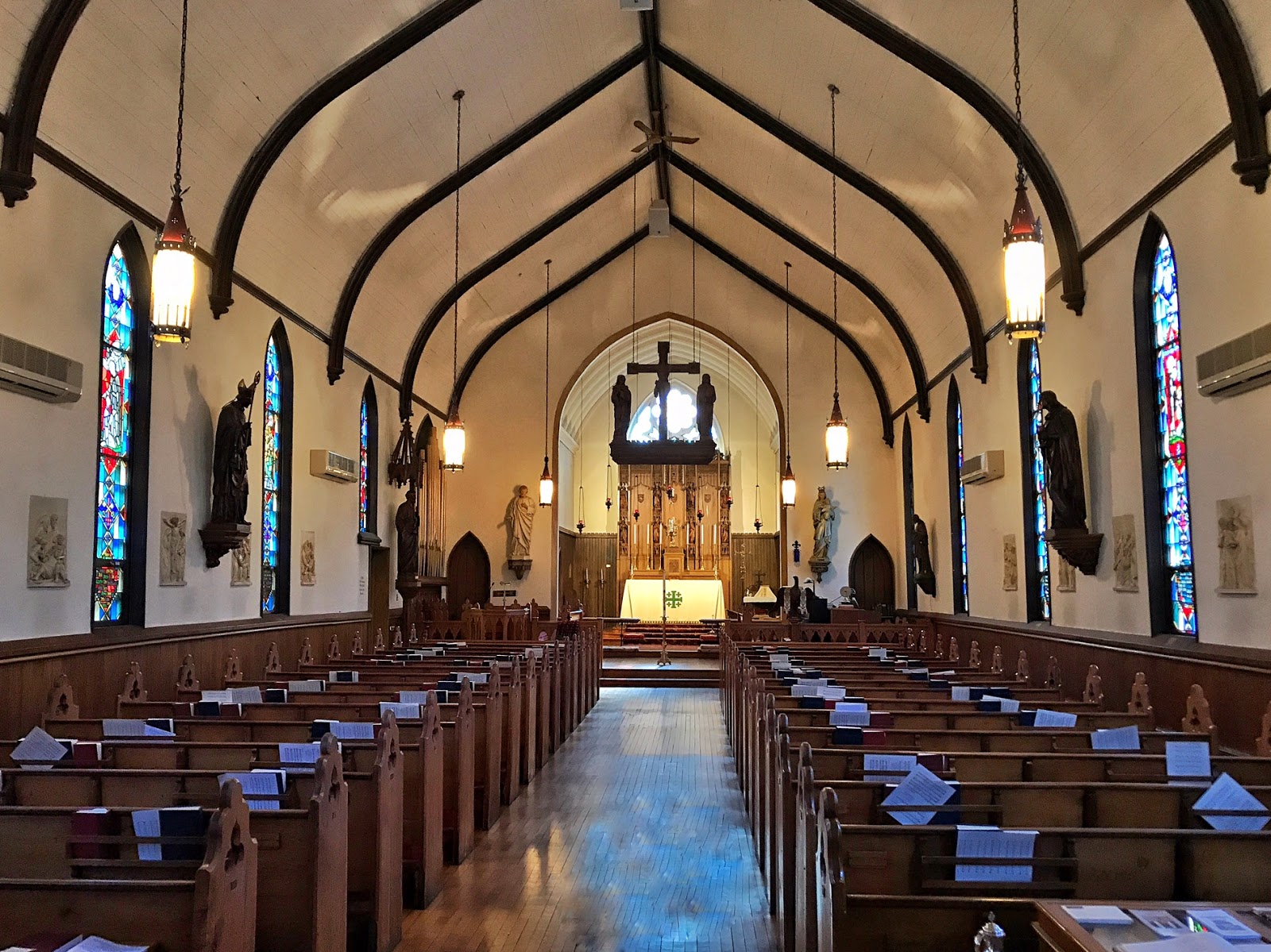 The sanctuary of St. Peter's before worship, yesterday.very night that he would be betrayed by a close friend, arrested, tortured and beaten, then the next day murdered. And he knew it was all coming. He told his friends what lay ahead, and even though they couldn’t grasp this reality, you can imagine the anxiety, confusion, and fear that must have filled the room in which they were gathered. This would have been a reasonable time for Jesus to bemoan his fate, perhaps hatch a getaway plan, maybe look for some sympathy or even pity from his friends. But this was not the case. He was thinking of their wellbeing. He says to them, “Do not let your hearts be troubled. Believe in God, believe also in me.”
 This is the Gospel text most often read at funerals, because it provides such comfort for troubled hearts. And it also tells us what the future holds for us, when we go to be with Jesus. Jesus says, “In my Father's house there are many dwelling places. If it were not so, would I have told you that I go to prepare a place for you?” Now, I’ve always preferred the old King James version of this text, “In my father’s house are many mansions …” because I think it better illustrates the kind of lavish love and the wonderful homecoming we can expect when we die.
Here’s what Steven Charleston, the retired Episcopal bishop of Alaska, says about heaven: “It will feel like home. When we first see it, really see it, it will look like the place we always wanted to call home. We will have imagined it before we find it, and so, when we see it, it will look and feel as though we had always known it, loved it, because it will be so much a part of who we are. The air will be crisp and cool, the light soft and golden, the scent fresh earth after rain. Then distant faces will look up to see us, the glimmer of recognition, and we will begin to run, even if before we had not been able to walk a single step, we will run and run to see them. We will be home.”
On this Mother’s Day, when I remember my own mother, who’s been gone for 15 years, and think that she’ll be among those faces that look up and see me … it’s hard not to choke up.
After the beautiful words about those mansions, Jesus told the disciples that he is going to prepare that place for us, that he will come again to take us to that place, a place where he is. And he says that we know the way to that place.
That’s beautiful language, but I’m guessing that the disciples probably looked at each other confused. We know the way to that place where Jesus is going? Really?
Back when I was young, I was one of those students who worried in class about asking a stupid question, so I often didn’t raise my hand. Then, some other student would raise her hand and ask the same question that I feared would be viewed as stupid. And it turned out to be a profound question that generated a lot of interest. Ever had that happen to you? In today’s Gospel we encounter two disciples who were not afraid to risk asking a stupid question, the question that was probably on everyone else’s minds—including us, the readers—but were afraid to ask.
While the others kept quiet, Thomas had the guts to speak up and ask the question that was on everyone’s minds. He said, “Lord, we do not know where you are going. How can we know the way?”In other words, “Jesus, we don’t know what you’re talking about.”
And that gave Jesus the opportunity to tell Thomas and the whole world this: “I am the way, and the truth, and the life.” Note that Jesus did not say, “Here’s a AAA roadmap to where I am going and where you also will go.” He didn’t say, Here’s a link to a website, a set of instructions, an iPhone with Google Maps, a recipe, a YouTube video or a checklist. No. He told them, I am the way. Get to know me and you’ll find the way. The way that is true. The way that leads to life.
Maybe it’s like this: Imagine that you are planning a trip to Toledo. There are two ways to get to Toledo. One is to get a Mapquest printout from the internet that provides all the travel directions you need. You have in hand all the factual information you need to find your way; and you can study the whole route in advance, hoping you won’t miss that crucial turn in Fort Wayne. If you do miss that crucial turn, you could be in trouble. Another way to get to Toledo is to have an experienced and trustworthy guide travel in the car with you, directing you along the way. You may not personally know the details of the route, but you can depend on your guide to direct each step, trusting that you will arrive safely and enjoying the company along the way. The trusted relationship is always a better way than a roadmap or a set of rules.
Jesus offers us that trusted relationship. And he’s a relationship that is true, a way that leads to life. Get to know Jesus—and, yes, we do know how to do that: Call out His name. Let the water be poured upon you. Eat this bread. Listen for the Spirit. Feast on His word. Love one another. Believe in Him. Trust in Him for everything. That’s the way.
But the disciples were still not satisfied with what Jesus told them. The apostle Philip speaks up, again saying what was probably on everyone else’s minds. He said, “Lord, show us the Father, and we will be satisfied.” In other words, Jesus, we’d like some proof.
I love Jesus’ response. He doesn’t throw Philip under the bus for questioning him. Instead, he says, "Have I been with you all this time, Philip, and you still do not know me? Whoever has seen me has seen the Father. How can you say, 'Show us the Father'?
You want proof from Jesus? He won’t hand you a spreadsheet or an equation. He offers you himself. Again, on this day, I think of my mother, and how she didn’t need to prove her love for me, because every day she offered herself. And every day, in spite of my stupid questions and my sometimes stupid ways, she accepted me, over and over again.
Yes, Jesus accepts us. Among the most striking words in our liturgy are these—maybe you’ve missed them. It’s in our closing prayer. Eternal God, heavenly Father, you have graciously accepted us as living members of your Son our Savior Jesus Christ …. We are accepted by God.
This Jesus—about whom the bible says, ‘by him all things were created: things in heaven and on earth, visible and invisible, whether thrones or powers or rulers or authorities; all things were created by him and for him’ (Colossians 1:16)—this Jesus, who came to earth as a human being and subjected himself to everything we go through. This Jesus has acceptedus. Let me close with a poem I wrote about Jesus accepting us—it’s about me, it’s about you, it’s about Jesus.
It’s called “Accepted.”
The life portrayed in my biopic wouldn’t be a pleasant topic,
No statuette would be awarded for the record I’ve recorded.
Prefer that it’s not said aloud ‘bout things of which I’m not so proud.
I missed the opportunity to help out my community.
I know that I deserve their scoff ‘cause I was somewhere goofing off.
Often couldn’t cut the mustard, stood there clueless, looking flustered.
Haven’t ever paid my dues and almost always missed the cues.
Too many times I dropped the ball, slept right through the wake-up call.
With noble traits I’m not endowed, never ran with the holy crowd.
They said that I’m not so good looking, doesn’t seem to know what’s cooking.
And doesn’t have that many smarts, screwed around and broke some hearts.
Missed my graduation day and hid from mom my GPA.
My fitness plans all fell apart, cholesterol’s still off the chart.
I’ll jog tomorrow right after wakin.’ But what’s that fryin’? Smells like bacon.
And so I come with many qualms, I’ve read no gospels, read no psalms,
Nor traveled far on mission trips, No daily prayers were on my lips,
Nor gave a cent for any alms—
But there are nail holes in his palms.
And though my life is not guilt free, He says there’s more that I can be.
In spite of all that I’ve been through, He says he’ll make me all brand new.
I asked him, “So, what should I do?”
With arms outstretched, he said, “It’s free.”
He pulled me close, accepted me.


No comments have been added yet.