
Writing a Story
Writing a Story
Many people think that the idea is the difficult part of writing a story, and this can be true. But there is another challenge too: finishing the story.
When I say finishing, I don’t just mean getting to the end. I will explain what I mean later.
Where do the ideas come from?
A lot of stories have a number of different ideas that are connected in some way. These ideas can come from your experiences, from people and places and events, and they can come from your imagination. But remember, your imagination is filled with your experiences, too.
These are the people and events that I thought about when I was planning Tortoises and Shells.
In 1999 I went to India with my great friend Jonathan. We flew with Syrian Airways, from London to Mumbai via Damascus, the Syrian capital. We didn’t get off the plane at Damascus, but I can remember standing at the open door and feeling the heat coming off the runway. It was like standing in front of a baking hot oven.
On the way back, one of the cabin crew spent a lot of time talking to us. Her name was Hiam and she lived in Homs. That Christmas she sent me a card, and a postcard of Palmyra. Looking back, I wish I had kept in touch with her.
The city of Homs became a battle ground in the Syrian civil war. I wonder how close the war has come to Hiam’s home and family.
I have been working in an English language school for the last four years, and I have met many students from all over the world. In 2012 I met two very different Syrian students. There have been no more students from Syria since 2012.
Fadi was studying to go to university in the UK. He was always smiling. He played the guitar in a band and enjoyed going to the gym. He was a very good-natured, relaxed person, and he wasn’t very interested in writing essays in English. He wanted to study textile engineering, and he went to a university in the north of England.
In lessons he would sometimes look down at his mobile, and when I asked him what he was doing he said he was watching videos of the destruction of Homs on Youtube. He said it was ‘funny’, but I know he meant ‘weird’. Fadi in the story is based a little bit on Fadi the student.
Naji was older. He was tall and intense, and he rarely came to class. He was an architect who wanted to continue his studies in the UK. One day he proudly showed me a photo of his family house - it was large and modern, and I hope it is still standing.
Naji was horrified at what was happening to his country. He was so worried about his family and friends he just couldn’t concentrate on anything else. I remember him trying to explain how Syrian society was tribal and very complicated. Eventually he left the school, abandoning his plans to study architecture.
I used Naji’s name for Fadi’s English teacher uncle.
The tortoise idea comes from my childhood in Bristol. I have a very vivid memory of a pet shop in Gloucester Road, close to the swimming pool. One day, I went in to see the animals and there was a large box on the floor, containing three or four tortoises. In those days (this was the late 1970s), it was still legal to import tortoises for the pet trade. I always imagined these tortoises were from Greece, but they could have come from Syria, or anywhere in the Middle East.
I returned to the shop with money and there was one tortoise left. It seemed the other tortoises had been chosen first because this tortoise had a damaged shell. So my tortoise had a small rough chip in the top of his shell. I didn’t mind. When I got him home I rubbed his shell with olive oil to make him shine, and I called him Achilles, just as Gerald Durrell had called his tortoise on Corfu.
I built Achilles a hutch, rather like a rabbit hutch, and a run made out of chicken wire pegged into the ground with tent pegs. Achilles could often be found jammed into the corner between the hutch and the fence, or he would walk around the edge of the run, his forelegs pushing at the wire, trying to get out. I didn’t like seeing him like this, so I would put him on the lawn and let him roam.
Here are Caster and Achilles sunning themselves. We called this corner of the garden Southern Turkey because it always got really warm.
You can see the chip in Achilles’ shell.
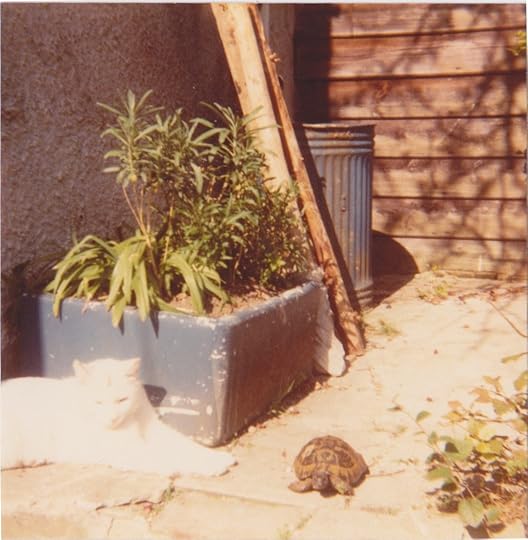
Achilles survived his first year in Britain and I can picture the moment I took him out of his hibernation box the following Spring and gave him a tomato.
Tortoises are not very fast, as everyone knows, but they make up for their slow speed by being very determined. And if you turn your back on a tortoise, thinking they will just hang around like a lazy cat, you are in for a surprise.
This happened to me. I had caught him once before, wobbling down the middle of the road outside the back gates. But the second time, he succeeded in his bid for freedom. It was awful. I can remember being completely distraught. I looked under every bush and shrub, in every corner, up and down the road, in the lane nearby. Everywhere. But he was gone. I had lost him.
I put a notice in the local Post Office, and a year later he was found by someone in the playing field. For some reason, Mum and I decided to let them keep him.
So, back to the story.
Tortoises are wild animals in the whole of the Middle East, including Syria, and I realised that this could make a good connection between the characters in the story. A little research confirmed this idea. A BBC article described how children in the refugee camps keep tortoises as pets to remind them of the homes they have left behind.
http://www.bbc.co.uk/news/world-middl...
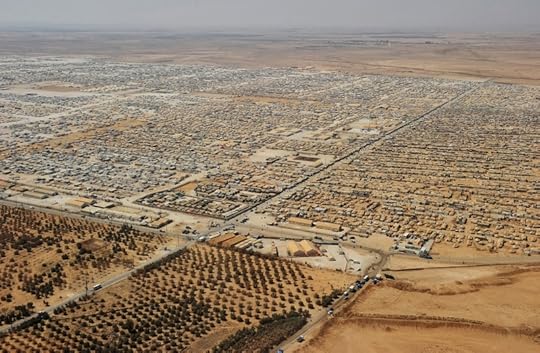
Finally, there is the war in Syria and the humanitarian crisis. Tens of thousands of families have had to leave their homes and flee. Many now live in camps outside Syria. I chose Zaatari camp, in Jordan, as it is one of the biggest. I wonder if the families of Hiam, Fadi and Naji are now living in a refugee camp.
The photojournalist in the story comes from further research. In the story she lends the children a camera and they take hundreds of photos, which she then shows to Alex and Fadi. You can read about projects such as this in the article below.
http://www.telegraph.co.uk/news/world...
Tortoises and Shells draws all these people and places and events together.
Finishing the story
The thing about finishing a story is that finishing is really only the beginning.
What I mean is this:
You have to write out the story to get the story straight - in your mind and on paper.
Then, you have to read what you have written.
Now you can write a second draft. This time, you don’t have to think about what happens, because you have done all the working out. You will probably change some scenes, and include some new ones, but you know the big idea. Now you can concentrate on the characters, the dialogue and description.
You should also think about the length of your story: would it be better if it was shorter or longer? Do you need all that description, or do you need more? Are the characters talking too much?
Read your second draft, correcting all the little mistakes you can spot. When you think it is ready, you ask someone to read it.
This person will be a very kind, helpful friend. They will tell you what they like and what they think will make it a better story. You can ask more than one person to read it, and you might find they say very different things. The important thing is to listen and to accept that some parts need to be rewritten.
Now you can make any changes you need to your story.
If you don’t have a title for your story, now is the time to think of one. Sometimes, a little phrase or detail in your story makes the perfect title. Read it through and see what you can find.


William Herring's Blog
- William Herring's profile
- 3 followers

