
To My Fellow White Writers: Let's Talk About Whitewashing
Hey there. It's been a while, I know. I did some things since September, like published Legally Ours, the final book in my Spitfire Series, and also published Bad Idea, the first book in a series of the same name. Yes, it's another book in a long, angsty, urban series. Yes, it ends on a cliffhanger. No, I am not trying to trick anyone into reading it despite the cliffhanger. I just like them.
But Bad Idea is different than my last series. See in writing this series, I broke a major unspoken rule of contemporary romance. I wrote characters who are not white.

I did this for a few reasons. One, I just wanted to write the story about Nico Soltero, a Puerto Rican man from a working-class neighborhood, and Layla Barros, a half-Brazilian, half-white NYU student because I thought it was interesting. But I also prioritized this book over other projects because I realized my last series was contributing to a major problem in romance: whitewashed narratives.
Look. It's no secret that the romance is pretty whitewashed. Take a look at the bestseller lists on Amazon. Look at almost all of the romantic comedies or TV shows produced over the last, oh, forever. Think about the television shows Sex in the City and Girls, stories set in incredibly diverse locations like New York City. Unless you're looking at ethnically aligned categories or channels, most of what you see is pretty damn white.
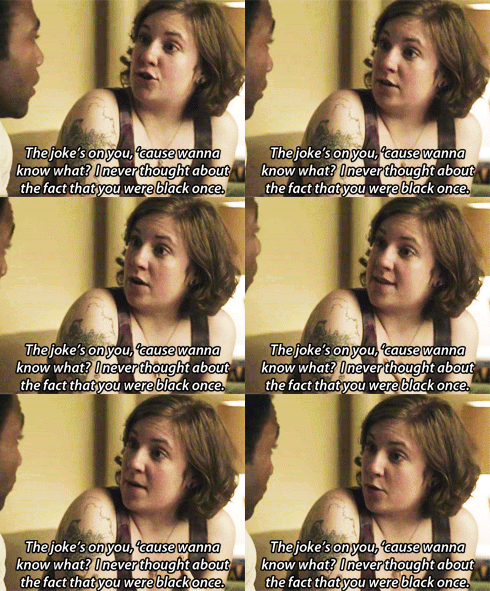
I have lived in New York, San Diego, Boston, and Seattle, all settings of my books. Fifteen years ago, I was Hannah Horvath, so I can tell you that there is absolutely no way you can live in any part of New York City and live a life that white. The city wasn't like that in 2001, and it's certainly not now. Urban dwellers in particular do not live in a racially homogenous world––why do we write it that way?
Whitewashed representations does two really bad things. First, it alienates half of potential readers. Yes, half. At least. That's what percentage of the U.S. is approximately people of color, and that statistic only grows if you think internationally. People are sick of homogenous storytelling, and with good reason. It's just plain false.
But whitewashing romance does something more insidious. It reinforces a world in which legitimacy and power belong primarily to those who are white. If we only read and write narratives about white characters, we are communicating, both through our dollars and pens, that their stories are the only ones that matter––whether we think that or not.
Let me say that again.
If you, by writing and reading "what you know," only read and write stories about white characters, you condition yourself and others that only white perspectives are worth our attention.
Look, to other white writers: I get it. It feels...scary and maybe impossible to write about cultural perspectives to which you don't belong, particularly considering the history of appropriation in this country. Thinking about it might make you feel like:

It doesn't help that American romance has a looooonnnnng history of fetishizing people of color (see James Fenimore Cooper, Lydia Marie Child...I could go on). I am not interested in being another Vanilla Ice or Miley Cyrus. I am not interested in using people of color as exoticized props or tools to demonstrate my "wokeness." And that's a fine line, my friends, particularly in a genre that often sexually objectifies its characters to begin with. It may feel safer to just "write what you know" to avoid offending anyone. But you guys, keeping your fictional worlds monochromatic is basically just pretending half of the population doesn't exist. Where's the humanity in that?
So. What can we do?
First of all, do your part to diversify the industry. Reach out to writers of color. Buy their work. Promote them as much or more than you would promote white writers. As Gabrielle Union recently said, pass the mic. It doesn't just have to be ours.
Not sure where to start? Here's a list of some fantastic writers of color and/or writers who create interesting, diverse stories. If you know others who should be on this list, let me know, and I'll add them:
- Dylan Allen
- Kimberly Reese
- CL Stacey
- S.L. Jennings
- Danielle Allen
- Nana Malone
- Ava Alise
- Kennedy Ryan
- Cathy Johns
- Claudia Burgoa
- Heather Orgeron
- Amy Harmon
Interested in learning about other writers of color? WOC In Romance is a great place to start.
Secondly, do your homework. Work to incorporate people of color into your stories in meaningful ways, but be conscious that your instincts are absolutely colored by the implicit racism steeped in our culture. Really learn about other identities that are not your own. I am not Puerto Rican, like the main character of my book, but I did my damnedest to portray his life in New York based on real scenes I witnessed, real people I know, and others to whom I reached out to confirm my impressions.
Find people who live the realities you want to portray. Take their perspectives seriously. Let them help you develop characters who are three-dimensional. Be humble enough to be called out when your versions of these characters are incorrect or even offensive. It's going to happen. That's okay. Just be willing to listen and revise, and you'll be fine.
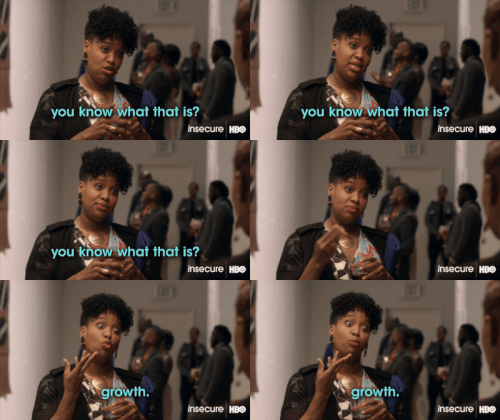
This genre is powerful. Romance is one of the oldest and most important forms of modern literature. Shakespeare, a romance writer, coined terms and phrases that changed the face of the English language. The novel, arguably the most influential form of the modern era, started with romance and has historically provided a voice for women, a long-marginalized population, since its beginning. Like it or not, our stories have the potential to shape the world––the way people see it and what they do with it. To that end, the representations we make in them matter. So let's hold ourselves accountable. We can do better.
SaveSaveSaveSaveSaveSaveSaveSave
SaveSaveSaveSaveSaveSaveSaveSave
But Bad Idea is different than my last series. See in writing this series, I broke a major unspoken rule of contemporary romance. I wrote characters who are not white.

I did this for a few reasons. One, I just wanted to write the story about Nico Soltero, a Puerto Rican man from a working-class neighborhood, and Layla Barros, a half-Brazilian, half-white NYU student because I thought it was interesting. But I also prioritized this book over other projects because I realized my last series was contributing to a major problem in romance: whitewashed narratives.
Look. It's no secret that the romance is pretty whitewashed. Take a look at the bestseller lists on Amazon. Look at almost all of the romantic comedies or TV shows produced over the last, oh, forever. Think about the television shows Sex in the City and Girls, stories set in incredibly diverse locations like New York City. Unless you're looking at ethnically aligned categories or channels, most of what you see is pretty damn white.

I have lived in New York, San Diego, Boston, and Seattle, all settings of my books. Fifteen years ago, I was Hannah Horvath, so I can tell you that there is absolutely no way you can live in any part of New York City and live a life that white. The city wasn't like that in 2001, and it's certainly not now. Urban dwellers in particular do not live in a racially homogenous world––why do we write it that way?

Whitewashed representations does two really bad things. First, it alienates half of potential readers. Yes, half. At least. That's what percentage of the U.S. is approximately people of color, and that statistic only grows if you think internationally. People are sick of homogenous storytelling, and with good reason. It's just plain false.

But whitewashing romance does something more insidious. It reinforces a world in which legitimacy and power belong primarily to those who are white. If we only read and write narratives about white characters, we are communicating, both through our dollars and pens, that their stories are the only ones that matter––whether we think that or not.
Let me say that again.
If you, by writing and reading "what you know," only read and write stories about white characters, you condition yourself and others that only white perspectives are worth our attention.
Look, to other white writers: I get it. It feels...scary and maybe impossible to write about cultural perspectives to which you don't belong, particularly considering the history of appropriation in this country. Thinking about it might make you feel like:

It doesn't help that American romance has a looooonnnnng history of fetishizing people of color (see James Fenimore Cooper, Lydia Marie Child...I could go on). I am not interested in being another Vanilla Ice or Miley Cyrus. I am not interested in using people of color as exoticized props or tools to demonstrate my "wokeness." And that's a fine line, my friends, particularly in a genre that often sexually objectifies its characters to begin with. It may feel safer to just "write what you know" to avoid offending anyone. But you guys, keeping your fictional worlds monochromatic is basically just pretending half of the population doesn't exist. Where's the humanity in that?
So. What can we do?
First of all, do your part to diversify the industry. Reach out to writers of color. Buy their work. Promote them as much or more than you would promote white writers. As Gabrielle Union recently said, pass the mic. It doesn't just have to be ours.

Not sure where to start? Here's a list of some fantastic writers of color and/or writers who create interesting, diverse stories. If you know others who should be on this list, let me know, and I'll add them:
- Dylan Allen
- Kimberly Reese
- CL Stacey
- S.L. Jennings
- Danielle Allen
- Nana Malone
- Ava Alise
- Kennedy Ryan
- Cathy Johns
- Claudia Burgoa
- Heather Orgeron
- Amy Harmon
Interested in learning about other writers of color? WOC In Romance is a great place to start.
Secondly, do your homework. Work to incorporate people of color into your stories in meaningful ways, but be conscious that your instincts are absolutely colored by the implicit racism steeped in our culture. Really learn about other identities that are not your own. I am not Puerto Rican, like the main character of my book, but I did my damnedest to portray his life in New York based on real scenes I witnessed, real people I know, and others to whom I reached out to confirm my impressions.
Find people who live the realities you want to portray. Take their perspectives seriously. Let them help you develop characters who are three-dimensional. Be humble enough to be called out when your versions of these characters are incorrect or even offensive. It's going to happen. That's okay. Just be willing to listen and revise, and you'll be fine.

This genre is powerful. Romance is one of the oldest and most important forms of modern literature. Shakespeare, a romance writer, coined terms and phrases that changed the face of the English language. The novel, arguably the most influential form of the modern era, started with romance and has historically provided a voice for women, a long-marginalized population, since its beginning. Like it or not, our stories have the potential to shape the world––the way people see it and what they do with it. To that end, the representations we make in them matter. So let's hold ourselves accountable. We can do better.
SaveSaveSaveSaveSaveSaveSaveSave
SaveSaveSaveSaveSaveSaveSaveSave


date newest »
newest »



I love romance. And I really enjoy the books that I read. HOWEVER, constantly reading books where POC aren't the hero/heroine can be quite discouraging. Sometimes when authors try to incorporate minorities in their stories, they never end up being the main character, and are often the "sidekick". Also they perpetuate major stereotypes which is honestly? Cringeworthy. And depending on some stories, the description of these characters are described either with stereotypical images or in a way that is fetishized as you said.
I, for one, love when authors switch it up. While the white perspective is quite interesting, living in one of the most multicultural cities in the world, I've realized that it isn't the only perspective.
We can honestly do better!