Pick a Future!
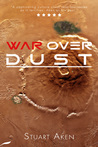 War Over Dust by Stuart Aken
My rating: 4 of 5 stars
One of the pleasures of reading science fiction is that the genre has always been “layered” in thought-provoking ways, creating a space in which to write (and read) about the social, political, environmental, spiritual, and moral issues roiling the present by projecting them into the future.
Here’s the Utopia we could build!
Here’s the Dystopia we’re headed for if we don’t change course!
Stuart Aken’s “Generation Mars: War Over Dust,” the second book in a projected trilogy, fits that template perfectly. Martian colonies are centuries-old; the earth is hot and wet and human-free, the icecaps having melted, sea-level having risen some 73 meters.
The colonies that “matter” on Mars are Marzero, a city-state with over two million residents, and Marion, with about a tenth the population.
The former is a hyper-capitalist, misogynistic, totalitarian kleptocracy, ruled by a PM—which stands not for Prime Minister but rather for PutinMaister—whose compound is the Trumpyramid . . . draw your own conclusions. Ironically, it brings to mind the current state of China: polluted, aggressively commercial, socially stratified.
The latter is a socialistic, cashless, egalitarian and leader-free community in which the offloading of work onto androids and robots has eliminated (involuntary) human labor, and genetic engineering, medical nanobots, and the option to transfer human consciousness into superandroids, has all but eliminated death. Perhaps the closest earth parallel would be the Israeli kibbutz—around 1955.
Life in Marzero revolves around work, with time off for buying things, eating bad food, drinking, and horrifically thorough abuse of women—virtually all of whom have the status of slaves, the great majority being essentially prostitutes, paid or unpaid. Hard to say whether religion there is “the opiate of the masses” or the amphetamine of the mob.
Secular and rationalist, the people of Marion—referred to snidely as “Marionets” in Marzero; they return the favor by referring to their neighbors as “Zeros”—occupy themselves with education, invention, physical activity, the arts, and collective governance. Sex is consensual across the lines of gender and marriage; clothing is optional: why, after all, would you pointlessly encumber your body when the weather didn’t require it?
The plot revolves around Daisa and Gabriel.
One of Marion’s newly-minted PhDs, at the age of nine—her aunt is 216, age functioning in entertainingly “non-standard” fashion in that particular community—Daisa, who “reads” to be somewhere in the 19-25 range in our years, heads off to Marzero to do research on Gabriel, an industrial worker who is the rising Prophet-of-the-People, hearing “god” during epileptic absence-seizures, under the tutelage and control of his “friend,” the Svengali-like Stefan.
It gives away nothing you don’t already know from the title to “reveal” that the two of them end up in the middle of a war.
So . . . The book *moves,* which is no small thing given the amount of contextualizing information we need to understand the landscape and the characters. Aken periodically succumbs to slightly didactic over-explanation, but not often enough or deeply enough to be off-putting.
The thematic elements that he juggles—politics, economics, religion, just for starters—hold ones interest and also force the reader to confront a variety of complicated and uncomfortable conundrums. The Bad Guys are a little monochromatic, but the problem of what it really means to be “Good” niggles in an ongoing way—to my mind: that’s the kind of “itch” that good fiction generates; I don’t want to read pablum; I enjoy complexity.
The characters—both core and peripheral—are generally well drawn, salted with a reasonable amount of human inconsistency. There is the occasional, somewhat jarring, flip in behavior or change in tone, but those lapses aren’t frequent enough to constitute a meaningful problem.
For the most part the book is well edited. While I have no problem with non-American dialects, in this case, the author’s Britticisms and English cadences were fairly smoothly subsumed in the colonists Mars-Speak: some of the Zeros sounded like they were speaking a variety of Cockney, others had something of an Aussie tinge, at least to my ear.
All in all, the book was a good ride. I look forward to the final section—I might even go back and read the first.
View all my reviews


No comments have been added yet.