MTG Comics Reread: Wayfarer
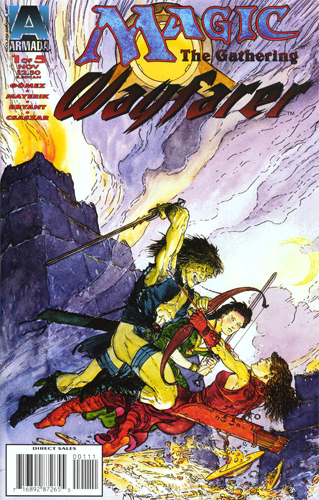
Wayfarer is bittersweet in many ways. It was published close to when the Armada Magic: The Gathering line was about to be discontinued. But more importantly, it ends on a cliffhanger that has never been satisfactorily resolved. The much-panned Battlemage video game attempted to provide some kind of conclusion, but even the best MTG lore historians agree that it’s rather lackluster.
Thus, we can only read the unreleased comic summary material that was made public nearly two decades after the fact and hope (fingers crossed) that Wizards of the Coast returns to the story someday. With the 25th anniversary expansion set on Dominaria, that hope is strong, albeit the chances are very small.
If you want to read fantastic summaries of the never-released Prelude to War and The Planeswalker War, in addition to the video game Battlemage, the excellent Multiverse in Review has you covered.
Wayfarer was published between November 1995 and March 1996.
STORY SYNOPSIS
After defeating Ravidel, Jared Carthalion begins wandering the land of Corondor to learn more about the five colors of mana while a villainous shadow grows in the background.
CREATIVES
The Wayfarer creative team had a lot of overlap with the one that worked on Shadow Mage. Jeff Gomez once again wrote the entire series, while Val Mayerik provided the pencils. Rick Bryant did the inks. For issues 4 and 5, Bryant was assisted by Gonzalo Mayo, also of the Shadow Mage team.
Mark Csaszar (The Legend of Jedit Ojanen) served as colorist.


Michael Kaluta provided cover art for the entire series. Kaluta is a decorated comic book artist who has been working in the industry since the 1970s. Surprisingly, he has worked on relatively few superhero comics, instead gravitating toward pulp, horror, and original stories. He’s best known for his run on The Shadow and for illustrating and directing the Alan Parsons Project music video for the song “Don’t Answer Me.” A frequent contributor to music and book projects, Kaluta was named a Spectrum Award Grand Master in 2003.
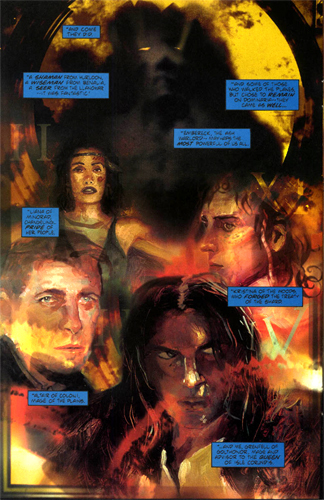
Finally, each issue had a painted story section that corresponded to the five colors of mana. Dennis Calero (Fallen Angel) did the stories in issues 1 through 4. His avant-garde style from the time really lends itself to these metaphysical “stories within stories.” For some reason, Calero did not provide the mana story for issue 5, and Mayerik filled in.

LORE
When Kristina transports herself and Jared to her home in the White Woods in issue 1, we learn that one of the lions in her menagerie is named Sandruu. This was, of course, the name of Kristina’s minotaur lover whom we met in Homelands and whom Taysir banished to some kind of prison realm during a fit of jealousy. Sandruu was likely to return in the unpublished Planeswalker War comic.
In issue 2, Kristina talks about missing Sandruu and Taysir, describing the latter as “that wise man I keep babbling about.” Is it possible Kristina is unaware that Taysir was the one who banished Sandruu to begin with because of Ravidel’s machinations?
In issue 3, Ravidel all but tells Liana that Taysir is his master. Taysir taking Ravidel as an apprentice is peculiar, as noted in the Homelands entry. In the back of issue 5, Jeof Vita writes, “Kudos to all of you who guessed that Taysir did indeed train Ravidel — and to those of you wondering how this could be, stay tuned!” Yet another question left unanswered by the series’ cancelation.
When is Jared’s birthday, and how old is he? Issue 1 of The Shadow Mage begins in the autumn of 1265. From the Battle of Aster Fall, it takes Jared and Ezer three months to get back to Arathoxia, and the season is described as “near the time of Yule.” Speaking to the Scarlet Vizier that same day, Ezer says, “This babe is the Master Jared — born nine months past.” If we take autumn of 1265 to mean September and Yuletide to mean December, it would mean that Jared was born approximately in March. However, issue 4 of Wayfarer takes place in autumn 1281 and opens with the line, “Earlier this evening, Kristina of the Woods wished Jared Carthalion a happy sixteenth birthday.” The year is correct — Jared would have turned 16 in 1281 — but his birthday should have occurred about six months earlier.
We know that pre-Mending Planeswalkers are long-lived. Grenfell Mor, Jared’s grandfather, is at least 1,300 years old at the time of this comic. One gets the sense that Jared’s mother, Gwendolyn, was also older than her apparent years, since it is said that she built the bridge city of Telemar.
Grenfell tells Jared that “your twisted ancestry has marauded through history since the time of the Blackblade.” The birth of the Carthalion line is, of course, recounted in the Dakkon Blackblade comic.
[EDIT 4/2/2018: We got confirmation that the Dakkon comic is still canon, thanks to episode one of the Dominaria story.]
Grenfell again mentions "the Treaty of the Shard," but there’s no indication as to what this means, especially since at this point in history The Shard is no longer in existence. (See also: Ice Age )
Ravidel refers to the Golgothian Sylex as the “Sylex of Argive,” and the Scarlet Vizier notes that it will “annihilate anything or anyone with a direct lineage to the time of the Brothers War.” While this is indeed what the card does in-game — namely, it destroys cards from the Antiquities expansion — this isn’t really what the sylex does in canon, where its effect is more like a nuclear blast on steroids. Shawn Carnes acknowledges the name change at the end of issue 5.
We also know that Ravidel somehow got the Golgothian Sylex from Ash Warlord Embereck shortly after the Ice Age ended, but the details of this event are shrouded in mystery.
In issue 5, we learn another scant detail about Ravidel’s home plane. We already know from the Summit at the Null Moon in Ice Age that Ravidel came from one of the 12 planes within The Shard. In issue 5 of Wayfarer, he says that the plane was destroyed when The Shard was formed. Presumably Ravidel was “dishonored … cast … out as a child” before this occurred.
Jared destroying the Golgothian Sylex in issue 5 is apparently canon.
Caliphear is definitely not killed during the events at the Dueling Chasm; she is merely unsummoned. Altair, however, likely perishes in the battle (a fact that Shawn Carnes confirms at the end of issue 5). Liana, meanwhile, is presumed to have died in the Abyss while stalling Ravidel in issue 3.
Daria, Taysir’s apprentice, is the first to arrive on Dominaria after the Mox Beacon is activated.
MISCELLANEOUS
Kadesha appears to have only four fingers on her right hand.

Hamath is said to have (or is in the process of making) an alliance with Avenant, which is described as an island north of Benalia. Avenant and Corondor are, literally, half a world away from each other so the purpose of this alliance is unclear, not to mention how long is must take for Avenant archers to travel to Corondor. We are, though, dealing with a world of magic, so anything is possible.
At one point, Elan says, “Today, Ravidel has finally played his wrong card.” I see what you did there, Jeff Gomez.
When Kristina interrupts the duel between Jared and Elan in issue 1, Kristina says, “Too much dried lobelia root, guys?” Lobelia root has never appeared on any MTG card, so we can only assume that it has some kind of intoxicating properties.
Kristina references the Order of Leitbur, which means she either traveled to or studied Sarpadia at one point.
In issue 4 of The Shadow Mage, the Grand Sultan states that there is a mysterious and powerful civilization hidden in the White Woods. In issue 2 of Wayfarer we learn that he was indeed referring to the Quirion Elves, which is divided into several tribes, namely the Calthyn and the Kieryn.
There seems to be a continuity error in issue 2. The transition panel on page 23 says, “Three days later,” but in the dialogue Jared says, “I told you yesterday … I’m not a bard.”
There’s a fun little Easter egg on page 25 of issue 2. When meeting Jared for the first time, the Force of Nature says, “Crescent of the dark … mark of the elder druid …” The crescent mark of the elder druids that Jared carries on his cheek is indeed the expansion symbol for The Dark set. Letter writers also point this out in the back of the same issue. Of course, the symbol also appeared in Ice Age and in a short story called “Feast of Kjeld” that appeared in Duelist issue 5. The always excellent Multiverse in Review has your back if you want to learn more about this story.
In the back of issue 2, the editors note that Ravidel’s planar barge is modeled after a War Barge.
One would think that the Trovash Engine that Jared and Kristina discover in issue 3 would have been printed on a physical card, possibly from the Antiquities set because it fits the flavor so well. However, this piece of Mishra-era mining equipment has never appeared on a physical MTG card.
During Grenfell’s tale, he says, “Something terrible had happened in Terisaire — to this day, the fate of that proud land is a mystery.” He also mentions that the council of Minorad drew on the scholarship of Taysir for knowledge. Since the third volume of the Urza-Mishra War comic was never produced — the comic “written” by Taysir which would have covered the events leading up to and including the sylex blast — it makes sense in the universe of the comics that the council of Minorad does not know how the war ended.
Grenfell Mor also utters the oath, “Sol’Kanar’s horns.”
The Scarlet Vizier appears at Ravidel’s side at the council at Minorad — meaning the Vizier is also more than 1,300 years old!
In issue 4, Ash Warlord Embereck says, “This place holds the key to my existence.” We’re not sure if he’s referring to Minorad or Dominaria as a whole, nor do we ever learn what he means.
In issue 5, Ravidel confirms that the Scarlet Vizier has perverse sexual appetites — as alluded to in The Shadow Mage
One of the monoliths in the Dueling Chasm of Golthonor is named Piru. Piru was Chromium (Rhuell)’s mate before she was killed by Dakkon Blackblade. In the comic Altair incorrectly calls her the “fabled fifth Elder Dragon.” She is actually the fabled sixth Elder Dragon, and her canonical status was confirmed in the first episode of the Dominaria story in 2018.
Caliphear is full of colorful curses. In issue 5, she says “Trine’s halo” — a nice reference to the Horned Halo and the fallen Serra Angel that wore it in ancient Corondor. See also the entry for the Fallen Angel comic.
Thus, we can only read the unreleased comic summary material that was made public nearly two decades after the fact and hope (fingers crossed) that Wizards of the Coast returns to the story someday. With the 25th anniversary expansion set on Dominaria, that hope is strong, albeit the chances are very small.
If you want to read fantastic summaries of the never-released Prelude to War and The Planeswalker War, in addition to the video game Battlemage, the excellent Multiverse in Review has you covered.
Wayfarer was published between November 1995 and March 1996.
STORY SYNOPSIS
After defeating Ravidel, Jared Carthalion begins wandering the land of Corondor to learn more about the five colors of mana while a villainous shadow grows in the background.
CREATIVES
The Wayfarer creative team had a lot of overlap with the one that worked on Shadow Mage. Jeff Gomez once again wrote the entire series, while Val Mayerik provided the pencils. Rick Bryant did the inks. For issues 4 and 5, Bryant was assisted by Gonzalo Mayo, also of the Shadow Mage team.
Mark Csaszar (The Legend of Jedit Ojanen) served as colorist.
Michael Kaluta provided cover art for the entire series. Kaluta is a decorated comic book artist who has been working in the industry since the 1970s. Surprisingly, he has worked on relatively few superhero comics, instead gravitating toward pulp, horror, and original stories. He’s best known for his run on The Shadow and for illustrating and directing the Alan Parsons Project music video for the song “Don’t Answer Me.” A frequent contributor to music and book projects, Kaluta was named a Spectrum Award Grand Master in 2003.
Finally, each issue had a painted story section that corresponded to the five colors of mana. Dennis Calero (Fallen Angel) did the stories in issues 1 through 4. His avant-garde style from the time really lends itself to these metaphysical “stories within stories.” For some reason, Calero did not provide the mana story for issue 5, and Mayerik filled in.
LORE
When Kristina transports herself and Jared to her home in the White Woods in issue 1, we learn that one of the lions in her menagerie is named Sandruu. This was, of course, the name of Kristina’s minotaur lover whom we met in Homelands and whom Taysir banished to some kind of prison realm during a fit of jealousy. Sandruu was likely to return in the unpublished Planeswalker War comic.
In issue 2, Kristina talks about missing Sandruu and Taysir, describing the latter as “that wise man I keep babbling about.” Is it possible Kristina is unaware that Taysir was the one who banished Sandruu to begin with because of Ravidel’s machinations?
In issue 3, Ravidel all but tells Liana that Taysir is his master. Taysir taking Ravidel as an apprentice is peculiar, as noted in the Homelands entry. In the back of issue 5, Jeof Vita writes, “Kudos to all of you who guessed that Taysir did indeed train Ravidel — and to those of you wondering how this could be, stay tuned!” Yet another question left unanswered by the series’ cancelation.
When is Jared’s birthday, and how old is he? Issue 1 of The Shadow Mage begins in the autumn of 1265. From the Battle of Aster Fall, it takes Jared and Ezer three months to get back to Arathoxia, and the season is described as “near the time of Yule.” Speaking to the Scarlet Vizier that same day, Ezer says, “This babe is the Master Jared — born nine months past.” If we take autumn of 1265 to mean September and Yuletide to mean December, it would mean that Jared was born approximately in March. However, issue 4 of Wayfarer takes place in autumn 1281 and opens with the line, “Earlier this evening, Kristina of the Woods wished Jared Carthalion a happy sixteenth birthday.” The year is correct — Jared would have turned 16 in 1281 — but his birthday should have occurred about six months earlier.
We know that pre-Mending Planeswalkers are long-lived. Grenfell Mor, Jared’s grandfather, is at least 1,300 years old at the time of this comic. One gets the sense that Jared’s mother, Gwendolyn, was also older than her apparent years, since it is said that she built the bridge city of Telemar.
Grenfell tells Jared that “your twisted ancestry has marauded through history since the time of the Blackblade.” The birth of the Carthalion line is, of course, recounted in the Dakkon Blackblade comic.
[EDIT 4/2/2018: We got confirmation that the Dakkon comic is still canon, thanks to episode one of the Dominaria story.]
Grenfell again mentions "the Treaty of the Shard," but there’s no indication as to what this means, especially since at this point in history The Shard is no longer in existence. (See also: Ice Age )
Ravidel refers to the Golgothian Sylex as the “Sylex of Argive,” and the Scarlet Vizier notes that it will “annihilate anything or anyone with a direct lineage to the time of the Brothers War.” While this is indeed what the card does in-game — namely, it destroys cards from the Antiquities expansion — this isn’t really what the sylex does in canon, where its effect is more like a nuclear blast on steroids. Shawn Carnes acknowledges the name change at the end of issue 5.
We also know that Ravidel somehow got the Golgothian Sylex from Ash Warlord Embereck shortly after the Ice Age ended, but the details of this event are shrouded in mystery.
In issue 5, we learn another scant detail about Ravidel’s home plane. We already know from the Summit at the Null Moon in Ice Age that Ravidel came from one of the 12 planes within The Shard. In issue 5 of Wayfarer, he says that the plane was destroyed when The Shard was formed. Presumably Ravidel was “dishonored … cast … out as a child” before this occurred.
Jared destroying the Golgothian Sylex in issue 5 is apparently canon.
Caliphear is definitely not killed during the events at the Dueling Chasm; she is merely unsummoned. Altair, however, likely perishes in the battle (a fact that Shawn Carnes confirms at the end of issue 5). Liana, meanwhile, is presumed to have died in the Abyss while stalling Ravidel in issue 3.
Daria, Taysir’s apprentice, is the first to arrive on Dominaria after the Mox Beacon is activated.
MISCELLANEOUS
Kadesha appears to have only four fingers on her right hand.
Hamath is said to have (or is in the process of making) an alliance with Avenant, which is described as an island north of Benalia. Avenant and Corondor are, literally, half a world away from each other so the purpose of this alliance is unclear, not to mention how long is must take for Avenant archers to travel to Corondor. We are, though, dealing with a world of magic, so anything is possible.
At one point, Elan says, “Today, Ravidel has finally played his wrong card.” I see what you did there, Jeff Gomez.
When Kristina interrupts the duel between Jared and Elan in issue 1, Kristina says, “Too much dried lobelia root, guys?” Lobelia root has never appeared on any MTG card, so we can only assume that it has some kind of intoxicating properties.
Kristina references the Order of Leitbur, which means she either traveled to or studied Sarpadia at one point.
In issue 4 of The Shadow Mage, the Grand Sultan states that there is a mysterious and powerful civilization hidden in the White Woods. In issue 2 of Wayfarer we learn that he was indeed referring to the Quirion Elves, which is divided into several tribes, namely the Calthyn and the Kieryn.
There seems to be a continuity error in issue 2. The transition panel on page 23 says, “Three days later,” but in the dialogue Jared says, “I told you yesterday … I’m not a bard.”
There’s a fun little Easter egg on page 25 of issue 2. When meeting Jared for the first time, the Force of Nature says, “Crescent of the dark … mark of the elder druid …” The crescent mark of the elder druids that Jared carries on his cheek is indeed the expansion symbol for The Dark set. Letter writers also point this out in the back of the same issue. Of course, the symbol also appeared in Ice Age and in a short story called “Feast of Kjeld” that appeared in Duelist issue 5. The always excellent Multiverse in Review has your back if you want to learn more about this story.
In the back of issue 2, the editors note that Ravidel’s planar barge is modeled after a War Barge.
One would think that the Trovash Engine that Jared and Kristina discover in issue 3 would have been printed on a physical card, possibly from the Antiquities set because it fits the flavor so well. However, this piece of Mishra-era mining equipment has never appeared on a physical MTG card.
During Grenfell’s tale, he says, “Something terrible had happened in Terisaire — to this day, the fate of that proud land is a mystery.” He also mentions that the council of Minorad drew on the scholarship of Taysir for knowledge. Since the third volume of the Urza-Mishra War comic was never produced — the comic “written” by Taysir which would have covered the events leading up to and including the sylex blast — it makes sense in the universe of the comics that the council of Minorad does not know how the war ended.
Grenfell Mor also utters the oath, “Sol’Kanar’s horns.”
The Scarlet Vizier appears at Ravidel’s side at the council at Minorad — meaning the Vizier is also more than 1,300 years old!
In issue 4, Ash Warlord Embereck says, “This place holds the key to my existence.” We’re not sure if he’s referring to Minorad or Dominaria as a whole, nor do we ever learn what he means.
In issue 5, Ravidel confirms that the Scarlet Vizier has perverse sexual appetites — as alluded to in The Shadow Mage
One of the monoliths in the Dueling Chasm of Golthonor is named Piru. Piru was Chromium (Rhuell)’s mate before she was killed by Dakkon Blackblade. In the comic Altair incorrectly calls her the “fabled fifth Elder Dragon.” She is actually the fabled sixth Elder Dragon, and her canonical status was confirmed in the first episode of the Dominaria story in 2018.
Caliphear is full of colorful curses. In issue 5, she says “Trine’s halo” — a nice reference to the Horned Halo and the fallen Serra Angel that wore it in ancient Corondor. See also the entry for the Fallen Angel comic.


No comments have been added yet.