Dirty Feet and the Condescension
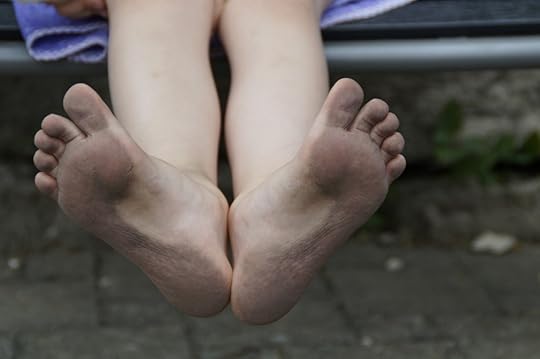
Recently I washed what were probably — no, certainly — the dirtiest feet I have ever washed in my life. The setting was not what I’ve been used to. I attend a local church many would consider to be one of the most privileged in Ghana. The feet I’ve washed during the communion service have tended to be very well kempt, and clean.
Recently, however, I have been visiting Adventist churches in some very rural places in Ghana. On a recent Sabbath I had the privilege of sharing in a communion service with one of these churches.
When I sat down for the foot-washing ritual it crossed my mind that I might be in for something I did not expect. I did flash a glance across at the left foot of the brother I was about to minister to as we sat on the wooden benches provided for outside the church. It looked clean enough from above, and I was somewhat reassured. I held his hands and asked his prayer requests.
After prayer I took the right foot in my hands, placed it gently in a pale of water and began to wash it. The initial view had been misleading. It was on the sole that the real issue lay, where the dirt really was. It was there that encrusted dirt clung tenaciously to skin, like sin to the soul. Perhaps my earlier foreboding prepared me for the shock, for I remained somewhat composed while the crust turned into slime in my hands. There was also the hardened black soil between the toes to rub out. It took effort to wash those feet with the air of one who washes such feet all the time.
To say the least it was a discomfiting experience. It was not offensive or upsetting in any way, just strangely and shockingly different. But it was the following day that I came upon thoughts that surely only a reflective perspective could afford; the kind that comes only after the shock of a traumatic event or the dizziness of a surreal moment has passed.
I thought about the feet, seeing them again in my mind’s eye. Then I thought about their owner. He was a young man of about twenty. He was dressed satisfactorily well, and had a calm, reasonable bearing.
Why did such a nice young man have such badly kept feet? I was not inclined to accept his obvious poverty as the answer. Yes he was poor, but that did not necessarily prevent a good bath. I reflected that anyone could have such dirty feet. I thought that it more likely came from an accommodating attitude to dirty feet than from any compelling influences of the local or personal economy — at best from the self-forgetfulness brought on by the stress of life.
My thoughts returned to my own mental condition at the time of the washing. I had been reassuring myself that I was experiencing what Jesus wanted me to when He ordained the ritual. I was condescending… to wash dirty feet, like Jesus had condescended to cleanse sinful humanity. No doubt that realisation was in part a source of my composure. Probably for the first time, the foot-washing ordinance called forth real humility from me. Hitherto I had never really felt humbled by it. It had simply been an otherwise culturally out-of-context, even strange deed that I did every quarter or so. It does not take humility to wash the feet of friends, at least not for me. Any initial humility in the gesture had long descended into the realm of theory and symbology.
But now I was realising that while washing those feet my reflection on condescension was incomplete, particularly as it related to the condescension of our Lord Jesus Christ. What did Jesus really do in the Condescension? To what truly, did He condescend?
In Plato’s Symposium, the (possibly fictional) philosopher Diotima relates that when we fall in love, we do not do so with the people who are the apparent objects of our affections. Her idea is that we actually love certain things about them: demeanors, traits, character, personality, and the like. She says we soon find out if we reflect deeply enough, that any qualities embedded in the personality of the person we love are possessed by numerous other people, and that in actuality we love not persons, but types of persons. We soon realize, she concludes, that it is abstract concepts such as goodness, beauty, wisdom, et cetera, that we really love.
I find that we often default to a similar abstraction of the condescension of Jesus. In that abstraction, Jesus condescends to the sinful state of humankind. He comes down from divine glory into human depravity. He comes down to our level, bears our sin. He dies for us. And yet, what I was experiencing with this young man was different. I was not washing Poverty’s feet; I was washing this young man’s feet. I was not humbling myself to the local economic climate of the Agona community, but to him. And if it was his own carelessness, his own lack of aversion to dirty feet, his own absence of hygienic sense, that had produced these horrible feet, then I was condescending not to some abstract societal construct, but to something real and deep inside him… something inherently true to him. In washing his feet I was condescending first to who he was, before anything he represented if at all.
You see, the difference is significant. If his dirty feet were a result of poverty, he could be excused. In fact, we would find it difficult to hold him responsible for them. But he was responsible for the condition of his feet. He was culpable, guilty. And is that not how sin is? Indeed, all the feet of all the young men in Agona might have been as dirty or dirtier that Sabbath afternoon, but if they were, none would have been the reason for any other. Each pair would have been dirty for its own reasons; reasons buried deep in the psyche of their owners.
In His condescension then, our Lord submitted to more than just the moral depravity of humanity. He took “the very nature of a servant”[1] in order to serve not merely humanity on an abstract level, but very specifically, me. He took on my depravity, my sin. Again, we should clarify the significance of this distinction. I am not responsible for all the evil in the world. What’s more, all humanity is not responsible for my sins. In other words, I am not a sinner because of anyone’s sin but my own. And if I sin, it is not because of the general human condition, however powerful its influence may be; ultimately it is because I choose to sin, and it is not due to humanity’s frailty, but my frailty. Humanity may confer an original propensity, but it is always my decision to resist or give in to it.
So sin is a personal reality. Yes, I am to a great degree a product of the larger society of human beings to which I belong. But this in no way impinges on my freedom of choice and independence of thought. So my actions remain my own responsibility, a responsibility I cannot distribute across humanity on an abstract level. I may be the product of a fallen state, but my actions are a product of my self.
So the condescension does not merely enter into the general condition of humankind: it penetrates deep into the person of every person. Just like I had to accept the person that created the dirty feet, Jesus condescended to be guilty of what I am personally guilty for. The attitude of sin is in me. The weakness in temptation is in me. The spiritual laziness is in me. It is my nature, cultivated by my practice. It is my making. In a deeply profound way, Jesus consented to be charged with this pitiable condition of mine.
Diotima did not known Jesus. If she existed at all, Jesus wasn’t born yet in her time. But if she had, she might have spoken of His kenosis, his coming down to our level, as something that transpired purely in the philosophical dimension of abstract concepts like sin, ethics, and human depravity (the fallen nature). For her, Jesus would no doubt have condescended to the general state of affairs we refer to as the fallen condition, rather than to any of us specifically.
Her thesis would have been intellectually stimulating, but it would have been theologically catastrophic as far as the salvation of individuals. That is because at best, such condescension can only save the notion of humanity, and not any human per se. The idea of depravity may have been successfully refuted, but actual propensity to sin would persist in the person. Salvation would have truly ascended into the realms of theoretical discourse, never to visit us more.
After washing the feet of a young man, I now see the personal relevance of the condescension in a deeper way than I hitherto have. Hitherto I have extended that deed of Christ from the level of general humanity — as the actual thing — to myself, by implication. It’s clearer now that it is not possible to save human society except by saving human persons. It is not possible to be guilty of humanity’s sin except by taking up the sins of each human being. Things are the other way around, and it is this slight but significant shift in the centrality of the condescension that I wish to share.
It is not that this personal view has been lost to us; I simply propose that perhaps it should be our default view. God so loved the world, because God so loved the worldlings.
__
[1] Philippians 2:7, NIV
If you enjoyed this, you’ll find similar pieces in my new book, Epiphany and Other Reflections
If you enjoyed this story, please click the