Reckoning… helping refugees in Greece
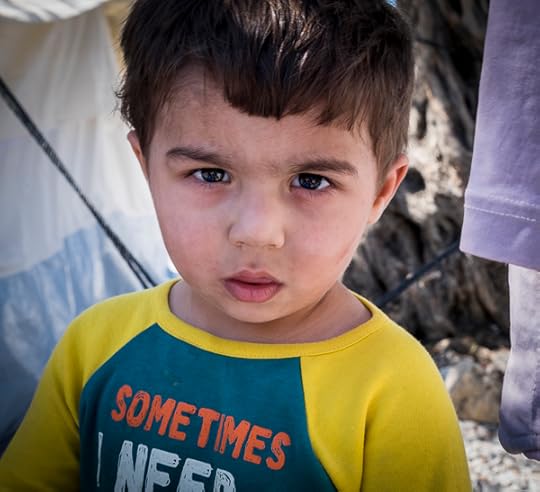
Six months ago, when my partner and I were planning our annual trip to the Greek island of Lesbos, we already knew about the mounting refugee crisis—though it hadn’t become a crisis yet. It was still a manageable situation.
In fact, for the twelve years we have been going to Lesbos, refugees have regularly crossed the narrow and treacherous channel from Turkey. In the summers, a walk along the north coast would always turn up an abandoned raft or two, a few discarded life preservers, sometimes a half dozen paddles neatly leaning against the rocky cliffs. In small groups, they arrived a couple of times a week, almost always young Afghan or Iraqi men fleeing wars started by the West in their countries.
By this spring, the numbers and methods started to change. Instead of a couple of rafts a week, one or two started to land every day, then three or four. Traffickers on the Turkish side crowded sixty people onto rubber dinghies built for twelve and launched them at night so they could cross the 10-kilometer-wide channel unseen, landing on Lesbos’ shores at sunrise. No longer only young men, the refugees included families, with infants and pregnant women, the majority escaping the civil war in Syria—and all with stories of family members killed, neighborhoods destroyed, and lives shattered.
Initially, the media paid little attention to the unfolding crisis in Greece, preferring instead to cover the migrants landing in Italy, coming from Libya in bigger boats and numbers, with attention-grabbing headlines if they capsized and hundreds drowned. That has changed, with the numbers and photographs now coming out of Greece with a numbing regularity. And the numbers are dramatic. At one time, 150 refugees arriving in our village of Molyvos seemed like a big day. Now, at least 2,000 arrive daily with spikes up to 4,000.
In another era or another country, this type of humanitarian crisis would be tackled with a massive international relief effort. That simply has not happened. In Molyvos, the United Nation’s premier refugee agency – UNHCR – has provided buses to help transport refugees from the north coast to the island’s capital (Mytilini, some 70 kilometers away), put up a couple of tents at an ad hoc transit spot managed by local volunteers, and picked up a few incidental expenses. The International Rescue Committee has similarly provided buses and a small emergency team ready to help. Both groups have been more active in Mytilini where the official refugee camps are located; but no organization has brought in the administrative know-how or level of resources needed to cope with a crisis increasingly referred to as Biblical, historic and unprecedented.
The Greek government is equally at fault. Unfortunately, as the refugee crisis unfolded over the summer, the national government was distracted by protracted negotiations for an international financial bailout. Equally unfortunately, it has used the economic crisis as an excuse for not deploying resources to assist the refugees, when it has a huge but not utilized resource at its disposal: the military. Just off the coast of Turkey, Lesbos is dotted with army camps, some even abandoned; and army trucks drive around every day with one soldier in the back. The camps, trucks and soldiers could all be utilized to transport, shelter, feed and legally process the refugees.
For a sociologist, Molyvos is a fascinating case study of how a community responds to a humanitarian crisis. From the beginning, local volunteers have organized food, dry clothes, and what shelter they could for some 90,000 refugees to date. Increasingly they have been helped by foreign volunteers who pitch in for a week or two; or in about a dozen cases, stay long-term, meaning two or three months.
It has not been easy. The island’s authorities have repeatedly capitulated to a loud and angry clique of anti-refugee activists who prevented even a single toilet for the refugees from being installed in Molyvos, fenced off a parking lot where at least they could sleep at night, and stopped the establishment of a proper transit spot approved by the island’s mayor. For a while, youths on motorbikes harassed them, forcing the refugees out of the village in the middle of the night. The lowest point may have been in a public hearing when a woman screamed that the refugees should be shot before reaching the beaches; and equally grim was the moment a local travel agent turned his hoses on the refugees to keep them from resting on the sidewalk outside his office.
Those ugly moments have been, fortunately, few. Aside from the organized volunteer efforts, many villagers have handed out food and water, invited refugees into their homes to shower, bought them meals, and driven them to Mytilini instead of letting them walk the long distance. One local hotel owner has a team ready any time of the day or night to meet the rafts as they come ashore on his private beach.
Since the spring, I have headed up a private fundraising effort to support the volunteers in both Molyvos and the island’s capital, and the generosity of donors has been astonishing. I have raised many more Euros than I ever imagined, and as a result, I’ve been able to buy lots of food, thousands of hats for protection against the brutal sun, and thousands of rain ponchos for the winter. I have paid for medications, transport services, plumbing repairs, and supplies for a mobile kitchen; and, I provide small food stipends for the long-term foreign volunteers assisting in Molyvos. I am often asked to fill small gaps where other funding isn’t available.
It has been deeply satisfying to help where I can. As long as I still have donations coming in, I will keep doing it. If you wish to make a donation, the instructions are on my web page: www.timothyjaysmith.com . Many thanks to everyone who has or will contribute.
Photo by Michael Honegger @ www.michaelhoneggerphotos.com