Skipping Strings
Skipping strings can add some pizazz to ordinary licks and patterns. Scales and arpeggios are normally taught with forms that ascend and descend using notes on adjacent strings. I too, started with this approach which was fine for learning forms. The string skipping light bulb went off in my head when I started to explore intervals. The wider the intervals got, the more it appeared I needed to skip some strings. It was the 6th interval that introduced me to the world of string skipping. From there, I made a concerted effort to add string skipping to my arsenal of licks.
The three-note-per-string pentatonic scales were very popular choices for string skipping. The first person I heard use string skipping with the three-note-per-string pentatonics was Paul Gilbert, but I learned later that Holdsworth was doing this much earlier. Here are several examples that illustrate string skipping:
Skipping strings can add some pizazz to ordinary licks and patterns. Scales and arpeggios are normally taught with forms that ascend and descend using notes on adjacent strings. I too started with this approach which was fine for learning forms. The string skipping light bulb went off in my head when I started to explore intervals. The wider the intervals got, the more it appeared I needed to skip some strings. It was the 6th interval that introduced me to the world of string skipping. From there, I made a concerted effort to add string skipping to my arsenal of licks.
The three-note-per-string pentatonic scales were very popular choices for string skipping. The first person I heard use string skipping with the three-note-per-string pentatonics was Paul Gilbert, but I learned later that Holdsworth was doing this much earlier. Here are several examples that illustrate string skipping:
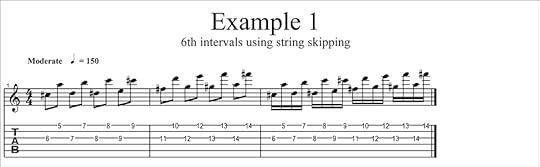
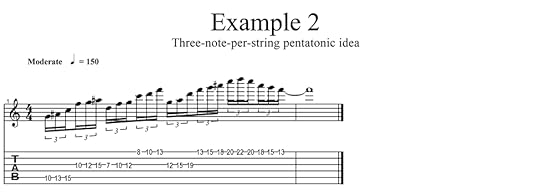
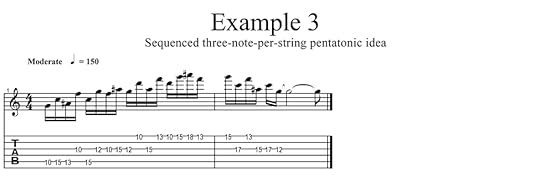

The three-note-per-string pentatonic scales were very popular choices for string skipping. The first person I heard use string skipping with the three-note-per-string pentatonics was Paul Gilbert, but I learned later that Holdsworth was doing this much earlier. Here are several examples that illustrate string skipping:
Skipping strings can add some pizazz to ordinary licks and patterns. Scales and arpeggios are normally taught with forms that ascend and descend using notes on adjacent strings. I too started with this approach which was fine for learning forms. The string skipping light bulb went off in my head when I started to explore intervals. The wider the intervals got, the more it appeared I needed to skip some strings. It was the 6th interval that introduced me to the world of string skipping. From there, I made a concerted effort to add string skipping to my arsenal of licks.
The three-note-per-string pentatonic scales were very popular choices for string skipping. The first person I heard use string skipping with the three-note-per-string pentatonics was Paul Gilbert, but I learned later that Holdsworth was doing this much earlier. Here are several examples that illustrate string skipping:


No comments have been added yet.