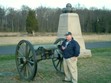
13 Hidden, Haunted, Hotspots of Gettysburg #6
The first day’s battle at Gettysburg literally swirled around
the Widow Mary Thompson’s house. In fact, it may be said that within sight of
the Widow Thompson’s stone house and barn atop Seminary Ridge, a decision was
made which completely altered the history of the world.
Imagine yourself Confederate General Robert E. Lee. You have
embarked upon your second invasion of the enemy’s country, marching your army
for three weeks northward, crossing into one of the largest, wealthiest, and
most influential states in the Union—Pennsylvania. During the campaign you have
attempted to gather in as much materiel as you could from the northern
states—avoiding pillaging Maryland as a gesture to a state that might still
join the Confederacy. But farmers and townsfolk throughout this area of
Pennsylvania have felt the sting of a hostile army “requisitioning” food
animals, draft animals and dry goods, such as shoes, hats, socks, medical
supplies and thousands of barrels of flour.
That’s one of the arguments for the invasion you discussed
with President Jefferson Davis: the war had been waged in the south for two
years putting extreme strain on the farmers, especially in the Shenandoah
Valley, to supply two armies fighting in Virginia. Another reason for invasion
was the hope of British recognition of the Confederacy as an independent
country; a victory on northern soil might convince them to send money, more
arms and supplies. As well, there was a powerful “Peace Party” in the Yankee
government; winning a battle in Pennsylvania, then threatening an attack on
Washington would add more credence to their arguments.
Since leaving the northern reaches of the Shenandoah Valley your
army has spread across southern Pennsylvania, northeastward toward Harrisburg,
the capitol of the state, and east, reaching the Susquehanna River at
Wrightsville on the road to Philadelphia. With the wings of your army separated
you have given all your commanders orders not to bring on a general engagement
with the enemy. In fact, after hearing that the enemy had crossed the Potomac,
you issued orders for the wings to begin to assemble near Cashtown and
Gettysburg.
Early this morning, however, arriving in Cashtown you heard
the ominous sound of cannons firing from the direction of Gettysburg, a town
that has several roads radiating out from its center. The sound of the guns
continues until you deem it necessary to personally find out who is violating
your orders, where it is happening, and just what is going on. As you get
closer to Gettysburg you begin to see clouds of black powder smoke rising in
the distance.
It is nearing 2:00 P.M. and additional evidence of a large battle can be seen—some wounded from your army filling aid stations and field hospitals along your route. More and more wounded as you got closer to Gettysburg. There’s a battle going on—a big battle—and you don’t know how it is turning out. You anxiously crest a ridge overlooking the town and you see what is happening. You are pleased with what you see.
As a young cadet at West Point, those many years ago, you’d
read about battles that changed the course of military history: Waterloo
stopped Napoleon in his tracks as he sought to conquer Europe; Cannae,
Hannibal’s battle of annihilation of the Romans; and, most relevantly,
Yorktown, where Washington won his country’s independence.
In front of you and to your left you see your troops pressing
the enemy from the north. More troops are arriving from the east and the attack
in your front resumes, pressing on “those people” from the west. The enemy is now
in full retreat with your troops pressing them through the town below only a
block or so behind them. The battle that you had wanted to avoid is now turning
into the victory on the enemy’s soil your country needs so much. The
apprehension for battle you felt just moments ago vanishes like the morning
mists in Virginia. Your army has presented you with a victory, a victory that
just might lead to the Confederacy’s independence. Now, how to make the most of
it.
Looking around you see that your aides are ordering men
around, cleaning up the area of debris and dead bodies, and beginning to have
your headquarters tents set up. The western slope of the ridge where this
school sits should do. They tell you it is a Lutheran Seminary.
Across the road you can see a small fieldstone house. Already
your aides have stationed four guards around it. From the position on the ridge
overlooking what is likely to become a battlefield, the spot is a good one for
headquarters….
And the controversy begins.
Sometimes historians can get picky, almost to an absurd
extent: “How many buttons did General Reynolds have on his coat when he was
shot?” picky. Lee’s headquarters site at Gettysburg is one of those historical
things that always had a mental asterisk after it. Did he or did he not use the
Widow Thompson’s house as his headquarters?
Major General George G. Meade, Lee’s counterpart at Gettysburg, has his headquarters plainly marked on the Taneytown Road, the Lydia Leister House. So there’s no controversy there, right?
Wrong. Certainly the Federal Government was sure enough of
its authenticity to purchase the Leister House as Meade’s Headquarters; no
doubt some of the more important decisions about the battle were made in that
house, such as whether to stay or retreat after the second day of battle. But
when the Confederate cannonade prior to Longstreet’s Assault (aka “Pickett’s
Charge”) began raining artillery shells around the Leister House, discretion
became the better part of valor and Meade moved his headquarters farther to the
east to a house on the Baltimore Pike.
Shouldn’t that also
be Meade’s Headquarters?
Not good enough for the National Park Service. When the
property came up for sale a number of years back, they passed on it. The
remnants of the house eventually tumbled down and were last seen (by me) being
loaded into the back of someone’s pickup truck who felt the need to save at
least some part of Meade’s second Gettysburg Headquarters.
But Lee’s headquarters at Gettysburg is a little more
nebulous. Historians mostly believe that Lee spent some time in the Thompson
House, at least enough to have dinner the night of July 1, and perhaps even a
few hours of shut-eye there as well. No doubt he was out early on July 2,
perhaps before dawn, scouting the enemy’s lines, receiving reports, adjusting
his own lines for battle, and giving orders for the coming day’s action. Former
Chief Historian of the National Park Service and a ten-year veteran as
historian at Gettysburg National Military Park, Harry W. Pfanz wrote in his
book Gettysburg: The Second Day about
Lee’s movements late July 1 and early July 2. He never mentions the Thompson
House but says Lee was on the move: before dark he visited General Ewell on the
Confederate left flank; later that evening Ewell rode over to see Lee,
apparently somewhere near Seminary Ridge. After that, Lee “returned to his tent
to sleep.”
Very early the next morning General Longstreet found Lee at
his headquarters, which Pfanz describes as a group of tents in an orchard on
the south side of the Chambersburg Road on the west side of Seminary Ridge.
There today is an upturned cannon monument—symbolic of high-ranking officer’s
headquarters locations on the Gettysburg Battlefield—with a plaque reading “‘My
headquarters were in tents in an apple orchard back of the Seminary along the
Chambersburg Pike.’–Robert E. Lee.”
That should end all arguments. I mean, Lee himself said it,
right?
Not so fast. The quote actually comes from an article written by Henry S. Moyer in 1907. As explained by Timothy H. Smith, Gettysburg Historian, author and Licensed Battlefield Guide in his book, The Story of Lee’s Headquarters Gettysburg, Pennsylvania Moyer visited the battlefield in 1874 and claimed he interviewed an elderly lady on the porch of the Thompson House. He asked her point-blank questions and received the same kind of answers: Yes, she lived in the house on July 1, 1863; No, General Lee did not have his headquarters in the house; No, Lee was never even in the house.
However, it couldn’t have been the Widow Thompson. She had
died the year before.
Moyer also wrote that sometime before 1870, Gettysburg historian Colonel John Bachelder had “told a good friend” (unnamed, of course) that he discussed with Lee where his headquarters were located at Gettysburg and was told that Lee answered in the following words: “My headquarters were in tents, in an apple orchard, back of the seminary along…” Yeah. You got it.
And that is where the National Park Service—or actually the
War Department who administered the battlefield in 1919 when the cannon
monument was erected—got the information.
[image error]
Lee is known to have done a great deal of battle planning
from a fallen log just north of the main seminary building (Schmucker Hall),
sending out scouting parties and conferencing with subordinates about his
battle plans.
Lee was also on the move much of the time. About 9:00 A.M. he left to visit General Ewell again. In his absence, Lee met with General Trimble who took him to the county almshouse on the road to Harrisburg, where there was a cupola for observation. They returned to Ewell’s headquarters to meet with Ewell to establish his actions for the day. Ewell then returned with Lee to Seminary Ridge. After that, Lee may have only returned to his headquarters in the evenings and may or may not have visited the Thompson House again before the Confederate retreat.
Over the years, the Thompson House had many incarnations, as
a residence, a “bawdy house,” and a museum. Tourist cabins grew up around it in
the first half of the 20th century and then “Larson’s Cottage Court”
in the second half. A modernized motel and restaurant occupied the site later.
In this century, the Civil War Trust was convinced that the Thompson House was a worthy project and purchased the motel and land in early 2015. By 2016, the motel and restaurant were razed, leaving the ground as open as it was in 1863. Walking trails lead to various sites of interest and the house has been restored and is open on special occasions.
Directions to Lee’s
Headquarters: Travel out Route 30 West toward the Seminary. At the top of
Seminary Ridge, on the right is parking for Lee’s Headquarters and the Thompson
House.
[image error]Widow Thompson’s House
Over the years I have collected a number of ghost stories
from the area.
When the ground was occupied by Larson’s Motel, sleeping tourists were awakened—not once, but a number of times—by obviously military noises just outside their rooms. Documented in Ghosts of Gettysburg IV is the story of a man and woman asleep in the western-most wing of the motel. Suddenly they were jolted awake by a horrendous explosion that rattled the walls and shook the mirrors in the room. The man leapt from bed, grabbed his robe and went outside to see what had exploded. He was met only by the cold, silent cannons representing Battery B, 4th U.S. Artillery sitting right behind his motel room.
From Ghosts of Gettysburg III comes the story of one of the dead soldiers “gathered up” by Lee’s aides to clean up the area before the general made his headquarters there. With little time to bury them all, some were unceremoniously piled in a small, cold, stone room in the lower part of the barn across the street from the Thompson House. One of bodies on the bottom of the pile, however, was not quite dead. For several days he lay under the oozing, decomposing pile of humanity, unable to free himself, slowly going mad. He was finally found, but died shortly afterward. His angry spirit is blamed for the explosive poltergeist activity a couple experienced coming from the cellar of their house built on the barn’s foundation. The activity would not cease until a priest was called to cleanse the house. The mark of a cross within a circle left by the priest on the door in the cellar is still there, confirmed to me just a few years ago by a former occupant.
[image error]Area where the “Buried Alive” barn once stood
But for modern thrill-seekers, take your video and still
cameras, digital recorders, pendulums and dowsing rods out to the Thompson
House complex some evening around dusk. See if you can capture any of the
spirit-remnants of the torn and tortured souls who once were as alive as you
and I. Good luck!
If you’re interested in more of the ghost stories associated with Seminary Ridge, check out my ebook Seminary Ridge Ghost Tour: A Ghosts of Gettysburg Self-Guided Tour.
Download a free PDF map of Gettysburg’s Hidden, Haunted, Hotspots sites