
Go as Meditation
A few weeks ago, I had the pleasure of going to the Midwest Go Open in Delaware, Ohio. I was shocked by how many people turned out! Finding 40 some odd Go players, let alone getting them in the same room, is quite the feat. I got to see other Go players I hadn’t seen for years. Towards the end of the week, I headed to the bar with a friend of mine, Ben. I find that during Go tournaments, I have the best philosophical conversations. Ben and I talked about what is the actual distinction between a 3 dan, 5 dan, 7 dan player. Part of it is attitude. Ben made a great observation. He said that lower ranked dan players have less focus than higher ranked players. He noted this when he saw a 1 dan Japanese professional play in the U.S. Open, she had laser like focus on the game. When she played, she poured herself into every move. I thought I would try it myself the next day.
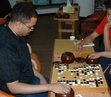
The next morning, I sat down to play my third game of the tournament. I decided that I would make it a goal to remain utterly focused on my game. I immediately recognized that my attention would wander. When waiting for my opponent to play, I would look at my neighbor's board and see how things were going. My eyes would wander. I would remember the lyrics to a rap battle I had listened to earlier in the week. I’d fidget and think about how cold the room was.
I realized that my lack of attention was wasting precious time. Did I really have the game so well in hand I could afford to not pay attention? Instead of letting my mind wander to the next extraneous object, I instead gently pushed myself back to the game. Every second I spent looking at my neighbor's board position, watching the ceiling, or humming a tune in my head, was one second I was not spending on the here and now, the board in front of me.
I decided to just gently bring my mind back to the game every time my eyes would wander. It shocked me just how unfocused on the game I was! It was hard at first, but I started to force myself to use my time wisely. If my opponent was taking a long time to think about their move, I forced myself to read out variations. If I felt that I had the variations read out to the best of my ability, I counted territory. If I felt I had a handle on the balance of territory, I read out end game moves and tried to find good tesujis. Where were the sente, double sente, and gote moves in the end game going to be? What order should I play them? I felt the game took on a new dimension for me. It was like meditation. I’ve done mindfulness meditation before. It relies on focusing on your breath, letting your wild brain wander, and then refocusing it on a focal point in the physical world. To keep your brain on the straight and narrow, you usually have a focus, usually counting forwards or backwards from 1 to 10. Playing a game of Go where I focused all my attention on the game was no different.
My level of play went up. My opponent didn’t surprise me with moves I hadn’t considered. I could make better tactical decisions because I counted constantly. I won 3 out of the 4 games at the Midwest Open. The second I started focusing completely on my game, the more I was able to bring my knowledge of the game to bear. I also noticed my emotional state was better during the game. I didn’t feel anxious, nervous, or fearful of losing. Focus brought me a feeling of objectivity. I think in the future I will take this lesson and apply it to life, and focus on the board in front me of me, wherever I happen to be.
The next morning, I sat down to play my third game of the tournament. I decided that I would make it a goal to remain utterly focused on my game. I immediately recognized that my attention would wander. When waiting for my opponent to play, I would look at my neighbor's board and see how things were going. My eyes would wander. I would remember the lyrics to a rap battle I had listened to earlier in the week. I’d fidget and think about how cold the room was.
I realized that my lack of attention was wasting precious time. Did I really have the game so well in hand I could afford to not pay attention? Instead of letting my mind wander to the next extraneous object, I instead gently pushed myself back to the game. Every second I spent looking at my neighbor's board position, watching the ceiling, or humming a tune in my head, was one second I was not spending on the here and now, the board in front of me.
I decided to just gently bring my mind back to the game every time my eyes would wander. It shocked me just how unfocused on the game I was! It was hard at first, but I started to force myself to use my time wisely. If my opponent was taking a long time to think about their move, I forced myself to read out variations. If I felt that I had the variations read out to the best of my ability, I counted territory. If I felt I had a handle on the balance of territory, I read out end game moves and tried to find good tesujis. Where were the sente, double sente, and gote moves in the end game going to be? What order should I play them? I felt the game took on a new dimension for me. It was like meditation. I’ve done mindfulness meditation before. It relies on focusing on your breath, letting your wild brain wander, and then refocusing it on a focal point in the physical world. To keep your brain on the straight and narrow, you usually have a focus, usually counting forwards or backwards from 1 to 10. Playing a game of Go where I focused all my attention on the game was no different.
My level of play went up. My opponent didn’t surprise me with moves I hadn’t considered. I could make better tactical decisions because I counted constantly. I won 3 out of the 4 games at the Midwest Open. The second I started focusing completely on my game, the more I was able to bring my knowledge of the game to bear. I also noticed my emotional state was better during the game. I didn’t feel anxious, nervous, or fearful of losing. Focus brought me a feeling of objectivity. I think in the future I will take this lesson and apply it to life, and focus on the board in front me of me, wherever I happen to be.


No comments have been added yet.
Sunday Go
For any and all interested in the ancient Chinese board game known as Go! Go is an immensely entertaining strategy game, inexpensive to play, as well as endlessly challenging. No two games of Go are t
...more
- Jonathan Hop's profile
- 8 followers

