Review: Ayaskala May Mini Issue
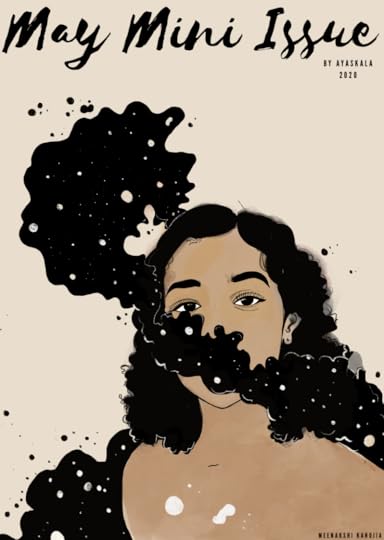
Ayaskala continuously succeeds in respectfully uplifting voices surrounding the de-stigmatization of mental health, whether with their bi-monthly columns or issues. In respect to May being acknowledged as Asian Pacific Islander Heritage Month, this mini-issue was compiled only with Asian-Pacific Islander voices. At first glance, Meenakshi Kanojia’s cover art is mysterious and inviting. Smoke covers the person drawn, their words soon to be revealed. Gentle trigger warnings are placed where necessary, and Ayaskala’s disclaimer stands against the romanticization of mental illness. The issue may be “mini”, but each of the nine poems leaves a lasting impression even after reading.
Anannya Uberoi opens with Darkroom, its quiet impact and masterful use of imagery describing what the reader can assume is a “regular” day: “so much is happening / in the morning before pancakes — / head is pulsing to the clockwork, / circadian rhythms are collapsing / in his valves leaving bursts of / fluttering rainbows on the / fleece-soft pillow. Mornings are / difficult.” Anisha Narain reasserts the overwhelming nature of the world’s tempo in Dissociation stating, “Everything is / moving too fast.”
Ismim Putera offers escapism from this fast pace with Hallucinogenic Lines, its cadence like a prayer and a wish. Jacqueline Wu’s Reflections of Humanity uses mixed media to observe new perspectives with slower contemplation in an arrangement seemingly mundane, beckoning the viewer to ponder these objects’ relation to their own lives without the use of words.
Returning to poetry, Maria Picone infuses hope and anger in Point//Counterpoint with a powerful proclamation, “We will survive longer than our quarantined/ produce drawers,” with righteous criticism, “Karen mourned her / Spring Break //the way an intubated person mourns / their voice” bringing to light the privilege of ignorance and current world events.
With this peak, the tone returns to soft quietude and longing with Mukund Gnanadesikan’s Empathy. A succinct execution of longing, Gnanadesikan seems to whisper, “Though I cry silently / Here I am, together scars grow fainter.”
The reader is then plunged with Shlagha Borah’s the unmistakable sound of drowning, the form of this poem seeming to imitate a kind of descent. Borah’s words echo, a cry of despair. Bitingly, Borah writes, “don’t tell me you’ve heard the sound of drowning / from within there,” her crescendo ending with resound.
Now to the ocean with Trishita Das’s recovery, where memory and loss leads to a quiet devastation. Heartbreak is painted with the physical, described as forgetting: “i forgot what it is to hold hands with rivers. / i forgot the rush and thunder of waves on the shore […] and i grew, and i changed, and i sank into myself.”
Das’s take your pills and keep quiet is a fitting ending to the collection and arguably its strongest piece. It calls for multiple read-throughs and weaves a myriad of emotions in this single narrative. How universal the statement: “bad days / have a way of starting out just like / good ones” depicting scenarios very true for others with the question asked (“why do things metastasize? You suppose / everything grows”). Das speaks life into love, “winter, if it could be painted in soft hues, / dusty shelves, / freshly mixed cement, / you.” as if to say this universe, these days, no matter how bad, could not be without you, the reader.
With the mini May issue, readers are provided a nuanced look at how mental health and well-being specifically affects Asian-Pacific Islander poets. The order in which these poems are read are precisely put in that each poem empowers the next. The imagery throughout is taut, using familiar images, such as water and everyday objects, to cement themes of desperation, pain, and even hope. The fluidity of the issue makes it seem as though these poets collaborated on the issue’s compilation.
Ayaskala is a safe haven for creatives to submit their mental health-oriented work by always taking the measures necessary to remain responsible and thoughtful so as not to harm their submitters and readers. With beauty, they remind the community that folks with mental illness are not alone and will never be alone. The mini May issue is proof this magazine will always be a necessary cornerstone in the literary community.