
School Choice is Resegregation
When my daughter was three, I began the search for a “good school.” By the time I found a school for Courtney, I despised the idea of “school choice. Since the early nineties, public schools have been hobbled by the focus on standardized testing and pressured to use dwindling resources on ever growing student bodies. Magnet schools and charters, hailed as a revolution in education, have never lived up to the promise of erasing the achievement gap. Whether charter, magnet, or traditional public, the trends persist: schools with more wealthy and white students do well; schools with more minority and special needs students do poorly.
The idea of school choice has always been based on the market economy. If families can vote with their feet, policy wonks reasoned, they will leave poor performing schools for better opportunities. Ideally, the poor performing schools would invest more money and resources into improving so they can compete with the others. In reality, poor performing schools that continue to house a large number of minority children continue to do poorly. Some of them may receive additional funding for Title I and specialized programs, but many of them face yearly teacher cuts and other punitive measures for failing to improve their numbers.
I attended Woodhill Elementary, a majority-minority school where 99% of the children are eligible for free lunch. Woodhill has received a D or F for its last three years of school performance. The fifth grade reading test scores are charted below.

Proficiency at Woodhill largely follows district trends, which means changes at the school level do not have a large effect on performance. So why not charter schools?
Charter schools reroute funds from local public schools to corporate entities that set their own guidelines as far as teachers and facilities. Research shows that charter schools are either overwhelmingly white or overwhelmingly black. As far as performance, charter schools follow the same trend as traditional schools. Piedmont has received Bs and Cs on its most recent report cards, staying slightly above Gaston County School’s average (with far less minority students).

Source: Piedmont Charter School
As I’ve mentioned before, the school system has used busing to integrate the middle and high schools, so that now two of the city’s three traditional high schools have an equal proportion of black and white students. When the county goes from six to nineteen magnet schools next year, desegregation is all but over.

This map of Gastonia and surrounding areas shows all the public schools indicated. The magnet elementary and middle schools are marked with an orange star. You can see they are clustered in the southern part of the city. The highlighted blue circle is Woodhill, just north of the Highland community.
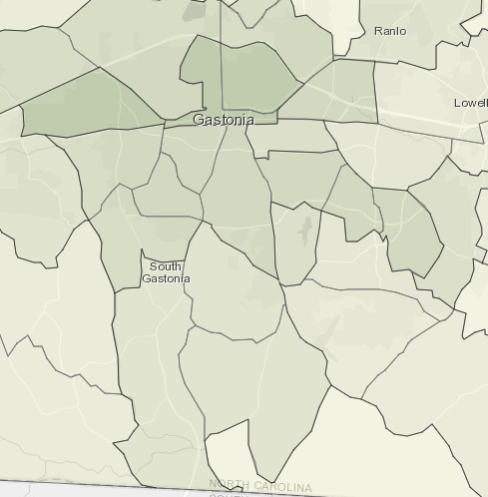
This map shows the relative percentage of African Americans by census tract (the darkest tracts are between 48-74% black). None of the schools in the darkest areas are being converted to magnet schools.
When choice is introduced to school systems, the parents who have the time, money, and resources to shop around do so. Parents end up deciding a school is good or bad based on how much the student body looks like their kids. White parents rarely use their choice to move to minority majority neighborhood schools. Students that depend on bus travel are less likely to attend transfer because they don’t have transportation. Instead of offering real choice, magnet schools perpetuate the divide between those who are privileged and those who are not.
The county could still do this right. Varying percentages of students will stay at their home school and participate in the same magnet programs that the transferred students will have. That means the students at Bessemer City Middle School will receive enough Technology and Industrial Engineering curriculum that they may consider enrolling in Highland School of Technology, the county’s first magnet school. Unfortunately, if past data is any indicator, the majority of 8th grade students would not qualify for the lottery.
Why is this important? We know that a child’s zip code determines their upward mobility. Children born in the Highland community are more likely to be born into households with single parents, poor parents, or parents with substance abuse issues. They are punished more often for behavior problems and miss more days of school due to behavior or illness. They are more likely to have an IEP and require support, which disqualifies them for advanced classes in high school. Most of them will not attend college if they even graduate high school. Are we really saying that these kids are getting the same opportunities as a child born in south Gastonia?
School choice only exacerbates inequality in Gaston County schools. Adding more choice will mean less opportunity for the kids who need it most.
Curious about what school I decided to send my daughter to? Click here.
Read more:
https://www.propublica.org/article/segregation-now-full-text
http://www.nea.org/home/33177.htm
https://www.newsobserver.com/news/local/article10255961.html


