
Meditation on silver: photographs & chains
A series of works by Kasia Wozniak & Lucie Gledhill
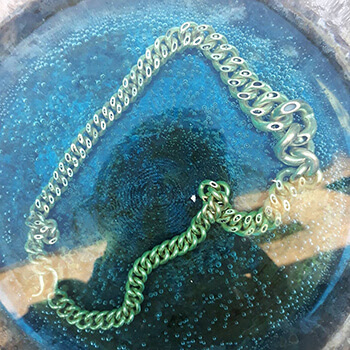
Take rainwater, silver and lavender oil.
Watch the dissolving links of a moon-bright chain.
Anoint a pane of glass in a darkened room.
Transmute metal into whispered images reflected in a mirror.
The work created by Gledhill and Wozniak is poised between alchemy and craft. Their projects, titled SWAP, were produced for COLLECT 2020.
They are intimately linked as the artists explore the possibilities of silver in various states - as solid or liquid, collected as crystals or swirled on photo-sensitive plates. They question the constraints of contemporary jewellery-making and photography, while using 19th century processes as their starting point.
Their approach chimes with John Ruskin’s insistence that ‘all art worthy of the name is the energy…[of] good craftsmanship and work of the fingers, joined with good emotion and work of the heart.’
Silver is transformed, by sunlight and by flame. Control and patience are made visible as metal reacts on the photographic plate, as it is heated and formed, as it twists against a neighbouring link. Gledhill’s curb chains connect back to their use as Victorian horse-bits and watchchains – their twisted links meant that they would lie flat. Traditionally, they were designed to keep things from wandering away, from being lost. In Gledhill’s reworking, her curb chains can be uneven, disorderly, and elements are deliberately lost in her partnership with Wozniak’s practice.
The chains are soldered, shaped and bathed. They re-emerge in Wozniak’s photographs as the subject of a picture. But they also create the essential raw material – the silver nitrate – to make that photographic image. The artworks no longer exist independently. They are interlinked.
For each work, Gledhill experiments with submerging her chains in a tank of nitric acid. The acid reacts with silver, but leaves gold intact. Sometimes the solder is left, sometimes the gold skin. The acid becomes saturated with the precious metal. As it evaporates, a single crystal forms, and suddenly, there is a mass of pure white flakes, like sea salt. Wozniak uses these crystals and the necklace to make a photograph. Her techniques, like Gledhill’s, are also derived from Victorian examples, outlined in The Silver Sunbeam (a ‘Practical and Theoretical Textbook on Sun Drawing and Photographic Printing’) published in 1864. She works with the wet collodion process, and a large format Gandolfi camera. This beautiful camera, built of mahogany and brass, with a distinctive pleated accordion body, is hard to date. But the Gandolfi family used the same production methods from the 1890s to 1982, when the last of the brothers retired, and their Peckham workshop closed. For SWAP, Wozniak has used 10 x 8” glass plates for her photographs and mirrors, alongside hand-poured blue glass from one of the few traditional makers still in Poland.
Wozniak chooses sitters who do not conform to mass-produced ideas of beauty. She pictures the curb chain, with its erosions and imperfections, on the bare skin of her model. We are made aware of its weight, and the sensation of touch; metal against collarbone.
And the silver, in its new incarnation on the photographic plate, captures the image of the links. Sometimes this is through the camera’s lens. Sometimes it is as a photogram, made by direct contact of the necklace on sensitised glass. Then Wozniak uses the silver to coat another plate, making a mirror that will tarnish over time. The handmade mirror draws attention to the leading themes of these projects - of seeing in a different light or from a different angle, of delighting in the analogue and the accidental. It also reminds us of the essential power of photography, its ability to double and therefore to disrupt. Rosalind Krauss’s description of photography being ‘the mirror with a memory’ seems particularly apt when looking at these works.
The works, with their deliberate blemishes, reinforces our understanding of the difficulties of creating a pristine image. And they remind us of Barthes’s insistence on the photograph as ‘mortal: like a living organism it is born on the level of sprouting silver grains, it flourishes a moment, then ages.’
Gledhill and Wozniak use the interplay between their works, the elements they share, to reshape our understanding of where one piece ends and another begins. Walter Pater once suggested that this sharing or overlapping was a virtue of the most pleasing and radical works of art. He offered a vision of the arts ‘lending each other new forces.’


Suzanne Fagence Cooper's Blog

- Suzanne Fagence Cooper's profile
- 30 followers

