The Last Rites of the Harvest
 By zakharovs
Excerpt from Scottish Herbs and Fairy Lore by Ellen Evert Hopman
If the last sheaf is taken early, it is called “the Maiden” (the Land Goddess in her youthful aspect). If late in the season, it is called “the Cailleach” (the Old Woman of winter, the veiled one, the ancient Land Goddess). It is dressed in clothing appropriate to a maiden or a crone, and given a place of honor at the harvest supper table where it is toasted and thanked.
Some houses keep the Cailleach or the Maiden in the farm kitchen for luck, maintaining a small collection of such figures for years. A Corn Mother, Rye Mother, Pea Mother, Flax Mother, etc., may be made to honor the fertile Spirit of each of these different crops.
 Photo © by Maigheach-gheal and licensed for reuse under Creative Commons.
A portion of the last sheaf of the harvest is kept to be buried in the first furrow plowed the next spring. Of course, every farm, and homestead must have a section of land that is never plowed and where no human ever goes (The Gudeman’s Croft). Wild weeds and grasses are allowed to grow undisturbed as a shelter for the Brownies and other Fairies.
Wheat Weavings and Corn Dollies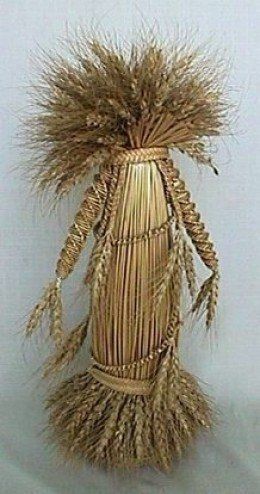
The Ivy Girl of Kent is a traditional straw piece that depicts the primitive image of the Earth Goddess in Britain.
The tradition of making a “Corn Dolly,” or female figure from the last sheaf of the harvest, has very ancient roots. The wheat weaving does not have to be a human figure, it can be a cornucopia (a horn of plenty) to be hung over the door for luck or a plaited weaving that is given to a lover or neighbor as a gift, for luck and to celebrate the end of the harvest.
 Ray Colliers Wildlife in the North — Corn Dollies https://www.wildernesscottages.co.uk/
In some areas the Corn Dolly is shaped like a dog. In Orkney, a straw dog (called the “bikko” [bitch] from the Old Norse “bikkja”) is placed at the door of the last farmer to bring in the harvest and is usually accompanied by a satirical note. The Orkney, “staw” dog (pronounced “stray”) is a life-sized dog made entirely of straw, sometimes with twisted straw ropes wound over a wooden frame.
On the Isle of Skye in the West of Scotland, the last sheaf embodies a Spirit goat called the gobhar bacach (cripple goat) and the woman who carries it home must pretend to limp (in Shetland, the Fairies are said to dance with a limp and their dance is called the “haltadans”).
The goat is passed from house to house and must be gotten rid of as quickly as possible or it will bring bad luck. It is carried in secret by the last farmer to thresh to a neighbor who is still threshing, and if the farmer is caught bringing the goat, there can be trouble because no one wants to receive it. The constant passing of the taunting goat has the effect of speeding up the harvest.
The goat has a deep spiritual meaning in the ancient Indo-European religion. In the Rig Veda of India (a collection of Vedic hymns from 1200–900 BCE), the goat is paired with the sacred horse, a solar animal that is offered as a sacrifice. At the horse sacrifice, a goat companion accompanies the horse to announce the offering to the Gods:
The Sacrifice of the Horse“When, as the ritual law ordains,
The men circle three times,
Leading the horse that is to be the oblation
On the path to the gods,
The goat who is the share for Pusan
Goes first, announcing the sacrifice to the gods.”
(Verse 4)
The goat is a fitting symbol to announce the great sacrifice of the Earth in the harvest season.
Straw Men and Scare CrowsWhile the last sheaf of grain is usually associated with the Land Goddess or with a female animal such as a bitch or a mare, in some areas, it is made into the figure of a straw man, a bull, a cock, a hare, a boar, or a billy-goat.
In northern Orkney, a scarecrow of straw is occasionally made at the end of the reaping. The “straw man” is seen as a magical helper for the farm, his function is to protect the farm from the trials of winter. Such a figure must never be dressed.
“When Broonie got a cloak or hood (Brownie)
He did his master nae mair good.” (no more good) (Traditional)
 Scottish Herbs and Fairy Lore, by Ellen Evert Hopman, Pendraig Publishing (June 21, 2011)
The Last Rites of the Harvest was originally published in Wild Goddess Magick: Witchology Blog on Medium, where people are continuing the conversation by highlighting and responding to this story.